

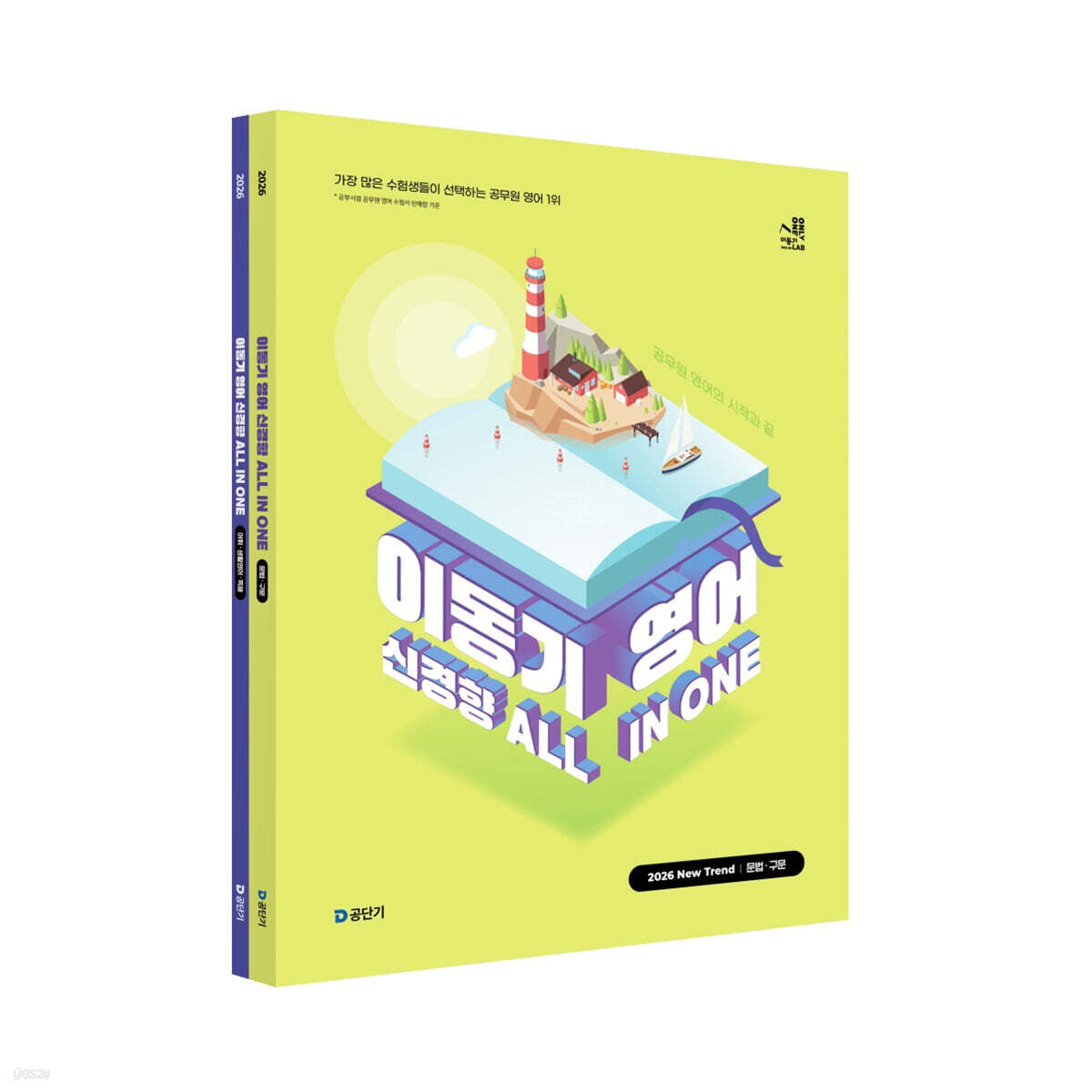
2026 Moving English New Trend All In One
 |
Description
Book Introduction
We present "2026 Mobile English New Trends All in One," a comprehensive guide to preparing you perfectly for the 2026 Civil Service English Exam by thoroughly analyzing and reflecting the latest trends in exam questions in accordance with the changing exam format.
『2026 Lee Dong-gi English New Trend All in One』 is a basic English textbook for civil servants that has been compiled with Mr. Lee Dong-gi's long-standing know-how in line with changing exam trends. It consists of two volumes (Volume 1: Grammar and Syntax, Volume 2: Vocabulary, Practical English, and Reading Comprehension).
In line with the changing trends in exam questions, which have shifted from simple memorization to prioritizing practical language skills and job-related relevance, 『2026 Mobile English New Trend All in One』 systematically reflects the changed exam points, such as practical English required for work, the latest reading comprehension types, and real-world vocabulary, and boldly excludes unnecessary content, containing only the essential learning points.
It is designed to help test takers efficiently build fundamentals and apply them immediately in real life.
The #1 civil servant English teacher, Mr. Lee Dong-gi's "2026 Lee Dong-gi English New Trend All in One" is the ultimate guide optimized for the changing exam landscape, and will surely support all test takers in passing the exam.
『2026 Lee Dong-gi English New Trend All in One』 is a basic English textbook for civil servants that has been compiled with Mr. Lee Dong-gi's long-standing know-how in line with changing exam trends. It consists of two volumes (Volume 1: Grammar and Syntax, Volume 2: Vocabulary, Practical English, and Reading Comprehension).
In line with the changing trends in exam questions, which have shifted from simple memorization to prioritizing practical language skills and job-related relevance, 『2026 Mobile English New Trend All in One』 systematically reflects the changed exam points, such as practical English required for work, the latest reading comprehension types, and real-world vocabulary, and boldly excludes unnecessary content, containing only the essential learning points.
It is designed to help test takers efficiently build fundamentals and apply them immediately in real life.
The #1 civil servant English teacher, Mr. Lee Dong-gi's "2026 Lee Dong-gi English New Trend All in One" is the ultimate guide optimized for the changing exam landscape, and will surely support all test takers in passing the exam.
- You can preview some of the book's contents.
Preview
index
Part 1 Grammar and Syntax
Chapter 01 Sentence Structure, Verb Types
POINT 01 Sentence Structure
Question Type 001 Verb vs.
verbal
POINT 02 Word order in interrogative questions
Question Type 002 Indirect Question Word Order
Question Type 003: Additive question in a sentence consisting of two verbs
POINT 03 Fully automatic verb
Question Type 004 Intransitive Verb + Preposition
POINT 04 Complement of Imperfect Verbs
Question Type 005 Complement of Major Incomplete Verbs
Question Type 006 Complement of Sensory Verbs
POINT 05 Complete Transitive Verbs
Question Type 007 Complete Transitive Verb + Preposition (Ⅹ)
Question Type 008 4-Format Not Allowed Complete Transitive Verbs
POINT 06 Complete transitive verbs and objects of action
Question Type 009: To-Infinitive/Gerund Object
Question Type 010: Memory Verbs/Regret/Stop
POINT 07 Key prepositions used with complete transitive verbs
Question Type 011 Verbs Frequently Used with Prepositional Phrases
POINT 08 Verbs of Award
Question Type 012 Verbs used with the preposition of meaning 'to'
Question Type 013 take, cost
POINT 09 Objective complement of imperfect transitive verbs
Question Type 014: Main Object Complement of Imperfect Transitive Verbs
POINT 10 Incomplete transitive verbs and object complements of actions
Question Type 015: Incomplete transitive verbs that take to-infinitive as their object complement
Question Type 016: Verbs of Ministry/Perception
Question Type 017: Incomplete transitive verbs that take participles as their object complements
POINT 11 Irregular conjugations of easily confusing verbs
Question Type 018 Verbs that require distinction between intransitive and transitive verbs
Chapter 02 Verb Forms
POINT 12 Perfect Tense
Question Type 019 Present Perfect have/has pp
Question Type 020 Past Perfect Had pp
POINT 13 Restrictions on the Use of Tenses
Question Type 021: Verbs that cannot be tested in the progressive tense
POINT 14: Agreement of tenses and exceptions
Question Type 022 Agreement of Tense
Question Type 023: Exceptions to Tense Agreement
Question Type 024: Expression of Time in Time/Conditional Adverbial Clauses
POINT 15 Expressions Related to Tenses
Question Type 025 ∼As soon as …
Question Type 026 Only when it becomes (finally) …
POINT 16 Active vs. Negative Voice
Passive voice distinction
Question Type 027 Active/Passive Voice
POINT 17 Passive voice by verb type
Question Type 028 Passive Voice of Intransitive Verb
Question Type 029: Passive Voice of Complete Transitive Verbs
Question Type 030 Passive Voice of Incomplete Transitive Verbs (Causative and Perceptual Verbs)
POINT 18 Choice of auxiliary verbs
Question Type 031 Main Auxiliary Verbs
Question Type 032 Key Expressions Using Auxiliary Verbs
POINT 19 Should auxiliary verb
Question Type 033 (should) + Verb Infinitive
POINT 20 Auxiliary Verb+have pp
Question Type 034 Auxiliary Verb+have pp
Chapter 03 Nouns, Pronouns, and Agreement
POINT 21 Understanding Nouns
Question Type 035 Noun Marking
Question Type 036: Modifier-Noun Number Agreement
Question Type 037 Absolute Uncountable Nouns
Question Type 038 Collective Nouns
POINT 22 Understanding Articles
Question Type 039: Usage of Articles
POINT 23 Position of articles
Question Type 040: Position of Articles
POINT 24 Personal Pronouns
Question Type 041 Reflexive Pronouns
Question Type 042 Subject/Object it
Question Type 043 Noun-Pronoun Number Agreement
POINT 25 Indefinite Pronouns
Question Type 044 one, another, other
Question Type 045 Usage of every
POINT 26 Partial Negation vs.
Total negation
Question Type 046 Partial Negation
POINT 27 Subject-Verb Number Agreement
Question Type 047 Subject-Verb Number Agreement in Cases with Complex Subjects
Question Type 048 Subject-Verb Number Agreement in Cases Where the Number of Subjects is Easy to Confuse
Question Type 049 Subject-Verb Number Agreement in Inverted Structure
Chapter 04 Auxiliary Verbs
POINT 28 The Role of Gerunds
Question Type 050 Gerunds that act as objects
POINT 29 The Role of the Infinitive
Question Type 051: To-Infinitive Noun Role
Question Type 052: To-Infinitive Adjective Role
Question Type 053: The Adverbial Role of the To-Infinitive
POINT 30 Changes in the form of auxiliary verbs
Question Type 054 Active and Passive Verbs
Question Type 055 Semantic Subject of Auxiliary Verb
POINT 31 Key Expressions with Auxiliary Verbs
Question Type 056: Expressions Using the Most Frequently Occurring Auxiliary Verbs
Question Type 057: Key Expressions Using Gerunds
POINT 32 Present Participle vs.
past participle
Question Type 058 Present Participle vs.
Past participle distinction
Question Type 059: Choosing the Participle of the Verb to Watch Out for
POINT 33 Participle Phrase
Question Type 060 Participle Phrase Form
Question Type 061 with Participle Phrase
Chapter 05 Adjectives, Adverbs, and Comparisons
POINT 34 Adjectives vs.
adverb
Question Type 062 Adjective vs.
Adverb classification
Question Type 063 Adjective/Adverb + Enough (Adverb)
POINT 35 Adjectives and Adverbs to Watch Out For
Question Type 064 Quantity Adjectives/Difficult Adjectives
Question Type 065 Similar Form Adjectives and Adverbs
Question Type 066: No duplicate negative adverbs
POINT 36 Comparison Syntax
Question Type 067 Comparison of the original and comparative degrees
Question Type 068 Superlative
Question Type 069 Comparative/Superlative Expressions
POINT 37 Comparative Expressions
Question Type 070: Comparative Expressions
Question Type 071 Latin Comparison
Question Type 072 Multiple Comparison
Question Type 073 The comparative, the comparative
Question Type 074 Superlative Substitute Expressions
POINT 38 Matching of comparison objects
Question Type 075: Matching of Comparison Objects
Chapter 06 Conjunctions
POINT 39 Parallel Structure of Coordinating Conjunctions
Question Type 076: Parallel Structure of Coordinate (Correlation) Conjunctions
Question Type 077: Correspondence of Correlative Conjunctions
POINT 40 Choosing a Noun Clause Conjunction
Question Type 078 Noun Clause Conjunction that vs.
what distinction
Question Type 079 “The relationship between A and B is the same as the relationship between C and D.”
POINT 41 Choosing a Subordinate Conjunction
Question Type 080: Adverbial Conjunction of Purpose/Result that
Question Type 081: Prohibition of double negation of conjunctions with negative meaning
Question Type 082 Adverbial Clause vs.
adverbial phrase
POINT 42 Key Concession Phrases
Question Type 083: Concessionary Sentences in Complex Relatives
Question Type 084: Conjunction as/though concessionary construction
POINT 43 Choosing a Relative Pronoun
Question Type 085 who/whose/whom, which/of which[whose] selection
Question Type 086 Relative Pronoun that
Question Type 087 Relative Pronoun vs.
what
Question Type 088 Preposition + Relative Pronoun
POINT 44 Relative Adverbs
Question Type 089 Relative Pronoun vs.
relative adverb
POINT 45 Complex Relatives
Question Type 090 whoever vs.
whomever
Chapter 07 Special Syntax
POINT 46 Basic Conditional Mood
Question Type 091: Be careful with conditional verb tenses
POINT 47 Other conditional sentences
Question Type 092 I wish conditional
Question Type 093 'If there is no ~' conditional
POINT 48 Object of Preposition
Question Type 094 Preposition to + Gerund
Question Type 095: Usage of Major Prepositions
POINT 49 Emphasis
Question Type 096 It ~ that … Emphasis Sentence
Question Type 097 Negative Emphasis
POINT 50 Dochi
Question Type 098 Inversion of sentences in Type 1 and Type 2 (pay attention to number agreement)
Question Type 099 Inversion by Emphasis of Adverbial Phrase (Beware of Inversion Form)
Be careful about matching the verb type with the 100th question type.
Part 2 Vocabulary
Chapter 01 New Trends in Exam Questions and Strategies
New Trend Question Type 01 Synonym Basis (Blank)
New Trend Question Type 02 Antonym Basis (Blank)
New Trend Question Type 03 Contextual Evidence (Blank)
New Trend Question Type 04 Definition Basis (Blank)
New Trend Question Type 05 Example Basis (Blank)
Chapter 02 Most Important Vocabulary
Most Important Vocabulary 01 Alleviate, worsen
Most Important Vocabulary 02 Rapidly Increase, Rapidly Decrease
Most Important Vocabulary 03 Stimulate, Arouse
Most Important Vocabulary 04: Throw Away, Quit
Most important vocabulary 05 important, essential
Most important vocabulary 06 Prevalent, common
Most important vocabulary 07 permanent, temporary
Most important vocabulary 08 remarkable, noticeable
Most important vocabulary 09 resilient, elastic
Top 10 Most Important Vocabulary Words Angry
Most Important Vocabulary 11 Hostile, Aggressive
Most important vocabulary 12 secret, secret
Most important vocabulary 13 honest
Most important vocabulary 14 bold, timid
Most Important Vocabulary 15 Luxurious
Most important vocabulary 16 inactive, listless
Most Important Vocabulary 17 Harmful
Part 3 Daily English
Chapter 01 New Trends in Exam Questions and Strategies
New Trend Question Type 01: Reason before the blank
New Trend Question Type 02: Reasons Behind the Blank
New Trend Question Type 03 Messenger Conversation - Reasons Before the Blank
New Trend Question Type 04 Messenger Conversation - Reasons Behind the Blank
Chapter 02: Practical English Expressions for Major Situations
Key Situation 01 Government Offices
Key Situation 02 Tourism - Travel and Accommodation, Restaurants
Key Situation 03 Airport and Road Traffic
Key Situation 04 Public Places - Banks, Hospitals, Libraries
Part 4 Reading
Chapter 01 Understanding Practical Text
New Trend Question Type 01 Email
Reading Formula 01: Purpose/Title/Summary of the New Trend Text
New Trend Question Type 02 Announcement
Reading Formula 02: Matching/Mismatching of New Trend Texts
New Trend Exam Type 03: Internet Information Articles (Web Documents)
Reading Formula 03 Synonyms for Shin Kyung-hyang's Text
Chapter 02 Identifying the topic of the text
Question Type 04 Topic, Title, Summary, Argument - Parentheses
Reading Formula 04: Two-parentheses
Question Type 04 Topic, Title, Summary, Claim - Criticism/Rebuttal
Reading Formula 05 Criticism/Rebuttal
Question Type 04 Topic, Title, Summary, Argument - Unbracketed
Reading Formula 06: Mi-brackets
Question Type 04 Topic, Title, Summary, Argument - Paragraph Summary
Reading Formula 07 Paragraph Summary
Question Type 04 Topic, Title, Summary, Argument - No Topic Sentence
Reading Formula 08 No Topic
Question Type 05: Fill in the blanks - First half blanks
Reading Formula 09 First Half Blank
Question Type 05: Fill in the blank - Middle blank
Reading Formula 10 Middle Blank
Question Type 05: Fill in the blanks - Second half blanks
Reading Formula 11, Second Half, Blank
Question Type 05: Fill in the blanks - Insert a connecting word
Reading Formula 12: Inserting Connecting Words
Question Type 06 Sentence Removal
Reading Formula 13 Sentence Removal
Chapter 03 Understanding the Flow of the Text
Question Type 07: Sequential Arrangement
Reading Formula 14: Sequential Arrangement
Question Type 08 Sentence Insertion
Insert 15 sentences of reading formula
Chapter 01 Sentence Structure, Verb Types
POINT 01 Sentence Structure
Question Type 001 Verb vs.
verbal
POINT 02 Word order in interrogative questions
Question Type 002 Indirect Question Word Order
Question Type 003: Additive question in a sentence consisting of two verbs
POINT 03 Fully automatic verb
Question Type 004 Intransitive Verb + Preposition
POINT 04 Complement of Imperfect Verbs
Question Type 005 Complement of Major Incomplete Verbs
Question Type 006 Complement of Sensory Verbs
POINT 05 Complete Transitive Verbs
Question Type 007 Complete Transitive Verb + Preposition (Ⅹ)
Question Type 008 4-Format Not Allowed Complete Transitive Verbs
POINT 06 Complete transitive verbs and objects of action
Question Type 009: To-Infinitive/Gerund Object
Question Type 010: Memory Verbs/Regret/Stop
POINT 07 Key prepositions used with complete transitive verbs
Question Type 011 Verbs Frequently Used with Prepositional Phrases
POINT 08 Verbs of Award
Question Type 012 Verbs used with the preposition of meaning 'to'
Question Type 013 take, cost
POINT 09 Objective complement of imperfect transitive verbs
Question Type 014: Main Object Complement of Imperfect Transitive Verbs
POINT 10 Incomplete transitive verbs and object complements of actions
Question Type 015: Incomplete transitive verbs that take to-infinitive as their object complement
Question Type 016: Verbs of Ministry/Perception
Question Type 017: Incomplete transitive verbs that take participles as their object complements
POINT 11 Irregular conjugations of easily confusing verbs
Question Type 018 Verbs that require distinction between intransitive and transitive verbs
Chapter 02 Verb Forms
POINT 12 Perfect Tense
Question Type 019 Present Perfect have/has pp
Question Type 020 Past Perfect Had pp
POINT 13 Restrictions on the Use of Tenses
Question Type 021: Verbs that cannot be tested in the progressive tense
POINT 14: Agreement of tenses and exceptions
Question Type 022 Agreement of Tense
Question Type 023: Exceptions to Tense Agreement
Question Type 024: Expression of Time in Time/Conditional Adverbial Clauses
POINT 15 Expressions Related to Tenses
Question Type 025 ∼As soon as …
Question Type 026 Only when it becomes (finally) …
POINT 16 Active vs. Negative Voice
Passive voice distinction
Question Type 027 Active/Passive Voice
POINT 17 Passive voice by verb type
Question Type 028 Passive Voice of Intransitive Verb
Question Type 029: Passive Voice of Complete Transitive Verbs
Question Type 030 Passive Voice of Incomplete Transitive Verbs (Causative and Perceptual Verbs)
POINT 18 Choice of auxiliary verbs
Question Type 031 Main Auxiliary Verbs
Question Type 032 Key Expressions Using Auxiliary Verbs
POINT 19 Should auxiliary verb
Question Type 033 (should) + Verb Infinitive
POINT 20 Auxiliary Verb+have pp
Question Type 034 Auxiliary Verb+have pp
Chapter 03 Nouns, Pronouns, and Agreement
POINT 21 Understanding Nouns
Question Type 035 Noun Marking
Question Type 036: Modifier-Noun Number Agreement
Question Type 037 Absolute Uncountable Nouns
Question Type 038 Collective Nouns
POINT 22 Understanding Articles
Question Type 039: Usage of Articles
POINT 23 Position of articles
Question Type 040: Position of Articles
POINT 24 Personal Pronouns
Question Type 041 Reflexive Pronouns
Question Type 042 Subject/Object it
Question Type 043 Noun-Pronoun Number Agreement
POINT 25 Indefinite Pronouns
Question Type 044 one, another, other
Question Type 045 Usage of every
POINT 26 Partial Negation vs.
Total negation
Question Type 046 Partial Negation
POINT 27 Subject-Verb Number Agreement
Question Type 047 Subject-Verb Number Agreement in Cases with Complex Subjects
Question Type 048 Subject-Verb Number Agreement in Cases Where the Number of Subjects is Easy to Confuse
Question Type 049 Subject-Verb Number Agreement in Inverted Structure
Chapter 04 Auxiliary Verbs
POINT 28 The Role of Gerunds
Question Type 050 Gerunds that act as objects
POINT 29 The Role of the Infinitive
Question Type 051: To-Infinitive Noun Role
Question Type 052: To-Infinitive Adjective Role
Question Type 053: The Adverbial Role of the To-Infinitive
POINT 30 Changes in the form of auxiliary verbs
Question Type 054 Active and Passive Verbs
Question Type 055 Semantic Subject of Auxiliary Verb
POINT 31 Key Expressions with Auxiliary Verbs
Question Type 056: Expressions Using the Most Frequently Occurring Auxiliary Verbs
Question Type 057: Key Expressions Using Gerunds
POINT 32 Present Participle vs.
past participle
Question Type 058 Present Participle vs.
Past participle distinction
Question Type 059: Choosing the Participle of the Verb to Watch Out for
POINT 33 Participle Phrase
Question Type 060 Participle Phrase Form
Question Type 061 with Participle Phrase
Chapter 05 Adjectives, Adverbs, and Comparisons
POINT 34 Adjectives vs.
adverb
Question Type 062 Adjective vs.
Adverb classification
Question Type 063 Adjective/Adverb + Enough (Adverb)
POINT 35 Adjectives and Adverbs to Watch Out For
Question Type 064 Quantity Adjectives/Difficult Adjectives
Question Type 065 Similar Form Adjectives and Adverbs
Question Type 066: No duplicate negative adverbs
POINT 36 Comparison Syntax
Question Type 067 Comparison of the original and comparative degrees
Question Type 068 Superlative
Question Type 069 Comparative/Superlative Expressions
POINT 37 Comparative Expressions
Question Type 070: Comparative Expressions
Question Type 071 Latin Comparison
Question Type 072 Multiple Comparison
Question Type 073 The comparative, the comparative
Question Type 074 Superlative Substitute Expressions
POINT 38 Matching of comparison objects
Question Type 075: Matching of Comparison Objects
Chapter 06 Conjunctions
POINT 39 Parallel Structure of Coordinating Conjunctions
Question Type 076: Parallel Structure of Coordinate (Correlation) Conjunctions
Question Type 077: Correspondence of Correlative Conjunctions
POINT 40 Choosing a Noun Clause Conjunction
Question Type 078 Noun Clause Conjunction that vs.
what distinction
Question Type 079 “The relationship between A and B is the same as the relationship between C and D.”
POINT 41 Choosing a Subordinate Conjunction
Question Type 080: Adverbial Conjunction of Purpose/Result that
Question Type 081: Prohibition of double negation of conjunctions with negative meaning
Question Type 082 Adverbial Clause vs.
adverbial phrase
POINT 42 Key Concession Phrases
Question Type 083: Concessionary Sentences in Complex Relatives
Question Type 084: Conjunction as/though concessionary construction
POINT 43 Choosing a Relative Pronoun
Question Type 085 who/whose/whom, which/of which[whose] selection
Question Type 086 Relative Pronoun that
Question Type 087 Relative Pronoun vs.
what
Question Type 088 Preposition + Relative Pronoun
POINT 44 Relative Adverbs
Question Type 089 Relative Pronoun vs.
relative adverb
POINT 45 Complex Relatives
Question Type 090 whoever vs.
whomever
Chapter 07 Special Syntax
POINT 46 Basic Conditional Mood
Question Type 091: Be careful with conditional verb tenses
POINT 47 Other conditional sentences
Question Type 092 I wish conditional
Question Type 093 'If there is no ~' conditional
POINT 48 Object of Preposition
Question Type 094 Preposition to + Gerund
Question Type 095: Usage of Major Prepositions
POINT 49 Emphasis
Question Type 096 It ~ that … Emphasis Sentence
Question Type 097 Negative Emphasis
POINT 50 Dochi
Question Type 098 Inversion of sentences in Type 1 and Type 2 (pay attention to number agreement)
Question Type 099 Inversion by Emphasis of Adverbial Phrase (Beware of Inversion Form)
Be careful about matching the verb type with the 100th question type.
Part 2 Vocabulary
Chapter 01 New Trends in Exam Questions and Strategies
New Trend Question Type 01 Synonym Basis (Blank)
New Trend Question Type 02 Antonym Basis (Blank)
New Trend Question Type 03 Contextual Evidence (Blank)
New Trend Question Type 04 Definition Basis (Blank)
New Trend Question Type 05 Example Basis (Blank)
Chapter 02 Most Important Vocabulary
Most Important Vocabulary 01 Alleviate, worsen
Most Important Vocabulary 02 Rapidly Increase, Rapidly Decrease
Most Important Vocabulary 03 Stimulate, Arouse
Most Important Vocabulary 04: Throw Away, Quit
Most important vocabulary 05 important, essential
Most important vocabulary 06 Prevalent, common
Most important vocabulary 07 permanent, temporary
Most important vocabulary 08 remarkable, noticeable
Most important vocabulary 09 resilient, elastic
Top 10 Most Important Vocabulary Words Angry
Most Important Vocabulary 11 Hostile, Aggressive
Most important vocabulary 12 secret, secret
Most important vocabulary 13 honest
Most important vocabulary 14 bold, timid
Most Important Vocabulary 15 Luxurious
Most important vocabulary 16 inactive, listless
Most Important Vocabulary 17 Harmful
Part 3 Daily English
Chapter 01 New Trends in Exam Questions and Strategies
New Trend Question Type 01: Reason before the blank
New Trend Question Type 02: Reasons Behind the Blank
New Trend Question Type 03 Messenger Conversation - Reasons Before the Blank
New Trend Question Type 04 Messenger Conversation - Reasons Behind the Blank
Chapter 02: Practical English Expressions for Major Situations
Key Situation 01 Government Offices
Key Situation 02 Tourism - Travel and Accommodation, Restaurants
Key Situation 03 Airport and Road Traffic
Key Situation 04 Public Places - Banks, Hospitals, Libraries
Part 4 Reading
Chapter 01 Understanding Practical Text
New Trend Question Type 01 Email
Reading Formula 01: Purpose/Title/Summary of the New Trend Text
New Trend Question Type 02 Announcement
Reading Formula 02: Matching/Mismatching of New Trend Texts
New Trend Exam Type 03: Internet Information Articles (Web Documents)
Reading Formula 03 Synonyms for Shin Kyung-hyang's Text
Chapter 02 Identifying the topic of the text
Question Type 04 Topic, Title, Summary, Argument - Parentheses
Reading Formula 04: Two-parentheses
Question Type 04 Topic, Title, Summary, Claim - Criticism/Rebuttal
Reading Formula 05 Criticism/Rebuttal
Question Type 04 Topic, Title, Summary, Argument - Unbracketed
Reading Formula 06: Mi-brackets
Question Type 04 Topic, Title, Summary, Argument - Paragraph Summary
Reading Formula 07 Paragraph Summary
Question Type 04 Topic, Title, Summary, Argument - No Topic Sentence
Reading Formula 08 No Topic
Question Type 05: Fill in the blanks - First half blanks
Reading Formula 09 First Half Blank
Question Type 05: Fill in the blank - Middle blank
Reading Formula 10 Middle Blank
Question Type 05: Fill in the blanks - Second half blanks
Reading Formula 11, Second Half, Blank
Question Type 05: Fill in the blanks - Insert a connecting word
Reading Formula 12: Inserting Connecting Words
Question Type 06 Sentence Removal
Reading Formula 13 Sentence Removal
Chapter 03 Understanding the Flow of the Text
Question Type 07: Sequential Arrangement
Reading Formula 14: Sequential Arrangement
Question Type 08 Sentence Insertion
Insert 15 sentences of reading formula
Detailed image

Publisher's Review
A guide to the changing exam!
A basic book that reflects the latest exam trends!
2026 Moving English New Trend All in One
The Ministry of Personnel Management announced changes to the English language exam format starting with the 2025 civil service exam, along with two sets of sample questions. With these changes being applied for the first time in this year's actual exam, test-takers are increasingly feeling the need for textbooks that can prepare them for the new exam format.
However, it is difficult to accurately predict and prepare for future exam trends using only one year's past exam questions.
Therefore, now more than ever, we need a systematic guide to accurately analyze and prepare for the changing exam.
"2026 Mobile English New Trends All in One" is a textbook designed to perfectly address these changes, helping test takers quickly grasp the changing test trends and effectively prepare for the actual exam.
This textbook consists of two volumes. Volume 1 covers grammar and syntax, and Volume 2 covers vocabulary, everyday English, and reading comprehension.
We carefully analyzed the changing trends in exam questions by field and selected only the core content that must be learned.
The detailed features are as follows:
1.
Analysis of question types
Based on the accumulated analysis know-how of the Mobile Institute and the revised exam questions, we analyzed and classified [question types] by grammar, reading comprehension, vocabulary, and everyday English.
We have provided key analysis points for each [question type] to help you learn effectively.
2.
Type Analysis & Strategy / Point Analysis / Grammar Explanation
In the [Type Analysis & Strategy] section of the grammar section, we have concisely presented the question points and solution strategies for each type.
[Point Analysis] provides a diagrammatic explanation of the test points and solution strategies covered in the text.
[Grammar Explanation] provides an easy-to-understand explanation of the key grammar points of the relevant question type.
3.
Parsing formula
In the grammar section, we have divided the syntax analysis formulas into 50 categories and included examples to enable quick and accurate understanding and interpretation of sentence structures.
Additionally, to help you review the syntax analysis formula, the "2026 Mobile English Grammar Study Guide" is provided as supplementary material at the Mobile Civil Servant English Cafe (https://cafe.naver.com/englishtongki).
You can check your understanding of the syntax analysis formulas you learned by solving the worksheet.
4.
Problems and Solutions
We've organized it so that you can solve and review problems related to each type of question you've studied in each area, ensuring a complete learning experience.
5.
Most Important Vocabulary / Practical English Expressions for Key Situations
In the vocabulary section, we have included the essential [most important vocabulary], and in the daily English section, we have organized [main situational English expressions] that may frequently appear on the exam to help you prepare for the exam.
6.
Reading Formula / Application Examples / Structural Analysis and Interpretation
In the reading comprehension section, we categorized the test patterns into 15 formulas, analyzed the solution strategy for each formula, applied the formulas learned in [Application Examples] and [Structural Analysis and Interpretation], and structurally analyzed the organic relationship between sentences in the [Application Examples] passage and presented an interpretation so that the overall flow of the text could be grasped at a glance.
7.
Practical examples and comprehensive problems
For each of the 15 reading comprehension formulas, two [practical example problems] are included.
And, we included [Comprehensive Problems] at the end of each chapter to ensure thorough review.
A basic book that reflects the latest exam trends!
2026 Moving English New Trend All in One
The Ministry of Personnel Management announced changes to the English language exam format starting with the 2025 civil service exam, along with two sets of sample questions. With these changes being applied for the first time in this year's actual exam, test-takers are increasingly feeling the need for textbooks that can prepare them for the new exam format.
However, it is difficult to accurately predict and prepare for future exam trends using only one year's past exam questions.
Therefore, now more than ever, we need a systematic guide to accurately analyze and prepare for the changing exam.
"2026 Mobile English New Trends All in One" is a textbook designed to perfectly address these changes, helping test takers quickly grasp the changing test trends and effectively prepare for the actual exam.
This textbook consists of two volumes. Volume 1 covers grammar and syntax, and Volume 2 covers vocabulary, everyday English, and reading comprehension.
We carefully analyzed the changing trends in exam questions by field and selected only the core content that must be learned.
The detailed features are as follows:
1.
Analysis of question types
Based on the accumulated analysis know-how of the Mobile Institute and the revised exam questions, we analyzed and classified [question types] by grammar, reading comprehension, vocabulary, and everyday English.
We have provided key analysis points for each [question type] to help you learn effectively.
2.
Type Analysis & Strategy / Point Analysis / Grammar Explanation
In the [Type Analysis & Strategy] section of the grammar section, we have concisely presented the question points and solution strategies for each type.
[Point Analysis] provides a diagrammatic explanation of the test points and solution strategies covered in the text.
[Grammar Explanation] provides an easy-to-understand explanation of the key grammar points of the relevant question type.
3.
Parsing formula
In the grammar section, we have divided the syntax analysis formulas into 50 categories and included examples to enable quick and accurate understanding and interpretation of sentence structures.
Additionally, to help you review the syntax analysis formula, the "2026 Mobile English Grammar Study Guide" is provided as supplementary material at the Mobile Civil Servant English Cafe (https://cafe.naver.com/englishtongki).
You can check your understanding of the syntax analysis formulas you learned by solving the worksheet.
4.
Problems and Solutions
We've organized it so that you can solve and review problems related to each type of question you've studied in each area, ensuring a complete learning experience.
5.
Most Important Vocabulary / Practical English Expressions for Key Situations
In the vocabulary section, we have included the essential [most important vocabulary], and in the daily English section, we have organized [main situational English expressions] that may frequently appear on the exam to help you prepare for the exam.
6.
Reading Formula / Application Examples / Structural Analysis and Interpretation
In the reading comprehension section, we categorized the test patterns into 15 formulas, analyzed the solution strategy for each formula, applied the formulas learned in [Application Examples] and [Structural Analysis and Interpretation], and structurally analyzed the organic relationship between sentences in the [Application Examples] passage and presented an interpretation so that the overall flow of the text could be grasped at a glance.
7.
Practical examples and comprehensive problems
For each of the 15 reading comprehension formulas, two [practical example problems] are included.
And, we included [Comprehensive Problems] at the end of each chapter to ensure thorough review.
GOODS SPECIFICS
- Date of issue: May 9, 2025
- Page count, weight, size: 440 pages | 225*300*30mm
- ISBN13: 9791169664134
- ISBN10: 116966413X
You may also like
카테고리
korean


korean

![ELLE 엘르 스페셜 에디션 A형 : 12월 [2025]](http://librairie.coreenne.fr/cdn/shop/files/b8e27a3de6c9538896439686c6b0e8fb.jpg?v=1766436872&width=3840)


