

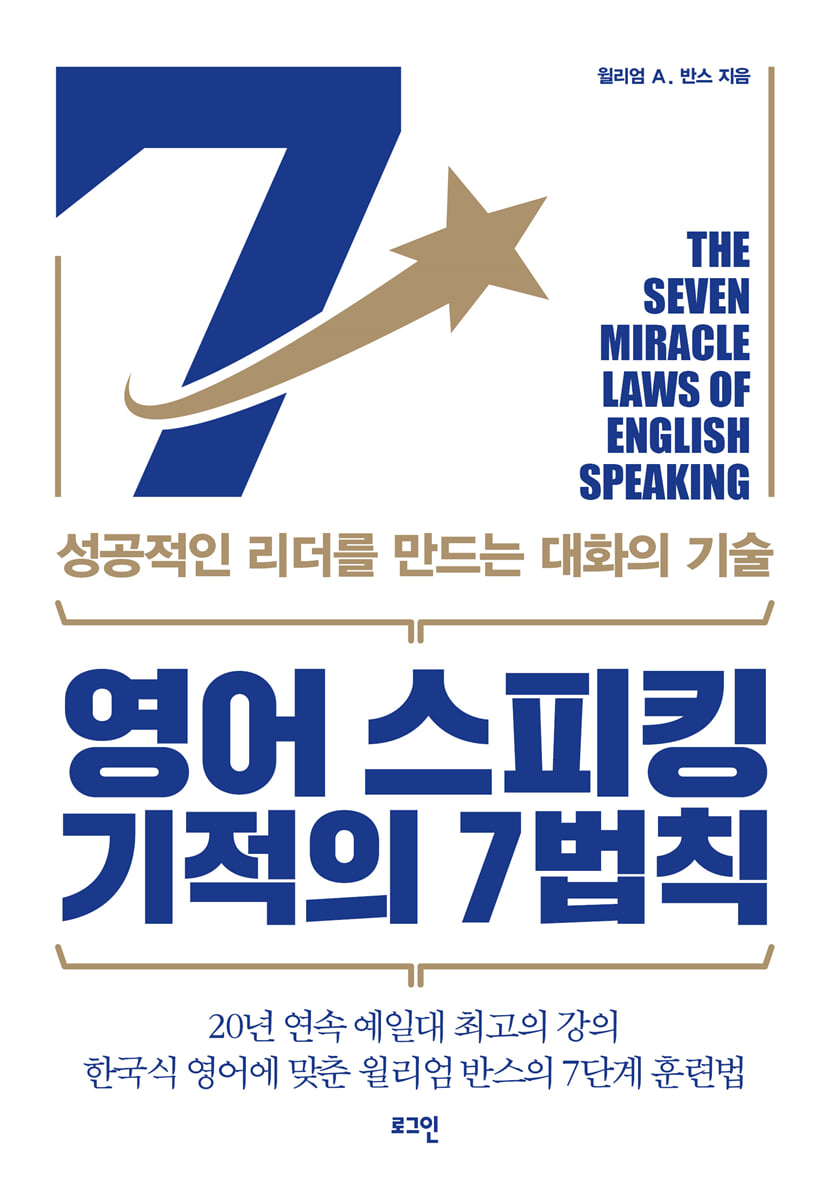
The 7 Miracle Laws of English Speaking
 |
Description
Book Introduction
Best lecture at Yale for 20 consecutive years
The "Most Useful Class" Voted by International Students from 75 Countries
It's not that foreigners can't understand your English sentences.
It's not because of the words or grammar
The most embarrassing moment when speaking English with a foreigner is when the other person doesn't understand what I said and asks me to repeat it, or even if they don't say it directly, they look embarrassed and hesitate to answer.
Why on earth can't foreigners understand what I'm saying?
The problem isn't with the words or the grammar, it's with the way you say it.
So, if a native speaker understands what I said, does that solve all my problems? No, that's not true.
If what I say sounds arrogant or offensive to the other person, it can leave a bad impression and cause harm in my daily life and work.
Ultimately, being "good" at English doesn't mean speaking grammatically sound sentences with perfect pronunciation, but rather how well you can convey what you want to say while leaving a positive impression.
This book summarizes the lessons of Professor William Barnes, who has taught English communication to numerous international students at Yale School of Management, into a '7-step English learning method' and introduces successful methods for speaking English.
In particular, it provides customized solutions for Korean readers by converting the 'Korean way of thinking' into an 'English way of thinking' and pointing out English errors that are particularly prominent among Koreans.
The "Most Useful Class" Voted by International Students from 75 Countries
It's not that foreigners can't understand your English sentences.
It's not because of the words or grammar
The most embarrassing moment when speaking English with a foreigner is when the other person doesn't understand what I said and asks me to repeat it, or even if they don't say it directly, they look embarrassed and hesitate to answer.
Why on earth can't foreigners understand what I'm saying?
The problem isn't with the words or the grammar, it's with the way you say it.
So, if a native speaker understands what I said, does that solve all my problems? No, that's not true.
If what I say sounds arrogant or offensive to the other person, it can leave a bad impression and cause harm in my daily life and work.
Ultimately, being "good" at English doesn't mean speaking grammatically sound sentences with perfect pronunciation, but rather how well you can convey what you want to say while leaving a positive impression.
This book summarizes the lessons of Professor William Barnes, who has taught English communication to numerous international students at Yale School of Management, into a '7-step English learning method' and introduces successful methods for speaking English.
In particular, it provides customized solutions for Korean readers by converting the 'Korean way of thinking' into an 'English way of thinking' and pointing out English errors that are particularly prominent among Koreans.
- You can preview some of the book's contents.
Preview
index
Preface to the First Edition
Preface to the Revised Edition
Features and Target Audience of this Book
Structure of this book
Ten Commandments for Thinking in English
Chapter 1: Use the English 'Information Package'
Speaking in a halting manner like Korean tires out native speakers.
Recognize the smallest unit of English thought
How to quickly recognize meaning units
Korean-style English escape method 1
Review
Chapter 2: Use the English Thinking Template
The problem isn't pronunciation.
The Effect of Thinking Templates
English Thinking Template Step 1: Choose a Character
English Thinking Template Step 2: Leave the Action to the Verb
Korean-style English escape method 2
250 Most Common Verbs in English Conversation
Review
Chapter 3: Understanding the Smooth Flow of English Sounds: "Linking"
The sounds of English are unstoppable, like a flowing river.
Types of liaisons
The effects and misunderstandings of liaison
Korean-style English escape method 3
Review
Chapter 4: Understanding English Melodies and the Hidden Meanings Within Them
Melody in English VS.
Melody in Korean
Two exercises to get closer to the tone of English
Melodies have hidden meanings
A special melody that helps convey meaning
Korean-style English escape method 4
Review
Chapter 5: The Power of 'Landmark Language' to Predict Conversation
Contextual direction keys 'milestone language'
Idiomatic milestone language
5 Ways to Escape Korean English
Review
Chapter 6: Designing English Messages
Message design determines the success or failure of a conversation.
The Basics of Message Design
Active Listening for Effective Communication
6 Ways to Escape Korean English
Review
Chapter 7: Small Talk: The Key to Success
There's a reason Westerners make small talk!
Formula 1: Seek Common Topics
Formula 2: Expand the answer
Formula 3: Encourage Conversation
Final advice
7 Ways to Escape Korean English
Review
Dr. Barnes' Top 7 Frequently Asked Questions
Conclusion
Answer and interpretation
Preface to the Revised Edition
Features and Target Audience of this Book
Structure of this book
Ten Commandments for Thinking in English
Chapter 1: Use the English 'Information Package'
Speaking in a halting manner like Korean tires out native speakers.
Recognize the smallest unit of English thought
How to quickly recognize meaning units
Korean-style English escape method 1
Review
Chapter 2: Use the English Thinking Template
The problem isn't pronunciation.
The Effect of Thinking Templates
English Thinking Template Step 1: Choose a Character
English Thinking Template Step 2: Leave the Action to the Verb
Korean-style English escape method 2
250 Most Common Verbs in English Conversation
Review
Chapter 3: Understanding the Smooth Flow of English Sounds: "Linking"
The sounds of English are unstoppable, like a flowing river.
Types of liaisons
The effects and misunderstandings of liaison
Korean-style English escape method 3
Review
Chapter 4: Understanding English Melodies and the Hidden Meanings Within Them
Melody in English VS.
Melody in Korean
Two exercises to get closer to the tone of English
Melodies have hidden meanings
A special melody that helps convey meaning
Korean-style English escape method 4
Review
Chapter 5: The Power of 'Landmark Language' to Predict Conversation
Contextual direction keys 'milestone language'
Idiomatic milestone language
5 Ways to Escape Korean English
Review
Chapter 6: Designing English Messages
Message design determines the success or failure of a conversation.
The Basics of Message Design
Active Listening for Effective Communication
6 Ways to Escape Korean English
Review
Chapter 7: Small Talk: The Key to Success
There's a reason Westerners make small talk!
Formula 1: Seek Common Topics
Formula 2: Expand the answer
Formula 3: Encourage Conversation
Final advice
7 Ways to Escape Korean English
Review
Dr. Barnes' Top 7 Frequently Asked Questions
Conclusion
Answer and interpretation
Detailed image

Into the book
How can I develop the habit of thinking and speaking in English? The answer is simple.
Think before you speak.
You might say, 'Everyone thinks before they speak,' but what I mean by thinking here is to think about what you want to say in units of meaning, following the new English way of thinking.
--- p.42 From “Chapter 1: Use the English ‘Information Package’”
Why didn't you understand? Many people might think it's because of the pronunciation, but in reality, typical Korean English pronunciation isn't particularly problematic, except for a few sounds that are particularly difficult to master.
Rather, the biggest part is speaking without using the English thought template.
--- p.53 From “Chapter 2: Use the English Thinking Template”
First of all, native speakers have the image of 'English as a language that flows smoothly without interruption.'
This image is formed by constantly hearing English from birth and growing up.
In short, English words that native speakers learn by ear are connected to each other without any breaks.
--- p.90 From Chapter 3, Understanding the Smooth Connection of English Sounds, ‘Linking’
Let's assume there is a person A who has no grammatical problems and can pronounce words perfectly when having a conversation.
But if A does not speak using the melody of English, unfortunately, A's English is very difficult for native speakers to understand.
Even though A is speaking English, if you don't listen carefully, it might sound like Korean to a native speaker.
On the other hand, let's say there is B who can perfectly use the correct English melody.
Sometimes, even if B's English grammar or pronunciation of words is somewhat inaccurate, native speakers find B's speech easier to understand than A's.
--- p.118 From “Chapter 4 Understanding the Melody of English and the Hidden Meanings Within It”
Just like conjunctions in Korean, English also has expressions that signal the message it wants to convey. These are called "signpost languages."
Because the number and types of milestone languages in English are much greater than those in Korean, the milestone languages can be said to play a greater role in communication.
Native speakers who are fluent in their speaking often use landmark language in their conversations.
--- p.149 From “Chapter 5: The Power of ‘Signpost Language’ to Predict Conversation”
When you're expressing your opinion or trying to persuade someone, you can organize it effectively by thinking about the idea you want to convey at home.
The ideas created in this way are concise, logical, and persuasive, and can leave a positive impact and impression.
I call a house that powerfully constructs a message a 'message house.'
--- p.187 From “Chapter 6: Message Design in English”
In fact, Koreans tend to speak directly.
When meeting someone for the first time or starting a new task, many people tend to rush to the main point and try to avoid small talk, believing it to be pointless.
This differs significantly from the approach of native speakers, who prefer small talk during first meetings to introduce themselves, explore the other person, and thereby build more effective communication.
Think before you speak.
You might say, 'Everyone thinks before they speak,' but what I mean by thinking here is to think about what you want to say in units of meaning, following the new English way of thinking.
--- p.42 From “Chapter 1: Use the English ‘Information Package’”
Why didn't you understand? Many people might think it's because of the pronunciation, but in reality, typical Korean English pronunciation isn't particularly problematic, except for a few sounds that are particularly difficult to master.
Rather, the biggest part is speaking without using the English thought template.
--- p.53 From “Chapter 2: Use the English Thinking Template”
First of all, native speakers have the image of 'English as a language that flows smoothly without interruption.'
This image is formed by constantly hearing English from birth and growing up.
In short, English words that native speakers learn by ear are connected to each other without any breaks.
--- p.90 From Chapter 3, Understanding the Smooth Connection of English Sounds, ‘Linking’
Let's assume there is a person A who has no grammatical problems and can pronounce words perfectly when having a conversation.
But if A does not speak using the melody of English, unfortunately, A's English is very difficult for native speakers to understand.
Even though A is speaking English, if you don't listen carefully, it might sound like Korean to a native speaker.
On the other hand, let's say there is B who can perfectly use the correct English melody.
Sometimes, even if B's English grammar or pronunciation of words is somewhat inaccurate, native speakers find B's speech easier to understand than A's.
--- p.118 From “Chapter 4 Understanding the Melody of English and the Hidden Meanings Within It”
Just like conjunctions in Korean, English also has expressions that signal the message it wants to convey. These are called "signpost languages."
Because the number and types of milestone languages in English are much greater than those in Korean, the milestone languages can be said to play a greater role in communication.
Native speakers who are fluent in their speaking often use landmark language in their conversations.
--- p.149 From “Chapter 5: The Power of ‘Signpost Language’ to Predict Conversation”
When you're expressing your opinion or trying to persuade someone, you can organize it effectively by thinking about the idea you want to convey at home.
The ideas created in this way are concise, logical, and persuasive, and can leave a positive impact and impression.
I call a house that powerfully constructs a message a 'message house.'
--- p.187 From “Chapter 6: Message Design in English”
In fact, Koreans tend to speak directly.
When meeting someone for the first time or starting a new task, many people tend to rush to the main point and try to avoid small talk, believing it to be pointless.
This differs significantly from the approach of native speakers, who prefer small talk during first meetings to introduce themselves, explore the other person, and thereby build more effective communication.
--- p.225 From “Chapter 7: Small Talk That Determines Success”
Publisher's Review
The art of conversation that leads to success at critical moments in life
Speak more easily and accurately with the 7-step learning method.
'Why can't I speak English easily?', 'Why do my English sentences sound so childish?', 'How can I break free from middle school-level English conversation?' Everyone has probably thought about these things at least once when learning English.
However, many people only think of the reason as something like, 'It's not my native language' or 'English and Korean have different language structures.'
However, when you actually go abroad, you can easily see foreigners whose native language is not English conversing with other foreigners in fluent English and socializing with various people without hesitation.
That is to say, the reason my English is not polished is not simply because English is a foreign language.
In this book, Professor Barnes presents seven techniques necessary for communicating in English more fluently than native speakers: 'English information packages,' 'English thought templates,' 'linking,' 'melody,' 'signpost language,' 'message design,' and 'small talk.'
By following the guide provided in the book step by step, even those who think and speak English as if they were Korean can naturally adopt a way of thinking appropriate for English.
The biggest advantage of this method is that it is a proven learning method that Professor Barnes has used to teach many Asian students at Yale University and has actually improved their English speaking skills.
So, regardless of the learner's English level, they can effectively improve their conversational skills by utilizing the vocabulary and grammar they currently know.
If you create English sentences with a way of thinking that is appropriate for the English language, the listener will be able to understand the words more easily and the speaker will be able to speak more fluently.
'No, why is this sentence wrong?'
Typical English Conversational Mistakes Made by 80% of Koreans
English expressions that have been transformed into Korean and are used only in Korea are called 'Konglish'.
If you speak Konglish, foreigners will obviously not understand what you are saying.
However, among the English expressions that Koreans like to use, there are some that are not Konglish but are so common that foreigners will have a mental breakdown when they hear them, and they are completely incomprehensible.
This happens even though there are no grammatical errors or misused words.
This is because there are English mistakes that Koreans in particular are prone to making.
This bad habit occurs so frequently that it can be said that most Koreans have at least one.
At the end of each chapter, Professor Barnes provides detailed explanations of incorrect Korean English expressions associated with that chapter.
As a Korean, it's hard to tell what the problem is, but from a native speaker's perspective, these expressions feel ambiguous and difficult to understand.
As you read, you may be reminded of your own English habits and blush in embarrassment, as all the examples are familiar.
However, I can confidently say that the advice in this book will be of great help in developing good English habits.
We also introduce awkward and unnatural expressions and English speaking that does not leave a good impression on the listener.
What if your words annoy the listener in everyday life, at school, or at important moments at work?
The author offers practical tips to avoid dire situations just by thinking about them.
If you want to avoid boring your listeners with a monotonous tone or being unfairly misunderstood even though you spoke with correct grammar, I recommend reading this part carefully.
Structure of this book
1.
7 Ways to Think in English
When I speak Korean, the words come out as I think, but when I speak English, it takes time because I have to put together Korean words, grammar, and pronunciation and then convert them into English.
Also, when converting Korean to English, various Korean elements can unconsciously intervene, making the expression awkward.
To solve this problem, learn how to convert your Korean way of thinking into an English way of thinking.
2.
Korean-style English escape method
Korean students studying abroad have high TOEFL scores and know a lot of difficult vocabulary, but they are particularly weak in speaking compared to other English skills.
The cause of this is largely influenced by several typical weaknesses that many Koreans have.
Based on his experience, Professor Barnes carefully examines the chronic problems of Korean English and provides tips on how to correct bad habits.
3.
Review
At first, it may seem very difficult to change a way of thinking that has already become naturally ingrained.
This problem is common when learning a foreign language, but it can be overcome with practice.
Once you learn to think in English, your overall English skills, not just your conversational skills, will improve dramatically.
Let's review what we've learned through sufficient practice and apply it to real-life situations.
Professor Barnes interprets being good at English as 'being able to communicate and convey your thoughts accurately and easily to others.'
So, if you want to be good at English, all you have to do is learn how to 'convey' and 'communicate' in English.
Through this book, let's effectively utilize the English knowledge that has been underutilized so far and build confidence in our communication skills.
Speak more easily and accurately with the 7-step learning method.
'Why can't I speak English easily?', 'Why do my English sentences sound so childish?', 'How can I break free from middle school-level English conversation?' Everyone has probably thought about these things at least once when learning English.
However, many people only think of the reason as something like, 'It's not my native language' or 'English and Korean have different language structures.'
However, when you actually go abroad, you can easily see foreigners whose native language is not English conversing with other foreigners in fluent English and socializing with various people without hesitation.
That is to say, the reason my English is not polished is not simply because English is a foreign language.
In this book, Professor Barnes presents seven techniques necessary for communicating in English more fluently than native speakers: 'English information packages,' 'English thought templates,' 'linking,' 'melody,' 'signpost language,' 'message design,' and 'small talk.'
By following the guide provided in the book step by step, even those who think and speak English as if they were Korean can naturally adopt a way of thinking appropriate for English.
The biggest advantage of this method is that it is a proven learning method that Professor Barnes has used to teach many Asian students at Yale University and has actually improved their English speaking skills.
So, regardless of the learner's English level, they can effectively improve their conversational skills by utilizing the vocabulary and grammar they currently know.
If you create English sentences with a way of thinking that is appropriate for the English language, the listener will be able to understand the words more easily and the speaker will be able to speak more fluently.
'No, why is this sentence wrong?'
Typical English Conversational Mistakes Made by 80% of Koreans
English expressions that have been transformed into Korean and are used only in Korea are called 'Konglish'.
If you speak Konglish, foreigners will obviously not understand what you are saying.
However, among the English expressions that Koreans like to use, there are some that are not Konglish but are so common that foreigners will have a mental breakdown when they hear them, and they are completely incomprehensible.
This happens even though there are no grammatical errors or misused words.
This is because there are English mistakes that Koreans in particular are prone to making.
This bad habit occurs so frequently that it can be said that most Koreans have at least one.
At the end of each chapter, Professor Barnes provides detailed explanations of incorrect Korean English expressions associated with that chapter.
As a Korean, it's hard to tell what the problem is, but from a native speaker's perspective, these expressions feel ambiguous and difficult to understand.
As you read, you may be reminded of your own English habits and blush in embarrassment, as all the examples are familiar.
However, I can confidently say that the advice in this book will be of great help in developing good English habits.
We also introduce awkward and unnatural expressions and English speaking that does not leave a good impression on the listener.
What if your words annoy the listener in everyday life, at school, or at important moments at work?
The author offers practical tips to avoid dire situations just by thinking about them.
If you want to avoid boring your listeners with a monotonous tone or being unfairly misunderstood even though you spoke with correct grammar, I recommend reading this part carefully.
Structure of this book
1.
7 Ways to Think in English
When I speak Korean, the words come out as I think, but when I speak English, it takes time because I have to put together Korean words, grammar, and pronunciation and then convert them into English.
Also, when converting Korean to English, various Korean elements can unconsciously intervene, making the expression awkward.
To solve this problem, learn how to convert your Korean way of thinking into an English way of thinking.
2.
Korean-style English escape method
Korean students studying abroad have high TOEFL scores and know a lot of difficult vocabulary, but they are particularly weak in speaking compared to other English skills.
The cause of this is largely influenced by several typical weaknesses that many Koreans have.
Based on his experience, Professor Barnes carefully examines the chronic problems of Korean English and provides tips on how to correct bad habits.
3.
Review
At first, it may seem very difficult to change a way of thinking that has already become naturally ingrained.
This problem is common when learning a foreign language, but it can be overcome with practice.
Once you learn to think in English, your overall English skills, not just your conversational skills, will improve dramatically.
Let's review what we've learned through sufficient practice and apply it to real-life situations.
Professor Barnes interprets being good at English as 'being able to communicate and convey your thoughts accurately and easily to others.'
So, if you want to be good at English, all you have to do is learn how to 'convey' and 'communicate' in English.
Through this book, let's effectively utilize the English knowledge that has been underutilized so far and build confidence in our communication skills.
GOODS SPECIFICS
- Date of issue: January 2, 2025
- Page count, weight, size: 288 pages | 396g | 145*210*19mm
- ISBN13: 9791169512459
- ISBN10: 1169512453
You may also like
카테고리
korean


korean

![GQ KOREA Mark (Monthly): December [2025]](http://librairie.coreenne.fr/cdn/shop/files/8ef265dbbfbf186523ed75ba7319009d.jpg?v=1765340328&width=3840)


