

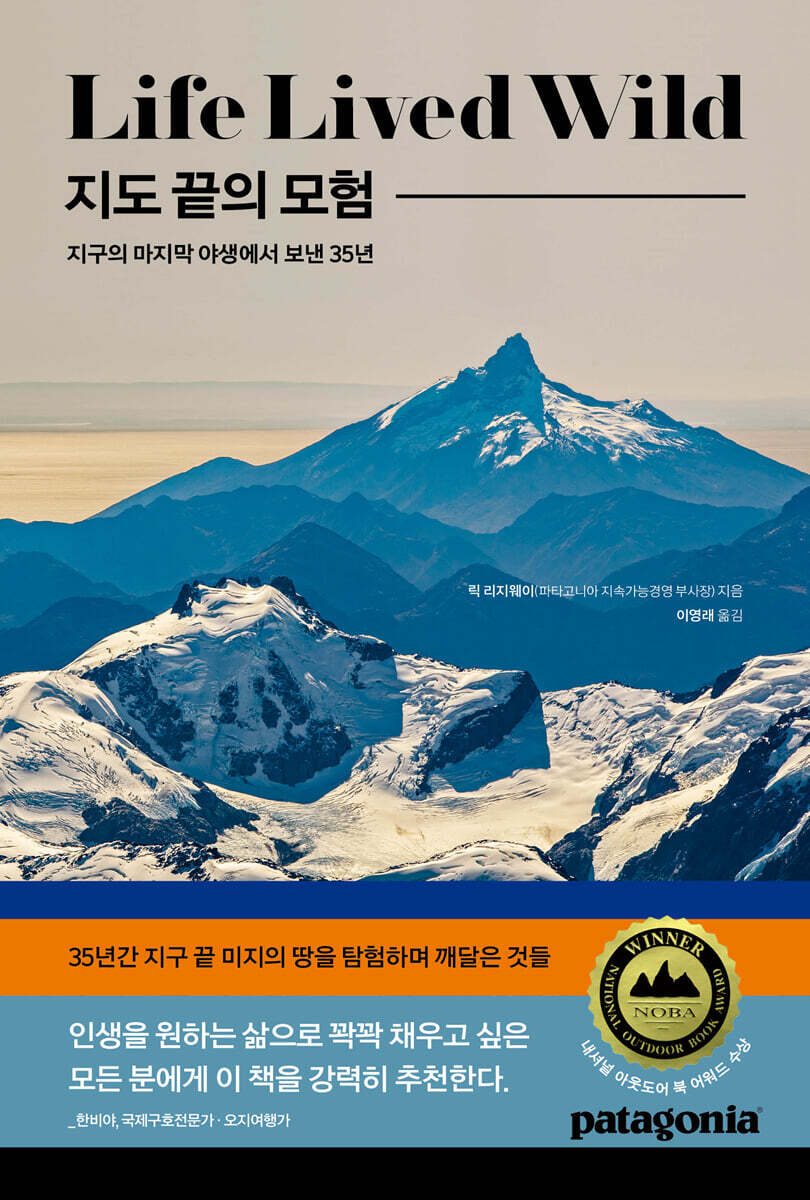
Adventure at the End of the Map
 |
Description
Book Introduction
Winner of the 2022 National Outdoor Book Award!
Rick Ridgeway, Patagonia's vice president of sustainability
What I've Learned from 35 Years of Exploring the Unknown Lands of the Earth
A philosophy of coexistence between humans and the wild, from a small tent in the most remote part of the world.
A book containing 35 years of adventures and insights into the coexistence of humans and nature by Rick Ridgeway, a legendary adventurer and Patagonia Vice President of Sustainability, who holds numerous records, including the first American to climb K2 without oxygen, the longest traverse of Borneo, and the first to climb the Great Wall of Antarctica.
When you think of outdoor brand Patagonia, there are three environmental campaigns that come to mind.
"Freedom to Roam," a wildlife migration corridor protection campaign, "One Wear," an unlimited clothing repair service, and a New York Times ad that read, "Don't Buy This Jacket."
The person who led the practical work of all these campaigns was Rick Ridgeway, author of this book, Adventures at the End of the Map.
From the 1976 American Bicentennial Everest Expedition to the 2015 Strait of Magellan Expedition in Patagonia, "Adventure at the End of the Map" chronicles a 40-year journey that movingly portrays how a passion for outdoor sports led to a love of nature and ultimately to an active environmental movement.
In particular, the stories of Patagonia founder Yvon Chouinard, who donated his entire company stock worth over 4 trillion won to an environmental foundation, The North Face founder Doug Tompkins, who donated millions of acres of land to create massive national parks in Chile and Argentina, and Rick Ridgeway, each dedicating themselves to the environmental movement in their own way, engrave the beauty of nature into the readers' souls and show the path that humanity should take.
Rick Ridgeway, Patagonia's vice president of sustainability
What I've Learned from 35 Years of Exploring the Unknown Lands of the Earth
A philosophy of coexistence between humans and the wild, from a small tent in the most remote part of the world.
A book containing 35 years of adventures and insights into the coexistence of humans and nature by Rick Ridgeway, a legendary adventurer and Patagonia Vice President of Sustainability, who holds numerous records, including the first American to climb K2 without oxygen, the longest traverse of Borneo, and the first to climb the Great Wall of Antarctica.
When you think of outdoor brand Patagonia, there are three environmental campaigns that come to mind.
"Freedom to Roam," a wildlife migration corridor protection campaign, "One Wear," an unlimited clothing repair service, and a New York Times ad that read, "Don't Buy This Jacket."
The person who led the practical work of all these campaigns was Rick Ridgeway, author of this book, Adventures at the End of the Map.
From the 1976 American Bicentennial Everest Expedition to the 2015 Strait of Magellan Expedition in Patagonia, "Adventure at the End of the Map" chronicles a 40-year journey that movingly portrays how a passion for outdoor sports led to a love of nature and ultimately to an active environmental movement.
In particular, the stories of Patagonia founder Yvon Chouinard, who donated his entire company stock worth over 4 trillion won to an environmental foundation, The North Face founder Doug Tompkins, who donated millions of acres of land to create massive national parks in Chile and Argentina, and Rick Ridgeway, each dedicating themselves to the environmental movement in their own way, engrave the beauty of nature into the readers' souls and show the path that humanity should take.
- You can preview some of the book's contents.
Preview
index
Recommended Article | The Last Challenge of Those Who Enjoyed Nature to the Fullest _Hanbiya
Prologue | Do it first, then solve it later
1 Prayer for Everest
2 K2 On the border between life and death
3. The person left in the clouds
4 The Beginning of an Adventure
5 Which is more problematic, losing or gaining?
6 Seven Summits Odyssey
7 Crossing Borneo Island
8 Beginner Mountaineers Who Wrote a New History in Climbing
9 Fun Seeking Guys, Two Boys
10 Where the Dragons Are
11 Uncharted Land, Magellan Fjords, Chile
12 Antarctica's Last Dog Sled Teams
13 Talk to Beluga
14 Civilization of Others
15 One Step for the Earth
16 Entrepreneurs Who Became Environmental Activists
17 Consistency is evidence of a small person
18 Life in the Food Chain
19 People with long bows
20 Two Funerals
21 Changtang, Walking in a World Without Humans
22 Freedom to wander
23 Dreaming of the world's best national park
24 The Last Expedition of the Two Boys
25. Patagonia National Park, a buffer zone between humans and wildlife
Conclusion | Lost and Found, and That's the Path I've Walked
Acknowledgements
A word from the editor | For those curious about the 'Patagonia spirit' - Kwang-Hyun Kim
Prologue | Do it first, then solve it later
1 Prayer for Everest
2 K2 On the border between life and death
3. The person left in the clouds
4 The Beginning of an Adventure
5 Which is more problematic, losing or gaining?
6 Seven Summits Odyssey
7 Crossing Borneo Island
8 Beginner Mountaineers Who Wrote a New History in Climbing
9 Fun Seeking Guys, Two Boys
10 Where the Dragons Are
11 Uncharted Land, Magellan Fjords, Chile
12 Antarctica's Last Dog Sled Teams
13 Talk to Beluga
14 Civilization of Others
15 One Step for the Earth
16 Entrepreneurs Who Became Environmental Activists
17 Consistency is evidence of a small person
18 Life in the Food Chain
19 People with long bows
20 Two Funerals
21 Changtang, Walking in a World Without Humans
22 Freedom to wander
23 Dreaming of the world's best national park
24 The Last Expedition of the Two Boys
25. Patagonia National Park, a buffer zone between humans and wildlife
Conclusion | Lost and Found, and That's the Path I've Walked
Acknowledgements
A word from the editor | For those curious about the 'Patagonia spirit' - Kwang-Hyun Kim
Detailed image

Into the book
I once calculated the time I slept in a tent.
It was a total of 5 years.
The place where I pitched my tent was the most remote place in the world, and I felt deeply connected to nature.
My experiences in the wild have completely changed my life and the way I live.
I learned to discern what is important in life through nature.
Man must remain in the wild land to save himself.
Because only there can you see your true self.
---From the "Prologue"
We are back to normal.
I thought of the usual photos taken at the top.
Photos of climbers standing, ice axes raised above their heads, waving victory flags.
But I didn't feel like I had conquered anything at all.
We were just two little people on top of the most wonderful mountain in the world, and the mountain didn't care about us.
---From "K2: On the Boundary of Life and Death"
Little by little, each year, the focus of my adventures shifted from wilderness sports to the wild places themselves, and increasingly to the wild animals in those places.
No, perhaps it could be seen as amplified rather than moved.
I still loved sports, but that passion paled in comparison to the time I spent in the wild among wild animals.
The solace I found in the wild was a big reason, but another important reason was that spending time in the wild gave me a greater awareness that I too was one of those animals.
---From "Talking to Beluga"
“After a year of climbing, a reporter asked Frank why he quit his job at Warner Bros. to climb.
Frank quoted a line from a poem by Robert Service, which he had learned through Dick.
'Because I wanted to see everything.' To do that, he decided to leave the path he had been on and embark on a completely new one when he turned fifty and became an adult.
There were no maps, no signs, no guarantee that we would ever reach our destination.
How many of us have the courage to do that?”
---From "Entrepreneurs Who Became Environmental Activists"
At the heart of it all is sports.
If it weren't for sports, we wouldn't be in the wild, if it weren't for the wild, we wouldn't fall in love with the beauty of nature, and if it weren't for our love of nature, we wouldn't be dedicated to saving it.
---From "Dreaming of the World's Best National Park"
Doug believed that to save ourselves, humans must live in harmony with our fellow wild animals and protect the wild lands they need not only to survive but to thrive.
He also believed that in order for humans to find comfort, they must constantly remind themselves of where they came from.
This is because it allows us to have a vision of where we need to go.
I took a handful of the berries I had brought down the hill and scattered them on his grave.
“He who eats the berry will return to Patagonia.”
It was a total of 5 years.
The place where I pitched my tent was the most remote place in the world, and I felt deeply connected to nature.
My experiences in the wild have completely changed my life and the way I live.
I learned to discern what is important in life through nature.
Man must remain in the wild land to save himself.
Because only there can you see your true self.
---From the "Prologue"
We are back to normal.
I thought of the usual photos taken at the top.
Photos of climbers standing, ice axes raised above their heads, waving victory flags.
But I didn't feel like I had conquered anything at all.
We were just two little people on top of the most wonderful mountain in the world, and the mountain didn't care about us.
---From "K2: On the Boundary of Life and Death"
Little by little, each year, the focus of my adventures shifted from wilderness sports to the wild places themselves, and increasingly to the wild animals in those places.
No, perhaps it could be seen as amplified rather than moved.
I still loved sports, but that passion paled in comparison to the time I spent in the wild among wild animals.
The solace I found in the wild was a big reason, but another important reason was that spending time in the wild gave me a greater awareness that I too was one of those animals.
---From "Talking to Beluga"
“After a year of climbing, a reporter asked Frank why he quit his job at Warner Bros. to climb.
Frank quoted a line from a poem by Robert Service, which he had learned through Dick.
'Because I wanted to see everything.' To do that, he decided to leave the path he had been on and embark on a completely new one when he turned fifty and became an adult.
There were no maps, no signs, no guarantee that we would ever reach our destination.
How many of us have the courage to do that?”
---From "Entrepreneurs Who Became Environmental Activists"
At the heart of it all is sports.
If it weren't for sports, we wouldn't be in the wild, if it weren't for the wild, we wouldn't fall in love with the beauty of nature, and if it weren't for our love of nature, we wouldn't be dedicated to saving it.
---From "Dreaming of the World's Best National Park"
Doug believed that to save ourselves, humans must live in harmony with our fellow wild animals and protect the wild lands they need not only to survive but to thrive.
He also believed that in order for humans to find comfort, they must constantly remind themselves of where they came from.
This is because it allows us to have a vision of where we need to go.
I took a handful of the berries I had brought down the hill and scattered them on his grave.
“He who eats the berry will return to Patagonia.”
---From "Patagonia National Park, a buffer zone between humans and wildlife"
Publisher's Review
“I highly recommend this book to anyone who wants to fill their life with what they want.” - Hanbiya (international relief expert, traveler)
“I have always looked upon Rick’s life with awe, admiration and wonder.
"How can one person achieve so much in one lifetime? If you want to know how to live life to the fullest, this book has the answer." _Jimmy Chin (Director of the Academy Award-winning film "Free Solo")
■ An adventurer who has explored the world from Everest to the Amazon and Antarctica,
Patagonia's Vice President of Sustainability Rick Ridgeway's 25 Adventures That Changed the World
Patagonia's Black Friday ad, "Don't buy this jacket," is considered one of the best slogans that imprinted Patagonia's corporate philosophy on the world.
The person who planned this campaign is Rick Ridgeway, author of Adventure at the End of the Map.
Rick Ridgeway's life is full of headline-grabbing firsts.
He was the first American to climb K2 without oxygen, the longest trek across Borneo, and the first to cross the Tibetan Plateau without power, a feat no outsider had ever attempted.
He also walked 483 kilometers from the summit of Mount Kilimanjaro to the coast of East Africa, tracking wildlife.
With a legendary history of adventures that National Geographic called "the man who defines the meaning of exploration and adventure," he led numerous environmental improvement projects during his 15 years as Patagonia's Chief Sustainability Officer, including the "Freedom to Roam Campaign," a movement to protect wildlife movement rights, the "One Wear Campaign," a resource recycling movement, and the "Footprint Chronicle Program," which minimizes environmental damage throughout the entire production process.
He also persuaded Walmart to establish the Sustainable Apparel Coalition (SAC), which grew into the world's largest non-profit organization with 40% of global textile brands, including Nike, Amazon, and Zara.
From legendary mountaineer to environmental activist who best utilizes capitalism
Rick Ridgeway says all these achievements come from playing sports in the wild.
He fell in love with high-altitude mountaineering after scaling a 3,000-meter peak without crampons or an ice axe, let alone protective gear, as a teenager. After giving up a doctoral program at UC Berkeley to join the US Bicentennial Everest Expedition, he expanded his adventures to the Amazon, Antarctica, Africa, and the Arctic over the next 35 years.
His experience in the untouched wilderness completely changed his life.
His passion for climbing the highest peaks gradually shifted to saving nature and wildlife as he witnessed the Patagonian plains being turned into tourist towns, the disappearance of Kilimanjaro's glaciers, and the decline of wildlife populations.
In particular, his encounters with Patagonia founder Yvon Chouinard and The North Face founder Doug Tompkins, who became his life mentors, led him to the forefront of the environmental movement.
■ Eccentric entrepreneurs who became environmental activists are changing the world!
“What matters is the challenge, the change that happens within yourself.” - Yvon Chouinard
Yvon Chouinard and Doug Tompkins were both successful entrepreneurs, but they viewed business as a means of protecting the environment.
Yvonne donates 1% of her sales to grassroots environmental organizations every year.
And Doug, a deep ecologist who viewed humans as a thread in the fabric of nature, a species without the moral right to dominate other species, risked his entire fortune and life to turn the beautiful primeval forests of Chile and Argentina into national parks.
Witnessing the dedication of these two men, Rick Ridgeway decides to use his adventuring skills to save endangered species.
And across the African plains, frozen tundra, lush jungles, and arid plateaus, he documented the ecology of endangered species such as elephants, chiru, right whales, and beluga whales in words and videos.
His documentary on Everest won an Emmy Award, and his journey across Tibet's Changtang Plateau, following the Chilu's spawning route, helped the Chinese government create a 1.5-million-acre nature reserve.
This book vividly captures Rick Ridgeway's 50 years of adventures and environmental activism with his colleagues in the wild.
The Do Boys, an adventure club led by Yvon Chouinard, Doug Tompkins, and Rick Ridgeway, has evolved into an environmental movement of eccentric entrepreneurs who enjoy risky adventures by day and discuss solutions to the environmental crisis by night.
Their friendship, which lasted over 50 years, shaped Warner Bros. president Frank Wells and NBC's "Today Show" anchor Tom Brokaw into accomplished mountaineers and environmentalists, and provided steadfast support to Doug Tompkins and his wife as they overcame all odds to complete Patagonia National Park.
“I intend to give these trees, this forest, all these buildings, trails and campsites back to Chile someday.
If that happens, the national park system in this country will grow.
But more importantly, it raises the bar for parks and strengthens people's pride in their parks.
“As your pride grows, you will want to protect the park better, right?”_ Chapter 23, “Dreaming of the World’s Best National Park”
■ A book of true adventure that awakens the courage to try what is fearful.
The most important achievement of "Adventure at the End of the Map" is that it allows us to experience close contact with nature.
Vivid descriptions and photographs of sacred mountains, vast deserts, and lush forests that fill 25 episodes inspire awe, simultaneously demonstrating the beauty, fragility, and power of nature.
Rick Ridgeway's reflections on the delicate balance of wildlife, indigenous culture, and ecosystems also illustrate the importance of coexistence for all life in nature.
Rick Ridgeway's conclusion, after observing the devastation of nature due to poaching and development, was that "when technology and opportunity are available, the default human response is to hunt wildlife until it disappears."
He proposes a 'fourth duty' to those who argue that the destruction of nature is inevitable because humans also have three duties: to eat, not to be eaten, and to reproduce.
'A good nature that feels beauty and seeks ways to connect with the universe, ways to connect with the web of nature that surrounds me.'
As he said, hope lies right here.
What I remember most is Rick Ridgeway's consistent reverence for nature.
A philosophy of coexistence between humans and the wild, from a small tent in the most remote part of the world!
- [Publisher's Weekly]
I guarantee you that his 25-chapter story will be more exciting and adventurous than Indiana Jones.
A true adventure book that demonstrates a deep respect for people and the ecosystem.
- [Inside Hook]
“I have always looked upon Rick’s life with awe, admiration and wonder.
"How can one person achieve so much in one lifetime? If you want to know how to live life to the fullest, this book has the answer." _Jimmy Chin (Director of the Academy Award-winning film "Free Solo")
■ An adventurer who has explored the world from Everest to the Amazon and Antarctica,
Patagonia's Vice President of Sustainability Rick Ridgeway's 25 Adventures That Changed the World
Patagonia's Black Friday ad, "Don't buy this jacket," is considered one of the best slogans that imprinted Patagonia's corporate philosophy on the world.
The person who planned this campaign is Rick Ridgeway, author of Adventure at the End of the Map.
Rick Ridgeway's life is full of headline-grabbing firsts.
He was the first American to climb K2 without oxygen, the longest trek across Borneo, and the first to cross the Tibetan Plateau without power, a feat no outsider had ever attempted.
He also walked 483 kilometers from the summit of Mount Kilimanjaro to the coast of East Africa, tracking wildlife.
With a legendary history of adventures that National Geographic called "the man who defines the meaning of exploration and adventure," he led numerous environmental improvement projects during his 15 years as Patagonia's Chief Sustainability Officer, including the "Freedom to Roam Campaign," a movement to protect wildlife movement rights, the "One Wear Campaign," a resource recycling movement, and the "Footprint Chronicle Program," which minimizes environmental damage throughout the entire production process.
He also persuaded Walmart to establish the Sustainable Apparel Coalition (SAC), which grew into the world's largest non-profit organization with 40% of global textile brands, including Nike, Amazon, and Zara.
From legendary mountaineer to environmental activist who best utilizes capitalism
Rick Ridgeway says all these achievements come from playing sports in the wild.
He fell in love with high-altitude mountaineering after scaling a 3,000-meter peak without crampons or an ice axe, let alone protective gear, as a teenager. After giving up a doctoral program at UC Berkeley to join the US Bicentennial Everest Expedition, he expanded his adventures to the Amazon, Antarctica, Africa, and the Arctic over the next 35 years.
His experience in the untouched wilderness completely changed his life.
His passion for climbing the highest peaks gradually shifted to saving nature and wildlife as he witnessed the Patagonian plains being turned into tourist towns, the disappearance of Kilimanjaro's glaciers, and the decline of wildlife populations.
In particular, his encounters with Patagonia founder Yvon Chouinard and The North Face founder Doug Tompkins, who became his life mentors, led him to the forefront of the environmental movement.
■ Eccentric entrepreneurs who became environmental activists are changing the world!
“What matters is the challenge, the change that happens within yourself.” - Yvon Chouinard
Yvon Chouinard and Doug Tompkins were both successful entrepreneurs, but they viewed business as a means of protecting the environment.
Yvonne donates 1% of her sales to grassroots environmental organizations every year.
And Doug, a deep ecologist who viewed humans as a thread in the fabric of nature, a species without the moral right to dominate other species, risked his entire fortune and life to turn the beautiful primeval forests of Chile and Argentina into national parks.
Witnessing the dedication of these two men, Rick Ridgeway decides to use his adventuring skills to save endangered species.
And across the African plains, frozen tundra, lush jungles, and arid plateaus, he documented the ecology of endangered species such as elephants, chiru, right whales, and beluga whales in words and videos.
His documentary on Everest won an Emmy Award, and his journey across Tibet's Changtang Plateau, following the Chilu's spawning route, helped the Chinese government create a 1.5-million-acre nature reserve.
This book vividly captures Rick Ridgeway's 50 years of adventures and environmental activism with his colleagues in the wild.
The Do Boys, an adventure club led by Yvon Chouinard, Doug Tompkins, and Rick Ridgeway, has evolved into an environmental movement of eccentric entrepreneurs who enjoy risky adventures by day and discuss solutions to the environmental crisis by night.
Their friendship, which lasted over 50 years, shaped Warner Bros. president Frank Wells and NBC's "Today Show" anchor Tom Brokaw into accomplished mountaineers and environmentalists, and provided steadfast support to Doug Tompkins and his wife as they overcame all odds to complete Patagonia National Park.
“I intend to give these trees, this forest, all these buildings, trails and campsites back to Chile someday.
If that happens, the national park system in this country will grow.
But more importantly, it raises the bar for parks and strengthens people's pride in their parks.
“As your pride grows, you will want to protect the park better, right?”_ Chapter 23, “Dreaming of the World’s Best National Park”
■ A book of true adventure that awakens the courage to try what is fearful.
The most important achievement of "Adventure at the End of the Map" is that it allows us to experience close contact with nature.
Vivid descriptions and photographs of sacred mountains, vast deserts, and lush forests that fill 25 episodes inspire awe, simultaneously demonstrating the beauty, fragility, and power of nature.
Rick Ridgeway's reflections on the delicate balance of wildlife, indigenous culture, and ecosystems also illustrate the importance of coexistence for all life in nature.
Rick Ridgeway's conclusion, after observing the devastation of nature due to poaching and development, was that "when technology and opportunity are available, the default human response is to hunt wildlife until it disappears."
He proposes a 'fourth duty' to those who argue that the destruction of nature is inevitable because humans also have three duties: to eat, not to be eaten, and to reproduce.
'A good nature that feels beauty and seeks ways to connect with the universe, ways to connect with the web of nature that surrounds me.'
As he said, hope lies right here.
What I remember most is Rick Ridgeway's consistent reverence for nature.
A philosophy of coexistence between humans and the wild, from a small tent in the most remote part of the world!
- [Publisher's Weekly]
I guarantee you that his 25-chapter story will be more exciting and adventurous than Indiana Jones.
A true adventure book that demonstrates a deep respect for people and the ecosystem.
- [Inside Hook]
GOODS SPECIFICS
- Date of issue: July 14, 2023
- Page count, weight, size: 524 pages | 782g | 152*225*33mm
- ISBN13: 9791197874390
- ISBN10: 1197874399
You may also like
카테고리
korean


korean

![GQ KOREA Mark (Monthly): December [2025]](http://librairie.coreenne.fr/cdn/shop/files/8ef265dbbfbf186523ed75ba7319009d.jpg?v=1765340328&width=3840)


