

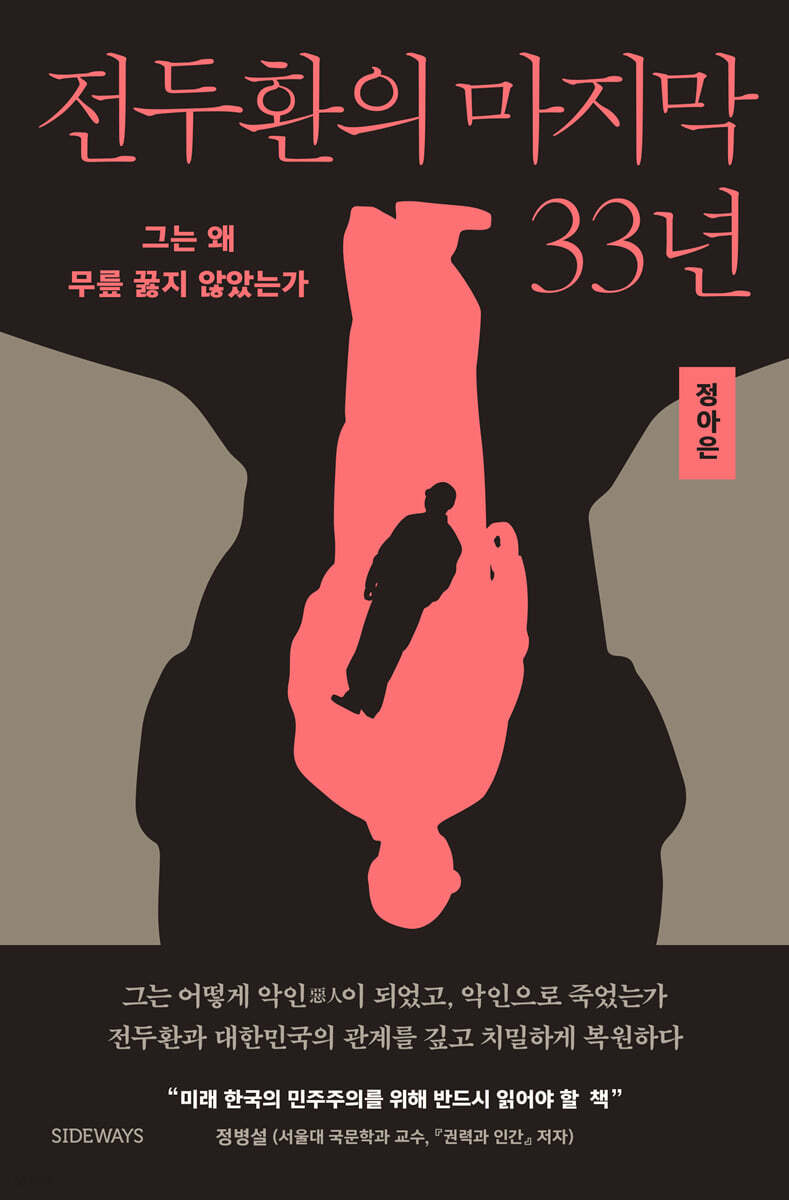
Chun Doo-hwan's last 33 years
 |
Description
Book Introduction
Why was Chun Doo-hwan able to live out the rest of his life without being convicted? What does the existence of Chun Doo-hwan tell us about this land? A biographical reportage and documentary reflection on a problematic figure. Deeply and meticulously restoring the relationship between Chun Doo-hwan and the Republic of Korea. The fact that Chun Doo-hwan, the 11th and 12th president of the Republic of Korea, was able to end his life without being condemned reveals the most acute and problematic aspect of the Republic of Korea. After seizing power through the December 12, 1979 military coup and carrying out unprecedented massacres and human rights violations, Chun Doo-hwan enjoyed a long life, living in luxury for 33 years after completing his term as president and leaving office. He has never received any just punishment from our society, nor has he ever truly repented for his crimes. He passed away peacefully at home on November 23, 2021, as if the pain and despair of the May 18 victims' families, who had been calling for an investigation and an apology for decades, were insignificant. Why couldn't we bring Chun Doo-hwan to his knees? Why could he not truly apologize for his wrongdoings, and why could he avoid the punishment he deserved from the nation and society? While there has been an abundance of commentary and analysis surrounding Chun Doo-hwan, our society has yet to provide a proper answer to this question. To answer that question, we must thoroughly examine the life of Chun Doo-hwan and the modern political, economic, social, and cultural history of the Republic of Korea from their origins, and comprehensively analyze the personal temperament, political environment of the time, and the historical context that enabled his many evil deeds. As Professor Jeong Byeong-seol of Seoul National University put it in the book, “reading Chun Doo-hwan is reading Korea,” and based on this critical awareness, it is bound to be a multi-layered and three-dimensional task that deeply and meticulously restores the relationship between Chun Doo-hwan and the Republic of Korea. Jeong Ah-eun, winner of the 18th Hankyoreh Literary Award, who has published five full-length novels and three humanities essays to date, has accomplished just that with this book. In 『The Last 33 Years of Chun Doo-hwan』, Jeong Ah-eun reconstructs the life of Chun Doo-hwan from birth to death, the time before and after his rise to power, and the rest of his life after his departure from power more thoroughly than any other document published to date. “The Last 33 Years of Chun Doo-hwan” is not a work that demonizes Chun Doo-hwan, nor is it a work that glorifies him as a hero. Instead, it is a biographical work that fiercely examines Chun Doo-hwan as a 'human being' and seeks to reveal his glory, contradictions, downfall, and the 'origin of evil' that gave birth to him, without reservation, within the horizon of modern Korean history. Why did Jeong Ah-eun begin and finish this work? She wrote down her reasons in her book. Because 'evil' that has not been properly identified will survive even after physical life is cut off and continue to exert influence into the future. We must now clearly recognize the true nature of Chun Doo-hwan, a villain who knew how to shed blood and tears and who could share deep love with those close to him. Asking how our community should remember and cope with the evil man that was Chun Doo-hwan will undoubtedly be the first step toward truly reflecting on the direction the Republic of Korea should take after his death. |
- You can preview some of the book's contents.
Preview
index
prolog
Part 1 Glory (1931-1980)
Chapter 1 | Syngman Rhee, Park Chung-hee, and Chun Doo-hwan
Chapter 2 | The 49-Year-Old Security Commander
Chapter 3 | The Desperate Struggle for Ascension: The Growth Process
Chapter 4 | Active and Relatable Military Academy Cadets
Chapter 5 | Day of Rebellion, December 12, 1979
Chapter 6 | The Day We Celebrated the Establishment of Original Sin
Chapter 7 | Standing on Gwangju and Ascending to Power
Chapter 8 | Chun Doo-hwan's Special Lightness
BRIDGE 1
The Night of December 12: The Three People Chun Doo-hwan Had to Overcome
Part 2 Contradiction (1981-1987)
Chapter 1 | What Was the 1980s Like?
Chapter 2 | One Man vs. Forty Million
Chapter 3 | South Korea's Copernican Shift
Chapter 4 | Using Talents as Your Arms and Legs
Chapter 5 | The Illegitimate President's Intentions
Chapter 6 | The Good Husband, the Brutal Slaughterer
Chapter 7 | The End of the Era of Making the Impossible Possible
BRIDGE 2
Fear and Love
Part 3: The Fall (1988-2021)
Chapter 1 | Holding my four-year-old granddaughter… .
Chapter 2 | The Most Fearsome Enemy, Roh Tae-woo
Chapter 3 | The Pause of Decline
Chapter 4 | The Day of Judgment and Kim Young-sam
Chapter 5 | Prison Life
Chapter 6 | The Two Polar Contrasts of Modern Korean History: Chun Doo-hwan vs. Kim Dae-jung
Chapter 7 | The Two Polar Contrasts of Modern Korean History: Chun Doo-hwan vs. Roh Moo-hyun
Chapter 8 | The Hammer Thrown by Park Chung-hee's Daughter
Chapter 9 | The Last Years of a Man Who Never Met Hisself
BRIDGE 3
Living as the spouse of a dictator
Part 4: The Origin of Evil
Chapter 1 | Sacrifices on the Altar of History
Chapter 2 | The Age of Glory
Chapter 3 | Who Misses Him and Why?
Chapter 4 | The Heavenly Punishment of the Living
Chapter 5 | A Society Where Good Is Observed
Epilogue
main
References
Part 1 Glory (1931-1980)
Chapter 1 | Syngman Rhee, Park Chung-hee, and Chun Doo-hwan
Chapter 2 | The 49-Year-Old Security Commander
Chapter 3 | The Desperate Struggle for Ascension: The Growth Process
Chapter 4 | Active and Relatable Military Academy Cadets
Chapter 5 | Day of Rebellion, December 12, 1979
Chapter 6 | The Day We Celebrated the Establishment of Original Sin
Chapter 7 | Standing on Gwangju and Ascending to Power
Chapter 8 | Chun Doo-hwan's Special Lightness
BRIDGE 1
The Night of December 12: The Three People Chun Doo-hwan Had to Overcome
Part 2 Contradiction (1981-1987)
Chapter 1 | What Was the 1980s Like?
Chapter 2 | One Man vs. Forty Million
Chapter 3 | South Korea's Copernican Shift
Chapter 4 | Using Talents as Your Arms and Legs
Chapter 5 | The Illegitimate President's Intentions
Chapter 6 | The Good Husband, the Brutal Slaughterer
Chapter 7 | The End of the Era of Making the Impossible Possible
BRIDGE 2
Fear and Love
Part 3: The Fall (1988-2021)
Chapter 1 | Holding my four-year-old granddaughter… .
Chapter 2 | The Most Fearsome Enemy, Roh Tae-woo
Chapter 3 | The Pause of Decline
Chapter 4 | The Day of Judgment and Kim Young-sam
Chapter 5 | Prison Life
Chapter 6 | The Two Polar Contrasts of Modern Korean History: Chun Doo-hwan vs. Kim Dae-jung
Chapter 7 | The Two Polar Contrasts of Modern Korean History: Chun Doo-hwan vs. Roh Moo-hyun
Chapter 8 | The Hammer Thrown by Park Chung-hee's Daughter
Chapter 9 | The Last Years of a Man Who Never Met Hisself
BRIDGE 3
Living as the spouse of a dictator
Part 4: The Origin of Evil
Chapter 1 | Sacrifices on the Altar of History
Chapter 2 | The Age of Glory
Chapter 3 | Who Misses Him and Why?
Chapter 4 | The Heavenly Punishment of the Living
Chapter 5 | A Society Where Good Is Observed
Epilogue
main
References
Detailed image

Into the book
Chun Doo-hwan left office in 1988 and died in 2021.
After sitting in the highest position of power for about 8 years and stepping down, he lived as a ‘former president’ for 33 years.
During that period, Chun Doo-hwan never did what he had to do.
The only thing he had to do was admit his mistake and apologize.
Although he did express regret vaguely, it was difficult to see it as an atonement in any respect.
True atonement begins with clearly identifying and admitting what you have done wrong.
He didn't admit any wrongdoing.
Moreover, he claimed innocence by shifting the blame for his mistakes to the North or to the “communist forces.”
The fact that he was sued for glorifying the Gwangju massacre as an "act of national defense" against communist forces in his memoirs written in his later years is clear evidence that Chun Doo-hwan had no intention of admitting his wrongdoing.
---From the "Prologue"
The path taken by former dictator Chun Doo-hwan was unlike any of those dictators.
Far from being in power for a long time, he was plagued by frequent protests from the opposition, barely completing his term and stepping down as president. After leaving office, he was unable to exert direct influence on South Korean politics, and lived in the country for 33 years as an ordinary citizen.
He was convicted and imprisoned eight years after leaving office, but was released after two years, and lived freely in the outside world, not in prison, until the end of his life.
He lived in a house with a total area of 1,652㎡ (approximately 500 pyeong) consisting of 4 lots and 3 buildings, and was protected by bodyguards. He was occasionally invited to the Blue House as a “former president” and spoke about “the future of the country” and “national security,” and played golf and frequented high-end restaurants with his close associates.
Then, at the age of 91, he passed away from a chronic illness.
---From the "Prologue"
The process of normalizing the unconventional, extravagant, and exceptional from Syngman Rhee to Park Chung-hee, and from Park Chung-hee to Chun Doo-hwan, was like a chart that clearly showed the process.
The soil of colonialism, division, and war demanded a miracle that would "make the impossible possible," and in the process of putting social pressure on leaders to drive that miracle, the cart before the horse was put, resulting in the destruction of the original utility and meaning of the miracle.
After the establishment of the South Korean government, the process of passing down a fatal and heavy burden among the leaders took a gradual path, in which the burden lost its original meaning and came to serve only corrupt selfish desires.
---From "Part 1, Chapter 1 | Syngman Rhee, Park Chung-hee, and Chun Doo-hwan"
It was a coincidence that he was selected as a key figure by an absolute ruler who was on the verge of doom, but it was the individual effort of Chun Doo-hwan that allowed him to protect the Security Command, grow his authority, and maintain a 'ready posture' to secure an important position at a crucial moment.
Chun Doo-hwan, who had lived his life fiercely seizing even the slightest opportunity to rise in status and maximizing his chances of rising in rank, leaped at the once-in-a-lifetime opportunity of the presidential candidacy with incredible momentum, seizing it, and thereafter, eliminating every possible scenario in modern Korean history, he galloped in the direction his ambitions pointed him to.
---From "Part 1, Chapter 2 | The 49-Year-Old Security Commander"
The image of Chun Doo-hwan during his days as a cadet at the Korea Military Academy, when he would just go to the Chief of Staff's house, was far from evil or ugly.
How young and unruffled was Chun Doo-hwan, suddenly dropping by the home of a Chief of Staff he had no personal relationship with! Until then, Chun Doo-hwan had naturally and positively expressed the qualities inherent in him.
No one demonstrates more clearly than Chun Doo-hwan that a person's strengths and weaknesses stem from the same root.
---From "Part 1, Chapter 4 | Active and Friendly Military Academy Cadets"
For Choi Kyu-ha, the few hours between December 12th and the early morning of December 13th were the last moments of hostility toward Chun Doo-hwan.
After that day, Choi Gyu-ha gradually softened his attitude.
Sitting in the formal position of president, he approved the documents handed over by Chun Doo-hwan with a much more friendly attitude than before, and maintained his presidency despite those around him urging him to resign.
During the Fifth Republic, it served as a major decoration to create the appearance of a 'peaceful transfer of power' by accepting various ceremonies provided by Chun Doo-hwan.
Later, when summoned to appear as a witness in trials related to Chun Doo-hwan, he did not respond at all, and he maintained a comfortable old age, resolutely refusing to play a role that only he could play in history, and took the truth of December 12 to his grave.
---From "Part 1, Chapter 5 | The Day of Rebellion, December 12, 1979"
Chun Doo-hwan gave orders to remain completely in the 'now', 'here', and 'me', to laugh freely, joke heartily, and inflict harm on the living human body.
To Chun Doo-hwan, his ‘past self’ was no different from anyone else.
It didn't matter what my past self said or did about Gwangju.
He could say and do anything as long as his 'present self' could survive and enjoy peace.
The fact that he viewed and responded to Gwangju superficially and from a thoroughly self-centered perspective from beginning to end stemmed from his fundamental disposition: the characteristic of thinking only in terms of the "present, here, and me," and his exceptional ability to be completely insensitive to others who were not related to him.
---From "Part 1, Chapter 7 | Stepping on Gwangju and Sitting on the Throne"
According to the National Archives, Chun Doo-hwan visited Gwangju a total of 18 times since taking office as the 11th president in 1980.
During his term, Chun Doo-hwan visited Gwangju one to four times a year.
There are countless testimonies and documents that show the situation at the time, including the Samcheong Education Corps, the attempt to enact the Private Education Act, and the excessive suppression of the Konkuk University protests.
Given these circumstances, it appears that both were true.
During his term, Chun Doo-hwan paid attention to Gwangju in his own way (albeit in a non-essential and impromptu manner), and at the same time, he constantly attempted outrageous acts such as the Samcheong Education Corps.
---From "Part 1, Chapter 8 | Chun Doo-hwan's Special Lightness"
During his time in power, the thing that Chun Doo-hwan devoted the most effort to was ‘economic development.’
Chun Doo-hwan, who had invited economic expert Park Bong-hwan as his tutor and studied economics separately since his days as the commander of the Security Command, continued to devote himself to understanding economic trends after taking office as president. He emphasized the importance of price stability and foreign debt repayment by discussing exchange rates and interest rates during regional inspections, press conferences, and conversations with business leaders.
---From "Part 2, Chapter 1 | What Was the 1980s Like?"
Before Chun Doo-hwan came to power, there was no case of the state's regular army shooting citizens in mass murder, no media consolidation and issuing individual reporting guidelines, no case of the president dismantling certain conglomerates at will, and no case of powerful figures in certain fields (mainly conglomerates) meeting with the president and directly offering bribes.
There was no case of the president's family and relatives on his wife's side entering public office en masse and amassing astronomical sums of money.
Even during the 18 years of rule of Park Chung-hee, who was called a “dictator,” no such measures were taken.
These practices, which can be called the limits or lower limits of social ethics, collapsed all at once or gradually during the Fifth Republic.
---From "Part 2, Chapter 2 | One Man vs. Forty Million People"
Even during the Fifth Republic, the appearance of an export-led and government-planned economy was maintained.
At times, things that were completely contrary to the market economy were carried out, such as suddenly dismantling the 7th largest conglomerate with 21 subsidiaries simply because they had offended the president.
However, in the midst of this, we can see that the policy of directly intervening in the government to control prices for price stability or distorting the market's price setting function by suppressing imports through administrative regulations is being eradicated.
---From "Part 2, Chapter 3 | The Copernican Transition in South Korea"
Kim Jae-ik, a leading figure in stabilization policies, was active in the Fifth Republic for only three years and four months, from June 1980, when he served as the chairman of the National Security Council's Economic Sciences Division, to October 1983, when he was sacrificed at the Aung San Mausoleum in Burma.
For three years and four months, Chun Doo-hwan did not accept all of Kim Jae-ik's claims, and after Kim Jae-ik's death, he spent the remainder of his term in a state of vacillation, turning to policies that produced immediate, visible results in order to preserve his regime, and then returning to stabilization.
In particular, systems such as the real-name financial transaction system were never implemented due to the illegal and corrupt nature of the regime itself.
---From "Part 2, Chapter 4 | Using Talents as Arms and Legs"
Although he was nominally the head of state, Chun Doo-hwan was a burden to the heads of state of other countries, especially those of countries where democracy had taken root.
In the case of the US President, whenever he held a summit with Chun Doo-hwan or tried to implement policies that would benefit South Korea, he faced strong criticism and opposition.
Because of his history of killing citizens and becoming president, the US Congress, which holds the power to approve decisions made by the US administration, was reluctant to provide the budget.
---From "Part 2, Chapter 5 | The Inner Thoughts of an Illegitimate President"
However, Chun Doo-hwan was fundamentally a person who liked people.
Rather than waiting for someone to approach me, I tend to take the initiative to express interest and reach out.
Although he was angry and upset during his visit to Baekdamsa Temple, he was the first to contact Roh Tae-woo to meet him, and when Kim Dae-jung, the "communist element" he had tried so hard to eliminate during his presidency, invited him as a "former president" after he took office, he was delighted and ran to the Blue House.
When he heard the news of Kim Young-sam's death, which sent him to prison, he went to the funeral to pay his respects.
---From "Part 2, Chapter 6 | The Good Husband, the Cruel Slaughterer"
Some of his ambitions were realized, but most of them came to nothing.
Although he succeeded in making his lifelong comrade and friend Roh Tae-woo the president, the prosecution under Roh Tae-woo's government launched a large-scale investigation into the Chun Doo-hwan family.
The Sixth Republic, backed by public opinion, drastically reduced the authority and scale of the National Elders Advisory Council, and Roh Tae-woo sent his close associates to urge Chun Doo-hwan to go abroad.
The deposed president was not only unable to exercise influence like the former king, but was also summoned to the Gwangju Special Committee and the Fifth Republic corruption hearings.
As time passed, the situation worsened, and during the Kim Young-sam administration, he was imprisoned and sentenced to death.
---From "Part 2, Chapter 7 | The End of the Era of Making the Impossible Work"
So, the situation that unfolded after Chun Doo-hwan's retirement was an amorphous state where the most important cornerstone of democracy had been laid, but the remaining areas were vaguely placed in the realm of vested interests and conventions, waiting for change. Compared to the situation after Park Chung-hee's death, it was a state that could be defined as a "half-constitutional situation."
Lurking in the middle of that situation, red and blazing, was the issue of dealing with the 'former president' who had started a civil war and seized the highest position of power. After that, South Korean society spent the next 30 years improvising to deal with that issue according to the political situation at hand, and then was faced with the scene of the former president ending his life on earth in freedom.
---From "Part 3, Chapter 1 | Holding My Four-Year-Old Granddaughter..."
Now, a new self-image was born within Roh Tae-woo.
A president elected by the people.
A president who becomes the head of state at the call of the people and can run the country in a fair and just manner.
A new self-image spread like wildfire in Roh Tae-woo's heart.
In a society where dynastic systems, which derived their authority to rule based on bloodlines, now exist only in history books, and where modern people live with a code of laws clearly inscribed in their hearts that all men are created equal and that power emanates from the people, there has been no leader more legitimate than the president elected by the people.
---From "Part 3, Chapter 2 | The Most Fearsome Enemy, Roh Tae-woo"
Because he was a brother born in the same boat as his predecessor, a blood relative who shared the DNA of a coup, beheading his predecessor, Chun Doo-hwan, was no different from beheading Roh Tae-woo himself.
When Chun Doo-hwan retreated to a remote mountain valley in Gangwon Province and disappeared from view, and the opposition parties, which had the upper hand in the minority government situation, began to pour out fire on the corruption of the Fifth Republic, Roh Tae-woo realized that he and the man who had been exiled to a remote temple were inseparable.
---From "Part 3, Chapter 3 | The Pause of Decline"
But Kim Young-sam went his own way without batting an eye.
Anyone interested in politics knows that the primary reason for sending two former presidents to prison while calling for "setting history straight" was to divert attention away from Kim Young-sam's own campaign finances, but that didn't bother Kim Young-sam at all.
He succeeded in turning the tide by presenting the perfectly justifiable cause of punishing the criminals and recovering the embezzled money, and now no one questions the source of the astronomical sums of money Kim Young-sam spent on his campaign funds.
But was there really any need to bother with that issue? If someone were to bring it up again, we could just do something to change the situation.
---From "Part 3, Chapter 4 | The Day of Judgment and Kim Young-sam"
Another key characteristic of Chun Doo-hwan emerges in the latter half of his imprisonment.
As he adjusted to prison life after his trial, he clearly revealed the strongest and most outstanding trait that had defined him, a trait he had never lost throughout his life: diligence, an unrivaled diligence.
---From "Part 3, Chapter 5 | Prison Life"
Chun Doo-hwan and Kim Dae-jung are polar opposites who show the opposing tendencies of our modern history.
In South Korea, which had to move straight from the dynastic era to the colonial era, and then straight from the colonial era to the divided nation era, Chun Doo-hwan was a person who embodied the authoritarianism that was a remnant of the dynastic era with his whole body, and Kim Dae-jung was a person who devoted his life to fighting to establish in Korea the democratic ideology that was suddenly transplanted from abroad.
If the former symbolizes force, materialism, winner-take-all, expediency, and pre-modernity, the latter symbolizes intelligence, human rights, modernity, and peace.
---From "Part 3, Chapter 6 | The Two Opposites in Modern Korean History: Chun Doo-hwan vs. Kim Dae-jung"
If there was a programmer who designed a game called 'Korean Politics', he would have sketched out the outline of the player Roh Moo-hyun from the time he designed the player Chun Doo-hwan.
Chun Doo-hwan and Roh Moo-hyun were figures with polar opposites, as if they were drawn out in the symmetry of a decalcomania.
---From "Part 3, Chapter 7 | The Two Opposites in Modern Korean History: Chun Doo-hwan vs. Roh Moo-hyun"
And soon after, he died of a chronic illness, and the good egos that remained inside Chun Doo-hwan also died.
The fragile self that was terrified of being attacked at any moment, the intellectual self that wanted to figure out the truth of what it had done, the self that thought it was okay to do so at the time but now that I think about it, it was a huge mistake and wanted to admit it and apologize, the self that wanted to kneel down in anger and apologize and be forgiven (I think there must have been a tiny amount of that inside Chun Doo-hwan too) have all passed away.
It never showed itself to the world, remaining dormant in the body of a 91-year-old warrior as a seed, and then completely lost its vitality.
---From "Part 3, Chapter 9 | The Last Years of a Man Who Never Met Hisself"
However, the consequences of Chun Doo-hwan's 33 years of life without reflection were not only passed on to his descendants.
Because Chun Doo-hwan, who had served his term without incident, lived for over thirty years without reflecting on his actions, his traces were left powerfully throughout the national community.
His traces became a huge black cloth that covered up the mistakes each member had made, making them invisible.
If the criminals had received the punishment they deserved, a black curtain would have been lifted and disappeared, but instead, it hung heavily over society, preventing those who had joined the military regime from seeking out and reclaiming the material and social benefits they still enjoyed. It also created negative side effects on the other side.
---From "Part 4, Chapter 1 | Sacrifices on the Altar of History"
Looking back at this history, I get the feeling that what people miss is not a specific person like Chun Doo-hwan, but rather an era represented by that person.
A time when I definitely felt that the country 'existed'.
A time when the image of a strong, capable, and exemplary leader could be ingrained and accepted within the hearts of the people.
There was a time when I, a hard worker, had a clear sense of belonging in the hearts of the people as a member of the 'Republic of Korea.'
---From "Part 4, Chapter 2 | The Age of Lost Glory"
In the 1980s, during the Chun Doo-hwan era, people would go to their next-door neighbors' houses to borrow phones, families upstairs and downstairs would meet to make kimchi together, and periodically, several households would gather together for a "bansanghoe."
When their parents were out of the house, the children would go to the house next door, upstairs, or downstairs to eat dinner and learn Chinese characters and arithmetic from the house next door.
When a public holiday fell on a long weekend, we went on a trip with another family in the neighborhood.
To welcome the president back from his overseas trip, members of schools and local groups were mobilized in large numbers, and people from all walks of life gathered to practice and train in preparation for the 'National Wind 81', '86 Asian Games', and '88 Olympics' programs.
The newly created professional baseball of that time brought together people from each region and created a custom of cheering, cheering, and mourning together.
---From "Part 4, Chapter 3 | Who Misses Him and Why?"
But in my view, Jeon Woo-won's confession is a slightly different matter.
Supporting Jeon Woo-won's actions with systems and the rule of law, and thus ensuring that the remaining military forces are held accountable, would naturally be the most desirable scenario.
But even if that doesn't happen right away, Chun Doo-hwan's grandson's actions won't be meaningless.
The moment a young man with Chun Doo-hwan's eyes went to Gwangju and knelt down, the moment the bereaved families of those who lost their children in the May 18th Democratization Movement embraced him and shed tears, a new microbe began to spread through Korean society.
Jeon Woo-won released new microbes into the river, which was already filled with the microbes of crime, laziness, selfishness, hatred, and hostility.
---From "Part 4, Chapter 4 | The Heavenly Punishment of the Living"
However, politicians Kim Young-sam and Kim Dae-jung used the punishment of Chun Doo-hwan for their own political gains, the National Assembly made or did not make laws according to the then head of government's "will to use" Chun Doo-hwan, and the prosecutors also made a farce by deciding not to indict, saying "a successful coup cannot be punished," and then a few months later, following the will of the head of government, indicted him.
No one in a position of decision-making power in Korean society had the will to condemn Chun Doo-hwan.
It seems that no one risked their job to protect the 'line'.
The spectacle of a notorious outlaw who caused the tragedy of soldiers massacring their own people, living out the rest of his life in luxury without being properly punished, must be traced to the failure of the certain 'line' that members of our society cherish and uphold.
After sitting in the highest position of power for about 8 years and stepping down, he lived as a ‘former president’ for 33 years.
During that period, Chun Doo-hwan never did what he had to do.
The only thing he had to do was admit his mistake and apologize.
Although he did express regret vaguely, it was difficult to see it as an atonement in any respect.
True atonement begins with clearly identifying and admitting what you have done wrong.
He didn't admit any wrongdoing.
Moreover, he claimed innocence by shifting the blame for his mistakes to the North or to the “communist forces.”
The fact that he was sued for glorifying the Gwangju massacre as an "act of national defense" against communist forces in his memoirs written in his later years is clear evidence that Chun Doo-hwan had no intention of admitting his wrongdoing.
---From the "Prologue"
The path taken by former dictator Chun Doo-hwan was unlike any of those dictators.
Far from being in power for a long time, he was plagued by frequent protests from the opposition, barely completing his term and stepping down as president. After leaving office, he was unable to exert direct influence on South Korean politics, and lived in the country for 33 years as an ordinary citizen.
He was convicted and imprisoned eight years after leaving office, but was released after two years, and lived freely in the outside world, not in prison, until the end of his life.
He lived in a house with a total area of 1,652㎡ (approximately 500 pyeong) consisting of 4 lots and 3 buildings, and was protected by bodyguards. He was occasionally invited to the Blue House as a “former president” and spoke about “the future of the country” and “national security,” and played golf and frequented high-end restaurants with his close associates.
Then, at the age of 91, he passed away from a chronic illness.
---From the "Prologue"
The process of normalizing the unconventional, extravagant, and exceptional from Syngman Rhee to Park Chung-hee, and from Park Chung-hee to Chun Doo-hwan, was like a chart that clearly showed the process.
The soil of colonialism, division, and war demanded a miracle that would "make the impossible possible," and in the process of putting social pressure on leaders to drive that miracle, the cart before the horse was put, resulting in the destruction of the original utility and meaning of the miracle.
After the establishment of the South Korean government, the process of passing down a fatal and heavy burden among the leaders took a gradual path, in which the burden lost its original meaning and came to serve only corrupt selfish desires.
---From "Part 1, Chapter 1 | Syngman Rhee, Park Chung-hee, and Chun Doo-hwan"
It was a coincidence that he was selected as a key figure by an absolute ruler who was on the verge of doom, but it was the individual effort of Chun Doo-hwan that allowed him to protect the Security Command, grow his authority, and maintain a 'ready posture' to secure an important position at a crucial moment.
Chun Doo-hwan, who had lived his life fiercely seizing even the slightest opportunity to rise in status and maximizing his chances of rising in rank, leaped at the once-in-a-lifetime opportunity of the presidential candidacy with incredible momentum, seizing it, and thereafter, eliminating every possible scenario in modern Korean history, he galloped in the direction his ambitions pointed him to.
---From "Part 1, Chapter 2 | The 49-Year-Old Security Commander"
The image of Chun Doo-hwan during his days as a cadet at the Korea Military Academy, when he would just go to the Chief of Staff's house, was far from evil or ugly.
How young and unruffled was Chun Doo-hwan, suddenly dropping by the home of a Chief of Staff he had no personal relationship with! Until then, Chun Doo-hwan had naturally and positively expressed the qualities inherent in him.
No one demonstrates more clearly than Chun Doo-hwan that a person's strengths and weaknesses stem from the same root.
---From "Part 1, Chapter 4 | Active and Friendly Military Academy Cadets"
For Choi Kyu-ha, the few hours between December 12th and the early morning of December 13th were the last moments of hostility toward Chun Doo-hwan.
After that day, Choi Gyu-ha gradually softened his attitude.
Sitting in the formal position of president, he approved the documents handed over by Chun Doo-hwan with a much more friendly attitude than before, and maintained his presidency despite those around him urging him to resign.
During the Fifth Republic, it served as a major decoration to create the appearance of a 'peaceful transfer of power' by accepting various ceremonies provided by Chun Doo-hwan.
Later, when summoned to appear as a witness in trials related to Chun Doo-hwan, he did not respond at all, and he maintained a comfortable old age, resolutely refusing to play a role that only he could play in history, and took the truth of December 12 to his grave.
---From "Part 1, Chapter 5 | The Day of Rebellion, December 12, 1979"
Chun Doo-hwan gave orders to remain completely in the 'now', 'here', and 'me', to laugh freely, joke heartily, and inflict harm on the living human body.
To Chun Doo-hwan, his ‘past self’ was no different from anyone else.
It didn't matter what my past self said or did about Gwangju.
He could say and do anything as long as his 'present self' could survive and enjoy peace.
The fact that he viewed and responded to Gwangju superficially and from a thoroughly self-centered perspective from beginning to end stemmed from his fundamental disposition: the characteristic of thinking only in terms of the "present, here, and me," and his exceptional ability to be completely insensitive to others who were not related to him.
---From "Part 1, Chapter 7 | Stepping on Gwangju and Sitting on the Throne"
According to the National Archives, Chun Doo-hwan visited Gwangju a total of 18 times since taking office as the 11th president in 1980.
During his term, Chun Doo-hwan visited Gwangju one to four times a year.
There are countless testimonies and documents that show the situation at the time, including the Samcheong Education Corps, the attempt to enact the Private Education Act, and the excessive suppression of the Konkuk University protests.
Given these circumstances, it appears that both were true.
During his term, Chun Doo-hwan paid attention to Gwangju in his own way (albeit in a non-essential and impromptu manner), and at the same time, he constantly attempted outrageous acts such as the Samcheong Education Corps.
---From "Part 1, Chapter 8 | Chun Doo-hwan's Special Lightness"
During his time in power, the thing that Chun Doo-hwan devoted the most effort to was ‘economic development.’
Chun Doo-hwan, who had invited economic expert Park Bong-hwan as his tutor and studied economics separately since his days as the commander of the Security Command, continued to devote himself to understanding economic trends after taking office as president. He emphasized the importance of price stability and foreign debt repayment by discussing exchange rates and interest rates during regional inspections, press conferences, and conversations with business leaders.
---From "Part 2, Chapter 1 | What Was the 1980s Like?"
Before Chun Doo-hwan came to power, there was no case of the state's regular army shooting citizens in mass murder, no media consolidation and issuing individual reporting guidelines, no case of the president dismantling certain conglomerates at will, and no case of powerful figures in certain fields (mainly conglomerates) meeting with the president and directly offering bribes.
There was no case of the president's family and relatives on his wife's side entering public office en masse and amassing astronomical sums of money.
Even during the 18 years of rule of Park Chung-hee, who was called a “dictator,” no such measures were taken.
These practices, which can be called the limits or lower limits of social ethics, collapsed all at once or gradually during the Fifth Republic.
---From "Part 2, Chapter 2 | One Man vs. Forty Million People"
Even during the Fifth Republic, the appearance of an export-led and government-planned economy was maintained.
At times, things that were completely contrary to the market economy were carried out, such as suddenly dismantling the 7th largest conglomerate with 21 subsidiaries simply because they had offended the president.
However, in the midst of this, we can see that the policy of directly intervening in the government to control prices for price stability or distorting the market's price setting function by suppressing imports through administrative regulations is being eradicated.
---From "Part 2, Chapter 3 | The Copernican Transition in South Korea"
Kim Jae-ik, a leading figure in stabilization policies, was active in the Fifth Republic for only three years and four months, from June 1980, when he served as the chairman of the National Security Council's Economic Sciences Division, to October 1983, when he was sacrificed at the Aung San Mausoleum in Burma.
For three years and four months, Chun Doo-hwan did not accept all of Kim Jae-ik's claims, and after Kim Jae-ik's death, he spent the remainder of his term in a state of vacillation, turning to policies that produced immediate, visible results in order to preserve his regime, and then returning to stabilization.
In particular, systems such as the real-name financial transaction system were never implemented due to the illegal and corrupt nature of the regime itself.
---From "Part 2, Chapter 4 | Using Talents as Arms and Legs"
Although he was nominally the head of state, Chun Doo-hwan was a burden to the heads of state of other countries, especially those of countries where democracy had taken root.
In the case of the US President, whenever he held a summit with Chun Doo-hwan or tried to implement policies that would benefit South Korea, he faced strong criticism and opposition.
Because of his history of killing citizens and becoming president, the US Congress, which holds the power to approve decisions made by the US administration, was reluctant to provide the budget.
---From "Part 2, Chapter 5 | The Inner Thoughts of an Illegitimate President"
However, Chun Doo-hwan was fundamentally a person who liked people.
Rather than waiting for someone to approach me, I tend to take the initiative to express interest and reach out.
Although he was angry and upset during his visit to Baekdamsa Temple, he was the first to contact Roh Tae-woo to meet him, and when Kim Dae-jung, the "communist element" he had tried so hard to eliminate during his presidency, invited him as a "former president" after he took office, he was delighted and ran to the Blue House.
When he heard the news of Kim Young-sam's death, which sent him to prison, he went to the funeral to pay his respects.
---From "Part 2, Chapter 6 | The Good Husband, the Cruel Slaughterer"
Some of his ambitions were realized, but most of them came to nothing.
Although he succeeded in making his lifelong comrade and friend Roh Tae-woo the president, the prosecution under Roh Tae-woo's government launched a large-scale investigation into the Chun Doo-hwan family.
The Sixth Republic, backed by public opinion, drastically reduced the authority and scale of the National Elders Advisory Council, and Roh Tae-woo sent his close associates to urge Chun Doo-hwan to go abroad.
The deposed president was not only unable to exercise influence like the former king, but was also summoned to the Gwangju Special Committee and the Fifth Republic corruption hearings.
As time passed, the situation worsened, and during the Kim Young-sam administration, he was imprisoned and sentenced to death.
---From "Part 2, Chapter 7 | The End of the Era of Making the Impossible Work"
So, the situation that unfolded after Chun Doo-hwan's retirement was an amorphous state where the most important cornerstone of democracy had been laid, but the remaining areas were vaguely placed in the realm of vested interests and conventions, waiting for change. Compared to the situation after Park Chung-hee's death, it was a state that could be defined as a "half-constitutional situation."
Lurking in the middle of that situation, red and blazing, was the issue of dealing with the 'former president' who had started a civil war and seized the highest position of power. After that, South Korean society spent the next 30 years improvising to deal with that issue according to the political situation at hand, and then was faced with the scene of the former president ending his life on earth in freedom.
---From "Part 3, Chapter 1 | Holding My Four-Year-Old Granddaughter..."
Now, a new self-image was born within Roh Tae-woo.
A president elected by the people.
A president who becomes the head of state at the call of the people and can run the country in a fair and just manner.
A new self-image spread like wildfire in Roh Tae-woo's heart.
In a society where dynastic systems, which derived their authority to rule based on bloodlines, now exist only in history books, and where modern people live with a code of laws clearly inscribed in their hearts that all men are created equal and that power emanates from the people, there has been no leader more legitimate than the president elected by the people.
---From "Part 3, Chapter 2 | The Most Fearsome Enemy, Roh Tae-woo"
Because he was a brother born in the same boat as his predecessor, a blood relative who shared the DNA of a coup, beheading his predecessor, Chun Doo-hwan, was no different from beheading Roh Tae-woo himself.
When Chun Doo-hwan retreated to a remote mountain valley in Gangwon Province and disappeared from view, and the opposition parties, which had the upper hand in the minority government situation, began to pour out fire on the corruption of the Fifth Republic, Roh Tae-woo realized that he and the man who had been exiled to a remote temple were inseparable.
---From "Part 3, Chapter 3 | The Pause of Decline"
But Kim Young-sam went his own way without batting an eye.
Anyone interested in politics knows that the primary reason for sending two former presidents to prison while calling for "setting history straight" was to divert attention away from Kim Young-sam's own campaign finances, but that didn't bother Kim Young-sam at all.
He succeeded in turning the tide by presenting the perfectly justifiable cause of punishing the criminals and recovering the embezzled money, and now no one questions the source of the astronomical sums of money Kim Young-sam spent on his campaign funds.
But was there really any need to bother with that issue? If someone were to bring it up again, we could just do something to change the situation.
---From "Part 3, Chapter 4 | The Day of Judgment and Kim Young-sam"
Another key characteristic of Chun Doo-hwan emerges in the latter half of his imprisonment.
As he adjusted to prison life after his trial, he clearly revealed the strongest and most outstanding trait that had defined him, a trait he had never lost throughout his life: diligence, an unrivaled diligence.
---From "Part 3, Chapter 5 | Prison Life"
Chun Doo-hwan and Kim Dae-jung are polar opposites who show the opposing tendencies of our modern history.
In South Korea, which had to move straight from the dynastic era to the colonial era, and then straight from the colonial era to the divided nation era, Chun Doo-hwan was a person who embodied the authoritarianism that was a remnant of the dynastic era with his whole body, and Kim Dae-jung was a person who devoted his life to fighting to establish in Korea the democratic ideology that was suddenly transplanted from abroad.
If the former symbolizes force, materialism, winner-take-all, expediency, and pre-modernity, the latter symbolizes intelligence, human rights, modernity, and peace.
---From "Part 3, Chapter 6 | The Two Opposites in Modern Korean History: Chun Doo-hwan vs. Kim Dae-jung"
If there was a programmer who designed a game called 'Korean Politics', he would have sketched out the outline of the player Roh Moo-hyun from the time he designed the player Chun Doo-hwan.
Chun Doo-hwan and Roh Moo-hyun were figures with polar opposites, as if they were drawn out in the symmetry of a decalcomania.
---From "Part 3, Chapter 7 | The Two Opposites in Modern Korean History: Chun Doo-hwan vs. Roh Moo-hyun"
And soon after, he died of a chronic illness, and the good egos that remained inside Chun Doo-hwan also died.
The fragile self that was terrified of being attacked at any moment, the intellectual self that wanted to figure out the truth of what it had done, the self that thought it was okay to do so at the time but now that I think about it, it was a huge mistake and wanted to admit it and apologize, the self that wanted to kneel down in anger and apologize and be forgiven (I think there must have been a tiny amount of that inside Chun Doo-hwan too) have all passed away.
It never showed itself to the world, remaining dormant in the body of a 91-year-old warrior as a seed, and then completely lost its vitality.
---From "Part 3, Chapter 9 | The Last Years of a Man Who Never Met Hisself"
However, the consequences of Chun Doo-hwan's 33 years of life without reflection were not only passed on to his descendants.
Because Chun Doo-hwan, who had served his term without incident, lived for over thirty years without reflecting on his actions, his traces were left powerfully throughout the national community.
His traces became a huge black cloth that covered up the mistakes each member had made, making them invisible.
If the criminals had received the punishment they deserved, a black curtain would have been lifted and disappeared, but instead, it hung heavily over society, preventing those who had joined the military regime from seeking out and reclaiming the material and social benefits they still enjoyed. It also created negative side effects on the other side.
---From "Part 4, Chapter 1 | Sacrifices on the Altar of History"
Looking back at this history, I get the feeling that what people miss is not a specific person like Chun Doo-hwan, but rather an era represented by that person.
A time when I definitely felt that the country 'existed'.
A time when the image of a strong, capable, and exemplary leader could be ingrained and accepted within the hearts of the people.
There was a time when I, a hard worker, had a clear sense of belonging in the hearts of the people as a member of the 'Republic of Korea.'
---From "Part 4, Chapter 2 | The Age of Lost Glory"
In the 1980s, during the Chun Doo-hwan era, people would go to their next-door neighbors' houses to borrow phones, families upstairs and downstairs would meet to make kimchi together, and periodically, several households would gather together for a "bansanghoe."
When their parents were out of the house, the children would go to the house next door, upstairs, or downstairs to eat dinner and learn Chinese characters and arithmetic from the house next door.
When a public holiday fell on a long weekend, we went on a trip with another family in the neighborhood.
To welcome the president back from his overseas trip, members of schools and local groups were mobilized in large numbers, and people from all walks of life gathered to practice and train in preparation for the 'National Wind 81', '86 Asian Games', and '88 Olympics' programs.
The newly created professional baseball of that time brought together people from each region and created a custom of cheering, cheering, and mourning together.
---From "Part 4, Chapter 3 | Who Misses Him and Why?"
But in my view, Jeon Woo-won's confession is a slightly different matter.
Supporting Jeon Woo-won's actions with systems and the rule of law, and thus ensuring that the remaining military forces are held accountable, would naturally be the most desirable scenario.
But even if that doesn't happen right away, Chun Doo-hwan's grandson's actions won't be meaningless.
The moment a young man with Chun Doo-hwan's eyes went to Gwangju and knelt down, the moment the bereaved families of those who lost their children in the May 18th Democratization Movement embraced him and shed tears, a new microbe began to spread through Korean society.
Jeon Woo-won released new microbes into the river, which was already filled with the microbes of crime, laziness, selfishness, hatred, and hostility.
---From "Part 4, Chapter 4 | The Heavenly Punishment of the Living"
However, politicians Kim Young-sam and Kim Dae-jung used the punishment of Chun Doo-hwan for their own political gains, the National Assembly made or did not make laws according to the then head of government's "will to use" Chun Doo-hwan, and the prosecutors also made a farce by deciding not to indict, saying "a successful coup cannot be punished," and then a few months later, following the will of the head of government, indicted him.
No one in a position of decision-making power in Korean society had the will to condemn Chun Doo-hwan.
It seems that no one risked their job to protect the 'line'.
The spectacle of a notorious outlaw who caused the tragedy of soldiers massacring their own people, living out the rest of his life in luxury without being properly punished, must be traced to the failure of the certain 'line' that members of our society cherish and uphold.
---From "Part 4, Chapter 5 | A Society Where Good Is Maintained"
Publisher's Review
How did he become a villain and die as a villain?
Asking the real reason we failed to condemn Chun Doo-hwan
Modern political history, economic history, and cultural history of the Republic of Korea
With a diverse and multi-layered spectrum,
A vivid account of Chun Doo-hwan's life and death.
“Reading Chun Doo-hwan is reading the Republic of Korea.”
Connecting the problematic time of an individual with the collective political time of this land
On November 23, 2021, Chun Doo-hwan, the 11th and 12th President of the Republic of Korea, passed away.
Born in 1931, his ninety years were full of ups and downs.
Chun Doo-hwan seized power through the December 12, 1979 military coup, and, after overcoming the Gwangju Massacre, held power for seven and a half years from August 1980 to February 1988.
After leaving office, he was exiled to Baekdamsa Temple for two years (from November 1988 to December 1990), and was imprisoned for two years (from December 1995 to December 1997).
He was originally sentenced to life imprisonment under the Kim Young-sam administration's policy of settling past wrongdoings, but after receiving a special pardon from the Kim Dae-jung administration, he enjoyed a long and prosperous life, living out his old age freely in his Yeonhui-dong home.
The vast majority of the people cried out that he should be justly condemned, but he spent the rest of his life insisting on his innocence until his death, with one entire wall of his house, which was about 500 pyeong and comprised of four lots and three buildings, covered with the speech he gave at his inauguration.
And now, the controversy over Chun Doo-hwan is ongoing.
The bereaved families of Gwangju and the countless victims of human rights abuses during Chun Doo-hwan's regime still shudder at the fact that he died without being justly convicted.
His grandson, who revealed his face to us in early 2023, is groaning in agony in front of everyone, calling his grandfather a murderer.
But that's not all.
Voices defending Chun Doo-hwan and asserting his innocence have persisted for decades, and complex and contradictory sentiments about the 1980s and the Fifth Republic are increasingly shared among many.
They recall that the Chun Doo-hwan era was the “greatest prosperity since Dangun,” and reveal their subtle feelings by saying, “Still, it was good to make a living during Chun Doo-hwan’s time.”
On YouTube and social media, young people have appeared who romantically praise or long for the 1980s under Chun Doo-hwan, using nicknames like “Jeontank” and “Angel Doo-hwan.”
They praise Chun Doo-hwan online, describing him as a “true patriot,” “a true economic president,” and “a strong and capable military president.”
In short, Chun Doo-hwan has become a political litmus test that draws a line in our society.
Everyone talks about it, but no one takes a comprehensive look at the person named Chun Doo-hwan.
Most agree that Chun Doo-hwan was a "bad guy," but no one traces the roots of his evil deeds to the personal and social traits that made him such a problematic figure.
Well then, let me ask again.
How should we view Chun Doo-hwan? Why was he able to spend the rest of his life in this country without ever apologizing? Why was South Korea unable to finally bring him to his knees? The process of finding these answers is by no means light or simple.
This is because it requires the intelligence and will to comprehensively understand Chun Doo-hwan's personal life from a three-dimensional perspective, historical perspective, and the contemporary context of the Republic of Korea, and to deeply examine 'the 33 years of his life after leaving office.'
Jeong Ah-eun, the author who has published five full-length novels and three humanities essays and won the 18th Hankyoreh Literary Award, has accomplished just that with this book, “The Last 33 Years of Chun Doo-hwan.”
After poring over numerous documents, conducting numerous interviews with various figures, and conducting documentary reflections on the contemporary environment, Jeong Ah-eun finally completed the work after several years of work.
Identifying Chun Doo-hwan as a human being, not a demon or a hero.
His journey, which took him through the December 12 Incident and Gwangju, portrayed the contradictions and passions of the 1980s.
In “The Last 33 Years of Chun Doo-hwan,” Jeong Ah-eun delves into why Chun Doo-hwan became a villain, lived as a villain, and was able to die as a villain.
Jeong Ah-eun's book is neither a work that condemns Chun Doo-hwan as a devil nor a work that glorifies him as a hero.
Instead, it is a biographical work that fiercely examines him as a 'human being' and seeks to reveal his glory, contradictions, downfall, and the 'origin of evil' symbolized by the figure of Chun Doo-hwan, without reservation, within the horizon of modern Korean history.
To truly understand the 33 years of Chun Doo-hwan's life and the relationship he forged with the Republic of Korea, we must understand how he encountered modern Korean history and rose to become the most powerful person in the land during a time of uncertainty.
To understand why Chun Doo-hwan never knelt, we must look squarely at his personal temperament and squarely at the context of modern political history in South Korea, which nurtured and elevated evildoers to the pinnacle of power.
To this end, Jeong Ah-eun comprehensively retraces the context of Chun Doo-hwan's personal time and Korea's collective political time.
In Part 1 of the book, “Glory (1931-1980),” the author deeply traces the 50 years from Chun Doo-hwan’s childhood until he became president.
That is, it depicts the process from his formative years when the seeds of Chun Doo-hwan's temperament sprouted, through the December 12, 1979 coup d'état and the Gwangju Uprising in May 1980, until he came to power as the highest authority in South Korea.
Jeong Ah-eun retraces his growth through the memoirs and various documents he left behind, meticulously examining the intense drama created by his tenacious determination to rise.
After graduating from the Korea Military Academy, Chun Doo-hwan rose through the ranks of the military, prepared to die at any moment. He was then appointed commander of the Security Command at the age of 49, seven months before Park Chung-hee's assassination.
What is most important is that he is the true successor to the lineage of tenacity that 'made the impossible possible' on the soil of colonialism, division, and war.
Jeong Ah-eun coolly analyzes what consistency Chun Doo-hwan had with Syngman Rhee and Park Chung-hee, the two most powerful figures in South Korea, and what differences he had from his two predecessors.
The author thoroughly reconstructs the night of December 12, 1979, when “85 soldiers took over the Republic of Korea of 37 million people,” and how he rose to power after overcoming the tragedy of Gwangju.
It explores the internal and external mechanisms that allowed Chun Doo-hwan to manipulate "information," weigh his relationship with the United States, trample on the law, and massacre his own people, and it highlights the horror of his unconcerned optimism and the "special lightness" that enabled his introspection.
Part 2 of this book, 'Contradiction (1981-1987),' shows how controversial and ironic the 1980s were for Chun Doo-hwan, who became president of South Korea without any legitimacy.
Jeong Ah-eun says.
The 1980s were a very problematic time, a passionate time marked by contradictions.
The period from the December 12, 1979 coup d'état to the June Struggle of 1987 was a time when the lawless outlaw Chun Doo-hwan gradually became the 'president' of this country through blatant violence, and it was a time when he risked his life 'making a living' to overcome the limitations of being an illegitimate president.
It was a time of suffering, when someone, somewhere, was being tortured to the point of crushing their bones; it was a time stained with more blatant corruption than any previous regime; it was a dark time that could be called a "one man versus 40 million people." However, it was also a time when Chun Doo-hwan brought forward an outstanding talent named Kim Jae-ik to bring about a Copernican transformation in the economic sphere, bringing material abundance to this land.
Chun Doo-hwan clearly demonstrated his tolerance for key personnel by placing them in the right positions, and these achievements of the Fifth Republic in the 1980s provided the basis for him to loudly proclaim his own achievements even after leaving office.
Therefore, as Jeong Ah-eun describes in her book, facing the contradictory situation of the 1980s head-on is an essential task in tracing why South Korea was unable to bring Chun Doo-hwan to his knees even after his retirement.
A deep and meticulous reflection on the relationship between South Korea and Chun Doo-hwan.
To take the first step toward healing the scars left in our community
Chun Doo-hwan enjoyed the honor of becoming the most powerful person in South Korea by faithfully following the tradition of his predecessors in making the impossible happen in the time and space of South Korea, which was like a huge vacuum after the division and war.
To compensate for his lack of legitimacy, he provided this land with a foundation of partial freedom and material abundance, and the individualism and sensual freedom that sprouted at that time reached their peak in South Korea in the 1990s.
Part 3 of the book, "The Downfall (1988-2021)," now examines his journey from the day he stepped down from the presidency until his death in 2021.
After Chun Doo-hwan stepped down from power, his closest friend, Roh Tae-woo, became president, and Kim Young-sam and Kim Dae-jung, who had dedicated their lives to democratization, became presidents one after another.
Roh Tae-woo coldly rejected Chun Doo-hwan, who shared the same roots as him; Kim Young-sam imprisoned him; and Kim Dae-jung released him from prison.
Roh Moo-hyun, who had become a star of this country overnight with the Fifth Republic hearing in December 1989, took a drastically different approach from Chun Doo-hwan after stepping down as president and disciplined himself. Park Geun-hye, Park Chung-hee's successor, confiscated Chun Doo-hwan's ill-gotten wealth, but she was not free from the shackles of personal revenge against Chun Doo-hwan.
So, as a result, after stepping down from power, Chun Doo-hwan lived freely in a spacious mansion with a swimming pool, screen golf course, and spacious garden, except for two years spent at Baekdamsa Temple and two years in prison.
Let me ask you again.
How was such a thing possible? Why did South Korea fail to properly punish the former murderer? Why were the rare punishments so fragmentary and arbitrary? In this three-part book, Jeong Ah-eun traces the personal, social, historical, and political dynamics surrounding Chun Doo-hwan and the most powerful figures in South Korea: Roh Tae-woo, Kim Young-sam, Kim Dae-jung, Roh Moo-hyun, and Park Geun-hye.
Jeong Ah-eun confronts the fact that our society's condemnation and forgiveness of Chun Doo-hwan were not motivated by the system or the rule of law, but by the personal motives of the highest decision-maker (regardless of political faction), and she coldly points out that Korean democracy has not yet made the leap forward since the introduction of the "direct election system."
As Jeong Ah-eun put it, Chun Doo-hwan has already become a painful 'great ego' of our society.
Chun Doo-hwan became a figure who showed the century we have lived through, a figure who was like a cross-section showing the 20th century of the Korean Peninsula, with its layers of history piled up one after another.
Therefore, honestly looking back on the 33 years since his retirement is nothing less than revealing the most acute and vulnerable aspects of the Republic of Korea.
The author tackles that very task in Part 3.
The final part 4 of "The Last 33 Years of Chun Doo-hwan," "The Origin of Evil," is a chapter that comprehensively reflects on the topics examined in parts 1 through 3: how the problematic figure Chun Doo-hwan was able to come to power in South Korea, how he was able to end his life without being condemned, and what deep scars and shackles he ultimately left on our society.
The author is writing.
If Chun Doo-hwan had reflected on his actions even after leaving office and sincerely asked for forgiveness, he might have received the "fair evaluation" that his family and close associates so desperately demanded.
The personality of the one who holds the highest level of decision-making power is not his own, and the moment he ascends to the position of the highest constitutional ruler, he comes into contact with the atmosphere of the society he belongs to and cannot help but be influenced by it.
Regardless of what crimes Chun Doo-hwan committed or what evil deeds he committed, the fact remains that the economy enjoyed a smooth sailing in the 1980s thanks to excellent officials who implemented good policies and Chun Doo-hwan wholly empowered them.
However, Chun Doo-hwan could not receive recognition for his 'merit' because he completely denied his original sin, and every time he denied his sin, his identity was reduced to that of a 'murderer', and each time the world recognized the heinous crime he had committed.
The author's intellectual spectrum shines, especially in Part 4, when examining the phenomenon of praise and romanticization of Chun Doo-hwan.
Based on the analyses of prominent political economists such as Kang Won-taek, Lim Hyeok-baek, Lee Je-min, and Choi Byeong-cheon, as well as the theories of Alexis de Tocqueville and Thomas Hobbes, the author argues that the regressive yearning for dictators in the 1980s paradoxically reflects how fiercely the people of South Korea have been exposed to competition since its incorporation into the global capitalist system in the 1990s, and how much people miss the "strong state" of the past development era and how much they long for the communal sense of belonging and solidarity of the 1980s.
However, according to Jeong Ah-eun, it is unimaginable that an extreme evil mutant like Chun Doo-hwan would rise to power again in this land.
In the final chapter of Part 4 of “The Last 33 Years of Chun Doo-hwan,” Jeong Ah-eun argues that preventing the reemergence of such figures depends on how we establish the most fundamental “lines” of this society: the rule of law and social norms.
Just as we are now witnessing vividly how the direct descendants of Chun Doo-hwan have suffered from a deep sense of guilt throughout their lives, the consequences and scars of failing to properly punish evil continue to painfully bind all members of this community for a long time.
So Jeong Ah-eun says.
Reading Chun Doo-hwan is reading Korea, and only a nation that reads itself accurately can move forward.
Only when we accurately look at the evil man Chun Doo-hwan and the relationship between Chun Doo-hwan and the Republic of Korea and move beyond it can we properly measure good and evil, words and actions, past and future, reality and ideals, and move forward as a healthy and mature society.
"The most important task is to understand the interplay of positive and negative aspects of South Korea."
Why We Should Read "Chun Doo-hwan's Last 33 Years" Now
"How could Chun Doo-hwan, who murdered his own people and seized power illegally, maintain power for seven years, and then live freely after stepping down from power without being properly punished?" In short, "Chun Doo-hwan's Last 33 Years" is the result of a lengthy exploration of this controversial question.
Although various works have been published about Chun Doo-hwan, who passed away in 2021, it has not been easy to find a biography of him written with rigorous research and a critical perspective in the Korean publishing industry.
There has been little attempt to deeply understand his personal life from a three-dimensional perspective, historical perspective, and communal perspective, and to critically examine the meaning of his '33 years of life after retirement.'
Existing writings on Chun Doo-hwan have either relied excessively on political objectives or partisan logic, or have delved deeply into specific events that can be used to describe him, such as the December 12 Incident or the May 18 Gwangju Democratization Movement.
That is, it is true that Chun Doo-hwan and his period in power have only been treated as a small part of modern Korean political history.
In that context, this book, “The Last 33 Years of Chun Doo-hwan,” can be said to be the first biographical reportage and documentary-like work on modern Korean history, written by Jeong Ah-eun, a mid-career Korean novelist and winner of the 18th Hankyoreh Literary Award, based on key literature about Chun Doo-hwan and the era.
The book's meticulous annotations, which include over 100 references and over 200 volumes, demonstrate the author's profound dedication and long-term research into the modern political history of South Korea and Chun Doo-hwan.
In addition to this thorough documentary research, the author's keen insight into modern Korean history and the country's dictators, the depth of humanity displayed by certain problematic individuals, and the social and cultural customs that dominated Korea over the past century are what drive this manuscript.
At the same time, rather than simply relying on past data and literature, Jeong Ah-eun's manuscript, including meticulous interviews with several figures who graduated from the Korea Military Academy, provides a multifaceted device that allows us to penetrate Chun Doo-hwan's trajectory and psychology.
Born in Suncheon, South Jeolla Province, in 1975, Jeong Ah-eun says she lived through the 1980s under Chun Doo-hwan before reaching puberty, and that she developed a curiosity about humanity in a time and space filled with secrets and anxiety.
In his manuscript, he also mentions traces of the guilt-by-association system that his father and his father's brothers suffered because one of his grandfather's brothers was a member of the South Korean Workers' Party.
Jeong Ah-eun reveals that this curiosity and childhood memories led her to ponder and explore society, nation, power, politics, and history after she became an adult.
This long-standing contemplation eventually blossomed into this 400-page book, which was evaluated as “the most important work in understanding how the negative and positive aspects of the Republic of Korea are intertwined” (Ra Jong-il).
Jeong Ah-eun's "The Last 33 Years of Chun Doo-hwan" is a fierce journey that unravels the life of a problematic figure who passed away on November 23, 2021, and the fundamental contradictions of South Korea that failed to condemn him. This will be the first step for our society to truly confront Chun Doo-hwan, intellectually reflect on his era, and overcome the deep scars he left behind.
Asking the real reason we failed to condemn Chun Doo-hwan
Modern political history, economic history, and cultural history of the Republic of Korea
With a diverse and multi-layered spectrum,
A vivid account of Chun Doo-hwan's life and death.
“Reading Chun Doo-hwan is reading the Republic of Korea.”
Connecting the problematic time of an individual with the collective political time of this land
On November 23, 2021, Chun Doo-hwan, the 11th and 12th President of the Republic of Korea, passed away.
Born in 1931, his ninety years were full of ups and downs.
Chun Doo-hwan seized power through the December 12, 1979 military coup, and, after overcoming the Gwangju Massacre, held power for seven and a half years from August 1980 to February 1988.
After leaving office, he was exiled to Baekdamsa Temple for two years (from November 1988 to December 1990), and was imprisoned for two years (from December 1995 to December 1997).
He was originally sentenced to life imprisonment under the Kim Young-sam administration's policy of settling past wrongdoings, but after receiving a special pardon from the Kim Dae-jung administration, he enjoyed a long and prosperous life, living out his old age freely in his Yeonhui-dong home.
The vast majority of the people cried out that he should be justly condemned, but he spent the rest of his life insisting on his innocence until his death, with one entire wall of his house, which was about 500 pyeong and comprised of four lots and three buildings, covered with the speech he gave at his inauguration.
And now, the controversy over Chun Doo-hwan is ongoing.
The bereaved families of Gwangju and the countless victims of human rights abuses during Chun Doo-hwan's regime still shudder at the fact that he died without being justly convicted.
His grandson, who revealed his face to us in early 2023, is groaning in agony in front of everyone, calling his grandfather a murderer.
But that's not all.
Voices defending Chun Doo-hwan and asserting his innocence have persisted for decades, and complex and contradictory sentiments about the 1980s and the Fifth Republic are increasingly shared among many.
They recall that the Chun Doo-hwan era was the “greatest prosperity since Dangun,” and reveal their subtle feelings by saying, “Still, it was good to make a living during Chun Doo-hwan’s time.”
On YouTube and social media, young people have appeared who romantically praise or long for the 1980s under Chun Doo-hwan, using nicknames like “Jeontank” and “Angel Doo-hwan.”
They praise Chun Doo-hwan online, describing him as a “true patriot,” “a true economic president,” and “a strong and capable military president.”
In short, Chun Doo-hwan has become a political litmus test that draws a line in our society.
Everyone talks about it, but no one takes a comprehensive look at the person named Chun Doo-hwan.
Most agree that Chun Doo-hwan was a "bad guy," but no one traces the roots of his evil deeds to the personal and social traits that made him such a problematic figure.
Well then, let me ask again.
How should we view Chun Doo-hwan? Why was he able to spend the rest of his life in this country without ever apologizing? Why was South Korea unable to finally bring him to his knees? The process of finding these answers is by no means light or simple.
This is because it requires the intelligence and will to comprehensively understand Chun Doo-hwan's personal life from a three-dimensional perspective, historical perspective, and the contemporary context of the Republic of Korea, and to deeply examine 'the 33 years of his life after leaving office.'
Jeong Ah-eun, the author who has published five full-length novels and three humanities essays and won the 18th Hankyoreh Literary Award, has accomplished just that with this book, “The Last 33 Years of Chun Doo-hwan.”
After poring over numerous documents, conducting numerous interviews with various figures, and conducting documentary reflections on the contemporary environment, Jeong Ah-eun finally completed the work after several years of work.
Identifying Chun Doo-hwan as a human being, not a demon or a hero.
His journey, which took him through the December 12 Incident and Gwangju, portrayed the contradictions and passions of the 1980s.
In “The Last 33 Years of Chun Doo-hwan,” Jeong Ah-eun delves into why Chun Doo-hwan became a villain, lived as a villain, and was able to die as a villain.
Jeong Ah-eun's book is neither a work that condemns Chun Doo-hwan as a devil nor a work that glorifies him as a hero.
Instead, it is a biographical work that fiercely examines him as a 'human being' and seeks to reveal his glory, contradictions, downfall, and the 'origin of evil' symbolized by the figure of Chun Doo-hwan, without reservation, within the horizon of modern Korean history.
To truly understand the 33 years of Chun Doo-hwan's life and the relationship he forged with the Republic of Korea, we must understand how he encountered modern Korean history and rose to become the most powerful person in the land during a time of uncertainty.
To understand why Chun Doo-hwan never knelt, we must look squarely at his personal temperament and squarely at the context of modern political history in South Korea, which nurtured and elevated evildoers to the pinnacle of power.
To this end, Jeong Ah-eun comprehensively retraces the context of Chun Doo-hwan's personal time and Korea's collective political time.
In Part 1 of the book, “Glory (1931-1980),” the author deeply traces the 50 years from Chun Doo-hwan’s childhood until he became president.
That is, it depicts the process from his formative years when the seeds of Chun Doo-hwan's temperament sprouted, through the December 12, 1979 coup d'état and the Gwangju Uprising in May 1980, until he came to power as the highest authority in South Korea.
Jeong Ah-eun retraces his growth through the memoirs and various documents he left behind, meticulously examining the intense drama created by his tenacious determination to rise.
After graduating from the Korea Military Academy, Chun Doo-hwan rose through the ranks of the military, prepared to die at any moment. He was then appointed commander of the Security Command at the age of 49, seven months before Park Chung-hee's assassination.
What is most important is that he is the true successor to the lineage of tenacity that 'made the impossible possible' on the soil of colonialism, division, and war.
Jeong Ah-eun coolly analyzes what consistency Chun Doo-hwan had with Syngman Rhee and Park Chung-hee, the two most powerful figures in South Korea, and what differences he had from his two predecessors.
The author thoroughly reconstructs the night of December 12, 1979, when “85 soldiers took over the Republic of Korea of 37 million people,” and how he rose to power after overcoming the tragedy of Gwangju.
It explores the internal and external mechanisms that allowed Chun Doo-hwan to manipulate "information," weigh his relationship with the United States, trample on the law, and massacre his own people, and it highlights the horror of his unconcerned optimism and the "special lightness" that enabled his introspection.
Part 2 of this book, 'Contradiction (1981-1987),' shows how controversial and ironic the 1980s were for Chun Doo-hwan, who became president of South Korea without any legitimacy.
Jeong Ah-eun says.
The 1980s were a very problematic time, a passionate time marked by contradictions.
The period from the December 12, 1979 coup d'état to the June Struggle of 1987 was a time when the lawless outlaw Chun Doo-hwan gradually became the 'president' of this country through blatant violence, and it was a time when he risked his life 'making a living' to overcome the limitations of being an illegitimate president.
It was a time of suffering, when someone, somewhere, was being tortured to the point of crushing their bones; it was a time stained with more blatant corruption than any previous regime; it was a dark time that could be called a "one man versus 40 million people." However, it was also a time when Chun Doo-hwan brought forward an outstanding talent named Kim Jae-ik to bring about a Copernican transformation in the economic sphere, bringing material abundance to this land.
Chun Doo-hwan clearly demonstrated his tolerance for key personnel by placing them in the right positions, and these achievements of the Fifth Republic in the 1980s provided the basis for him to loudly proclaim his own achievements even after leaving office.
Therefore, as Jeong Ah-eun describes in her book, facing the contradictory situation of the 1980s head-on is an essential task in tracing why South Korea was unable to bring Chun Doo-hwan to his knees even after his retirement.
A deep and meticulous reflection on the relationship between South Korea and Chun Doo-hwan.
To take the first step toward healing the scars left in our community
Chun Doo-hwan enjoyed the honor of becoming the most powerful person in South Korea by faithfully following the tradition of his predecessors in making the impossible happen in the time and space of South Korea, which was like a huge vacuum after the division and war.
To compensate for his lack of legitimacy, he provided this land with a foundation of partial freedom and material abundance, and the individualism and sensual freedom that sprouted at that time reached their peak in South Korea in the 1990s.
Part 3 of the book, "The Downfall (1988-2021)," now examines his journey from the day he stepped down from the presidency until his death in 2021.
After Chun Doo-hwan stepped down from power, his closest friend, Roh Tae-woo, became president, and Kim Young-sam and Kim Dae-jung, who had dedicated their lives to democratization, became presidents one after another.
Roh Tae-woo coldly rejected Chun Doo-hwan, who shared the same roots as him; Kim Young-sam imprisoned him; and Kim Dae-jung released him from prison.
Roh Moo-hyun, who had become a star of this country overnight with the Fifth Republic hearing in December 1989, took a drastically different approach from Chun Doo-hwan after stepping down as president and disciplined himself. Park Geun-hye, Park Chung-hee's successor, confiscated Chun Doo-hwan's ill-gotten wealth, but she was not free from the shackles of personal revenge against Chun Doo-hwan.
So, as a result, after stepping down from power, Chun Doo-hwan lived freely in a spacious mansion with a swimming pool, screen golf course, and spacious garden, except for two years spent at Baekdamsa Temple and two years in prison.
Let me ask you again.
How was such a thing possible? Why did South Korea fail to properly punish the former murderer? Why were the rare punishments so fragmentary and arbitrary? In this three-part book, Jeong Ah-eun traces the personal, social, historical, and political dynamics surrounding Chun Doo-hwan and the most powerful figures in South Korea: Roh Tae-woo, Kim Young-sam, Kim Dae-jung, Roh Moo-hyun, and Park Geun-hye.
Jeong Ah-eun confronts the fact that our society's condemnation and forgiveness of Chun Doo-hwan were not motivated by the system or the rule of law, but by the personal motives of the highest decision-maker (regardless of political faction), and she coldly points out that Korean democracy has not yet made the leap forward since the introduction of the "direct election system."
As Jeong Ah-eun put it, Chun Doo-hwan has already become a painful 'great ego' of our society.
Chun Doo-hwan became a figure who showed the century we have lived through, a figure who was like a cross-section showing the 20th century of the Korean Peninsula, with its layers of history piled up one after another.
Therefore, honestly looking back on the 33 years since his retirement is nothing less than revealing the most acute and vulnerable aspects of the Republic of Korea.
The author tackles that very task in Part 3.
The final part 4 of "The Last 33 Years of Chun Doo-hwan," "The Origin of Evil," is a chapter that comprehensively reflects on the topics examined in parts 1 through 3: how the problematic figure Chun Doo-hwan was able to come to power in South Korea, how he was able to end his life without being condemned, and what deep scars and shackles he ultimately left on our society.
The author is writing.
If Chun Doo-hwan had reflected on his actions even after leaving office and sincerely asked for forgiveness, he might have received the "fair evaluation" that his family and close associates so desperately demanded.
The personality of the one who holds the highest level of decision-making power is not his own, and the moment he ascends to the position of the highest constitutional ruler, he comes into contact with the atmosphere of the society he belongs to and cannot help but be influenced by it.
Regardless of what crimes Chun Doo-hwan committed or what evil deeds he committed, the fact remains that the economy enjoyed a smooth sailing in the 1980s thanks to excellent officials who implemented good policies and Chun Doo-hwan wholly empowered them.
However, Chun Doo-hwan could not receive recognition for his 'merit' because he completely denied his original sin, and every time he denied his sin, his identity was reduced to that of a 'murderer', and each time the world recognized the heinous crime he had committed.
The author's intellectual spectrum shines, especially in Part 4, when examining the phenomenon of praise and romanticization of Chun Doo-hwan.
Based on the analyses of prominent political economists such as Kang Won-taek, Lim Hyeok-baek, Lee Je-min, and Choi Byeong-cheon, as well as the theories of Alexis de Tocqueville and Thomas Hobbes, the author argues that the regressive yearning for dictators in the 1980s paradoxically reflects how fiercely the people of South Korea have been exposed to competition since its incorporation into the global capitalist system in the 1990s, and how much people miss the "strong state" of the past development era and how much they long for the communal sense of belonging and solidarity of the 1980s.
However, according to Jeong Ah-eun, it is unimaginable that an extreme evil mutant like Chun Doo-hwan would rise to power again in this land.
In the final chapter of Part 4 of “The Last 33 Years of Chun Doo-hwan,” Jeong Ah-eun argues that preventing the reemergence of such figures depends on how we establish the most fundamental “lines” of this society: the rule of law and social norms.
Just as we are now witnessing vividly how the direct descendants of Chun Doo-hwan have suffered from a deep sense of guilt throughout their lives, the consequences and scars of failing to properly punish evil continue to painfully bind all members of this community for a long time.
So Jeong Ah-eun says.
Reading Chun Doo-hwan is reading Korea, and only a nation that reads itself accurately can move forward.
Only when we accurately look at the evil man Chun Doo-hwan and the relationship between Chun Doo-hwan and the Republic of Korea and move beyond it can we properly measure good and evil, words and actions, past and future, reality and ideals, and move forward as a healthy and mature society.
"The most important task is to understand the interplay of positive and negative aspects of South Korea."
Why We Should Read "Chun Doo-hwan's Last 33 Years" Now
"How could Chun Doo-hwan, who murdered his own people and seized power illegally, maintain power for seven years, and then live freely after stepping down from power without being properly punished?" In short, "Chun Doo-hwan's Last 33 Years" is the result of a lengthy exploration of this controversial question.
Although various works have been published about Chun Doo-hwan, who passed away in 2021, it has not been easy to find a biography of him written with rigorous research and a critical perspective in the Korean publishing industry.
There has been little attempt to deeply understand his personal life from a three-dimensional perspective, historical perspective, and communal perspective, and to critically examine the meaning of his '33 years of life after retirement.'
Existing writings on Chun Doo-hwan have either relied excessively on political objectives or partisan logic, or have delved deeply into specific events that can be used to describe him, such as the December 12 Incident or the May 18 Gwangju Democratization Movement.
That is, it is true that Chun Doo-hwan and his period in power have only been treated as a small part of modern Korean political history.
In that context, this book, “The Last 33 Years of Chun Doo-hwan,” can be said to be the first biographical reportage and documentary-like work on modern Korean history, written by Jeong Ah-eun, a mid-career Korean novelist and winner of the 18th Hankyoreh Literary Award, based on key literature about Chun Doo-hwan and the era.
The book's meticulous annotations, which include over 100 references and over 200 volumes, demonstrate the author's profound dedication and long-term research into the modern political history of South Korea and Chun Doo-hwan.
In addition to this thorough documentary research, the author's keen insight into modern Korean history and the country's dictators, the depth of humanity displayed by certain problematic individuals, and the social and cultural customs that dominated Korea over the past century are what drive this manuscript.
At the same time, rather than simply relying on past data and literature, Jeong Ah-eun's manuscript, including meticulous interviews with several figures who graduated from the Korea Military Academy, provides a multifaceted device that allows us to penetrate Chun Doo-hwan's trajectory and psychology.
Born in Suncheon, South Jeolla Province, in 1975, Jeong Ah-eun says she lived through the 1980s under Chun Doo-hwan before reaching puberty, and that she developed a curiosity about humanity in a time and space filled with secrets and anxiety.
In his manuscript, he also mentions traces of the guilt-by-association system that his father and his father's brothers suffered because one of his grandfather's brothers was a member of the South Korean Workers' Party.
Jeong Ah-eun reveals that this curiosity and childhood memories led her to ponder and explore society, nation, power, politics, and history after she became an adult.
This long-standing contemplation eventually blossomed into this 400-page book, which was evaluated as “the most important work in understanding how the negative and positive aspects of the Republic of Korea are intertwined” (Ra Jong-il).
Jeong Ah-eun's "The Last 33 Years of Chun Doo-hwan" is a fierce journey that unravels the life of a problematic figure who passed away on November 23, 2021, and the fundamental contradictions of South Korea that failed to condemn him. This will be the first step for our society to truly confront Chun Doo-hwan, intellectually reflect on his era, and overcome the deep scars he left behind.
GOODS SPECIFICS
- Date of issue: May 15, 2023
- Page count, weight, size: 400 pages | 678g | 148*225*30mm
- ISBN13: 9791191998184
- ISBN10: 1191998185
You may also like
카테고리
korean


korean

![GQ KOREA Mark (Monthly): December [2025]](http://librairie.coreenne.fr/cdn/shop/files/8ef265dbbfbf186523ed75ba7319009d.jpg?v=1765340328&width=3840)


