

stakes
 |
Description
Book Introduction
- A word from MD
-
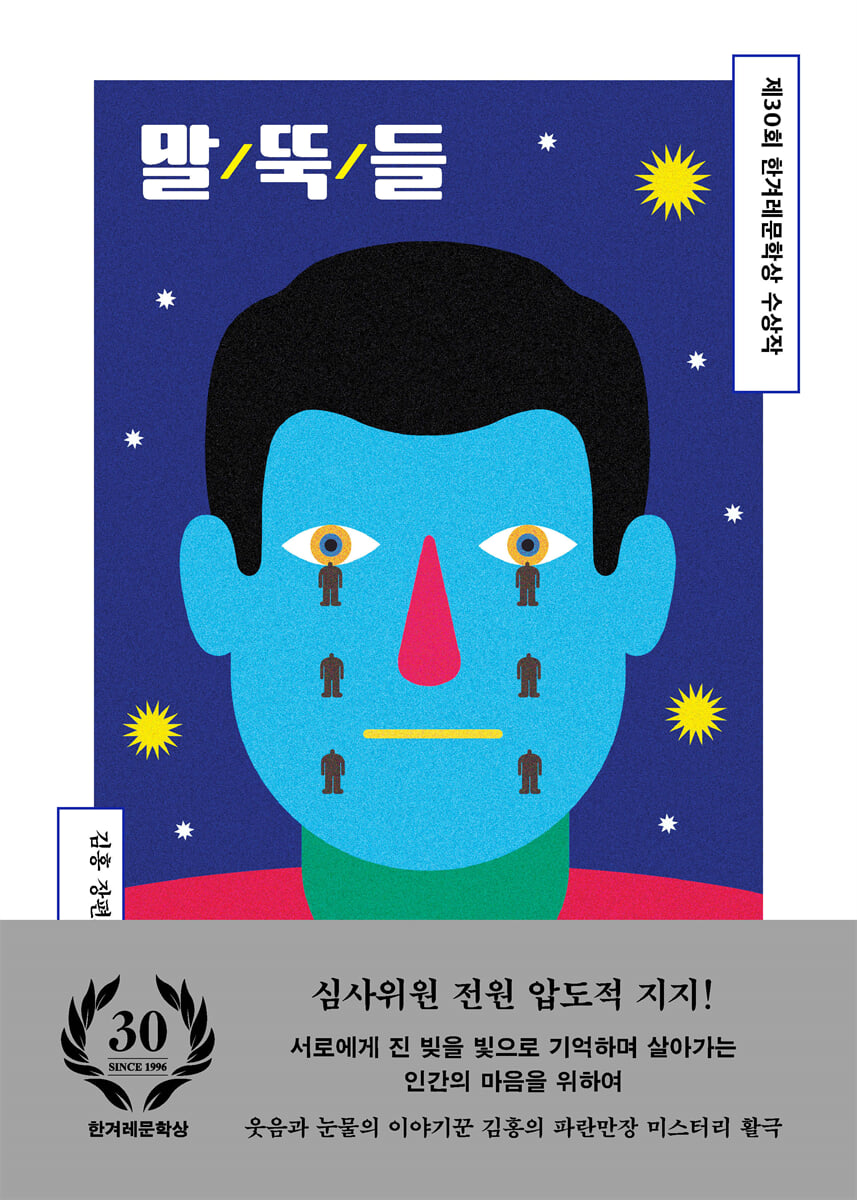
Winner of the 30th Hankyoreh Literary AwardWhat if one day the dead were "silverized" and raised like stakes in the city center? This novel explores this bizarre fantasy with a brisk pace and humor, capturing the face of the times.
Author Kim Hong, who has written his own black comedy novels, won the Hankyoreh Literary Award for this work, proving that literature is still a living form of ethics.
August 22, 2025. Novel/Poetry PD Kim Yu-ri
“From the sea to the city, from the city, a stake came before me.”
For the symbolic heart of human beings who live remembering the debts they owe to one another with light.
A thrilling mystery action film by Kim Hong, a storyteller of laughter and tears!
The Hankyoreh Literary Award, established in 1996 to promote the development and future of Korean literature, celebrates its 30th anniversary in 2025.
Meanwhile, the Hankyoreh Literary Award has established itself as the most credible full-length literary award for novels in Korea, discovering writers and works with outstanding abilities and individuality, such as Shim Yun-kyung's "My Beautiful Garden," Park Min-gyu's "The Last Fan Club of Sammi Superstars," Yoon Go-eun's "Zero Gravity Syndrome," Choi Jin-young's "The Name of the Girl Who Passed By You," Jang Kang-myeong's "Bleach," Lee Hyuk-jin's "The Lying Boat," Kang Hwa-gil's "Another Person," Park Seo-ryeon's "The Airship Girl Kang Ju-ryong," and Ha Seung-min's "Melanin."
The Hankyoreh Literary Award, which has long been loved by readers, is publishing its 30th award-winning work, “Stakes.”
The Hankyoreh Literary Award, which celebrated its 30th anniversary with an increased prize of 50 million won, selected Kim Hong's "Stakes" as this year's winner among a total of 349 entries, an increase of 110 from the previous year.
The eight judges cited “fun, straightforward writing, timeliness that reflects the martial law situation at a surprising pace, and narrative without preaching” as reasons for selecting the winning work.
The award received overwhelming support, praising the work as “a meaningful achievement that lives up to the 30-year trajectory of the Hankyoreh Literary Award and a work that revives the belief that literature is still a valid form of ethics,” as it “does not avoid the current political landscape and signs of crisis, but responds to them through literature.”
《Stakes》 begins with the bizarre premise that those who died unjustly, sadly, and lonely without a name are 'turned into corpses' and appear as 'stakes' all over the city.
“Focusing on the mystery of the emergence and disappearance of stakes, it offers a comprehensive view of 21st-century South Korea, encompassing everything from the corrupt politics and behavior of capital to the struggles of the common people, who must survive within that system, to the compassion and solidarity that ordinary people should possess.”
Literary critic Seo Young-in, who was in charge of judging the book, said that the most essential message conveyed by “Stakes” is “tears,” and that “the moment when the foreign worker who died from poisoning by toxic substances at a smelter, the delivery worker who crashed into India after not being able to sleep for four days, and the child who died after being hit by that delivery truck all appear as stakes, it becomes clear that these deaths are social deaths.” She praised the work as “tracing and reflecting on this social death and social sadness” and recorded it. Novelist Pyeon Hye-young said, “The ethics of mourning and solidarity that this novel touches on will come with a narrative vitality rarely seen in recent times and will plunge down into the reader like a solid stake.”
Novelist Kang Hwa-gil emphasized Kim Hong’s unique specialties as “sharply capturing and boldly depicting the point where the misfortune of the individual and the misfortune of the world meet,” while novelist Park Seo-ryeon emphasized “the destructive power of a long, sweeping novel that relentlessly shatters a person’s lifetime view of novels” and “a narrative that boldly rushes forward as if to redefine the relationship between the world we perceive and probability from the beginning.”
Novelist Shim Yun-kyung praised the novel for being “the will to overcome such wounds and helplessness that was finally put into print” in relation to the martial law regime we experienced just half a year ago, and novelist Jeong Ji-ah praised the novel for being “a novel that is so dizzying that it is entangled with mystery, politics, capital, class, and other grand discourses,” saying that it is so neat that it is simple and not distracting at all, and that it is a rare find that one can read an interesting work in one sitting.
Kim Hong, who began his career through the 2017 Dong-A Ilbo New Year's Literary Contest, has solidified his own literary world, shining with unique settings, eccentric imagination, and sharp insight into society, by publishing the full-length novels "Smoking Oreo," "Woof, Woof," and "Price King!!!."
“Stakes” is a work that the author worked on for about ten years after coming up with “Stakes of People Driven Upside Down” (Author’s Note, September 14, 2014) in 2014, before he even made his literary debut.
It stands out even more (judge Han Chang-hoon) in that it has achieved yet another evolution while maintaining its charms, such as a sharp sense of the times, unpredictable developments, and solid humor.
Having been active as a novelist for eight years, he won the Munhakdongne Novel Award in 2023 and has now won the Hankyoreh Literary Award for his fourth full-length novel, “Stakes,” so his future path is highly anticipated.
For the symbolic heart of human beings who live remembering the debts they owe to one another with light.
A thrilling mystery action film by Kim Hong, a storyteller of laughter and tears!
The Hankyoreh Literary Award, established in 1996 to promote the development and future of Korean literature, celebrates its 30th anniversary in 2025.
Meanwhile, the Hankyoreh Literary Award has established itself as the most credible full-length literary award for novels in Korea, discovering writers and works with outstanding abilities and individuality, such as Shim Yun-kyung's "My Beautiful Garden," Park Min-gyu's "The Last Fan Club of Sammi Superstars," Yoon Go-eun's "Zero Gravity Syndrome," Choi Jin-young's "The Name of the Girl Who Passed By You," Jang Kang-myeong's "Bleach," Lee Hyuk-jin's "The Lying Boat," Kang Hwa-gil's "Another Person," Park Seo-ryeon's "The Airship Girl Kang Ju-ryong," and Ha Seung-min's "Melanin."
The Hankyoreh Literary Award, which has long been loved by readers, is publishing its 30th award-winning work, “Stakes.”
The Hankyoreh Literary Award, which celebrated its 30th anniversary with an increased prize of 50 million won, selected Kim Hong's "Stakes" as this year's winner among a total of 349 entries, an increase of 110 from the previous year.
The eight judges cited “fun, straightforward writing, timeliness that reflects the martial law situation at a surprising pace, and narrative without preaching” as reasons for selecting the winning work.
The award received overwhelming support, praising the work as “a meaningful achievement that lives up to the 30-year trajectory of the Hankyoreh Literary Award and a work that revives the belief that literature is still a valid form of ethics,” as it “does not avoid the current political landscape and signs of crisis, but responds to them through literature.”
《Stakes》 begins with the bizarre premise that those who died unjustly, sadly, and lonely without a name are 'turned into corpses' and appear as 'stakes' all over the city.
“Focusing on the mystery of the emergence and disappearance of stakes, it offers a comprehensive view of 21st-century South Korea, encompassing everything from the corrupt politics and behavior of capital to the struggles of the common people, who must survive within that system, to the compassion and solidarity that ordinary people should possess.”
Literary critic Seo Young-in, who was in charge of judging the book, said that the most essential message conveyed by “Stakes” is “tears,” and that “the moment when the foreign worker who died from poisoning by toxic substances at a smelter, the delivery worker who crashed into India after not being able to sleep for four days, and the child who died after being hit by that delivery truck all appear as stakes, it becomes clear that these deaths are social deaths.” She praised the work as “tracing and reflecting on this social death and social sadness” and recorded it. Novelist Pyeon Hye-young said, “The ethics of mourning and solidarity that this novel touches on will come with a narrative vitality rarely seen in recent times and will plunge down into the reader like a solid stake.”
Novelist Kang Hwa-gil emphasized Kim Hong’s unique specialties as “sharply capturing and boldly depicting the point where the misfortune of the individual and the misfortune of the world meet,” while novelist Park Seo-ryeon emphasized “the destructive power of a long, sweeping novel that relentlessly shatters a person’s lifetime view of novels” and “a narrative that boldly rushes forward as if to redefine the relationship between the world we perceive and probability from the beginning.”
Novelist Shim Yun-kyung praised the novel for being “the will to overcome such wounds and helplessness that was finally put into print” in relation to the martial law regime we experienced just half a year ago, and novelist Jeong Ji-ah praised the novel for being “a novel that is so dizzying that it is entangled with mystery, politics, capital, class, and other grand discourses,” saying that it is so neat that it is simple and not distracting at all, and that it is a rare find that one can read an interesting work in one sitting.
Kim Hong, who began his career through the 2017 Dong-A Ilbo New Year's Literary Contest, has solidified his own literary world, shining with unique settings, eccentric imagination, and sharp insight into society, by publishing the full-length novels "Smoking Oreo," "Woof, Woof," and "Price King!!!."
“Stakes” is a work that the author worked on for about ten years after coming up with “Stakes of People Driven Upside Down” (Author’s Note, September 14, 2014) in 2014, before he even made his literary debut.
It stands out even more (judge Han Chang-hoon) in that it has achieved yet another evolution while maintaining its charms, such as a sharp sense of the times, unpredictable developments, and solid humor.
Having been active as a novelist for eight years, he won the Munhakdongne Novel Award in 2023 and has now won the Hankyoreh Literary Award for his fourth full-length novel, “Stakes,” so his future path is highly anticipated.
- You can preview some of the book's contents.
Preview
index
one
two
three
Author's Note
Recommendation
two
three
Author's Note
Recommendation
Detailed image

Into the book
The next news story was about piles that had washed up on the west coast.
He said it was unprecedented.
The long row of stakes, parts of which were exposed by the low tide, remained vivid in Jang's mind.
Who did you go to see the stakes with? The scene immediately came to mind, like a still cut.
As with many other good and beautiful memories, Haeju was by his side.
There was a legend written on the sign that the dead would go out to the distant sea and become stakes.
--- p.25
And… …everyone lies to everyone.
From very small to very large.
--- p.26
No one can hit me.
Because those who want to harm others must risk themselves.
The world is confident in itself, but it is more vulnerable than it thinks.
--- p.35
Jang suddenly realized that they were office workers no different from himself.
There may have been many similarities, except that they both involved crime as a profession.
Ordinary people who expect to get off work at 6 o'clock but often can't, frequently work outside the office, and are dissatisfied with their lives...
Just a little sadistic.
--- p.53
thank god.
Still, that's a relief.
Because I'm not dead.
Jang sat down and cried, drying himself with a towel.
--- p.64
The heads of the stakes were smooth and without a single hair, and their faces were smooth as if they had just washed their faces.
They had been buried upside down in the mud for a very long time.
The skin, which had never been in contact with air or seawater, was mummified without any signs of decay.
While reading the article, I learned that this condition is called 'shiraphwa'.
Except for the dark complexion and the overall puffiness of his face, he looked like someone who had just fallen asleep with his eyes closed.
Because their eyes were closed and they had no distinct expressions, they all looked like one person's face.
Or it wouldn't be strange if it were everyone's face.
--- p.84
Jang needed that too.
I knew that I had to do that much to be on par with others.
It was even more desperate because I had fallen to the bottom.
Even though it was impossible for a bastard to become a nobleman, he had to run like a dog to at least serve as a servant in a nobleman's household.
--- p.89
Jang was also stingy when it came to other people's difficulties.
I felt like I knew why the world was going wrong with each passing day.
--- p.92
“Hey, what’s wrong with you?
are you okay?"
“It’s not okay.”
I couldn't remember when it was okay.
It seemed like the world was being particularly harsh on Jang.
Even if I think about it calmly, it really was like that.
--- p.121
What kind of disaster is it when the dead return as stakes? I was very curious about the position of the Seoul Metropolitan Government, which sent the text.
--- p.131
The stakes appeared in a way that seemed to appear out of nowhere.
It always came suddenly, whether it was when they first washed up on the beach, when they gathered together in the county gymnasium and then disappeared, or when they stood in the squares of major cities across the country.
No one has ever witnessed a stake move under its own power.
So it raised questions.
Opinions were divided as to where the ability to manifest them came from.
--- p.135
A blurry photo of the stakes and people moving busily around the wall and air dome that obscures the stakes.
The scenery in other cities, other than Gwanghwamun, was not much different.
--- p.143
Jang considered the possibility that his misfortune was connected to the world.
The appearance of unprecedented beings felt like a harbinger of greater misfortune.
The situation was so precarious that there was no need to be overconfident or show off one's misfortune, and it was becoming equally unstable.
It was so trivial to ask why everything that happened to me was happening to me.
--- p.143
If you think about it, the soul is definitely a representative overvalued asset.
It was the first step toward creative accounting.
--- p.157
A stake appeared in the lobby.
There is a pile standing in the middle of the first floor of the building.
From the sea to the city, from the city, a stake came before me.
--- p.158
The stakes did not appear in just one place.
It was a situation where people were getting closer one step at a time.
From the sea to the beach, from the beach to the city, from the city to you.
--- p.168
“Not everything in this world happens for a reason.
Some things are just accidents.
Everything in this world can happen or it can't happen.
I wonder why you think that something like that shouldn't happen to Jean in particular."
--- p.184
“I thought that somewhere out there, there must be someone crying like us right now.”
--- p.187
The collectors, who had hesitated for a moment, took off their masks one by one.
They greeted each other awkwardly, as if seeing each other for the first time.
I looked at the stakes I was trying to carry in my body bag and wiped my eyes one by one.
So, among the people who came out to the square, there was not a single one who did not cry.
--- p.210
Everyone was telling their stories as if they had been waiting for it.
I wrote about a memorable death that I remember.
It was clear to all of them that the unforgettable death had returned in the form of a stake.
Each of them sent a certified letter and uploaded a screenshot.
I wrote and filed an application for an injunction and also wrote a petition to submit to the court.
The records of nameless stakes were piling up.
--- p.247
Accidents, minor accidents, major accidents, accidents for which measures have been taken and the outcome has not been confirmed to the end.
And the names kept coming up.
There were too many names.
It was realistic to see that there was no way to pinpoint the name Jang was looking for.
The pain was so immense and unclear.
It took a long time to verify the truth buried beneath the documents.
--- p.258
“Temelin.”
Nothing changed.
One more time.
“Temelin, we must go back now.
“I will remember you.”
--- p.278
Temelin, you're going to go all the way without paying me back.
Take care.
Don't pay my debt and keep holding on to it.
Don't be sad, I'll always remember you for that.
The truth that big debt makes big riches always holds true.
But our debt is different from theirs.
He who owes nothing to anyone is poor in heart.
There are people who write down the feelings they have given to each other in a notebook so that they do not forget, and live their entire lives remembering that debt.
This will convince the world someday.
He said it was unprecedented.
The long row of stakes, parts of which were exposed by the low tide, remained vivid in Jang's mind.
Who did you go to see the stakes with? The scene immediately came to mind, like a still cut.
As with many other good and beautiful memories, Haeju was by his side.
There was a legend written on the sign that the dead would go out to the distant sea and become stakes.
--- p.25
And… …everyone lies to everyone.
From very small to very large.
--- p.26
No one can hit me.
Because those who want to harm others must risk themselves.
The world is confident in itself, but it is more vulnerable than it thinks.
--- p.35
Jang suddenly realized that they were office workers no different from himself.
There may have been many similarities, except that they both involved crime as a profession.
Ordinary people who expect to get off work at 6 o'clock but often can't, frequently work outside the office, and are dissatisfied with their lives...
Just a little sadistic.
--- p.53
thank god.
Still, that's a relief.
Because I'm not dead.
Jang sat down and cried, drying himself with a towel.
--- p.64
The heads of the stakes were smooth and without a single hair, and their faces were smooth as if they had just washed their faces.
They had been buried upside down in the mud for a very long time.
The skin, which had never been in contact with air or seawater, was mummified without any signs of decay.
While reading the article, I learned that this condition is called 'shiraphwa'.
Except for the dark complexion and the overall puffiness of his face, he looked like someone who had just fallen asleep with his eyes closed.
Because their eyes were closed and they had no distinct expressions, they all looked like one person's face.
Or it wouldn't be strange if it were everyone's face.
--- p.84
Jang needed that too.
I knew that I had to do that much to be on par with others.
It was even more desperate because I had fallen to the bottom.
Even though it was impossible for a bastard to become a nobleman, he had to run like a dog to at least serve as a servant in a nobleman's household.
--- p.89
Jang was also stingy when it came to other people's difficulties.
I felt like I knew why the world was going wrong with each passing day.
--- p.92
“Hey, what’s wrong with you?
are you okay?"
“It’s not okay.”
I couldn't remember when it was okay.
It seemed like the world was being particularly harsh on Jang.
Even if I think about it calmly, it really was like that.
--- p.121
What kind of disaster is it when the dead return as stakes? I was very curious about the position of the Seoul Metropolitan Government, which sent the text.
--- p.131
The stakes appeared in a way that seemed to appear out of nowhere.
It always came suddenly, whether it was when they first washed up on the beach, when they gathered together in the county gymnasium and then disappeared, or when they stood in the squares of major cities across the country.
No one has ever witnessed a stake move under its own power.
So it raised questions.
Opinions were divided as to where the ability to manifest them came from.
--- p.135
A blurry photo of the stakes and people moving busily around the wall and air dome that obscures the stakes.
The scenery in other cities, other than Gwanghwamun, was not much different.
--- p.143
Jang considered the possibility that his misfortune was connected to the world.
The appearance of unprecedented beings felt like a harbinger of greater misfortune.
The situation was so precarious that there was no need to be overconfident or show off one's misfortune, and it was becoming equally unstable.
It was so trivial to ask why everything that happened to me was happening to me.
--- p.143
If you think about it, the soul is definitely a representative overvalued asset.
It was the first step toward creative accounting.
--- p.157
A stake appeared in the lobby.
There is a pile standing in the middle of the first floor of the building.
From the sea to the city, from the city, a stake came before me.
--- p.158
The stakes did not appear in just one place.
It was a situation where people were getting closer one step at a time.
From the sea to the beach, from the beach to the city, from the city to you.
--- p.168
“Not everything in this world happens for a reason.
Some things are just accidents.
Everything in this world can happen or it can't happen.
I wonder why you think that something like that shouldn't happen to Jean in particular."
--- p.184
“I thought that somewhere out there, there must be someone crying like us right now.”
--- p.187
The collectors, who had hesitated for a moment, took off their masks one by one.
They greeted each other awkwardly, as if seeing each other for the first time.
I looked at the stakes I was trying to carry in my body bag and wiped my eyes one by one.
So, among the people who came out to the square, there was not a single one who did not cry.
--- p.210
Everyone was telling their stories as if they had been waiting for it.
I wrote about a memorable death that I remember.
It was clear to all of them that the unforgettable death had returned in the form of a stake.
Each of them sent a certified letter and uploaded a screenshot.
I wrote and filed an application for an injunction and also wrote a petition to submit to the court.
The records of nameless stakes were piling up.
--- p.247
Accidents, minor accidents, major accidents, accidents for which measures have been taken and the outcome has not been confirmed to the end.
And the names kept coming up.
There were too many names.
It was realistic to see that there was no way to pinpoint the name Jang was looking for.
The pain was so immense and unclear.
It took a long time to verify the truth buried beneath the documents.
--- p.258
“Temelin.”
Nothing changed.
One more time.
“Temelin, we must go back now.
“I will remember you.”
--- p.278
Temelin, you're going to go all the way without paying me back.
Take care.
Don't pay my debt and keep holding on to it.
Don't be sad, I'll always remember you for that.
The truth that big debt makes big riches always holds true.
But our debt is different from theirs.
He who owes nothing to anyone is poor in heart.
There are people who write down the feelings they have given to each other in a notebook so that they do not forget, and live their entire lives remembering that debt.
This will convince the world someday.
--- pp.279-280
Publisher's Review
“I will remember you”
The struggles of the common people amidst the world's incomprehensibility
A story of compassion, solidarity, and mourning for others
Stakes that are said to be the remains of the dead who were driven upside down into the sea.
One day, piles wash up on the beach, and a bank loan officer, Jang, gets caught up in a strange incident where he is locked in a trunk without knowing what happened.
Good things don't happen to Jang, such as breaking off the engagement with his lover who was preparing for marriage and falling out of favor with the head of the bank.
Although he is a self-deprecating jerk who calls himself a bastard within the strict rules of the class, he is still waiting for a chance to redeem himself.
Contrary to the prevailing winds of hope, no one stands on his side as bad news continues to strike, and misfortunes that are too much for him to handle on his own weigh on him day by day.
The police are cynical towards the victim, Jang, and the bank also presses Jang with unexpected events.
Just when he thought everything had turned its back on him, he heard the news of the death of his old close friend, Taei.
After receiving Tae-yi's remains, Jang reflects on a long-standing misunderstanding with his friend.
Meanwhile, the piles that have come up on land are causing serious social unrest, but the government is not doing its job properly.
What are the stakes? What are they for, coming ashore to do, and what do they demand of people? Standing before them, people shed inexplicable tears, and collectors in white protective suits carry away the stakes.
Stakes that reappear even after being removed.
Stakes that keep coming from the sea to the land, from the land to the city, and from the city to you.
For some, it is perceived as anxiety, for others, as a serious threat.
But, among the piles' pasts that are gradually being revealed, there is something that Jang did a dozen years ago that is implicated.
Hostility and appeasement pour in like a cross between, and strange things happen one after another to the point where it is now difficult to know who to trust.
Will Jang be able to overcome the misfortunes that befell him and live a full life? Can society, encountering the unknown Other, overcome its fear and anxiety and create a true community?
《Stakes》 begins with the unbelievable misfortune that befell Jang, “an ordinary person who expects to get off work at 6 o’clock but often can’t, frequently works outside the office, and is dissatisfied with his life,” and calls out the aspects of social death that we have easily erased in the new class society ruled by capitalism, packaged as convenience and rationality, through the name “stakes.”
From the sea to the city, from the city to me, as the stakes advance, we shed tears without knowing it.
The eyes are sharp as they criticize the human, corporate, and government systems that are in chaos right before our eyes due to the presence of tear gas.
The author's sharp critical awareness and novelistic fun that embraces the unreal and the real come to life in his unique rhythmic writing style.
He who owes nothing to anyone is poor in heart.
There are people who write down the feelings they have given to each other in a notebook so that they do not forget, and live their entire lives remembering that debt.
With this, I will convince the world someday._From the text
The Hankyoreh Literary Award: 30 Years of Korean Literature
A quirky piece that captivates with mystery, pathos, and humor.
With Korean writers becoming the first Koreans to sweep the world's most prestigious literary awards, and with interest in Korean literature at home and abroad at a fever pitch, the Hankyoreh Literary Award, celebrating its 30th anniversary, has a special commitment.
As a work that concludes thirty years of promoting the vitality and future of Korean literature, “Stakes” is also deeply meaningful.
The Hankyoreh Literary Award seeks to go one step further with the novel "Stakes," which has acquired a solid literary mark through its originality, a story that is persuasive through mystery, pathos, and humor, and a thematic consciousness that penetrates the problems of Korean society that has achieved rapid compressed growth.
We will continue to solidify new territories for Korean literature by discovering stories of 'us here and now' with boundless imagination.
Author's Note
There are 220 notes in the folder just for this novel.
“Don’t try your luck here.”
This was written on October 7, 2017.
Although the sentences were not written verbatim, I was worried about some of the decisions in the chapter and repeated them over and over again.
“He’s smart, but he’s stupid.”
Written on February 8, 2021.
I copied it when talking about Taei.
“You, read Hegel’s work for a hundred days.
Wisdom becomes a hundredfold.”
Written on September 10, 2019.
I don't know what you mean.
Why did you write it?
The oldest record is from September 14, 2014.
“The stakes of people who are upside down.”
Although it didn't make it into a sentence for the novel, I'll copy one more so that I can remember it.
“The stake protects you.
“It’s not you who’s protecting it.”
February 26, 2025.
The struggles of the common people amidst the world's incomprehensibility
A story of compassion, solidarity, and mourning for others
Stakes that are said to be the remains of the dead who were driven upside down into the sea.
One day, piles wash up on the beach, and a bank loan officer, Jang, gets caught up in a strange incident where he is locked in a trunk without knowing what happened.
Good things don't happen to Jang, such as breaking off the engagement with his lover who was preparing for marriage and falling out of favor with the head of the bank.
Although he is a self-deprecating jerk who calls himself a bastard within the strict rules of the class, he is still waiting for a chance to redeem himself.
Contrary to the prevailing winds of hope, no one stands on his side as bad news continues to strike, and misfortunes that are too much for him to handle on his own weigh on him day by day.
The police are cynical towards the victim, Jang, and the bank also presses Jang with unexpected events.
Just when he thought everything had turned its back on him, he heard the news of the death of his old close friend, Taei.
After receiving Tae-yi's remains, Jang reflects on a long-standing misunderstanding with his friend.
Meanwhile, the piles that have come up on land are causing serious social unrest, but the government is not doing its job properly.
What are the stakes? What are they for, coming ashore to do, and what do they demand of people? Standing before them, people shed inexplicable tears, and collectors in white protective suits carry away the stakes.
Stakes that reappear even after being removed.
Stakes that keep coming from the sea to the land, from the land to the city, and from the city to you.
For some, it is perceived as anxiety, for others, as a serious threat.
But, among the piles' pasts that are gradually being revealed, there is something that Jang did a dozen years ago that is implicated.
Hostility and appeasement pour in like a cross between, and strange things happen one after another to the point where it is now difficult to know who to trust.
Will Jang be able to overcome the misfortunes that befell him and live a full life? Can society, encountering the unknown Other, overcome its fear and anxiety and create a true community?
《Stakes》 begins with the unbelievable misfortune that befell Jang, “an ordinary person who expects to get off work at 6 o’clock but often can’t, frequently works outside the office, and is dissatisfied with his life,” and calls out the aspects of social death that we have easily erased in the new class society ruled by capitalism, packaged as convenience and rationality, through the name “stakes.”
From the sea to the city, from the city to me, as the stakes advance, we shed tears without knowing it.
The eyes are sharp as they criticize the human, corporate, and government systems that are in chaos right before our eyes due to the presence of tear gas.
The author's sharp critical awareness and novelistic fun that embraces the unreal and the real come to life in his unique rhythmic writing style.
He who owes nothing to anyone is poor in heart.
There are people who write down the feelings they have given to each other in a notebook so that they do not forget, and live their entire lives remembering that debt.
With this, I will convince the world someday._From the text
The Hankyoreh Literary Award: 30 Years of Korean Literature
A quirky piece that captivates with mystery, pathos, and humor.
With Korean writers becoming the first Koreans to sweep the world's most prestigious literary awards, and with interest in Korean literature at home and abroad at a fever pitch, the Hankyoreh Literary Award, celebrating its 30th anniversary, has a special commitment.
As a work that concludes thirty years of promoting the vitality and future of Korean literature, “Stakes” is also deeply meaningful.
The Hankyoreh Literary Award seeks to go one step further with the novel "Stakes," which has acquired a solid literary mark through its originality, a story that is persuasive through mystery, pathos, and humor, and a thematic consciousness that penetrates the problems of Korean society that has achieved rapid compressed growth.
We will continue to solidify new territories for Korean literature by discovering stories of 'us here and now' with boundless imagination.
Author's Note
There are 220 notes in the folder just for this novel.
“Don’t try your luck here.”
This was written on October 7, 2017.
Although the sentences were not written verbatim, I was worried about some of the decisions in the chapter and repeated them over and over again.
“He’s smart, but he’s stupid.”
Written on February 8, 2021.
I copied it when talking about Taei.
“You, read Hegel’s work for a hundred days.
Wisdom becomes a hundredfold.”
Written on September 10, 2019.
I don't know what you mean.
Why did you write it?
The oldest record is from September 14, 2014.
“The stakes of people who are upside down.”
Although it didn't make it into a sentence for the novel, I'll copy one more so that I can remember it.
“The stake protects you.
“It’s not you who’s protecting it.”
February 26, 2025.
GOODS SPECIFICS
- Date of issue: August 30, 2025
- Page count, weight, size: 312 pages | 152*210*14mm
- ISBN13: 9791172133061
You may also like
카테고리
korean


korean

![GQ KOREA Mark (Monthly): December [2025]](http://librairie.coreenne.fr/cdn/shop/files/8ef265dbbfbf186523ed75ba7319009d.jpg?v=1765340328&width=3840)


