

The Sinking Francis
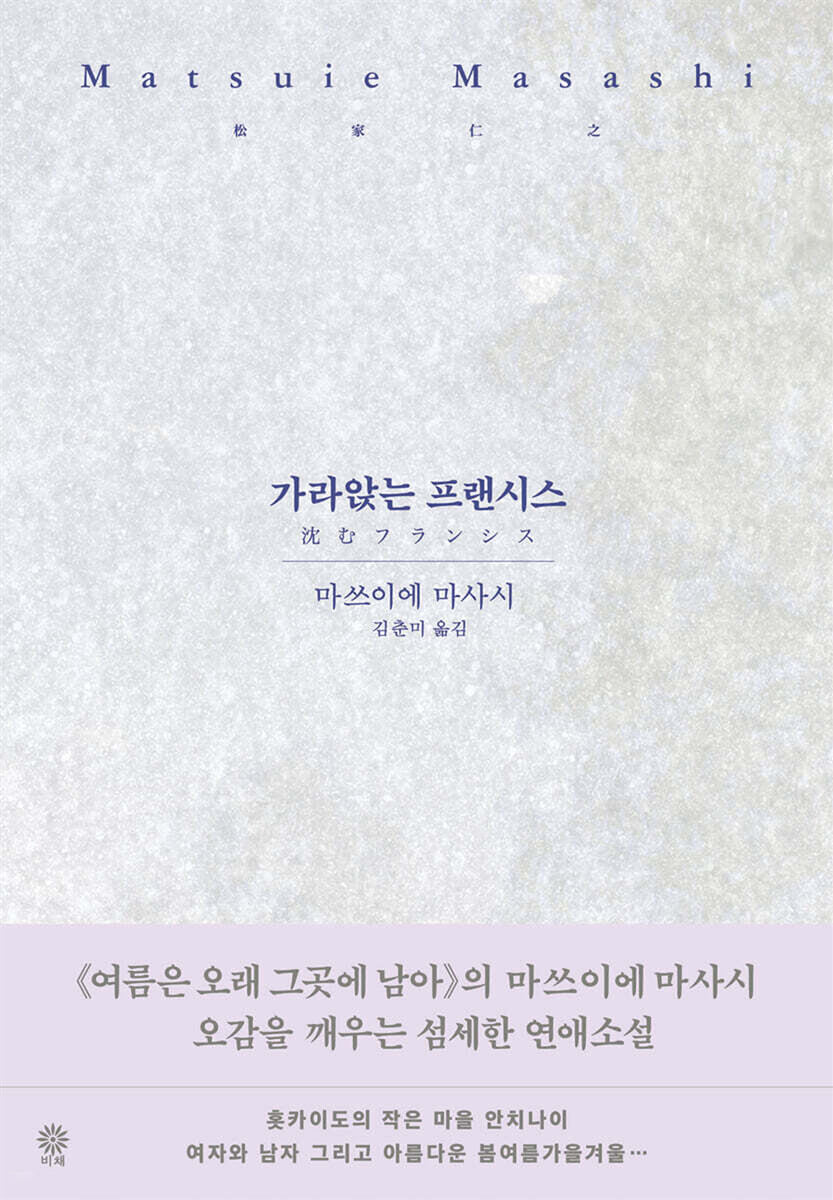 |
Description
Book Introduction
Masashi Matsui of "Summer Remains There for a Long Time"
A delicate romance novel that awakens the five senses
“If the five senses of man developed out of necessity,
Conversely, if you don't write it down, you might lose it.
I wanted to capture and express the vivid senses of life through language.
The time when the five senses are most delicately alive
I thought it might be a moment of love
“I started writing romance novels.” _Masashi Matsui┃From an interview commemorating the publication
In 2012, Masashi Matsui made a brilliant debut in the Japanese literary world with his outstanding debut work, “Summer Remains There for a Long Time.”
Her second novel, The Sinking Francis, published the following year, is a work that meticulously explores the inexplicable bond of love shared between a man and a woman who meet by chance in a small town in Hokkaido.
The scenery of nature, which sometimes cheers and sometimes watches with rage as people live, love, and suffer, unfolds with a refined touch.
Snow fluttering in the wind, water flowing beneath the frozen ground, the wind caressing the wheat fields, the feel of the wood inside a wooden house, the fresh air and the smell of sunlight… … Set in Hokkaido, a land that preserves its ancient memories, this story depicts a romantic relationship between adults that pleasantly awakens all of the senses.
The world of author Masashi Matsuie is fully imbued with the politeness and praise for nature of "Summer Remains There for a Long Time," the recovery of everyday life and space of "I Don't Know Whether It's Elegant," and the affectionate contemplation and awe for time of "We All Return Home."
A delicate romance novel that awakens the five senses
“If the five senses of man developed out of necessity,
Conversely, if you don't write it down, you might lose it.
I wanted to capture and express the vivid senses of life through language.
The time when the five senses are most delicately alive
I thought it might be a moment of love
“I started writing romance novels.” _Masashi Matsui┃From an interview commemorating the publication
In 2012, Masashi Matsui made a brilliant debut in the Japanese literary world with his outstanding debut work, “Summer Remains There for a Long Time.”
Her second novel, The Sinking Francis, published the following year, is a work that meticulously explores the inexplicable bond of love shared between a man and a woman who meet by chance in a small town in Hokkaido.
The scenery of nature, which sometimes cheers and sometimes watches with rage as people live, love, and suffer, unfolds with a refined touch.
Snow fluttering in the wind, water flowing beneath the frozen ground, the wind caressing the wheat fields, the feel of the wood inside a wooden house, the fresh air and the smell of sunlight… … Set in Hokkaido, a land that preserves its ancient memories, this story depicts a romantic relationship between adults that pleasantly awakens all of the senses.
The world of author Masashi Matsuie is fully imbued with the politeness and praise for nature of "Summer Remains There for a Long Time," the recovery of everyday life and space of "I Don't Know Whether It's Elegant," and the affectionate contemplation and awe for time of "We All Return Home."
- You can preview some of the book's contents.
Preview
Detailed image

Into the book
“Whatever has a form will eventually disappear, but what has disappeared will remain forever by losing its form.
That's what it looks like to me.
A lot has flowed to get here.
A bear cub that lost its parents, a fox drawn by the scent of food, even the Ainu people who came to live here in ancient times were actually headed somewhere else.
But you can fish in the river, catch animals, and there are plenty of fruits from the trees.
The mainlanders who reclaimed this area and gave it the Chinese character Anchinai did not actually come here with this as their purpose.
I was thinking of using it as a transit point, but at some point I ended up settling down and living there.
Here, it is not a destination for anyone.
“Since time immemorial.”
Minorikawa laughed softly.
“But what about that? The truth is, everyone just goes with the flow.
People are standing in a place that has been reached at some point as if something is carrying them.
Like seeds carried by the wind, wherever you are, it is like a travel destination.
“Because it’s a tourist destination, people connect easily.”
--- pp.101-102
Whether it was food or drinks, Kazuhiko's creations were solemn and without any omissions.
It seemed as if within Kazuhiko, there was a net-like sequence, an unerring scale, and a guideline that always pointed in the same direction, invisible to Geiko.
It was a simple connection between the comfort of being together and the anxiety of what would happen if we left or tried to leave.
--- p.122
The snow that fell on Geiko's glove, without any guidance, happened to be stared at for such a long time, but most crystals are not seen by anyone.
The path ahead for this irreversible journey that has suddenly begun is uncertain.
But there is not a single piece of snow that does not land permanently.
The only thing that is clear is that fact.
It makes my body cold to the core.
The white of snow is already spreading around.
The snow was piling up evenly, deliberately, and silently, as if in a hurry to hide something.
--- p.125
Geiko thought that it was all just stories that seemed like they were drawn in a picture or heard somewhere.
However, people may be troubled by such common stories, and because they are common stories, they may not be able to easily escape from them.
Geiko thought about the quiet time that had piled up inside Kazuhiko, whom she had been holding alone for a long time.
That's what it looks like to me.
A lot has flowed to get here.
A bear cub that lost its parents, a fox drawn by the scent of food, even the Ainu people who came to live here in ancient times were actually headed somewhere else.
But you can fish in the river, catch animals, and there are plenty of fruits from the trees.
The mainlanders who reclaimed this area and gave it the Chinese character Anchinai did not actually come here with this as their purpose.
I was thinking of using it as a transit point, but at some point I ended up settling down and living there.
Here, it is not a destination for anyone.
“Since time immemorial.”
Minorikawa laughed softly.
“But what about that? The truth is, everyone just goes with the flow.
People are standing in a place that has been reached at some point as if something is carrying them.
Like seeds carried by the wind, wherever you are, it is like a travel destination.
“Because it’s a tourist destination, people connect easily.”
--- pp.101-102
Whether it was food or drinks, Kazuhiko's creations were solemn and without any omissions.
It seemed as if within Kazuhiko, there was a net-like sequence, an unerring scale, and a guideline that always pointed in the same direction, invisible to Geiko.
It was a simple connection between the comfort of being together and the anxiety of what would happen if we left or tried to leave.
--- p.122
The snow that fell on Geiko's glove, without any guidance, happened to be stared at for such a long time, but most crystals are not seen by anyone.
The path ahead for this irreversible journey that has suddenly begun is uncertain.
But there is not a single piece of snow that does not land permanently.
The only thing that is clear is that fact.
It makes my body cold to the core.
The white of snow is already spreading around.
The snow was piling up evenly, deliberately, and silently, as if in a hurry to hide something.
--- p.125
Geiko thought that it was all just stories that seemed like they were drawn in a picture or heard somewhere.
However, people may be troubled by such common stories, and because they are common stories, they may not be able to easily escape from them.
Geiko thought about the quiet time that had piled up inside Kazuhiko, whom she had been holding alone for a long time.
--- p.174
Publisher's Review
Anchinai, a small town in Hokkaido
Women and men and beautiful spring, summer, fall, and winter…
Adult romance is like a short, deep nap
The novel opens with a scene of something resembling a corpse floating in the river.
If this were the beginning, the police or detectives would appear, questioning witnesses and solving mysteries, but "The Sinking Francis" resolutely avoids the path of a crime investigation and immediately switches scenes.
In the parking lot behind the post office, the protagonist, Geiko, gets into a red delivery truck to collect the mail to be delivered today.
He worked at a general trading company in Tokyo, but a few months ago he packed up everything and came to a small town in Hokkaido.
Why would a woman in her mid-thirties come to the countryside alone? Why would she take on a part-time job as a mail deliveryman? It's no wonder the eyes of the rural village were on her.
But the unfamiliar and uncomfortable times soon fade, and Geiko gradually seeps into the village.
Then one day, Geiko meets Kazuhiko, who lives in a wooden house by the river.
He lives with the mysterious being 'Francis' and is an audiophile who collects all kinds of sounds from around the world.
Unlike Geiko, who hesitates, Kazuhiko approaches without hesitation, and the two become lovers.
As their love begins, Geiko becomes more and more curious about him.
The roar of collapsing glaciers in Alaska, the whistle of a steam locomotive outside London, the roar of a crowd at a South American festival—the sounds of the world come alive in his collection, but his own voice remains unheard.
A subtle distance and lingering secrets.
And then one night, the lights go out throughout the town and complete darkness falls.
A delicate sensibility that captures the breath of nature and humanity
The literary world of Masashi Matsui, woven with splendid scenery.
"The Sinking Francis" is a romantic novel about a man and a woman in their thirties who meet by chance and experience excitement, love, and suffering.
Every corner of the landscape contains Masashi Matsui's deep interest and themes that continue in "Summer Remains There for a Long Time," such as a deep understanding of space, a longing for a rich life with taste, awe for nature that has endured eons, and respect for adults who have accumulated wisdom layer by layer.
Additionally, as a spatial background, it connects with "We All Go Home," which is set in the fictional city of Edaru in Hokkaido, so fans who continue to explore the author's world will find the reading experience even more enjoyable.
Bichae will continue to showcase Matsui's literature, which holds a unique position in the Japanese contemporary literary world, including the coming-of-age novel "Foam" and the prequel to "Summer Remains There for a Long Time," tentatively titled "Where Even Angels Cannot Tread."
Introduction of main characters (※Contains spoilers)
-Muyo Keiko:
At the age of thirty-five, I broke up with my boyfriend and quit my job at a general trading company in Tokyo where I had worked for thirteen years.
He moves to Anchinai, a small mountain village in Hokkaido, and begins his second life as a part-time postal worker.
-Kazuhiko Teratomino:
A thirty-eight-year-old man living in a single-story house by the river.
Audiophile.
He lives a leisurely life managing a small hydroelectric power plant.
Drive a white Jeep Cherokee.
-Kiichiro Watanabe:
Anchinai Post Office Director.
When he realizes that Geiko cannot continue working as a postman for a fraction of the salary of a Tokyo company, he sets out to find a marriage partner for Geiko.
-Minorikawa:
An elderly woman living in the northeastern end of Saribe District, which is usually a delivery stop.
As he is blind, he asks Geiko to read his mail for him.
-Tachiki:
A gas station attendant and a source of local gossip.
Women and men and beautiful spring, summer, fall, and winter…
Adult romance is like a short, deep nap
The novel opens with a scene of something resembling a corpse floating in the river.
If this were the beginning, the police or detectives would appear, questioning witnesses and solving mysteries, but "The Sinking Francis" resolutely avoids the path of a crime investigation and immediately switches scenes.
In the parking lot behind the post office, the protagonist, Geiko, gets into a red delivery truck to collect the mail to be delivered today.
He worked at a general trading company in Tokyo, but a few months ago he packed up everything and came to a small town in Hokkaido.
Why would a woman in her mid-thirties come to the countryside alone? Why would she take on a part-time job as a mail deliveryman? It's no wonder the eyes of the rural village were on her.
But the unfamiliar and uncomfortable times soon fade, and Geiko gradually seeps into the village.
Then one day, Geiko meets Kazuhiko, who lives in a wooden house by the river.
He lives with the mysterious being 'Francis' and is an audiophile who collects all kinds of sounds from around the world.
Unlike Geiko, who hesitates, Kazuhiko approaches without hesitation, and the two become lovers.
As their love begins, Geiko becomes more and more curious about him.
The roar of collapsing glaciers in Alaska, the whistle of a steam locomotive outside London, the roar of a crowd at a South American festival—the sounds of the world come alive in his collection, but his own voice remains unheard.
A subtle distance and lingering secrets.
And then one night, the lights go out throughout the town and complete darkness falls.
A delicate sensibility that captures the breath of nature and humanity
The literary world of Masashi Matsui, woven with splendid scenery.
"The Sinking Francis" is a romantic novel about a man and a woman in their thirties who meet by chance and experience excitement, love, and suffering.
Every corner of the landscape contains Masashi Matsui's deep interest and themes that continue in "Summer Remains There for a Long Time," such as a deep understanding of space, a longing for a rich life with taste, awe for nature that has endured eons, and respect for adults who have accumulated wisdom layer by layer.
Additionally, as a spatial background, it connects with "We All Go Home," which is set in the fictional city of Edaru in Hokkaido, so fans who continue to explore the author's world will find the reading experience even more enjoyable.
Bichae will continue to showcase Matsui's literature, which holds a unique position in the Japanese contemporary literary world, including the coming-of-age novel "Foam" and the prequel to "Summer Remains There for a Long Time," tentatively titled "Where Even Angels Cannot Tread."
Introduction of main characters (※Contains spoilers)
-Muyo Keiko:
At the age of thirty-five, I broke up with my boyfriend and quit my job at a general trading company in Tokyo where I had worked for thirteen years.
He moves to Anchinai, a small mountain village in Hokkaido, and begins his second life as a part-time postal worker.
-Kazuhiko Teratomino:
A thirty-eight-year-old man living in a single-story house by the river.
Audiophile.
He lives a leisurely life managing a small hydroelectric power plant.
Drive a white Jeep Cherokee.
-Kiichiro Watanabe:
Anchinai Post Office Director.
When he realizes that Geiko cannot continue working as a postman for a fraction of the salary of a Tokyo company, he sets out to find a marriage partner for Geiko.
-Minorikawa:
An elderly woman living in the northeastern end of Saribe District, which is usually a delivery stop.
As he is blind, he asks Geiko to read his mail for him.
-Tachiki:
A gas station attendant and a source of local gossip.
GOODS SPECIFICS
- Date of issue: August 25, 2025
- Page count, weight, size: 192 pages | 252g | 137*197*20mm
- ISBN13: 9791173322440
- ISBN10: 1173322442
You may also like
카테고리
korean


korean

![GQ KOREA Mark (Monthly): December [2025]](http://librairie.coreenne.fr/cdn/shop/files/8ef265dbbfbf186523ed75ba7319009d.jpg?v=1765340328&width=3840)


