

The Rules of Money
 |
Description
Book Introduction
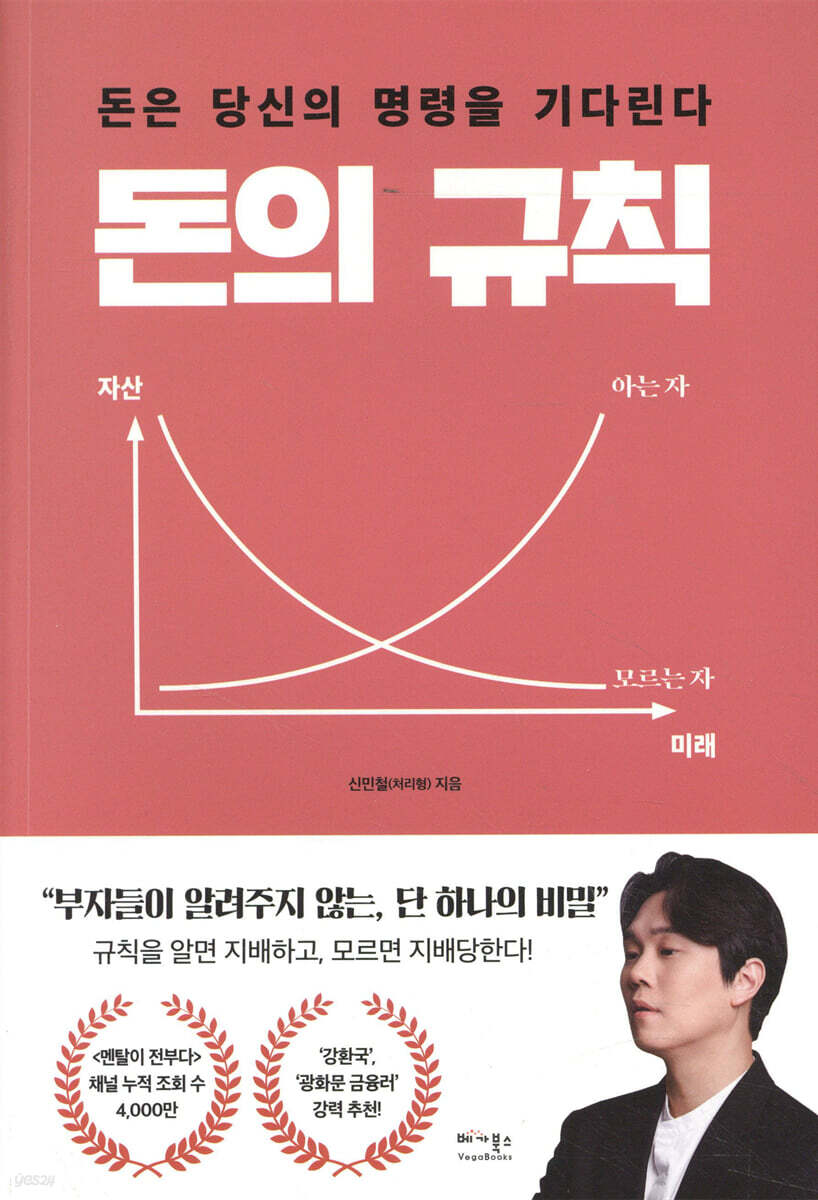
“The first book of the ‘processing type’ [Mental is everything], written over 13 years and 10,000 hours!” Even if you play one game, you need rules! The investment classic that captivated the eyes and ears of 150,000 people. How Investment Master "Cheol-Hyung" Uses 100x Leverage The value of the currency is falling, Soaring prices, Only those who know the 'rules' of this world can achieve wealth! Money has evolved steadily over time, taking different forms over time. When we think of money, we usually think of currency units like 100,000 won or 1 million won, but this thinking is not much different from that of ancient Europeans who believed that 'the Earth is square and that at the end of it there would be an infinite waterfall falling down.' We are so obsessed with concepts expressed in numbers that we fail to realize the true value and meaning that exists beyond them. Things that replaced money, like salt, seashells, and glass beads, have appeared and disappeared, but despite the long history and countless forms, money's most important meaning has always been the same. The ability to exchange what I want Yes, that's right. It is ‘purchasing power’. This book delves into the essence of money's "purchasing power," and covers the basic concepts, methods, and detailed rules of how to accumulate it, how to use it, how to manage it, and how to store it. 'Handling' defines this as '5 rules that govern money' and explains it in detail with various pictures, indicators, and examples. In particular, the magic of compound interest, leverage, debt ratio, and average price, which were easily accessible but not properly utilized, can also be said to be the unique benefits of this book. Everyone has different circumstances and environments, such as short-term investors, long-term investors, and differences in capital. The 'processing type' presents 'situation-specific coping methods' that take into account the individual's various circumstances and levels, and grants the individual the ability to 'handle' them. From the easy-to-overlook "finding good assets," to the more challenging psychological issues like "sunk costs" and "behavioral bias errors," it helps you deeply ingrain the mindset of a true investor. The belief and determination of the 'processing type' to grant 'economic freedom' to everyone, whether they are starting to invest, currently investing, or stopping investing, are evident. |
- You can preview some of the book's contents.
Preview
index
[Chapter 1] Open
5 Rules for Mastering Money
[Chapter 2] Do you know the rules of money?
2-1 The rules of investing are changing.
2-2 Know money to control money
2-3 Reasons why you are poor even if you work hard to save
[Chapter 3] The Rules of Conservation - Save Money Properly
3-1 Your money is melting away
3-2 Why the Rich Get Richer
3-3 Inflation Hidden in Chicken Prices
3-4 Reasons Why You Shouldn't Leave Your Money Alone
3-5 The problem isn't the price of chicken!
Is it okay to save money during a period of 3-6 interest rate hikes?
3-7 Reasons to Invest
3-8 Convert money into assets
3-9 The Law of Cold Chisam
[Chapter 4] The Rules of Amplification - Roll Money Like a Snowball
The magic of 4-1 compound interest
4-2 Apple and Amazon
4-3 Basic and applied formulas for compound interest
4-4 Double-Edged Sword, Leverage
4-5 The flaws of the capitalist system that the rich all know
Why Leverage 4-6 is Scary
4-7 The real name of the debt
Get your hands on the 4-8 currency generator.
4-9 Become a currency issuer
Super application formula of 4-10 compound interest
[Chapter 5] Rules of Management - Manage Money Risk
The Key to Leverage 5-1: Risk Management
5-2 Desirable Use of Leverage
5-3 How to Use Leverage - Advanced Edition
5-4 Total Debt Ratio vs. Debt Ratio by Asset
5-5 Risk Management by Asset
5-6 Be mindful of your ability to repay
5-7 Leverage Management When Interest Rates Rise
The Flower of Leverage 5-8: Debt Ratio Control
5-9 If you can't do this, don't borrow money.
5-10 Debt Ratio 518 Rule
5-11 Ultimate Weapon Leverage
[Chapter 6] Rules of Classification - Keep Your Money Divided
6-1 Good assets to keep money in
6-2 Purchasing power and batteries
6-3 The Nonsense of Money and the Inability to Store Value
6-4 Put your money in a purchasing power battery
6-5 Labeling of Money
6-6 Short-term - Short-term purchasing power
6-7 mid-term purchasing power
6-8 Long-term - Surplus purchasing power
[Chapter 7] The Rule of Conversion - When you get money, just buy it.
7-1 Donsaenggyengsa
7-2 Limitations of Countertrend Betting
7-3 3 Reasons to Sell
7-4 If you need money urgently, do this.
7-5 Infinite Compound Interest
[Chapter 8] Mental Health is Everything - The Importance of Mental Health Management
8-1 The trap of the average price
8-2 Sunk Costs and the Anchoring Effect
Don't obsess over the 8-3 yield.
8-4 Action Bias Error
8-5 Budeuktamseum
Why You Need 8-6 Goals
8-7 10 billion won in cash vs. 10 billion won in wisdom
8-8 Economic Freedom
[Chapter 9] Just know this!
How to find good stocks
Apple, Google, Amazon, and Tesla
Timing for Growth Stock Investment
Stock valuation methods
Finding Asset Value: Stocks
Finding Asset Value: Bitcoin
The optical illusion of exchange rates
stagflation
Short-term and long-term yield inversion and economic recession
The true nature of inflation
efficient market theory
Can you predict stock prices?
Market average vs. active funds
Stock market adages that ruin your investments
I need faith
[Chapter 10] Close
Money awaits your command
5 Rules for Mastering Money
[Chapter 2] Do you know the rules of money?
2-1 The rules of investing are changing.
2-2 Know money to control money
2-3 Reasons why you are poor even if you work hard to save
[Chapter 3] The Rules of Conservation - Save Money Properly
3-1 Your money is melting away
3-2 Why the Rich Get Richer
3-3 Inflation Hidden in Chicken Prices
3-4 Reasons Why You Shouldn't Leave Your Money Alone
3-5 The problem isn't the price of chicken!
Is it okay to save money during a period of 3-6 interest rate hikes?
3-7 Reasons to Invest
3-8 Convert money into assets
3-9 The Law of Cold Chisam
[Chapter 4] The Rules of Amplification - Roll Money Like a Snowball
The magic of 4-1 compound interest
4-2 Apple and Amazon
4-3 Basic and applied formulas for compound interest
4-4 Double-Edged Sword, Leverage
4-5 The flaws of the capitalist system that the rich all know
Why Leverage 4-6 is Scary
4-7 The real name of the debt
Get your hands on the 4-8 currency generator.
4-9 Become a currency issuer
Super application formula of 4-10 compound interest
[Chapter 5] Rules of Management - Manage Money Risk
The Key to Leverage 5-1: Risk Management
5-2 Desirable Use of Leverage
5-3 How to Use Leverage - Advanced Edition
5-4 Total Debt Ratio vs. Debt Ratio by Asset
5-5 Risk Management by Asset
5-6 Be mindful of your ability to repay
5-7 Leverage Management When Interest Rates Rise
The Flower of Leverage 5-8: Debt Ratio Control
5-9 If you can't do this, don't borrow money.
5-10 Debt Ratio 518 Rule
5-11 Ultimate Weapon Leverage
[Chapter 6] Rules of Classification - Keep Your Money Divided
6-1 Good assets to keep money in
6-2 Purchasing power and batteries
6-3 The Nonsense of Money and the Inability to Store Value
6-4 Put your money in a purchasing power battery
6-5 Labeling of Money
6-6 Short-term - Short-term purchasing power
6-7 mid-term purchasing power
6-8 Long-term - Surplus purchasing power
[Chapter 7] The Rule of Conversion - When you get money, just buy it.
7-1 Donsaenggyengsa
7-2 Limitations of Countertrend Betting
7-3 3 Reasons to Sell
7-4 If you need money urgently, do this.
7-5 Infinite Compound Interest
[Chapter 8] Mental Health is Everything - The Importance of Mental Health Management
8-1 The trap of the average price
8-2 Sunk Costs and the Anchoring Effect
Don't obsess over the 8-3 yield.
8-4 Action Bias Error
8-5 Budeuktamseum
Why You Need 8-6 Goals
8-7 10 billion won in cash vs. 10 billion won in wisdom
8-8 Economic Freedom
[Chapter 9] Just know this!
How to find good stocks
Apple, Google, Amazon, and Tesla
Timing for Growth Stock Investment
Stock valuation methods
Finding Asset Value: Stocks
Finding Asset Value: Bitcoin
The optical illusion of exchange rates
stagflation
Short-term and long-term yield inversion and economic recession
The true nature of inflation
efficient market theory
Can you predict stock prices?
Market average vs. active funds
Stock market adages that ruin your investments
I need faith
[Chapter 10] Close
Money awaits your command
Detailed image

Into the book
I think about money all day long.
The fruits of that thinking are contained in this book, and I am confident that this book will completely change your existing ideas about money and investing.
This means that it contains concepts that are different from existing common sense.
This book thoroughly analyzes the essence of money, which 95% of people never realize from birth until death.
--- p.10
Because of these shortcomings, human productivity has remained in a structure that has made it difficult to significantly increase for a very long time.
Division of labor in each field according to each person's ability is the most productive method, but in the barter era, a certain degree of self-sufficiency was essential due to the limitations mentioned above.
This structure lowered the productivity of the entire group, and eventually, to overcome the structural limitations of barter, mankind created a groundbreaking invention called money.
The invention of money eliminated all the disadvantages of barter, dramatically increasing the productivity of humanity as a whole.
Money made it possible to exchange the goods each person produced easily and conveniently, without being restricted by the structural limitations of barter.
--- p.33
There is a word that suddenly became popular as house prices and stock prices skyrocketed.
The new word 'sudden beggar' refers to people who were only saving money in the bank who suddenly became beggars overnight as the value of their assets skyrocketed.
However, it would be a mistake to think that the lightning beggar really appeared like a bolt from the blue.
No one became poor overnight.
The phenomenon of people who diligently save cash without any assets becoming poorer has been going on for a long time.
It's just that people couldn't feel it with their skin.
--- p.53
The gap between the average net worth of the top 20% and bottom 20% of Koreans is widening, jumping from 100 times in 2017 to 167 times in 2020.
What about the future? Could the current situation suddenly reverse itself and the gap between rich and poor narrow? The likelihood is extremely slim.
Because the value of money continues to fall and asset prices continue to rise, the rich will continue to increase their wealth by buying new assets with that money.
In this situation, anyone who wants to become rich must do something right now.
--- p.56
Following currency, housing also experienced significant fluctuations.
In March 2022, when quantitative easing ended, the consumer price index rose 8.5%, but during the same period, the US home price index rose by nearly 20%.
It was the same in Korea.
South Korea's consumer price index rose 3.7% in February 2022, but housing prices rose by over 12%.
As mentioned earlier, various statistics are 'smoothed' to make inflation appear as small as possible, so it is understandable that inflation is understated. However, it may be difficult to understand that housing prices have risen so much compared to inflation.
--- p.72
In all human societies, whether medieval or modern, money flows from the upper classes to the lower classes.
The company takes money and pays its employees, the employees use that money to eat out, and the restaurant owner takes that money and pays the part-time workers a salary.
In this way, money has a class structure that constantly flows from top to bottom, from A to B.
The rich and powerful, corresponding to A, are located close to the money issuing machine, while ordinary people, corresponding to B, are located far from the money issuing machine.
So by the time money flows from the upper classes to the lower classes, widespread inflation has already devalued the currency, leaving most ordinary people with significant losses.
--- p.149
No matter how much interest rates rise, in most cases you will need to use leverage.
A simple calculation will quickly reveal the reason.
For example, let's say you invested in the S&P 500 ETF, which holds 500 of the most representative companies in the United States.
The average annual return of the S&P 500 is 12%, assuming dividends are reinvested.
Of course, there are times when it is higher, lower, or even negative, but it doesn't matter because you're not investing for 1-2 years.
Sometimes people ask whether stock prices don't fall during periods of rising interest rates, but that's not necessarily the case.
Stock prices are unpredictable in the short term.
Since leverage is not a major issue if used safely, you should do your calculations assuming a long-term investment.
--- p.196
Growth stocks and cryptocurrencies are representative examples of high-growth assets that are invested in based on future value rather than present value.
Growth stocks are stocks that do not currently generate much income, but whose price is formed based on expectations that the company will grow significantly in the future.
For example, a stock that currently earns only $1 per share and is priced at $100 may seem ridiculously expensive, but what if the stock earns $10 per share in five years?
It would be well worth the investment, even if it meant enduring the five-year wait.
The stocks of these companies are called growth stocks.
--- p.247
Another problem is water-riding, which is also a phenomenon caused by the obsession with average prices.
If a stock you bought for 100 won becomes 80 won, and you buy more stocks of the same amount, the average price will drop to 90 won.
In that case, I think that what was once a 25% increase would now be broken even with a 12.5% increase.
So, every time the price goes down, you keep riding the wave.
The only time it's okay to ride the wave is when the fundamentals are good, but the price is falling due to external factors or market conditions.
The water riding mentioned above refers to a wrong investment method that is done with the sole intention of lowering the average price to lower the price that can be used as a break-even point.
There is no need to ask how this is distinguished.
Just put your hand on your heart and ask yourself:
Because you can fool others, but you can't fool yourself.
--- p.287
The reason service business revenue is important is that it provides steady and predictable income.
Most of Apple's recent services, such as Apple Music, Apple TV+, and Apple Arcade, are subscription-based.
Subscription models can be expected to generate consistent revenue because customers who pay this month are more likely to pay next month and the month after that.
Having a steady stream of predictable income can be a huge boost to running a business.
Because there is no major difficulty in planning expenses, new investments can also be made.
New investments can further increase profitability, creating a virtuous cycle.
This is precisely why Apple was able to become the world's largest company by market capitalization.
--- p.322
The risk-free interest rate refers to the rate of return on an investment that can yield profits without any risk, and is generally used as the yield on 10-year government bonds.
Expected returns vary depending on each individual's investment philosophy.
Unless the institution announces a target stock price to the public, you can determine whether the investment is worth the investment you desire and then carefully input your desired rate of return.
If I input the rate of return I want and it doesn't produce the growth potential I want, then even stocks that others say are good are meaningless to me.
--- p.345
Price is a social agreement, and since the subject of that agreement is people, the subject of price is people.
Gold is shiny and aesthetically beautiful, so does it have intrinsic value as a gem?
The subject that values a jewel is also a person.
All things that are said to have intrinsic value in gold are ultimately recognized as having value by people.
This means that it does not have any intrinsic value in itself.
And that final agreement is the price.
If Bitcoin becomes widely accepted as the ultimate payment method in the digital age, that will immediately become Bitcoin's intrinsic value.
Its value will increase as it is recognized by people.
--- p.365
There is a saying in the American financial world that even if a gold bar is placed in the middle of an office, no one will pick it up.
To American financiers who firmly believe in efficient market theory, if the gold bars were truly valuable, anyone would have taken them, so at least to them, the gold bars are not that valuable.
Likewise, a person who believes in efficient markets would not pick up a 50,000 won bill even if it fell at his feet.
If that note had any value, someone would have already taken it.
This is what actually happens in the market.
A situation where the price of an asset with high future value is undervalued is not much different from having money lying around right in front of you.
The fruits of that thinking are contained in this book, and I am confident that this book will completely change your existing ideas about money and investing.
This means that it contains concepts that are different from existing common sense.
This book thoroughly analyzes the essence of money, which 95% of people never realize from birth until death.
--- p.10
Because of these shortcomings, human productivity has remained in a structure that has made it difficult to significantly increase for a very long time.
Division of labor in each field according to each person's ability is the most productive method, but in the barter era, a certain degree of self-sufficiency was essential due to the limitations mentioned above.
This structure lowered the productivity of the entire group, and eventually, to overcome the structural limitations of barter, mankind created a groundbreaking invention called money.
The invention of money eliminated all the disadvantages of barter, dramatically increasing the productivity of humanity as a whole.
Money made it possible to exchange the goods each person produced easily and conveniently, without being restricted by the structural limitations of barter.
--- p.33
There is a word that suddenly became popular as house prices and stock prices skyrocketed.
The new word 'sudden beggar' refers to people who were only saving money in the bank who suddenly became beggars overnight as the value of their assets skyrocketed.
However, it would be a mistake to think that the lightning beggar really appeared like a bolt from the blue.
No one became poor overnight.
The phenomenon of people who diligently save cash without any assets becoming poorer has been going on for a long time.
It's just that people couldn't feel it with their skin.
--- p.53
The gap between the average net worth of the top 20% and bottom 20% of Koreans is widening, jumping from 100 times in 2017 to 167 times in 2020.
What about the future? Could the current situation suddenly reverse itself and the gap between rich and poor narrow? The likelihood is extremely slim.
Because the value of money continues to fall and asset prices continue to rise, the rich will continue to increase their wealth by buying new assets with that money.
In this situation, anyone who wants to become rich must do something right now.
--- p.56
Following currency, housing also experienced significant fluctuations.
In March 2022, when quantitative easing ended, the consumer price index rose 8.5%, but during the same period, the US home price index rose by nearly 20%.
It was the same in Korea.
South Korea's consumer price index rose 3.7% in February 2022, but housing prices rose by over 12%.
As mentioned earlier, various statistics are 'smoothed' to make inflation appear as small as possible, so it is understandable that inflation is understated. However, it may be difficult to understand that housing prices have risen so much compared to inflation.
--- p.72
In all human societies, whether medieval or modern, money flows from the upper classes to the lower classes.
The company takes money and pays its employees, the employees use that money to eat out, and the restaurant owner takes that money and pays the part-time workers a salary.
In this way, money has a class structure that constantly flows from top to bottom, from A to B.
The rich and powerful, corresponding to A, are located close to the money issuing machine, while ordinary people, corresponding to B, are located far from the money issuing machine.
So by the time money flows from the upper classes to the lower classes, widespread inflation has already devalued the currency, leaving most ordinary people with significant losses.
--- p.149
No matter how much interest rates rise, in most cases you will need to use leverage.
A simple calculation will quickly reveal the reason.
For example, let's say you invested in the S&P 500 ETF, which holds 500 of the most representative companies in the United States.
The average annual return of the S&P 500 is 12%, assuming dividends are reinvested.
Of course, there are times when it is higher, lower, or even negative, but it doesn't matter because you're not investing for 1-2 years.
Sometimes people ask whether stock prices don't fall during periods of rising interest rates, but that's not necessarily the case.
Stock prices are unpredictable in the short term.
Since leverage is not a major issue if used safely, you should do your calculations assuming a long-term investment.
--- p.196
Growth stocks and cryptocurrencies are representative examples of high-growth assets that are invested in based on future value rather than present value.
Growth stocks are stocks that do not currently generate much income, but whose price is formed based on expectations that the company will grow significantly in the future.
For example, a stock that currently earns only $1 per share and is priced at $100 may seem ridiculously expensive, but what if the stock earns $10 per share in five years?
It would be well worth the investment, even if it meant enduring the five-year wait.
The stocks of these companies are called growth stocks.
--- p.247
Another problem is water-riding, which is also a phenomenon caused by the obsession with average prices.
If a stock you bought for 100 won becomes 80 won, and you buy more stocks of the same amount, the average price will drop to 90 won.
In that case, I think that what was once a 25% increase would now be broken even with a 12.5% increase.
So, every time the price goes down, you keep riding the wave.
The only time it's okay to ride the wave is when the fundamentals are good, but the price is falling due to external factors or market conditions.
The water riding mentioned above refers to a wrong investment method that is done with the sole intention of lowering the average price to lower the price that can be used as a break-even point.
There is no need to ask how this is distinguished.
Just put your hand on your heart and ask yourself:
Because you can fool others, but you can't fool yourself.
--- p.287
The reason service business revenue is important is that it provides steady and predictable income.
Most of Apple's recent services, such as Apple Music, Apple TV+, and Apple Arcade, are subscription-based.
Subscription models can be expected to generate consistent revenue because customers who pay this month are more likely to pay next month and the month after that.
Having a steady stream of predictable income can be a huge boost to running a business.
Because there is no major difficulty in planning expenses, new investments can also be made.
New investments can further increase profitability, creating a virtuous cycle.
This is precisely why Apple was able to become the world's largest company by market capitalization.
--- p.322
The risk-free interest rate refers to the rate of return on an investment that can yield profits without any risk, and is generally used as the yield on 10-year government bonds.
Expected returns vary depending on each individual's investment philosophy.
Unless the institution announces a target stock price to the public, you can determine whether the investment is worth the investment you desire and then carefully input your desired rate of return.
If I input the rate of return I want and it doesn't produce the growth potential I want, then even stocks that others say are good are meaningless to me.
--- p.345
Price is a social agreement, and since the subject of that agreement is people, the subject of price is people.
Gold is shiny and aesthetically beautiful, so does it have intrinsic value as a gem?
The subject that values a jewel is also a person.
All things that are said to have intrinsic value in gold are ultimately recognized as having value by people.
This means that it does not have any intrinsic value in itself.
And that final agreement is the price.
If Bitcoin becomes widely accepted as the ultimate payment method in the digital age, that will immediately become Bitcoin's intrinsic value.
Its value will increase as it is recognized by people.
--- p.365
There is a saying in the American financial world that even if a gold bar is placed in the middle of an office, no one will pick it up.
To American financiers who firmly believe in efficient market theory, if the gold bars were truly valuable, anyone would have taken them, so at least to them, the gold bars are not that valuable.
Likewise, a person who believes in efficient markets would not pick up a 50,000 won bill even if it fell at his feet.
If that note had any value, someone would have already taken it.
This is what actually happens in the market.
A situation where the price of an asset with high future value is undervalued is not much different from having money lying around right in front of you.
--- p.388
Publisher's Review
Money, information, flow, knowledge, connections… .
What does ‘investment’ really require of us?
★★★★★
Kang Hwan-guk, author of ‘Giant’s Portfolio’
An all-round investment guide recommended by Jin Seo-bin, CEO of ANTVERSE, a "Gwanghwamun finance expert"!
Doing what you want, when you want, without any restrictions.
At the end of that longing, the author encountered 'investment'.
Everyone dreams of 'financial freedom' at least once, but making that dream come true is nearly impossible.
The reason is simple.
Because I don't know how.
Those who don't feel frustrated because they don't know the method will continue to live in poverty, but those who feel frustrated because they don't know the method at least have the potential to become rich.
I recommend this book to anyone who has that potential.
There are probably very few people who live their lives doing what they want, when they want, and with whom they want.
Because life does not give us ‘freedom’ so easily.
Author Shin Min-cheol (Cheori-hyeong) was also a person far from wealthy until just a few years ago.
I had to show up for work on time, rain or shine, and I had to work even when I was sick.
One day, while living with a negative balance on his bank account and worrying about his overdue credit card bill, the author thinks.
‘There is definitely hope for me too…’
The hope is none other than 'earning money even when you are not working'.
The author, who knew nothing about investing, asked for help from a friend who was investing in stocks and made a profit of 500,000 won in just a few days.
It may be nothing to some, but to the author, that 500,000 won was not just 'money' but 'another world'.
This book contains basic knowledge and a vast amount of investment information on various investments, including gold, Bitcoin, stocks, and real estate.
But through this book, you must encounter a world greater than knowledge and more beautiful than information.
That is the ‘correct belief of investors.’
Having your own investment philosophy is more valuable than 100 million won or 1 billion won.
Because that philosophy could make 10 billion won or 100 billion won in the future.
Everything in the world has rules that make its existence possible.
Without that rule, it cannot exist, and even if it did exist, its meaning would disappear.
Of course, money has rules too.
If you learn and understand the rules, the size of your assets will inevitably increase.
And there's no need for anything special.
This book will become a companion for every investor.
What does ‘investment’ really require of us?
★★★★★
Kang Hwan-guk, author of ‘Giant’s Portfolio’
An all-round investment guide recommended by Jin Seo-bin, CEO of ANTVERSE, a "Gwanghwamun finance expert"!
Doing what you want, when you want, without any restrictions.
At the end of that longing, the author encountered 'investment'.
Everyone dreams of 'financial freedom' at least once, but making that dream come true is nearly impossible.
The reason is simple.
Because I don't know how.
Those who don't feel frustrated because they don't know the method will continue to live in poverty, but those who feel frustrated because they don't know the method at least have the potential to become rich.
I recommend this book to anyone who has that potential.
There are probably very few people who live their lives doing what they want, when they want, and with whom they want.
Because life does not give us ‘freedom’ so easily.
Author Shin Min-cheol (Cheori-hyeong) was also a person far from wealthy until just a few years ago.
I had to show up for work on time, rain or shine, and I had to work even when I was sick.
One day, while living with a negative balance on his bank account and worrying about his overdue credit card bill, the author thinks.
‘There is definitely hope for me too…’
The hope is none other than 'earning money even when you are not working'.
The author, who knew nothing about investing, asked for help from a friend who was investing in stocks and made a profit of 500,000 won in just a few days.
It may be nothing to some, but to the author, that 500,000 won was not just 'money' but 'another world'.
This book contains basic knowledge and a vast amount of investment information on various investments, including gold, Bitcoin, stocks, and real estate.
But through this book, you must encounter a world greater than knowledge and more beautiful than information.
That is the ‘correct belief of investors.’
Having your own investment philosophy is more valuable than 100 million won or 1 billion won.
Because that philosophy could make 10 billion won or 100 billion won in the future.
Everything in the world has rules that make its existence possible.
Without that rule, it cannot exist, and even if it did exist, its meaning would disappear.
Of course, money has rules too.
If you learn and understand the rules, the size of your assets will inevitably increase.
And there's no need for anything special.
This book will become a companion for every investor.
GOODS SPECIFICS
- Date of issue: February 15, 2023
- Page count, weight, size: 408 pages | 722g | 152*225*25mm
- ISBN13: 9791192488257
- ISBN10: 1192488253
You may also like
카테고리
korean


korean

![ELLE 엘르 스페셜 에디션 A형 : 12월 [2025]](http://librairie.coreenne.fr/cdn/shop/files/b8e27a3de6c9538896439686c6b0e8fb.jpg?v=1766436872&width=3840)


