

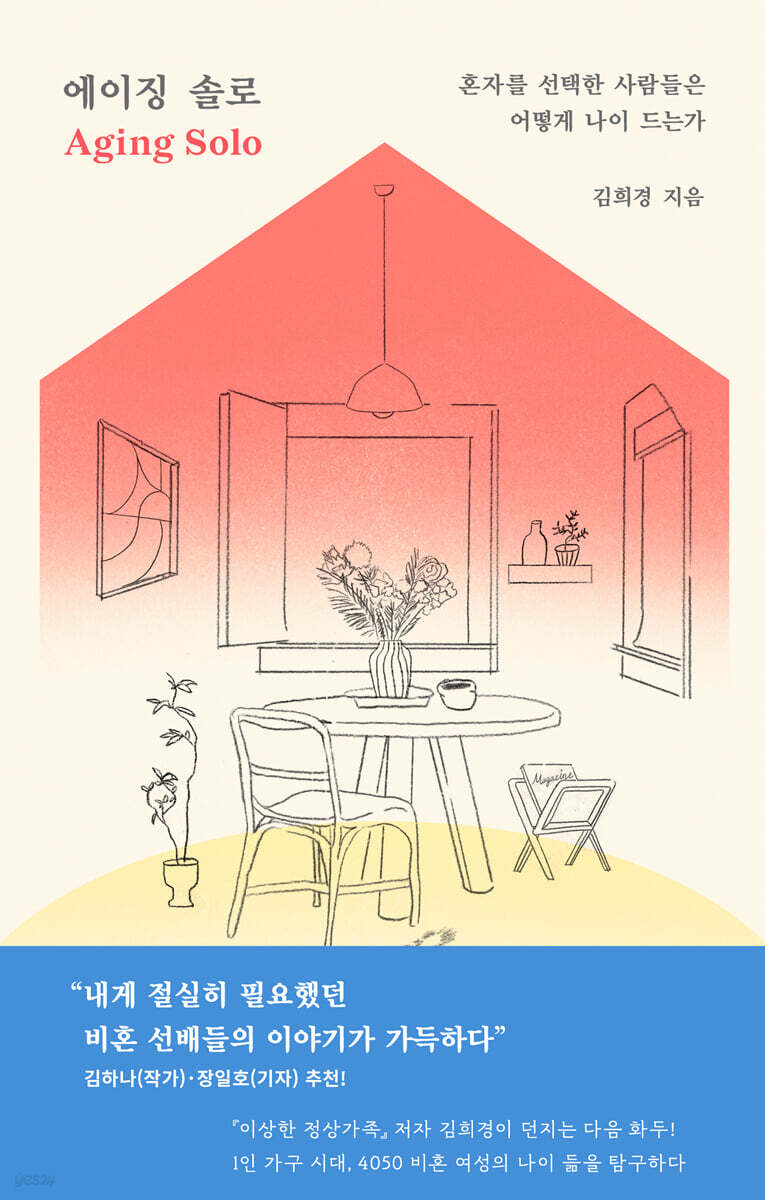
Aging Solo
 |
Description
Book Introduction
- A word from MD
-
It's time for a paradigm shift regarding family.The disintegration of the normal family, the increase in the unmarried population, and the expansion of non-relative households.
A new family model is needed.
Kim Hee-kyung, author of "Strange Normal Family," sheds light on the lives of unmarried middle-aged people in "Aging Solo."
We interviewed several people and analyzed their reasons for not marrying, how to build relationships alone, and concerns about old age.
March 28, 2023. Social and Political PD Son Min-gyu
The disintegration of the normal family, the increase in the unmarried population, and the expansion of non-relative households…
We need a new model of life
Illuminating the lives of unmarried middle-aged people in the era of single-person households.
The traditional family model is disintegrating.
Single-person households (33.4% of all households as of 2021) now outnumber households comprised of a couple and children (29.3%), which are called "normal families."
Amidst the rapidly rising number of single-person households, various outlooks are pouring in, and the domestic single-person household policy and discourse can be summarized as “young people are single, middle-aged people are divorced, and old people are widowed.”
Between content showcasing the confident lifestyles of singles in their 20s and 30s and measures to prevent loneliness for middle-aged and elderly single-person households who have become alone due to divorce or bereavement, there is a gap in the story about unmarried middle-aged people who chose to be 'alone' early on and have lived on their own for over 20 years.
However, middle-aged single-person households are not something that can be treated as if they exist or do not exist.
Middle-aged single-person households already account for a large number, accounting for 37% of all single-person households.
Also, considering the younger generation's strong tendency to prefer not to marry (in the "2020 Family Status Survey," 52.9% of those in their 20s and 52.7% of those in their 30s said they would live alone without getting married), the number of "aging solo" people in their 40s and 50s who will age alone is expected to increase significantly.
The life cycle and aging journey currently experienced by unmarried middle-aged people in their 40s and 50s may soon become the 'standard' model of life.
Now, here's why you should pay attention to aging solo.
"Aging Solo" is a book that sheds light on the lives of unmarried middle-aged people, a gap in discussions about single-person households.
As a single, middle-aged woman living alone, the author met with 19 single women in their 40s and 50s who, like her, live alone. We talked about why they chose not to marry in Korean society, how they cope with loneliness and build intimacy, and their journeys to prepare for old age.
The colorful and rich stories of aging soloists will serve as a guide for all those aging alone, and will be the most accurate guide for understanding single-person households and the single-person household society.
We need a new model of life
Illuminating the lives of unmarried middle-aged people in the era of single-person households.
The traditional family model is disintegrating.
Single-person households (33.4% of all households as of 2021) now outnumber households comprised of a couple and children (29.3%), which are called "normal families."
Amidst the rapidly rising number of single-person households, various outlooks are pouring in, and the domestic single-person household policy and discourse can be summarized as “young people are single, middle-aged people are divorced, and old people are widowed.”
Between content showcasing the confident lifestyles of singles in their 20s and 30s and measures to prevent loneliness for middle-aged and elderly single-person households who have become alone due to divorce or bereavement, there is a gap in the story about unmarried middle-aged people who chose to be 'alone' early on and have lived on their own for over 20 years.
However, middle-aged single-person households are not something that can be treated as if they exist or do not exist.
Middle-aged single-person households already account for a large number, accounting for 37% of all single-person households.
Also, considering the younger generation's strong tendency to prefer not to marry (in the "2020 Family Status Survey," 52.9% of those in their 20s and 52.7% of those in their 30s said they would live alone without getting married), the number of "aging solo" people in their 40s and 50s who will age alone is expected to increase significantly.
The life cycle and aging journey currently experienced by unmarried middle-aged people in their 40s and 50s may soon become the 'standard' model of life.
Now, here's why you should pay attention to aging solo.
"Aging Solo" is a book that sheds light on the lives of unmarried middle-aged people, a gap in discussions about single-person households.
As a single, middle-aged woman living alone, the author met with 19 single women in their 40s and 50s who, like her, live alone. We talked about why they chose not to marry in Korean society, how they cope with loneliness and build intimacy, and their journeys to prepare for old age.
The colorful and rich stories of aging soloists will serve as a guide for all those aging alone, and will be the most accurate guide for understanding single-person households and the single-person household society.
- You can preview some of the book's contents.
Preview
index
Recommendation
prolog
Chapter 1: The Aging Solo is Coming
― A map of single life for single women in their 40s and 50s
1.
Becoming middle-aged solo
2.
If you ask why I am single
3.
Are women who don't have children selfish?
4.
Are aging solos lonelier?
5.
When you're sick alone, do this
Chapter 2: Solo Doesn't Live Alone
― On intimacy outside the loose and secure family
1.
The one person you love the most?
2.
Does being single mean independence from one's family?
3.
A life centered on friendship
4.
Leaning on others and putting down roots in the village
Chapter 3: The Lie of Growing Old Alone
― The imagination of single people preparing for livelihood, housing, care, and death
1.
Feeding oneself
2.
Where should I live?
3.
Aging Solo and Parental Care
4.
Facing illness and lonely death
5.
Will we still be able to care for each other when we become grandmothers?
Chapter 4: Creating a Place for Solo People in Korean Society
― Dreaming of a system that welcomes ‘me’ and ‘us’
1.
Discrimination against single people, singleism
2.
To create a system that embraces solos
3.
Drawing a future family
Epilogue
List of referenced books
main
prolog
Chapter 1: The Aging Solo is Coming
― A map of single life for single women in their 40s and 50s
1.
Becoming middle-aged solo
2.
If you ask why I am single
3.
Are women who don't have children selfish?
4.
Are aging solos lonelier?
5.
When you're sick alone, do this
Chapter 2: Solo Doesn't Live Alone
― On intimacy outside the loose and secure family
1.
The one person you love the most?
2.
Does being single mean independence from one's family?
3.
A life centered on friendship
4.
Leaning on others and putting down roots in the village
Chapter 3: The Lie of Growing Old Alone
― The imagination of single people preparing for livelihood, housing, care, and death
1.
Feeding oneself
2.
Where should I live?
3.
Aging Solo and Parental Care
4.
Facing illness and lonely death
5.
Will we still be able to care for each other when we become grandmothers?
Chapter 4: Creating a Place for Solo People in Korean Society
― Dreaming of a system that welcomes ‘me’ and ‘us’
1.
Discrimination against single people, singleism
2.
To create a system that embraces solos
3.
Drawing a future family
Epilogue
List of referenced books
main
Detailed image

Into the book
Actually, I don't think marriage is necessary, but I'm not a non-marriage person either.
Although I respect people who have certain beliefs and firmly adhere to the "~ism" of living a life of marriage and non-marriage, I feel it is a bit awkward.
I think the question of how to cultivate intimate relationships in one's life can change at any time depending on the time and situation.
--- p.38
I often get asked why I live alone.
Someone I met for work once asked me this question before I could even answer: “You married your work because you’re a fierce woman (I don’t know why I came up with that weird expression…).”
When I was working as a reporter, there was a time when someone at a company dinner asked me, with an innocent expression, “Why don’t you find a partner?” and I was taken aback.
Marrying work? What kind of dry imagination is that?
I remember reading a sentence in a novelist's writing a while ago that said that if you can tell at a glance whether someone is a police officer or a journalist, they've made a mistake.
I think so too.
--- p.42
- Song Mi-young said, “I didn’t choose to be single, I just chose not to get married.”
“Everyone talks as if marriage is the norm and not getting married is a choice, but isn’t that the opposite? Something
Saying you will do something is a choice.
“I didn’t choose to be single. I never even thought about marriage since I was young, and I just kept living that way.”
--- pp.53~54
- The single-person households that ranked 'loneliness' as their current concern were men in their 30s (1st), men in their 20s (2nd), men in their 40s (2nd), men in their 50s (3rd), and women in their 30s (3rd).
They were mostly men, and the younger they were, the more likely they were to be lonely.
Aging single women in their 40s and 50s ranked 'loneliness' in 4th place, a relatively low ranking.
--- p.80
- In a research report titled “Does the concept of guardian in the medical field include various families?” published in 2019, the Social Health Research Institute pointed out that “excessive ‘guardian search’ by hospitals is being carried out ‘at the level of risk management’” and that “it is not a ‘patient-centered’ way of thinking, but a ‘convenience-centered’ way of thinking.”
Because of this practice, people who fall outside the framework of the so-called "normal family," such as single-person households and same-sex couples, suffer from the pain of not being able to have the person they spend their daily lives with as their actual guardian.
The report pointed out that this goes beyond simply not receiving medical services and means that their conditions of existence are systematically ignored and not recognized by society.
--- p.97
- Park Jin-young said, “People who live alone naturally have no choice but to be alone when they are sick, and in those times, they have to do their best to be sick.
“Where is there any time to be lonely?” he asked.
right.
When you are sick and find it difficult to endure alone, you can ask for help, and you can create a network where the sick person does not have to repeat the request for help.
--- p.106
- When you try to narrow down the definition of 'the one person you love most', a romantic love relationship almost automatically comes to mind.
Just like the legendary line from the movie Jerry Maguire, “You complete me,” the one person who will make me the best version of myself, the one who can make me perfect beyond my wildest dreams.
The one who can fill my void simply because he is him and not someone else.
I think that this is the level of things that must happen to be able to say, ‘This is the person I love the most.’
This may have been another reason why I, a single person, felt awkward that day.
--- p.114
- There are also research results from psychologists that show that having multiple different intimate relationships rather than just one loved one increases life satisfaction.
People who have multiple relationships to share different emotions—when they are sad and need comfort, when they want to share happiness, when they need to ease anxiety, etc.—are happier than those who share all of their emotions with only a few very close relationships.
--- p.127
- “In situations where someone in the family has to take on caregiving, the unmarried daughter is the one who can relatively easily take on caregiving through personal choice and decision,” he diagnosed, “but in the process, it naturally becomes a monopoly on caregiving, and it becomes a painful swamp of caregiving that cannot be escaped.”
In his study, single women were hurt by the burden of single-person caregiving that did not recognize their efforts, and many were forced to quit their jobs because they could not manage caregiving at the same time.
--- pp.225~226
- I used to think that losing cognitive ability meant losing one's self, that is, losing one's life, but seeing my father, I realized that wasn't the case.
As permanent brain damage became clear and the family began to give up trying to bring my father back to reality, a faint sense of order emerged in his disorganized speech and actions.
Although he may have lost the coherent narrative of his life's history, his ingrained habits and traits remain.
--- p.234
- The current marriage is an institution based on an agreement that assumes that one is engaging in entirely exclusive sexual activity, but I wondered if care, which is absolutely essential to a person's survival, rather than sexual activity, wouldn't be a more reasonable standard for forming a family union.
Doesn't the concept that a family can be formed as long as people care for each other, regardless of how childbirth occurs within or outside the institutional framework, make more sense in light of the function of the family?
Although I respect people who have certain beliefs and firmly adhere to the "~ism" of living a life of marriage and non-marriage, I feel it is a bit awkward.
I think the question of how to cultivate intimate relationships in one's life can change at any time depending on the time and situation.
--- p.38
I often get asked why I live alone.
Someone I met for work once asked me this question before I could even answer: “You married your work because you’re a fierce woman (I don’t know why I came up with that weird expression…).”
When I was working as a reporter, there was a time when someone at a company dinner asked me, with an innocent expression, “Why don’t you find a partner?” and I was taken aback.
Marrying work? What kind of dry imagination is that?
I remember reading a sentence in a novelist's writing a while ago that said that if you can tell at a glance whether someone is a police officer or a journalist, they've made a mistake.
I think so too.
--- p.42
- Song Mi-young said, “I didn’t choose to be single, I just chose not to get married.”
“Everyone talks as if marriage is the norm and not getting married is a choice, but isn’t that the opposite? Something
Saying you will do something is a choice.
“I didn’t choose to be single. I never even thought about marriage since I was young, and I just kept living that way.”
--- pp.53~54
- The single-person households that ranked 'loneliness' as their current concern were men in their 30s (1st), men in their 20s (2nd), men in their 40s (2nd), men in their 50s (3rd), and women in their 30s (3rd).
They were mostly men, and the younger they were, the more likely they were to be lonely.
Aging single women in their 40s and 50s ranked 'loneliness' in 4th place, a relatively low ranking.
--- p.80
- In a research report titled “Does the concept of guardian in the medical field include various families?” published in 2019, the Social Health Research Institute pointed out that “excessive ‘guardian search’ by hospitals is being carried out ‘at the level of risk management’” and that “it is not a ‘patient-centered’ way of thinking, but a ‘convenience-centered’ way of thinking.”
Because of this practice, people who fall outside the framework of the so-called "normal family," such as single-person households and same-sex couples, suffer from the pain of not being able to have the person they spend their daily lives with as their actual guardian.
The report pointed out that this goes beyond simply not receiving medical services and means that their conditions of existence are systematically ignored and not recognized by society.
--- p.97
- Park Jin-young said, “People who live alone naturally have no choice but to be alone when they are sick, and in those times, they have to do their best to be sick.
“Where is there any time to be lonely?” he asked.
right.
When you are sick and find it difficult to endure alone, you can ask for help, and you can create a network where the sick person does not have to repeat the request for help.
--- p.106
- When you try to narrow down the definition of 'the one person you love most', a romantic love relationship almost automatically comes to mind.
Just like the legendary line from the movie Jerry Maguire, “You complete me,” the one person who will make me the best version of myself, the one who can make me perfect beyond my wildest dreams.
The one who can fill my void simply because he is him and not someone else.
I think that this is the level of things that must happen to be able to say, ‘This is the person I love the most.’
This may have been another reason why I, a single person, felt awkward that day.
--- p.114
- There are also research results from psychologists that show that having multiple different intimate relationships rather than just one loved one increases life satisfaction.
People who have multiple relationships to share different emotions—when they are sad and need comfort, when they want to share happiness, when they need to ease anxiety, etc.—are happier than those who share all of their emotions with only a few very close relationships.
--- p.127
- “In situations where someone in the family has to take on caregiving, the unmarried daughter is the one who can relatively easily take on caregiving through personal choice and decision,” he diagnosed, “but in the process, it naturally becomes a monopoly on caregiving, and it becomes a painful swamp of caregiving that cannot be escaped.”
In his study, single women were hurt by the burden of single-person caregiving that did not recognize their efforts, and many were forced to quit their jobs because they could not manage caregiving at the same time.
--- pp.225~226
- I used to think that losing cognitive ability meant losing one's self, that is, losing one's life, but seeing my father, I realized that wasn't the case.
As permanent brain damage became clear and the family began to give up trying to bring my father back to reality, a faint sense of order emerged in his disorganized speech and actions.
Although he may have lost the coherent narrative of his life's history, his ingrained habits and traits remain.
--- p.234
- The current marriage is an institution based on an agreement that assumes that one is engaging in entirely exclusive sexual activity, but I wondered if care, which is absolutely essential to a person's survival, rather than sexual activity, wouldn't be a more reasonable standard for forming a family union.
Doesn't the concept that a family can be formed as long as people care for each other, regardless of how childbirth occurs within or outside the institutional framework, make more sense in light of the function of the family?
--- pp.307~308
Publisher's Review
Why is living alone still considered deviant and abnormal?
A Close Rebuttal to the Baseless Discrimination and Stigmatization Attached to Single Life
“Of course, there are people for whom loneliness is a real problem, but I also think people are susceptible to stereotypes.
“It’s not that it’s fun, but I think there are many cases where people think that it’s lonely because people label the feeling of being alone as loneliness.”_Pages 82-83
Perhaps the most powerful conspiracy against those who live alone is the saying, "Living alone is lonely." As discourse and policies regarding single-person households are primarily framed from the perspective of preventing "deaths from loneliness," exaggerated fears about aging alone have spread throughout Korean society.
However, among the single women the author met, none cited loneliness or anxiety about dying alone as serious problems.
This book directly refutes this stereotype by introducing a study that "divided the elderly into those with and without children, those whose children lived nearby and those whose children lived far away, and investigated their satisfaction, worries, loneliness, and anxiety. As a result, the satisfaction level of the elderly who lived alone without children was the highest, and the level of loneliness and anxiety was also lower."
Moreover, the rise of single-person households is often treated as a major cause of low birth rates and a sign of community breakdown.
In particular, single women are often subject to prejudiced views and criticism simply because they have not married or given birth.
During a confirmation hearing in 2019, a member of the National Assembly criticized a single female candidate, saying, “It’s good for you to pursue your own career, but I also want you to contribute to the development of the country.”
The author points out that viewing the life of an unmarried person as incomplete and casting a critical eye on women who have not given birth are nothing more than products of the "ideology of the normal family" that criticizes women who do not follow the path of "marriage-childbirth-childrearing."
Furthermore, based on research showing that “there is a high correlation between the husband’s share of housework and childcare labor and the total fertility rate,” the cause of the low birth rate is not the increase in single-person households, but rather the patriarchal culture.
"Aging Solo" examines the real-life experiences and testimonies of single women in their 40s and 50s, along with the latest research, to provide the most vivid and accurate text for understanding life alone.
You can put aside your “unnecessary fears” by relying on the words of aging solo seniors who say, “I feel like life gets better as I get older.”
Can I age freely and safely as a single person?
Against the social script that says, “If you live alone, you’ll be lonely when you get older.”
Stories of Soloists Inventing Relationships, Caregiving, and Old Age
Most of the aging solos the author has met have one thing in common: they are single, but they do not live alone.
They live in large and small communities based on loose but tight intimacy.
Some people live alone in a village connected to their neighbors, some pool their money with friends to buy a house and live together, and some create alternative living community models.
They care for each other outside the family and go through life together.
The unmarried women's community 'Bibi' (short for 'Bihondeulbihaeng') in Jeonju-si, Jeollabuk-do, and the elderly women's community 'Norumok Hyanggi' in Yeoju-si, Gyeonggi-do, introduced in this book, show that "growing old together as singles" is possible in Korea as well.
“If we have the strength to endure each other, we can overcome anything else.
Is there a relationship so beautiful, so possible, without enduring someone? There isn't.
But I endure it because it's good.
Because I like that person, because I like them, I think I have to take on some of that responsibility.
“I believe that the fundamental foundation that makes community possible is the mind that can support others because someone supports me.” _Page 257
Even for the author, who has lived independently for a long time, asking for and receiving help from others is unfamiliar.
The author also talks with aging solos, takes care of parents, and learns how to give and receive help from others.
Beyond the script of romantic love, beyond the dichotomy of independence and dependence, “a voice that expands the boundaries of life and creates a place by our side” has arrived.
Dreaming of a system that welcomes ‘me’ and ‘us’
Creating a place for solos in the workplace, hospitals, and society
American social psychologist Bella DePaulle named the phenomenon of thinking that marriage is more ideal than being single and having prejudice against single people as 'singlism.'
He points out that this singleism is not just an attitude, but “permeates all structures of society, including laws and institutions, so that even singles who say they have never experienced discrimination in their daily lives cannot avoid it.”
The aging soloists in this book also testified that they experienced institutional discrimination, both large and small.
The two biggest challenges they cited were housing and care.
The government's housing supply system assigns subscription points based on marital status and number of children, making it difficult for single-person households to receive subscription benefits.
Hospitals still require family members of origin to accompany patients as guardians for risk management reasons, and singles cannot take care of their loved ones at work because they are not family members, even if they want to.
Moreover, unmarried women are often perceived as a surplus labor force for their families of origin, and their own circumstances often become difficult as they shoulder the burden of caring for single parents.
The rise of living alone is a global phenomenon that extends beyond Korea.
If living alone is an inevitable social change, shouldn't the system itself change? Japanese sociologist Emiko Ochiai once said, "If there is no longer a social unit to which everyone belongs, then the only fundamental unit of society is the individual."
Author Kim Hee-kyung also says that the time has come to shift the unit of welfare from the family to the individual.
The experiences and testimonies of single middle-aged people in this book are filled with institutional improvements that could revise the outdated system under the ideology of the "normal family" and new imaginations about a society beyond the family.
How about starting from this story?
A Close Rebuttal to the Baseless Discrimination and Stigmatization Attached to Single Life
“Of course, there are people for whom loneliness is a real problem, but I also think people are susceptible to stereotypes.
“It’s not that it’s fun, but I think there are many cases where people think that it’s lonely because people label the feeling of being alone as loneliness.”_Pages 82-83
Perhaps the most powerful conspiracy against those who live alone is the saying, "Living alone is lonely." As discourse and policies regarding single-person households are primarily framed from the perspective of preventing "deaths from loneliness," exaggerated fears about aging alone have spread throughout Korean society.
However, among the single women the author met, none cited loneliness or anxiety about dying alone as serious problems.
This book directly refutes this stereotype by introducing a study that "divided the elderly into those with and without children, those whose children lived nearby and those whose children lived far away, and investigated their satisfaction, worries, loneliness, and anxiety. As a result, the satisfaction level of the elderly who lived alone without children was the highest, and the level of loneliness and anxiety was also lower."
Moreover, the rise of single-person households is often treated as a major cause of low birth rates and a sign of community breakdown.
In particular, single women are often subject to prejudiced views and criticism simply because they have not married or given birth.
During a confirmation hearing in 2019, a member of the National Assembly criticized a single female candidate, saying, “It’s good for you to pursue your own career, but I also want you to contribute to the development of the country.”
The author points out that viewing the life of an unmarried person as incomplete and casting a critical eye on women who have not given birth are nothing more than products of the "ideology of the normal family" that criticizes women who do not follow the path of "marriage-childbirth-childrearing."
Furthermore, based on research showing that “there is a high correlation between the husband’s share of housework and childcare labor and the total fertility rate,” the cause of the low birth rate is not the increase in single-person households, but rather the patriarchal culture.
"Aging Solo" examines the real-life experiences and testimonies of single women in their 40s and 50s, along with the latest research, to provide the most vivid and accurate text for understanding life alone.
You can put aside your “unnecessary fears” by relying on the words of aging solo seniors who say, “I feel like life gets better as I get older.”
Can I age freely and safely as a single person?
Against the social script that says, “If you live alone, you’ll be lonely when you get older.”
Stories of Soloists Inventing Relationships, Caregiving, and Old Age
Most of the aging solos the author has met have one thing in common: they are single, but they do not live alone.
They live in large and small communities based on loose but tight intimacy.
Some people live alone in a village connected to their neighbors, some pool their money with friends to buy a house and live together, and some create alternative living community models.
They care for each other outside the family and go through life together.
The unmarried women's community 'Bibi' (short for 'Bihondeulbihaeng') in Jeonju-si, Jeollabuk-do, and the elderly women's community 'Norumok Hyanggi' in Yeoju-si, Gyeonggi-do, introduced in this book, show that "growing old together as singles" is possible in Korea as well.
“If we have the strength to endure each other, we can overcome anything else.
Is there a relationship so beautiful, so possible, without enduring someone? There isn't.
But I endure it because it's good.
Because I like that person, because I like them, I think I have to take on some of that responsibility.
“I believe that the fundamental foundation that makes community possible is the mind that can support others because someone supports me.” _Page 257
Even for the author, who has lived independently for a long time, asking for and receiving help from others is unfamiliar.
The author also talks with aging solos, takes care of parents, and learns how to give and receive help from others.
Beyond the script of romantic love, beyond the dichotomy of independence and dependence, “a voice that expands the boundaries of life and creates a place by our side” has arrived.
Dreaming of a system that welcomes ‘me’ and ‘us’
Creating a place for solos in the workplace, hospitals, and society
American social psychologist Bella DePaulle named the phenomenon of thinking that marriage is more ideal than being single and having prejudice against single people as 'singlism.'
He points out that this singleism is not just an attitude, but “permeates all structures of society, including laws and institutions, so that even singles who say they have never experienced discrimination in their daily lives cannot avoid it.”
The aging soloists in this book also testified that they experienced institutional discrimination, both large and small.
The two biggest challenges they cited were housing and care.
The government's housing supply system assigns subscription points based on marital status and number of children, making it difficult for single-person households to receive subscription benefits.
Hospitals still require family members of origin to accompany patients as guardians for risk management reasons, and singles cannot take care of their loved ones at work because they are not family members, even if they want to.
Moreover, unmarried women are often perceived as a surplus labor force for their families of origin, and their own circumstances often become difficult as they shoulder the burden of caring for single parents.
The rise of living alone is a global phenomenon that extends beyond Korea.
If living alone is an inevitable social change, shouldn't the system itself change? Japanese sociologist Emiko Ochiai once said, "If there is no longer a social unit to which everyone belongs, then the only fundamental unit of society is the individual."
Author Kim Hee-kyung also says that the time has come to shift the unit of welfare from the family to the individual.
The experiences and testimonies of single middle-aged people in this book are filled with institutional improvements that could revise the outdated system under the ideology of the "normal family" and new imaginations about a society beyond the family.
How about starting from this story?
GOODS SPECIFICS
- Date of issue: March 22, 2023
- Page count, weight, size: 332 pages | 330g | 120*188*20mm
- ISBN13: 9788962624885
- ISBN10: 8962624885
You may also like
카테고리
korean


korean

![GQ KOREA Mark (Monthly): December [2025]](http://librairie.coreenne.fr/cdn/shop/files/8ef265dbbfbf186523ed75ba7319009d.jpg?v=1765340328&width=3840)


