

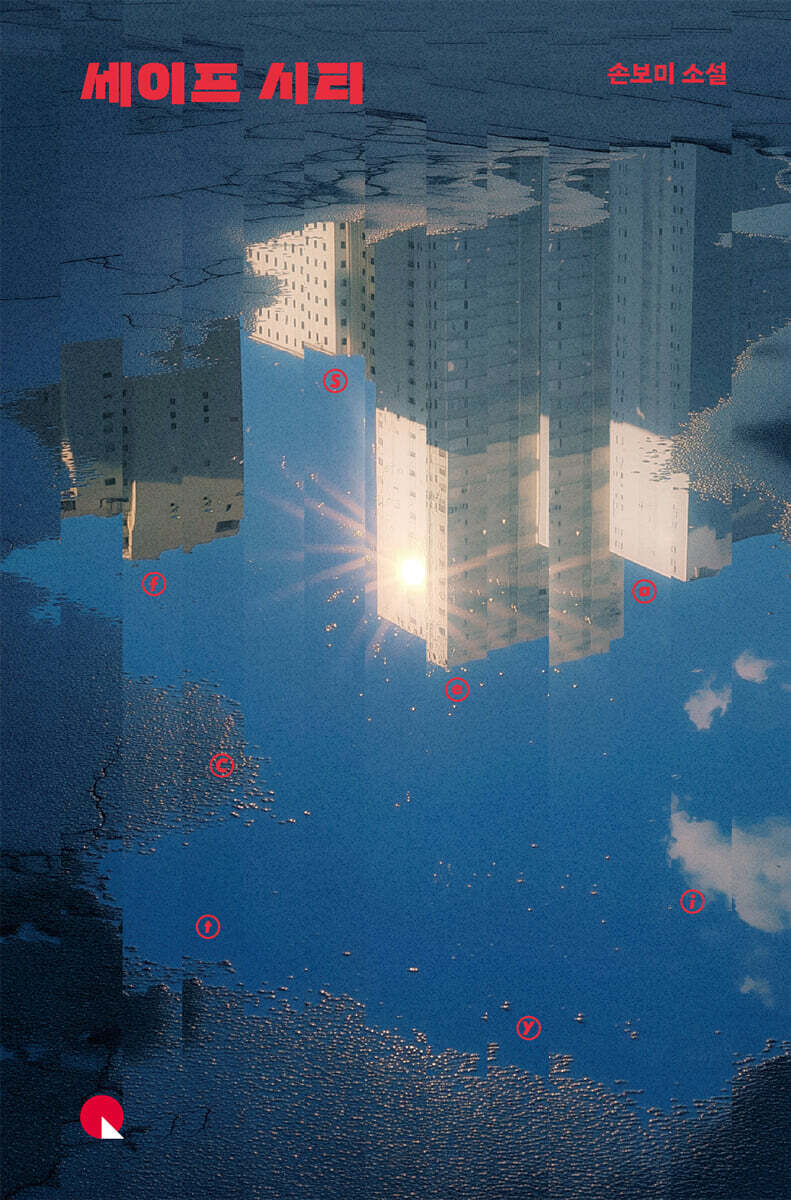
Safe City
 |
Description
Book Introduction
- A word from MD
-
Son Bo-mi's social mystery novelA near future where polarization has become extreme.
People keep themselves safe by dividing the new and old city areas into 'safe cities'.
The most problematic area is none other than Zone X.
A chain of destruction incidents occurs there, and this is the trigger for the introduction of memory correction techniques.
A social mystery that shows how technology and power manipulate the truth.
July 29, 2025. Novel/Poetry PD Kim Yu-ri
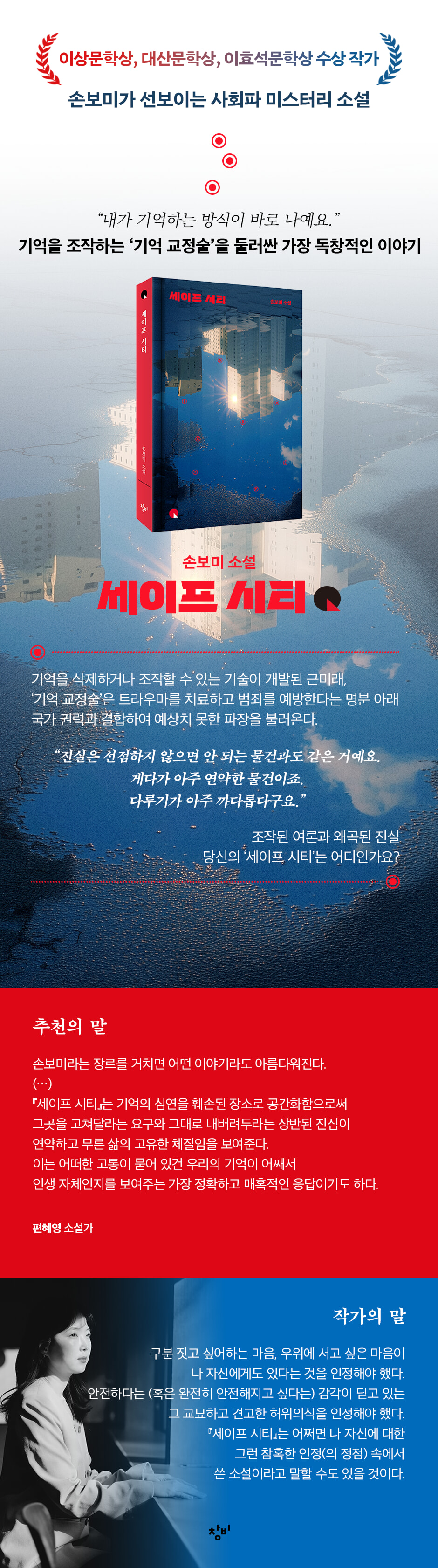
“The way I remember myself is who I am.”
The most fascinating questions surrounding 'memory manipulation'
A new level reached by Son Bo-mi's novels
Novelist Son Bo-mi, who has established herself as one of the most notable contemporary writers by winning major domestic literary awards such as the Yi Sang Literary Award, Daesan Literary Award, Lee Hyo-seok Literary Award, and Hankook Ilbo Literary Award, has returned with her new full-length novel, “Safe City.”
The author, who has expanded the world of fiction with keen insight and sophisticated narrative structure, opens up a new horizon for Son Bo-mi's novels in this new work by further refining the literary depth and genre tension she has accumulated so far.
"Safe City" is a social mystery novel set in the near future, where technology has been developed to erase or manipulate human memories.
When "memory correction techniques," packaged under the guise of trauma treatment and crime prevention, are combined with state power, what defines human identity?
This work traces the ethical dilemmas and workings of power surrounding science and technology, deeply exploring the relationship between truth and ethics through the struggles of a woman surrounded by manipulated public opinion and distorted truth.
With its dense plot and delicate inner descriptions, this novel maintains the tension of the mystery genre while raising sharp questions, and it sheds a chilling light on the structural realities of our society.
In particular, it sharply captures gendered violence in the age of technological supremacy, manipulation of public opinion through social media, and the vulnerability of truth, and directly confronts the problems of contemporary Korean society.
The most fascinating questions surrounding 'memory manipulation'
A new level reached by Son Bo-mi's novels
Novelist Son Bo-mi, who has established herself as one of the most notable contemporary writers by winning major domestic literary awards such as the Yi Sang Literary Award, Daesan Literary Award, Lee Hyo-seok Literary Award, and Hankook Ilbo Literary Award, has returned with her new full-length novel, “Safe City.”
The author, who has expanded the world of fiction with keen insight and sophisticated narrative structure, opens up a new horizon for Son Bo-mi's novels in this new work by further refining the literary depth and genre tension she has accumulated so far.
"Safe City" is a social mystery novel set in the near future, where technology has been developed to erase or manipulate human memories.
When "memory correction techniques," packaged under the guise of trauma treatment and crime prevention, are combined with state power, what defines human identity?
This work traces the ethical dilemmas and workings of power surrounding science and technology, deeply exploring the relationship between truth and ethics through the struggles of a woman surrounded by manipulated public opinion and distorted truth.
With its dense plot and delicate inner descriptions, this novel maintains the tension of the mystery genre while raising sharp questions, and it sheds a chilling light on the structural realities of our society.
In particular, it sharply captures gendered violence in the age of technological supremacy, manipulation of public opinion through social media, and the vulnerability of truth, and directly confronts the problems of contemporary Korean society.
- You can preview some of the book's contents.
Preview
index
Part 1 / Part 2 / Part 3 / Part 4
Author's Note
Author's Note
Detailed image
Into the book
“It’s too dangerous.
What if that person's entire brain function is compromised? No one, not even a vicious criminal, has the right to put someone else at risk.
Besides, does it make sense to manipulate human memory in that way? It would raise ethical issues.
Memory is the person himself.
“Whatever that memory is, it is that person.”
--- p.41
"That's different? Why is it different? Can we say that the way we remember something now is the same as it was ten years ago? Can we say that what we remembered a year ago is the same as what we remember now?
Human memory changes.
We forget things that were once very important, memories we swore we would never forget, without even realizing it.
Humans are not unique.
“The idea that a human being is unique is an illusion.”
--- p.42
“Think of the ripples on a lake.
What we need to find is not a stone thrown into a lake.
What we need to find is the pattern of the waves rippling at this very moment.
It's always right before our eyes.”
--- p.50
The hammer drill thrown far away, the man's hat, her flip-flops, the sound of people's footsteps, the feeling of something inside me expanding hotly.
She felt so wet all over her body, but she couldn't tell if it was from blood or sweat.
--- p.89
The noises of the city coming from somewhere far away.
Buildings that look like they're going to collapse at any moment, but never will, and long banners hanging over them - we're in danger.
Please fix us.
Or, quite the opposite: Leave this place alone! There's life here!
--- p.102
There was a subtle atmosphere of that night that was hinted at in the article - vicious male criminals and terrified women.
But it wasn't.
That night, it was the man who was terrified.
The women were not scared, they were angry.
To conceal what actually happened while pretending it was true.
A narrative that subtly omits important facts while pretending to reveal even the smallest details.
--- p.121
“The truth is something that must be seized.
Besides, it's a very fragile thing.
It's very tricky to handle.
You can't just leave it there and let someone else take it away.
Do you know how much effort it takes to do that?”
--- pp.139-140
I wondered how that memory would be distorted, contaminated, and flow through the man's mind, and where it would ultimately settle.
In the end, all memories change, and the me of a year ago who remembers the same thing is different from the me of now, said Im Yun-seong.
But she felt that was the point.
She thought that the way memories flow is a specific way a human being exists.
--- p.193
“People don’t often think about the possibility that they could be a victim of something.
It's a different world.
But evil deeds are different.
Isn't that right? Those who have overcome the desire to use violence against others never forget the actions of those who have succumbed to that desire.
“Every time I see the face of someone who has had such a desire, I feel a strange sense of happiness.”
--- p.209
“Why… do you want that?”
“Because if the conflict doesn’t surface, nothing changes.
Look, this isn't about who's right or wrong.
This is life, this is a fight.
It's a fight to save more people.
We may win or we may lose.
“All we have to do is give our best to win.”
What if that person's entire brain function is compromised? No one, not even a vicious criminal, has the right to put someone else at risk.
Besides, does it make sense to manipulate human memory in that way? It would raise ethical issues.
Memory is the person himself.
“Whatever that memory is, it is that person.”
--- p.41
"That's different? Why is it different? Can we say that the way we remember something now is the same as it was ten years ago? Can we say that what we remembered a year ago is the same as what we remember now?
Human memory changes.
We forget things that were once very important, memories we swore we would never forget, without even realizing it.
Humans are not unique.
“The idea that a human being is unique is an illusion.”
--- p.42
“Think of the ripples on a lake.
What we need to find is not a stone thrown into a lake.
What we need to find is the pattern of the waves rippling at this very moment.
It's always right before our eyes.”
--- p.50
The hammer drill thrown far away, the man's hat, her flip-flops, the sound of people's footsteps, the feeling of something inside me expanding hotly.
She felt so wet all over her body, but she couldn't tell if it was from blood or sweat.
--- p.89
The noises of the city coming from somewhere far away.
Buildings that look like they're going to collapse at any moment, but never will, and long banners hanging over them - we're in danger.
Please fix us.
Or, quite the opposite: Leave this place alone! There's life here!
--- p.102
There was a subtle atmosphere of that night that was hinted at in the article - vicious male criminals and terrified women.
But it wasn't.
That night, it was the man who was terrified.
The women were not scared, they were angry.
To conceal what actually happened while pretending it was true.
A narrative that subtly omits important facts while pretending to reveal even the smallest details.
--- p.121
“The truth is something that must be seized.
Besides, it's a very fragile thing.
It's very tricky to handle.
You can't just leave it there and let someone else take it away.
Do you know how much effort it takes to do that?”
--- pp.139-140
I wondered how that memory would be distorted, contaminated, and flow through the man's mind, and where it would ultimately settle.
In the end, all memories change, and the me of a year ago who remembers the same thing is different from the me of now, said Im Yun-seong.
But she felt that was the point.
She thought that the way memories flow is a specific way a human being exists.
--- p.193
“People don’t often think about the possibility that they could be a victim of something.
It's a different world.
But evil deeds are different.
Isn't that right? Those who have overcome the desire to use violence against others never forget the actions of those who have succumbed to that desire.
“Every time I see the face of someone who has had such a desire, I feel a strange sense of happiness.”
--- p.209
“Why… do you want that?”
“Because if the conflict doesn’t surface, nothing changes.
Look, this isn't about who's right or wrong.
This is life, this is a fight.
It's a fight to save more people.
We may win or we may lose.
“All we have to do is give our best to win.”
--- p.230
Publisher's Review
Humans consumed outside of the manipulated truth
The triangular structure of ethics, public opinion, and power surrounding dignity
'Her', a female police officer who obtained a false confession from an unexpected suspect while investigating a kidnapping case of a young girl.
Meanwhile, the real culprit kills his family and then commits suicide.
The narrator in the work, who is unable to overcome the pressure of the chief investigator who reprimands him and submits a leave of absence, suffers from insomnia.
Her husband stays by her side faithfully, but cracks slowly appear in their daily life.
Meanwhile, her husband's college classmate, neuroscientist Lim Yun-seong, is working on a 'memory correction' project to selectively delete or control human memories using brain-computer interface (BCI) technology.
To his seductive question, “Is there a memory you want to erase?” she reveals her instinctive rejection by replying, “Memories are that person itself.”
The narrator's beliefs clash sharply with those of the technologist Im Yun-seong, who claims that the uniqueness of humans and memory is an illusion, but their argument does not last long.
One morning, unable to endure a sleepless night, the narrator impulsively heads to the old city center and, in an abandoned building, witnesses a confrontation between a bathroom vandal and homeless women.
She intervenes in the case with her police instincts and is hospitalized with serious injuries from a hammer drill wielded by the criminal.
The mayor announces that the arrested toilet vandal will be the first official test subject of "memory correction surgery," and begins a massive public relations campaign to justify this.
Lim Yoon-seong pressures her to give false testimony supporting the technology at the public hearing.
For Lim Yun-seong and his wife, Choi Jin-yu, the introduction of this technology is not just a scientific achievement, but a means to gain power.
This work also vividly shows the process of how truth is manipulated and distributed in the age of social media.
“The truth is something that must be seized.
Besides, it's a very fragile thing.
The sentence, “It’s very difficult to handle,” conveys a chilling sense of reality to readers living in this day and age, while also containing the cold insight that truth is not fact, but merely an arrangement of preempted and fabricated information.
The irony of a 'safe city'
The novel is set in a starkly divided city.
There is even a commercialized app called 'Safe City' that displays safe zones by level.
The new city center, which has been redeveloped under government control, and the old city center, which has been neglected by the government and is called the 'X zone', where various crimes and hatred are concentrated.
To make matters worse, a bizarre chain of vandalism attacks targeting only women's restrooms in the "X Zone" has occurred, fueling public anxiety and disgust.
A banner hanging in the old city center reads, “We are in danger.
The conflicting slogans of “Fix us!” and “Leave us alone! There’s life here!” vividly reveal the city’s divisions.
Cities are not only places of residence, but also serve as laboratories of power and public opinion formed by various classes and groups.
Through the hierarchy of these spaces, the author keenly dissects the mechanisms of power structure and public opinion formation, and depicts the ethical confusion and psychological cracks experienced by the characters within them with his uniquely sensuous prose.
In particular, the irony inherent in the term “safe city”—the paradox that the more we pursue safety, the more dangerous the city becomes—symbolically demonstrates the dystopian reality created by technology and control.
A philosophical exploration beyond mystery
"Safe City" straddles the line between genre fiction and serious literature, offering readers both intellectual thrills and ethical tension.
Although it is based on mystery and science fiction imagination, the questions contained within are thoroughly directed towards reality.
The themes this work addresses are complex and multi-layered, from the existential awakening that accepts that even imperfect and wounded memories are part of our existence, to the ethical dilemmas posed by technological advancements and the question of gendered violence.
A serial crime that destroys only women's restrooms, a crisis of trust created by the frame of a "female police officer on leave after a miscarriage," and the increasingly vulnerable presence of homeless women in downtown areas.
The author delicately captures the intersections of issues of memory and power with gender, and goes beyond simple social criticism to explore the fundamental conditions of human existence.
"Safe City," which delicately addresses such a weighty subject while maintaining its narrative momentum, demonstrates a new realm for Son Bo-mi's literature and the new possibilities of social fiction.
In an age where memory manipulation is possible, what should we protect and what should we give up?
It is time to confront the most pressing and fundamental questions that pose to all of us living in an age of technological supremacy.
Author's Note (partial)
The word "Stop" written in front of an X-shaped circuit breaker.
I put my hands in my jumper pockets and suddenly looked up, and I saw a forty-story building under construction in front of Yongsan Station.
A red light flashes ceaselessly from the top of the building.
By then, the construction was almost finished.
The cold wind made my nose numb.
It was only about a kilometer away, but somehow it felt so far away from me.
It seemed even further away from the village I had just passed.
A completely different way of life.
But I knew that this thinking I had was wrong.
Arrogant.
There, too, and here, there were places where people lived.
I had no basis for evaluating the quality of that life.
No, making that distinction itself was a sin.
All the time we lived in Yongsan, there was talk of redevelopment around the railroad tracks and development of the Yongsan Business District.
We were the ones who were going to leave anyway and had nothing to do with development.
But sometimes I wondered.
If that really happens, if this area is developed, where will the people who live there go? Where will the owners of the old-fashioned pubs selling fried chicken near the train tracks go? What about the property owners who have to open metal sliding doors to get in? What about the clothing store owners with their old mannequins in their window displays?
Will terrible things happen again?
(syncopation)
I had to admit that I too had a desire to differentiate, a desire to be superior.
I had to acknowledge the subtle and entrenched false consciousness that underpinned my sense of safety (or the desire to be completely safe).
Perhaps, you could say that 『Safe City』 is a novel written at the height of such a cruel admission about myself.
At the same time, I also had this thought.
If I had been an honest and upright person, I might not have been able to write a novel at all.
Summer 2025
Son Bo-mi
The triangular structure of ethics, public opinion, and power surrounding dignity
'Her', a female police officer who obtained a false confession from an unexpected suspect while investigating a kidnapping case of a young girl.
Meanwhile, the real culprit kills his family and then commits suicide.
The narrator in the work, who is unable to overcome the pressure of the chief investigator who reprimands him and submits a leave of absence, suffers from insomnia.
Her husband stays by her side faithfully, but cracks slowly appear in their daily life.
Meanwhile, her husband's college classmate, neuroscientist Lim Yun-seong, is working on a 'memory correction' project to selectively delete or control human memories using brain-computer interface (BCI) technology.
To his seductive question, “Is there a memory you want to erase?” she reveals her instinctive rejection by replying, “Memories are that person itself.”
The narrator's beliefs clash sharply with those of the technologist Im Yun-seong, who claims that the uniqueness of humans and memory is an illusion, but their argument does not last long.
One morning, unable to endure a sleepless night, the narrator impulsively heads to the old city center and, in an abandoned building, witnesses a confrontation between a bathroom vandal and homeless women.
She intervenes in the case with her police instincts and is hospitalized with serious injuries from a hammer drill wielded by the criminal.
The mayor announces that the arrested toilet vandal will be the first official test subject of "memory correction surgery," and begins a massive public relations campaign to justify this.
Lim Yoon-seong pressures her to give false testimony supporting the technology at the public hearing.
For Lim Yun-seong and his wife, Choi Jin-yu, the introduction of this technology is not just a scientific achievement, but a means to gain power.
This work also vividly shows the process of how truth is manipulated and distributed in the age of social media.
“The truth is something that must be seized.
Besides, it's a very fragile thing.
The sentence, “It’s very difficult to handle,” conveys a chilling sense of reality to readers living in this day and age, while also containing the cold insight that truth is not fact, but merely an arrangement of preempted and fabricated information.
The irony of a 'safe city'
The novel is set in a starkly divided city.
There is even a commercialized app called 'Safe City' that displays safe zones by level.
The new city center, which has been redeveloped under government control, and the old city center, which has been neglected by the government and is called the 'X zone', where various crimes and hatred are concentrated.
To make matters worse, a bizarre chain of vandalism attacks targeting only women's restrooms in the "X Zone" has occurred, fueling public anxiety and disgust.
A banner hanging in the old city center reads, “We are in danger.
The conflicting slogans of “Fix us!” and “Leave us alone! There’s life here!” vividly reveal the city’s divisions.
Cities are not only places of residence, but also serve as laboratories of power and public opinion formed by various classes and groups.
Through the hierarchy of these spaces, the author keenly dissects the mechanisms of power structure and public opinion formation, and depicts the ethical confusion and psychological cracks experienced by the characters within them with his uniquely sensuous prose.
In particular, the irony inherent in the term “safe city”—the paradox that the more we pursue safety, the more dangerous the city becomes—symbolically demonstrates the dystopian reality created by technology and control.
A philosophical exploration beyond mystery
"Safe City" straddles the line between genre fiction and serious literature, offering readers both intellectual thrills and ethical tension.
Although it is based on mystery and science fiction imagination, the questions contained within are thoroughly directed towards reality.
The themes this work addresses are complex and multi-layered, from the existential awakening that accepts that even imperfect and wounded memories are part of our existence, to the ethical dilemmas posed by technological advancements and the question of gendered violence.
A serial crime that destroys only women's restrooms, a crisis of trust created by the frame of a "female police officer on leave after a miscarriage," and the increasingly vulnerable presence of homeless women in downtown areas.
The author delicately captures the intersections of issues of memory and power with gender, and goes beyond simple social criticism to explore the fundamental conditions of human existence.
"Safe City," which delicately addresses such a weighty subject while maintaining its narrative momentum, demonstrates a new realm for Son Bo-mi's literature and the new possibilities of social fiction.
In an age where memory manipulation is possible, what should we protect and what should we give up?
It is time to confront the most pressing and fundamental questions that pose to all of us living in an age of technological supremacy.
Author's Note (partial)
The word "Stop" written in front of an X-shaped circuit breaker.
I put my hands in my jumper pockets and suddenly looked up, and I saw a forty-story building under construction in front of Yongsan Station.
A red light flashes ceaselessly from the top of the building.
By then, the construction was almost finished.
The cold wind made my nose numb.
It was only about a kilometer away, but somehow it felt so far away from me.
It seemed even further away from the village I had just passed.
A completely different way of life.
But I knew that this thinking I had was wrong.
Arrogant.
There, too, and here, there were places where people lived.
I had no basis for evaluating the quality of that life.
No, making that distinction itself was a sin.
All the time we lived in Yongsan, there was talk of redevelopment around the railroad tracks and development of the Yongsan Business District.
We were the ones who were going to leave anyway and had nothing to do with development.
But sometimes I wondered.
If that really happens, if this area is developed, where will the people who live there go? Where will the owners of the old-fashioned pubs selling fried chicken near the train tracks go? What about the property owners who have to open metal sliding doors to get in? What about the clothing store owners with their old mannequins in their window displays?
Will terrible things happen again?
(syncopation)
I had to admit that I too had a desire to differentiate, a desire to be superior.
I had to acknowledge the subtle and entrenched false consciousness that underpinned my sense of safety (or the desire to be completely safe).
Perhaps, you could say that 『Safe City』 is a novel written at the height of such a cruel admission about myself.
At the same time, I also had this thought.
If I had been an honest and upright person, I might not have been able to write a novel at all.
Summer 2025
Son Bo-mi
GOODS SPECIFICS
- Date of issue: July 25, 2025
- Format: Hardcover book binding method guide
- Page count, weight, size: 248 pages | 350g | 122*188*18mm
- ISBN13: 9788936439835
You may also like
카테고리
korean


korean

![GQ KOREA Mark (Monthly): December [2025]](http://librairie.coreenne.fr/cdn/shop/files/8ef265dbbfbf186523ed75ba7319009d.jpg?v=1765340328&width=3840)


