

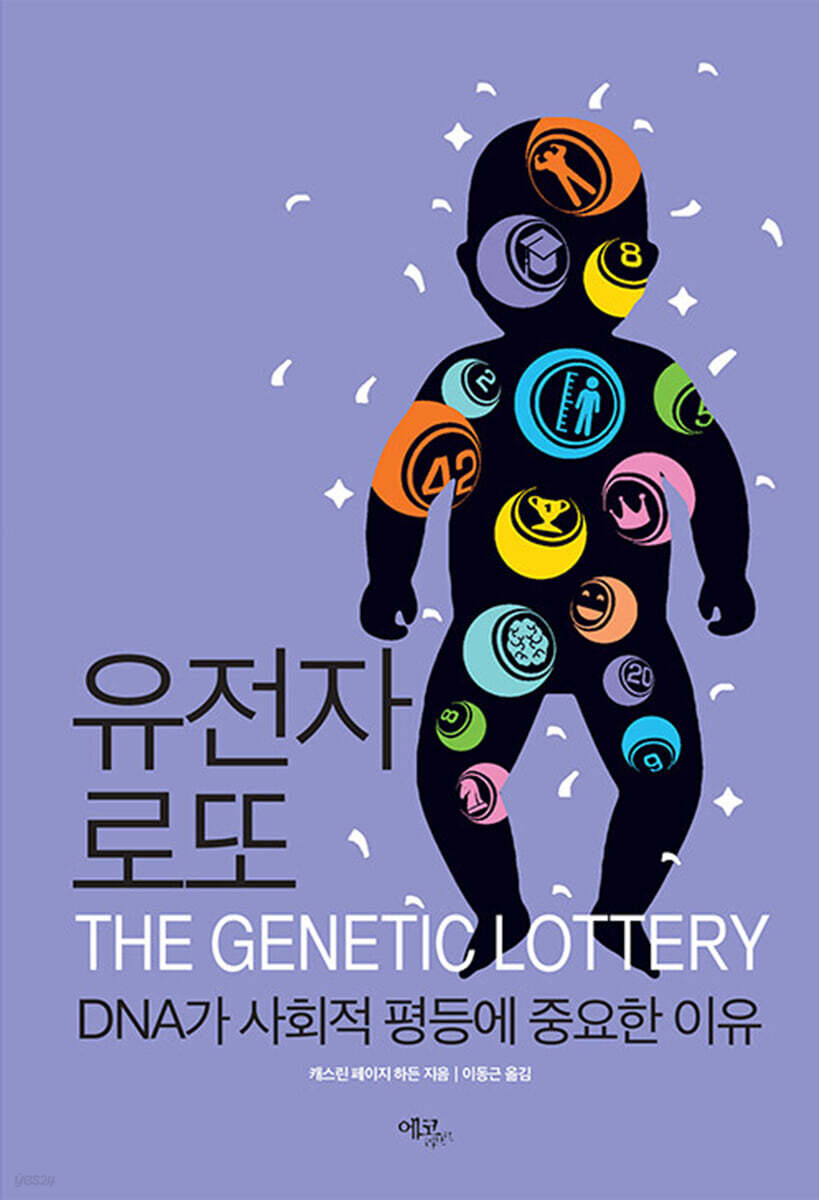
Genetic Lotto
 |
Description
Book Introduction
- A word from MD
-
Let's face it, genes matter.There are misconceptions about genetics because of Nazi eugenics.
But genes are important.
Just as the family you are born into has a great influence on your life, so do your genes.
The key, then, is not to ignore genetics, but to set a direction.
Genetics should aim for equality, not discrimination.
March 10, 2023. Social and Political PD Son Min-gyu
Why Genes Matter for Social Equality
A provocative and timely book that explains why genetics is needed for a more just and equitable society.
Equality is one of the most important issues of the times we live in.
Although people may have different ideas about equality, no one, whether left or right, rejects an equal society.
Therefore, for a more equal society, there needs to be intense discussion and debate on the question of “how can we improve inequality?”
A topic that often comes up when discussing whether inequality is fair or unfair is the concept of “equality of opportunity.”
So what exactly should we consider "opportunity," and what must be in place for opportunity to be equal? Generally, equality of opportunity means that everyone, regardless of their circumstances of birth, has the opportunity to lead a healthy and fulfilling life.
In other words, a society with equal opportunity is one in which the chance of birth does not determine a person's fate.
However, from the perspective of equal opportunity, the various statistics showing the current inequality in our society are extremely miserable.
The same goes for the United States, which is cited as an example in this book.
In 2018, young people from families in the top 25 percent of the income distribution were nearly four times more likely to graduate from college than young people from families in the bottom 25 percent of the income distribution.
Sixty-two percent of wealthy Americans have earned a bachelor's degree by age 24, compared to only 16 percent of poor Americans.
Of course, these data only show correlation, not causation, but in public discussions and academic papers addressing inequality, two facts about these statistics are taken for granted.
First, data on the relationship between the social and environmental conditions in which a child is born and that child's final life outcomes are scientifically useful.
Second, these statistics are morally significant.
When considering the difference between fair and unfair inequality, many people distinguish between unfair inequality as inequality that is tied to the accidents of birth beyond an individual's control, such as being born with privilege or being born into poverty.
But there is another birth coincidence that correlates with adult inequality.
It's not the social environment we're born into, it's our genes.
This is a topic that is dealt with in earnest in this book.
The distribution of the educational polygenic index, which is based on the various DNA mutations that each person has (see Chapter 3 for how to calculate the polygenic index), is not much different from the relationship between family income and college graduation rates.
That is, groups in the top 25 percent of the 'genetic' distribution with a polygenic index were nearly four times more likely to graduate from college than groups in the bottom 25 percent.
Therefore, this book argues that the relationship between genes and educational outcomes is of great empirical and moral importance for understanding inequality in society.
Just as people are born into wealthy or poor families, being born with a particular set of genetic mutations is a result of a birth lottery.
Just as we cannot choose our parents, we cannot choose the environment or genes our parents pass down to us.
The outcome of the genetic lottery is institutional power, much like social class, that dictates who gets more and who gets less in almost every part of society.
A provocative and timely book that explains why genetics is needed for a more just and equitable society.
Equality is one of the most important issues of the times we live in.
Although people may have different ideas about equality, no one, whether left or right, rejects an equal society.
Therefore, for a more equal society, there needs to be intense discussion and debate on the question of “how can we improve inequality?”
A topic that often comes up when discussing whether inequality is fair or unfair is the concept of “equality of opportunity.”
So what exactly should we consider "opportunity," and what must be in place for opportunity to be equal? Generally, equality of opportunity means that everyone, regardless of their circumstances of birth, has the opportunity to lead a healthy and fulfilling life.
In other words, a society with equal opportunity is one in which the chance of birth does not determine a person's fate.
However, from the perspective of equal opportunity, the various statistics showing the current inequality in our society are extremely miserable.
The same goes for the United States, which is cited as an example in this book.
In 2018, young people from families in the top 25 percent of the income distribution were nearly four times more likely to graduate from college than young people from families in the bottom 25 percent of the income distribution.
Sixty-two percent of wealthy Americans have earned a bachelor's degree by age 24, compared to only 16 percent of poor Americans.
Of course, these data only show correlation, not causation, but in public discussions and academic papers addressing inequality, two facts about these statistics are taken for granted.
First, data on the relationship between the social and environmental conditions in which a child is born and that child's final life outcomes are scientifically useful.
Second, these statistics are morally significant.
When considering the difference between fair and unfair inequality, many people distinguish between unfair inequality as inequality that is tied to the accidents of birth beyond an individual's control, such as being born with privilege or being born into poverty.
But there is another birth coincidence that correlates with adult inequality.
It's not the social environment we're born into, it's our genes.
This is a topic that is dealt with in earnest in this book.
The distribution of the educational polygenic index, which is based on the various DNA mutations that each person has (see Chapter 3 for how to calculate the polygenic index), is not much different from the relationship between family income and college graduation rates.
That is, groups in the top 25 percent of the 'genetic' distribution with a polygenic index were nearly four times more likely to graduate from college than groups in the bottom 25 percent.
Therefore, this book argues that the relationship between genes and educational outcomes is of great empirical and moral importance for understanding inequality in society.
Just as people are born into wealthy or poor families, being born with a particular set of genetic mutations is a result of a birth lottery.
Just as we cannot choose our parents, we cannot choose the environment or genes our parents pass down to us.
The outcome of the genetic lottery is institutional power, much like social class, that dictates who gets more and who gets less in almost every part of society.
- You can preview some of the book's contents.
Preview
index
Part 1: Understanding Genetics
01 Entering
02 Genetic Lotto
03 Cookbooks and College
04 Lineage and Race
05 Lotto of Life's Opportunities
06 Random assignment of nature
07 Mysterious Principle
Part 2: Understanding Equality Correctly
08 Possible Alternative Worlds
09 Understanding the acquired using the congenital
10 Personal Responsibility
Differences that do not form 11 layers
12 Anti-Eugenic Science and Policy
Acknowledgements
main
Translator's Note
Search
01 Entering
02 Genetic Lotto
03 Cookbooks and College
04 Lineage and Race
05 Lotto of Life's Opportunities
06 Random assignment of nature
07 Mysterious Principle
Part 2: Understanding Equality Correctly
08 Possible Alternative Worlds
09 Understanding the acquired using the congenital
10 Personal Responsibility
Differences that do not form 11 layers
12 Anti-Eugenic Science and Policy
Acknowledgements
main
Translator's Note
Search
Publisher's Review
Left and Right Attitudes toward Genes and Equality
But there is one thing we must note here.
This is something that must be pointed out when interpreting educational and social inequality and claiming that it is somehow related to genetics.
So, faced with the fact that the genetic lottery creates inequality, what stance should the so-called left and right take to create a more equal society? The right must overcome the dark history of eugenics, while the left must overcome its overemphasis on society's role, which has led to its denial of human differences.
The author may seem to agree with right-wing arguments at first glance by basing his argument on genetic differences, but he is actually a libertarian who wants to make the world more equal.
Harden states that the goal of this book is to reframe “the relationship between genetics and equality.”
Then he asks the following question:
Can we disentangle human behavioral genetics, from Galton's observations that are invariably featured in eugenics to modern genetic studies of intelligence and education, from the racist, classist, and eugenicist ideologies with which it has been intertwined for decades?
-Can we draw a new synthesis?
-Can this new synthesis broaden our understanding of what equality looks like and how we can achieve it?
However, the claim that genetics can be useful in achieving the goal of social equality is often met with skepticism.
The dangers eugenics poses are particularly significant.
On the other hand, the benefits of linking genetics and social inequality seem meager.
Even if genetics and egalitarianism could be combined to form a new synthesis, why take the risk? Given the dark legacy of eugenics in America, it seems optimistic, even naive, to think that genetic research can be understood or used in new ways.
But when considering the risks and benefits, there is something that is being overlooked.
The problem is that most academics and the general public do not understand the principle that genetic differences between people lead to social inequality.
It is dangerous for this situation to continue.
This situation cannot continue any longer.
We are now living in a golden age of genetic research.
We have new technologies that make it easy to collect genetic data from millions of people, and we are rapidly developing new statistical methods to analyze this data.
But simply discovering new genetic knowledge is not enough.
As genetic research moves beyond the ivory tower and into the public sphere, scientists and the public must consider what genetic research means for human identity and equality.
But the task of creating meaning in this way is being hindered by extremely extreme and hateful voices.
Thus, the author, along with Eric Turkheimer and Dick Nisbett, warns:
If those with progressive political values abdicate their responsibility to engage with the science of human abilities and human behavioral genetics, rejecting genetic determinism and scientifically false racist views, the field will be dominated by those who do not share those values.
The goal of this book
What can human behavioral genetics do to achieve social equality and create a better society? To answer this question, the author structures this book as follows.
The first half focuses on explaining the importance of genetics in understanding social inequality.
Of course, there are many counterarguments, but to explain why, we need to look at the detailed research methods of how behavioral genetics research is conducted.
And to understand what was achieved by that method, we must also delve into the philosophy of science.
Chapter 2 further elaborates on the genetic lottery metaphor by presenting life science and statistical concepts such as genetic recombination, polygenic inheritance, and normal distribution.
And throughout Chapter 2 and the book, the focus is on genetic differences among people that arise not by selection through preimplantation genetic diagnosis or other reproductive technologies, but by chance through the natural lottery of genetic inheritance.
Chapter 3 describes common methods for examining how genetic differences among people are associated with differences in life outcomes, specifically genome-wide association studies and polygenic index studies.
Chapter 4 explores why genome-wide association studies fail to explain the causes of group differences, particularly differences between racial groups.
There's a constant stream of books and articles about "innate" racial differences, but these are just meaningless noise and fury.
Rather, genetic research on social inequality, including twin studies and DNA measurements, has recently focused almost entirely on understanding individual differences between people whose genetic lineage is entirely European and who are likely to be classified as purely white.
This narrowing of the scope fundamentally qualifies all the empirical results described in the book.
Current genetic research addressing social and behavioral phenotypes focuses on people of European descent.
Such genetic studies do not provide a scientifically meaningful interpretation of social inequalities between racial and ethnic groups.
But when we consider why people return time and again to the scientifically meaningless question of whether there are genetic differences between races, it reveals how we have abdicated our social responsibility to use genetics to bring about change.
This part is explained in Chapter 4.
Regardless of how genes are distributed within and between socially constructed racial groups, the idea that genetics can absolve us of social responsibility is a false pretext that must be discarded.
Chapter 5 addresses fundamental questions about the results of genome-wide association studies and polygenic index studies.
“Does this study reveal a genetic cause?” To address this question, let’s take a step back and consider a more general question: “What is the cause?”
After clarifying what causation is (and what it does not tell us), Chapter 6 applies the concept of causation to understanding the results of genome-wide association studies and heritability studies.
Here, we review the vast body of evidence supporting the idea that genes are responsible for significant life outcomes, such as educational attainment.
Chapter 7 concludes the first half of the book by explaining what we know about the mechanisms linking genes and education.
In the second half, we explore what we can do with the genetic knowledge that is crucial for understanding social inequality.
What remains if we abandon the eugenics formula that genetic differences form the basis of innately superior and inferior human classes? Chapters 8 and 9 explore how understanding human genetic differences can improve efforts to change the world through social policies and interventions.
Chapter 10 explores why people reject information about the genetic causes of human behavior and considers how blaming genes for luck in life might actually reduce the stigma attached to those who "fail" in education and economics.
Chapter 11 explores why scraping away notions of inferiority and superiority is particularly difficult when it comes to genetically influenced intelligence test scores and educational outcomes.
And we compare how people view genetic research that addresses these psychological aspects with genetic research that addresses other traits, such as hearing impairment or autism.
Finally, Chapter 12 outlines five principles for anti-eugenic science and policy.
The author's left-leaning political leanings are not hidden throughout the book.
The author earnestly hopes that readers of different political persuasions will recognize the importance of the questions raised here, even if they vehemently disagree with the solutions proposed in this book.
Conservative readers would do well to remember that the ancient Greeks, the authors of the Bible, and the Founding Fathers were also preoccupied with the concept of justice.
In an age of accelerating technological change and exponential growth in genetic knowledge, how can we "act justly"? The author believes this is a crucial question for all of us, regardless of political affiliation.
But there is one thing we must note here.
This is something that must be pointed out when interpreting educational and social inequality and claiming that it is somehow related to genetics.
So, faced with the fact that the genetic lottery creates inequality, what stance should the so-called left and right take to create a more equal society? The right must overcome the dark history of eugenics, while the left must overcome its overemphasis on society's role, which has led to its denial of human differences.
The author may seem to agree with right-wing arguments at first glance by basing his argument on genetic differences, but he is actually a libertarian who wants to make the world more equal.
Harden states that the goal of this book is to reframe “the relationship between genetics and equality.”
Then he asks the following question:
Can we disentangle human behavioral genetics, from Galton's observations that are invariably featured in eugenics to modern genetic studies of intelligence and education, from the racist, classist, and eugenicist ideologies with which it has been intertwined for decades?
-Can we draw a new synthesis?
-Can this new synthesis broaden our understanding of what equality looks like and how we can achieve it?
However, the claim that genetics can be useful in achieving the goal of social equality is often met with skepticism.
The dangers eugenics poses are particularly significant.
On the other hand, the benefits of linking genetics and social inequality seem meager.
Even if genetics and egalitarianism could be combined to form a new synthesis, why take the risk? Given the dark legacy of eugenics in America, it seems optimistic, even naive, to think that genetic research can be understood or used in new ways.
But when considering the risks and benefits, there is something that is being overlooked.
The problem is that most academics and the general public do not understand the principle that genetic differences between people lead to social inequality.
It is dangerous for this situation to continue.
This situation cannot continue any longer.
We are now living in a golden age of genetic research.
We have new technologies that make it easy to collect genetic data from millions of people, and we are rapidly developing new statistical methods to analyze this data.
But simply discovering new genetic knowledge is not enough.
As genetic research moves beyond the ivory tower and into the public sphere, scientists and the public must consider what genetic research means for human identity and equality.
But the task of creating meaning in this way is being hindered by extremely extreme and hateful voices.
Thus, the author, along with Eric Turkheimer and Dick Nisbett, warns:
If those with progressive political values abdicate their responsibility to engage with the science of human abilities and human behavioral genetics, rejecting genetic determinism and scientifically false racist views, the field will be dominated by those who do not share those values.
The goal of this book
What can human behavioral genetics do to achieve social equality and create a better society? To answer this question, the author structures this book as follows.
The first half focuses on explaining the importance of genetics in understanding social inequality.
Of course, there are many counterarguments, but to explain why, we need to look at the detailed research methods of how behavioral genetics research is conducted.
And to understand what was achieved by that method, we must also delve into the philosophy of science.
Chapter 2 further elaborates on the genetic lottery metaphor by presenting life science and statistical concepts such as genetic recombination, polygenic inheritance, and normal distribution.
And throughout Chapter 2 and the book, the focus is on genetic differences among people that arise not by selection through preimplantation genetic diagnosis or other reproductive technologies, but by chance through the natural lottery of genetic inheritance.
Chapter 3 describes common methods for examining how genetic differences among people are associated with differences in life outcomes, specifically genome-wide association studies and polygenic index studies.
Chapter 4 explores why genome-wide association studies fail to explain the causes of group differences, particularly differences between racial groups.
There's a constant stream of books and articles about "innate" racial differences, but these are just meaningless noise and fury.
Rather, genetic research on social inequality, including twin studies and DNA measurements, has recently focused almost entirely on understanding individual differences between people whose genetic lineage is entirely European and who are likely to be classified as purely white.
This narrowing of the scope fundamentally qualifies all the empirical results described in the book.
Current genetic research addressing social and behavioral phenotypes focuses on people of European descent.
Such genetic studies do not provide a scientifically meaningful interpretation of social inequalities between racial and ethnic groups.
But when we consider why people return time and again to the scientifically meaningless question of whether there are genetic differences between races, it reveals how we have abdicated our social responsibility to use genetics to bring about change.
This part is explained in Chapter 4.
Regardless of how genes are distributed within and between socially constructed racial groups, the idea that genetics can absolve us of social responsibility is a false pretext that must be discarded.
Chapter 5 addresses fundamental questions about the results of genome-wide association studies and polygenic index studies.
“Does this study reveal a genetic cause?” To address this question, let’s take a step back and consider a more general question: “What is the cause?”
After clarifying what causation is (and what it does not tell us), Chapter 6 applies the concept of causation to understanding the results of genome-wide association studies and heritability studies.
Here, we review the vast body of evidence supporting the idea that genes are responsible for significant life outcomes, such as educational attainment.
Chapter 7 concludes the first half of the book by explaining what we know about the mechanisms linking genes and education.
In the second half, we explore what we can do with the genetic knowledge that is crucial for understanding social inequality.
What remains if we abandon the eugenics formula that genetic differences form the basis of innately superior and inferior human classes? Chapters 8 and 9 explore how understanding human genetic differences can improve efforts to change the world through social policies and interventions.
Chapter 10 explores why people reject information about the genetic causes of human behavior and considers how blaming genes for luck in life might actually reduce the stigma attached to those who "fail" in education and economics.
Chapter 11 explores why scraping away notions of inferiority and superiority is particularly difficult when it comes to genetically influenced intelligence test scores and educational outcomes.
And we compare how people view genetic research that addresses these psychological aspects with genetic research that addresses other traits, such as hearing impairment or autism.
Finally, Chapter 12 outlines five principles for anti-eugenic science and policy.
The author's left-leaning political leanings are not hidden throughout the book.
The author earnestly hopes that readers of different political persuasions will recognize the importance of the questions raised here, even if they vehemently disagree with the solutions proposed in this book.
Conservative readers would do well to remember that the ancient Greeks, the authors of the Bible, and the Founding Fathers were also preoccupied with the concept of justice.
In an age of accelerating technological change and exponential growth in genetic knowledge, how can we "act justly"? The author believes this is a crucial question for all of us, regardless of political affiliation.
GOODS SPECIFICS
- Date of issue: February 24, 2023
- Page count, weight, size: 416 pages | 572g | 148*217*20mm
- ISBN13: 9788962632477
- ISBN10: 8962632470
You may also like
카테고리
korean


korean

![GQ KOREA Mark (Monthly): December [2025]](http://librairie.coreenne.fr/cdn/shop/files/8ef265dbbfbf186523ed75ba7319009d.jpg?v=1765340328&width=3840)


