

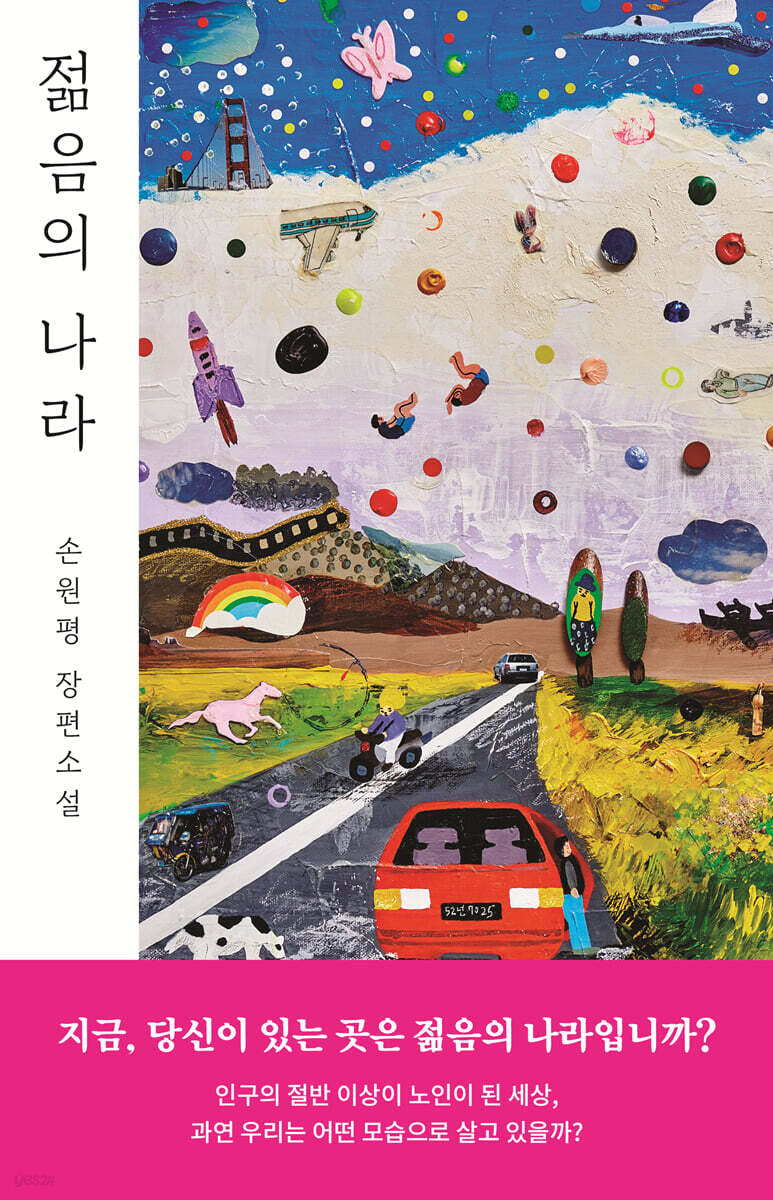
Land of Youth
 |
Description
Book Introduction
- A word from MD
-
Our Future as Drawn by Son Won-pyeong, Author of "Almond"In the near future, South Korea will be a country where the majority of the population is elderly due to low birth rates and an aging population.
Younger generations are being replaced by AI robots and laid off, and competition for jobs with second-generation immigrants is becoming increasingly burdensome.
The protagonist, Nara, struggles to enter Sycamore Island, the paradise of their dreams.
A chilling novel depicting a future that is just around the corner.
August 5, 2025. Novel/Poetry PD Kim Yu-ri
A bestseller with 1.5 million copies sold, published in 30 countries worldwide, and ranked first in the Japan Bookstore Award.
The future of Korea as depicted by Son Won-pyeong, author of Almond.
Will your youth be safe in this "country of the elderly," where low birth rates and an aging population are a reality?
This is a story that should never happen.
But it is also a story that must exist somewhere.
So I hope this story doesn't become your story, but at the same time, I hope it definitely becomes your story.
_From the author's note
Author Wonpyeong Son, who has illuminated the beings on the margins of our society with his sharp gaze and delicate sensibility in works such as "Almond" and "The Thirty Strikes Back," presents "The Land of Youth," a work set in the near future.
This novel depicts various aspects of a future society where the challenges of our time—aging population, low birth rates, the normalization of AI, rapid technological advancements, extreme hatred and discrimination, increasing foreign immigrants, and euthanasia—have become a reality, through the diary of the protagonist, Yu Na-ra.
In the near future, Korea will see the elderly make up the majority of the population due to the effects of low birth rates and an aging population.
The twenty-nine-year-old country is struggling with life being replaced by younger people and machines.
Even the few close relationships one has are not smooth.
Even a three-minute phone call with his mother, his only family, is awkward, and his roommate Elijah uses his status as a second-generation immigrant, a "publicly recognized socially disadvantaged person," as a weapon to upset the nation.
In this lonely reality, Nara is always wondering about the whereabouts of her Aunt Min-a, who was the light of her childhood but is now out of contact.
But even this country has a dream.
The idea is to officially enter Sycamore Island and become an actor.
Sycamore Island, an artificial island created somewhere in the South Pacific, is centered around a strange character named Camilla Redner.
It is a so-called utopia where super-rich seniors from all over the world can enjoy luxurious services and spend their old age, and the young people who provide the services can also enjoy a satisfying life.
But then, by chance, an unexpected opportunity comes to the country.
You will be hired at Yukasiel, the largest senior welfare facility in the country.
Yukasiel has a business agreement with Sycamore Island, so your experience at Yukasiel will be helpful in working at Sycamore Island.
A country where you can enter Yukasiel as a counselor and meet various seniors.
Will she be able to escape her bleak reality and achieve her dreams on Sycamore, the island of hope?
The future of Korea as depicted by Son Won-pyeong, author of Almond.
Will your youth be safe in this "country of the elderly," where low birth rates and an aging population are a reality?
This is a story that should never happen.
But it is also a story that must exist somewhere.
So I hope this story doesn't become your story, but at the same time, I hope it definitely becomes your story.
_From the author's note
Author Wonpyeong Son, who has illuminated the beings on the margins of our society with his sharp gaze and delicate sensibility in works such as "Almond" and "The Thirty Strikes Back," presents "The Land of Youth," a work set in the near future.
This novel depicts various aspects of a future society where the challenges of our time—aging population, low birth rates, the normalization of AI, rapid technological advancements, extreme hatred and discrimination, increasing foreign immigrants, and euthanasia—have become a reality, through the diary of the protagonist, Yu Na-ra.
In the near future, Korea will see the elderly make up the majority of the population due to the effects of low birth rates and an aging population.
The twenty-nine-year-old country is struggling with life being replaced by younger people and machines.
Even the few close relationships one has are not smooth.
Even a three-minute phone call with his mother, his only family, is awkward, and his roommate Elijah uses his status as a second-generation immigrant, a "publicly recognized socially disadvantaged person," as a weapon to upset the nation.
In this lonely reality, Nara is always wondering about the whereabouts of her Aunt Min-a, who was the light of her childhood but is now out of contact.
But even this country has a dream.
The idea is to officially enter Sycamore Island and become an actor.
Sycamore Island, an artificial island created somewhere in the South Pacific, is centered around a strange character named Camilla Redner.
It is a so-called utopia where super-rich seniors from all over the world can enjoy luxurious services and spend their old age, and the young people who provide the services can also enjoy a satisfying life.
But then, by chance, an unexpected opportunity comes to the country.
You will be hired at Yukasiel, the largest senior welfare facility in the country.
Yukasiel has a business agreement with Sycamore Island, so your experience at Yukasiel will be helpful in working at Sycamore Island.
A country where you can enter Yukasiel as a counselor and meet various seniors.
Will she be able to escape her bleak reality and achieve her dreams on Sycamore, the island of hope?
- You can preview some of the book's contents.
Preview
index
january
Sapphire Lake
Sunshine Mountain
New City Field
Ariadne's Garden
Free House
december
Author's Note
Sapphire Lake
Sunshine Mountain
New City Field
Ariadne's Garden
Free House
december
Author's Note
Detailed image

Into the book
January 1st
I decided to live like it was midsummer even in the middle of winter.
January 2nd
There was once a person who was closer to me than family, even though he was not family.
Someone who I don't even know is alive or dead now, but who always holds a big place in my heart.
January 24th
A person who maintains his wealth even in old age.
Such a person is respected.
I don't know if that's something to be respected, but it's undeniable that most respected elders meet that criteria.
February 24th
- They say that everyone lives and everyone dies.
So, I must live and die the way I want.
That's my dream.
Living a simple life and then naturally disappearing one day.
- What kind of dream is that?
- At this age, everyone starts to dream like that.
March 15th
What does it feel like to be a stranger in the land of your birth?
What is the state of mind of a person who has lived on this land from the beginning but cannot be its owner?
I can't help but feel uncomfortable having to be so careful and cautious in caring for immigrants like you.
You can freely express your feelings by using the word discrimination as a weapon, but I have no weapon.
April 5th
If following your dreams makes you unhappy, what purpose is there in living?
April 17th
What do the pitiful numbers that fall to me after counseling, supporting, and trying to please the elderly mean?
Those insignificant numbers seem to be my existence, my calling card, and the rank the world has given me.
April 23rd
- Because hatred breeds more hatred.
And words do not rule thoughts.
The moment you say you hate someone, you start to hate them more than you actually hated them.
April 26th
Can I calmly admit that my last words represent the entirety of my life?
May 6th
People without money live as they did in the past, fading away towards death, living as long as fate allows.
Carrying all the anxiety, fear, and pain on his shoulders.
I asked Jaehee if death wasn't fair to everyone.
But it has been known for a very long time that the form of death reveals a person's class.
May 11th
- Do you know what the biggest pattern in my life is? It's you.
May 29th
- Looks like you don't know yet.
No matter how much science advances, no matter how much labor costs rise, in the end, the cheapest thing in the world is people.
June 8th
- In every heaven there will be shade.
I may not be able to remove all the shadows, but I want to be someone who can provide at least a ray of sunshine.
June 22nd
- The reason you only have good memories of me is because I never had the chance to hurt you.
I decided to live like it was midsummer even in the middle of winter.
January 2nd
There was once a person who was closer to me than family, even though he was not family.
Someone who I don't even know is alive or dead now, but who always holds a big place in my heart.
January 24th
A person who maintains his wealth even in old age.
Such a person is respected.
I don't know if that's something to be respected, but it's undeniable that most respected elders meet that criteria.
February 24th
- They say that everyone lives and everyone dies.
So, I must live and die the way I want.
That's my dream.
Living a simple life and then naturally disappearing one day.
- What kind of dream is that?
- At this age, everyone starts to dream like that.
March 15th
What does it feel like to be a stranger in the land of your birth?
What is the state of mind of a person who has lived on this land from the beginning but cannot be its owner?
I can't help but feel uncomfortable having to be so careful and cautious in caring for immigrants like you.
You can freely express your feelings by using the word discrimination as a weapon, but I have no weapon.
April 5th
If following your dreams makes you unhappy, what purpose is there in living?
April 17th
What do the pitiful numbers that fall to me after counseling, supporting, and trying to please the elderly mean?
Those insignificant numbers seem to be my existence, my calling card, and the rank the world has given me.
April 23rd
- Because hatred breeds more hatred.
And words do not rule thoughts.
The moment you say you hate someone, you start to hate them more than you actually hated them.
April 26th
Can I calmly admit that my last words represent the entirety of my life?
May 6th
People without money live as they did in the past, fading away towards death, living as long as fate allows.
Carrying all the anxiety, fear, and pain on his shoulders.
I asked Jaehee if death wasn't fair to everyone.
But it has been known for a very long time that the form of death reveals a person's class.
May 11th
- Do you know what the biggest pattern in my life is? It's you.
May 29th
- Looks like you don't know yet.
No matter how much science advances, no matter how much labor costs rise, in the end, the cheapest thing in the world is people.
June 8th
- In every heaven there will be shade.
I may not be able to remove all the shadows, but I want to be someone who can provide at least a ray of sunshine.
June 22nd
- The reason you only have good memories of me is because I never had the chance to hurt you.
--- From the text
Publisher's Review
This book is a prophetic book!
How will we support the rapidly growing elderly population, and who will care for them? How will immigrants, filling the job gaps caused by population decline and aging, transform Korean society? What will the future hold for young people, who will become a minority voter, lose their political voice, and be forced to compete with artificial intelligence?
The future that researchers like me envision is a hazy world built like a skeleton with dry statistical blocks.
Readers of this book will have the wondrous experience of having their literary imagination filled with the colors of that world and the people who live within it.
The future in the novel contains a virtual reality that has not yet been realized, but it is surprisingly neither unfamiliar nor awkward.
Because if the changes in our society that are currently underway continue, this is the world our children will likely live in.
A true prophet is not one who foresees the future, but one who sees and criticizes the present.
He is a man who truly hopes that his voice calling for destruction will be heard, that the present will change, and that his predictions about the future will be proven wrong.
In that sense, this novel comes to me as a prophecy.
- From the 'Recommendation' by Lee Cheol-hee (Professor of Economics, Seoul National University / Director of the Population Cluster, Institute for National Future Strategy, Seoul National University)
Always an anxious name, young man
"The Land of Youth" depicts the diverse aspects of a future Korea where an aging population has become a reality, with the vast majority of elderly people and the minority group of young people.
Overflowing with wealth, entrepreneurs and celebrities from around the world spend their dreamy later years on Sycamore Island in the South Pacific, a place created by the mysterious Camilla Redner, where they receive special treatment from young people.
In Korea, most elderly people enter residential facilities operated by the private foundation Yukasiel, a government-designated company.
Yukasiel is operated by grading units from A to F, and you must have the appropriate financial ability to enter each unit.
In particular, the elderly in Unit F are required to work, and if they do not do so, they will be expelled.
Of course, you can also choose to take care of yourself without going into these nursing homes.
Meanwhile, the lives of the young generation, contrasting with those of the elderly, are also important points to note in this novel.
A country that closely resembles today's anxious youth: Elijah, a second-generation immigrant who works as a nurse at a nursing home for the elderly and actively participates in anti-gerontological rallies; Jaehee, an elite doctor who earns a high salary and practices elective death (a system that allows elderly people with clear identities and sufficient means to legally choose death); and Suhyeon, an illegal elective death broker who came down from the North after the opening of the country.
It is an interesting portrayal of young people moving towards a new future in their own way to survive in a society of, for, and by the elderly.
A name that is always valid across time, family
The word family always leaves me with a feeling of confusion.
Now, the only person in the world I can call family is my mother.
-In the text
In 『The Land of Youth』, not only is the conflict between generations permeating the entire work, but family relationships also appear as an important element.
At twenty-nine, Nara's only family is her awkward mother, but as a child, she had an 'alicorn'-like Aunt Min-a who inspired her to dream of becoming an actress and introduced her to the world.
Aunt Min-a, Nara, and Nara's mother, Eugene, are not related by blood, but they share a bond that is even stronger than that.
However, when her father, her real family, appears, Aunt Min-a, who was a kind of pseudo-family member, disappears.
This novel questions what family is, explores the relationships we have with those we care about, and demonstrates that restoring genuine relationships can be a key to solving the problems facing future society.
In particular, it has great implications for us living in the present day, as it allows us to look into the conflicts and overcoming processes between family members that anyone can experience regardless of time.
Death as a means of revealing class
There is widespread criticism of the elderly who choose to live as long as life allows without scheduling their death in advance.
In common parlance, there are many people who look at the elderly with the thought, 'Why are you still alive? Just die quickly.'
-In the text
This novel is set in a near-future society where aging has reached an extreme, and deals head-on with the sensitive topic of "selective death," currently referred to as euthanasia or death with dignity.
The author suggests that future elective systems, while seemingly designed to guarantee individual autonomy and dignity, are in fact designed for social efficiency and cost savings.
Can institutionalizing human death and granting the power of choice within it truly be considered dignified? Rather than providing an answer, "The Land of Youth" exposes the inconvenient structure in detail, leading readers to enter a space of ethical judgment and reflection.
This allows readers to perceive the choice as not just one of the hypothetical settings of a future society, but as a problem worth thinking about in relation to reality.
Youthful challenges, old age comes to everyone
I admit that I have perceived the elderly as simply 'people in a state of old age'.
But gradually I came to realize.
The fact that they too were once me.
-In the text
The author allows the nation to experience all of Yukasiel's units, which naturally leads to a change in the nation's thoughts on the elderly.
And it's dramatic in that it has the nation's voice directly revealed in the Sycamore Island job interview how and to what extent the nation has awakened.
Thanks to the nation's confession, readers gain clues on how to overcome social problems such as the generational conflict between the elderly and the young, human versus technology, native versus immigrant, and the class conflict arising from capitalism.
Moreover, even if the future is heavily dystopian, it gives us hope that it can lead to different endings depending on our perspective.
The 'country of youth' we should be dreaming of
There was a time when I wanted to erase everything and go there.
But now I know my roots are firmly planted here.
So, wouldn't it be possible to step into the unknown world and branch out?
I don't know if it will be beautiful or ugly, if my choice will be fortunate or if it will leave me with regret.
-In the text
"The Land of Youth" presents a utopia not as a perfect paradise, but as a space for experimenting with its possibilities.
Sycamore Island in the work has structural limitations, but through the process of various generations and classes coming together to create their own order, it makes us reconsider the concept of 'ideal'.
That is, Sycamore Island is certainly imperfect, but within it lies the way humans care for each other, solidarity with others, art, and dreams.
By not presenting the utopia in the work as a complete entity, but rather as a process of moving toward possibility, the author makes us realize that even in imperfection, the individual's will to understand others and to continue making meaningful attempts is important.
Personal records and diaries that testify to the times
Will something new happen this year? (…) Where will I be and what will I be doing that day? Will things be better than they are now?
I hope so.
That's why I'm writing my diary with that hope.
-In the text
"The Land of Youth" is a narrative experiment that interweaves inner confessions and observations of the external world through the format of a "diary."
The device of the diary gives the work a consistent sense of time, while at the same time allowing the reader to directly encounter the country's hidden inner self through raw, unrefined language.
Moreover, the daily life recorded by the nation goes beyond a space for simply expressing personal feelings and develops into a record of a cross-section of the times experienced by a young man.
In other words, the country's difficult reality does not end with feelings of exhaustion or disillusionment, but is transformed into a fervent hope for the world.
The country's diary gradually becomes a kind of testimony.
Accordingly, in order to solve problems such as the instability of labor endured by the younger generation, humans being replaced by machines, and family and generational conflicts, it is emphasized that not only individual awakening but also empathy and solidarity among all those living in the same era are necessary.
How will we support the rapidly growing elderly population, and who will care for them? How will immigrants, filling the job gaps caused by population decline and aging, transform Korean society? What will the future hold for young people, who will become a minority voter, lose their political voice, and be forced to compete with artificial intelligence?
The future that researchers like me envision is a hazy world built like a skeleton with dry statistical blocks.
Readers of this book will have the wondrous experience of having their literary imagination filled with the colors of that world and the people who live within it.
The future in the novel contains a virtual reality that has not yet been realized, but it is surprisingly neither unfamiliar nor awkward.
Because if the changes in our society that are currently underway continue, this is the world our children will likely live in.
A true prophet is not one who foresees the future, but one who sees and criticizes the present.
He is a man who truly hopes that his voice calling for destruction will be heard, that the present will change, and that his predictions about the future will be proven wrong.
In that sense, this novel comes to me as a prophecy.
- From the 'Recommendation' by Lee Cheol-hee (Professor of Economics, Seoul National University / Director of the Population Cluster, Institute for National Future Strategy, Seoul National University)
Always an anxious name, young man
"The Land of Youth" depicts the diverse aspects of a future Korea where an aging population has become a reality, with the vast majority of elderly people and the minority group of young people.
Overflowing with wealth, entrepreneurs and celebrities from around the world spend their dreamy later years on Sycamore Island in the South Pacific, a place created by the mysterious Camilla Redner, where they receive special treatment from young people.
In Korea, most elderly people enter residential facilities operated by the private foundation Yukasiel, a government-designated company.
Yukasiel is operated by grading units from A to F, and you must have the appropriate financial ability to enter each unit.
In particular, the elderly in Unit F are required to work, and if they do not do so, they will be expelled.
Of course, you can also choose to take care of yourself without going into these nursing homes.
Meanwhile, the lives of the young generation, contrasting with those of the elderly, are also important points to note in this novel.
A country that closely resembles today's anxious youth: Elijah, a second-generation immigrant who works as a nurse at a nursing home for the elderly and actively participates in anti-gerontological rallies; Jaehee, an elite doctor who earns a high salary and practices elective death (a system that allows elderly people with clear identities and sufficient means to legally choose death); and Suhyeon, an illegal elective death broker who came down from the North after the opening of the country.
It is an interesting portrayal of young people moving towards a new future in their own way to survive in a society of, for, and by the elderly.
A name that is always valid across time, family
The word family always leaves me with a feeling of confusion.
Now, the only person in the world I can call family is my mother.
-In the text
In 『The Land of Youth』, not only is the conflict between generations permeating the entire work, but family relationships also appear as an important element.
At twenty-nine, Nara's only family is her awkward mother, but as a child, she had an 'alicorn'-like Aunt Min-a who inspired her to dream of becoming an actress and introduced her to the world.
Aunt Min-a, Nara, and Nara's mother, Eugene, are not related by blood, but they share a bond that is even stronger than that.
However, when her father, her real family, appears, Aunt Min-a, who was a kind of pseudo-family member, disappears.
This novel questions what family is, explores the relationships we have with those we care about, and demonstrates that restoring genuine relationships can be a key to solving the problems facing future society.
In particular, it has great implications for us living in the present day, as it allows us to look into the conflicts and overcoming processes between family members that anyone can experience regardless of time.
Death as a means of revealing class
There is widespread criticism of the elderly who choose to live as long as life allows without scheduling their death in advance.
In common parlance, there are many people who look at the elderly with the thought, 'Why are you still alive? Just die quickly.'
-In the text
This novel is set in a near-future society where aging has reached an extreme, and deals head-on with the sensitive topic of "selective death," currently referred to as euthanasia or death with dignity.
The author suggests that future elective systems, while seemingly designed to guarantee individual autonomy and dignity, are in fact designed for social efficiency and cost savings.
Can institutionalizing human death and granting the power of choice within it truly be considered dignified? Rather than providing an answer, "The Land of Youth" exposes the inconvenient structure in detail, leading readers to enter a space of ethical judgment and reflection.
This allows readers to perceive the choice as not just one of the hypothetical settings of a future society, but as a problem worth thinking about in relation to reality.
Youthful challenges, old age comes to everyone
I admit that I have perceived the elderly as simply 'people in a state of old age'.
But gradually I came to realize.
The fact that they too were once me.
-In the text
The author allows the nation to experience all of Yukasiel's units, which naturally leads to a change in the nation's thoughts on the elderly.
And it's dramatic in that it has the nation's voice directly revealed in the Sycamore Island job interview how and to what extent the nation has awakened.
Thanks to the nation's confession, readers gain clues on how to overcome social problems such as the generational conflict between the elderly and the young, human versus technology, native versus immigrant, and the class conflict arising from capitalism.
Moreover, even if the future is heavily dystopian, it gives us hope that it can lead to different endings depending on our perspective.
The 'country of youth' we should be dreaming of
There was a time when I wanted to erase everything and go there.
But now I know my roots are firmly planted here.
So, wouldn't it be possible to step into the unknown world and branch out?
I don't know if it will be beautiful or ugly, if my choice will be fortunate or if it will leave me with regret.
-In the text
"The Land of Youth" presents a utopia not as a perfect paradise, but as a space for experimenting with its possibilities.
Sycamore Island in the work has structural limitations, but through the process of various generations and classes coming together to create their own order, it makes us reconsider the concept of 'ideal'.
That is, Sycamore Island is certainly imperfect, but within it lies the way humans care for each other, solidarity with others, art, and dreams.
By not presenting the utopia in the work as a complete entity, but rather as a process of moving toward possibility, the author makes us realize that even in imperfection, the individual's will to understand others and to continue making meaningful attempts is important.
Personal records and diaries that testify to the times
Will something new happen this year? (…) Where will I be and what will I be doing that day? Will things be better than they are now?
I hope so.
That's why I'm writing my diary with that hope.
-In the text
"The Land of Youth" is a narrative experiment that interweaves inner confessions and observations of the external world through the format of a "diary."
The device of the diary gives the work a consistent sense of time, while at the same time allowing the reader to directly encounter the country's hidden inner self through raw, unrefined language.
Moreover, the daily life recorded by the nation goes beyond a space for simply expressing personal feelings and develops into a record of a cross-section of the times experienced by a young man.
In other words, the country's difficult reality does not end with feelings of exhaustion or disillusionment, but is transformed into a fervent hope for the world.
The country's diary gradually becomes a kind of testimony.
Accordingly, in order to solve problems such as the instability of labor endured by the younger generation, humans being replaced by machines, and family and generational conflicts, it is emphasized that not only individual awakening but also empathy and solidarity among all those living in the same era are necessary.
GOODS SPECIFICS
- Date of issue: August 8, 2025
- Page count, weight, size: 292 pages | 138*214*20mm
- ISBN13: 9791198363596
- ISBN10: 1198363592
You may also like
카테고리
korean


korean

![GQ KOREA Mark (Monthly): December [2025]](http://librairie.coreenne.fr/cdn/shop/files/8ef265dbbfbf186523ed75ba7319009d.jpg?v=1765340328&width=3840)


