

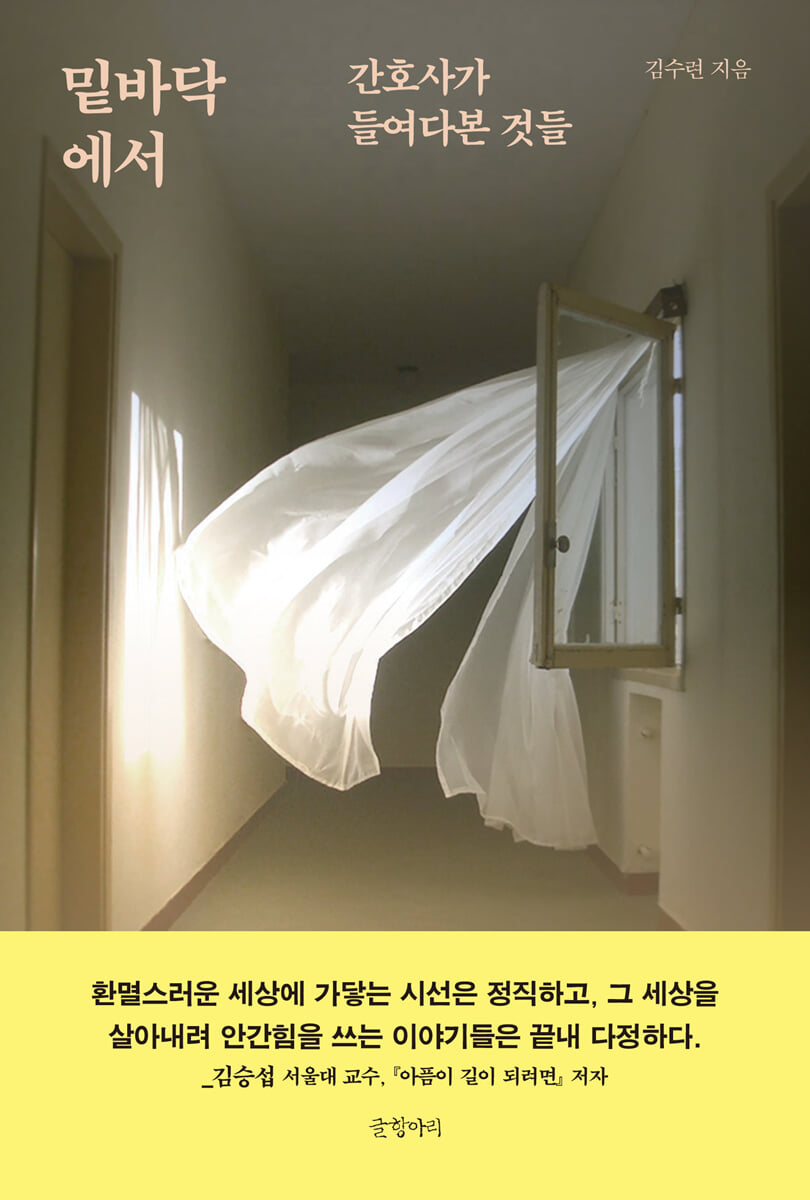
From the bottom
 |
Description
Book Introduction
I am Kim Su-ryeon. Born in 1991 The character for outstanding skill is 秀, which means to train. I am a nurse working in the intensive care unit. This is a record of my experiences as a nurse for seven years. “As a nurse with substance, I have a duty to break the silence.” There is one person here. He worked as a nurse in the intensive care unit of a large hospital in Seoul for seven years. He published a book called "From the Bottom." The sentence above is precisely why the author wrote the book. The experiences he wrote about as a nurse are rarely revealed before. He defined himself as a bottom-tier being. The floor is dirty, deep and dark. He was afraid that people would dislike his own voice echoing from the floor, but he put the megaphone to his mouth, fearing that the despair would continue for the rest of his life. The sound spreads far and deep. Through his honest and affectionate writing. |
- You can preview some of the book's contents.
Preview
index
Recommended Preface: Thoroughly Collapsed_Kang Kyung-hwa, Professor, College of Nursing, Hallym University
Recommended Preface: What Comes Back When You Ignore Reality_Professor Choi Kyu-jin, Inha University College of Medicine
Opening the door—there's a voice here
Entering
Chapter 1
From the bottom
Wasps
Small, pretty, and trivial things
swirl
gill
Chapter 2
mina
About my father
Glory and Time
affair
Unspeakable
The Shape of Death
Half-human, half-beast and empathy: Our hearts must be empty.
Words that could not be said
Chapter 3
Sitting quietly by the river
Statement (Nurse Park Seon-wook: Problems with the Preceptor System)
Report of an accident in the hospital
The wolf appeared
Closing the door─and yet
Recommended Preface: What Comes Back When You Ignore Reality_Professor Choi Kyu-jin, Inha University College of Medicine
Opening the door—there's a voice here
Entering
Chapter 1
From the bottom
Wasps
Small, pretty, and trivial things
swirl
gill
Chapter 2
mina
About my father
Glory and Time
affair
Unspeakable
The Shape of Death
Half-human, half-beast and empathy: Our hearts must be empty.
Words that could not be said
Chapter 3
Sitting quietly by the river
Statement (Nurse Park Seon-wook: Problems with the Preceptor System)
Report of an accident in the hospital
The wolf appeared
Closing the door─and yet
Detailed image
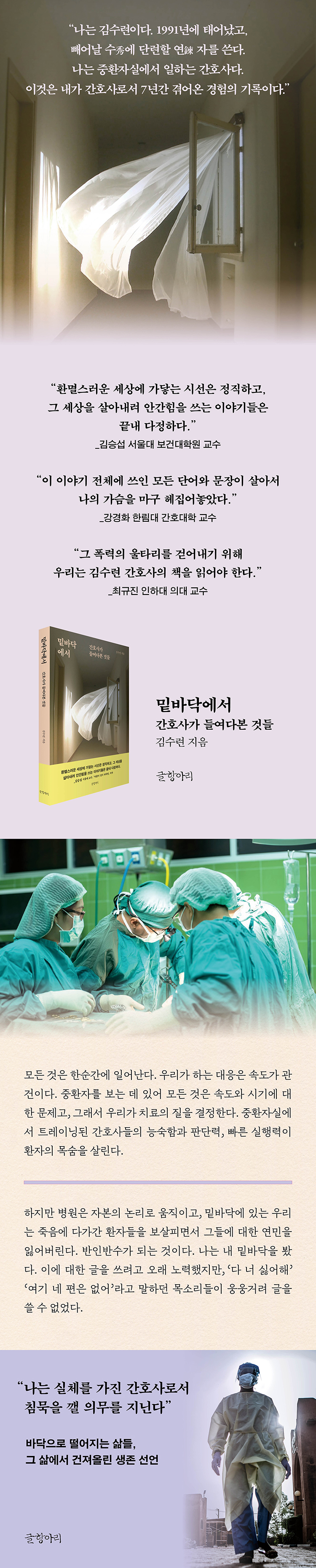
Into the book
I want to talk about the days I spent.
About living, even if it's so shabby and a mess.
In the past, I was nitpicking and being unhappy over trivial things every day, and many days were crumpled and tattered because of my fault.
Nevertheless, one day it shone like sunshine.
I wanted to talk about that.
--- p.21
The intern said he would write a prescription, but if he didn't, I had to call him again.
The interns were busy too.
There were times when I couldn't get a prescription because I had to go into the operating room or MRI room, and there were times when the prescription wasn't given until the end of my shift.
I had to make a lot of phone calls and fuss until I got my prescription.
Interns often gave incorrect prescriptions.
It was their first time, just like it was my first time.
I had to call them to get it corrected, and the prescriptions they gave me were often wrong, including the dosage.
Little things kept getting tangled up and piling up.
--- pp.30~31
I wonder if I wasn't even human to you.
Or maybe I did something terrible without knowing it? (…) If I hadn't spent time with you, what kind of person would I be?
It's painful to imagine that.
My mind would have been healthier, and I would never have thought about what the edge of a cliff would look like.
But this assumption is meaningless.
These things have passed me by, and my heart is like a soft clay tablet. No matter how many happy things happen, the things that have scratched me and passed by cannot be erased.
Do you remember 2017? What a year it was for you, what you did those days? I lived with death those days.
--- pp.69~70
I must confess that I feel a sense of indebtedness towards my writing.
My writing was not honest about those senseless deaths.
I couldn't really capture what happened inside.
The things I have written about on the ground are all a collection of memories from a few times when the manpower situation was the best and material support was not bad.
(…) My writing is like a white sheet covered over a mangled corpse.
(…) We couldn’t even run as fast as we wanted.
It's not that we don't work hard, it's that we don't have enough nurses and they're not trained.
No matter how hard I tried, no matter how much I exhausted myself every day, I just couldn't reach them, so I lost patients in vain.
I couldn't write them down.
I am not even being honest in this post.
I hope the patient's family never knows the edge of death.
No, you need to know.
I want them to know that their deaths were suspicious, that under different circumstances there might have been some possibility, and that these deaths were therefore not respected.
--- pp.150~151
And there is one more element.
It's a headcount.
No matter how much experience a nurse has, if there are too few nurses compared to the number of patients, everyone in the intensive care unit will be in a difficult situation.
Our job is to closely monitor and respond quickly, but if each person has to see more patients, attention decreases and fatigue increases rapidly.
Nurses, who often work long hours without regular breaks, make more mistakes and often miss important signs as fatigue builds up.
It is sometimes fatal.
So the patient-to-nurse ratio shows a very clear correlation with patient mortality.
For every additional patient per nurse, the patient's mortality rate increases by 7 percent.
If you add one more patient to your charge, it's 14 percent, and if you add one more patient from there, it's 31 percent.
This number increases endlessly.
About living, even if it's so shabby and a mess.
In the past, I was nitpicking and being unhappy over trivial things every day, and many days were crumpled and tattered because of my fault.
Nevertheless, one day it shone like sunshine.
I wanted to talk about that.
--- p.21
The intern said he would write a prescription, but if he didn't, I had to call him again.
The interns were busy too.
There were times when I couldn't get a prescription because I had to go into the operating room or MRI room, and there were times when the prescription wasn't given until the end of my shift.
I had to make a lot of phone calls and fuss until I got my prescription.
Interns often gave incorrect prescriptions.
It was their first time, just like it was my first time.
I had to call them to get it corrected, and the prescriptions they gave me were often wrong, including the dosage.
Little things kept getting tangled up and piling up.
--- pp.30~31
I wonder if I wasn't even human to you.
Or maybe I did something terrible without knowing it? (…) If I hadn't spent time with you, what kind of person would I be?
It's painful to imagine that.
My mind would have been healthier, and I would never have thought about what the edge of a cliff would look like.
But this assumption is meaningless.
These things have passed me by, and my heart is like a soft clay tablet. No matter how many happy things happen, the things that have scratched me and passed by cannot be erased.
Do you remember 2017? What a year it was for you, what you did those days? I lived with death those days.
--- pp.69~70
I must confess that I feel a sense of indebtedness towards my writing.
My writing was not honest about those senseless deaths.
I couldn't really capture what happened inside.
The things I have written about on the ground are all a collection of memories from a few times when the manpower situation was the best and material support was not bad.
(…) My writing is like a white sheet covered over a mangled corpse.
(…) We couldn’t even run as fast as we wanted.
It's not that we don't work hard, it's that we don't have enough nurses and they're not trained.
No matter how hard I tried, no matter how much I exhausted myself every day, I just couldn't reach them, so I lost patients in vain.
I couldn't write them down.
I am not even being honest in this post.
I hope the patient's family never knows the edge of death.
No, you need to know.
I want them to know that their deaths were suspicious, that under different circumstances there might have been some possibility, and that these deaths were therefore not respected.
--- pp.150~151
And there is one more element.
It's a headcount.
No matter how much experience a nurse has, if there are too few nurses compared to the number of patients, everyone in the intensive care unit will be in a difficult situation.
Our job is to closely monitor and respond quickly, but if each person has to see more patients, attention decreases and fatigue increases rapidly.
Nurses, who often work long hours without regular breaks, make more mistakes and often miss important signs as fatigue builds up.
It is sometimes fatal.
So the patient-to-nurse ratio shows a very clear correlation with patient mortality.
For every additional patient per nurse, the patient's mortality rate increases by 7 percent.
If you add one more patient to your charge, it's 14 percent, and if you add one more patient from there, it's 31 percent.
This number increases endlessly.
--- pp.200~201
Publisher's Review
24 hours, every second gnaws at them
The nurses work in three shifts.
On his work days, he wakes up at 3 a.m.
When I first started, I either slept lightly all night or couldn't sleep at all.
It was 4 o'clock when I got out of the blanket that was like a jar and arrived at the hospital.
Look at the computer and check and write down the patient's medical history and current condition.
At 5 o'clock, I enter the ward, change with the night shift workers, and count the number of items compared to the number of treatments.
40 short 20-gauge intravenous vinca catheters, 40 short 22-gauge catheters, 2 18-French Foley catheters, 5 16-French catheters, 10 transparent tapes…
Items are often out of order or things like scissors are missing, so he searches through trash cans that are a mixture of soiled diapers and phlegm-stained toilet paper.
The handover will be received before 6 o'clock.
The handover speed is so fast that it's nerve-wracking and mistakes are bound to happen.
After the handover is complete, the patient's condition is checked from head to toe.
Count the number of pills and administer the morning medication.
Check the remaining amount of drug being administered intravenously.
Check the drainage tube, catheter, patient's skin and sputum condition, ventilator and dialysis machine dosage, and thermometer batteries.
Unfortunately, something always goes wrong with one of these, and if you miss it, things can go wrong in a cascade.
Meanwhile, guardians call and ask for an explanation of the patient's condition.
Here's a list of things to do for each duty:
Medication, patient positioning, oral care, suction, specimen testing, prescription processing, electric and room preparation…
If there is an abnormality in the test results, the resident should be called to inform them, but they often answer the phone or hang up mid-call.
Nurses are always following residents around like debt collectors.
Meanwhile, the patient may suddenly vomit blood in the urine, the ventilator circuit may become disconnected, or the jack that attaches the monitor may become loose, causing an alarm to sound.
If you forget to call the resident again at the end of your shift, you will be required to fill out a 'Proximity Error Report'.
It's a kind of statement of affairs.
The daily life of many nurses is like a tangled thread.
Everything suddenly becomes tangled.
There's not enough power to plug in a bunch of pumps, and if you delay for a moment, the battery alarm goes off. If a patient coughs and you answer the phone first, the ventilator circuit gets dirty with phlegm. If you administer the drug to put the patient to sleep first because the concentration is low, the patient starts thrashing and the line leaks.
While waiting for the blood test results to mix the missing electrolytes into the dialysis fluid to be connected to the dialysis machine, other things come up in the meantime, so they rush over and mix the electrolytes. While they are mixing the electrolytes, an alarm goes off to tell them that the medication that puts other patients to sleep is running out.
Nurses who care for patients' lives often make mistakes because they are overworked and in a rush.
After handing over, the senior nurses' anger awaits because of the inaccurate handling of the work.
The overwhelming weight of a task can manifest itself in imperfect performance, and those who look at their mistakes daily like a mirror become adept at self-deprecation.
'Yes, I am a person without answers.
He's a nobody.
'I'm a mess, by nature.' Then, as he wanders through the dark streets, he slaps himself.
A crushing system, forced sorrow
The above content is the author's daily experience as a new nurse.
He wrote that in his 20s, “as I grew older, I sometimes thought about death.”
Those days are long gone, but for the sake of future generations who are facing the same daily lives as I did back then, I dig into memories, delve into the hospital system, and uncover the root causes of the harm and harassment we inflict on each other.
The harassment from the nurses at that time took many forms.
When the author got conjunctivitis, he told him not to pretend to be sick, and one day he dragged him to the linen closet and threatened him, saying, "I'm going to treat you like you don't exist anymore."
'There's no one on your side here.
'Everyone hates you!' A senior hit his back with the palm of his hand.
He also dragged me around by the back of my neck and embarrassed me in front of my patients.
This is a form of violence commonly referred to among nurses as “burning culture” (although the author objects to this term).
The author cannot forget 2017.
I knew I was a person with many limitations, but that year, one of my senior nurses was unbearably harsh (of course, many of my other seniors were kind and generous people).
At the time, the author was suffering from severe depression due to overwork and had trouble sleeping.
But in reality, which was like a riverbed, if I tried to stick my head out of the water with all my might, it felt like my senior's foot was stepping on me and pushing me into the water.
When I read the obituary of nurse Park Seon-wook, who ended her life by so-called 'burning' at that time, the author thought that I could have been that person.
The book also details the cruel and tragic consequences of the hierarchical structure of doctors and nurses.
Much of the nurses' work requires a doctor's decision, and the residents, being busy in their own way, often failed to answer calls or respond to texts.
Problems that arise from this lack of communication between doctors and nurses are often the responsibility of the nurses, who often write near miss reports.
Furthermore, these nurses tremble in fear and confess to the sexual harassment and sexual assault by doctors that are so blatant.
Although he was a sexually harassing doctor, there were many times when I couldn't do my job without his help.
Fearing that, they often kept their mouths shut.
This is all violence that comes from the system.
The cause can only be identified by looking up from the nurse's seat.
The author points out the problems of the hospital system, which continues to delay recruiting nurses and operates solely according to capitalist logic, through detailed statistics and data.
We also want to save patients
There was a patient.
He underwent kidney cancer surgery and was transferred to the intensive care unit. While regaining consciousness, his blood pressure dropped slightly.
The patient seemed to be in pain and annoyed when the nurse in charge opened the dressing to check the surgical site and then put it back on.
So I suddenly hit the nurse in the face.
There was another patient.
He had come in with a blocked blood vessel in the bleeding area due to intra-abdominal bleeding.
The nurse told him not to move because the right femoral artery where the sheath was inserted should not be flexed, but he continued to move.
When the nurse applied a restraint with the patient's right leg extended for safety, the patient became angry and spat on a tissue and threw it on the floor.
When the nurse lifted the trash can onto the bed, he hit it and dropped it on the floor.
“Hey, you do some chores.” There was also a patient like this.
He asked for cold water, but the water the nurse gave him didn't seem cold enough.
He said, throwing the glass of water.
“Come back again.
“Is this cold water to you? Do you think I’m an idiot?” the author says.
“Our job is to take care of the smallest human needs and the most messy things.
That's holistic nursing.
But do we really have to be looked down on and even become targets of anger?” Nurses always want to empathize with patients, even though their backs and wrists are damaged from changing their positions and moving them.
But it's not easy.
One day, a junior said in distress.
“I feel like I start to see patients as objects.
“It’s just so hard and I keep getting sullen.”
“Hospitals seem to want nurses to be machines, but we are human beings with delicate emotions,” the author says.
So, I have no choice but to raise my voice and make demands at the hospital.
Nurses say they can be kinder and more generous to their patients when they are less busy, less tired, and less miserable.
To do that, we need to hire more nurses.
There have been dozens of opportunities to enact such laws.
But the government and hospitals missed that, so nurses feel like they are half human, half beast, unable to empathize with their patients.
In the spring of 2020, during the first wave of the pandemic, the author was dispatched to an intensive care unit in Daegu, caring for COVID-19 patients.
All the patients she cared for there died without exception.
At this she speaks more loudly.
"The government should expand public hospital beds." This means that the government should operate essential medical areas, such as infectious disease and trauma care, that are not profitable but essential.
Nurses, who must be at the forefront of patients' lives, constantly monitoring their condition and acting quickly, leave the hospital completely exhausted at every moment.
In 2020, nurses who sacrificed their lives in fear appealed for safety and increased staffing, but their voices were silenced.
Even now, nurses, who number only one-third of the OECD average, manage five times as many hospital beds as the OECD average.
They are always exploited, busy and tired.
The patient-to-nurse ratio shows a very strong correlation with patient mortality.
For every additional patient per nurse, the patient's mortality rate increases by 7 percent.
If you add one more patient to your charge, it's 14 percent, and if you add one more patient from there, it's 31 percent.
This number increases endlessly.
This percentage itself is someone's life.
Most people don't know exactly what a nurse does.
In this book, the authors explain in detail what they do other than giving injections, cleaning up after patients, and washing their hands and feet.
They are on the front lines responding to patients where speed is of the essence.
When it comes to caring for critically ill patients, it's all about speed and timing, and that's why nurses determine the quality of care.
Patients' lives often depend on the skill, judgment, and quick execution of trained nurses.
However, as this book points out, the preceptor-preceptee training system for nurses remains a chronic problem, and various institutional difficulties are causing them to quit.
Any of us can become a patient.
There is a possibility that all of us who are brought to hospitals today will pay the price for the hospital, the state, and society silencing nurses.
The nurses work in three shifts.
On his work days, he wakes up at 3 a.m.
When I first started, I either slept lightly all night or couldn't sleep at all.
It was 4 o'clock when I got out of the blanket that was like a jar and arrived at the hospital.
Look at the computer and check and write down the patient's medical history and current condition.
At 5 o'clock, I enter the ward, change with the night shift workers, and count the number of items compared to the number of treatments.
40 short 20-gauge intravenous vinca catheters, 40 short 22-gauge catheters, 2 18-French Foley catheters, 5 16-French catheters, 10 transparent tapes…
Items are often out of order or things like scissors are missing, so he searches through trash cans that are a mixture of soiled diapers and phlegm-stained toilet paper.
The handover will be received before 6 o'clock.
The handover speed is so fast that it's nerve-wracking and mistakes are bound to happen.
After the handover is complete, the patient's condition is checked from head to toe.
Count the number of pills and administer the morning medication.
Check the remaining amount of drug being administered intravenously.
Check the drainage tube, catheter, patient's skin and sputum condition, ventilator and dialysis machine dosage, and thermometer batteries.
Unfortunately, something always goes wrong with one of these, and if you miss it, things can go wrong in a cascade.
Meanwhile, guardians call and ask for an explanation of the patient's condition.
Here's a list of things to do for each duty:
Medication, patient positioning, oral care, suction, specimen testing, prescription processing, electric and room preparation…
If there is an abnormality in the test results, the resident should be called to inform them, but they often answer the phone or hang up mid-call.
Nurses are always following residents around like debt collectors.
Meanwhile, the patient may suddenly vomit blood in the urine, the ventilator circuit may become disconnected, or the jack that attaches the monitor may become loose, causing an alarm to sound.
If you forget to call the resident again at the end of your shift, you will be required to fill out a 'Proximity Error Report'.
It's a kind of statement of affairs.
The daily life of many nurses is like a tangled thread.
Everything suddenly becomes tangled.
There's not enough power to plug in a bunch of pumps, and if you delay for a moment, the battery alarm goes off. If a patient coughs and you answer the phone first, the ventilator circuit gets dirty with phlegm. If you administer the drug to put the patient to sleep first because the concentration is low, the patient starts thrashing and the line leaks.
While waiting for the blood test results to mix the missing electrolytes into the dialysis fluid to be connected to the dialysis machine, other things come up in the meantime, so they rush over and mix the electrolytes. While they are mixing the electrolytes, an alarm goes off to tell them that the medication that puts other patients to sleep is running out.
Nurses who care for patients' lives often make mistakes because they are overworked and in a rush.
After handing over, the senior nurses' anger awaits because of the inaccurate handling of the work.
The overwhelming weight of a task can manifest itself in imperfect performance, and those who look at their mistakes daily like a mirror become adept at self-deprecation.
'Yes, I am a person without answers.
He's a nobody.
'I'm a mess, by nature.' Then, as he wanders through the dark streets, he slaps himself.
A crushing system, forced sorrow
The above content is the author's daily experience as a new nurse.
He wrote that in his 20s, “as I grew older, I sometimes thought about death.”
Those days are long gone, but for the sake of future generations who are facing the same daily lives as I did back then, I dig into memories, delve into the hospital system, and uncover the root causes of the harm and harassment we inflict on each other.
The harassment from the nurses at that time took many forms.
When the author got conjunctivitis, he told him not to pretend to be sick, and one day he dragged him to the linen closet and threatened him, saying, "I'm going to treat you like you don't exist anymore."
'There's no one on your side here.
'Everyone hates you!' A senior hit his back with the palm of his hand.
He also dragged me around by the back of my neck and embarrassed me in front of my patients.
This is a form of violence commonly referred to among nurses as “burning culture” (although the author objects to this term).
The author cannot forget 2017.
I knew I was a person with many limitations, but that year, one of my senior nurses was unbearably harsh (of course, many of my other seniors were kind and generous people).
At the time, the author was suffering from severe depression due to overwork and had trouble sleeping.
But in reality, which was like a riverbed, if I tried to stick my head out of the water with all my might, it felt like my senior's foot was stepping on me and pushing me into the water.
When I read the obituary of nurse Park Seon-wook, who ended her life by so-called 'burning' at that time, the author thought that I could have been that person.
The book also details the cruel and tragic consequences of the hierarchical structure of doctors and nurses.
Much of the nurses' work requires a doctor's decision, and the residents, being busy in their own way, often failed to answer calls or respond to texts.
Problems that arise from this lack of communication between doctors and nurses are often the responsibility of the nurses, who often write near miss reports.
Furthermore, these nurses tremble in fear and confess to the sexual harassment and sexual assault by doctors that are so blatant.
Although he was a sexually harassing doctor, there were many times when I couldn't do my job without his help.
Fearing that, they often kept their mouths shut.
This is all violence that comes from the system.
The cause can only be identified by looking up from the nurse's seat.
The author points out the problems of the hospital system, which continues to delay recruiting nurses and operates solely according to capitalist logic, through detailed statistics and data.
We also want to save patients
There was a patient.
He underwent kidney cancer surgery and was transferred to the intensive care unit. While regaining consciousness, his blood pressure dropped slightly.
The patient seemed to be in pain and annoyed when the nurse in charge opened the dressing to check the surgical site and then put it back on.
So I suddenly hit the nurse in the face.
There was another patient.
He had come in with a blocked blood vessel in the bleeding area due to intra-abdominal bleeding.
The nurse told him not to move because the right femoral artery where the sheath was inserted should not be flexed, but he continued to move.
When the nurse applied a restraint with the patient's right leg extended for safety, the patient became angry and spat on a tissue and threw it on the floor.
When the nurse lifted the trash can onto the bed, he hit it and dropped it on the floor.
“Hey, you do some chores.” There was also a patient like this.
He asked for cold water, but the water the nurse gave him didn't seem cold enough.
He said, throwing the glass of water.
“Come back again.
“Is this cold water to you? Do you think I’m an idiot?” the author says.
“Our job is to take care of the smallest human needs and the most messy things.
That's holistic nursing.
But do we really have to be looked down on and even become targets of anger?” Nurses always want to empathize with patients, even though their backs and wrists are damaged from changing their positions and moving them.
But it's not easy.
One day, a junior said in distress.
“I feel like I start to see patients as objects.
“It’s just so hard and I keep getting sullen.”
“Hospitals seem to want nurses to be machines, but we are human beings with delicate emotions,” the author says.
So, I have no choice but to raise my voice and make demands at the hospital.
Nurses say they can be kinder and more generous to their patients when they are less busy, less tired, and less miserable.
To do that, we need to hire more nurses.
There have been dozens of opportunities to enact such laws.
But the government and hospitals missed that, so nurses feel like they are half human, half beast, unable to empathize with their patients.
In the spring of 2020, during the first wave of the pandemic, the author was dispatched to an intensive care unit in Daegu, caring for COVID-19 patients.
All the patients she cared for there died without exception.
At this she speaks more loudly.
"The government should expand public hospital beds." This means that the government should operate essential medical areas, such as infectious disease and trauma care, that are not profitable but essential.
Nurses, who must be at the forefront of patients' lives, constantly monitoring their condition and acting quickly, leave the hospital completely exhausted at every moment.
In 2020, nurses who sacrificed their lives in fear appealed for safety and increased staffing, but their voices were silenced.
Even now, nurses, who number only one-third of the OECD average, manage five times as many hospital beds as the OECD average.
They are always exploited, busy and tired.
The patient-to-nurse ratio shows a very strong correlation with patient mortality.
For every additional patient per nurse, the patient's mortality rate increases by 7 percent.
If you add one more patient to your charge, it's 14 percent, and if you add one more patient from there, it's 31 percent.
This number increases endlessly.
This percentage itself is someone's life.
Most people don't know exactly what a nurse does.
In this book, the authors explain in detail what they do other than giving injections, cleaning up after patients, and washing their hands and feet.
They are on the front lines responding to patients where speed is of the essence.
When it comes to caring for critically ill patients, it's all about speed and timing, and that's why nurses determine the quality of care.
Patients' lives often depend on the skill, judgment, and quick execution of trained nurses.
However, as this book points out, the preceptor-preceptee training system for nurses remains a chronic problem, and various institutional difficulties are causing them to quit.
Any of us can become a patient.
There is a possibility that all of us who are brought to hospitals today will pay the price for the hospital, the state, and society silencing nurses.
GOODS SPECIFICS
- Date of issue: February 10, 2023
- Page count, weight, size: 256 pages | 362g | 135*200*15mm
- ISBN13: 9791169090742
- ISBN10: 1169090745
You may also like
카테고리
korean


korean

![GQ KOREA Mark (Monthly): December [2025]](http://librairie.coreenne.fr/cdn/shop/files/8ef265dbbfbf186523ed75ba7319009d.jpg?v=1765340328&width=3840)


