

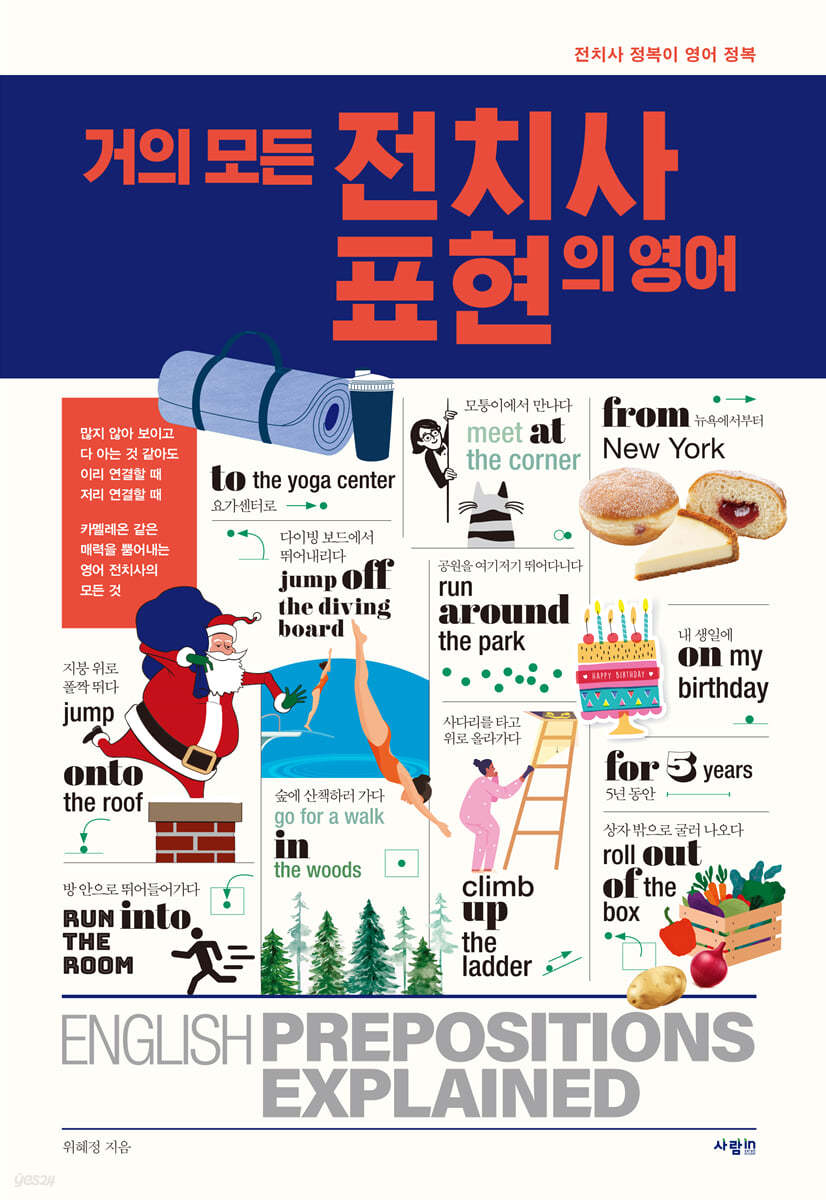
Almost all prepositional expressions in English
 |
Description
Book Introduction
Almost everything you need to know about prepositions that will make your English language work for you.
The reason why you need to study prepositions is that, firstly, sentence formation is impossible because phrases cannot be connected without prepositions, secondly, prepositions change the nuance of sentences, and thirdly, prepositions can make sentences more concise.
However, due to the inherent limitations of functional words, I have never properly studied such important prepositions.
『Almost All Prepositional Expressions in English』 brings prepositions, which had been pushed out of the center stage by content words, to the center and covers almost every aspect of them.
Through this, learners will acquire new things they never dreamed of as prepositions, learn to use prepositions accurately that they had previously guessed because their meanings were similar, reduce mistakes in using prepositions that they had made by thinking of them as Korean, and learn clearly which content words go before specific prepositions.
The reason why you need to study prepositions is that, firstly, sentence formation is impossible because phrases cannot be connected without prepositions, secondly, prepositions change the nuance of sentences, and thirdly, prepositions can make sentences more concise.
However, due to the inherent limitations of functional words, I have never properly studied such important prepositions.
『Almost All Prepositional Expressions in English』 brings prepositions, which had been pushed out of the center stage by content words, to the center and covers almost every aspect of them.
Through this, learners will acquire new things they never dreamed of as prepositions, learn to use prepositions accurately that they had previously guessed because their meanings were similar, reduce mistakes in using prepositions that they had made by thinking of them as Korean, and learn clearly which content words go before specific prepositions.
- You can preview some of the book's contents.
Preview
index
prolog
Study like this
Structure of this book
PART 1 About Prepositions
What are prepositions?
UNIT 1 Almost all the prepositions you will find in English
UNIT 2 Preposition Meanings in Pictures
UNIT 3 Prepositions through Comparison (1)
at/on/in + place-related noun
at + place-related noun
on + place-related noun
in + place-related noun
Comparison of the differences in meaning between at/on/in + place-related nouns
UNIT 4 Prepositions through Comparison (2)
at/on/in + time-related noun
at + time noun
on + time noun
in + time noun
Comparison of the differences in meaning between on/in + time-related nouns
Comparison of the differences in meaning between at/on + time-related nouns
UNIT 5 Prepositions through Comparison (3)
1.
by vs.
until
2.
in vs.
into
3.
on vs.
onto
4.
for vs.
during
5.
between vs.
among
6.
(a)round vs.
about
7.
about vs.
on
8.
near vs.
next to
9.
because of vs.
due to
10.
after vs.
in .
11.
from vs.
since
UNIT 6 Expressions that seem like prepositions but aren't
PART 2: THE MOST COMMON MISTAKES WITH PREPOSITIONS
UNIT 1 Adding Unnecessary Prepositions
1.
Using prepositions with transitive verbs that don't require prepositions
2.
Insertion of unnecessary prepositions according to Korean interpretation
The mistake of putting a preposition before an adverb
The mistake of putting a preposition after a verb that expresses the five senses
The mistake of putting a preposition before the indirect object in the 4th form sentence
3.
Marking a preposition before certain expressions that do not require a preposition
UNIT 2 Missing essential prepositions
1.
Missing preposition after intransitive verb that requires preposition
2.
Specific phrases that are frequently omitted
3.
Missing prepositions needed for Korean interpretation only
When the preposition paired with the noun is missing
When you don't use double prepositions well
UNIT 3 Confusion in Preposition Use
Preposition usage error when switching from type 4 to type 3
Misuse of the preposition "partner"
Using prepositions that change meaning
UNIT 4 Confusing Uses of to
PART 3 Almost all expressions about prepositions
CHAPTER 1 Almost all expressions of the preposition for
UNIT 1 Verb + for
UNIT 2 Adjective/Past Participle + for
UNIT 3 Noun + for
CHAPTER 2 Almost all prepositions from expressions
UNIT 1 Verb + from
UNIT 2 Noun + from
CHAPTER 3 Almost all prepositions about expressions
UNIT 1 Verb + about
UNIT 2 Adjective/Past Participle + about
UNIT 3 Noun + about
CHAPTER 4 Almost all expressions of the preposition in
UNIT 1 Verb + in
UNIT 2 Adjective/Past Participle + in
UNIT 3 Noun + in
CHAPTER 5 Almost all prepositions of to expressions
UNIT 1 Verb + to
UNIT 2 Adjective/Past Participle + to
UNIT 3 Noun + to
CHAPTER 6 Almost all prepositions of at expression
UNIT 1 Verb + at
UNIT 2 Adjective/Past Participle + at
UNIT 3 Noun + at
CHAPTER 7 Almost all expressions of the preposition up
UNIT 1 Verb + up
CHAPTER 8 Almost all prepositions of on
UNIT 1 Verb + on
UNIT 2 Noun + on
CHAPTER 9 Almost all prepositions with expressions
UNIT 1 Verb + with
UNIT 2 Adjective/Past Participle + with
UNIT 3 Noun + with
CHAPTER 10 Almost all expressions of the preposition of
UNIT 1 Verb + of
UNIT 2 Adjective/Past Participle + of
INDEX
References
Study like this
Structure of this book
PART 1 About Prepositions
What are prepositions?
UNIT 1 Almost all the prepositions you will find in English
UNIT 2 Preposition Meanings in Pictures
UNIT 3 Prepositions through Comparison (1)
at/on/in + place-related noun
at + place-related noun
on + place-related noun
in + place-related noun
Comparison of the differences in meaning between at/on/in + place-related nouns
UNIT 4 Prepositions through Comparison (2)
at/on/in + time-related noun
at + time noun
on + time noun
in + time noun
Comparison of the differences in meaning between on/in + time-related nouns
Comparison of the differences in meaning between at/on + time-related nouns
UNIT 5 Prepositions through Comparison (3)
1.
by vs.
until
2.
in vs.
into
3.
on vs.
onto
4.
for vs.
during
5.
between vs.
among
6.
(a)round vs.
about
7.
about vs.
on
8.
near vs.
next to
9.
because of vs.
due to
10.
after vs.
in .
11.
from vs.
since
UNIT 6 Expressions that seem like prepositions but aren't
PART 2: THE MOST COMMON MISTAKES WITH PREPOSITIONS
UNIT 1 Adding Unnecessary Prepositions
1.
Using prepositions with transitive verbs that don't require prepositions
2.
Insertion of unnecessary prepositions according to Korean interpretation
The mistake of putting a preposition before an adverb
The mistake of putting a preposition after a verb that expresses the five senses
The mistake of putting a preposition before the indirect object in the 4th form sentence
3.
Marking a preposition before certain expressions that do not require a preposition
UNIT 2 Missing essential prepositions
1.
Missing preposition after intransitive verb that requires preposition
2.
Specific phrases that are frequently omitted
3.
Missing prepositions needed for Korean interpretation only
When the preposition paired with the noun is missing
When you don't use double prepositions well
UNIT 3 Confusion in Preposition Use
Preposition usage error when switching from type 4 to type 3
Misuse of the preposition "partner"
Using prepositions that change meaning
UNIT 4 Confusing Uses of to
PART 3 Almost all expressions about prepositions
CHAPTER 1 Almost all expressions of the preposition for
UNIT 1 Verb + for
UNIT 2 Adjective/Past Participle + for
UNIT 3 Noun + for
CHAPTER 2 Almost all prepositions from expressions
UNIT 1 Verb + from
UNIT 2 Noun + from
CHAPTER 3 Almost all prepositions about expressions
UNIT 1 Verb + about
UNIT 2 Adjective/Past Participle + about
UNIT 3 Noun + about
CHAPTER 4 Almost all expressions of the preposition in
UNIT 1 Verb + in
UNIT 2 Adjective/Past Participle + in
UNIT 3 Noun + in
CHAPTER 5 Almost all prepositions of to expressions
UNIT 1 Verb + to
UNIT 2 Adjective/Past Participle + to
UNIT 3 Noun + to
CHAPTER 6 Almost all prepositions of at expression
UNIT 1 Verb + at
UNIT 2 Adjective/Past Participle + at
UNIT 3 Noun + at
CHAPTER 7 Almost all expressions of the preposition up
UNIT 1 Verb + up
CHAPTER 8 Almost all prepositions of on
UNIT 1 Verb + on
UNIT 2 Noun + on
CHAPTER 9 Almost all prepositions with expressions
UNIT 1 Verb + with
UNIT 2 Adjective/Past Participle + with
UNIT 3 Noun + with
CHAPTER 10 Almost all expressions of the preposition of
UNIT 1 Verb + of
UNIT 2 Adjective/Past Participle + of
INDEX
References
Detailed image

Publisher's Review
Conquering prepositions is conquering English!
A big misconception that learners have about prepositions is that they are parts of speech that do not need to be studied separately.
Unlike content words such as verbs, adjectives, and nouns, there are not many of them, and above all, they are called ‘function words’, so people do not pay much attention to them.
But prepositions are not as easy as you think.
It is unfamiliar because it is a part of speech that does not exist in the Korean language, and more than anything, it plays its role just as well as the content word, but we, as non-native speakers, do not know it properly.
If grammar, content words, etc. function as the hardware and software that create sentences, then prepositions can be said to be the resolution that controls the nuance of meaning.
Just as you need the right resolution to see a clear screen, you need to know prepositions well to convey meaning accurately.
So, although it is a functional word, it is a part that requires as much effort and study as content words.
The benefits of studying prepositions properly are as follows:
1.
You can accurately grasp the nuances of a sentence.
Although content words such as verbs and nouns determine the nuance of a sentence, prepositions can also play a role.
This is especially true when looking at only the Korean meaning.
I'll work until 5 pm
I'll submit the report by tomorrow.
Both are the Korean word for 'until', but the first sentence means that I will work until 5 o'clock, but I will not work after 5 o'clock, and the second sentence means that I may submit the report this afternoon, tonight, or tomorrow noon, but in any case, I will submit it by tomorrow without delay.
If you rewrite it to be similar to our language, it will become a sentence that native speakers cannot understand.
Studying prepositions is important for communication purposes.
2.
The number of unwanted mistakes made based on Korean language standards is reduced.
There is a big rule in English: 'Transitive verbs do not use prepositions when they take an object, and intransitive verbs use prepositions when they take an object.'
However, looking at the Korean interpretation of approve (to approve of ~) and accompany (to accompany ~), it seems that the preposition should not be used for the verb in front, but the preposition with should be used for the verb in back.
However, approve is an intransitive verb that must be followed by of when it means 'to approve of', and accompany is a transitive verb that must be followed by no preposition.
In "Almost All Prepositional Expressions in English," this book explains in detail when Koreans should use prepositions and when they shouldn't, and when to is mistakenly written as of, thereby reducing mistakes in preposition use.
3.
We list verbs/adjectives/nouns that are used in conjunction with specific prepositions.
Up until now, there have been many books that focused on content words and dealt with which prepositions come after specific content words.
In "English with Almost All Prepositional Expressions," the content words (verb/adjective*past participle/noun) that come before specific prepositions, such as answer to (answer to ~), result in (result from/result comes out as ~), come from (comes from ~, is produced from ~), are organized to allow for more comprehensive use of prepositions.
A big misconception that learners have about prepositions is that they are parts of speech that do not need to be studied separately.
Unlike content words such as verbs, adjectives, and nouns, there are not many of them, and above all, they are called ‘function words’, so people do not pay much attention to them.
But prepositions are not as easy as you think.
It is unfamiliar because it is a part of speech that does not exist in the Korean language, and more than anything, it plays its role just as well as the content word, but we, as non-native speakers, do not know it properly.
If grammar, content words, etc. function as the hardware and software that create sentences, then prepositions can be said to be the resolution that controls the nuance of meaning.
Just as you need the right resolution to see a clear screen, you need to know prepositions well to convey meaning accurately.
So, although it is a functional word, it is a part that requires as much effort and study as content words.
The benefits of studying prepositions properly are as follows:
1.
You can accurately grasp the nuances of a sentence.
Although content words such as verbs and nouns determine the nuance of a sentence, prepositions can also play a role.
This is especially true when looking at only the Korean meaning.
I'll work until 5 pm
I'll submit the report by tomorrow.
Both are the Korean word for 'until', but the first sentence means that I will work until 5 o'clock, but I will not work after 5 o'clock, and the second sentence means that I may submit the report this afternoon, tonight, or tomorrow noon, but in any case, I will submit it by tomorrow without delay.
If you rewrite it to be similar to our language, it will become a sentence that native speakers cannot understand.
Studying prepositions is important for communication purposes.
2.
The number of unwanted mistakes made based on Korean language standards is reduced.
There is a big rule in English: 'Transitive verbs do not use prepositions when they take an object, and intransitive verbs use prepositions when they take an object.'
However, looking at the Korean interpretation of approve (to approve of ~) and accompany (to accompany ~), it seems that the preposition should not be used for the verb in front, but the preposition with should be used for the verb in back.
However, approve is an intransitive verb that must be followed by of when it means 'to approve of', and accompany is a transitive verb that must be followed by no preposition.
In "Almost All Prepositional Expressions in English," this book explains in detail when Koreans should use prepositions and when they shouldn't, and when to is mistakenly written as of, thereby reducing mistakes in preposition use.
3.
We list verbs/adjectives/nouns that are used in conjunction with specific prepositions.
Up until now, there have been many books that focused on content words and dealt with which prepositions come after specific content words.
In "English with Almost All Prepositional Expressions," the content words (verb/adjective*past participle/noun) that come before specific prepositions, such as answer to (answer to ~), result in (result from/result comes out as ~), come from (comes from ~, is produced from ~), are organized to allow for more comprehensive use of prepositions.
GOODS SPECIFICS
- Date of issue: December 5, 2024
- Page count, weight, size: 384 pages | 894g | 170*250*21mm
- ISBN13: 9791171011179
- ISBN10: 1171011172
You may also like
카테고리
korean


korean

![GQ KOREA Mark (Monthly): December [2025]](http://librairie.coreenne.fr/cdn/shop/files/8ef265dbbfbf186523ed75ba7319009d.jpg?v=1765340328&width=3840)


