

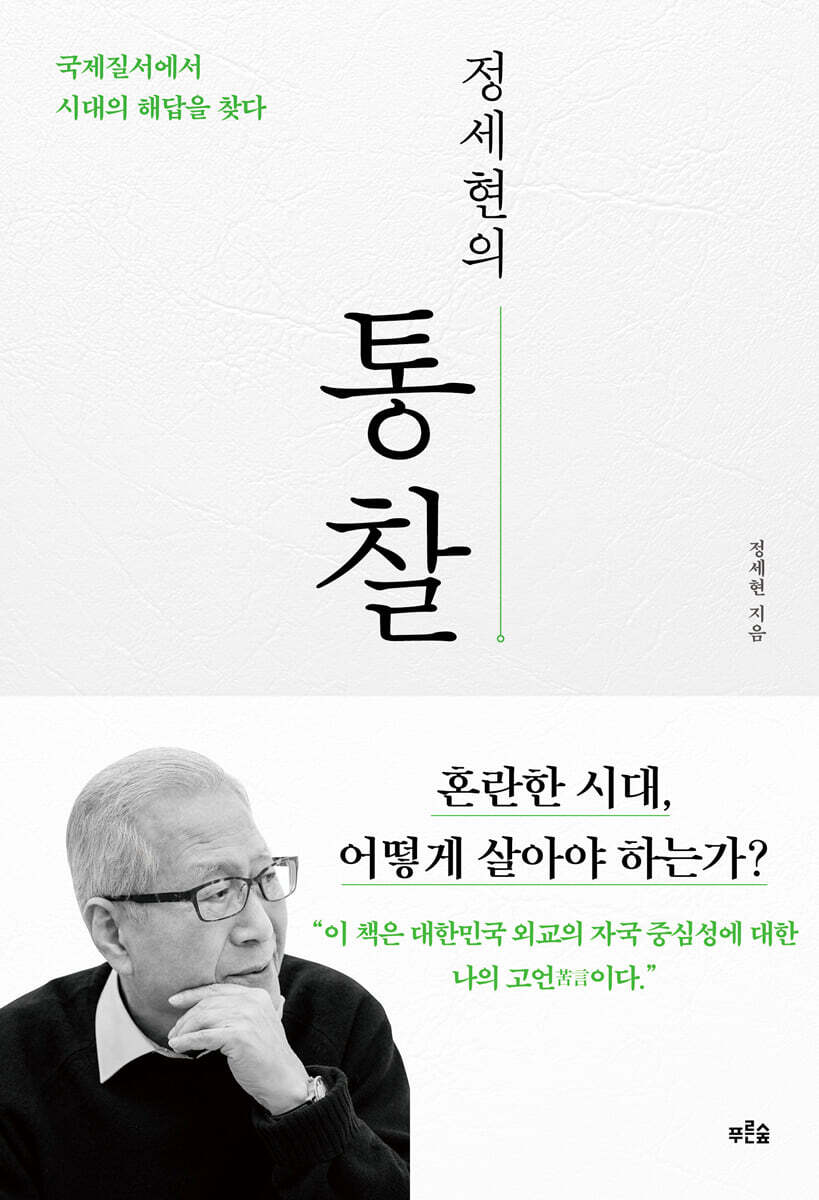
Jeong Se-hyeon's insight
 |
Description
Book Introduction
- A word from MD
-
A world in chaos, what is the future of South Korea?The US-led world order is shaking.
Russia invaded Ukraine.
There are also frequent predictions that China will attack Taiwan.
As tensions rise on the Korean Peninsula and in Northeast Asia, former Unification Minister Jeong Se-hyun has spoken out.
This book condenses the insights gained from observing the situation in Northeast Asia for a long time.
February 17, 2023. Social and Political PD Son Min-gyu
A new book has been published by former Unification Minister Jeong Se-hyun, containing his thoughts and experiences on “the path forward for inter-Korean relations in international politics, which he has pursued academically and professionally for nearly 50 years, and the nation-centered nature of South Korea’s diplomacy.”
The author, who has studied international politics and spent half his life working on unification issues in the field, retraces the paths we have taken within the dynamics of international politics from the Three Kingdoms period to the present.
Through this, we sincerely explore why it is important to pursue national self-centeredness and self-goal from a diplomatic perspective, and what path and how to proceed to achieve this.
Minister Chung Se-hyun, who has long worked both within and outside the international order, will offer insightful insights that will help us navigate the current turbulent times with wisdom.
The author, who has studied international politics and spent half his life working on unification issues in the field, retraces the paths we have taken within the dynamics of international politics from the Three Kingdoms period to the present.
Through this, we sincerely explore why it is important to pursue national self-centeredness and self-goal from a diplomatic perspective, and what path and how to proceed to achieve this.
Minister Chung Se-hyun, who has long worked both within and outside the international order, will offer insightful insights that will help us navigate the current turbulent times with wisdom.
- You can preview some of the book's contents.
Preview
index
Author's Note
Part 1: The World of International Politics
Chapter 1 What is International Politics?
The True Face of International Politics as Seen Through the Ukraine Crisis│How Ukraine Can Be Safe│How Putin Reads the Changing International Order in 2022
Chapter 2: What is ‘politics’ apart from ‘international’?
: Another name for the apparatus of violence, politics│Law is far, fists are close│The apparatus of violence is also present in international politics│Why was the territorial waters 3 nautical miles?
Part 2: The Rise of Western Powers and Japan's Expansion
Chapter 1 What is Pax Sinica?
: China's World-Running International Order│When Did China's Subjugation Begin?│Creating China's International Order
Chapter 2: How did 19th-century Japan become a great power?
Let's Learn from Britain, Not China│Korea, the First Country Japan Tried by Force│Theory of Center and Periphery│Japan's Challenge: From 'War Criminal Nation to Number Two'│The Dream of 'Pax Japonica'
Chapter 3: Can Korea, Japan, and China become closer?
: Korea and Japan, a long-standing relationship of mutual respect│Korea and China, two countries close yet different│Japan and China, a rivalry to dominate East Asia
Part 3: International Politics during the Cold War
Chapter 1: How Did the United States Create the International Order?
From military order to economic order and then......│The process of creating an information order│The era of competition with the Soviet Union
Chapter 2: What were Korea's international relations like in the 20th century?
: Syngman Rhee's government: Pro-Americanism and anti-communism, justification and tools│Park Chung-hee and Chun Doo-hwan's military governments: Creating legitimacy through pro-Americanism│Roh Tae-woo's government: Northern Policy and serving the United States│Is the United States the basis of our legitimacy?│What is the number one goal of foreign policy and the first means of security?
Part 4: The Era of American Unilateralism: China's Rise to the G2 and Korea's Developed Status
Chapter 1: How far does America's sphere of influence extend?
: The beginning of the US-centered international order│Europe, the home of the heart│The Middle East, where oil is found│Central Asia, a check on Russia│Africa, although not in the direct sphere of influence of the US│The Asia-Pacific region, home to China, the G2
Chapter 2 How did China grow in power?
: Two Centennial Dreams│Is the Pursuit of the Chinese Dream Wrong?│The Potential for Rapid Growth and Population│"A Challenge to NATO's Security"│American Delusions and Illusions│Politicians and Policymakers Must Be Different
Chapter 3: Korea in the Era of American Unilateralism
: Kim Young-sam government: 'Boorang-meori' spirit and ROK-US cooperation│Kim Dae-jung government: Persuaded and led│Roh Moo-hyun government: Strategic deal with 'fool Roh Moo-hyun'│Lee Myung-bak government: An alliance that 'couldn't be better' for the US│Attitude of staff│International politics is ultimately a matter of guts
Part 5: The 21st Century G2 Era: A Turbulent International Order
Chapter 1: What is Korean diplomacy like in the 21st century G2 era?
: Korea in a period of upheaval in the international order│Park Geun-hye administration: The theory of North Korea's collapse and the US's assertiveness│The critical difference between investment and subservience│The parallel theory between 17th-century Joseon and 21st-century Korea│The habit of serving and the mental dependence on the US when using international politics for domestic politics
Chapter 2: How can we solve the North Korean nuclear issue?
: Who is responsible for the North Korean nuclear issue?
Chapter 3: The Moon Jae-in Administration: What Should We Remember About the Brief Spring on the Korean Peninsula?
: Luckily, the PyeongChang Olympics│How did the summit come about?│The world of strong vested interests, the military-industrial complex│The 'Korea-US Working Group' that holds back everything│The Tamiflu incident and the breakdown of the Hanoi summit│The devil's detail, 'complete coordination'│I feel sorry for the Moon Jae-in administration that has worked hard│It's time to make the Korea-US relationship as independent as national power│Seeking a realistic strategy to break through the military-industrial complex│A list of investments that must not be forgotten
Chapter 4: What impact will the Ukraine crisis have on the North Korean nuclear issue and our diplomacy?
: Ukraine's Belief in the Promise│ North Korea No More CVID│ North Korea's 6th Nuclear Test Is Not 5+1│ South Korea's Position in the Trilateral Alliance Between South Korea, the US, and Japan│ Getting Too Close to the US Could Put It Under Japan│ A Different Perspective on Solving the North Korean Nuclear Issue: Inter-Korean Reunification
Part 1: The World of International Politics
Chapter 1 What is International Politics?
The True Face of International Politics as Seen Through the Ukraine Crisis│How Ukraine Can Be Safe│How Putin Reads the Changing International Order in 2022
Chapter 2: What is ‘politics’ apart from ‘international’?
: Another name for the apparatus of violence, politics│Law is far, fists are close│The apparatus of violence is also present in international politics│Why was the territorial waters 3 nautical miles?
Part 2: The Rise of Western Powers and Japan's Expansion
Chapter 1 What is Pax Sinica?
: China's World-Running International Order│When Did China's Subjugation Begin?│Creating China's International Order
Chapter 2: How did 19th-century Japan become a great power?
Let's Learn from Britain, Not China│Korea, the First Country Japan Tried by Force│Theory of Center and Periphery│Japan's Challenge: From 'War Criminal Nation to Number Two'│The Dream of 'Pax Japonica'
Chapter 3: Can Korea, Japan, and China become closer?
: Korea and Japan, a long-standing relationship of mutual respect│Korea and China, two countries close yet different│Japan and China, a rivalry to dominate East Asia
Part 3: International Politics during the Cold War
Chapter 1: How Did the United States Create the International Order?
From military order to economic order and then......│The process of creating an information order│The era of competition with the Soviet Union
Chapter 2: What were Korea's international relations like in the 20th century?
: Syngman Rhee's government: Pro-Americanism and anti-communism, justification and tools│Park Chung-hee and Chun Doo-hwan's military governments: Creating legitimacy through pro-Americanism│Roh Tae-woo's government: Northern Policy and serving the United States│Is the United States the basis of our legitimacy?│What is the number one goal of foreign policy and the first means of security?
Part 4: The Era of American Unilateralism: China's Rise to the G2 and Korea's Developed Status
Chapter 1: How far does America's sphere of influence extend?
: The beginning of the US-centered international order│Europe, the home of the heart│The Middle East, where oil is found│Central Asia, a check on Russia│Africa, although not in the direct sphere of influence of the US│The Asia-Pacific region, home to China, the G2
Chapter 2 How did China grow in power?
: Two Centennial Dreams│Is the Pursuit of the Chinese Dream Wrong?│The Potential for Rapid Growth and Population│"A Challenge to NATO's Security"│American Delusions and Illusions│Politicians and Policymakers Must Be Different
Chapter 3: Korea in the Era of American Unilateralism
: Kim Young-sam government: 'Boorang-meori' spirit and ROK-US cooperation│Kim Dae-jung government: Persuaded and led│Roh Moo-hyun government: Strategic deal with 'fool Roh Moo-hyun'│Lee Myung-bak government: An alliance that 'couldn't be better' for the US│Attitude of staff│International politics is ultimately a matter of guts
Part 5: The 21st Century G2 Era: A Turbulent International Order
Chapter 1: What is Korean diplomacy like in the 21st century G2 era?
: Korea in a period of upheaval in the international order│Park Geun-hye administration: The theory of North Korea's collapse and the US's assertiveness│The critical difference between investment and subservience│The parallel theory between 17th-century Joseon and 21st-century Korea│The habit of serving and the mental dependence on the US when using international politics for domestic politics
Chapter 2: How can we solve the North Korean nuclear issue?
: Who is responsible for the North Korean nuclear issue?
Chapter 3: The Moon Jae-in Administration: What Should We Remember About the Brief Spring on the Korean Peninsula?
: Luckily, the PyeongChang Olympics│How did the summit come about?│The world of strong vested interests, the military-industrial complex│The 'Korea-US Working Group' that holds back everything│The Tamiflu incident and the breakdown of the Hanoi summit│The devil's detail, 'complete coordination'│I feel sorry for the Moon Jae-in administration that has worked hard│It's time to make the Korea-US relationship as independent as national power│Seeking a realistic strategy to break through the military-industrial complex│A list of investments that must not be forgotten
Chapter 4: What impact will the Ukraine crisis have on the North Korean nuclear issue and our diplomacy?
: Ukraine's Belief in the Promise│ North Korea No More CVID│ North Korea's 6th Nuclear Test Is Not 5+1│ South Korea's Position in the Trilateral Alliance Between South Korea, the US, and Japan│ Getting Too Close to the US Could Put It Under Japan│ A Different Perspective on Solving the North Korean Nuclear Issue: Inter-Korean Reunification
Detailed image
.jpg)
Publisher's Review
From the Ukraine crisis
2023 South Korea's diplomatic issues and even the North Korean nuclear issue
How should we live in these chaotic times?
"Finding the Answers of Our Times in the International Order"
Former Minister of Unification Jeong Se-hyun, who has been involved in international politics and Korean Peninsula unification issues for over 50 years, has published a new book, "Jeong Se-hyun's Insight," by Purunsup.
The author, who studied international politics and began his career as a civil servant at the Ministry of Unification, has always considered the unification of the Korean Peninsula as a parallel issue to diplomatic issues, and has contemplated domestic and international situations.
The concept that the author, who has been contemplating these issues for a long time, came up with is ‘national centricity.’
Whether it's diplomacy or unification, we have personally realized that only by maintaining a national focus can we achieve what we want without being swayed by the powerful nations.
This book presents the author's diplomatic insight, developed through a long and astute reading of the international political landscape, through the lens of "national centricity."
It addresses what is most important in international politics and the still-valid solution to the North Korean nuclear issue.
In particular, in the historical context where the countries that entered the Korean Peninsula since the Three Kingdoms period have long maintained only one-sided international relations, we look back at “how the independent Republic of Korea has formed international relations within a certain international order” and what changes have occurred from the Syngman Rhee administration to the Moon Jae-in administration, along with “important events in international relations related to inter-Korean relations.”
This is to “understand, rethink, and make a new resolution.”
Above all, 『Jeong Se-hyun's Insight』 contains the zeitgeist that is essential for us living in 2023.
Just as the international order was turbulent in the 19th century when Japan and Germany emerged as great powers, the international order is once again turbulent since the 21st century when the full-fledged G2 era began.
We are witnessing this stark reality through the events in Ukraine.
As we face another period of upheaval in the international order, how should we find answers? What are the differences between the 19th-century Korean Empire and the 21st-century Republic of Korea, and how do they remain the same?
In international politics, there are only big and high nations, not small and low ones.
The Path Forward for South Korean Diplomacy in a World of Gangster-like International Politics
In this book, which consists of five parts, the author first shows the stark nature of diplomacy, which is no different from the "world of gangsters," through various historical scenes, and then identifies the core of national power and the true nature of ambition of the current superpowers, the United States, China, and Japan.
If you want to know the essence of international politics, you can find it in this book.
It also briefly outlines the core causes of the ongoing conflict between Russia and Ukraine, what will happen in the future, and what kind of diplomacy South Korea should pursue, using this as an example.
Part 2 looks back at the relationship between Korea, China, and Japan during the Pax Sinica era, when China ruled the world.
By comparing Japan's foreign policy, which relied heavily on China, with that of South Korea, we can understand why Japan was the first of the three countries to be incorporated into the international order, and how these two countries achieved their current international standing.
Above all, how did China, once the center of the world and the ideology of Sinocentrism, collapse so quickly at the hands of Western powers? The answer lies in this chapter.
The fate of the three countries quickly diverged depending on whether they could read the flow of the world or not.
Meanwhile, in the West, the Cold War is coming to an end, and an American-centered international order is rapidly emerging.
Part 3 examines the process by which the United States took over the world and Korea's international relations within it.
Starting with the Syngman Rhee government, we can infer the flow of international affairs centered on the Korean Peninsula through the ROK-US relations established by the Park Chung-hee, Chun Doo-hwan, and Roh Tae-woo governments, and further through the inter-Korean relations after the armistice agreement.
Which of these presidents developed diplomatic theories that are still useful today?
Next, we examine the 'G2 era today', where American hegemony is declining, China is rising, and the international order is in turmoil.
Looking ahead to the future, this article reveals how Korea, which has become a truly advanced nation in economic, military, and cultural terms, will strengthen its independent international relations and diplomatic focus befitting its national power, while safeguarding its national interests.
Parts 4 and 5 explain the major foreign policies of the Kim Young-sam administration, followed by the Kim Dae-jung, Roh Moo-hyun, Lee Myung-bak, Park Geun-hye, and Moon Jae-in administrations.
In particular, it emphasizes the need to clarify who is responsible for the North Korean nuclear issue through the causal relationship of events related to the issue analyzed through a chronological concept, and to raise a voice that sometimes criticizes the United States as well.
Finally, I reiterate the impact the Ukraine crisis will have on the North Korean nuclear issue and our diplomacy, and offer the author's candid views on what we should be wary of and what we should resolve to do now.
The author's views on whether unification between North and South Korea is still valid can also be found in this chapter.
The author has always considered these experiences, learned while living off the country's income, to be public goods.
I witnessed North Korea's first nuclear test up close, and while serving in key positions in three administrations—Kim Young-sam, Kim Dae-jung, and Roh Moo-hyun—I have pondered South Korea's role in the turbulent waters of international politics.
The author's professional reflections and adult insights, born from his long career, provide food for thought not only for young people aspiring to become diplomats, but also for individuals seeking to venture out into the world.
After reading this book, you will know.
The answer to our times, as always, lies in the international order.
The author still remembers the words of Professor Lee Yong-hee, which he heard when he was a college student over 50 years ago.
“In the world of diplomacy, if it’s not your country, it’s someone else’s country.
Even if you become diplomats in the future, do not become diplomats who work for the interests of other countries, but become diplomats who work hard for the interests of your own country.
You have to get your mind straight and get to work.
“In the world of international politics, if we do not develop the habit of distinguishing between our own country and another’s, we will end up with the foolish result of not knowing which country’s interests we are busily working for.” (p. 7)
2023 South Korea's diplomatic issues and even the North Korean nuclear issue
How should we live in these chaotic times?
"Finding the Answers of Our Times in the International Order"
Former Minister of Unification Jeong Se-hyun, who has been involved in international politics and Korean Peninsula unification issues for over 50 years, has published a new book, "Jeong Se-hyun's Insight," by Purunsup.
The author, who studied international politics and began his career as a civil servant at the Ministry of Unification, has always considered the unification of the Korean Peninsula as a parallel issue to diplomatic issues, and has contemplated domestic and international situations.
The concept that the author, who has been contemplating these issues for a long time, came up with is ‘national centricity.’
Whether it's diplomacy or unification, we have personally realized that only by maintaining a national focus can we achieve what we want without being swayed by the powerful nations.
This book presents the author's diplomatic insight, developed through a long and astute reading of the international political landscape, through the lens of "national centricity."
It addresses what is most important in international politics and the still-valid solution to the North Korean nuclear issue.
In particular, in the historical context where the countries that entered the Korean Peninsula since the Three Kingdoms period have long maintained only one-sided international relations, we look back at “how the independent Republic of Korea has formed international relations within a certain international order” and what changes have occurred from the Syngman Rhee administration to the Moon Jae-in administration, along with “important events in international relations related to inter-Korean relations.”
This is to “understand, rethink, and make a new resolution.”
Above all, 『Jeong Se-hyun's Insight』 contains the zeitgeist that is essential for us living in 2023.
Just as the international order was turbulent in the 19th century when Japan and Germany emerged as great powers, the international order is once again turbulent since the 21st century when the full-fledged G2 era began.
We are witnessing this stark reality through the events in Ukraine.
As we face another period of upheaval in the international order, how should we find answers? What are the differences between the 19th-century Korean Empire and the 21st-century Republic of Korea, and how do they remain the same?
In international politics, there are only big and high nations, not small and low ones.
The Path Forward for South Korean Diplomacy in a World of Gangster-like International Politics
In this book, which consists of five parts, the author first shows the stark nature of diplomacy, which is no different from the "world of gangsters," through various historical scenes, and then identifies the core of national power and the true nature of ambition of the current superpowers, the United States, China, and Japan.
If you want to know the essence of international politics, you can find it in this book.
It also briefly outlines the core causes of the ongoing conflict between Russia and Ukraine, what will happen in the future, and what kind of diplomacy South Korea should pursue, using this as an example.
Part 2 looks back at the relationship between Korea, China, and Japan during the Pax Sinica era, when China ruled the world.
By comparing Japan's foreign policy, which relied heavily on China, with that of South Korea, we can understand why Japan was the first of the three countries to be incorporated into the international order, and how these two countries achieved their current international standing.
Above all, how did China, once the center of the world and the ideology of Sinocentrism, collapse so quickly at the hands of Western powers? The answer lies in this chapter.
The fate of the three countries quickly diverged depending on whether they could read the flow of the world or not.
Meanwhile, in the West, the Cold War is coming to an end, and an American-centered international order is rapidly emerging.
Part 3 examines the process by which the United States took over the world and Korea's international relations within it.
Starting with the Syngman Rhee government, we can infer the flow of international affairs centered on the Korean Peninsula through the ROK-US relations established by the Park Chung-hee, Chun Doo-hwan, and Roh Tae-woo governments, and further through the inter-Korean relations after the armistice agreement.
Which of these presidents developed diplomatic theories that are still useful today?
Next, we examine the 'G2 era today', where American hegemony is declining, China is rising, and the international order is in turmoil.
Looking ahead to the future, this article reveals how Korea, which has become a truly advanced nation in economic, military, and cultural terms, will strengthen its independent international relations and diplomatic focus befitting its national power, while safeguarding its national interests.
Parts 4 and 5 explain the major foreign policies of the Kim Young-sam administration, followed by the Kim Dae-jung, Roh Moo-hyun, Lee Myung-bak, Park Geun-hye, and Moon Jae-in administrations.
In particular, it emphasizes the need to clarify who is responsible for the North Korean nuclear issue through the causal relationship of events related to the issue analyzed through a chronological concept, and to raise a voice that sometimes criticizes the United States as well.
Finally, I reiterate the impact the Ukraine crisis will have on the North Korean nuclear issue and our diplomacy, and offer the author's candid views on what we should be wary of and what we should resolve to do now.
The author's views on whether unification between North and South Korea is still valid can also be found in this chapter.
The author has always considered these experiences, learned while living off the country's income, to be public goods.
I witnessed North Korea's first nuclear test up close, and while serving in key positions in three administrations—Kim Young-sam, Kim Dae-jung, and Roh Moo-hyun—I have pondered South Korea's role in the turbulent waters of international politics.
The author's professional reflections and adult insights, born from his long career, provide food for thought not only for young people aspiring to become diplomats, but also for individuals seeking to venture out into the world.
After reading this book, you will know.
The answer to our times, as always, lies in the international order.
The author still remembers the words of Professor Lee Yong-hee, which he heard when he was a college student over 50 years ago.
“In the world of diplomacy, if it’s not your country, it’s someone else’s country.
Even if you become diplomats in the future, do not become diplomats who work for the interests of other countries, but become diplomats who work hard for the interests of your own country.
You have to get your mind straight and get to work.
“In the world of international politics, if we do not develop the habit of distinguishing between our own country and another’s, we will end up with the foolish result of not knowing which country’s interests we are busily working for.” (p. 7)
GOODS SPECIFICS
- Date of issue: February 16, 2023
- Page count, weight, size: 292 pages | 416g | 140*205*20mm
- ISBN13: 9791156754039
- ISBN10: 1156754038
You may also like
카테고리
korean


korean

![GQ KOREA Mark (Monthly): December [2025]](http://librairie.coreenne.fr/cdn/shop/files/8ef265dbbfbf186523ed75ba7319009d.jpg?v=1765340328&width=3840)


