

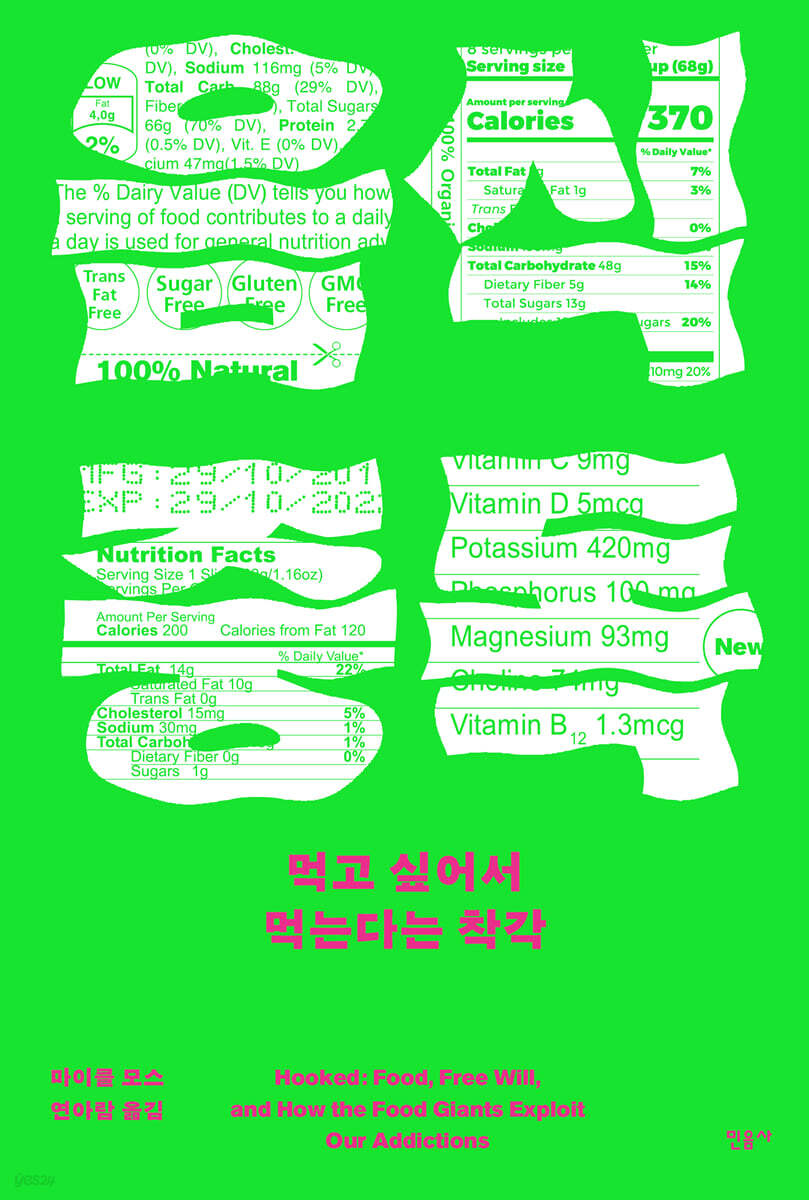
food addiction
 |
Description
Book Introduction
- A word from MD
-
Bad appetite createdMany people already know about a healthy diet.
So why are so many people suffering from obesity, diabetes, and high blood pressure? Michael Moss, who won the 2010 Pulitzer Prize for his reporting on hamburger contamination, says the food industry is to blame.
We delve into how bad food is made and how it manipulates our appetites.
February 3, 2023. Social and Political PD Son Min-gyu
“You are addicted to eating now!”
Digging into the gap between food and free will
How Big Food Companies Exploit Addiction
[New York Times], Amazon Bestseller
New work by Pulitzer Prize-winning author Michael Morse
Taking aim at processed foods with the science of addiction.
“For the past 4 million years since the birth of mankind, food addiction has been the driving force behind humanity’s prosperity.
It's only been in the last 40 years that food addiction has become so damaging to humans.
What on earth happened? The food changed.” ―From the text
Could food be addictive, like cigarettes or drugs? This book answers the question: yes, it can be.
Our modern diet, dominated by processed foods, fast foods, convenience foods, artificial sweeteners, and artificial flavors, is disrupting our taste buds and metabolism.
Above all, it makes food more addictive.
Veteran journalist Michael Moss, who won the 2010 Pulitzer Prize for his reporting on hamburger contamination, has published Food Addiction by Minumsa.
Moss exposes how the processed food industry exploits our evolved instincts, our food memories and emotions, loopholes in laws and policies, and our indifference to maximize profits.
From corporate boardrooms to food factories, courtrooms, legislatures, and laboratories, this book illuminates the biological and social causes of food addiction, helping readers regain control of their eating habits and move toward a healthier future.
Digging into the gap between food and free will
How Big Food Companies Exploit Addiction
[New York Times], Amazon Bestseller
New work by Pulitzer Prize-winning author Michael Morse
Taking aim at processed foods with the science of addiction.
“For the past 4 million years since the birth of mankind, food addiction has been the driving force behind humanity’s prosperity.
It's only been in the last 40 years that food addiction has become so damaging to humans.
What on earth happened? The food changed.” ―From the text
Could food be addictive, like cigarettes or drugs? This book answers the question: yes, it can be.
Our modern diet, dominated by processed foods, fast foods, convenience foods, artificial sweeteners, and artificial flavors, is disrupting our taste buds and metabolism.
Above all, it makes food more addictive.
Veteran journalist Michael Moss, who won the 2010 Pulitzer Prize for his reporting on hamburger contamination, has published Food Addiction by Minumsa.
Moss exposes how the processed food industry exploits our evolved instincts, our food memories and emotions, loopholes in laws and policies, and our indifference to maximize profits.
From corporate boardrooms to food factories, courtrooms, legislatures, and laboratories, this book illuminates the biological and social causes of food addiction, helping readers regain control of their eating habits and move toward a healthier future.
- You can preview some of the book's contents.
Preview
index
Prologue - The Girl in Love with Hamburgers
1. Instinctively attracted to food / INSIDE ADDICTION
Chapter 1: What is Addiction?
Philip Morris Acknowledges the Addictive Nature of Tobacco | The Changing Concept of Addiction | The Complexity of Addiction | Can Food Be Addictive? | A Look Inside the Brain | "Repetitive Behaviors That Some People Find Hard to Quit"
Chapter 2: Where Addiction Begins
Surgery for the Morbidly Obese | Appetite Is in the Brain, Not the Stomach | The Brain's Mechanism for Inducing Desire | What We Like and What We Crave | The Driven and Inhibited Brain | Addicted to Speed | Cues to Stimulate Appetite Are Everywhere
Chapter 3: Taste is Memory
The Cook Who Lost His Taste | How the Brain Remembers Food | We Eat What We Remember | People Who Eat to Forget | Advertisements That Target Memory | The Illusion of Eating Because You Like It
Chapter 4: Humans are instinctively drawn to eating.
Ardi's upright walking | The development of the sense of smell that provided a variety of flavors | The stomach that detects the calories in food | Fat that stores energy
2 Food Changed, Addictive / OUTSIDE ADDICTION
Chapter 5: Stimulate Your Instincts
The Temptation of Low Prices | Convenience Foods That Dominate Modern Life | The More Variety, the More We Want | What Does a Nutrition Facts Label Tell Us?
Chapter 6: The Battle Over Processed Foods
The Lawyer Who Knocked Out Trans Fats | What the McDonald's Lawsuit Left Behind | Moving Congress | Support or Control
Chapter 7: The Golden Market of Diet
The History of Diet Control | Absorbing the Diet Industry | The Effectiveness of Diet Programs | The Endless Evolution toward 'Healthy' Foods
Chapter 8: Risking Your Life for Genetic Research
Growing Concerns | High-Protein, Low-Glycemic Diet Project | Could Genetic Research Hold the Answer | Taste Disturbances
Epilogue: Redefining the Value of Food
Acknowledgements
main
References
1. Instinctively attracted to food / INSIDE ADDICTION
Chapter 1: What is Addiction?
Philip Morris Acknowledges the Addictive Nature of Tobacco | The Changing Concept of Addiction | The Complexity of Addiction | Can Food Be Addictive? | A Look Inside the Brain | "Repetitive Behaviors That Some People Find Hard to Quit"
Chapter 2: Where Addiction Begins
Surgery for the Morbidly Obese | Appetite Is in the Brain, Not the Stomach | The Brain's Mechanism for Inducing Desire | What We Like and What We Crave | The Driven and Inhibited Brain | Addicted to Speed | Cues to Stimulate Appetite Are Everywhere
Chapter 3: Taste is Memory
The Cook Who Lost His Taste | How the Brain Remembers Food | We Eat What We Remember | People Who Eat to Forget | Advertisements That Target Memory | The Illusion of Eating Because You Like It
Chapter 4: Humans are instinctively drawn to eating.
Ardi's upright walking | The development of the sense of smell that provided a variety of flavors | The stomach that detects the calories in food | Fat that stores energy
2 Food Changed, Addictive / OUTSIDE ADDICTION
Chapter 5: Stimulate Your Instincts
The Temptation of Low Prices | Convenience Foods That Dominate Modern Life | The More Variety, the More We Want | What Does a Nutrition Facts Label Tell Us?
Chapter 6: The Battle Over Processed Foods
The Lawyer Who Knocked Out Trans Fats | What the McDonald's Lawsuit Left Behind | Moving Congress | Support or Control
Chapter 7: The Golden Market of Diet
The History of Diet Control | Absorbing the Diet Industry | The Effectiveness of Diet Programs | The Endless Evolution toward 'Healthy' Foods
Chapter 8: Risking Your Life for Genetic Research
Growing Concerns | High-Protein, Low-Glycemic Diet Project | Could Genetic Research Hold the Answer | Taste Disturbances
Epilogue: Redefining the Value of Food
Acknowledgements
main
References
Into the book
There's a reason why drugs stimulate the brain so powerfully.
Such drugs must be extremely exciting to the brain to allay the inner fear that they are extremely dangerous if abused.
Because if you don't maximize the craving you feel in the early stages and don't give an enormous amount of pleasure as a reward for using the drug, you won't use it.
Processed foods, on the other hand, are very easy to become obsessed with.
Processed foods are cheap, quick, easy to obtain, and generally safe, at least when considering their direct impact on health and social well-being.
We tend not to think about the long-term effects of processed foods.
It doesn't even take a shock to the brain to get people to eat.
A word at the right moment is enough.
---From "Chapter 1: What is Addiction"
Of all the substances we can become addicted to, nothing stimulates the brain faster than food.
To be precise, it is a specific type of food.
It is no exaggeration to say that the phenomenal success of processed foods is due in part to the rapid pace at which they are produced in all aspects.
The entire industry is built on speed, and that characteristic is evident right from the manufacturing plants.
(…) By reducing production time and thus reducing costs, the price of the product can be lowered, which ultimately makes processed foods more attractive and satisfying.
The speed at which consumers shop at supermarkets is also carefully calculated.
(…) Above all, the speed with which processed foods reach consumers is remarkable.
Processed foods can be opened quickly, heated quickly in the microwave, and most importantly, stimulate the brain quickly once they enter the mouth.
---From "Chapter 2: Where Does Addiction Begin?"
The same goes for eating habits.
Of all the things your brain does to help you eat, one of the most powerful is the power of memory that helps you decide what to eat.
The way food and food manufacturers can influence our behavior is fundamentally because of the information we receive, store, and recall.
We remember what we eat and we eat what we remember.
---From "Chapter 3: Taste is Memory"
Studies show that sugar and fat stimulate the brain more when combined than when consumed separately.
However, it is difficult to find foods in nature that combine fat and sugar.
Even breast milk contains, on average, only 3.5 percent fat and 7 percent sugar.
However, fat and sugar are closely related to the foods that dominate modern people's diet.
A typical processed snack contains 24 percent fat and 57 percent sugar.
Processed food manufacturers have added sugar to salty hot dogs, spaghetti sauce, bread, and even frozen chicken.
About three-quarters of the foods we eat contain significant amounts of salt, not to mention added sugar, which also enhances the stimulation provided by fat.
---From "Chapter 3: Taste is Memory"
As food companies succeeded in making snacking the fourth meal of the day, their profits grew along with our waistlines.
Modern people consume an average of 580 calories a day through snacking.
This figure is approximately one-quarter of the daily intake.
Snacking also pairs perfectly with processed foods that are made to be cheap and convenient.
We don't snack on carrots, which we buy at the supermarket, bring home, wash, peel, and chop before storing.
Food companies have come up with snacks like candy in small cellophane bags, pre-packaged chocolate bars, drinks you can eat with a straw, food in microwaveable bags, and things like yogurt and fruit purees in easy-to-squeeze tubes.
Most of these are foods that can be purchased on the spot without much thought.
---From "Chapter 5: Stimulate Your Instincts"
Researchers have discovered one aspect of human nature that makes our love of variety particularly advantageous to food companies.
The fact is that consumers who seek variety buy more and eat more.
(…) “Even if you just look at the supermarket, there is an incredible variety of food.
“The more variety there is in food, whether at home or in a restaurant, the more we tend to eat until we get sick of it.” Food companies that try to capitalize on the human desire for variety to boost sales don’t actually need to change their products.
Studies show that if you're distracted while eating, like watching TV or using your phone, you'll end up eating more than if you were focused on your food.
If you focus on something distracting, like an electronic device, instead of food, your brain may forget that it is eating food while you are distracted.
Then, when you focus on the food again, it feels like the food has changed and looks new.
As a result, we become unable to control our overeating.
---From "Chapter 5: Stimulate Your Instincts"
The power of carbonated drinks is so powerful that our bodies can be fooled into thinking they're burning at least a certain amount of calories.
Even though you're not actually burning any calories.
This may be why, when soda sales began to surge in the 1980s, obesity rates rose in a strikingly similar parabolic pattern.
If you become addicted to carbonated beverages that cheat your metabolism in this way, you're not just giving up your free will; you're also handing the processed food industry the secrets to wreaking havoc on your body.
---From "Chapter 6: The Battle Surrounding Processed Foods"
The important thing is that we still don't know much about taste and the brain.
We don't yet know what happens when the brain receives signals from taste buds that it's consuming a lot of sugar, but the sugar never reaches the stomach (because it wasn't there in the first place), or at least when the actual intake differs from what the taste buds sense.
Even though sweeteners will be abundant in processed foods in the future, I have never seen a study that predicts or analyzes how the human body will react to these substances.
Will the brain simply ignore it? Or will it become angry at being tricked and fight back in some way?
---From "Chapter 8: Risking Your Life on Genetic Research"
We tend to like what we eat rather than what we want to eat.
In other words, forming new eating habits allows us to decide for ourselves what foods we like to eat.
But as we now know, when we change what we eat, food companies change their products to keep us coming back for more.
The weapons we use every time are salt, sugar, and fat.
They will continue to do this to make their products appear less addictive than they actually are, or to be something completely different from what they actually are.
Such drugs must be extremely exciting to the brain to allay the inner fear that they are extremely dangerous if abused.
Because if you don't maximize the craving you feel in the early stages and don't give an enormous amount of pleasure as a reward for using the drug, you won't use it.
Processed foods, on the other hand, are very easy to become obsessed with.
Processed foods are cheap, quick, easy to obtain, and generally safe, at least when considering their direct impact on health and social well-being.
We tend not to think about the long-term effects of processed foods.
It doesn't even take a shock to the brain to get people to eat.
A word at the right moment is enough.
---From "Chapter 1: What is Addiction"
Of all the substances we can become addicted to, nothing stimulates the brain faster than food.
To be precise, it is a specific type of food.
It is no exaggeration to say that the phenomenal success of processed foods is due in part to the rapid pace at which they are produced in all aspects.
The entire industry is built on speed, and that characteristic is evident right from the manufacturing plants.
(…) By reducing production time and thus reducing costs, the price of the product can be lowered, which ultimately makes processed foods more attractive and satisfying.
The speed at which consumers shop at supermarkets is also carefully calculated.
(…) Above all, the speed with which processed foods reach consumers is remarkable.
Processed foods can be opened quickly, heated quickly in the microwave, and most importantly, stimulate the brain quickly once they enter the mouth.
---From "Chapter 2: Where Does Addiction Begin?"
The same goes for eating habits.
Of all the things your brain does to help you eat, one of the most powerful is the power of memory that helps you decide what to eat.
The way food and food manufacturers can influence our behavior is fundamentally because of the information we receive, store, and recall.
We remember what we eat and we eat what we remember.
---From "Chapter 3: Taste is Memory"
Studies show that sugar and fat stimulate the brain more when combined than when consumed separately.
However, it is difficult to find foods in nature that combine fat and sugar.
Even breast milk contains, on average, only 3.5 percent fat and 7 percent sugar.
However, fat and sugar are closely related to the foods that dominate modern people's diet.
A typical processed snack contains 24 percent fat and 57 percent sugar.
Processed food manufacturers have added sugar to salty hot dogs, spaghetti sauce, bread, and even frozen chicken.
About three-quarters of the foods we eat contain significant amounts of salt, not to mention added sugar, which also enhances the stimulation provided by fat.
---From "Chapter 3: Taste is Memory"
As food companies succeeded in making snacking the fourth meal of the day, their profits grew along with our waistlines.
Modern people consume an average of 580 calories a day through snacking.
This figure is approximately one-quarter of the daily intake.
Snacking also pairs perfectly with processed foods that are made to be cheap and convenient.
We don't snack on carrots, which we buy at the supermarket, bring home, wash, peel, and chop before storing.
Food companies have come up with snacks like candy in small cellophane bags, pre-packaged chocolate bars, drinks you can eat with a straw, food in microwaveable bags, and things like yogurt and fruit purees in easy-to-squeeze tubes.
Most of these are foods that can be purchased on the spot without much thought.
---From "Chapter 5: Stimulate Your Instincts"
Researchers have discovered one aspect of human nature that makes our love of variety particularly advantageous to food companies.
The fact is that consumers who seek variety buy more and eat more.
(…) “Even if you just look at the supermarket, there is an incredible variety of food.
“The more variety there is in food, whether at home or in a restaurant, the more we tend to eat until we get sick of it.” Food companies that try to capitalize on the human desire for variety to boost sales don’t actually need to change their products.
Studies show that if you're distracted while eating, like watching TV or using your phone, you'll end up eating more than if you were focused on your food.
If you focus on something distracting, like an electronic device, instead of food, your brain may forget that it is eating food while you are distracted.
Then, when you focus on the food again, it feels like the food has changed and looks new.
As a result, we become unable to control our overeating.
---From "Chapter 5: Stimulate Your Instincts"
The power of carbonated drinks is so powerful that our bodies can be fooled into thinking they're burning at least a certain amount of calories.
Even though you're not actually burning any calories.
This may be why, when soda sales began to surge in the 1980s, obesity rates rose in a strikingly similar parabolic pattern.
If you become addicted to carbonated beverages that cheat your metabolism in this way, you're not just giving up your free will; you're also handing the processed food industry the secrets to wreaking havoc on your body.
---From "Chapter 6: The Battle Surrounding Processed Foods"
The important thing is that we still don't know much about taste and the brain.
We don't yet know what happens when the brain receives signals from taste buds that it's consuming a lot of sugar, but the sugar never reaches the stomach (because it wasn't there in the first place), or at least when the actual intake differs from what the taste buds sense.
Even though sweeteners will be abundant in processed foods in the future, I have never seen a study that predicts or analyzes how the human body will react to these substances.
Will the brain simply ignore it? Or will it become angry at being tricked and fight back in some way?
---From "Chapter 8: Risking Your Life on Genetic Research"
We tend to like what we eat rather than what we want to eat.
In other words, forming new eating habits allows us to decide for ourselves what foods we like to eat.
But as we now know, when we change what we eat, food companies change their products to keep us coming back for more.
The weapons we use every time are salt, sugar, and fat.
They will continue to do this to make their products appear less addictive than they actually are, or to be something completely different from what they actually are.
---From the "Epilogue"
Publisher's Review
★ New York Times, Amazon Bestseller
★ New work by Pulitzer Prize-winning author Michael Morse
★ Targeting processed foods with the science of addiction.
“For the past 4 million years since the birth of mankind, food addiction has been the driving force behind humanity’s prosperity.
It's only been in the last 40 years that food addiction has become so damaging to humans.
What on earth happened? The food changed.” ―From the text
Could food be addictive, like cigarettes or drugs? This book answers the question: yes, it can be.
Our modern diet, dominated by processed foods, fast foods, convenience foods, artificial sweeteners, and artificial flavors, is disrupting our taste buds and metabolism.
Above all, it makes food more addictive.
Veteran journalist Michael Moss, who won the 2010 Pulitzer Prize for his reporting on hamburger contamination, has published Food Addiction by Minumsa.
Moss exposes how the processed food industry exploits our evolved instincts, our food memories and emotions, loopholes in laws and policies, and our indifference to maximize profits.
From corporate boardrooms to food factories, courtrooms, legislatures, and laboratories, this book illuminates the biological and social causes of food addiction, helping readers regain control of their eating habits and move toward a healthier future.
Are you eating because you really want to eat it?
Modern Eating Habits Through the Lens of Addiction
In his previous book, Salt Sugar Fat, Michael Morse exposed how food companies use salt, sugar, and fat to deceive consumers. In his book launch interview, he confronts a crucial question.
“But aren’t these products addictive like drugs?” Everyone knows that salad is healthier than potato chips.
Yet, many people pick up potato chips and snack on them even when they think they are full.
If factors beyond willpower and taste are at play in eating food—if food is inherently addictive—then efforts to abstain from processed foods will fundamentally hit a wall.
In this article, Moss examines the modern diet, including processed foods, from the perspective of addiction in general, and examines the real dangers inherent in food and eating.
By examining the findings of various studies on addiction, Moss scientifically proves that food can be more addictive than alcohol, cigarettes, or drugs.
The scary thing about addiction is that much of its cause lies within us, or more precisely, within our brains.
The human brain has its own neurotransmitters, such as dopamine, that create feelings of pleasure and trigger compulsive behavior.
This chemical turns on a switch that controls cravings, and an inhibitory system triggered in the prefrontal cortex and hippocampus puts the brakes on cravings.
Sweet (sugar), salty (salt), and fatty (fat) foods are powerful triggers for the brain's craving switch, the reward circuit.
The author vividly describes how eating a chocolate-covered donut triggers the brain's sense of smell and taste, triggering memories of the food and triggering a fundamental craving.
The faster it reaches the brain, the greater the potential for addiction. While cigarette smoke takes 10 seconds to activate the brain's reward circuitry, sugar on the tongue takes only 0.6 seconds.
This magic of speed is what makes processed foods more addictive than cocaine, heroin, or nicotine.
Our bodies, which remember the pleasure they felt from 'sweet and salty' foods, fall into a state of continuing to crave that food even when they feel full.
We crave what gives us pleasure, and when we feel pleasure there, we crave it again.
This cycle is at the heart of addiction.
Not satisfied with sugar-free drinks?
Why are diets and regimens so difficult?
Because humans are naturally designed to want more food.
Deep-seated cravings for food are no surprise.
The instinct to turn the craving switch on and off played a crucial role in the survival of our ancestors who were constantly short of food.
Since energy and nutrient intake through eating is essential for survival, it activates the brain's reward circuits most easily, quickly, and preferentially.
This means that in the very moment when we reach for another spoonful of food even though we're not hungry or reach for fast food despite being concerned about our health, our brains may seriously think, "There's nothing more important than this."
The structure and mechanisms of the human body have also evolved to work in cooperation with the brain to obtain maximum energy (calories) with minimum effort.
First, with the advent of upright walking, the structure of our nose and mouth changed (making us the only animals that can choke on food), and we gained the fantastic sense of flavor in addition to the five basic tastes.
By developing the means to enjoy a variety of foods, humans were able to survive by consuming whatever food was available, even in times of rapid climate and environmental changes.
The human body has also developed the ability to judge the caloric content of food, and the stomach plays a role in this.
When the stomach detects calories and tells the brain that the food is good for you, the brain creates a feeling of pleasure and makes you eat more of that food.
Of course, the stomach also sends signals to the brain to stop eating, but when faced with a diet that is excessively high in calories and low in fiber and water, it usually acts in a way that stimulates appetite.
Body fat, which causes frustration for many dieters, was also essential for the survival and prosperity of mankind.
The brain's dramatically increased activity, the increased frequency of childbirth and milk production, and the need to store up significant amounts of extra energy to cope with sudden famines were met by body fat.
The role of fat is so crucial that when calorie intake is reduced, fat will try to maintain itself by lowering metabolic rate and reducing the energy used for basic life functions.
In this way, the human body is designed to not only like food but also want more food.
This is also why artificial sweeteners, which provide sweetness without calories, cannot replace real sugar. (Even today, when the harmful effects of excessive sugar intake are widely known, people eat 33 kilograms of sugar a year.) The ability to overeat is also a result of evolution.
Sweetness is a habit that cannot be broken.
This is the hardest part about food addiction.
Sweet and delicious, fast and convenient, and a variety of processed foods to choose from.
We are becoming more and more addicted
All of this has seemed to have been very beneficial to humans over the past four million years since the emergence of mankind.
But in a food environment dominated by the processed food industry over the past 40 years, this has become a problem.
Global food giants, with their enormous financial power and market dominance, constantly launch new products that manipulate the senses that trigger addiction, exploit memories and emotions related to food, and combine flavors and aromas not found in nature.
Here, various strategies are mobilized to make the most of human eating habits and the mechanisms of the human body that have evolved over a long period of time.
Humans instinctively like sweets.
So they came up with sweet foods.
Food companies have added over 60 different types of sugar to foods that weren't sweet in the past, leading us to believe that all foods must be very sweet.
Likewise, salt and fat levels have been increased to stimulate the bliss point (the point of consumption that provides the highest level of satisfaction).
Humans like convenience.
So they came up with convenient food that didn't require cooking.
Now, three-quarters of the calories we get from food come from processed foods that can be eaten raw or simply heated.
Food companies, well aware of our human passion for variety, have created the illusion of endless choice.
The more variety there is, the more products are sold.
So much has happened to food over time, and so rapidly from an evolutionary perspective, that some scientists say our unnatural eating habits are horribly out of sync with our biology.
Because the human brain and body have not had time to adapt to the changes in the modern diet in their ability to judge the calories in food and metabolize them.
- In the text
This is not the only effort to increase consumers' 'stomach share'.
Companies use psychology to their fullest advantage to seduce us with low prices, flashy packaging, emotionally charged advertising, and sophisticated product placement strategies.
Nutrition facts labels claim to provide detailed and accurate product information, but it's not easy to discern the actual health impacts of complex ingredient lists and numbers.
As concerns and awareness about processed foods grow, companies are acquiring diet brands or launching low-calorie, diet, and premium lines that claim to offer both taste and health benefits.
We are making a double profit by producing “foods that make us fat and foods that make us slim.”
Outside the factory, in courts and legislatures, they battle to control our eating habits, while simultaneously supporting research to find "healthier" foods and then backing away from studies that might suggest the harmful and addictive nature of processed foods.
The result of corporations taking control of our eating habits is a surge in overeating and obesity.
Food researchers attribute America's trend toward overeating and snacking to the early 1980s.
This also coincides with the rise in obesity that began in the late 1970s.
According to the Centers for Disease Control and Prevention (CDC), the obesity rate among Americans reached 42 percent in 2018, a steady increase from 15 percent in the late 1970s and 30 percent in 2000.
The rate of obesity also showed a steep increase, from 4.7 percent in 2000 to 9.2 percent in 2018.
A variety of conditions, including cardiovascular disease, type 2 diabetes, certain cancers, and musculoskeletal disorders including knee osteoarthritis, are linked to overeating or poor eating habits, and medical costs are skyrocketing accordingly.
Rethinking the meaning of eating
To make peace with food, which has always been and will continue to be with us.
In today's world of abundant food and processed foods dominating our diets, it's easy to turn on the craving switch and increasingly difficult to turn it off.
In these situations, everyone feels anxious in one way or another when faced with food.
Because you can't stop eating, because you eat too often, because you eat too much, because you refuse to eat at all, because you gain weight too easily or not at all, because you can't control your eating by binge eating and fasting, etc.
But considering that no one overeats unprocessed, natural foods, it becomes clear why we need to rethink our highly stimulating food environment.
Michael Moss, who has covered and reported on food safety issues for over 20 years, uses interviews with countless food industry insiders, analysis of litigation records, and industry data to incisively examine how companies are making food more addictive.
The author acknowledges that breaking free from the influence of food addiction is a difficult, instinctive task.
However, the author emphasizes that if companies understand their strategies and apply them in reverse, they can at least escape from a unilaterally disadvantaged position.
Paying attention to what you eat and how you eat it, recognizing and savoring the flavors in your food, and creating healthier and more enjoyable memories of your meals are all steps toward forming new eating habits and regaining control over your diet.
This book, "Food Addiction," will serve as a stepping stone for readers who have experienced struggles due to unhealthy eating habits.
A blend of investigative journalism, science fiction, and food-related writing, "Food Addiction" exposes the reality of the processed food industry, which is no different from the tobacco industry.
The book's central theme, food addiction, will not only shock the public but also challenge the thinking of free-market advocates.
-[New York Times]
Continuing the exposé of the processed food industry that began with "The Table of Betrayal" in 2013, this book maintains its sharp perspective and clear reporting, while illuminating the science of addiction by revealing that processed foods are no different from drugs.
If knowledge is truly power, this book will empower us to protect ourselves from the insidious schemes of the big food corporations.
-[San Francisco Chronicle]
Pulitzer Prize winner Moss details the insidious ways food companies, much like tobacco companies, use addiction to food, trigger childhood sensory memories, and exploit our dependence on food as a corporate strategy.
A sharp, yet powerful, exploration of the giant food corporations that sell us food, addict us, and keep us constantly consuming it.
-[Kirkus Review]
★ New work by Pulitzer Prize-winning author Michael Morse
★ Targeting processed foods with the science of addiction.
“For the past 4 million years since the birth of mankind, food addiction has been the driving force behind humanity’s prosperity.
It's only been in the last 40 years that food addiction has become so damaging to humans.
What on earth happened? The food changed.” ―From the text
Could food be addictive, like cigarettes or drugs? This book answers the question: yes, it can be.
Our modern diet, dominated by processed foods, fast foods, convenience foods, artificial sweeteners, and artificial flavors, is disrupting our taste buds and metabolism.
Above all, it makes food more addictive.
Veteran journalist Michael Moss, who won the 2010 Pulitzer Prize for his reporting on hamburger contamination, has published Food Addiction by Minumsa.
Moss exposes how the processed food industry exploits our evolved instincts, our food memories and emotions, loopholes in laws and policies, and our indifference to maximize profits.
From corporate boardrooms to food factories, courtrooms, legislatures, and laboratories, this book illuminates the biological and social causes of food addiction, helping readers regain control of their eating habits and move toward a healthier future.
Are you eating because you really want to eat it?
Modern Eating Habits Through the Lens of Addiction
In his previous book, Salt Sugar Fat, Michael Morse exposed how food companies use salt, sugar, and fat to deceive consumers. In his book launch interview, he confronts a crucial question.
“But aren’t these products addictive like drugs?” Everyone knows that salad is healthier than potato chips.
Yet, many people pick up potato chips and snack on them even when they think they are full.
If factors beyond willpower and taste are at play in eating food—if food is inherently addictive—then efforts to abstain from processed foods will fundamentally hit a wall.
In this article, Moss examines the modern diet, including processed foods, from the perspective of addiction in general, and examines the real dangers inherent in food and eating.
By examining the findings of various studies on addiction, Moss scientifically proves that food can be more addictive than alcohol, cigarettes, or drugs.
The scary thing about addiction is that much of its cause lies within us, or more precisely, within our brains.
The human brain has its own neurotransmitters, such as dopamine, that create feelings of pleasure and trigger compulsive behavior.
This chemical turns on a switch that controls cravings, and an inhibitory system triggered in the prefrontal cortex and hippocampus puts the brakes on cravings.
Sweet (sugar), salty (salt), and fatty (fat) foods are powerful triggers for the brain's craving switch, the reward circuit.
The author vividly describes how eating a chocolate-covered donut triggers the brain's sense of smell and taste, triggering memories of the food and triggering a fundamental craving.
The faster it reaches the brain, the greater the potential for addiction. While cigarette smoke takes 10 seconds to activate the brain's reward circuitry, sugar on the tongue takes only 0.6 seconds.
This magic of speed is what makes processed foods more addictive than cocaine, heroin, or nicotine.
Our bodies, which remember the pleasure they felt from 'sweet and salty' foods, fall into a state of continuing to crave that food even when they feel full.
We crave what gives us pleasure, and when we feel pleasure there, we crave it again.
This cycle is at the heart of addiction.
Not satisfied with sugar-free drinks?
Why are diets and regimens so difficult?
Because humans are naturally designed to want more food.
Deep-seated cravings for food are no surprise.
The instinct to turn the craving switch on and off played a crucial role in the survival of our ancestors who were constantly short of food.
Since energy and nutrient intake through eating is essential for survival, it activates the brain's reward circuits most easily, quickly, and preferentially.
This means that in the very moment when we reach for another spoonful of food even though we're not hungry or reach for fast food despite being concerned about our health, our brains may seriously think, "There's nothing more important than this."
The structure and mechanisms of the human body have also evolved to work in cooperation with the brain to obtain maximum energy (calories) with minimum effort.
First, with the advent of upright walking, the structure of our nose and mouth changed (making us the only animals that can choke on food), and we gained the fantastic sense of flavor in addition to the five basic tastes.
By developing the means to enjoy a variety of foods, humans were able to survive by consuming whatever food was available, even in times of rapid climate and environmental changes.
The human body has also developed the ability to judge the caloric content of food, and the stomach plays a role in this.
When the stomach detects calories and tells the brain that the food is good for you, the brain creates a feeling of pleasure and makes you eat more of that food.
Of course, the stomach also sends signals to the brain to stop eating, but when faced with a diet that is excessively high in calories and low in fiber and water, it usually acts in a way that stimulates appetite.
Body fat, which causes frustration for many dieters, was also essential for the survival and prosperity of mankind.
The brain's dramatically increased activity, the increased frequency of childbirth and milk production, and the need to store up significant amounts of extra energy to cope with sudden famines were met by body fat.
The role of fat is so crucial that when calorie intake is reduced, fat will try to maintain itself by lowering metabolic rate and reducing the energy used for basic life functions.
In this way, the human body is designed to not only like food but also want more food.
This is also why artificial sweeteners, which provide sweetness without calories, cannot replace real sugar. (Even today, when the harmful effects of excessive sugar intake are widely known, people eat 33 kilograms of sugar a year.) The ability to overeat is also a result of evolution.
Sweetness is a habit that cannot be broken.
This is the hardest part about food addiction.
Sweet and delicious, fast and convenient, and a variety of processed foods to choose from.
We are becoming more and more addicted
All of this has seemed to have been very beneficial to humans over the past four million years since the emergence of mankind.
But in a food environment dominated by the processed food industry over the past 40 years, this has become a problem.
Global food giants, with their enormous financial power and market dominance, constantly launch new products that manipulate the senses that trigger addiction, exploit memories and emotions related to food, and combine flavors and aromas not found in nature.
Here, various strategies are mobilized to make the most of human eating habits and the mechanisms of the human body that have evolved over a long period of time.
Humans instinctively like sweets.
So they came up with sweet foods.
Food companies have added over 60 different types of sugar to foods that weren't sweet in the past, leading us to believe that all foods must be very sweet.
Likewise, salt and fat levels have been increased to stimulate the bliss point (the point of consumption that provides the highest level of satisfaction).
Humans like convenience.
So they came up with convenient food that didn't require cooking.
Now, three-quarters of the calories we get from food come from processed foods that can be eaten raw or simply heated.
Food companies, well aware of our human passion for variety, have created the illusion of endless choice.
The more variety there is, the more products are sold.
So much has happened to food over time, and so rapidly from an evolutionary perspective, that some scientists say our unnatural eating habits are horribly out of sync with our biology.
Because the human brain and body have not had time to adapt to the changes in the modern diet in their ability to judge the calories in food and metabolize them.
- In the text
This is not the only effort to increase consumers' 'stomach share'.
Companies use psychology to their fullest advantage to seduce us with low prices, flashy packaging, emotionally charged advertising, and sophisticated product placement strategies.
Nutrition facts labels claim to provide detailed and accurate product information, but it's not easy to discern the actual health impacts of complex ingredient lists and numbers.
As concerns and awareness about processed foods grow, companies are acquiring diet brands or launching low-calorie, diet, and premium lines that claim to offer both taste and health benefits.
We are making a double profit by producing “foods that make us fat and foods that make us slim.”
Outside the factory, in courts and legislatures, they battle to control our eating habits, while simultaneously supporting research to find "healthier" foods and then backing away from studies that might suggest the harmful and addictive nature of processed foods.
The result of corporations taking control of our eating habits is a surge in overeating and obesity.
Food researchers attribute America's trend toward overeating and snacking to the early 1980s.
This also coincides with the rise in obesity that began in the late 1970s.
According to the Centers for Disease Control and Prevention (CDC), the obesity rate among Americans reached 42 percent in 2018, a steady increase from 15 percent in the late 1970s and 30 percent in 2000.
The rate of obesity also showed a steep increase, from 4.7 percent in 2000 to 9.2 percent in 2018.
A variety of conditions, including cardiovascular disease, type 2 diabetes, certain cancers, and musculoskeletal disorders including knee osteoarthritis, are linked to overeating or poor eating habits, and medical costs are skyrocketing accordingly.
Rethinking the meaning of eating
To make peace with food, which has always been and will continue to be with us.
In today's world of abundant food and processed foods dominating our diets, it's easy to turn on the craving switch and increasingly difficult to turn it off.
In these situations, everyone feels anxious in one way or another when faced with food.
Because you can't stop eating, because you eat too often, because you eat too much, because you refuse to eat at all, because you gain weight too easily or not at all, because you can't control your eating by binge eating and fasting, etc.
But considering that no one overeats unprocessed, natural foods, it becomes clear why we need to rethink our highly stimulating food environment.
Michael Moss, who has covered and reported on food safety issues for over 20 years, uses interviews with countless food industry insiders, analysis of litigation records, and industry data to incisively examine how companies are making food more addictive.
The author acknowledges that breaking free from the influence of food addiction is a difficult, instinctive task.
However, the author emphasizes that if companies understand their strategies and apply them in reverse, they can at least escape from a unilaterally disadvantaged position.
Paying attention to what you eat and how you eat it, recognizing and savoring the flavors in your food, and creating healthier and more enjoyable memories of your meals are all steps toward forming new eating habits and regaining control over your diet.
This book, "Food Addiction," will serve as a stepping stone for readers who have experienced struggles due to unhealthy eating habits.
A blend of investigative journalism, science fiction, and food-related writing, "Food Addiction" exposes the reality of the processed food industry, which is no different from the tobacco industry.
The book's central theme, food addiction, will not only shock the public but also challenge the thinking of free-market advocates.
-[New York Times]
Continuing the exposé of the processed food industry that began with "The Table of Betrayal" in 2013, this book maintains its sharp perspective and clear reporting, while illuminating the science of addiction by revealing that processed foods are no different from drugs.
If knowledge is truly power, this book will empower us to protect ourselves from the insidious schemes of the big food corporations.
-[San Francisco Chronicle]
Pulitzer Prize winner Moss details the insidious ways food companies, much like tobacco companies, use addiction to food, trigger childhood sensory memories, and exploit our dependence on food as a corporate strategy.
A sharp, yet powerful, exploration of the giant food corporations that sell us food, addict us, and keep us constantly consuming it.
-[Kirkus Review]
GOODS SPECIFICS
- Date of issue: January 20, 2023
- Page count, weight, size: 392 pages | 642g | 145*215*23mm
- ISBN13: 9788937469268
- ISBN10: 893746926X
You may also like
카테고리
korean


korean

![GQ KOREA Mark (Monthly): December [2025]](http://librairie.coreenne.fr/cdn/shop/files/8ef265dbbfbf186523ed75ba7319009d.jpg?v=1765340328&width=3840)


