

Kim Hye-soon's Death Trilogy
 |
Description
Book Introduction
- A word from MD
-
The pinnacle of Kim Hye-soon's poetics: the Death TrilogyKim Hye-soon, the first Asian poet to win the 2025 German International Prize for Literature, is attracting global attention.
The death trilogy, a representative work of a poet who has represented modern Korean poetry for 46 years, has been compiled into one volume.
He experiences “dignified death” every day while writing poetry.
It unfolds at a glance a unique world built with the hottest and most radical language of poetry.
July 22, 2025. Novel/Poetry PD Kim Yu-ri
“Death is not a one-time, linear event in time.
“It is a life event that is vengeful and endlessly returning.”
The voice of a multi-person body that lives through death
A single poem unfolding among the 'tongueless mother tongue'
The hottest and most radical language of our time, read by people around the world, by Kim Hye-soon.
'I Do Poetry' and 'I Do Bird' have established the territory of poetry.
Kim Hye-soon's Death Trilogy: The Pinnacle of Poetry in One Volume
“I died and died every day while writing these poems.
But what made me wake up again each day
Wasn't it because I had images and rhythms in my pocket?
The paradox that one cannot rise from death without going through it.
Poetry is a transcendental record of death, so it must have been like that.
If you say you will come to me tomorrow, I will rise from the dead today.”
- From “The Poet’s Words” (Kim Hye-sun’s Death Trilogy, 2025)
Winner of the 2019 Canadian Griffin Poetry Award, selected as an International Writer by the Royal Society of Literature (RSL) in 2022, winner of the National Book Critics Circle (NBCC) Award in 2024, and elected as a member of the American Academy of Arts and Sciences (AAAS) in 2025.
This is the history that poet Kim Hye-sun wrote and walked with the modifier of being the ‘first Korean.’
Kim Hye-soon, the "poet of poets," who renewed the aesthetics of modern Korean poetry with the language of the body that confronts the dominant language, and whose name became a "poetics."
For over 46 years since he began publishing poetry in 1979, the poet has always stood at the “front line of the poetic body, the first to say goodbye to institutionalized histories” (Lee Gwang-ho).
Thus, Kim Hye-sun's poetry collection is not simply the work of a single poet; it is like a constellation, an archive of poetic experimentation that has captured the most cutting-edge points of modern Korean poetry in each period ahead of anyone else.
For Kim Hye-soon, women are beings who see “the identity of a photograph that lives and dies like the moon that rises and sets within one’s body, growing and shrinking.”
That is why the poet who said, “A woman’s body is an infinite fractal figure” also confessed that he hopes that his poetry “has a way of being in the world and reading the world like a fractal figure” (What it means for a woman to write, Munhakdongne, 2002).
Without stopping to think about the way women exist, she has achieved a unique poetic achievement through the rhythm itself, which is the time, energy, tension, and dizziness that unfolds in poetry, and the methodology that operates the aesthetics and ethics of poetry within that rhythm.
Furthermore, she has demonstrated a bold and distinct international presence by opening up a new poetic ecstasy while ‘staying true to the emotions and identities that exist in a woman’s body, penetrating nightmares and darkness with a voice that coexists with affection and fury’ (the words of the Swedish Cicada Award selection committee).
Above all, he has built an aesthetic theory of poetry that goes beyond life experience by moving between solidarity with those who are grieving over death and a priori intuition about death.
Through the 'Death Trilogy', which structurally weaves the connection between collective sorrow, such as social disaster and the trauma of war, and individual death, the new territory of language and poetry, which no one has ever set foot on, is being expanded even today.
As the poet's chronology suggests, Kim Hye-sun's poetry has been in full swing since 1979 and is still ongoing.
It's just amazing.
“It is a life event that is vengeful and endlessly returning.”
The voice of a multi-person body that lives through death
A single poem unfolding among the 'tongueless mother tongue'
The hottest and most radical language of our time, read by people around the world, by Kim Hye-soon.
'I Do Poetry' and 'I Do Bird' have established the territory of poetry.
Kim Hye-soon's Death Trilogy: The Pinnacle of Poetry in One Volume
“I died and died every day while writing these poems.
But what made me wake up again each day
Wasn't it because I had images and rhythms in my pocket?
The paradox that one cannot rise from death without going through it.
Poetry is a transcendental record of death, so it must have been like that.
If you say you will come to me tomorrow, I will rise from the dead today.”
- From “The Poet’s Words” (Kim Hye-sun’s Death Trilogy, 2025)
Winner of the 2019 Canadian Griffin Poetry Award, selected as an International Writer by the Royal Society of Literature (RSL) in 2022, winner of the National Book Critics Circle (NBCC) Award in 2024, and elected as a member of the American Academy of Arts and Sciences (AAAS) in 2025.
This is the history that poet Kim Hye-sun wrote and walked with the modifier of being the ‘first Korean.’
Kim Hye-soon, the "poet of poets," who renewed the aesthetics of modern Korean poetry with the language of the body that confronts the dominant language, and whose name became a "poetics."
For over 46 years since he began publishing poetry in 1979, the poet has always stood at the “front line of the poetic body, the first to say goodbye to institutionalized histories” (Lee Gwang-ho).
Thus, Kim Hye-sun's poetry collection is not simply the work of a single poet; it is like a constellation, an archive of poetic experimentation that has captured the most cutting-edge points of modern Korean poetry in each period ahead of anyone else.
For Kim Hye-soon, women are beings who see “the identity of a photograph that lives and dies like the moon that rises and sets within one’s body, growing and shrinking.”
That is why the poet who said, “A woman’s body is an infinite fractal figure” also confessed that he hopes that his poetry “has a way of being in the world and reading the world like a fractal figure” (What it means for a woman to write, Munhakdongne, 2002).
Without stopping to think about the way women exist, she has achieved a unique poetic achievement through the rhythm itself, which is the time, energy, tension, and dizziness that unfolds in poetry, and the methodology that operates the aesthetics and ethics of poetry within that rhythm.
Furthermore, she has demonstrated a bold and distinct international presence by opening up a new poetic ecstasy while ‘staying true to the emotions and identities that exist in a woman’s body, penetrating nightmares and darkness with a voice that coexists with affection and fury’ (the words of the Swedish Cicada Award selection committee).
Above all, he has built an aesthetic theory of poetry that goes beyond life experience by moving between solidarity with those who are grieving over death and a priori intuition about death.
Through the 'Death Trilogy', which structurally weaves the connection between collective sorrow, such as social disaster and the trauma of war, and individual death, the new territory of language and poetry, which no one has ever set foot on, is being expanded even today.
As the poet's chronology suggests, Kim Hye-sun's poetry has been in full swing since 1979 and is still ongoing.
It's just amazing.
- You can preview some of the book's contents.
Preview
index
Poet's Words l 7
Volume 1: Autobiography of Death l 9
Volume 2: The Winged Illusionist l 115
Volume 3: "If the Earth Dies, Who Will the Moon Revolve?" l 367
Prose "Mother of Death" l 591
Chronology l 607
Volume 1: Autobiography of Death l 9
Volume 2: The Winged Illusionist l 115
Volume 3: "If the Earth Dies, Who Will the Moon Revolve?" l 367
Prose "Mother of Death" l 591
Chronology l 607
Detailed image
.jpg)
Into the book
Each poem is a funeral.
It's an impossible mourning.
I keep trying to do funerals.
I think my mother's death can only be expressed through writing.
The death of the mother, the death of the mother, sits within the writing.
Can we say that death has an atmosphere?
Can we say that death has a sense?
[… … ]
My mother had cut herself off from me by giving birth to me.
I must have been hurt by that incident.
After that first incident of disconnection, my mother held me in her arms and breastfed me.
So why wouldn't there be a second disconnect?
My mother cut me off from her for the second time, then held me and fed me black milk.
Then I inherited death from my mother.
I inherited the scars of parting again.
Come to think of it, death has been my mother since I was born.
Death was feminine.
So my wounds will also be feminine.
Death is not a noun, it is an adjective and an adverb.
The dead do not become nouns when they die.
It can be an adjective, adverb, or conjunction.
It was only after I was in the embrace of my mother's death that I felt like I had become a poet.
Through the birth of death, I was reborn as a poet.
Surrounded by adjectives, adverbs, and conjunctions.
The basis of my poetry is death.
Writing poetry that is half absence and half presence.
Writing poetry that throws existence into absence and absence into existence.
And so the poet is embraced by death.
A poet of nothing, embraced by nothing.
After the mother disappears, the poet who disappeared enters the missing house.
As if the house held the intimate details of a dead death that could only be redeemed through poetry.
As if there were a detailed separation of dead relationships.
As if it were full of sand.
It's an impossible mourning.
I keep trying to do funerals.
I think my mother's death can only be expressed through writing.
The death of the mother, the death of the mother, sits within the writing.
Can we say that death has an atmosphere?
Can we say that death has a sense?
[… … ]
My mother had cut herself off from me by giving birth to me.
I must have been hurt by that incident.
After that first incident of disconnection, my mother held me in her arms and breastfed me.
So why wouldn't there be a second disconnect?
My mother cut me off from her for the second time, then held me and fed me black milk.
Then I inherited death from my mother.
I inherited the scars of parting again.
Come to think of it, death has been my mother since I was born.
Death was feminine.
So my wounds will also be feminine.
Death is not a noun, it is an adjective and an adverb.
The dead do not become nouns when they die.
It can be an adjective, adverb, or conjunction.
It was only after I was in the embrace of my mother's death that I felt like I had become a poet.
Through the birth of death, I was reborn as a poet.
Surrounded by adjectives, adverbs, and conjunctions.
The basis of my poetry is death.
Writing poetry that is half absence and half presence.
Writing poetry that throws existence into absence and absence into existence.
And so the poet is embraced by death.
A poet of nothing, embraced by nothing.
After the mother disappears, the poet who disappeared enters the missing house.
As if the house held the intimate details of a dead death that could only be redeemed through poetry.
As if there were a detailed separation of dead relationships.
As if it were full of sand.
--- From "Prose, Mother of Death"
Publisher's Review
『Kim Hye-sun's Death Trilogy』(Munhak-kwa-Jiseongsa, 2025) is a poetry collection that compiles the death trilogy, 『Autobiography of Death』(2016), 『Wing Fantasy Pain』(2019), and 『When the Earth Dies, Who Will the Moon Revolve Around?』(2022).
It was pre-released at the Seoul International Book Fair in June of this year and attracted keen interest from readers as well as overseas publishers.
The book includes the entire collection of poems from the Death Trilogy, the unpublished prose "Mother of Death," and the poem "Going Going Gone" (included in "Wing Fantasy Pain"), which was introduced in the April 2022 issue of the New York Times Magazine and garnered much attention, translated into five languages: English, German, French, Japanese, and Chinese.
As I was binding three volumes of poetry into one, the total number of pages quickly exceeded 600.
If the poem seems long, the witty verse and the poet's unique rhythm become intertwined, and the implicit poems that seem to go back and forth between oral and recited are also short, so I hope that the readers will have enough 'time on the open page' for each poem, so I chose a four-page binding, and an exposed binding style with an empty spine to visually reveal the bound form.
“My parents were my past, and after they died, they became my future,” the poet said, and in this way, he named death “a vengeful and endlessly returning event of life” in which the sequence of daily life and mourning is repeated. Inspired by this, the cover is made of intense blood red paper, and the main text is made of different papers, one by one, with poems of mourning engraved in black ink on white paper for each volume and ash-colored paper full of soot from being re-burned.
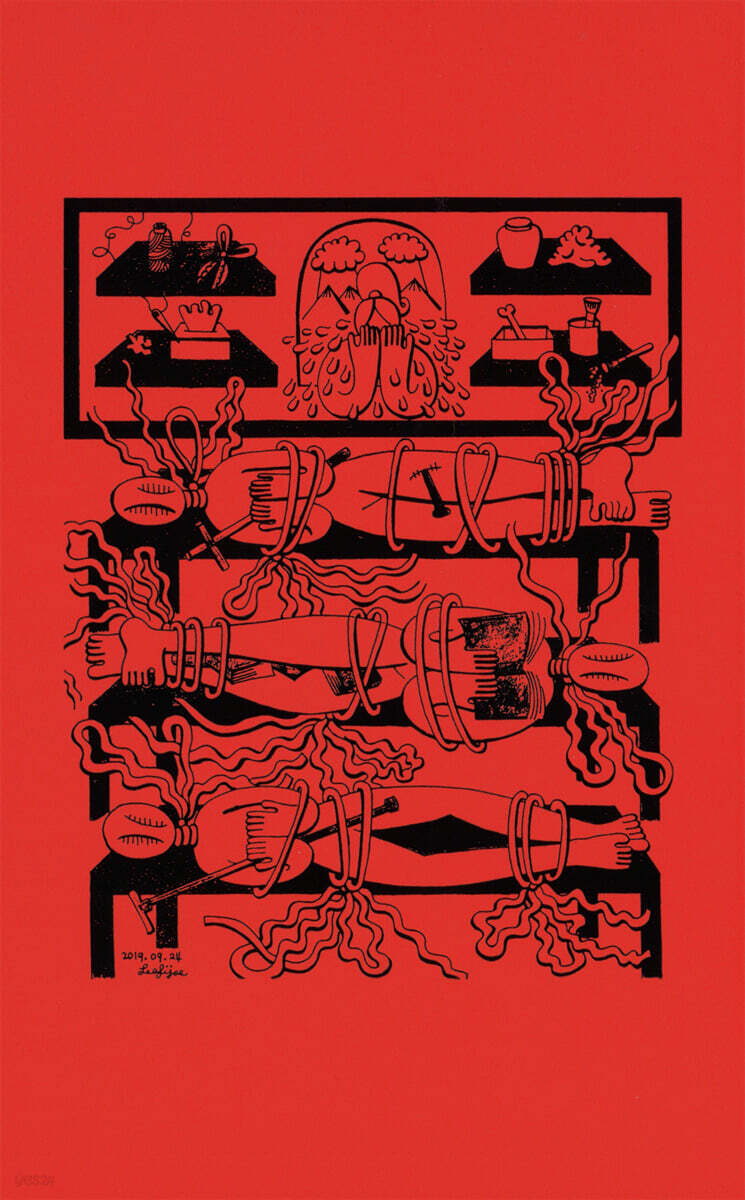
The front cover features a drawing by contemporary artist 'Epi' with a symbolic meaning printed in ink, and the back cover features the title of the book, 'Kim Hye-soon's Death Trilogy', translated into five languages: Chinese, Japanese, English, German, and French.
Contemporary artist 'Epi', who has six drawings on the cover and the main text, has been creating altars for the countless bodies that parasitize on women's bodies (extinct bodies, bodies of the future, bodies of the other shaped by the senses) through paintings, sculptures, and installations using various materials ranging from reinforced plastic to gold dust.
In 2025, she became the first Korean to receive the Dorothea Tanning Award, established by the Foundation for Contemporary Arts in New York.
“A poet is a person who takes responsibility for all dying beings.
Writing poetry is like cooking.
Just as cooking involves killing and preparing living things outside of oneself, poetry involves taking something alive and throwing it into the world of language.
[… … ] Death is not an individual or personal experience, but something that none of us can experience, because it is something that belongs to everyone.
I believe that only a poet, who resists death by repeating passive death, can achieve this.
Since it is the writing of a being who killed himself and became many, that is, revenge, isn't it about going beyond 'me' and communicating with others and alienated beings?
“Practicing this kind of death would be the politics of poetry.”
- Kim Hye-soon (from the 2024 Gwangju Biennale German Pavilion Kim Hye-soon × Park Sul Dialogue)
“A daughter writing about her mother’s death is a way of saying ‘no.’
What is 'no'?
That is, a mother's life is not life, and a mother's death is not death.
The mother is not a mother, and the daughter is not a daughter.
To bring out what was not life in my mother's life, death, and to bring out what was not death in my mother's death, life.
Now that my mother is dead, her life and death within me are jumbled, and her life and death have seeped into each other like stains and spread.
So now, mother becomes the daughter of a woman (daughter) who writes poetry, both before and after life, and before and after death, and becomes mother's mother, and becomes the woman who writes poetry herself.
[… … ]
A woman is already possessed of death when she is born.
Just like the poet's fate.
Death is a priori.
If I have a poetic strategy for unraveling life and death, it is this perspective on life and death.
[… … ]
A life entangled with her daughter, a life that spread with her daughter, a life that was omnipresent with her daughter, and so the mother became absent yet present like a desert.
Like beings in the '/' of life/death like sand.
The two lips overlapped.
Mom became 'not' a mom.
Death has become 'not'."
- From the prose "Mother of Death"
The first volume of the Death Trilogy is Autobiography of Death (2016), winner of the 2019 Canadian Griffin Poetry Award.
In 2015, poet Kim Hye-sun suddenly collapsed and collapsed at a subway station.
She went to the hospital in pain that felt like her whole body was being shocked by electricity every moment, but due to the MERS outbreak, she was put in the double pain of having to move from one hospital to another.
Amidst the tragedy of the Sewol ferry disaster and the continuing social deaths, her pain escaped the body and rapidly transformed into a poetic state, literally writing 49 poems of death in a frenzied manner.
The result is a poem so terrible that it is impossible to read without pain, literary-wise, that it brings a rift to this otherwise perfectly civilized world.
This collection of poems is itself a record of the forty-nine memorial services for the 'living dead.'
“In the horrific aftermath of the 2014 Sewol ferry disaster, Korean poet Kim Hye-soon wrote a tragic piece filled with immense shock, anger, and a respect for the souls of the children who were driven by this disaster.
And he composed a poem consisting of 49 chapters, one for each day the dead must wait for reincarnation.
Through Choi Don-mi's masterful translation, we hear Kim Hye-soon's poetry, a transnational clash of shamanism, modernism, and feminism, cry out in "a melancholic tone no one has ever sung before."
The tone beyond death may sound like life itself, the poet sings, “even death cannot enter deep within me.”
- From the 2019 Griffin Poetry Award Selection Remarks
The second volume, Phantom Pain Wings (2019), is the first Korean poetry collection to win the 2024 National Book Critics Circle Award.
Poet Kim Hye-soon has long developed poetry using the 'bodies' of all living animals, including humans, including the serial poem "It's Okay Because They're Pigs" (Bloom, Pigs), which deals with the culling of 3 million pigs due to foot-and-mouth disease.
In 『Wing Fantasy』, the poet expands this body into a ‘bird.’
If Kim Hye-soon's 'biopoetics', which "detects poetry through the intimacy of the body," is contained in the poetry collections 『What it means for a woman to write』 and 『Women, Doing Poetry』 and the prose collection 『Doing Female Beast Asia』, this poetry collection is right between these books.
In this “eternal void of sorrow” (Victoria Chang, The New York Times Magazine), the poet unfolds a narrative sequence of new ventriloquism that explores the constant physical and existential struggle against power and gender violence.
The strong rhythm, characterized by visual wordplay and word arrangement, reads like the lines of a chant.
In this way, Kim Hye-soon blends traditional folklore and mythology with contemporary psychodramatic realities to present works as diverse as The Cremation Ceremony, Agnès Varda's Film and the Legacy of Ideals, Francis Bacon's Portrait of Pope Innocent X, and Princess Cyclone in a Hospital.
『Wing Fantasy』 was also selected as one of the '5 Best Poetry Books of 2023' by the New York Times and one of the '11 Best Poetry Books of 2023' by the Washington Post.
My mom
My dad
Now I see
we are
Community of Farewell
- From “The Poet’s Words” (Wing Fantasy, 2019)
“Mom is the window, the window is the sunlight, the sunlight is the handle, the handle is the footprint, the footprint is the front door.
My longing is endlessly postponed.
My longing moves on to the next object.
“It goes around the world.”
- From the prose "Metonymy of Loss"
“While writing the poem ‘Wing Fantasy’, I began to think about ‘birds’ as animals that share finitude and infinity with humans, and thus as animals with a double bind.
This can be said because the bird functions as a metaphor for the 'dead' in the collective unconscious.
At the same time, he appears as a strange other who divides the living and the dead.
Birds are animals that show both presence and absence at the same time.
[… … ] I looked at this animal, the bird, as a being that possesses both returning and wandering, a being that has both wings and feet, and I wanted to ‘become a bird.’
“While writing this collection of poems, I felt a lot of the ‘bird’s eye’ looking at me. It’s like the gaze of an animal that has stopped judging, but it also seems to be a reflection of my unconsciousness that feels like death is looking at me.”
- From 『Kim Hye-sun's Words』 (Maeumsanchaek, 2023)
The third volume, After Earth Dies, Who Will Moon Orbit? (2022), is the poet's most recent poetry collection and is scheduled for publication in English next year (by New Directions, USA).
The translation was done by Choi Don-mi, who previously translated “Autobiography of Death” and “Winged Fantasy Pain” into English.
(Translator Donmi Choi is also a poet who won the 2020 National Book Award for her poetry collection, DMZ Colony.
He previously won the Lucienstrik Translation Award in 2011 for poet Kim Hye-soon's "All the Garbage of the World, Unite!" (anthology), the Lucienstrik Translation Award and the Canadian Griffin Poetry Award in 2019 for "Autobiography of Death," and the National Book Critics Circle Award in 2024 for "Wing Fantasy Tube" (jointly with poet Kim Hye-soon).
In this collection of poems, the poet laments the death of the world.
Part 1 is a collection of poems of sorrow written while the poet was lingering over death, written when his mother was sick and after she passed away.
Part 2 contains the despair of the times faced with the global disaster of COVID-19, and Part 3 contains a record of wandering in an empty desert outside of death.
The poet, through his personal experience of illness and death, looks at the death of the world and the sorrow hidden in each and every death.
As we seek to unite in a 'solidarity of sorrow,' we watch with all our might what the fragments of life, shattered like sand, are doing in the desert of oblivion, which is death itself.
Through Kim Hye-sun's poetry, we can finally discover that death is 'something we must infinitely experience and infinitely overcome in life, something we suffer while living.'
“Poetry is a record of the poet dying before the subject dies.
Poetry is about confronting cruel deaths through a farewell to things and the world, and constructing a transcendental, dizzying, and distant death.
[… … ] Is there any event as meaningless as death? Death is meaningless because it is meaningless.
Yet, the Tinkerbell of the poetry we write is always 'death'.
Without this absence and disappearance of death, the rhythm of poetry would not occur.
[… … ]
Death is something we must infinitely experience in life, something we must infinitely overcome, something we suffer from while living.
I'm stuck with life as sand that fits my life perfectly.
By suffering through this life, poetry leads human existence to another, better place.
I would like to say that the poems in this collection look at the countless deaths around the world through the lens of the illness and death of close relatives, and they examine how much sorrow lies hidden in each and every death, where the Earth, burdened with this sorrow, is headed, and what our lives, times, and days are doing in the desert of oblivion, like sand.”
- From Kim Hye-sun (『Kim Hye-sun's Words』)
Poet's words
There are very few people on this planet right now who will not be leaving in a hundred years.
With that merciless death before and after life, wouldn't it have been natural to weave an arabesque of death or listen to a round song of death?
Our souls are equal because death is fair before and behind us.
Therefore, death is the most ferocious good, grace, and eternity.
I died and died every day while writing these poems.
But wasn't it because I had images and rhythms in my pocket that I got up again each day?
The paradox that one cannot rise from death without going through it.
Poetry is a transcendental record of death, so it must have been like that.
If you say you will come to me tomorrow, I will rise from the dead today.
June 2025
Kim Hye-soon
It was pre-released at the Seoul International Book Fair in June of this year and attracted keen interest from readers as well as overseas publishers.
The book includes the entire collection of poems from the Death Trilogy, the unpublished prose "Mother of Death," and the poem "Going Going Gone" (included in "Wing Fantasy Pain"), which was introduced in the April 2022 issue of the New York Times Magazine and garnered much attention, translated into five languages: English, German, French, Japanese, and Chinese.
As I was binding three volumes of poetry into one, the total number of pages quickly exceeded 600.
If the poem seems long, the witty verse and the poet's unique rhythm become intertwined, and the implicit poems that seem to go back and forth between oral and recited are also short, so I hope that the readers will have enough 'time on the open page' for each poem, so I chose a four-page binding, and an exposed binding style with an empty spine to visually reveal the bound form.
“My parents were my past, and after they died, they became my future,” the poet said, and in this way, he named death “a vengeful and endlessly returning event of life” in which the sequence of daily life and mourning is repeated. Inspired by this, the cover is made of intense blood red paper, and the main text is made of different papers, one by one, with poems of mourning engraved in black ink on white paper for each volume and ash-colored paper full of soot from being re-burned.
The front cover features a drawing by contemporary artist 'Epi' with a symbolic meaning printed in ink, and the back cover features the title of the book, 'Kim Hye-soon's Death Trilogy', translated into five languages: Chinese, Japanese, English, German, and French.
Contemporary artist 'Epi', who has six drawings on the cover and the main text, has been creating altars for the countless bodies that parasitize on women's bodies (extinct bodies, bodies of the future, bodies of the other shaped by the senses) through paintings, sculptures, and installations using various materials ranging from reinforced plastic to gold dust.
In 2025, she became the first Korean to receive the Dorothea Tanning Award, established by the Foundation for Contemporary Arts in New York.
“A poet is a person who takes responsibility for all dying beings.
Writing poetry is like cooking.
Just as cooking involves killing and preparing living things outside of oneself, poetry involves taking something alive and throwing it into the world of language.
[… … ] Death is not an individual or personal experience, but something that none of us can experience, because it is something that belongs to everyone.
I believe that only a poet, who resists death by repeating passive death, can achieve this.
Since it is the writing of a being who killed himself and became many, that is, revenge, isn't it about going beyond 'me' and communicating with others and alienated beings?
“Practicing this kind of death would be the politics of poetry.”
- Kim Hye-soon (from the 2024 Gwangju Biennale German Pavilion Kim Hye-soon × Park Sul Dialogue)
“A daughter writing about her mother’s death is a way of saying ‘no.’
What is 'no'?
That is, a mother's life is not life, and a mother's death is not death.
The mother is not a mother, and the daughter is not a daughter.
To bring out what was not life in my mother's life, death, and to bring out what was not death in my mother's death, life.
Now that my mother is dead, her life and death within me are jumbled, and her life and death have seeped into each other like stains and spread.
So now, mother becomes the daughter of a woman (daughter) who writes poetry, both before and after life, and before and after death, and becomes mother's mother, and becomes the woman who writes poetry herself.
[… … ]
A woman is already possessed of death when she is born.
Just like the poet's fate.
Death is a priori.
If I have a poetic strategy for unraveling life and death, it is this perspective on life and death.
[… … ]
A life entangled with her daughter, a life that spread with her daughter, a life that was omnipresent with her daughter, and so the mother became absent yet present like a desert.
Like beings in the '/' of life/death like sand.
The two lips overlapped.
Mom became 'not' a mom.
Death has become 'not'."
- From the prose "Mother of Death"
The first volume of the Death Trilogy is Autobiography of Death (2016), winner of the 2019 Canadian Griffin Poetry Award.
In 2015, poet Kim Hye-sun suddenly collapsed and collapsed at a subway station.
She went to the hospital in pain that felt like her whole body was being shocked by electricity every moment, but due to the MERS outbreak, she was put in the double pain of having to move from one hospital to another.
Amidst the tragedy of the Sewol ferry disaster and the continuing social deaths, her pain escaped the body and rapidly transformed into a poetic state, literally writing 49 poems of death in a frenzied manner.
The result is a poem so terrible that it is impossible to read without pain, literary-wise, that it brings a rift to this otherwise perfectly civilized world.
This collection of poems is itself a record of the forty-nine memorial services for the 'living dead.'
“In the horrific aftermath of the 2014 Sewol ferry disaster, Korean poet Kim Hye-soon wrote a tragic piece filled with immense shock, anger, and a respect for the souls of the children who were driven by this disaster.
And he composed a poem consisting of 49 chapters, one for each day the dead must wait for reincarnation.
Through Choi Don-mi's masterful translation, we hear Kim Hye-soon's poetry, a transnational clash of shamanism, modernism, and feminism, cry out in "a melancholic tone no one has ever sung before."
The tone beyond death may sound like life itself, the poet sings, “even death cannot enter deep within me.”
- From the 2019 Griffin Poetry Award Selection Remarks
The second volume, Phantom Pain Wings (2019), is the first Korean poetry collection to win the 2024 National Book Critics Circle Award.
Poet Kim Hye-soon has long developed poetry using the 'bodies' of all living animals, including humans, including the serial poem "It's Okay Because They're Pigs" (Bloom, Pigs), which deals with the culling of 3 million pigs due to foot-and-mouth disease.
In 『Wing Fantasy』, the poet expands this body into a ‘bird.’
If Kim Hye-soon's 'biopoetics', which "detects poetry through the intimacy of the body," is contained in the poetry collections 『What it means for a woman to write』 and 『Women, Doing Poetry』 and the prose collection 『Doing Female Beast Asia』, this poetry collection is right between these books.
In this “eternal void of sorrow” (Victoria Chang, The New York Times Magazine), the poet unfolds a narrative sequence of new ventriloquism that explores the constant physical and existential struggle against power and gender violence.
The strong rhythm, characterized by visual wordplay and word arrangement, reads like the lines of a chant.
In this way, Kim Hye-soon blends traditional folklore and mythology with contemporary psychodramatic realities to present works as diverse as The Cremation Ceremony, Agnès Varda's Film and the Legacy of Ideals, Francis Bacon's Portrait of Pope Innocent X, and Princess Cyclone in a Hospital.
『Wing Fantasy』 was also selected as one of the '5 Best Poetry Books of 2023' by the New York Times and one of the '11 Best Poetry Books of 2023' by the Washington Post.
My mom
My dad
Now I see
we are
Community of Farewell
- From “The Poet’s Words” (Wing Fantasy, 2019)
“Mom is the window, the window is the sunlight, the sunlight is the handle, the handle is the footprint, the footprint is the front door.
My longing is endlessly postponed.
My longing moves on to the next object.
“It goes around the world.”
- From the prose "Metonymy of Loss"
“While writing the poem ‘Wing Fantasy’, I began to think about ‘birds’ as animals that share finitude and infinity with humans, and thus as animals with a double bind.
This can be said because the bird functions as a metaphor for the 'dead' in the collective unconscious.
At the same time, he appears as a strange other who divides the living and the dead.
Birds are animals that show both presence and absence at the same time.
[… … ] I looked at this animal, the bird, as a being that possesses both returning and wandering, a being that has both wings and feet, and I wanted to ‘become a bird.’
“While writing this collection of poems, I felt a lot of the ‘bird’s eye’ looking at me. It’s like the gaze of an animal that has stopped judging, but it also seems to be a reflection of my unconsciousness that feels like death is looking at me.”
- From 『Kim Hye-sun's Words』 (Maeumsanchaek, 2023)
The third volume, After Earth Dies, Who Will Moon Orbit? (2022), is the poet's most recent poetry collection and is scheduled for publication in English next year (by New Directions, USA).
The translation was done by Choi Don-mi, who previously translated “Autobiography of Death” and “Winged Fantasy Pain” into English.
(Translator Donmi Choi is also a poet who won the 2020 National Book Award for her poetry collection, DMZ Colony.
He previously won the Lucienstrik Translation Award in 2011 for poet Kim Hye-soon's "All the Garbage of the World, Unite!" (anthology), the Lucienstrik Translation Award and the Canadian Griffin Poetry Award in 2019 for "Autobiography of Death," and the National Book Critics Circle Award in 2024 for "Wing Fantasy Tube" (jointly with poet Kim Hye-soon).
In this collection of poems, the poet laments the death of the world.
Part 1 is a collection of poems of sorrow written while the poet was lingering over death, written when his mother was sick and after she passed away.
Part 2 contains the despair of the times faced with the global disaster of COVID-19, and Part 3 contains a record of wandering in an empty desert outside of death.
The poet, through his personal experience of illness and death, looks at the death of the world and the sorrow hidden in each and every death.
As we seek to unite in a 'solidarity of sorrow,' we watch with all our might what the fragments of life, shattered like sand, are doing in the desert of oblivion, which is death itself.
Through Kim Hye-sun's poetry, we can finally discover that death is 'something we must infinitely experience and infinitely overcome in life, something we suffer while living.'
“Poetry is a record of the poet dying before the subject dies.
Poetry is about confronting cruel deaths through a farewell to things and the world, and constructing a transcendental, dizzying, and distant death.
[… … ] Is there any event as meaningless as death? Death is meaningless because it is meaningless.
Yet, the Tinkerbell of the poetry we write is always 'death'.
Without this absence and disappearance of death, the rhythm of poetry would not occur.
[… … ]
Death is something we must infinitely experience in life, something we must infinitely overcome, something we suffer from while living.
I'm stuck with life as sand that fits my life perfectly.
By suffering through this life, poetry leads human existence to another, better place.
I would like to say that the poems in this collection look at the countless deaths around the world through the lens of the illness and death of close relatives, and they examine how much sorrow lies hidden in each and every death, where the Earth, burdened with this sorrow, is headed, and what our lives, times, and days are doing in the desert of oblivion, like sand.”
- From Kim Hye-sun (『Kim Hye-sun's Words』)
Poet's words
There are very few people on this planet right now who will not be leaving in a hundred years.
With that merciless death before and after life, wouldn't it have been natural to weave an arabesque of death or listen to a round song of death?
Our souls are equal because death is fair before and behind us.
Therefore, death is the most ferocious good, grace, and eternity.
I died and died every day while writing these poems.
But wasn't it because I had images and rhythms in my pocket that I got up again each day?
The paradox that one cannot rise from death without going through it.
Poetry is a transcendental record of death, so it must have been like that.
If you say you will come to me tomorrow, I will rise from the dead today.
June 2025
Kim Hye-soon
GOODS SPECIFICS
- Date of issue: June 18, 2025
- Format: Guide to book binding methods for four-sided binding
- Page count, weight, size: 616 pages | 746g | 128*205*33mm
- ISBN13: 9788932044088
You may also like
카테고리
korean


korean

![GQ KOREA Mark (Monthly): December [2025]](http://librairie.coreenne.fr/cdn/shop/files/8ef265dbbfbf186523ed75ba7319009d.jpg?v=1765340328&width=3840)


