

A Collapsing World and Demography
 |
Description
Book Introduction
- A word from MD
-
It was good in hindsight, but I'm afraid of what's to come.Peter Zeihan, a geopolitics expert who has created a buzz with every book he publishes.
The future he envisions is not bright.
The outlook presented in 『Demography and the Collapsing World』 is bleak.
The world is becoming poorer.
Conflicts over scarce resources are also on the rise.
The war in Ukraine is just beginning, with more bad news to come.
January 31, 2023. Social and Political PD Son Min-gyu
Peter Zeihan's fourth book
Why the 21st-Century Nostradamus Predicts the Collapse of the World
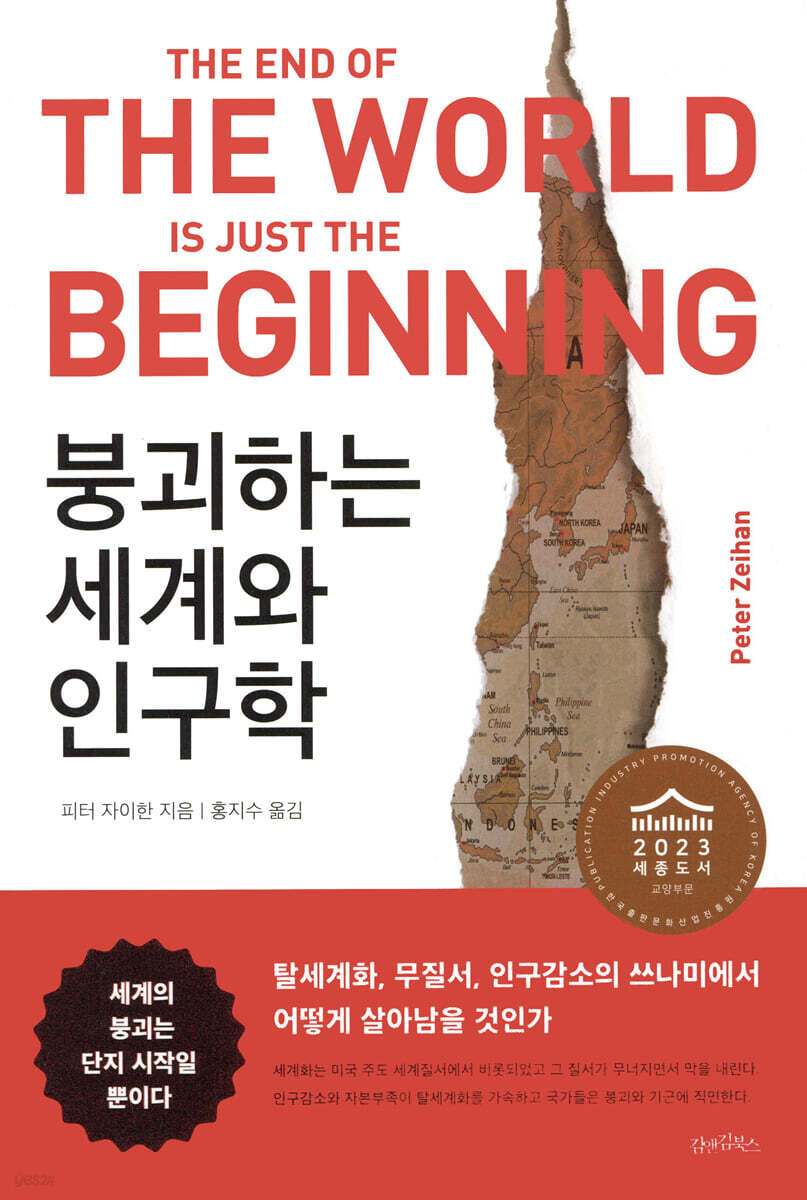
Geopolitical strategist Zaihan's fourth book, The End of the World Is Just the Beginning, has been published.
Zaihan described the process of writing this book as “a journey of mixed emotions.”
The process of publishing the Korean version was a bewildering experience.
If Zaihan felt that way about the completion of a grand discourse, the publisher of the Korean edition was at a loss as to how to accept the harsh predictions about the world we live in.
In this book, Zaihan says that the end of the world as we know it will come.
The golden age of the past 75 years is over and now is the time of collapse.
Globalization is collapsing and industrialization is collapsing.
The global division of labor system and network are collapsing.
The kind of world collapse predicted in this book is beyond our imagination.
What is even more puzzling is that there is no clear way for Korea to overcome this.
Zaihan is called the Nostradamus of the 21st century for his remarkable predictive powers.
His first book, American Hegemony and Geopolitics in the 21st Century, predicted Trump's America, and in The Shale Revolution and the World Without America, he predicted Russia's invasion of Ukraine.
In 『Each for himself: A world of survival and geopolitics』, he predicted the collapse of China.
So it's hard to dismiss his prediction of the world's collapse.
Zaihan says the collapse will begin in earnest in the 2020s, not in the near future.
It is said that we may go beyond deglobalization and head towards deindustrialization and decivilization.
Raw materials, fuel, and food are all becoming scarce.
The famine that was thought to have disappeared returns.
In a disconnected and collapsing world, those regions that cannot be self-sufficient in materials, food, or energy, or cannot obtain them by force, will suffer the most.
North America is definitely not.
East Asia and Korea suffer the most.
Why does Zaihan believe the world is collapsing? Because the combination of geopolitics and demographics that ushered in the golden age of the postwar era is now operating in the exact opposite direction.
There is no end in sight to the Russo-Ukrainian war.
The era of geopolitical conflict has begun.
Meanwhile, the US-led world order is on the verge of collapse.
Neither the security of allies, nor free market access, nor stable energy distribution are any longer strategic concerns for the United States.
In a world where each country is left to its own devices, countries are left in turmoil.
The Russo-Ukrainian war alone is causing serious disruptions to energy and grain supplies.
Even though one of the three great wars predicted by Zaihan has only just begun.
The bigger problem is that the population collapse has only just begun.
In the 2020s, baby boomers in major countries are retiring in large numbers.
The population effect of life extension has also ended.
The population decline is progressing rapidly.
South Korea's birth rate fell below 1 a long time ago, and China's population is also declining.
The aging process is accelerating.
The population that produces and consumes is decreasing, while the population that needs to be supported is increasing.
Savings disappear and you end up living off of your savings.
Capital is scarce and demand is shrinking.
Investment, production, consumption, and trade all collapse.
Long-distance transportation systems also collapse.
People become poor and countries become desperate.
It is difficult to predict what actions countries will take.
East Asian countries, which must import a significant portion of their energy, raw materials, and food, face the greatest challenges.
The end is coming for the Asian stock companies that can neither make goods cheaply nor sell them.
On the other hand, North America has a large domestic market, abundant energy, and plenty of arable land, yet its population is not decreasing much.
The real North American era is coming.
In the preface to the Korean edition, Zaihan said, “The future of the world is Korea’s future.”
It sounded like the future of the world depended on Korea.
Can Korea truly prevent deglobalization or find a way to navigate its challenges? How can it avoid the scourge of demographic collapse? We face this enormous and daunting challenge.
Why the 21st-Century Nostradamus Predicts the Collapse of the World
Geopolitical strategist Zaihan's fourth book, The End of the World Is Just the Beginning, has been published.
Zaihan described the process of writing this book as “a journey of mixed emotions.”
The process of publishing the Korean version was a bewildering experience.
If Zaihan felt that way about the completion of a grand discourse, the publisher of the Korean edition was at a loss as to how to accept the harsh predictions about the world we live in.
In this book, Zaihan says that the end of the world as we know it will come.
The golden age of the past 75 years is over and now is the time of collapse.
Globalization is collapsing and industrialization is collapsing.
The global division of labor system and network are collapsing.
The kind of world collapse predicted in this book is beyond our imagination.
What is even more puzzling is that there is no clear way for Korea to overcome this.
Zaihan is called the Nostradamus of the 21st century for his remarkable predictive powers.
His first book, American Hegemony and Geopolitics in the 21st Century, predicted Trump's America, and in The Shale Revolution and the World Without America, he predicted Russia's invasion of Ukraine.
In 『Each for himself: A world of survival and geopolitics』, he predicted the collapse of China.
So it's hard to dismiss his prediction of the world's collapse.
Zaihan says the collapse will begin in earnest in the 2020s, not in the near future.
It is said that we may go beyond deglobalization and head towards deindustrialization and decivilization.
Raw materials, fuel, and food are all becoming scarce.
The famine that was thought to have disappeared returns.
In a disconnected and collapsing world, those regions that cannot be self-sufficient in materials, food, or energy, or cannot obtain them by force, will suffer the most.
North America is definitely not.
East Asia and Korea suffer the most.
Why does Zaihan believe the world is collapsing? Because the combination of geopolitics and demographics that ushered in the golden age of the postwar era is now operating in the exact opposite direction.
There is no end in sight to the Russo-Ukrainian war.
The era of geopolitical conflict has begun.
Meanwhile, the US-led world order is on the verge of collapse.
Neither the security of allies, nor free market access, nor stable energy distribution are any longer strategic concerns for the United States.
In a world where each country is left to its own devices, countries are left in turmoil.
The Russo-Ukrainian war alone is causing serious disruptions to energy and grain supplies.
Even though one of the three great wars predicted by Zaihan has only just begun.
The bigger problem is that the population collapse has only just begun.
In the 2020s, baby boomers in major countries are retiring in large numbers.
The population effect of life extension has also ended.
The population decline is progressing rapidly.
South Korea's birth rate fell below 1 a long time ago, and China's population is also declining.
The aging process is accelerating.
The population that produces and consumes is decreasing, while the population that needs to be supported is increasing.
Savings disappear and you end up living off of your savings.
Capital is scarce and demand is shrinking.
Investment, production, consumption, and trade all collapse.
Long-distance transportation systems also collapse.
People become poor and countries become desperate.
It is difficult to predict what actions countries will take.
East Asian countries, which must import a significant portion of their energy, raw materials, and food, face the greatest challenges.
The end is coming for the Asian stock companies that can neither make goods cheaply nor sell them.
On the other hand, North America has a large domestic market, abundant energy, and plenty of arable land, yet its population is not decreasing much.
The real North American era is coming.
In the preface to the Korean edition, Zaihan said, “The future of the world is Korea’s future.”
It sounded like the future of the world depended on Korea.
Can Korea truly prevent deglobalization or find a way to navigate its challenges? How can it avoid the scourge of demographic collapse? We face this enormous and daunting challenge.
- You can preview some of the book's contents.
Preview
index
Preface to the Korean edition
prolog
Part 1: The End of an Era
01 It started like this
Agricultural settlement revolution
Water Revolution
Wind Revolution
Industrial Revolution
02 Accidental Superpower
The United States is the most powerful maritime power in history.
The United States is the most powerful and stable industrial nation in history.
03 Complete Transformation
04 Our Story
Give up farming
05 Accelerate History
06 Learning creepy words
07 The End of the Addition Era
08 Messy Models
Russia as a success story
Japan aging gracefully
Get out, coronavirus
09 Remnants of the Addition Era
Addition in the United States 1: Geographical Conditions
Addition in America 2: Baby Boomers and Millennials
Addition in America 3: Culture
Addition of America 4: Mexico
The end of the world as we know it
A brief note from the author… and Moscow
Part 2 Transportation
10 A long way
The physical hardship of transportation
Transportation in the Age of Ocean Navigation
11 Breaking Free from Constraints: The Industrialization of Transport
12 Americanization of Trade
Effect 1.
Ships: Much larger, more powerful, but… much slower.
Effect 2.
Containerization: Building a Better Box
Effect 3.
Ports: growing in size and shrinking in number
Effect 4.
Cities: The Explosion of Cities
Effect 5.
Supply Chain: Production local, sales global
dissolution
13. Large-scale dismantling
The World Ahead: Inviting—and Avoiding—Danger
14 Storm-Tossed Harbor
Deep breath
Part 3 Finance
15 Currency: Going Where You've Never Been Before
The long road to currency
Building trust
Reserve currency: Big shot
Failure from success
16 The Adventure of Capital
Free Money: The Asian Financial Model
Great Convergence: The Euro Model
From boom to bust and back to boom again: The American model
17 Disaster is relative
18 Reaffirming the End of the Additive Era: Population Structure and Capital
Summary of the 19th Golden Age of Loans
20 Navigating Future Financial Failures
Part 4 Energy
21. Harpooning Progress
The Road to Modern Energy: War, Cults, Whales, and… Knitting?
22 Oil order under the US-led world order
23 Oil Map: Current Situation
24 Oil is more than just oil.
Inelasticity
Possibility of disruption
Inseparable
A countermeasure that is not a countermeasure
Oil means more than just oil.
Oil has a greater meaning than just oil.
Climate change
25 Fueling the Future
Part 5 Industrial Materials
26 Breaking down history
Lessons from the Past, Lessons for the Future
Things to keep in mind before jumping into the main topic
27 Required Materials
28 Materials that will be in the spotlight in the future
29 Unchanging materials
30 Unique Materials
31 Materials with a stable supply
32 This is how the world ends
Part 6 Manufacturing
33 Creating the World We Know
Start from scratch
How and why it works
Just-in-time production method
34 Current map
Manufacturing in East Asia: Globalization Made Real
German-centered European manufacturing
Manufacturing in North America: A Bunch of Options
35 Map of the Future
The End of Asia Inc.
The disintegration of Europe
The North American Century
emerging hub
36 Creating a New World
Analyzing the Collapse
Part 7 Agriculture
37 What's at stake?
Building Abundance
38 Geopolitics of Vulnerability
39 Avoiding or Accepting the Worst Case
40 Alleviating Famine
The Art and Science of Input Materials
“Progressive” steps backward
41 Expand your diet, reduce your diet
42 Agriculture and Climate Change
A Tale of Two Regions
Understanding Climate Change 1: It's Not Heat, It's Humidity
Understanding Climate Change 2: Keep an Eye on the Wind
Understanding Climate Change 3: Two is Better than One
Understanding Climate Change 4: The End of Marginal Land
Look a little further ahead
43 Feeding the New World
The Third Horseman's Long Journey
Epilogue
Acknowledgements
footnote
prolog
Part 1: The End of an Era
01 It started like this
Agricultural settlement revolution
Water Revolution
Wind Revolution
Industrial Revolution
02 Accidental Superpower
The United States is the most powerful maritime power in history.
The United States is the most powerful and stable industrial nation in history.
03 Complete Transformation
04 Our Story
Give up farming
05 Accelerate History
06 Learning creepy words
07 The End of the Addition Era
08 Messy Models
Russia as a success story
Japan aging gracefully
Get out, coronavirus
09 Remnants of the Addition Era
Addition in the United States 1: Geographical Conditions
Addition in America 2: Baby Boomers and Millennials
Addition in America 3: Culture
Addition of America 4: Mexico
The end of the world as we know it
A brief note from the author… and Moscow
Part 2 Transportation
10 A long way
The physical hardship of transportation
Transportation in the Age of Ocean Navigation
11 Breaking Free from Constraints: The Industrialization of Transport
12 Americanization of Trade
Effect 1.
Ships: Much larger, more powerful, but… much slower.
Effect 2.
Containerization: Building a Better Box
Effect 3.
Ports: growing in size and shrinking in number
Effect 4.
Cities: The Explosion of Cities
Effect 5.
Supply Chain: Production local, sales global
dissolution
13. Large-scale dismantling
The World Ahead: Inviting—and Avoiding—Danger
14 Storm-Tossed Harbor
Deep breath
Part 3 Finance
15 Currency: Going Where You've Never Been Before
The long road to currency
Building trust
Reserve currency: Big shot
Failure from success
16 The Adventure of Capital
Free Money: The Asian Financial Model
Great Convergence: The Euro Model
From boom to bust and back to boom again: The American model
17 Disaster is relative
18 Reaffirming the End of the Additive Era: Population Structure and Capital
Summary of the 19th Golden Age of Loans
20 Navigating Future Financial Failures
Part 4 Energy
21. Harpooning Progress
The Road to Modern Energy: War, Cults, Whales, and… Knitting?
22 Oil order under the US-led world order
23 Oil Map: Current Situation
24 Oil is more than just oil.
Inelasticity
Possibility of disruption
Inseparable
A countermeasure that is not a countermeasure
Oil means more than just oil.
Oil has a greater meaning than just oil.
Climate change
25 Fueling the Future
Part 5 Industrial Materials
26 Breaking down history
Lessons from the Past, Lessons for the Future
Things to keep in mind before jumping into the main topic
27 Required Materials
28 Materials that will be in the spotlight in the future
29 Unchanging materials
30 Unique Materials
31 Materials with a stable supply
32 This is how the world ends
Part 6 Manufacturing
33 Creating the World We Know
Start from scratch
How and why it works
Just-in-time production method
34 Current map
Manufacturing in East Asia: Globalization Made Real
German-centered European manufacturing
Manufacturing in North America: A Bunch of Options
35 Map of the Future
The End of Asia Inc.
The disintegration of Europe
The North American Century
emerging hub
36 Creating a New World
Analyzing the Collapse
Part 7 Agriculture
37 What's at stake?
Building Abundance
38 Geopolitics of Vulnerability
39 Avoiding or Accepting the Worst Case
40 Alleviating Famine
The Art and Science of Input Materials
“Progressive” steps backward
41 Expand your diet, reduce your diet
42 Agriculture and Climate Change
A Tale of Two Regions
Understanding Climate Change 1: It's Not Heat, It's Humidity
Understanding Climate Change 2: Keep an Eye on the Wind
Understanding Climate Change 3: Two is Better than One
Understanding Climate Change 4: The End of Marginal Land
Look a little further ahead
43 Feeding the New World
The Third Horseman's Long Journey
Epilogue
Acknowledgements
footnote
Publisher's Review
How the world we know was created
The 75-year golden age brought about by the Bretton Woods system
In the 75 years since the end of World War II, the world's population has nearly tripled.
Materials became abundant and living conditions improved by leaps and bounds.
Jaihan calls this period the Golden Age.
To understand the immense changes that lie ahead, we must first understand how humanity arrived at the golden age we enjoy today.
This book traces the history of humanity and traces the secrets of the remarkable growth and abundance achieved by humanity since World War II.
It is surprising what happened during this short period, called the post-war era.
Industrialization, which had been the exclusive domain of some advanced countries, has spread throughout the world.
Urbanization took place and the world's population grew explosively.
Transportation costs were lowered, the global division of labor expanded, and economies of scale were maximized.
It has become an era of globalization.
The beginning of all these changes was the world order created by the United States.
The United States, the only de facto victor of World War II, dismantled its colonial empires in Europe and Asia.
He bought the geopolitics of the free world allies to counter the Soviet Union.
Gave up the domestic market.
The nations of the free world could not and did not need to wage war.
Thanks to the US Navy, the sea routes have become free and safe.
There was free access to resources.
Globalization has begun.
Developing countries in Asia, including Korea, have also embarked on industrialization.
It was possible to break free from the constraints of geographical conditions that had strangled the nation's fate for thousands of years.
Zeihan calls it the Bretton Woods system, or in other words, the American-led world order.
The world began to develop at an unprecedented pace on the basis of the safe and open order created by the United States.
And then the magic of demographics worked.
The birth rate is falling, but the population is increasing.
It was an effect of extending lifespan.
The population that consumes and produces is increasing, but the population that supports it is decreasing.
Savings increased and capital was constantly created.
Capital flowed into every corner of the world.
Huge investments were made in infrastructure.
There has also been significant investment in Brazil's poor soil soybean farms.
A global division of labor system was established.
As China joined the ranks, economies of scale were maximized.
But Zaihan says globalization has already peaked and is collapsing.
It is said that it will begin to collapse in earnest in the 2020s and end in the 2030s.
The world we knew will soon come to an end.
Geographical conditions that bring about success different from the present will come into play.
The maps of transportation, energy, finance, industrial materials, manufacturing, and agriculture will change, redefining winners and losers.
This is the topic that Zaihan seeks to address in this book.
How this world collapses
Geopolitics is back, and the demographic disaster is upon us.
In February 2022, Russia invaded Ukraine.
Zaihan had already predicted this situation in the section titled “Russia-Europe Global War” in “The Shale Revolution and a World Without America,” published in 2019.
Faced with geopolitical insecurity due to its wide and fragile borders, Russia was seen as likely to launch an invasion before its demographics became more desperate.
And whether Russia won or lost the war, it was said that Russia would collapse due to population collapse.
Zaihan's basic argument is that America's withdrawal from the world will lead to geopolitical conflict in the Eastern Hemisphere.
The current picture is that geopolitical collapse is occurring even though the United States has not completely withdrawn.
Regardless of the outcome of the war, Ukraine is on the verge of national collapse.
Not only was territory lost, but populations were wiped out, agriculture was destroyed, and the industrial base was wiped out.
The Black Sea has virtually lost its function as a sea route.
Russia's situation is not much different.
More importantly, this war triggered German rearmament.
Whether the United States likes it or not, the era of geopolitics has arrived, and the United States is part of that game.
We are living in a world where geopolitical conflicts can erupt anywhere, whether in the Persian Gulf, the South China Sea, or the Taiwan Strait, and where it is no surprise that sea lanes are blocked and energy flows are disrupted.
But geopolitics isn't everything.
As the baby boomers retire en masse in the 2020s, the magic of demographics comes to a halt.
The life extension effect has also ended.
The era of population decline has arrived.
Now the demographic disaster begins.
Zaihan says the ongoing population collapse will result in a population decline equivalent to the Black Death over the next 20-30 years.
The problem isn't the current population, but the lack of young people to have children in the future.
The population decline trend is accelerating.
Most countries passed the point of no return by 1980.
The productive population is decreasing, but the population to support is rapidly increasing.
You have no money to save and end up living off of your savings.
Demand is down, investment is down, and trade is down.
The issue is not growth, but survival.
Global demand is running low and the US is closing its markets.
Europe is also closed.
Everyone is obsessed with protecting their own country's needs.
Even localized geopolitical conflicts can make access to energy and resources impossible or expensive.
Transportation costs are skyrocketing.
Long-distance freight transport is taking a hit.
Economies of scale disappear and the effects of division of labor disappear.
Globalization will end completely.
Most of them become poor.
Everything becomes precious.
Food supplies are at risk.
Countries that depend on imports for raw materials, energy, and food are the most desperate.
Trading countries that rely on exports are the hardest hit.
It is difficult to predict how countries will act when they become desperate.
The combination of unstable geopolitics and desperate demographics will lead to the complete collapse of the world.
Aspects of a Collapsing World 1: Transportation, Energy, and Industrial Materials
The End of an Era of Reliable Long-Distance Transportation and Energy Access
In the American-led world, neither imperial tyranny nor pirate raids have disappeared.
Maritime transport routes have become free and safe.
As the United States opened its markets, trade increased.
Ships became larger, container ships appeared, and long-distance maritime transport developed.
The port also became larger.
A global supply chain has been formed.
The world's prosperity has been fueled by a global division of labor and economies of scale, which are based on cheap and safe long-distance transportation.
If this transportation system collapses, industrialization, urbanization, and globalization will also collapse.
If the United States fails to protect the sea lanes, maritime transportation routes will become unstable.
Whether it's the Arabian Sea, the Mediterranean Sea, the Red Sea, the Black Sea, or the South China Sea, passage can be blocked or cargo ships can be seized at any time.
Even if the United States no longer opens its markets and its population declines, trade will shrink, the division of labor will break down, transportation demand will decrease, and long-distance transportation systems will collapse.
Free access to and distribution of energy has been a core pillar of the US-led world order.
Imperialist legacies and regional powers that impeded access to oil had to be eliminated.
The world economy grew, America's allies expanded, and the need for more and more oil grew.
Even the United States relied on imports.
Even after the Cold War ended, I couldn't let go.
And then shale came along in 2014.
The shale revolution has changed America's strategic calculations about the global energy sector.
The stakes in ensuring stable oil distribution have changed.
Military conflicts are occurring or will occur, whether along the Russian border or in the Persian Gulf.
In the future, 40 percent of the world's oil supply will be unsustainable.
Even if input prices rise, capital flows fail, or transportation routes are compromised, oil production and supply will be seriously disrupted.
A disruption in the supply of oil for even a few weeks could bring down modern civilization.
Solar and wind power are hardly alternatives.
In most cases, the areas where solar or wind power is available and the areas where it is needed do not match.
In a worst-case scenario, countries may become dependent again on self-sufficient coal.
With the advent of the US-led world order, countless materials became available for purchase in a free and fair global market.
The world order established stability, stability promoted economic growth, economic growth enabled technological progress, and technological progress increased the demand for materials.
Over the past 75 years, the list of materials needed for modern life has expanded more than tenfold.
This book covers the current status and future of major industrial materials such as iron, cobalt, nickel, lithium, silver, uranium, and zinc.
You will learn which materials are used where and how important they are.
But everything begins to change when America withdraws from the world order.
Unpredictable competitions will unfold all over the world.
Economic predictions become impossible.
Predictions about industrial materials also become impossible.
Predicting technological applications also becomes impossible.
Access to industrial materials may become impossible, except for a few countries that have materials in the region or have the military capacity to access other areas where materials are available.
Deindustrialization will occur.
Aspects of a Collapsing World 2: Finance and Manufacturing
The Golden Age of Lending and the End of the Asian Stock Company
The dollar emerged as the reserve currency under the Bretton Woods system.
It was a gold standard system.
Under the dollar reserve currency system, the world economy developed at an unprecedented pace.
As the world economy grew in size, the gold standard system was replaced by a fiat currency system.
There was an endless supply of cheap capital.
There was no need to worry about prices.
Because the population was growing.
It was the age of venture capital.
Investment funds poured into every project.
Since 2006, monetary inflation has become the norm.
The European financial crisis caused the money supply to increase by more than 80 percent.
The same goes for Japan.
China continued its massive monetary expansion.
Since 2007, the supply of yuan has increased by 800 percent.
The economy was larger and had a much larger reserve currency than the US dollar.
The Chinese economy is in fact neither consumption-driven nor export-driven, but rather a loan-driven economy.
Whether in China, Europe, or Japan, irresponsible monetary policies will have consequences.
In the era of fiat money, bills are being raised for the explosion in available capital and the explosion in the money supply.
The population structure that has so far greatly expanded the supply of capital and suppressed the increase in the cost of capital is now collapsing.
The populations of most countries are aging.
Their retirement years are concentrated in the 2020s and 30s.
As they retire almost simultaneously, they will no longer be supplying capital to the global economy.
If the money supply increases without capital supply, inflation will occur.
It becomes a vicious cycle.
At the very moment when the United States no longer supports the world order, when it can no longer support it.
The money supply dries up and the cost of borrowing increases.
The era of addition is over.
Under the US-led world order, East Asia became the center of global manufacturing.
The success of Asian manufacturing is a result of the region's diverse labor markets and the US-backed security environment and trade networks.
But now both of these are problematic.
Demographic collapse hits the former, and America's change of heart hits the latter.
As manufacturing costs rise and security becomes more uncertain, we will lose our position as a global manufacturing hub.
As the number of middle-aged and older workers increases due to an aging population, wages become more expensive.
Exports must continue, but if the United States closes its markets or restricts access, the Asian economic model will be difficult to maintain.
China imports more than 70 percent of its 14 million barrels of oil per day.
Japan, South Korea, and Taiwan import more than 95 percent of their needs.
But when regional conflicts or security crises occur, access to energy and inputs becomes impossible or expensive.
In a deglobalized world, North America is emerging as a new manufacturing hub.
America has markets and vast land.
There is geographic diversity.
Prices for food, electricity, oil, and land vary greatly from region to region.
There's also Mexico.
The wage gap with the US is one-sixth.
They are complementary due to the wage gap.
Moreover, the United States has the healthiest demographic structure among developed countries.
Mexico is the same.
Do East Asian countries have the capacity to engage in productive cooperation that would enable a diverse, integrated, and peaceful manufacturing supply chain? Can a regional economic community like the European Union be created? The moment the United States fails to engage or obstructs such efforts, any remaining cooperation will end.
Aspects of a Collapsing World 3: Agriculture
The age of famine is coming
Humans have been cultivating wheat since ancient times.
It grows quickly, adapts easily, and is easy to cultivate.
It could be stored for a long time.
Empires needed wheat to expand, and they waged wars to gain land to grow wheat.
It was the US-led world order that brought down the world of wheat.
Sea routes were made safe and imperialist expansion was prohibited.
Technology and inputs were also invested in marginal lands.
The Green Revolution took place, quadrupling agricultural production in developing countries.
Many areas where people barely managed to survive have been transformed into areas with a stable food supply.
Agricultural trade expanded and more diverse varieties were grown.
Wheat was pushed to the periphery.
The era that fed 8 billion people and allowed them to eat out-of-season fruit is coming to an end.
The United States will not or cannot become involved in maintaining world order.
Geopolitical conflicts become more frequent.
Globally transported grains and soybeans account for 20-25 percent, but global transport of inputs accounts for 80 percent.
To produce nitrogen fertilizer, you need natural gas.
Ginseng salt and volcanic ash, which are sources of potassium, are also needed.
Access to these inputs becomes more difficult or expensive.
Long-distance transportation systems are not maintained.
The network will collapse.
The variety of agricultural products is decreasing and yields are becoming unstable.
There is a problem with the food supply.
Things happen where the country collapses.
Zaihan predicts that in the future, more than one billion people will die from hunger and two billion will suffer from chronic malnutrition.
Only the United States, France, and Canada have a full supply chain within their own borders, from agricultural loans to fuel and fertilizer.
There are food exporting countries like Brazil that are unable to secure inputs properly.
Some importing countries may not be able to obtain food, or even if they can, they may be dependent on exporting countries.
Russia uses food diplomacy to consolidate its control over surrounding regions such as Mongolia and Tajikistan.
France could effectively rule Morocco, Tunisia, Algeria, etc.
Turkey uses its agricultural prowess to extract geopolitical concessions from countries like Azerbaijan, Georgia, Greece, and Syria.
The biggest loser is China.
Oil, which accounts for 80 percent of our needs, and other imported goods must be imported from far away at high prices.
If you can import it, that's better.
China's existing agricultural system is over-invested and now lacks both labor and capital to invest.
China will soon face massive food shortages.
The real American era is coming.
North America's fantastic geographic, demographic, and climatic conditions
People think of the Bretton Woods system as a kind of Pax Americana.
It is also called the American Century.
Jaihan says that is not the case.
The US-led world order is said to have been a system in which the US accepted economic disadvantages to win the loyalty of its global allies, and the result was globalization.
The American Century, people say, was a century of American sacrifice, and that sacrifice will no longer continue.
The United States will begin to act like a normal country.
As the United States withdraws from maintaining world order, the structural, strategic, and economic factors that artificially supported the Asian and European systems will disappear.
Europe is disintegrating and the Chinese system is collapsing.
The true American century is just beginning.
The United States has one of the healthiest demographics in the world.
As population decline becomes more serious, the remaining spending power is concentrated in North America.
The shock from the retirement of the baby boomers will not last long.
Because there is a relatively thick layer of millennials.
It is a unique country with a constant influx of immigrants and a culture that is receptive to immigration.
Moreover, the United States has enough usable land to support more than twice its current population.
The shale revolution has eliminated the need to worry about energy supply.
Canada and Mexico are also oil-producing countries.
Energy is surplus and electricity bills are cheap.
Manufacturing is already moving in large numbers back to the United States.
When trade networks break down, the flow becomes stronger.
The United States is also the largest exporter of agricultural products.
While climate change is turning farmland elsewhere into wasteland, it is turning marginal land into farmland in the United States.
The power of geographical conditions is concentrated in the United States.
On the other hand, China does not have much time.
China's population decline has already begun.
The question is not whether a challenge to China's hegemony is possible.
The very existence of the Chinese system is at stake.
Everything in modern China, from its industrial structure to its food supply, is a direct result of the American-led world order.
If the US pulls out, China's access to energy will be disrupted.
Manufacturing revenues will disappear, and the ability to import the raw materials needed to make those products, as well as the ability to import and produce food, will be lost.
There is a difference between the cost of access rising and access itself becoming impossible.
In the former case, industrial hollowing out occurs.
In the latter case, deindustrialization occurs.
China faces deindustrialization and deurbanization on an unprecedented scale.
There is even the possibility of political disintegration and decivilization.
This will happen regardless of whether or not American intervention continues, simply because of population collapse.
Korea's Fate in the Age of Deglobalization and Population Collapse
What is Korea's survival strategy?
Zaihan says that if the United States abandons its role as custodian of order, the world will not function properly.
They say that the geopolitical conflict in the Eastern Hemisphere will dismantle the global network that has existed so far, that is, the globalized world.
The world is torn apart.
This trend is becoming more irreversible and more catastrophic as population collapse causes the world to split apart, and nations become poorer and more desperate.
The behavior of nations becomes unpredictable.
Korea is in the midst of such deglobalization and population collapse.
In the future, when the United States leaves, Korea will be an export-driven country with no real allies, no real resources, no domestic market, and the worst demographic structure.
In the preface to the Korean edition, Zaihan describes the future Korea faces as follows:
“Without globalization, Korea’s economic sector cannot exist.
Without the demographic structure seen over the past quarter century, neither the capital structure nor the level of labor productivity can be maintained.
South Korea is the country with the highest dependence on exports and imports, has the fastest aging population in the world, and has the lowest birth rate.
Whether it's energy access, physical security, a stable workforce, or access to markets and raw materials—issues that will only get worse in the 2020s and 2030s—South Korea is already, “altogether,” the most seriously exposed.
“I don’t know how Korea will survive in a world where multiple, accelerating and overlapping crises are occurring almost simultaneously in transportation, finance, energy, raw materials, manufacturing, and agriculture.”
What is the path for Korea to navigate the challenges of deglobalization and demographic collapse? Is there even one? Will Koreans, with their creativity, technology, tenacity, and unwavering will, as Jaihan suggests, find a way? Korea has limited time and resources.
What must we do now to confront the immense challenges of deglobalization and demographic collapse? I highly recommend this book to anyone concerned about Korea's fate.
The 75-year golden age brought about by the Bretton Woods system
In the 75 years since the end of World War II, the world's population has nearly tripled.
Materials became abundant and living conditions improved by leaps and bounds.
Jaihan calls this period the Golden Age.
To understand the immense changes that lie ahead, we must first understand how humanity arrived at the golden age we enjoy today.
This book traces the history of humanity and traces the secrets of the remarkable growth and abundance achieved by humanity since World War II.
It is surprising what happened during this short period, called the post-war era.
Industrialization, which had been the exclusive domain of some advanced countries, has spread throughout the world.
Urbanization took place and the world's population grew explosively.
Transportation costs were lowered, the global division of labor expanded, and economies of scale were maximized.
It has become an era of globalization.
The beginning of all these changes was the world order created by the United States.
The United States, the only de facto victor of World War II, dismantled its colonial empires in Europe and Asia.
He bought the geopolitics of the free world allies to counter the Soviet Union.
Gave up the domestic market.
The nations of the free world could not and did not need to wage war.
Thanks to the US Navy, the sea routes have become free and safe.
There was free access to resources.
Globalization has begun.
Developing countries in Asia, including Korea, have also embarked on industrialization.
It was possible to break free from the constraints of geographical conditions that had strangled the nation's fate for thousands of years.
Zeihan calls it the Bretton Woods system, or in other words, the American-led world order.
The world began to develop at an unprecedented pace on the basis of the safe and open order created by the United States.
And then the magic of demographics worked.
The birth rate is falling, but the population is increasing.
It was an effect of extending lifespan.
The population that consumes and produces is increasing, but the population that supports it is decreasing.
Savings increased and capital was constantly created.
Capital flowed into every corner of the world.
Huge investments were made in infrastructure.
There has also been significant investment in Brazil's poor soil soybean farms.
A global division of labor system was established.
As China joined the ranks, economies of scale were maximized.
But Zaihan says globalization has already peaked and is collapsing.
It is said that it will begin to collapse in earnest in the 2020s and end in the 2030s.
The world we knew will soon come to an end.
Geographical conditions that bring about success different from the present will come into play.
The maps of transportation, energy, finance, industrial materials, manufacturing, and agriculture will change, redefining winners and losers.
This is the topic that Zaihan seeks to address in this book.
How this world collapses
Geopolitics is back, and the demographic disaster is upon us.
In February 2022, Russia invaded Ukraine.
Zaihan had already predicted this situation in the section titled “Russia-Europe Global War” in “The Shale Revolution and a World Without America,” published in 2019.
Faced with geopolitical insecurity due to its wide and fragile borders, Russia was seen as likely to launch an invasion before its demographics became more desperate.
And whether Russia won or lost the war, it was said that Russia would collapse due to population collapse.
Zaihan's basic argument is that America's withdrawal from the world will lead to geopolitical conflict in the Eastern Hemisphere.
The current picture is that geopolitical collapse is occurring even though the United States has not completely withdrawn.
Regardless of the outcome of the war, Ukraine is on the verge of national collapse.
Not only was territory lost, but populations were wiped out, agriculture was destroyed, and the industrial base was wiped out.
The Black Sea has virtually lost its function as a sea route.
Russia's situation is not much different.
More importantly, this war triggered German rearmament.
Whether the United States likes it or not, the era of geopolitics has arrived, and the United States is part of that game.
We are living in a world where geopolitical conflicts can erupt anywhere, whether in the Persian Gulf, the South China Sea, or the Taiwan Strait, and where it is no surprise that sea lanes are blocked and energy flows are disrupted.
But geopolitics isn't everything.
As the baby boomers retire en masse in the 2020s, the magic of demographics comes to a halt.
The life extension effect has also ended.
The era of population decline has arrived.
Now the demographic disaster begins.
Zaihan says the ongoing population collapse will result in a population decline equivalent to the Black Death over the next 20-30 years.
The problem isn't the current population, but the lack of young people to have children in the future.
The population decline trend is accelerating.
Most countries passed the point of no return by 1980.
The productive population is decreasing, but the population to support is rapidly increasing.
You have no money to save and end up living off of your savings.
Demand is down, investment is down, and trade is down.
The issue is not growth, but survival.
Global demand is running low and the US is closing its markets.
Europe is also closed.
Everyone is obsessed with protecting their own country's needs.
Even localized geopolitical conflicts can make access to energy and resources impossible or expensive.
Transportation costs are skyrocketing.
Long-distance freight transport is taking a hit.
Economies of scale disappear and the effects of division of labor disappear.
Globalization will end completely.
Most of them become poor.
Everything becomes precious.
Food supplies are at risk.
Countries that depend on imports for raw materials, energy, and food are the most desperate.
Trading countries that rely on exports are the hardest hit.
It is difficult to predict how countries will act when they become desperate.
The combination of unstable geopolitics and desperate demographics will lead to the complete collapse of the world.
Aspects of a Collapsing World 1: Transportation, Energy, and Industrial Materials
The End of an Era of Reliable Long-Distance Transportation and Energy Access
In the American-led world, neither imperial tyranny nor pirate raids have disappeared.
Maritime transport routes have become free and safe.
As the United States opened its markets, trade increased.
Ships became larger, container ships appeared, and long-distance maritime transport developed.
The port also became larger.
A global supply chain has been formed.
The world's prosperity has been fueled by a global division of labor and economies of scale, which are based on cheap and safe long-distance transportation.
If this transportation system collapses, industrialization, urbanization, and globalization will also collapse.
If the United States fails to protect the sea lanes, maritime transportation routes will become unstable.
Whether it's the Arabian Sea, the Mediterranean Sea, the Red Sea, the Black Sea, or the South China Sea, passage can be blocked or cargo ships can be seized at any time.
Even if the United States no longer opens its markets and its population declines, trade will shrink, the division of labor will break down, transportation demand will decrease, and long-distance transportation systems will collapse.
Free access to and distribution of energy has been a core pillar of the US-led world order.
Imperialist legacies and regional powers that impeded access to oil had to be eliminated.
The world economy grew, America's allies expanded, and the need for more and more oil grew.
Even the United States relied on imports.
Even after the Cold War ended, I couldn't let go.
And then shale came along in 2014.
The shale revolution has changed America's strategic calculations about the global energy sector.
The stakes in ensuring stable oil distribution have changed.
Military conflicts are occurring or will occur, whether along the Russian border or in the Persian Gulf.
In the future, 40 percent of the world's oil supply will be unsustainable.
Even if input prices rise, capital flows fail, or transportation routes are compromised, oil production and supply will be seriously disrupted.
A disruption in the supply of oil for even a few weeks could bring down modern civilization.
Solar and wind power are hardly alternatives.
In most cases, the areas where solar or wind power is available and the areas where it is needed do not match.
In a worst-case scenario, countries may become dependent again on self-sufficient coal.
With the advent of the US-led world order, countless materials became available for purchase in a free and fair global market.
The world order established stability, stability promoted economic growth, economic growth enabled technological progress, and technological progress increased the demand for materials.
Over the past 75 years, the list of materials needed for modern life has expanded more than tenfold.
This book covers the current status and future of major industrial materials such as iron, cobalt, nickel, lithium, silver, uranium, and zinc.
You will learn which materials are used where and how important they are.
But everything begins to change when America withdraws from the world order.
Unpredictable competitions will unfold all over the world.
Economic predictions become impossible.
Predictions about industrial materials also become impossible.
Predicting technological applications also becomes impossible.
Access to industrial materials may become impossible, except for a few countries that have materials in the region or have the military capacity to access other areas where materials are available.
Deindustrialization will occur.
Aspects of a Collapsing World 2: Finance and Manufacturing
The Golden Age of Lending and the End of the Asian Stock Company
The dollar emerged as the reserve currency under the Bretton Woods system.
It was a gold standard system.
Under the dollar reserve currency system, the world economy developed at an unprecedented pace.
As the world economy grew in size, the gold standard system was replaced by a fiat currency system.
There was an endless supply of cheap capital.
There was no need to worry about prices.
Because the population was growing.
It was the age of venture capital.
Investment funds poured into every project.
Since 2006, monetary inflation has become the norm.
The European financial crisis caused the money supply to increase by more than 80 percent.
The same goes for Japan.
China continued its massive monetary expansion.
Since 2007, the supply of yuan has increased by 800 percent.
The economy was larger and had a much larger reserve currency than the US dollar.
The Chinese economy is in fact neither consumption-driven nor export-driven, but rather a loan-driven economy.
Whether in China, Europe, or Japan, irresponsible monetary policies will have consequences.
In the era of fiat money, bills are being raised for the explosion in available capital and the explosion in the money supply.
The population structure that has so far greatly expanded the supply of capital and suppressed the increase in the cost of capital is now collapsing.
The populations of most countries are aging.
Their retirement years are concentrated in the 2020s and 30s.
As they retire almost simultaneously, they will no longer be supplying capital to the global economy.
If the money supply increases without capital supply, inflation will occur.
It becomes a vicious cycle.
At the very moment when the United States no longer supports the world order, when it can no longer support it.
The money supply dries up and the cost of borrowing increases.
The era of addition is over.
Under the US-led world order, East Asia became the center of global manufacturing.
The success of Asian manufacturing is a result of the region's diverse labor markets and the US-backed security environment and trade networks.
But now both of these are problematic.
Demographic collapse hits the former, and America's change of heart hits the latter.
As manufacturing costs rise and security becomes more uncertain, we will lose our position as a global manufacturing hub.
As the number of middle-aged and older workers increases due to an aging population, wages become more expensive.
Exports must continue, but if the United States closes its markets or restricts access, the Asian economic model will be difficult to maintain.
China imports more than 70 percent of its 14 million barrels of oil per day.
Japan, South Korea, and Taiwan import more than 95 percent of their needs.
But when regional conflicts or security crises occur, access to energy and inputs becomes impossible or expensive.
In a deglobalized world, North America is emerging as a new manufacturing hub.
America has markets and vast land.
There is geographic diversity.
Prices for food, electricity, oil, and land vary greatly from region to region.
There's also Mexico.
The wage gap with the US is one-sixth.
They are complementary due to the wage gap.
Moreover, the United States has the healthiest demographic structure among developed countries.
Mexico is the same.
Do East Asian countries have the capacity to engage in productive cooperation that would enable a diverse, integrated, and peaceful manufacturing supply chain? Can a regional economic community like the European Union be created? The moment the United States fails to engage or obstructs such efforts, any remaining cooperation will end.
Aspects of a Collapsing World 3: Agriculture
The age of famine is coming
Humans have been cultivating wheat since ancient times.
It grows quickly, adapts easily, and is easy to cultivate.
It could be stored for a long time.
Empires needed wheat to expand, and they waged wars to gain land to grow wheat.
It was the US-led world order that brought down the world of wheat.
Sea routes were made safe and imperialist expansion was prohibited.
Technology and inputs were also invested in marginal lands.
The Green Revolution took place, quadrupling agricultural production in developing countries.
Many areas where people barely managed to survive have been transformed into areas with a stable food supply.
Agricultural trade expanded and more diverse varieties were grown.
Wheat was pushed to the periphery.
The era that fed 8 billion people and allowed them to eat out-of-season fruit is coming to an end.
The United States will not or cannot become involved in maintaining world order.
Geopolitical conflicts become more frequent.
Globally transported grains and soybeans account for 20-25 percent, but global transport of inputs accounts for 80 percent.
To produce nitrogen fertilizer, you need natural gas.
Ginseng salt and volcanic ash, which are sources of potassium, are also needed.
Access to these inputs becomes more difficult or expensive.
Long-distance transportation systems are not maintained.
The network will collapse.
The variety of agricultural products is decreasing and yields are becoming unstable.
There is a problem with the food supply.
Things happen where the country collapses.
Zaihan predicts that in the future, more than one billion people will die from hunger and two billion will suffer from chronic malnutrition.
Only the United States, France, and Canada have a full supply chain within their own borders, from agricultural loans to fuel and fertilizer.
There are food exporting countries like Brazil that are unable to secure inputs properly.
Some importing countries may not be able to obtain food, or even if they can, they may be dependent on exporting countries.
Russia uses food diplomacy to consolidate its control over surrounding regions such as Mongolia and Tajikistan.
France could effectively rule Morocco, Tunisia, Algeria, etc.
Turkey uses its agricultural prowess to extract geopolitical concessions from countries like Azerbaijan, Georgia, Greece, and Syria.
The biggest loser is China.
Oil, which accounts for 80 percent of our needs, and other imported goods must be imported from far away at high prices.
If you can import it, that's better.
China's existing agricultural system is over-invested and now lacks both labor and capital to invest.
China will soon face massive food shortages.
The real American era is coming.
North America's fantastic geographic, demographic, and climatic conditions
People think of the Bretton Woods system as a kind of Pax Americana.
It is also called the American Century.
Jaihan says that is not the case.
The US-led world order is said to have been a system in which the US accepted economic disadvantages to win the loyalty of its global allies, and the result was globalization.
The American Century, people say, was a century of American sacrifice, and that sacrifice will no longer continue.
The United States will begin to act like a normal country.
As the United States withdraws from maintaining world order, the structural, strategic, and economic factors that artificially supported the Asian and European systems will disappear.
Europe is disintegrating and the Chinese system is collapsing.
The true American century is just beginning.
The United States has one of the healthiest demographics in the world.
As population decline becomes more serious, the remaining spending power is concentrated in North America.
The shock from the retirement of the baby boomers will not last long.
Because there is a relatively thick layer of millennials.
It is a unique country with a constant influx of immigrants and a culture that is receptive to immigration.
Moreover, the United States has enough usable land to support more than twice its current population.
The shale revolution has eliminated the need to worry about energy supply.
Canada and Mexico are also oil-producing countries.
Energy is surplus and electricity bills are cheap.
Manufacturing is already moving in large numbers back to the United States.
When trade networks break down, the flow becomes stronger.
The United States is also the largest exporter of agricultural products.
While climate change is turning farmland elsewhere into wasteland, it is turning marginal land into farmland in the United States.
The power of geographical conditions is concentrated in the United States.
On the other hand, China does not have much time.
China's population decline has already begun.
The question is not whether a challenge to China's hegemony is possible.
The very existence of the Chinese system is at stake.
Everything in modern China, from its industrial structure to its food supply, is a direct result of the American-led world order.
If the US pulls out, China's access to energy will be disrupted.
Manufacturing revenues will disappear, and the ability to import the raw materials needed to make those products, as well as the ability to import and produce food, will be lost.
There is a difference between the cost of access rising and access itself becoming impossible.
In the former case, industrial hollowing out occurs.
In the latter case, deindustrialization occurs.
China faces deindustrialization and deurbanization on an unprecedented scale.
There is even the possibility of political disintegration and decivilization.
This will happen regardless of whether or not American intervention continues, simply because of population collapse.
Korea's Fate in the Age of Deglobalization and Population Collapse
What is Korea's survival strategy?
Zaihan says that if the United States abandons its role as custodian of order, the world will not function properly.
They say that the geopolitical conflict in the Eastern Hemisphere will dismantle the global network that has existed so far, that is, the globalized world.
The world is torn apart.
This trend is becoming more irreversible and more catastrophic as population collapse causes the world to split apart, and nations become poorer and more desperate.
The behavior of nations becomes unpredictable.
Korea is in the midst of such deglobalization and population collapse.
In the future, when the United States leaves, Korea will be an export-driven country with no real allies, no real resources, no domestic market, and the worst demographic structure.
In the preface to the Korean edition, Zaihan describes the future Korea faces as follows:
“Without globalization, Korea’s economic sector cannot exist.
Without the demographic structure seen over the past quarter century, neither the capital structure nor the level of labor productivity can be maintained.
South Korea is the country with the highest dependence on exports and imports, has the fastest aging population in the world, and has the lowest birth rate.
Whether it's energy access, physical security, a stable workforce, or access to markets and raw materials—issues that will only get worse in the 2020s and 2030s—South Korea is already, “altogether,” the most seriously exposed.
“I don’t know how Korea will survive in a world where multiple, accelerating and overlapping crises are occurring almost simultaneously in transportation, finance, energy, raw materials, manufacturing, and agriculture.”
What is the path for Korea to navigate the challenges of deglobalization and demographic collapse? Is there even one? Will Koreans, with their creativity, technology, tenacity, and unwavering will, as Jaihan suggests, find a way? Korea has limited time and resources.
What must we do now to confront the immense challenges of deglobalization and demographic collapse? I highly recommend this book to anyone concerned about Korea's fate.
GOODS SPECIFICS
- Date of issue: January 19, 2023
- Page count, weight, size: 544 pages | 798g | 153*225*26mm
- ISBN13: 9788989566885
- ISBN10: 8989566886
You may also like
카테고리
korean


korean

![GQ KOREA Mark (Monthly): December [2025]](http://librairie.coreenne.fr/cdn/shop/files/8ef265dbbfbf186523ed75ba7319009d.jpg?v=1765340328&width=3840)


