

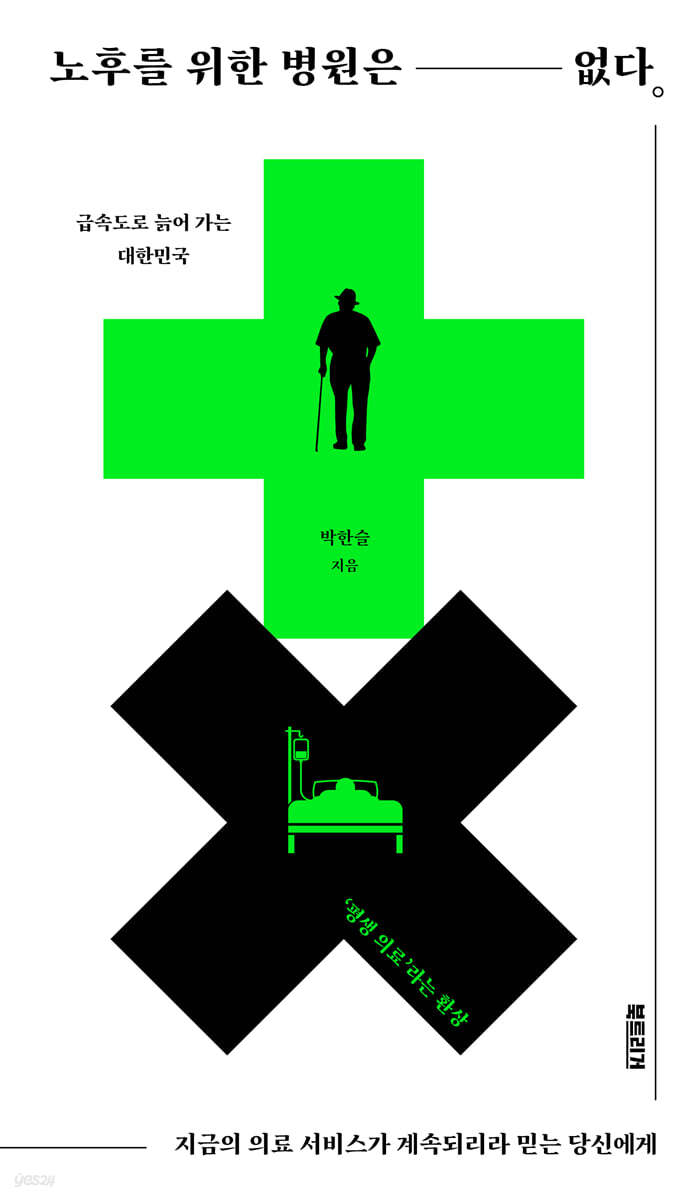
There is no hospital for old age.
 |
Description
Book Introduction
- A word from MD
-
Are Korean hospitals okay like this?In Korea today, anyone can go to the hospital if they are sick, and the cost of treatment is not a burden.
But things could get worse in the near future.
The practice of 'burning' nurses, the disappearance of local hospitals, the phenomenon of avoiding specialists such as obstetricians and gynecologists, etc.
Alarm bells are ringing everywhere.
October 25, 2022. Social and Political PD Son Min-gyu
Our crumbling hospital,
The "no-answer medical" problem you need to solve to secure your retirement
This book is a complete analysis of Korean medical policy by Park Han-seul, a "writing pharmacist" who started out as a pharmacist at a university hospital and now works as a writer for major media outlets.
The Korean medical community seems to have suffered a kind of "panic" due to COVID-19 and the doctors' strike that occurred during it, but the author reveals in this book that this is only the tip of the iceberg, not the beginning or the end of the great chaos that the Korean medical community has been experiencing and will now face in greater detail.
We, as medical consumers, have only seen fragmentary information about various incidents and issues in the medical field through the media - the burning of nurses, departments that are absolutely necessary but difficult for medical professionals to endure, assistant physicians (PAs) with unclear standards and reality, increasing examination times inversely proportional to shortened consultation times, the crisis in local medical care caused by the extremely 'rational' choices of each individual medical consumer and provider and the regional talent selection system devised as a countermeasure, the 'doctors' strike' using COVID-19 as leverage, but in fact the 'medical community vs. government' conflict that has been around for a very long time - etc. - These are explained in a way that can be understood at once through solid statistical data and eloquent analysis.
As readers read this familiar yet unfamiliar "medical story from a strange land," they will come to realize that in a society where the "value of life" is literally light in pursuit of extreme cost-effectiveness, medical care is no exception.
Also, as someone who has lived their entire lives using hospitals and will have to live with hospitals for a long time to come, whether they like it or not, as a main player in the medical field, this will be an opportunity to think about the future of Korean medicine in a super-aged society and refine my position.
The "no-answer medical" problem you need to solve to secure your retirement
This book is a complete analysis of Korean medical policy by Park Han-seul, a "writing pharmacist" who started out as a pharmacist at a university hospital and now works as a writer for major media outlets.
The Korean medical community seems to have suffered a kind of "panic" due to COVID-19 and the doctors' strike that occurred during it, but the author reveals in this book that this is only the tip of the iceberg, not the beginning or the end of the great chaos that the Korean medical community has been experiencing and will now face in greater detail.
We, as medical consumers, have only seen fragmentary information about various incidents and issues in the medical field through the media - the burning of nurses, departments that are absolutely necessary but difficult for medical professionals to endure, assistant physicians (PAs) with unclear standards and reality, increasing examination times inversely proportional to shortened consultation times, the crisis in local medical care caused by the extremely 'rational' choices of each individual medical consumer and provider and the regional talent selection system devised as a countermeasure, the 'doctors' strike' using COVID-19 as leverage, but in fact the 'medical community vs. government' conflict that has been around for a very long time - etc. - These are explained in a way that can be understood at once through solid statistical data and eloquent analysis.
As readers read this familiar yet unfamiliar "medical story from a strange land," they will come to realize that in a society where the "value of life" is literally light in pursuit of extreme cost-effectiveness, medical care is no exception.
Also, as someone who has lived their entire lives using hospitals and will have to live with hospitals for a long time to come, whether they like it or not, as a main player in the medical field, this will be an opportunity to think about the future of Korean medicine in a super-aged society and refine my position.
- You can preview some of the book's contents.
Preview
index
Opening remarks: A medical story from a country where life is cheap.
Part 1: The Shadow of a State-of-the-Art General Hospital
Chapter 1 - The Soil Where the Evil Habit of Burning Grows
Chapter 2 - The Birth of the Physician Assistant (PA) and the Department of Pediatrics
Chapter 3 - A Hospital Full of Testing Equipment Instead of Medical Staff
Part 2: Individual Rights, Systemic Failure
Chapter 4 - The Disappearance of the Medication Guide in "Ppalli Ppalli"
Chapter 5 - Patients' Choice of Hospitals and the Decline of Rural Healthcare
Chapter 6 - Regional Aversion of Medical Personnel and Regional Talent Selection
Part 3: Why Current Healthcare Is Unsustainable
Chapter 7 - The Old Cracks Revealed by COVID-19
Chapter 8 - The 'Real' Reason Doctors Went on Strike
Chapter 9 - The Super-Aging Society and the Future of Korean Healthcare
Closing Remarks: Why We Need to Talk About 'Healthcare' in Our Common Language
Part 1: The Shadow of a State-of-the-Art General Hospital
Chapter 1 - The Soil Where the Evil Habit of Burning Grows
Chapter 2 - The Birth of the Physician Assistant (PA) and the Department of Pediatrics
Chapter 3 - A Hospital Full of Testing Equipment Instead of Medical Staff
Part 2: Individual Rights, Systemic Failure
Chapter 4 - The Disappearance of the Medication Guide in "Ppalli Ppalli"
Chapter 5 - Patients' Choice of Hospitals and the Decline of Rural Healthcare
Chapter 6 - Regional Aversion of Medical Personnel and Regional Talent Selection
Part 3: Why Current Healthcare Is Unsustainable
Chapter 7 - The Old Cracks Revealed by COVID-19
Chapter 8 - The 'Real' Reason Doctors Went on Strike
Chapter 9 - The Super-Aging Society and the Future of Korean Healthcare
Closing Remarks: Why We Need to Talk About 'Healthcare' in Our Common Language
Detailed image
Into the book
The number of patients a ward nurse in a general hospital is responsible for per day is approximately 10.1 (as of 2019).
Looking at it this way, it is natural that it is difficult to tell whether the number is small or large, but if you compare it to the number of patients per nurse overseas, you can get a rough idea.
In the United States, nurse-to-patient ratios vary from state to state, but many states have laws regulating this. New York State requires about four nurses per patient in a typical internal medicine ward, and California requires about five nurses per patient.
Even this is only based on the actual working staff, excluding management staff such as head nurses, so there is a big difference compared to Korea.
---From "Chapter 1: The Soil Where the Evil Habit of Burning Grows"
If we look at the profit structure of general hospitals in our country, we can find one very peculiar thing.
The largest portion of the revenue earned through medical practices at hospitals is ‘examination fees.’
According to the 『Hospital Management Analysis』 data published by the Korea Health Industry Development Institute, the top source of medical revenue generated by domestic general hospitals is ‘examination fees,’ accounting for 18.7% of the total.
'Radiation costs' also accounted for 14% of the total, which includes the cost of radiation therapy for cancer treatment, but the cost of commonly received CT scans and X-rays accounted for a larger proportion.
In summary, approximately 30% of hospitals' medical revenue is the cost of 'testing' in a broad sense.
On the other hand, the proportion of ‘consultation fees’, which can be said to be the exclusive domain of doctors, was only 6.2%.
Considering that hospital room fees account for 11.4% of the revenue of general hospitals, the cost of a hospital room is much higher than the cost of a doctor's consultation.
---From "Chapter 3: A Hospital Full of Testing Equipment Instead of Medical Staff"
The first reason, as discussed in Chapter 3, is that Koreans do not yet perceive much benefit from ‘counseling’ and are therefore unlikely to pay for it.
So, from the perspective of a pharmacist who provides drug counseling services, I don't really feel the need to spend time on counseling.
However, if you choose the 'individual packaging' method of advanced countries overseas, you will inevitably have to spend a lot of time on medication instructions.
If the medicine is prepared in the form of a medicine pouch, the explanation can be completed with, "If it says 'morning', take it in the morning," but if the individual medicines are packaged separately, the explanation "The name of this medicine is A, it has this effect, and you should take it in the morning" must be repeated for B and C to ensure that the patient is fully informed.
Rather than spending so much time on medication guidance that patients don't even feel is very useful, we've evolved to focus on dispensing time, minimizing 'explanations' as much as possible, and increasing the convenience of taking medication.
---From "The medication instructions that disappeared in Chapter 4, 'Hurry, hurry'"
Wages for medical personnel, including doctors, are much higher in rural areas than in Seoul.
Of course, in the case of doctors, it is difficult to introduce specific data in many ways because it varies greatly depending on whether they are specialists or not, if they are specialists, what department they majored in, and how their work style differs.
However, if the major is roughly the same and the work style is similar, the wage in a local metropolitan city is at least 2 to 2.5 times higher than the wage in Seoul.
Especially in the case of pharmacists, who have a relatively large female workforce, there is a difference of about 1.5 times in wages between Gangnam-Bundang and other regions within the same metropolitan area.
Considering the relatively low cost of living and housing prices in rural areas, the actual wage gap is even larger. However, this wage gap persists because medical professionals are reluctant to work in rural areas.
---From "Chapter 6: Medical Personnel's Aversion to Local Areas and Regional Talent Selection"
This is why various 'show doctors' who appear on TV shows continue to receive the public's love.
In reality, the medical institutions I experience only give you a diagnosis or prescribe medicine when you tell them where you are sick, but I like show doctors because they not only give you health advice but also kindly explain diseases.
Within the medical community, there is a lot of criticism of various show doctors, but it's disappointing that no one seems to try to understand why they're so popular.
This is also where the shortcomings of Korean medical care, which has neglected consultation and pursued only cost-effectiveness, are most clearly revealed.
We had to deal with the aftermath in the form of a flood of fake news during the COVID-19 pandemic.
All the sacrifices Korean healthcare made for efficiency in terms of facilities and communication are now being paid for.
And eventually, even the medical staff began to bill the state.
It's a doctors' strike.
---From "Chapter 7: A Very Old Crack Revealed by COVID-19"
As things are now, this problem will become more severe in a super-aging society due to rising medical costs. There are two main solutions.
The first is to increase health insurance revenue.
Currently, health insurance income is composed of health insurance premiums deducted from income (approximately 85%) and government subsidies (approximately 15%), so this amount can be increased.
However, it has not been implemented well because it requires measures similar to tax increases, which politicians are very reluctant to do, whether it is health insurance premiums or government-supported taxes.
So the second method, spending squeezing, is still ongoing as of 2022.
In the past, if a drug helped improve the symptoms of a disease for which there was no proper treatment, health insurance was widely applied even if its medical validity was somewhat low.
But now that we don't have that luxury anymore, we're withdrawing all health insurance coverage for these drugs.
The most representative recent case of conflict is Regalon®, a drug containing silymarin prescribed for liver disease.
When health insurance coverage for this drug, which is prescribed at a cost of approximately 15 billion won per year, was withdrawn, the manufacturer protested and is still in litigation as of 2022.
Looking at it this way, it is natural that it is difficult to tell whether the number is small or large, but if you compare it to the number of patients per nurse overseas, you can get a rough idea.
In the United States, nurse-to-patient ratios vary from state to state, but many states have laws regulating this. New York State requires about four nurses per patient in a typical internal medicine ward, and California requires about five nurses per patient.
Even this is only based on the actual working staff, excluding management staff such as head nurses, so there is a big difference compared to Korea.
---From "Chapter 1: The Soil Where the Evil Habit of Burning Grows"
If we look at the profit structure of general hospitals in our country, we can find one very peculiar thing.
The largest portion of the revenue earned through medical practices at hospitals is ‘examination fees.’
According to the 『Hospital Management Analysis』 data published by the Korea Health Industry Development Institute, the top source of medical revenue generated by domestic general hospitals is ‘examination fees,’ accounting for 18.7% of the total.
'Radiation costs' also accounted for 14% of the total, which includes the cost of radiation therapy for cancer treatment, but the cost of commonly received CT scans and X-rays accounted for a larger proportion.
In summary, approximately 30% of hospitals' medical revenue is the cost of 'testing' in a broad sense.
On the other hand, the proportion of ‘consultation fees’, which can be said to be the exclusive domain of doctors, was only 6.2%.
Considering that hospital room fees account for 11.4% of the revenue of general hospitals, the cost of a hospital room is much higher than the cost of a doctor's consultation.
---From "Chapter 3: A Hospital Full of Testing Equipment Instead of Medical Staff"
The first reason, as discussed in Chapter 3, is that Koreans do not yet perceive much benefit from ‘counseling’ and are therefore unlikely to pay for it.
So, from the perspective of a pharmacist who provides drug counseling services, I don't really feel the need to spend time on counseling.
However, if you choose the 'individual packaging' method of advanced countries overseas, you will inevitably have to spend a lot of time on medication instructions.
If the medicine is prepared in the form of a medicine pouch, the explanation can be completed with, "If it says 'morning', take it in the morning," but if the individual medicines are packaged separately, the explanation "The name of this medicine is A, it has this effect, and you should take it in the morning" must be repeated for B and C to ensure that the patient is fully informed.
Rather than spending so much time on medication guidance that patients don't even feel is very useful, we've evolved to focus on dispensing time, minimizing 'explanations' as much as possible, and increasing the convenience of taking medication.
---From "The medication instructions that disappeared in Chapter 4, 'Hurry, hurry'"
Wages for medical personnel, including doctors, are much higher in rural areas than in Seoul.
Of course, in the case of doctors, it is difficult to introduce specific data in many ways because it varies greatly depending on whether they are specialists or not, if they are specialists, what department they majored in, and how their work style differs.
However, if the major is roughly the same and the work style is similar, the wage in a local metropolitan city is at least 2 to 2.5 times higher than the wage in Seoul.
Especially in the case of pharmacists, who have a relatively large female workforce, there is a difference of about 1.5 times in wages between Gangnam-Bundang and other regions within the same metropolitan area.
Considering the relatively low cost of living and housing prices in rural areas, the actual wage gap is even larger. However, this wage gap persists because medical professionals are reluctant to work in rural areas.
---From "Chapter 6: Medical Personnel's Aversion to Local Areas and Regional Talent Selection"
This is why various 'show doctors' who appear on TV shows continue to receive the public's love.
In reality, the medical institutions I experience only give you a diagnosis or prescribe medicine when you tell them where you are sick, but I like show doctors because they not only give you health advice but also kindly explain diseases.
Within the medical community, there is a lot of criticism of various show doctors, but it's disappointing that no one seems to try to understand why they're so popular.
This is also where the shortcomings of Korean medical care, which has neglected consultation and pursued only cost-effectiveness, are most clearly revealed.
We had to deal with the aftermath in the form of a flood of fake news during the COVID-19 pandemic.
All the sacrifices Korean healthcare made for efficiency in terms of facilities and communication are now being paid for.
And eventually, even the medical staff began to bill the state.
It's a doctors' strike.
---From "Chapter 7: A Very Old Crack Revealed by COVID-19"
As things are now, this problem will become more severe in a super-aging society due to rising medical costs. There are two main solutions.
The first is to increase health insurance revenue.
Currently, health insurance income is composed of health insurance premiums deducted from income (approximately 85%) and government subsidies (approximately 15%), so this amount can be increased.
However, it has not been implemented well because it requires measures similar to tax increases, which politicians are very reluctant to do, whether it is health insurance premiums or government-supported taxes.
So the second method, spending squeezing, is still ongoing as of 2022.
In the past, if a drug helped improve the symptoms of a disease for which there was no proper treatment, health insurance was widely applied even if its medical validity was somewhat low.
But now that we don't have that luxury anymore, we're withdrawing all health insurance coverage for these drugs.
The most representative recent case of conflict is Regalon®, a drug containing silymarin prescribed for liver disease.
When health insurance coverage for this drug, which is prescribed at a cost of approximately 15 billion won per year, was withdrawn, the manufacturer protested and is still in litigation as of 2022.
---From “Chapter 9: The Super-Aging Society and the Future of Korean Healthcare”
Publisher's Review
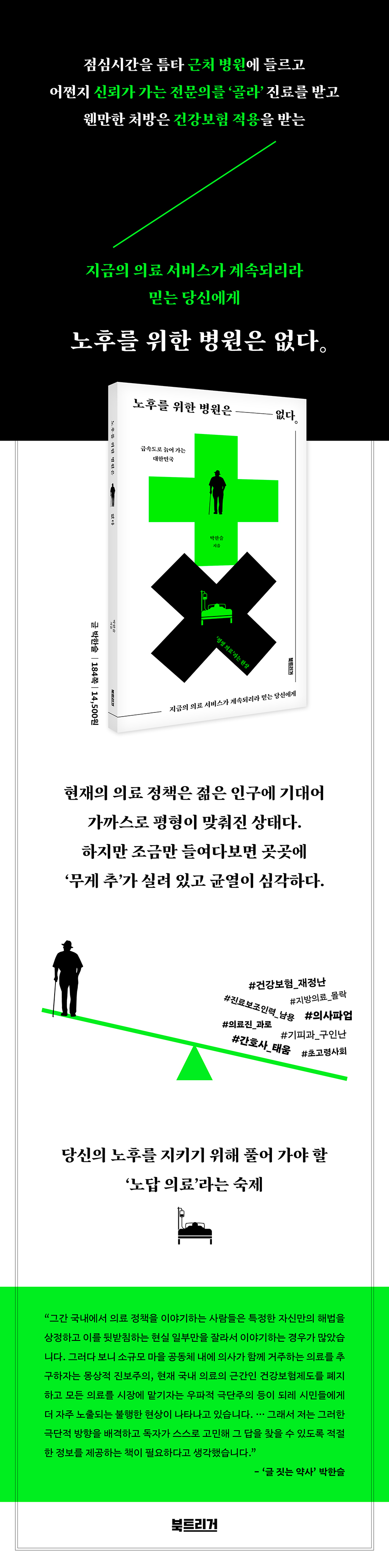
A state of 'medical equilibrium' barely achieved by relying on a young population,
This 'equilibrium' will soon be broken
The author begins the book with a statistical analysis showing that in Korea, each doctor sees an average of 58.3 patients per day.
This is not a surprising figure, considering the feeling we get when we wait to receive treatment.
Because we have become so accustomed to this situation, it is difficult to properly see the strange structure of medicine today.
According to data analyzed by the author, in major advanced countries with economies not much different in size from ours, this figure drops dramatically to just 8.1.
This means that Korea has 5 to 6 times more.
To borrow the author's analogy, we are now descending a 10-person elevator with 60 people in it, and in some ways, it is even more dangerous.
This is because it means that the patient's 'value of life' is 5 to 6 times lighter, not just in weight.
The author emphasizes that to understand why this phenomenon is occurring in Korea, it is essential to examine Korea's medical system and policies.
Although this distorted structure still serves its purpose, this 'strange equilibrium' cannot last long.
And because Korea is 'aging' more rapidly than previously expected, that 'collapse' is being brought forward.
According to Statistics Korea's "2022 Elderly Statistics," Korea's aging rate is much faster than that of other advanced countries such as the United States, the United Kingdom, and Japan, and if this trend continues, Korea will enter a "super-aged society" as soon as 2025.
It will take only seven years to move from an aging society to a super-aged society, which is also the highest figure in the world.
In this context, the author says, current healthcare policies are barely balanced, relying on a young population.
Although it is still barely recovering, the population structure itself will be completely different when the current middle-aged generation becomes the 'elderly', the main user group of medical services.
The author asserts that an inverted triangle structure will take hold, with the elderly population exceeding the economically active working-age population, and that the current level of access to medical services will no longer be possible.
Therefore, as we are currently a major part of the “working-age population” and will be the first to bear the brunt of this medical collapse, it is “absolutely necessary to have a proper understanding of medical policy and actively express our opinions.”
And that moment must be right now, when the demographic structure is changing.
The inside story of a hospital that seems to be full of 'smart doctors'
Issues in Korean Healthcare Reaching a Tipping Point
The background of medical dramas that are always a hot topic with young and cool actors playing doctors is mostly 'general hospitals'.
That's why, when the general public hears the words 'hospital' or 'medical care,' the first place that comes to mind is often a general hospital rather than a small local clinic.
The author says, “Coincidentally, the space that most concisely shows the problems of Korean medical care is also a general hospital.”
So, in Part 1, we delve into what really happens “in the shadows of these seemingly glamorous, cutting-edge general hospitals,” delving into issues like “burnout,” avoidance of departments, clinical assistants, and the ever-shorter consultation times and increasing examination times.
In Part 2, we structurally examine the unintended but more serious social problems that arise as a result of the extremely "rational" medical choices made by both medical consumers and providers as individuals.
We examine the omission of medication instructions at Korean pharmacies, which is typified by the "three-meal-a-day medicine packaging" method that cannot be found anywhere else in the world; the "medical shopping" that has distorted the right to "choose" the hospital you want to go to and go whenever you want; and the avoidance of local areas by medical professionals seeking to secure Seoul's infrastructure, just like in all other industries, and the resulting crisis in local medical care.
What is common in the contents of Parts 1 and 2 is the problem of cost-effectiveness that ultimately supports the insensitivity to safety throughout Korean society, and on the other hand, the problem of the unreasonable medical system that 'runs a deficit even if proper treatment is provided.'
Part 3 delves into the long-standing conflict between the medical community and the government surrounding these dilemmas and the evaluation criteria of the Health Insurance Review & Assessment Service (HIRA), leading to the doctors' strike that erupted using COVID-19 as leverage.
We conclude by exploring future scenarios for Korean healthcare and some feasible solutions as we approach a super-aged society.
The realm of disease and death, which cannot be left to experts alone.
The greatest feature and strength of this book is that it calls us, who are mostly medical consumers and non-experts, into proper "medical stakeholders" and provides a forum for us to think together.
In any industry, there are experts in that field, and the gap in knowledge and capabilities between them and the general public is significant. Therefore, in most cases in our lives, we often think, "It's best to leave it to the experts."
This is generally a reasonable judgment, but the author argues that the medical issues that are the subject of this book cannot be left that way, and should not be.
Since we all inevitably age, it is very important to think about the issues of disease and death for ourselves.
So, there is an increasing trend of books and media covering this topic.
If so, there is ample reason to take a closer look at the issues of hospitals and medical care, which are so closely related to disease and death, and to think for yourself based on the information you gain from that understanding.
The author of this book, Hanseul Park, has a unique background as a former pharmacist at a university hospital and now majors in statistics and writes about social issues.
Having experience as both a healthcare consumer and provider has not only given me a broad and balanced perspective, but also enabled me to fully utilize my second major, statistics, to conduct thorough data collection, high-level analysis, and, most importantly, to "make expert data easy to understand."
The author says that “people who have talked about medical policy in Korea have often assumed their own specific solutions and talked about only a part of the reality that supports them,” so we should be wary of “dreamy progressivism that seeks medical care where doctors live together in small village communities, and right-wing extremism that seeks to abolish the health insurance system, which is the foundation of domestic medical care, and leave all medical care to the market.”
Even in a situation where "it has become so common to turn a deaf ear to differences in ideology and direction," I wrote this book to at least share the serious problems facing Korean medicine and to remind everyone that this is a "homework" for all of us.
This 'equilibrium' will soon be broken
The author begins the book with a statistical analysis showing that in Korea, each doctor sees an average of 58.3 patients per day.
This is not a surprising figure, considering the feeling we get when we wait to receive treatment.
Because we have become so accustomed to this situation, it is difficult to properly see the strange structure of medicine today.
According to data analyzed by the author, in major advanced countries with economies not much different in size from ours, this figure drops dramatically to just 8.1.
This means that Korea has 5 to 6 times more.
To borrow the author's analogy, we are now descending a 10-person elevator with 60 people in it, and in some ways, it is even more dangerous.
This is because it means that the patient's 'value of life' is 5 to 6 times lighter, not just in weight.
The author emphasizes that to understand why this phenomenon is occurring in Korea, it is essential to examine Korea's medical system and policies.
Although this distorted structure still serves its purpose, this 'strange equilibrium' cannot last long.
And because Korea is 'aging' more rapidly than previously expected, that 'collapse' is being brought forward.
According to Statistics Korea's "2022 Elderly Statistics," Korea's aging rate is much faster than that of other advanced countries such as the United States, the United Kingdom, and Japan, and if this trend continues, Korea will enter a "super-aged society" as soon as 2025.
It will take only seven years to move from an aging society to a super-aged society, which is also the highest figure in the world.
In this context, the author says, current healthcare policies are barely balanced, relying on a young population.
Although it is still barely recovering, the population structure itself will be completely different when the current middle-aged generation becomes the 'elderly', the main user group of medical services.
The author asserts that an inverted triangle structure will take hold, with the elderly population exceeding the economically active working-age population, and that the current level of access to medical services will no longer be possible.
Therefore, as we are currently a major part of the “working-age population” and will be the first to bear the brunt of this medical collapse, it is “absolutely necessary to have a proper understanding of medical policy and actively express our opinions.”
And that moment must be right now, when the demographic structure is changing.
The inside story of a hospital that seems to be full of 'smart doctors'
Issues in Korean Healthcare Reaching a Tipping Point
The background of medical dramas that are always a hot topic with young and cool actors playing doctors is mostly 'general hospitals'.
That's why, when the general public hears the words 'hospital' or 'medical care,' the first place that comes to mind is often a general hospital rather than a small local clinic.
The author says, “Coincidentally, the space that most concisely shows the problems of Korean medical care is also a general hospital.”
So, in Part 1, we delve into what really happens “in the shadows of these seemingly glamorous, cutting-edge general hospitals,” delving into issues like “burnout,” avoidance of departments, clinical assistants, and the ever-shorter consultation times and increasing examination times.
In Part 2, we structurally examine the unintended but more serious social problems that arise as a result of the extremely "rational" medical choices made by both medical consumers and providers as individuals.
We examine the omission of medication instructions at Korean pharmacies, which is typified by the "three-meal-a-day medicine packaging" method that cannot be found anywhere else in the world; the "medical shopping" that has distorted the right to "choose" the hospital you want to go to and go whenever you want; and the avoidance of local areas by medical professionals seeking to secure Seoul's infrastructure, just like in all other industries, and the resulting crisis in local medical care.
What is common in the contents of Parts 1 and 2 is the problem of cost-effectiveness that ultimately supports the insensitivity to safety throughout Korean society, and on the other hand, the problem of the unreasonable medical system that 'runs a deficit even if proper treatment is provided.'
Part 3 delves into the long-standing conflict between the medical community and the government surrounding these dilemmas and the evaluation criteria of the Health Insurance Review & Assessment Service (HIRA), leading to the doctors' strike that erupted using COVID-19 as leverage.
We conclude by exploring future scenarios for Korean healthcare and some feasible solutions as we approach a super-aged society.
The realm of disease and death, which cannot be left to experts alone.
The greatest feature and strength of this book is that it calls us, who are mostly medical consumers and non-experts, into proper "medical stakeholders" and provides a forum for us to think together.
In any industry, there are experts in that field, and the gap in knowledge and capabilities between them and the general public is significant. Therefore, in most cases in our lives, we often think, "It's best to leave it to the experts."
This is generally a reasonable judgment, but the author argues that the medical issues that are the subject of this book cannot be left that way, and should not be.
Since we all inevitably age, it is very important to think about the issues of disease and death for ourselves.
So, there is an increasing trend of books and media covering this topic.
If so, there is ample reason to take a closer look at the issues of hospitals and medical care, which are so closely related to disease and death, and to think for yourself based on the information you gain from that understanding.
The author of this book, Hanseul Park, has a unique background as a former pharmacist at a university hospital and now majors in statistics and writes about social issues.
Having experience as both a healthcare consumer and provider has not only given me a broad and balanced perspective, but also enabled me to fully utilize my second major, statistics, to conduct thorough data collection, high-level analysis, and, most importantly, to "make expert data easy to understand."
The author says that “people who have talked about medical policy in Korea have often assumed their own specific solutions and talked about only a part of the reality that supports them,” so we should be wary of “dreamy progressivism that seeks medical care where doctors live together in small village communities, and right-wing extremism that seeks to abolish the health insurance system, which is the foundation of domestic medical care, and leave all medical care to the market.”
Even in a situation where "it has become so common to turn a deaf ear to differences in ideology and direction," I wrote this book to at least share the serious problems facing Korean medicine and to remind everyone that this is a "homework" for all of us.
GOODS SPECIFICS
- Publication date: October 20, 2022
- Page count, weight, size: 184 pages | 284g | 127*218*10mm
- ISBN13: 9791189799823
- ISBN10: 1189799820
You may also like
카테고리
korean


korean

![GQ KOREA Mark (Monthly): December [2025]](http://librairie.coreenne.fr/cdn/shop/files/8ef265dbbfbf186523ed75ba7319009d.jpg?v=1765340328&width=3840)


