

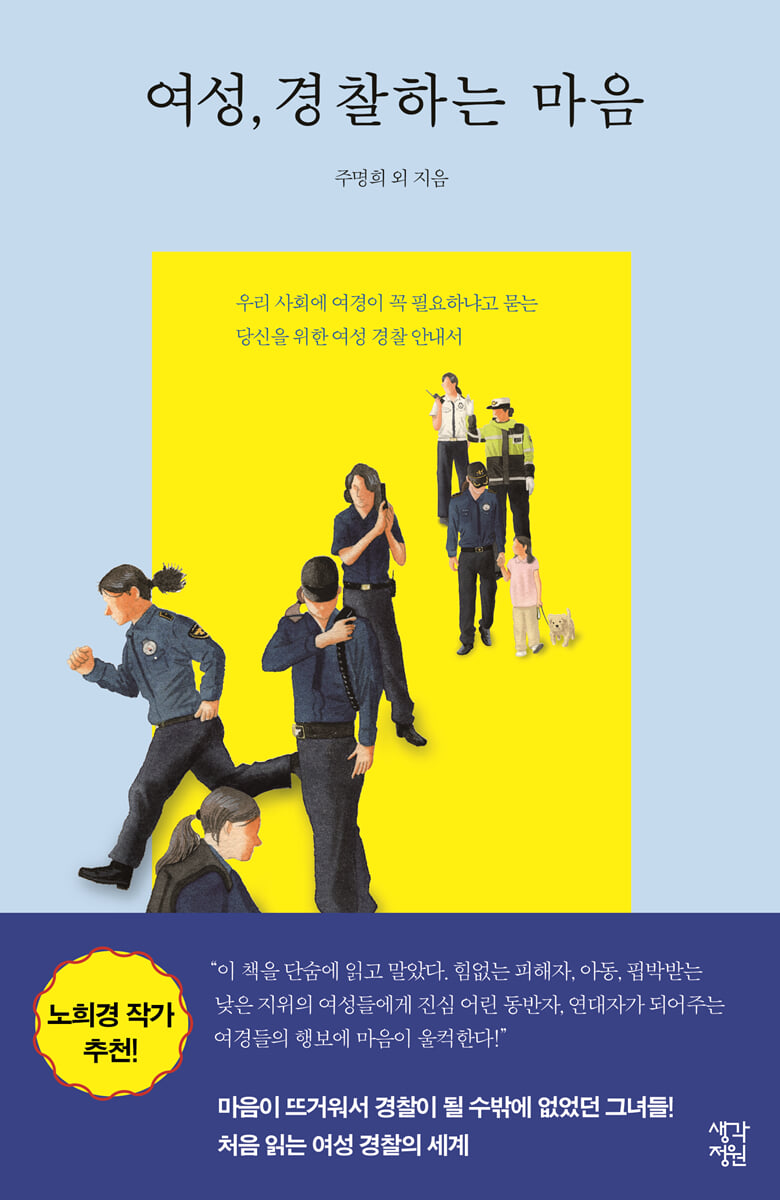
Women, police officer's mind
 |
Description
Book Introduction
- A word from MD
-
The Work and Voices of Female Police OfficersAs video footage of a female police officer failing to subdue a victim went viral, criticism of the police's ineffectiveness grew.
Although it has been revealed that the video only shows a portion of the situation at the scene, prejudice against female police officers persists.
This book confronts prejudice and hate by presenting the unedited, authentic voices of female police officers.
October 25, 2022. Social and Political PD Son Min-gyu
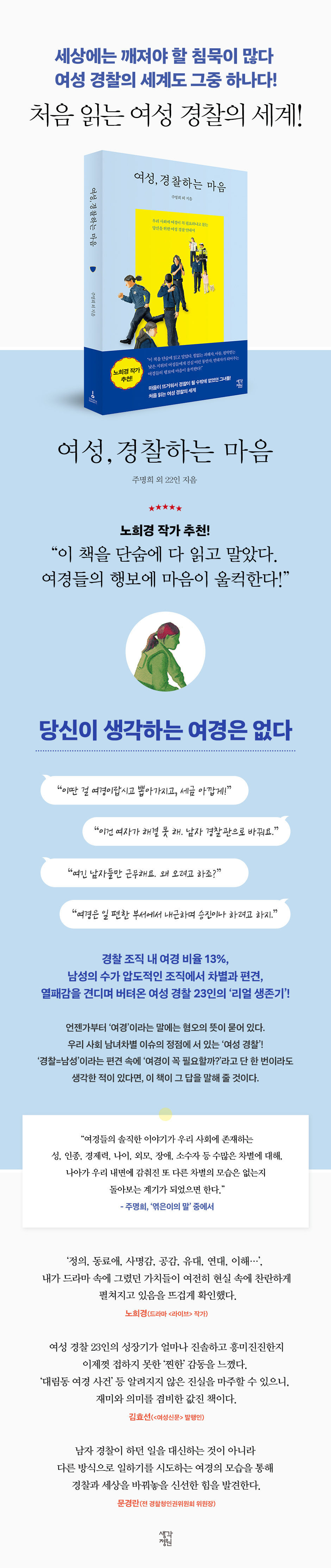
The world of female police officers, read for the first time,
What kind of presence do female police officers have among us?
At the very pinnacle of the sharp gender conflict and conflict between men and women in Korean society are 'female police officers.'
A series of incidents were reported in which female police officers were unable to subdue suspects on the spot, sparking the so-called "uselessness of female police officers" theory that female police officers are unnecessary, which then spread into blind misogyny.
Ridicule, personal attacks, and unpleasant, hateful language were hurled at the female police officer.
The main argument was that physically weak women were less able to respond when dealing with criminals.
At first glance, it may seem reasonable, but underneath the surface, there is a deep-seated 'gender division' and 'sex discrimination'.
Since the first female police officers were hired during the US military government in 1947, the proportion of female police officers in the police force has been slightly over 13% as of 2022, 75 years later.
Although women's advancement in society has become more active as the deep-rooted gender discrimination structure has been broken down, the police organization still shows a long way to go.
This book collects 31 essays by 23 female police officers.
It contains vivid stories from the field about what it is like to be a female police officer in an organization where the number of male police officers is overwhelming.
This is a record of the struggles of female police officers, which documents why they jumped into the difficult and dangerous world of the police force despite knowing the social perception that 'police = male' and the discrimination and inequality that result from it, what made their hearts burn with justice and a sense of mission, and how they endured prejudice and discrimination both inside and outside the organization.
Their struggles and exploits, driven by a passionate heart that could not turn away from compassion for the weak and an extraordinary sense of justice, compel them to become police officers. This story moves beyond the debate over female and male police officers and asks what a true police officer is.
Furthermore, it leads to the fundamental diagnosis that it is more urgent to establish a system and institutions that can create real police officers.
"Do we really need female police officers in our society?" If you've ever wondered this question in the face of fake news and distorted criticism fueled by anti-female police, this book will answer it.
What kind of presence do female police officers have among us?
At the very pinnacle of the sharp gender conflict and conflict between men and women in Korean society are 'female police officers.'
A series of incidents were reported in which female police officers were unable to subdue suspects on the spot, sparking the so-called "uselessness of female police officers" theory that female police officers are unnecessary, which then spread into blind misogyny.
Ridicule, personal attacks, and unpleasant, hateful language were hurled at the female police officer.
The main argument was that physically weak women were less able to respond when dealing with criminals.
At first glance, it may seem reasonable, but underneath the surface, there is a deep-seated 'gender division' and 'sex discrimination'.
Since the first female police officers were hired during the US military government in 1947, the proportion of female police officers in the police force has been slightly over 13% as of 2022, 75 years later.
Although women's advancement in society has become more active as the deep-rooted gender discrimination structure has been broken down, the police organization still shows a long way to go.
This book collects 31 essays by 23 female police officers.
It contains vivid stories from the field about what it is like to be a female police officer in an organization where the number of male police officers is overwhelming.
This is a record of the struggles of female police officers, which documents why they jumped into the difficult and dangerous world of the police force despite knowing the social perception that 'police = male' and the discrimination and inequality that result from it, what made their hearts burn with justice and a sense of mission, and how they endured prejudice and discrimination both inside and outside the organization.
Their struggles and exploits, driven by a passionate heart that could not turn away from compassion for the weak and an extraordinary sense of justice, compel them to become police officers. This story moves beyond the debate over female and male police officers and asks what a true police officer is.
Furthermore, it leads to the fundamental diagnosis that it is more urgent to establish a system and institutions that can create real police officers.
"Do we really need female police officers in our society?" If you've ever wondered this question in the face of fake news and distorted criticism fueled by anti-female police, this book will answer it.
- You can preview some of the book's contents.
Preview
index
Part 1: The Sorrow of a Woman: Somewhere Between Discrimination and Difference
Chapter 1: I can't communicate with women, so I'll change to a male police officer.
I told you not to come in, but I will go in further.
To meet me, look for the Economic Team's Ssamdak
Naejangtang? Sounds good.
Let's go!
That being said, being a police officer is a stable job.
The day I took off the 'beginner' label
I will become stronger
A policewoman must prove her passion
Thanks to the power of solidarity and uniform, again!
Chapter 2: I Had to Be Justice First
Thank you, Lee Ji-eun, twenty-two!
The roundhouse kick shown in the interview
Dreaming of a lively action film, "People of the Police Department"
The day I started maternity leave
Discrimination goes beyond police lines
To those who ask why I am confessing now
The brutal story of a 20-something female police officer with a short haircut
Police Officer Kim, who made his first nest in the red-light district
Part 2: The Joy of Being a Police Officer: Where Everyone's Pain and Suffering Is Erased
Chapter 3: One Person's Effort Can Change the World
Jeongin's sweater
I want to be proof that the world is getting better.
Are you on the side of women because you are a female detective?
A wicked daughter who knows no grace became a police officer.
Where is the woman here, it's the police!
The place I should be is the Earth Station!
Hey, forget you even came to the police station.
Chapter 4: Women Who Became Police Officers Because Their Hearts Were Passionate
Can you do this all day long, seeing dead bodies and blood?
I am an African UN police officer.
Power, can I covet it?
Overcome great power with small force
The disappearance of the bee and the policewoman
Together we can go far
My Time Leap Story
Earthquake, there are high-quality dramas
Chapter 1: I can't communicate with women, so I'll change to a male police officer.
I told you not to come in, but I will go in further.
To meet me, look for the Economic Team's Ssamdak
Naejangtang? Sounds good.
Let's go!
That being said, being a police officer is a stable job.
The day I took off the 'beginner' label
I will become stronger
A policewoman must prove her passion
Thanks to the power of solidarity and uniform, again!
Chapter 2: I Had to Be Justice First
Thank you, Lee Ji-eun, twenty-two!
The roundhouse kick shown in the interview
Dreaming of a lively action film, "People of the Police Department"
The day I started maternity leave
Discrimination goes beyond police lines
To those who ask why I am confessing now
The brutal story of a 20-something female police officer with a short haircut
Police Officer Kim, who made his first nest in the red-light district
Part 2: The Joy of Being a Police Officer: Where Everyone's Pain and Suffering Is Erased
Chapter 3: One Person's Effort Can Change the World
Jeongin's sweater
I want to be proof that the world is getting better.
Are you on the side of women because you are a female detective?
A wicked daughter who knows no grace became a police officer.
Where is the woman here, it's the police!
The place I should be is the Earth Station!
Hey, forget you even came to the police station.
Chapter 4: Women Who Became Police Officers Because Their Hearts Were Passionate
Can you do this all day long, seeing dead bodies and blood?
I am an African UN police officer.
Power, can I covet it?
Overcome great power with small force
The disappearance of the bee and the policewoman
Together we can go far
My Time Leap Story
Earthquake, there are high-quality dramas
Detailed image
Into the book
Three patrol cars responded to a report that a father was physically blocking a son with schizophrenia with a knife, but the GPS was not accurate.
While I was wandering around, I was the first to get the direction right and say, “This way!” When I arrived at the scene, I honestly wasn’t scared.
As I was trying to persuade my son to stand off from his father and carefully separate him before the other officers arrived, I didn't have time to think about whether I was a female or male police officer.
---From "Kang Seung-yeon"
My concerns were hidden for months.
As the higher-ups continued to try to cover it up, I became exhausted and started thinking, 'If only I could just stay quiet, everything would end well...' and even 'Did I really do something wrong?'
But there was a voice inside me that kept knocking at me.
"If I were a police officer and met a victim of sexual assault who was reluctant to come forward, wouldn't I encourage them to continue to be courageous? I'd tell them, 'You need courage to prevent this from happening again, so even if it's difficult now, please be courageous.'" To become a just police officer, I must first uphold justice myself.
If I don't have the courage, someone else might get hurt.
More than anything, I wanted to become a police officer to beat up bad people.
---From "Lee Ji-eun"
While patrolling in the dark of the evening, I sometimes encountered a woman sitting alone in the park smoking a cigarette on her way home from work.
She wouldn't have been able to smoke at work.
I won't be able to smoke in the house I'm moving into soon.
He smoked a cigarette to relieve the stress of the day, but he couldn't shake off his anxious feelings.
She was briefly surprised to see me in my police uniform, then relieved to see that I was a female police officer.
I quietly took out a cigarette and smoked it next to her.
We shared a sense of security, smoking cigarettes in a back alley without speaking.
---From "Lee Eun-ae"
When a little chick comes squeaking, people pass by thinking, "It's just been born," without paying attention to what the chick is saying.
But when one of the ssamdak flaps its wings and pecks at me as if it wants to draw blood, I look up and see what the ssamdak is after, thinking, 'What's the problem?'
I couldn't be a chick who squirmed and kicked her feet in the face of the false prejudice that it was okay to treat younger people carelessly and that female police officers were less professional than male officers in investigations.
To survive like that, I became a notorious ssamdak in the economic team.
---From "Lee Bi-hyeon"
Even after moving to a different police station, I applied to the security department.
Again I was asked the same question, “Why would a woman want to be a security guard?”
---From "Wow, here we go again" Even though four years have passed, it is still Geumnyeo's space.
One day, we received a report of a suspected chemical attack at a university in the district.
We had to set up a police line at the scene and wait for the chemical terrorism unit to arrive.
I was in a hurry, so I sniffed around to find the area that smelled.
Thinking back now, it was really stupid.
If it was a hazardous substance, it would be death….
I crawled on my knees to find the source of the smell and prevent the damage from spreading.
The cause was undiluted cleaning detergent.
It was fortunate that it ended up being a fuss, but it was a heartbreaking thing.
---From "Lee Su-jin"
“You seem to be single, but this case involves dealing with multiple male suspects, so please change the case to a male police officer.” Although the complainant responded that marital status and investigative ability are separate issues, the complainant continued to argue that an unmarried female police officer would not be able to handle the case.
One complainant yelled at me, swearing at me, but when I handed the receiver over to a male investigator who was only four years older than me, he obediently continued the conversation.
---From "Sleep"
The video was plastered all over social media, various websites, and YouTube.
The comments were spreading towards female police officers, including me, and towards misogyny.
At first, they called me a 'runaway policewoman' while mentioning the way I was backing away, but later, when the full video with my voice was released, they started criticizing me as a 'crazy policewoman who orders citizens to put handcuffs on them.'
It wasn't all true.
I didn't run away, and I didn't order the civilians to be handcuffed.
The situation was cleverly manipulated, with the voices of the traffic police officer assisting with the arrest, me, and the hostess mixed together.
The location of the incident was 'Guro-dong', but it was 'Daerim-dong', which is known as a dangerous area, and the fact that the two men in their 40s and 50s were drunk 'old men' was also a fabrication to maximize the incompetence of the female police officer.
---From "Lee Seon-yeong"
Even though I was immature, I became stronger as I met many victims and found solutions.
My past wounds have become a valuable asset in empathizing with the pain of victims, and sometimes even helped me analyze victim statements in investigations of rape and sexual assault where there is no evidence.
Sometimes I feel intimidated by the discrimination and hateful gazes directed at female police officers, but every time, I think of the 'victims who were wronged and powerless', including the woman who gave me bread and a letter.
---From "Kim Young-eun"
Come to think of it, I didn't know that somewhere deep inside I had an inferiority complex toward female police officers.
I thought I would be disadvantaged because I was a female police officer, so I would always be defensive and try to look good to my colleagues.
In the meantime, it would have started to resemble an authoritarian police officer.
Only after I admitted that I had been caught up in my own 'prejudice against police officers' was I able to shake off the uncomfortable feeling in my heart.
I realized that the sense of victimization as a female police officer can disappear when I confidently show my true self as a police officer.
---From "Kim Se-ryeong"
“Can you handle seeing dead bodies and blood?” It was advice not to take one’s job as a detective lightly.
Although I often feel emotionally shaken when I encounter a tragic death scene, I always feel that rational judgment is more necessary for resolving the case and for the deceased and their bereaved family.
A basic livelihood security recipient who died alone in a goshiwon (a boarding house) due to financial difficulties, a father who took his own life in the mountains due to his chronic illness, a mother and daughter who died in front of their apartment building in a fire, etc. He responds to many tragic death cases and calmly concludes them, but whenever he happens to pass by the scene of the incident later, he can't help but recall the emotions of that day.
Every time, I brace myself, thinking that my job is to prevent unjust deaths.
While I was wandering around, I was the first to get the direction right and say, “This way!” When I arrived at the scene, I honestly wasn’t scared.
As I was trying to persuade my son to stand off from his father and carefully separate him before the other officers arrived, I didn't have time to think about whether I was a female or male police officer.
---From "Kang Seung-yeon"
My concerns were hidden for months.
As the higher-ups continued to try to cover it up, I became exhausted and started thinking, 'If only I could just stay quiet, everything would end well...' and even 'Did I really do something wrong?'
But there was a voice inside me that kept knocking at me.
"If I were a police officer and met a victim of sexual assault who was reluctant to come forward, wouldn't I encourage them to continue to be courageous? I'd tell them, 'You need courage to prevent this from happening again, so even if it's difficult now, please be courageous.'" To become a just police officer, I must first uphold justice myself.
If I don't have the courage, someone else might get hurt.
More than anything, I wanted to become a police officer to beat up bad people.
---From "Lee Ji-eun"
While patrolling in the dark of the evening, I sometimes encountered a woman sitting alone in the park smoking a cigarette on her way home from work.
She wouldn't have been able to smoke at work.
I won't be able to smoke in the house I'm moving into soon.
He smoked a cigarette to relieve the stress of the day, but he couldn't shake off his anxious feelings.
She was briefly surprised to see me in my police uniform, then relieved to see that I was a female police officer.
I quietly took out a cigarette and smoked it next to her.
We shared a sense of security, smoking cigarettes in a back alley without speaking.
---From "Lee Eun-ae"
When a little chick comes squeaking, people pass by thinking, "It's just been born," without paying attention to what the chick is saying.
But when one of the ssamdak flaps its wings and pecks at me as if it wants to draw blood, I look up and see what the ssamdak is after, thinking, 'What's the problem?'
I couldn't be a chick who squirmed and kicked her feet in the face of the false prejudice that it was okay to treat younger people carelessly and that female police officers were less professional than male officers in investigations.
To survive like that, I became a notorious ssamdak in the economic team.
---From "Lee Bi-hyeon"
Even after moving to a different police station, I applied to the security department.
Again I was asked the same question, “Why would a woman want to be a security guard?”
---From "Wow, here we go again" Even though four years have passed, it is still Geumnyeo's space.
One day, we received a report of a suspected chemical attack at a university in the district.
We had to set up a police line at the scene and wait for the chemical terrorism unit to arrive.
I was in a hurry, so I sniffed around to find the area that smelled.
Thinking back now, it was really stupid.
If it was a hazardous substance, it would be death….
I crawled on my knees to find the source of the smell and prevent the damage from spreading.
The cause was undiluted cleaning detergent.
It was fortunate that it ended up being a fuss, but it was a heartbreaking thing.
---From "Lee Su-jin"
“You seem to be single, but this case involves dealing with multiple male suspects, so please change the case to a male police officer.” Although the complainant responded that marital status and investigative ability are separate issues, the complainant continued to argue that an unmarried female police officer would not be able to handle the case.
One complainant yelled at me, swearing at me, but when I handed the receiver over to a male investigator who was only four years older than me, he obediently continued the conversation.
---From "Sleep"
The video was plastered all over social media, various websites, and YouTube.
The comments were spreading towards female police officers, including me, and towards misogyny.
At first, they called me a 'runaway policewoman' while mentioning the way I was backing away, but later, when the full video with my voice was released, they started criticizing me as a 'crazy policewoman who orders citizens to put handcuffs on them.'
It wasn't all true.
I didn't run away, and I didn't order the civilians to be handcuffed.
The situation was cleverly manipulated, with the voices of the traffic police officer assisting with the arrest, me, and the hostess mixed together.
The location of the incident was 'Guro-dong', but it was 'Daerim-dong', which is known as a dangerous area, and the fact that the two men in their 40s and 50s were drunk 'old men' was also a fabrication to maximize the incompetence of the female police officer.
---From "Lee Seon-yeong"
Even though I was immature, I became stronger as I met many victims and found solutions.
My past wounds have become a valuable asset in empathizing with the pain of victims, and sometimes even helped me analyze victim statements in investigations of rape and sexual assault where there is no evidence.
Sometimes I feel intimidated by the discrimination and hateful gazes directed at female police officers, but every time, I think of the 'victims who were wronged and powerless', including the woman who gave me bread and a letter.
---From "Kim Young-eun"
Come to think of it, I didn't know that somewhere deep inside I had an inferiority complex toward female police officers.
I thought I would be disadvantaged because I was a female police officer, so I would always be defensive and try to look good to my colleagues.
In the meantime, it would have started to resemble an authoritarian police officer.
Only after I admitted that I had been caught up in my own 'prejudice against police officers' was I able to shake off the uncomfortable feeling in my heart.
I realized that the sense of victimization as a female police officer can disappear when I confidently show my true self as a police officer.
---From "Kim Se-ryeong"
“Can you handle seeing dead bodies and blood?” It was advice not to take one’s job as a detective lightly.
Although I often feel emotionally shaken when I encounter a tragic death scene, I always feel that rational judgment is more necessary for resolving the case and for the deceased and their bereaved family.
A basic livelihood security recipient who died alone in a goshiwon (a boarding house) due to financial difficulties, a father who took his own life in the mountains due to his chronic illness, a mother and daughter who died in front of their apartment building in a fire, etc. He responds to many tragic death cases and calmly concludes them, but whenever he happens to pass by the scene of the incident later, he can't help but recall the emotions of that day.
Every time, I brace myself, thinking that my job is to prevent unjust deaths.
---From "Investigator K"
Publisher's Review
“Where is the woman here, it’s the police!”
A bold voice we must listen to
It was Chuseok.
It was a holiday, so the police officers were supposed to have the day off, and the weather was nice, there were no reports, and everything was peaceful.
Around that time, a 112 report was made saying, 'Two men are harassing the owner at Restaurant 00.'
When we arrived at the scene, we saw two men sitting on the curbstone.
One of the assailants, who had spotted the police officer, looked at me and shouted, “It’s a woman!”
I spoke in a louder, more firm voice.
"Where is the woman here? It's the police!" (-from the text)
This is the story of police officer Kim So-young, who participated as the author of this book.
'Police are men', and female police officers are seen as women before they become police officers. This may be the extent of our society's perception of female police officers.
Police officer Kim So-young responds like this.
"Where's the woman here? It's the police!" Perhaps the solemnity in her cry resonates with our hearts because her resistance to discrimination and her proud pride in the police resonate with us.
Carol Gilligan, a renowned psychologist and the first professor of women's studies at Harvard University, says in her book, "The Bold Voice" (published by Saenggakjeongwon), that our society should pay attention to "women's voices."
For a long time, humanity was divided into femininity and masculinity, and both men and women lost their 'voices' and became hurt and unhappy.
Dr. Gilligan argues that only when we listen to the gestures and 'voices' of women opposing discrimination can humanity move toward a happy society.
This book contains the voices of female police officers for the first time in the 70-year history of the Korean police force.
Prejudice, discrimination, and hatred against female police officers both inside and outside the police force. In an organization where the number of male officers is overwhelming, most female police officers have been considered unfit for the police force from the moment they first step foot in the force, as beings 'other' than male police officers.
Because of this, not only were they not welcomed, they were not even given a proper opportunity to demonstrate their abilities.
Due to the special nature of the police force, even protests by female police officers against discrimination have been ignored as “against custom,” and this book clearly shows the presence of female police officers, who have been invisible in our society.
They had a passionate heart and had no choice but to become police officers.
Showing the way to true feminism
However, this book is not a story of the struggles of fearsome feminist policewomen.
It centers around the daily lives of female police officers working in various positions, from district police officers to detectives, riot police, martial arts instructors, and even chiefs.
Subduing a suspect causing a disturbance in the middle of the night, protecting a victim's wife from an abusive husband, leading the way in disposing of explosives, chasing drug dealers until dawn, and evacuating abused children to safety.
He looks just like any other police officer.
In it, female police officers painfully reveal that they themselves were victims of sexual harassment within the organization, speak out against unfair discrimination, are not afraid of injustice, confess to the mistakes of hating women despite being women themselves, and reflect on ignoring complainants, even showing wariness of the police's authority.
This is because they believe that only when the police are just can they “become true companions and allies to ordinary people, victims, children, and persecuted women.”
Dr. Carol Gilligan said.
“Do not abuse your power, do not discriminate, do not turn away from those in need, and above all, do not exclude yourself from the group of people in need.
In other words, true feminism is about recovering one's true self and humanity and resisting wrong authority." The calm and honest stories told by 23 female police officers make us reflect on the path that true feminism should take.
There is no such thing as a policewoman as you think.
Female police officers, a fresh force that will change the police and the world!
“What a waste of taxpayer money to hire someone like this as a police officer!”
“A female police officer can’t solve this.
“Change to a male police officer.”
“Can a female police officer really go there?”
“Only men work here.
“Why do you want to come?”
“Female police officers work in comfortable departments and try to get promoted.”
Female police officers are at the center of gender discrimination issues that occur throughout our society.
The deep-rooted prejudice that ‘justice = power = men’ has led to the view of female police officers as useless from the beginning.
A representative example is the 'Daerim-dong police assault incident' that occurred in 2019.
The video of the incident was posted on social media, various websites, YouTube, and even public broadcasting under the title, “A female police officer can’t even subdue a drunk suspect,” and it spread to the public debate about the uselessness of female police officers.
Although it was revealed that the video content was manipulated, the truth could not keep up with the speed of the fake and was buried.
Ultimately, this incident became known as the 'Daerim-dong female police officer incident' due to the discrimination and hatred attached to the word 'female police officer.'
One thing that is fortunate is that this incident led to the 'Gender Research Group', a study group of female police officers within the police organization at the time, issuing a statement calling for an end to hatred against female police officers, and the voices of female police officers began to be heard in the world.
The study group was founded in 2017 by female police officers who asked, “Why don’t we have senior police officers to talk to when we experience discrimination and inequality as women?”
Since then, I have continued to read and participate in seminars with the aim of creating a 'gender-equal culture' within the organization, while also considering the role that the police organization can play for women of various levels, such as female suspects and female victims that I meet in the field.
The research group planned this book because it believed that a better world could be created by sharing awareness of problems and exploring solutions both inside and outside of the organization.
Through the previously untold stories of female police officers, past and present, we aim to create a rift in male-dominated organizations and our society, and further deliver a message of courage, support, and solidarity to contemporary women, fellow police officers, and the public.
Ultimately, to resolve the 'gender conflict' that plagues us all, the true meaning lies in looking back together to see where the problem originated, rather than seeking the cause in women or men.
“When several female police officers gather together, they naturally start talking about discrimination.
She is angry, talking about how she has been unfairly discriminated against and sexually harassed.
When asked why they remain in the police force despite such discrimination, most people give similar answers.
Our society cannot do without female police officers! In addition to meeting basic security needs, female police officers at police stations play a crucial role in managing female victims and perpetrators, protecting children and adolescents, and enhancing fairness in work and administrative procedures.
The absence of women's voices in public decision-making processes within the police force means that the opinions of half of the citizens are being ignored.
To say that female police officers 'represent women' is to say that they reflect the opinions of various roles in our society, such as mothers, girlfriends, and daughters.
I, too, have personally witnessed the exclusion of essential aspects of the case-handling process at police stations, district police stations, and regional offices.
“Here’s another reason why I can’t leave this organization.” (-from the text)
A bold voice we must listen to
It was Chuseok.
It was a holiday, so the police officers were supposed to have the day off, and the weather was nice, there were no reports, and everything was peaceful.
Around that time, a 112 report was made saying, 'Two men are harassing the owner at Restaurant 00.'
When we arrived at the scene, we saw two men sitting on the curbstone.
One of the assailants, who had spotted the police officer, looked at me and shouted, “It’s a woman!”
I spoke in a louder, more firm voice.
"Where is the woman here? It's the police!" (-from the text)
This is the story of police officer Kim So-young, who participated as the author of this book.
'Police are men', and female police officers are seen as women before they become police officers. This may be the extent of our society's perception of female police officers.
Police officer Kim So-young responds like this.
"Where's the woman here? It's the police!" Perhaps the solemnity in her cry resonates with our hearts because her resistance to discrimination and her proud pride in the police resonate with us.
Carol Gilligan, a renowned psychologist and the first professor of women's studies at Harvard University, says in her book, "The Bold Voice" (published by Saenggakjeongwon), that our society should pay attention to "women's voices."
For a long time, humanity was divided into femininity and masculinity, and both men and women lost their 'voices' and became hurt and unhappy.
Dr. Gilligan argues that only when we listen to the gestures and 'voices' of women opposing discrimination can humanity move toward a happy society.
This book contains the voices of female police officers for the first time in the 70-year history of the Korean police force.
Prejudice, discrimination, and hatred against female police officers both inside and outside the police force. In an organization where the number of male officers is overwhelming, most female police officers have been considered unfit for the police force from the moment they first step foot in the force, as beings 'other' than male police officers.
Because of this, not only were they not welcomed, they were not even given a proper opportunity to demonstrate their abilities.
Due to the special nature of the police force, even protests by female police officers against discrimination have been ignored as “against custom,” and this book clearly shows the presence of female police officers, who have been invisible in our society.
They had a passionate heart and had no choice but to become police officers.
Showing the way to true feminism
However, this book is not a story of the struggles of fearsome feminist policewomen.
It centers around the daily lives of female police officers working in various positions, from district police officers to detectives, riot police, martial arts instructors, and even chiefs.
Subduing a suspect causing a disturbance in the middle of the night, protecting a victim's wife from an abusive husband, leading the way in disposing of explosives, chasing drug dealers until dawn, and evacuating abused children to safety.
He looks just like any other police officer.
In it, female police officers painfully reveal that they themselves were victims of sexual harassment within the organization, speak out against unfair discrimination, are not afraid of injustice, confess to the mistakes of hating women despite being women themselves, and reflect on ignoring complainants, even showing wariness of the police's authority.
This is because they believe that only when the police are just can they “become true companions and allies to ordinary people, victims, children, and persecuted women.”
Dr. Carol Gilligan said.
“Do not abuse your power, do not discriminate, do not turn away from those in need, and above all, do not exclude yourself from the group of people in need.
In other words, true feminism is about recovering one's true self and humanity and resisting wrong authority." The calm and honest stories told by 23 female police officers make us reflect on the path that true feminism should take.
There is no such thing as a policewoman as you think.
Female police officers, a fresh force that will change the police and the world!
“What a waste of taxpayer money to hire someone like this as a police officer!”
“A female police officer can’t solve this.
“Change to a male police officer.”
“Can a female police officer really go there?”
“Only men work here.
“Why do you want to come?”
“Female police officers work in comfortable departments and try to get promoted.”
Female police officers are at the center of gender discrimination issues that occur throughout our society.
The deep-rooted prejudice that ‘justice = power = men’ has led to the view of female police officers as useless from the beginning.
A representative example is the 'Daerim-dong police assault incident' that occurred in 2019.
The video of the incident was posted on social media, various websites, YouTube, and even public broadcasting under the title, “A female police officer can’t even subdue a drunk suspect,” and it spread to the public debate about the uselessness of female police officers.
Although it was revealed that the video content was manipulated, the truth could not keep up with the speed of the fake and was buried.
Ultimately, this incident became known as the 'Daerim-dong female police officer incident' due to the discrimination and hatred attached to the word 'female police officer.'
One thing that is fortunate is that this incident led to the 'Gender Research Group', a study group of female police officers within the police organization at the time, issuing a statement calling for an end to hatred against female police officers, and the voices of female police officers began to be heard in the world.
The study group was founded in 2017 by female police officers who asked, “Why don’t we have senior police officers to talk to when we experience discrimination and inequality as women?”
Since then, I have continued to read and participate in seminars with the aim of creating a 'gender-equal culture' within the organization, while also considering the role that the police organization can play for women of various levels, such as female suspects and female victims that I meet in the field.
The research group planned this book because it believed that a better world could be created by sharing awareness of problems and exploring solutions both inside and outside of the organization.
Through the previously untold stories of female police officers, past and present, we aim to create a rift in male-dominated organizations and our society, and further deliver a message of courage, support, and solidarity to contemporary women, fellow police officers, and the public.
Ultimately, to resolve the 'gender conflict' that plagues us all, the true meaning lies in looking back together to see where the problem originated, rather than seeking the cause in women or men.
“When several female police officers gather together, they naturally start talking about discrimination.
She is angry, talking about how she has been unfairly discriminated against and sexually harassed.
When asked why they remain in the police force despite such discrimination, most people give similar answers.
Our society cannot do without female police officers! In addition to meeting basic security needs, female police officers at police stations play a crucial role in managing female victims and perpetrators, protecting children and adolescents, and enhancing fairness in work and administrative procedures.
The absence of women's voices in public decision-making processes within the police force means that the opinions of half of the citizens are being ignored.
To say that female police officers 'represent women' is to say that they reflect the opinions of various roles in our society, such as mothers, girlfriends, and daughters.
I, too, have personally witnessed the exclusion of essential aspects of the case-handling process at police stations, district police stations, and regional offices.
“Here’s another reason why I can’t leave this organization.” (-from the text)
GOODS SPECIFICS
- Publication date: October 21, 2022
- Page count, weight, size: 260 pages | 410g | 140*215*15mm
- ISBN13: 9791191360455
- ISBN10: 1191360458
You may also like
카테고리
korean


korean

![GQ KOREA Mark (Monthly): December [2025]](http://librairie.coreenne.fr/cdn/shop/files/8ef265dbbfbf186523ed75ba7319009d.jpg?v=1765340328&width=3840)


