

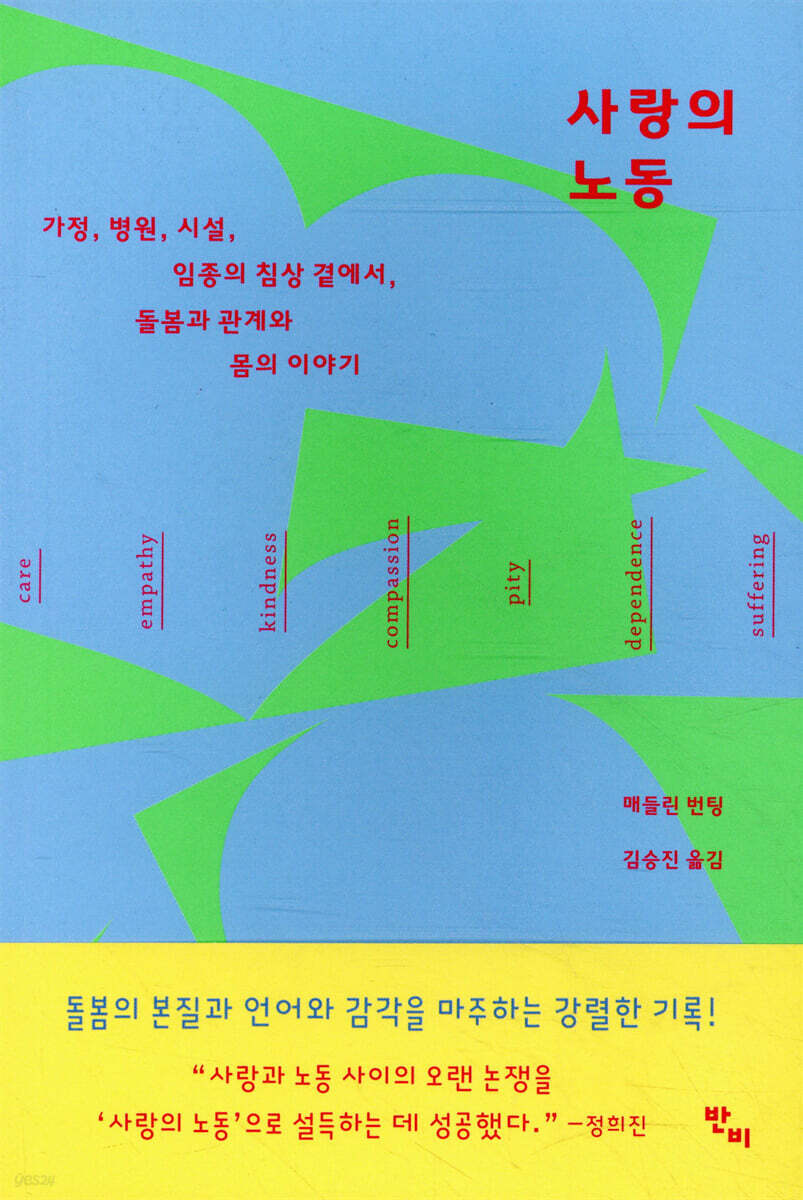
Labor of Love
 |
Description
Book Introduction
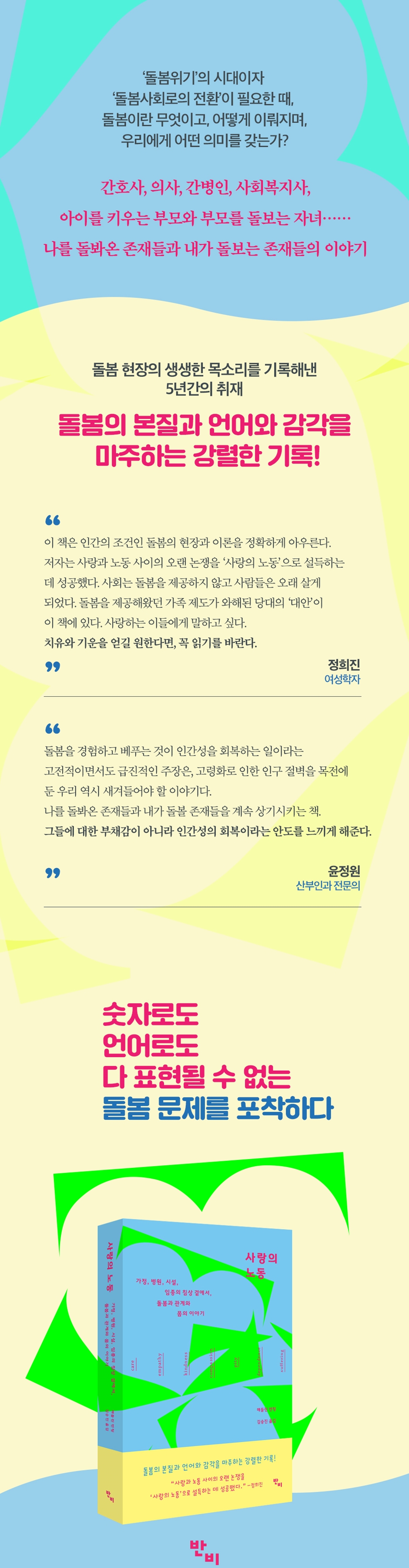
Nurses, doctors, caregivers, social workers,
Parents raising children and children caring for their parents… …
The story of those who have cared for me and those I care for
Five years of reporting documenting the vivid voices of caregivers.
Care gaps, single-parent care, young caregivers, blind spots in care… … Over the past few years, care has become a hot topic in our society as a variety of problems and ‘crises.’
At the same time, the "transition to a care society" is being discussed as a key solution to various social problems, from aging to polarization, the collapse of public services, gender inequality, environmental destruction, and the climate crisis.
While agendas and discourses emphasizing the value and universality of care have grown more than ever, social discussion remains insufficient. Despite the constant increase in demand for care, chronic undervaluation, low wages, unstable labor, shortages of personnel and budget, and the disconnect between care policies and the field remain unresolved.
More fundamentally, we must acknowledge the reality that, despite the fact that all humans must care and be cared for in order to survive, for each of us, care is something we do not want to do, and even if we recognize its importance, it is simply viewed as something scary and overwhelming.
It is time to ask concrete questions and examine in detail what care is, how it is achieved, and what it means to us.
"Labor of Love" is a book that captures the stories, experiences, and interactions of countless caregivers, nurses, doctors, social workers, researchers, activists, parents raising children, and children caring for their parents.
Author Madeleine Bunting, a journalist and author, wrote this book after five years of reporting.
We visit various care settings, including general hospitals, hospices, facilities, general practitioner (GP) clinics, homes, and civic groups, and interview members to convey the vivid voices of the field.
In addition, through a thorough examination of relevant statistics and literature, it examines macro- and socio-structural issues related to social care, and even explores the historical aspects of care.
By exploring literature and art on themes of housework, healing, recovery, and loving relationships, it also richly reveals the nuances of caregiving.
In addition, by presenting words closely related to care at the end of each chapter and explaining their etymology and meaning, we aim to examine the cultural context that shapes our understanding of care.
It is undoubtedly a profound and comprehensive record of the landscape of caregiving.
Parents raising children and children caring for their parents… …
The story of those who have cared for me and those I care for
Five years of reporting documenting the vivid voices of caregivers.
Care gaps, single-parent care, young caregivers, blind spots in care… … Over the past few years, care has become a hot topic in our society as a variety of problems and ‘crises.’
At the same time, the "transition to a care society" is being discussed as a key solution to various social problems, from aging to polarization, the collapse of public services, gender inequality, environmental destruction, and the climate crisis.
While agendas and discourses emphasizing the value and universality of care have grown more than ever, social discussion remains insufficient. Despite the constant increase in demand for care, chronic undervaluation, low wages, unstable labor, shortages of personnel and budget, and the disconnect between care policies and the field remain unresolved.
More fundamentally, we must acknowledge the reality that, despite the fact that all humans must care and be cared for in order to survive, for each of us, care is something we do not want to do, and even if we recognize its importance, it is simply viewed as something scary and overwhelming.
It is time to ask concrete questions and examine in detail what care is, how it is achieved, and what it means to us.
"Labor of Love" is a book that captures the stories, experiences, and interactions of countless caregivers, nurses, doctors, social workers, researchers, activists, parents raising children, and children caring for their parents.
Author Madeleine Bunting, a journalist and author, wrote this book after five years of reporting.
We visit various care settings, including general hospitals, hospices, facilities, general practitioner (GP) clinics, homes, and civic groups, and interview members to convey the vivid voices of the field.
In addition, through a thorough examination of relevant statistics and literature, it examines macro- and socio-structural issues related to social care, and even explores the historical aspects of care.
By exploring literature and art on themes of housework, healing, recovery, and loving relationships, it also richly reveals the nuances of caregiving.
In addition, by presenting words closely related to care at the end of each chapter and explaining their etymology and meaning, we aim to examine the cultural context that shapes our understanding of care.
It is undoubtedly a profound and comprehensive record of the landscape of caregiving.
- You can preview some of the book's contents.
Preview
index
Recommendation
To the readers
introduction
1 Invisible Heart
care
2 The Art of Maintenance
Empathy
3 Listening to Vivaldi: In a civic group
kindness
4 The Dark Matter of Care: In the Hospital
mercy
5 300 decisions a day: in general practitioner clinics
sympathy
6 Becoming a Witness: At the Caregiver's Side
dependence
7 The Boatman's Duty: On the Deathbed
pain
8 possible futures
Acknowledgements
main
References
Search
To the readers
introduction
1 Invisible Heart
care
2 The Art of Maintenance
Empathy
3 Listening to Vivaldi: In a civic group
kindness
4 The Dark Matter of Care: In the Hospital
mercy
5 300 decisions a day: in general practitioner clinics
sympathy
6 Becoming a Witness: At the Caregiver's Side
dependence
7 The Boatman's Duty: On the Deathbed
pain
8 possible futures
Acknowledgements
main
References
Search
Detailed image
Into the book
We need to better understand the meaning of the short word 'care'.
We need to better understand where the motivation to provide care comes from and what knowledge and skills are needed to provide care.
Some care work takes place at home.
Parents take care of their children, siblings take care of each other, and to varying degrees, children also take care of their parents.
Some care is built on the bonds of friendship between friends, love between lovers, and neighbors.
Meanwhile, for millions of people, caregiving is also a job.
Caregivers in nursing homes, clinics, and wards need the ability to quickly build trust and empathy in their hectic work environments.
--- p.12
Despite the vast scale of care work, there are cultural barriers in our society that make it invisible.
There exists a deep-rooted culture that stubbornly refuses to acknowledge the value of labor that sustains human well-being.
The goal of this book is to reveal the vast, often hidden, interwoven network of care: the importance of care, the extent of care work, and the complex and delicate skills required for care work.
Our society does not invest time, money, or value in the care economy, nor does it recognize the time, attention, empathy, respect, trust, dignity, reciprocity, and solidarity that flow within care relationships.
Our society also fails to recognize that quality care depends on a larger context, including adequate compensation, good working conditions, adequate funding, effective organizational management, and cultural recognition.
Contrary to what is tiredly mythologized, caregiving is not the job of saints, angels, or heroes.
--- pp.15~16
Care is still an offline activity.
This is because you have to be physically present with the person in so many ways, such as bathing them, feeding them, cleaning them, tidying them up, holding their hand, and watching over them.
Physical proximity can also be a crucial factor in providing care.
Things like who lives close enough to visit, or who can bring you food or keep you company can be crucial.
… … Care cannot be left entirely to the individual.
This is because it is made up of the network of connections that are created by who knows who lives nearby, how they meet, and what kind of relationships they develop.
However, over the past several decades, increased geographic mobility has eroded the community networks that were once essential for providing care.
--- p.19
In 1995, the United Nations estimated the value of unpaid care work worldwide (for children, the sick, and the elderly) at about $16 trillion, but this figure was likely an underestimate, noting that the size of “non-market activities within the home” could be equivalent to 80 percent of global GDP.
More recently, the Office for National Statistics estimated the value of unpaid care work (sometimes called 'informal care work') in the UK at £59.5 billion.
According to scholars, unpaid care work is likely worth between one-third and one-half of GDP in any given country.
--- p.43
The precarious and unsustainable combination of three factors – the increasing entry of women into the workforce, the growing demand for care, and inadequate public services – bore the brunt of the decade-long wave of budget cuts that followed the 2008 global financial crisis.
Austerity measures have also included squeezing the wages of care workers.
From social care to child care and nursing, the care workforce, largely made up of women, has been hit hard by wage cuts brought on by austerity policies.
The cultural stereotype that caregiving should be cheap has resurfaced.
--- p.55
“I had to see how the human body breaks down.
It was my job to deal with it.
Some experiences really have a profound impact.
I've come to realize that there are times when physical pleasure comes in non-sexual ways.
I was able to hug my grandmother, take care of her, and wash her vagina.
It was clear that it gave the patient comfort and pleasure, but it wasn't sexual at all.
When someone is really weak and sick, even conversation becomes difficult.
Sometimes, they run out of things to talk about, and it becomes difficult for them to follow the conversation or clearly express what they want to say.
So physical relationships can become very important.
Physical tasks like dressing and bathing become important tasks for me to do.
"Having skin-to-skin contact with someone can be very powerful."
--- pp.90~91
Care is often talked about as an 'action', but sometimes it is expressed by doing nothing.
One social worker working in palliative care explained that it's important to know when to step back and when to say nothing.
There are times when it's necessary to hold onto uncertainty and anxiety for a while and let things unfold on their own, without trying to reach any conclusions, results, or certainties.
The kind of caregiving that requires suppressing intense emotions can be incredibly difficult.
--- p.102
One common struggle many people mentioned was the loss of privacy experienced by families of children with disabilities.
Raising a child with a disability requires exposing even the most intimate aspects of what happens in the home to the supervision, observation, analysis, and judgment of the welfare system.
The most fundamental premise of parenting—that parents should have the greatest authority in decisions regarding their children—is being shaken.
The personal biases of government service personnel can permeate broader decision-making.
Parents must explain to the person in charge where they live, how they manage their home, what parenting style they use, and what and how they feed their children.
Add to this the class and literacy gaps between the two, and this process can be deeply humiliating, and the stigma can be permanent.
--- pp.119~120
“It was such a complex and deep journey.
On this journey, I have come to realize that we are all interdependent.
But dependence carries a stigma.
I want to tell this story outside.
“It is part of the human experience and therefore belongs to all of us.”
--- p.125
Care is the area where our society collectively makes fundamental decisions about the value of each individual's life.
If someone is unable to be employed and must constantly rely on the care of others, is that less valuable than others? If participating in the market, earning money, and purchasing goods are how our society measures human worth, then we must clearly oppose this.
--- p.149
John and Sally deal with unpredictable, chaotic, and uncontrolled bodies and emotions in their daily routine.
One nurse said one of her roles was to maintain composure.
“Care is order and organization.
We need to limit complexity and build confidence in staff, patients, and families.
In times of crisis, patients and their families often lose control.
And there is an implicit request here.
“Please keep order.”
--- pp.181~182
Protecting patient dignity is a delicate interplay between distancing and reassurance.
One nurse said she avoids eye contact when washing patients to maintain their dignity.
It is only after everything is finished that you look into the patient's eyes.
At the hospital, I noticed that the nurses would deliberately speak cheerfully when bathing patients or moving them around in bed.
It's meant to give you the feeling that what you're doing now is normal.
Talking about the weather or where the patient has lived before can distract the patient from the potentially embarrassing experience of having a stranger wash their body.
A nurse's intervention may be a simple task, but it also involves specialized and skilled skills.
--- p.195
“I see so much suffering.
But we also see a desperate hope for hope.
As a trained general practitioner, I have come to accept that my very presence there is valuable.
Sometimes we are the cure ourselves.
And I have to accept that my role is not to change people.
We strive to find and actually find out that everyone's life is interesting.
As if each person were a ball of thread, we follow the thread until we discover humanity.
That's what care is.
We need to keep our distance, but we need to empathize.
We should feel their pain, but we should not be tormented by it.
So, you shouldn’t just accept that pain.”
--- pp.239~240
Dying is painful enough in itself, without even needing to add to the story of the humiliating process of losing control of one's body and moving ever closer to dependence and vulnerability.
In the process of dying, the materiality of our bodies resists the social conventions that have governed our entire adult lives.
And we smell the powerful, unforgettable scent of death.
A culture steeped in images of idealized bodies (youthful, slim, fit, slightly tanned, sexual, etc.) has driven out knowledge from our society about the physical decline and disintegration that occurs with age.
--- pp.335~336
Seeing the caregivers' expressionless faces was one of the most painful moments during my entire research for this book.
The expression on his face said it all.
Too many resources have been taken away from those who face the painful side of life firsthand.
Most obviously, there is a lack of time and the financial compensation is inadequate.
Moreover, because society does not have a good cultural understanding of death, we cannot expect them to acknowledge their work and value.
They are isolated not only from each other, but also from the larger social context that gives meaning and dignity to their experiences.
What they are left with is the raw reality and tragedy of their declining bodies.
--- p.353
Today, this gift economy has been obscured and buried by language, institutional structures, policy documents, and public discourse that obsesses over incidents and accusations, leaving it to be quietly held in the hearts of individuals, without social recognition.
To reclaim the value of care and give due recognition and recognition to the imagination, courage, and hard work that goes into it, we need a gift economy that is properly recognized and rewarded.
Care can never be expressed or measured in words (except in the exceptional works of artists like Reggio, Tolstoy, and Ross).
But this is the raw material through which we experience humanity in ourselves and in others.
We need to better understand where the motivation to provide care comes from and what knowledge and skills are needed to provide care.
Some care work takes place at home.
Parents take care of their children, siblings take care of each other, and to varying degrees, children also take care of their parents.
Some care is built on the bonds of friendship between friends, love between lovers, and neighbors.
Meanwhile, for millions of people, caregiving is also a job.
Caregivers in nursing homes, clinics, and wards need the ability to quickly build trust and empathy in their hectic work environments.
--- p.12
Despite the vast scale of care work, there are cultural barriers in our society that make it invisible.
There exists a deep-rooted culture that stubbornly refuses to acknowledge the value of labor that sustains human well-being.
The goal of this book is to reveal the vast, often hidden, interwoven network of care: the importance of care, the extent of care work, and the complex and delicate skills required for care work.
Our society does not invest time, money, or value in the care economy, nor does it recognize the time, attention, empathy, respect, trust, dignity, reciprocity, and solidarity that flow within care relationships.
Our society also fails to recognize that quality care depends on a larger context, including adequate compensation, good working conditions, adequate funding, effective organizational management, and cultural recognition.
Contrary to what is tiredly mythologized, caregiving is not the job of saints, angels, or heroes.
--- pp.15~16
Care is still an offline activity.
This is because you have to be physically present with the person in so many ways, such as bathing them, feeding them, cleaning them, tidying them up, holding their hand, and watching over them.
Physical proximity can also be a crucial factor in providing care.
Things like who lives close enough to visit, or who can bring you food or keep you company can be crucial.
… … Care cannot be left entirely to the individual.
This is because it is made up of the network of connections that are created by who knows who lives nearby, how they meet, and what kind of relationships they develop.
However, over the past several decades, increased geographic mobility has eroded the community networks that were once essential for providing care.
--- p.19
In 1995, the United Nations estimated the value of unpaid care work worldwide (for children, the sick, and the elderly) at about $16 trillion, but this figure was likely an underestimate, noting that the size of “non-market activities within the home” could be equivalent to 80 percent of global GDP.
More recently, the Office for National Statistics estimated the value of unpaid care work (sometimes called 'informal care work') in the UK at £59.5 billion.
According to scholars, unpaid care work is likely worth between one-third and one-half of GDP in any given country.
--- p.43
The precarious and unsustainable combination of three factors – the increasing entry of women into the workforce, the growing demand for care, and inadequate public services – bore the brunt of the decade-long wave of budget cuts that followed the 2008 global financial crisis.
Austerity measures have also included squeezing the wages of care workers.
From social care to child care and nursing, the care workforce, largely made up of women, has been hit hard by wage cuts brought on by austerity policies.
The cultural stereotype that caregiving should be cheap has resurfaced.
--- p.55
“I had to see how the human body breaks down.
It was my job to deal with it.
Some experiences really have a profound impact.
I've come to realize that there are times when physical pleasure comes in non-sexual ways.
I was able to hug my grandmother, take care of her, and wash her vagina.
It was clear that it gave the patient comfort and pleasure, but it wasn't sexual at all.
When someone is really weak and sick, even conversation becomes difficult.
Sometimes, they run out of things to talk about, and it becomes difficult for them to follow the conversation or clearly express what they want to say.
So physical relationships can become very important.
Physical tasks like dressing and bathing become important tasks for me to do.
"Having skin-to-skin contact with someone can be very powerful."
--- pp.90~91
Care is often talked about as an 'action', but sometimes it is expressed by doing nothing.
One social worker working in palliative care explained that it's important to know when to step back and when to say nothing.
There are times when it's necessary to hold onto uncertainty and anxiety for a while and let things unfold on their own, without trying to reach any conclusions, results, or certainties.
The kind of caregiving that requires suppressing intense emotions can be incredibly difficult.
--- p.102
One common struggle many people mentioned was the loss of privacy experienced by families of children with disabilities.
Raising a child with a disability requires exposing even the most intimate aspects of what happens in the home to the supervision, observation, analysis, and judgment of the welfare system.
The most fundamental premise of parenting—that parents should have the greatest authority in decisions regarding their children—is being shaken.
The personal biases of government service personnel can permeate broader decision-making.
Parents must explain to the person in charge where they live, how they manage their home, what parenting style they use, and what and how they feed their children.
Add to this the class and literacy gaps between the two, and this process can be deeply humiliating, and the stigma can be permanent.
--- pp.119~120
“It was such a complex and deep journey.
On this journey, I have come to realize that we are all interdependent.
But dependence carries a stigma.
I want to tell this story outside.
“It is part of the human experience and therefore belongs to all of us.”
--- p.125
Care is the area where our society collectively makes fundamental decisions about the value of each individual's life.
If someone is unable to be employed and must constantly rely on the care of others, is that less valuable than others? If participating in the market, earning money, and purchasing goods are how our society measures human worth, then we must clearly oppose this.
--- p.149
John and Sally deal with unpredictable, chaotic, and uncontrolled bodies and emotions in their daily routine.
One nurse said one of her roles was to maintain composure.
“Care is order and organization.
We need to limit complexity and build confidence in staff, patients, and families.
In times of crisis, patients and their families often lose control.
And there is an implicit request here.
“Please keep order.”
--- pp.181~182
Protecting patient dignity is a delicate interplay between distancing and reassurance.
One nurse said she avoids eye contact when washing patients to maintain their dignity.
It is only after everything is finished that you look into the patient's eyes.
At the hospital, I noticed that the nurses would deliberately speak cheerfully when bathing patients or moving them around in bed.
It's meant to give you the feeling that what you're doing now is normal.
Talking about the weather or where the patient has lived before can distract the patient from the potentially embarrassing experience of having a stranger wash their body.
A nurse's intervention may be a simple task, but it also involves specialized and skilled skills.
--- p.195
“I see so much suffering.
But we also see a desperate hope for hope.
As a trained general practitioner, I have come to accept that my very presence there is valuable.
Sometimes we are the cure ourselves.
And I have to accept that my role is not to change people.
We strive to find and actually find out that everyone's life is interesting.
As if each person were a ball of thread, we follow the thread until we discover humanity.
That's what care is.
We need to keep our distance, but we need to empathize.
We should feel their pain, but we should not be tormented by it.
So, you shouldn’t just accept that pain.”
--- pp.239~240
Dying is painful enough in itself, without even needing to add to the story of the humiliating process of losing control of one's body and moving ever closer to dependence and vulnerability.
In the process of dying, the materiality of our bodies resists the social conventions that have governed our entire adult lives.
And we smell the powerful, unforgettable scent of death.
A culture steeped in images of idealized bodies (youthful, slim, fit, slightly tanned, sexual, etc.) has driven out knowledge from our society about the physical decline and disintegration that occurs with age.
--- pp.335~336
Seeing the caregivers' expressionless faces was one of the most painful moments during my entire research for this book.
The expression on his face said it all.
Too many resources have been taken away from those who face the painful side of life firsthand.
Most obviously, there is a lack of time and the financial compensation is inadequate.
Moreover, because society does not have a good cultural understanding of death, we cannot expect them to acknowledge their work and value.
They are isolated not only from each other, but also from the larger social context that gives meaning and dignity to their experiences.
What they are left with is the raw reality and tragedy of their declining bodies.
--- p.353
Today, this gift economy has been obscured and buried by language, institutional structures, policy documents, and public discourse that obsesses over incidents and accusations, leaving it to be quietly held in the hearts of individuals, without social recognition.
To reclaim the value of care and give due recognition and recognition to the imagination, courage, and hard work that goes into it, we need a gift economy that is properly recognized and rewarded.
Care can never be expressed or measured in words (except in the exceptional works of artists like Reggio, Tolstoy, and Ross).
But this is the raw material through which we experience humanity in ourselves and in others.
--- p.417
Publisher's Review
Capturing care issues that cannot be expressed in numbers or words
Care cannot be standardized and cannot be described in words.
This is the author's concern and insight after studying and reporting on care for a long period of time.
Much of care is based on 'tacit knowledge', and care is "felt with the heart and touch."
This is where the major challenges of discussing care arise, and the author overcomes these limitations by capturing specific, crucial moments from the stories of those in the care field to convey the reality of care to the reader.
Many nurses, caregivers, medical assistants, and family members of patients say that many activities that constitute care—such as bathing, feeding, cleaning, tidying up, holding hands, and watching—require “being physically present.”
No matter how much care relies on technology, care is still an “offline activity.”
One caregiver emphasized the importance of “physical work,” noting that “being in physical contact with someone can be very powerful.”
One nurse emphasized that it is not helpful for nursing to flow with sentimentality, and that care should be about “doing something,” and above all, it should be an “action.”
One general practitioner says that even in this age of advanced technology, “the most powerful diagnostic tool a doctor has is the ability to listen.”
Physicians must be able to communicate with patients through expressions of interest, gestures, and encouragement, and they must also synthesize and organize the patient's story to find connections with their own medical knowledge.
Nurses, who must deal with “unpredictable, chaotic, and uncontrolled bodies and emotions as part of their daily routine,” avoid eye contact to wash patients while protecting their dignity or engage in more cheerful, everyday conversation.
The authors call this “the subtle interplay between distancing and reassurance.”
Experienced nurses understand that touch and voice are the most important things that leave a lasting impression on patients, and they lead patient risk management by demonstrating accumulated expertise and sophisticated judgment that allows them to “spot small signs” in tasks that seem simple and repetitive at first glance, such as central venous catheter insertion.
The insights and knowledge about care gleaned from these concrete experiences cut through false dichotomies.
Caregiving is often perceived as a flat dichotomy of 'head vs. heart,' 'active vs. passive,' and 'skilled vs. unskilled.'
We cannot ignore the problem of applying business logic to care, or the extreme perception that care is only the result of (religious) self-sacrifice, or the gender stereotype that considers care a woman's job.
However, as you follow the story, which is woven from the author's long-term research and observations, as well as his own experiences raising children and caring for aging parents, you will naturally realize that caregiving involves many intertwined elements.
Caring for someone requires not only expertise and skills, but also insight, creativity, and empathy.
Equally important are routine and repetitive tasks.
“Good care is as much an art as a skill, as much a professional competence as a skill.” This book recognizes and captures the delicate interactions of care and conveys to us the essence of quality nursing, caregiving, treatment, and nurturing.
“Caring is the most human thing.”
A journey of understanding, discovery, and recovery of humanity
This book does not simply extol the value of care or seek to maximize its potential.
It also covers how much effort it takes to provide care under the current social system, how life can be devastated when good care is not received, the exploitation, alienation, and humiliation workers experience in the process of care 'labor,' and the violence that unhealthy care relationships can lead to.
The issue of care, portrayed from such a balanced perspective, helps us dispel vague fears about care and take a step away from ignorance.
Furthermore, it vividly reminds us that care has always been present in our lives and that most of us have accumulated knowledge that is embodied through care.
The book argues that all care deals with vulnerability, interdependence, and suffering.
Approaching life and society from a care perspective reveals the human condition that has often been ignored in modern society.
Throughout the book, we see that the moments when people feel stripped of their dignity, autonomy, and humanity are linked to issues of care.
When care enters the user-provider system as it is today, the result is that the caregivers are unable to build relationships due to insufficient time and too many procedures.
Conversely, we can also witness that true learning about humanity occurs when we care for others, seek to understand them, and affirm our own humanity.
Through this book, readers will not only understand but also sensibly empathize with the idea that care is “the raw material through which we experience our own humanity and that of others.”
Care cannot be standardized and cannot be described in words.
This is the author's concern and insight after studying and reporting on care for a long period of time.
Much of care is based on 'tacit knowledge', and care is "felt with the heart and touch."
This is where the major challenges of discussing care arise, and the author overcomes these limitations by capturing specific, crucial moments from the stories of those in the care field to convey the reality of care to the reader.
Many nurses, caregivers, medical assistants, and family members of patients say that many activities that constitute care—such as bathing, feeding, cleaning, tidying up, holding hands, and watching—require “being physically present.”
No matter how much care relies on technology, care is still an “offline activity.”
One caregiver emphasized the importance of “physical work,” noting that “being in physical contact with someone can be very powerful.”
One nurse emphasized that it is not helpful for nursing to flow with sentimentality, and that care should be about “doing something,” and above all, it should be an “action.”
One general practitioner says that even in this age of advanced technology, “the most powerful diagnostic tool a doctor has is the ability to listen.”
Physicians must be able to communicate with patients through expressions of interest, gestures, and encouragement, and they must also synthesize and organize the patient's story to find connections with their own medical knowledge.
Nurses, who must deal with “unpredictable, chaotic, and uncontrolled bodies and emotions as part of their daily routine,” avoid eye contact to wash patients while protecting their dignity or engage in more cheerful, everyday conversation.
The authors call this “the subtle interplay between distancing and reassurance.”
Experienced nurses understand that touch and voice are the most important things that leave a lasting impression on patients, and they lead patient risk management by demonstrating accumulated expertise and sophisticated judgment that allows them to “spot small signs” in tasks that seem simple and repetitive at first glance, such as central venous catheter insertion.
The insights and knowledge about care gleaned from these concrete experiences cut through false dichotomies.
Caregiving is often perceived as a flat dichotomy of 'head vs. heart,' 'active vs. passive,' and 'skilled vs. unskilled.'
We cannot ignore the problem of applying business logic to care, or the extreme perception that care is only the result of (religious) self-sacrifice, or the gender stereotype that considers care a woman's job.
However, as you follow the story, which is woven from the author's long-term research and observations, as well as his own experiences raising children and caring for aging parents, you will naturally realize that caregiving involves many intertwined elements.
Caring for someone requires not only expertise and skills, but also insight, creativity, and empathy.
Equally important are routine and repetitive tasks.
“Good care is as much an art as a skill, as much a professional competence as a skill.” This book recognizes and captures the delicate interactions of care and conveys to us the essence of quality nursing, caregiving, treatment, and nurturing.
“Caring is the most human thing.”
A journey of understanding, discovery, and recovery of humanity
This book does not simply extol the value of care or seek to maximize its potential.
It also covers how much effort it takes to provide care under the current social system, how life can be devastated when good care is not received, the exploitation, alienation, and humiliation workers experience in the process of care 'labor,' and the violence that unhealthy care relationships can lead to.
The issue of care, portrayed from such a balanced perspective, helps us dispel vague fears about care and take a step away from ignorance.
Furthermore, it vividly reminds us that care has always been present in our lives and that most of us have accumulated knowledge that is embodied through care.
The book argues that all care deals with vulnerability, interdependence, and suffering.
Approaching life and society from a care perspective reveals the human condition that has often been ignored in modern society.
Throughout the book, we see that the moments when people feel stripped of their dignity, autonomy, and humanity are linked to issues of care.
When care enters the user-provider system as it is today, the result is that the caregivers are unable to build relationships due to insufficient time and too many procedures.
Conversely, we can also witness that true learning about humanity occurs when we care for others, seek to understand them, and affirm our own humanity.
Through this book, readers will not only understand but also sensibly empathize with the idea that care is “the raw material through which we experience our own humanity and that of others.”
GOODS SPECIFICS
- Publication date: October 7, 2022
- Format: Paperback book binding method guide
- Page count, weight, size: 248 pages | 584g | 142*210*20mm
- ISBN13: 9791192107936
- ISBN10: 1192107934
You may also like
카테고리
korean


korean

![GQ KOREA Mark (Monthly): December [2025]](http://librairie.coreenne.fr/cdn/shop/files/8ef265dbbfbf186523ed75ba7319009d.jpg?v=1765340328&width=3840)


