

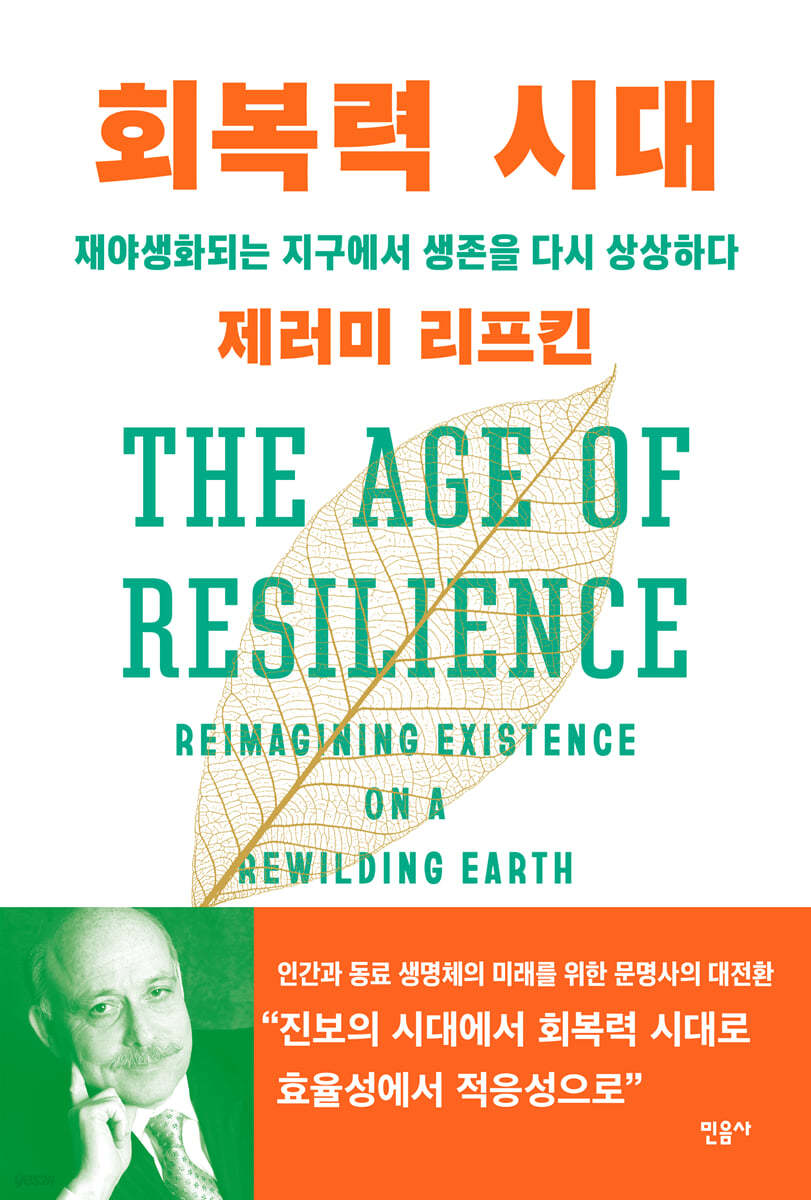
The Age of Resilience
 |
Description
Book Introduction
Key points from Jeremy Rifkin's new book, "The Age of Resilience," which took eight years to prepare. A great transformation in the history of civilization for our future! "From an era of progress to an era of resilience, the axis of history shifts." - We are moving from efficiency to adaptability, from financial capital to ecological capital, We are in the midst of a major shift from productivity to regeneration, from growth to prosperity. - Instead of globalization declining, globalization is on the rise. - As biopolitics gains momentum, geopolitics is withering away. - Ecological regional governance is capturing the imagination of the younger generation. Representative democracy is giving way to citizen councils and decentralized citizen politics. - Cold and indifferent reason is giving way to empathy and biophilia consciousness. A Whole New Story for Humanity in Crisis: "The Age of Resilience" Viruses continue to emerge, the climate is warming, and the planet is returning to its wild side. Our human species is currently helpless against the chaos unfolding around us. The principles of efficiency that drove industrial development made us the dominant species on Earth, but ultimately led to the destruction of the natural world. How can we avoid mass extinction and sustain life? In "The Age of Resilience," world-renowned futurist and economic and social thinker Jeremy Rifkin deconstructs the dying era of progress and presents a narrative of a new, rising civilization. Completed after eight years of writing, this book, which will be published simultaneously in major countries around the world on November 1, 2022, compiles the results of his 50 years of research on the global economy and society, governance innovation, and climate change. |
- You can preview some of the book's contents.
Preview
index
Introduction 9
Part 1: Efficiency vs. Entropy: The Dialectic of Modernity
1.
Masks, ventilators, toilet paper: 21 reasons why adaptability is more important than efficiency.
2.
Taylorism and the Laws of Thermodynamics 34
3.
Real World: Natural Capital 59
Part 2: The Earth's Assetization and the Immigrant Workforce
4.
The Great Chaos: Enclosures of Earth's Time and Space 79
5.
The Ultimate Plunder: The Commodification of Earth's Power, Gene Pool, and the Electromagnetic Spectrum 95
6.
Capitalism's Dilemma: Increasing Efficiency, Fewer Workers, and Rising Consumer Debt 135
Part 3: How We Got Here: Rethinking Earth's Evolution
7.
The Ecological Self: We Are Each Our Own Dispersing Pattern 167
8.
A New Origin Story: Biological Clocks and Electromagnetic Fields Synchronize and Shape Life 190
9.
Beyond Scientific Methodology: Modeling Complex Adaptive Social and Ecological Systems 214
Part 4: The Age of Resilience: The End of the Industrial Age
10.
Resilience Revolution Infrastructure 239
11.
The Rise of Ecoregional Governance 265
12.
Representative Democracy Replaced by Decentralized Peer Politics 287
13.
The Emergence of a Life-Love Consciousness 316
Acknowledgments 364
Note 366
Search 418
Part 1: Efficiency vs. Entropy: The Dialectic of Modernity
1.
Masks, ventilators, toilet paper: 21 reasons why adaptability is more important than efficiency.
2.
Taylorism and the Laws of Thermodynamics 34
3.
Real World: Natural Capital 59
Part 2: The Earth's Assetization and the Immigrant Workforce
4.
The Great Chaos: Enclosures of Earth's Time and Space 79
5.
The Ultimate Plunder: The Commodification of Earth's Power, Gene Pool, and the Electromagnetic Spectrum 95
6.
Capitalism's Dilemma: Increasing Efficiency, Fewer Workers, and Rising Consumer Debt 135
Part 3: How We Got Here: Rethinking Earth's Evolution
7.
The Ecological Self: We Are Each Our Own Dispersing Pattern 167
8.
A New Origin Story: Biological Clocks and Electromagnetic Fields Synchronize and Shape Life 190
9.
Beyond Scientific Methodology: Modeling Complex Adaptive Social and Ecological Systems 214
Part 4: The Age of Resilience: The End of the Industrial Age
10.
Resilience Revolution Infrastructure 239
11.
The Rise of Ecoregional Governance 265
12.
Representative Democracy Replaced by Decentralized Peer Politics 287
13.
The Emergence of a Life-Love Consciousness 316
Acknowledgments 364
Note 366
Search 418
Into the book
A great shift from adapting nature to adapting the human species to adapting the human species to nature will require a discarding of the traditional Baconian approach to scientific inquiry, which distorts nature's secrets and focuses on viewing the Earth as a resource and commodity for our species' exclusive consumption.
Instead, we must embrace a fundamentally new scientific paradigm that the next generation of scientists is calling complex adaptive social-ecological systems thinking.
This new approach to science sees nature not as a "resource" but as a "source of life," ultimately perceiving the Earth as a self-organizing, self-evolving system so complex that its trajectory cannot be predicted in advance.
So what's needed is not a science of preemption, but a science of prediction and careful adaptation.
--- pp.17~18
During the industrial era, one-third of the world's topsoil was degraded.
Scientists say there is only 60 years' worth of topsoil left on Earth to feed humanity.
It takes over 500 years to replace one inch of topsoil.
Scientists also warn that climate change could trigger mass extinctions, leading to the loss of up to 50 percent of all existing species within the next 80 years.
Meanwhile, Earth's oxygen is disappearing at a rate unprecedented in the past two billion years.
Marine phytoplankton, which produces half of the Earth's oxygen, are currently under threat from rising ocean temperatures caused by global warming.
A new study suggests that global ocean oxygen depletion could occur as early as 2100 due to the loss of phytoplankton.
Likewise, terrifyingly, rising global temperatures caused by greenhouse gases are rapidly increasing the intensity of floods, hurricanes, droughts, and wildfires, destabilizing ecosystems and expanding areas of the planet that are uninhabitable.
By 2070, about 19 percent of the Earth will be a "barely habitable hot zone."
--- p.41~42
The story of how we arrived at this historical juncture and the fundamental shift in our conceptions of time and space begins innocently enough in 14th-century medieval Europe with two developments that would later define the modern era.
The first was the invention of the mechanical clock and the strict scheduling of time by Benedictine monks in their daily liturgy.
Second, artists of the Italian Renaissance developed linear perspective in art.
--- p.80
The biological clock organizes the internal activity patterns of each organism and synchronizes its relationship with the Earth's daily, lunar, seasonal, and annual cycles, and it is this electromagnetic field, another force we are only just beginning to understand, that plays a crucial role in establishing not only the spatial but also the temporal patterns of each species.
--- p.200
Resilience does not mean reestablishing the exact status quo.
The passage of time and events, however insignificant their footprints, always change patterns, processes, and relationships, in nature as well as in society.
Resilience should be viewed not as a 'state of being' in the world, but as a way of acting in the world.
Ultimately, adaptability is a function of time.
Through it, individual organisms, specific species, or larger biological communities participate in all the interactive processes and patterns that make up the Earth's microbiomes, ecosystems, and biomes.
--- p.220
The World Wildlife Fund (WWF) defines an ecoregion as “the most striking example of biodiversity in a particular key habitat type.”
This must be due to a high degree of species richness and endemism, a high degree of taxonomic endemism, a special ecological or evolutionary phenomenon, or a global rarity of a key habitat type.
This classification system allows scientists, governments, and communities to assess the health and biodiversity of their local ecosystems, with the dual purpose of aligning the social realm with the larger natural realm and easily identifying weaknesses in the ecological region that need improvement.
In contrast, ecoregional governance means that when a part of an ecoregion is managed by the government, a sense of belonging, attachment, identity, and participation are created, anthropologically, psychologically, socially, economically, and politically.
Attachment to an ecoregion often transcends arbitrary political boundaries and encompasses the entire ecoregion in which the community resides.
This transboundary ecological distinction has become even more relevant in recent years as climate change-induced floods, droughts, wildfires, and hurricanes have transcended national boundaries and forced countries and regions sharing the same ecological region to respond cooperatively.
--- pp.277~278
The fundamental dilemma facing all ongoing and emerging bioregional governance efforts, including those in the Great Lakes and Cascadia, is that the moment we decide to co-manage an ecoregion, we are forced to wrestle between two conflicting worldviews.
Should we follow the conventional wisdom inherent in the gospel of efficiency, which has persisted throughout the industrial age and interprets environmental conservation in strictly commercial terms? In short, should we view the efficient management of the resources of the Great Lakes ecoregion for future commercial exploitation as our primary mission?
If this traditional mindset prevails, ecoregional governance will continue to develop a myopic, human-centered relationship with the Great Lakes ecosystem.
That is, we will be more concerned with how society adapts the ecosystem to the pragmatic requirements of society, rather than how society adapts to the conditions of the ecosystem.
This is an important distinction and one that warrants urgent discussion, as either "management" or "stewardship" of the Great Lakes will become the norm depending on which direction adaptation takes.
Because it is so arduous, few people have walked this path before.
But this is the path we must take from now on for the survival and prosperity of our human species.
Instead, we must embrace a fundamentally new scientific paradigm that the next generation of scientists is calling complex adaptive social-ecological systems thinking.
This new approach to science sees nature not as a "resource" but as a "source of life," ultimately perceiving the Earth as a self-organizing, self-evolving system so complex that its trajectory cannot be predicted in advance.
So what's needed is not a science of preemption, but a science of prediction and careful adaptation.
--- pp.17~18
During the industrial era, one-third of the world's topsoil was degraded.
Scientists say there is only 60 years' worth of topsoil left on Earth to feed humanity.
It takes over 500 years to replace one inch of topsoil.
Scientists also warn that climate change could trigger mass extinctions, leading to the loss of up to 50 percent of all existing species within the next 80 years.
Meanwhile, Earth's oxygen is disappearing at a rate unprecedented in the past two billion years.
Marine phytoplankton, which produces half of the Earth's oxygen, are currently under threat from rising ocean temperatures caused by global warming.
A new study suggests that global ocean oxygen depletion could occur as early as 2100 due to the loss of phytoplankton.
Likewise, terrifyingly, rising global temperatures caused by greenhouse gases are rapidly increasing the intensity of floods, hurricanes, droughts, and wildfires, destabilizing ecosystems and expanding areas of the planet that are uninhabitable.
By 2070, about 19 percent of the Earth will be a "barely habitable hot zone."
--- p.41~42
The story of how we arrived at this historical juncture and the fundamental shift in our conceptions of time and space begins innocently enough in 14th-century medieval Europe with two developments that would later define the modern era.
The first was the invention of the mechanical clock and the strict scheduling of time by Benedictine monks in their daily liturgy.
Second, artists of the Italian Renaissance developed linear perspective in art.
--- p.80
The biological clock organizes the internal activity patterns of each organism and synchronizes its relationship with the Earth's daily, lunar, seasonal, and annual cycles, and it is this electromagnetic field, another force we are only just beginning to understand, that plays a crucial role in establishing not only the spatial but also the temporal patterns of each species.
--- p.200
Resilience does not mean reestablishing the exact status quo.
The passage of time and events, however insignificant their footprints, always change patterns, processes, and relationships, in nature as well as in society.
Resilience should be viewed not as a 'state of being' in the world, but as a way of acting in the world.
Ultimately, adaptability is a function of time.
Through it, individual organisms, specific species, or larger biological communities participate in all the interactive processes and patterns that make up the Earth's microbiomes, ecosystems, and biomes.
--- p.220
The World Wildlife Fund (WWF) defines an ecoregion as “the most striking example of biodiversity in a particular key habitat type.”
This must be due to a high degree of species richness and endemism, a high degree of taxonomic endemism, a special ecological or evolutionary phenomenon, or a global rarity of a key habitat type.
This classification system allows scientists, governments, and communities to assess the health and biodiversity of their local ecosystems, with the dual purpose of aligning the social realm with the larger natural realm and easily identifying weaknesses in the ecological region that need improvement.
In contrast, ecoregional governance means that when a part of an ecoregion is managed by the government, a sense of belonging, attachment, identity, and participation are created, anthropologically, psychologically, socially, economically, and politically.
Attachment to an ecoregion often transcends arbitrary political boundaries and encompasses the entire ecoregion in which the community resides.
This transboundary ecological distinction has become even more relevant in recent years as climate change-induced floods, droughts, wildfires, and hurricanes have transcended national boundaries and forced countries and regions sharing the same ecological region to respond cooperatively.
--- pp.277~278
The fundamental dilemma facing all ongoing and emerging bioregional governance efforts, including those in the Great Lakes and Cascadia, is that the moment we decide to co-manage an ecoregion, we are forced to wrestle between two conflicting worldviews.
Should we follow the conventional wisdom inherent in the gospel of efficiency, which has persisted throughout the industrial age and interprets environmental conservation in strictly commercial terms? In short, should we view the efficient management of the resources of the Great Lakes ecoregion for future commercial exploitation as our primary mission?
If this traditional mindset prevails, ecoregional governance will continue to develop a myopic, human-centered relationship with the Great Lakes ecosystem.
That is, we will be more concerned with how society adapts the ecosystem to the pragmatic requirements of society, rather than how society adapts to the conditions of the ecosystem.
This is an important distinction and one that warrants urgent discussion, as either "management" or "stewardship" of the Great Lakes will become the norm depending on which direction adaptation takes.
Because it is so arduous, few people have walked this path before.
But this is the path we must take from now on for the survival and prosperity of our human species.
--- p.286
Publisher's Review
From an Era of Progress to an Era of Resilience, From Efficiency to Adaptability
As we move through the Age of Progress, efficiency has become the gold standard for organizing time, and the human species has been engaged in a relentless quest to optimize the exploitation, commodification, and consumption of natural resources at ever-increasing speeds and in ever-shrinking time intervals, all with the goal of enhancing societal prosperity.
In this process of depletion of nature, space became synonymous with passive natural resources, and the primary role of politics and economics became managing nature as property.
This orientation has elevated humanity to the dominant species on Earth while simultaneously leading the natural world to ruin.
Rifkin argues that while the era of progress marched in step with efficiency, the emerging era of resilience marches in step with adaptability.
The shift from efficiency to adaptability is accompanied by sweeping economic and social transformations, including shifts from productivity to regeneration, from growth to prosperity, from ownership to access, from buyer-seller markets to supplier-user networks, from linear processes to cybernetic processes, from vertically integrated economies of scale to horizontally integrated economies of scale, from centralized value chains to decentralized value chains, from giant conglomerates to fluid sharing, blockchain-forming, agile high-tech SMEs, from intellectual property to open-source knowledge sharing, from gross domestic product (GDP) to quality of life indices (QLI), from negative externalities to circularity, and from geopolitics to biosphere politics.
Younger generations are already transitioning from growth to prosperity, from financial capital to ecological capital, from consumer sovereignty to environmental stewardship, from globalization to decentralization, and from representative democracy to citizens' assemblies and decentralized, peer-to-peer politics.
On the same line, as empathy and love for life become the new norms, cool and indifferent reason is weakening.
At a time when the human species despairs about its own future, Rifkin opens a window into a radically different future, offering a bold blueprint for a second chance at life on Earth.
A Subversive Reflection on the History of Human Civilization: The World's Laws Misread by Great Men
A century ago, about 85 percent of the Earth's surface was still characterized by wilderness, but today less than 23 percent of the land remains untouched by human alteration, and even these last wilderness areas are expected to be lost to human hands in the coming decades.
This is the first time in 3.5 billion years that life has appeared on Earth.
Much of the blame for this state of affairs lies with the scientific, economic, and business communities, which have provided a narrative about how the global economy works, claiming that it is optimal for promoting economic gain and ensuring human well-being.
And often the story begins with René Descartes, the French mathematician and scientist who is considered the first modern philosopher.
He believed that unrestrained, mathematically armed human thought could create an orderly, predictable, and self-perpetuating mechanical analogue of existence on Earth (as God does in the universe).
However, it was difficult to explain the gravity that all machines face, but Isaac Newton, who enthusiastically supported him, discovered a mathematical formula to explain gravity.
For Newton, who assumed that a single law could explain why planets move in certain ways and why apples fall from trees in certain ways, the universe of matter and motion was orderly and calculable, with no room for spontaneity or unpredictability.
In short, it was a world of quantity without quality.
He mathematized the Age of Enlightenment by backing up his insights with mathematical proofs, and mathematics provided the foundation for the Age of Progress.
Meanwhile, there are people who are called the fathers of modern science before them.
First, Francis Bacon believed that the most fundamental human resource was the ability to detach oneself from nature, to observe it rigorously from a distance, to extract its secrets and accumulate them into an “objective knowledge” of the world, with which one could “influence everything possible and extend the boundaries of the human kingdom.”
Galileo also based all his scientific investigations on what he had learned about the mathematics of perspective from artists and architects.
"Objectivity," interpreted as being detached and rational, has maintained a dominant influence not only in the elite world of science but also in popular culture for over 500 years, and along with this, the concept that we are all autonomous agents who observe, objectify, and use the world without permission to secure our egos has become dominant.
From the Forefront of Industrialization to Ecoregional Governance: The Great Lakes: Past and Present
At about noon on June 22, 1969, sparks from a train traveling on the Cuyahoga River Bridge in Cleveland fell into the river and ignited industrial waste floating on the surface.
The flames that broke out like this quickly spread across the river, reaching heights of more than five stories in some areas.
Fires broke out not only in the Cuyahoga River, which discharged polluted water into Lake Erie, but also in the Chicago River in Illinois, the Buffalo River in New York, and the Rouge River in Michigan, which carried polluted water to the Great Lakes during the heyday of the Industrial Age.
For a long time, it was considered "normal" for various pollutants, such as oil, solvents, industrial chemicals, and waste, to flow down tributaries and into the Great Lakes.
The Cuyahoga River fire sparked a public awareness of the negative externalities—the entropic costs—that have accumulated over 150 years of industrial development in the Great Lakes region, the cradle of the First and Second Industrial Revolutions.
In April 1970, ten months after the fire, the first Earth Day was celebrated with peaceful demonstrations demanding fundamental environmental reform, and up to 20 million Americans took to the streets.
In December 1970, the U.S. Congress authorized the creation of the Environmental Protection Agency (EPA), which was responsible for environmental issues and reform.
In 1983, the governors of Illinois, Indiana, Michigan, Minnesota, Ohio, and Wisconsin formed the Great Lakes Governors' Council, with New York and Pennsylvania joining in 1989 and Canada becoming a full member in 2015.
This is because we share the recognition that environmental management in the Great Lakes region, which holds 20 percent of the Earth's total surface freshwater, is crucial to the economic and social well-being of the people living around the lakes, and that responding to climate change has no borders.
Today, the Great Lakes region is a leader in building ecoregional approaches and creating more resilient economies and societies.
A community of life protected by warm empathy rather than cold reason.
Amid warnings that climate change, driven by our reliance on fossil fuels, is leading us to the sixth mass extinction, we are reminded of the truth that our lives and those of our fellow creatures exist as processes, patterns, and flows.
All living things are extensions of the Earth's realm.
Minerals and nutrients from the continental crust, water from the hydrosphere, and oxygen from the atmosphere constantly circulate through us in the form of atoms and molecules, residing in our cells, tissues, and organs as prescribed by our DNA.
And while we live, we just keep replacing them at various intervals.
Our bodies are not ours alone.
This means that it is shared with various living organisms such as bacteria, viruses, protozoa, archaea, and fungi.
In fact, more than half of the cells in the human body and most of the DNA that makes us up do not belong to us, but to other living creatures that exist in every corner of our bodies.
The Earth's species and ecosystems do not reside solely at the edges of our bodies, but constantly flow in and out of them.
We are the planet itself, literally and metaphorically.
Ultimately, we are left with an entropic bill in the form of global warming emissions that threaten the future of life on Earth.
Ironically, however, our species, unlike our fellow creatures, has a Janus-faced face.
Because while we are a species that plunders and destroys nature, we can also be healers.
We are a blessed species with a special quality wired into our neural circuits: the impulse to empathize.
The impulse to empathize boasts flexibility and infinite extensibility.
This rare and precious attribute has evolved, declined, and resurfaced repeatedly.
In recent years, younger generations have begun to broaden the scope of their empathic impulses beyond the human species to include all fellow creatures who are part of our evolutionary family.
This, what biologists call a life consciousness, cannot but be a hopeful sign of a new path forward.
As we move through the Age of Progress, efficiency has become the gold standard for organizing time, and the human species has been engaged in a relentless quest to optimize the exploitation, commodification, and consumption of natural resources at ever-increasing speeds and in ever-shrinking time intervals, all with the goal of enhancing societal prosperity.
In this process of depletion of nature, space became synonymous with passive natural resources, and the primary role of politics and economics became managing nature as property.
This orientation has elevated humanity to the dominant species on Earth while simultaneously leading the natural world to ruin.
Rifkin argues that while the era of progress marched in step with efficiency, the emerging era of resilience marches in step with adaptability.
The shift from efficiency to adaptability is accompanied by sweeping economic and social transformations, including shifts from productivity to regeneration, from growth to prosperity, from ownership to access, from buyer-seller markets to supplier-user networks, from linear processes to cybernetic processes, from vertically integrated economies of scale to horizontally integrated economies of scale, from centralized value chains to decentralized value chains, from giant conglomerates to fluid sharing, blockchain-forming, agile high-tech SMEs, from intellectual property to open-source knowledge sharing, from gross domestic product (GDP) to quality of life indices (QLI), from negative externalities to circularity, and from geopolitics to biosphere politics.
Younger generations are already transitioning from growth to prosperity, from financial capital to ecological capital, from consumer sovereignty to environmental stewardship, from globalization to decentralization, and from representative democracy to citizens' assemblies and decentralized, peer-to-peer politics.
On the same line, as empathy and love for life become the new norms, cool and indifferent reason is weakening.
At a time when the human species despairs about its own future, Rifkin opens a window into a radically different future, offering a bold blueprint for a second chance at life on Earth.
A Subversive Reflection on the History of Human Civilization: The World's Laws Misread by Great Men
A century ago, about 85 percent of the Earth's surface was still characterized by wilderness, but today less than 23 percent of the land remains untouched by human alteration, and even these last wilderness areas are expected to be lost to human hands in the coming decades.
This is the first time in 3.5 billion years that life has appeared on Earth.
Much of the blame for this state of affairs lies with the scientific, economic, and business communities, which have provided a narrative about how the global economy works, claiming that it is optimal for promoting economic gain and ensuring human well-being.
And often the story begins with René Descartes, the French mathematician and scientist who is considered the first modern philosopher.
He believed that unrestrained, mathematically armed human thought could create an orderly, predictable, and self-perpetuating mechanical analogue of existence on Earth (as God does in the universe).
However, it was difficult to explain the gravity that all machines face, but Isaac Newton, who enthusiastically supported him, discovered a mathematical formula to explain gravity.
For Newton, who assumed that a single law could explain why planets move in certain ways and why apples fall from trees in certain ways, the universe of matter and motion was orderly and calculable, with no room for spontaneity or unpredictability.
In short, it was a world of quantity without quality.
He mathematized the Age of Enlightenment by backing up his insights with mathematical proofs, and mathematics provided the foundation for the Age of Progress.
Meanwhile, there are people who are called the fathers of modern science before them.
First, Francis Bacon believed that the most fundamental human resource was the ability to detach oneself from nature, to observe it rigorously from a distance, to extract its secrets and accumulate them into an “objective knowledge” of the world, with which one could “influence everything possible and extend the boundaries of the human kingdom.”
Galileo also based all his scientific investigations on what he had learned about the mathematics of perspective from artists and architects.
"Objectivity," interpreted as being detached and rational, has maintained a dominant influence not only in the elite world of science but also in popular culture for over 500 years, and along with this, the concept that we are all autonomous agents who observe, objectify, and use the world without permission to secure our egos has become dominant.
From the Forefront of Industrialization to Ecoregional Governance: The Great Lakes: Past and Present
At about noon on June 22, 1969, sparks from a train traveling on the Cuyahoga River Bridge in Cleveland fell into the river and ignited industrial waste floating on the surface.
The flames that broke out like this quickly spread across the river, reaching heights of more than five stories in some areas.
Fires broke out not only in the Cuyahoga River, which discharged polluted water into Lake Erie, but also in the Chicago River in Illinois, the Buffalo River in New York, and the Rouge River in Michigan, which carried polluted water to the Great Lakes during the heyday of the Industrial Age.
For a long time, it was considered "normal" for various pollutants, such as oil, solvents, industrial chemicals, and waste, to flow down tributaries and into the Great Lakes.
The Cuyahoga River fire sparked a public awareness of the negative externalities—the entropic costs—that have accumulated over 150 years of industrial development in the Great Lakes region, the cradle of the First and Second Industrial Revolutions.
In April 1970, ten months after the fire, the first Earth Day was celebrated with peaceful demonstrations demanding fundamental environmental reform, and up to 20 million Americans took to the streets.
In December 1970, the U.S. Congress authorized the creation of the Environmental Protection Agency (EPA), which was responsible for environmental issues and reform.
In 1983, the governors of Illinois, Indiana, Michigan, Minnesota, Ohio, and Wisconsin formed the Great Lakes Governors' Council, with New York and Pennsylvania joining in 1989 and Canada becoming a full member in 2015.
This is because we share the recognition that environmental management in the Great Lakes region, which holds 20 percent of the Earth's total surface freshwater, is crucial to the economic and social well-being of the people living around the lakes, and that responding to climate change has no borders.
Today, the Great Lakes region is a leader in building ecoregional approaches and creating more resilient economies and societies.
A community of life protected by warm empathy rather than cold reason.
Amid warnings that climate change, driven by our reliance on fossil fuels, is leading us to the sixth mass extinction, we are reminded of the truth that our lives and those of our fellow creatures exist as processes, patterns, and flows.
All living things are extensions of the Earth's realm.
Minerals and nutrients from the continental crust, water from the hydrosphere, and oxygen from the atmosphere constantly circulate through us in the form of atoms and molecules, residing in our cells, tissues, and organs as prescribed by our DNA.
And while we live, we just keep replacing them at various intervals.
Our bodies are not ours alone.
This means that it is shared with various living organisms such as bacteria, viruses, protozoa, archaea, and fungi.
In fact, more than half of the cells in the human body and most of the DNA that makes us up do not belong to us, but to other living creatures that exist in every corner of our bodies.
The Earth's species and ecosystems do not reside solely at the edges of our bodies, but constantly flow in and out of them.
We are the planet itself, literally and metaphorically.
Ultimately, we are left with an entropic bill in the form of global warming emissions that threaten the future of life on Earth.
Ironically, however, our species, unlike our fellow creatures, has a Janus-faced face.
Because while we are a species that plunders and destroys nature, we can also be healers.
We are a blessed species with a special quality wired into our neural circuits: the impulse to empathize.
The impulse to empathize boasts flexibility and infinite extensibility.
This rare and precious attribute has evolved, declined, and resurfaced repeatedly.
In recent years, younger generations have begun to broaden the scope of their empathic impulses beyond the human species to include all fellow creatures who are part of our evolutionary family.
This, what biologists call a life consciousness, cannot but be a hopeful sign of a new path forward.
GOODS SPECIFICS
- Publication date: November 1, 2022
- Page count, weight, size: 432 pages | 630g | 152*225*25mm
- ISBN13: 9788937427367
- ISBN10: 8937427362
You may also like
카테고리
korean


korean

![GQ KOREA Mark (Monthly): December [2025]](http://librairie.coreenne.fr/cdn/shop/files/8ef265dbbfbf186523ed75ba7319009d.jpg?v=1765340328&width=3840)


