

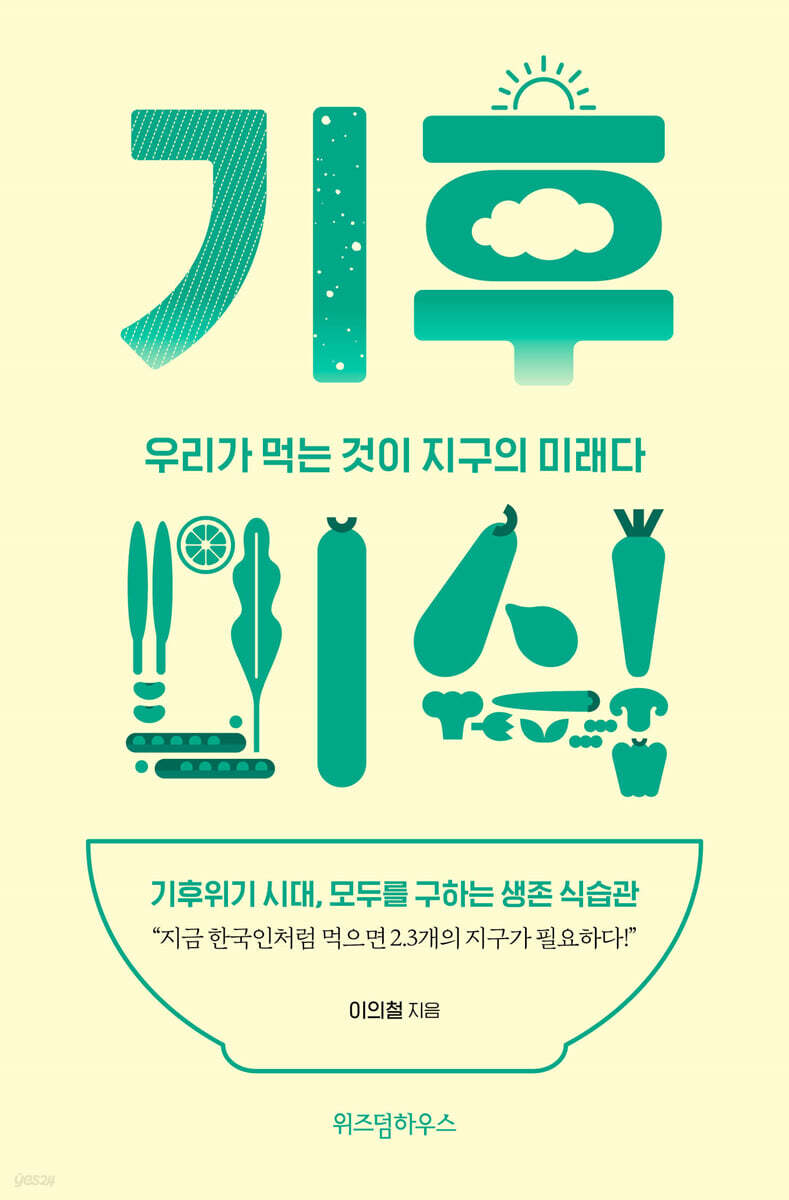
Climate Gourmet
 |
Description
Book Introduction
Klimagourmet: A Survival Diet for Everyone in the Climate Crisis
Eating is no longer a private matter.
What we decide to eat not only determines the health of those who eat it, but also the shape of the planet we live on.
With the climate crisis reaching a critical level, energy transition alone is not enough.
It's time to discuss a shift in diet! "Climate gastronomy" refers to the practice of preparing and serving food that minimizes greenhouse gas emissions and that respects sustainable ecosystems.
Responsible food consumption for the Earth, life, and humanity.
Dr. Lee Eui-cheol, an occupational and environmental medicine specialist who speaks courageously about people's health and the global environment based on his extensive field experience and verified scientific data, informs us of the current dire situation and guides us into the world of abundant and beneficial eating habits called climate gastronomy.
Eating is no longer a private matter.
What we decide to eat not only determines the health of those who eat it, but also the shape of the planet we live on.
With the climate crisis reaching a critical level, energy transition alone is not enough.
It's time to discuss a shift in diet! "Climate gastronomy" refers to the practice of preparing and serving food that minimizes greenhouse gas emissions and that respects sustainable ecosystems.
Responsible food consumption for the Earth, life, and humanity.
Dr. Lee Eui-cheol, an occupational and environmental medicine specialist who speaks courageously about people's health and the global environment based on his extensive field experience and verified scientific data, informs us of the current dire situation and guides us into the world of abundant and beneficial eating habits called climate gastronomy.
- You can preview some of the book's contents.
Preview
index
Prologue | One Meal Today Changes Our Future
Part 1.
A future that threatens survival is approaching.
A catastrophe that has already become part of everyday life
The climate crisis ultimately leads to a food crisis.
The serious impact of a 0.1 degree difference on our body
Another colony built on climate inequality
One Step Further: Himalayan Ice Caps and Climate Refugees
Part 2.
Saving the Earth with Food
Changing your diet comes before buying an electric car.
Among greenhouse gases, there are priorities that must be addressed.
Super bacteria born from livestock farming
Why You Shouldn't Eat Marine Life
One Step Further: Is Opposing Palm Oil Eco-Friendly?
Part 3.
Nutrition to Fight Human Extinction
Protein obsession spells disaster
Low-carb diets that harm your health
Growth obsession is destroying children's health and the planet.
Insulin resistance, the root cause of all modern chronic diseases
One Step Further: Dementia, a Health Disaster Threatening the Future
Part 4.
Climate Gastronomy: Sustainable Recipes for Everyone
Meals that save me and the planet
Climate gastronomy is now the new normal.
International Solidarity for Zero Carbon Emissions
Imagination for K-Natural Plant-Based Diet
Practicing a rich, diverse, and beneficial natural plant-based diet
One step further_ 'Vegetarian-based' movement
Epilogue | From Climate Villain to Climate Gastronomy Leader
supplement
Seasonal Food Guide
High-nutrient, natural plant-based diet
Books recommended for climate gourmets
References
Part 1.
A future that threatens survival is approaching.
A catastrophe that has already become part of everyday life
The climate crisis ultimately leads to a food crisis.
The serious impact of a 0.1 degree difference on our body
Another colony built on climate inequality
One Step Further: Himalayan Ice Caps and Climate Refugees
Part 2.
Saving the Earth with Food
Changing your diet comes before buying an electric car.
Among greenhouse gases, there are priorities that must be addressed.
Super bacteria born from livestock farming
Why You Shouldn't Eat Marine Life
One Step Further: Is Opposing Palm Oil Eco-Friendly?
Part 3.
Nutrition to Fight Human Extinction
Protein obsession spells disaster
Low-carb diets that harm your health
Growth obsession is destroying children's health and the planet.
Insulin resistance, the root cause of all modern chronic diseases
One Step Further: Dementia, a Health Disaster Threatening the Future
Part 4.
Climate Gastronomy: Sustainable Recipes for Everyone
Meals that save me and the planet
Climate gastronomy is now the new normal.
International Solidarity for Zero Carbon Emissions
Imagination for K-Natural Plant-Based Diet
Practicing a rich, diverse, and beneficial natural plant-based diet
One step further_ 'Vegetarian-based' movement
Epilogue | From Climate Villain to Climate Gastronomy Leader
supplement
Seasonal Food Guide
High-nutrient, natural plant-based diet
Books recommended for climate gourmets
References
Detailed image

Into the book
《Climate Gourmet》 not only covers climate, environmental pollution, food, and nutrition, but also the importance of harmony and balance among the various life forms on Earth.
Therefore, I hope that readers who read this book will not only change their diet, but will also naturally embody the perspective that the various living and non-living things on Earth are not tools or raw materials for humans, but companions who share our lives with us.
In a capitalist era where all human actions are reduced to mere means of making money, constantly hindering our rational judgment and practice, I believe this awareness will serve as a compass for not only changing our diets, but also for decisions that promote the sustainable prosperity of humanity and all life.
--- p.9
However, many people still perceive the climate crisis only as a weather-related problem such as heat, heavy rain, and typhoons.
It seems that we are not fully aware of the fact that the climate crisis will lead to extreme events that are currently unimaginable, trigger extreme social conflict, and ultimately threaten the very survival of humanity.
Because otherwise, it wouldn't be possible to be this peaceful.
--- p.14
Korea is no exception to the damage caused by rising sea levels.
Greenpeace analyzed the damage to Korea using data from Climate Central, and predicted that by 2030, 5% of the country's land area will be submerged and 3.32 million people will suffer flood damage due to the combined effects of rising sea levels and typhoons.
By region, the areas with the highest number of victims were Gyeonggi-do, Incheon, Seoul, Jeollabuk-do, and Chungcheongnam-do.
Specifically, major national facilities such as Incheon International Airport, Incheon Port, Busan Port, Pyeongtaek Port, Incheon Combined Cycle Power Plant, Seoincheon Combined Cycle Power Plant, Shinincheon Combined Cycle Power Plant, Incheon LNG Combined Cycle Power Plant, Dangjin Thermal Power Plant, Hanbit Nuclear Power Plant, Namdong Industrial Complex, Sihwa-Banwol Industrial Complex, Hyundai Steel Dangjin Plant, and cities built by reclaiming land from the sea such as Songdo International City and Cheongna International City are expected to be flooded or suffer flood damage at least once a year.
--- p.23
The climate crisis also has a major impact on agriculture.
It's perhaps to be expected, as temperatures and precipitation fluctuate.
You can experience climate change while watching the market.
The most shocking changes are the tangerines and bananas.
I was surprised to see Hwanggeumhyang, Redhyang, Hallabong, and Cheonhyehyang on display at a local agricultural product store in Sejong City, where I live.
(…) The fact that such a variety of citrus fruits are being shipped even from Sejong means that some fundamental change is taking place.
It was common knowledge that citrus fruits were a representative subtropical crop and could only be grown on Jeju Island in Korea, which has a temperate climate.
However, this type of citrus cultivation is increasingly spreading not in Jeju Island or the southern region, but in the central region.
Now is the time for the contents of textbooks to change.
Conventional wisdom is collapsing.
--- pp.26~27
To define animal protein as high quality because it promotes rapid weight gain and growth is to treat humans like factory farmed livestock.
It can be seen as a nutritional concept focused on quickly developing a high-quality workforce to produce products within a mass production system.
It's as if they don't care much about how these workers get sick and die in their middle or old age, just as the health of the livestock that will be slaughtered anyway is not important.
--- p.122
Coincidentally, the diet that is essential for human health is also the diet that all of humanity must practice to alleviate the climate crisis.
A diet that excludes animal protein, cooking oil, and sugar is recently called a 'WholeFood, Plant-Based diet (WFPB diet)'.
Whether it's due to worsening health or climate-related disasters, we're facing a situation where we need to fundamentally shift our diet to a plant-based diet to avoid life-threatening threats.
But there is no need to despair.
Because if we take action to change, the future will definitely be different.
--- p.139
Since the publication of its 2016 dietary guidelines, the Netherlands has announced additional policies aimed at making climate gastronomy the “new normal.”
In 2018, the Dutch Ministry of Education announced that all future dinners at its events would be vegetarian by default, with meat or seafood only served to those who requested it.
In 2019, the government of Amsterdam, the capital of the Netherlands, made the same declaration as the Ministry of Education.
Currently, students receiving formal education in the Netherlands are receiving basic climate gastronomy education at school, and Amsterdam residents are also living in an atmosphere where climate gastronomy is the 'new normal'.
--- p.155
In the age of climate crisis, what matters is initiative and imagination.
In a situation where people are forced to give up animal products, climate gourmet food is bound to be met with negative reactions.
However, if you actively use your delicious imagination while you still have the time, the shift to a plant-based, climate-conscious gastronomy can be an enjoyable journey toward new tastes.
And in the process, we can naturally slow down the climate crisis little by little.
As the world takes notice of Korea's K-food, if we simultaneously introduce K-natural plant-based food and K-climate cuisine, Korea will play a significant role in responding to the global climate crisis.
Therefore, I hope that readers who read this book will not only change their diet, but will also naturally embody the perspective that the various living and non-living things on Earth are not tools or raw materials for humans, but companions who share our lives with us.
In a capitalist era where all human actions are reduced to mere means of making money, constantly hindering our rational judgment and practice, I believe this awareness will serve as a compass for not only changing our diets, but also for decisions that promote the sustainable prosperity of humanity and all life.
--- p.9
However, many people still perceive the climate crisis only as a weather-related problem such as heat, heavy rain, and typhoons.
It seems that we are not fully aware of the fact that the climate crisis will lead to extreme events that are currently unimaginable, trigger extreme social conflict, and ultimately threaten the very survival of humanity.
Because otherwise, it wouldn't be possible to be this peaceful.
--- p.14
Korea is no exception to the damage caused by rising sea levels.
Greenpeace analyzed the damage to Korea using data from Climate Central, and predicted that by 2030, 5% of the country's land area will be submerged and 3.32 million people will suffer flood damage due to the combined effects of rising sea levels and typhoons.
By region, the areas with the highest number of victims were Gyeonggi-do, Incheon, Seoul, Jeollabuk-do, and Chungcheongnam-do.
Specifically, major national facilities such as Incheon International Airport, Incheon Port, Busan Port, Pyeongtaek Port, Incheon Combined Cycle Power Plant, Seoincheon Combined Cycle Power Plant, Shinincheon Combined Cycle Power Plant, Incheon LNG Combined Cycle Power Plant, Dangjin Thermal Power Plant, Hanbit Nuclear Power Plant, Namdong Industrial Complex, Sihwa-Banwol Industrial Complex, Hyundai Steel Dangjin Plant, and cities built by reclaiming land from the sea such as Songdo International City and Cheongna International City are expected to be flooded or suffer flood damage at least once a year.
--- p.23
The climate crisis also has a major impact on agriculture.
It's perhaps to be expected, as temperatures and precipitation fluctuate.
You can experience climate change while watching the market.
The most shocking changes are the tangerines and bananas.
I was surprised to see Hwanggeumhyang, Redhyang, Hallabong, and Cheonhyehyang on display at a local agricultural product store in Sejong City, where I live.
(…) The fact that such a variety of citrus fruits are being shipped even from Sejong means that some fundamental change is taking place.
It was common knowledge that citrus fruits were a representative subtropical crop and could only be grown on Jeju Island in Korea, which has a temperate climate.
However, this type of citrus cultivation is increasingly spreading not in Jeju Island or the southern region, but in the central region.
Now is the time for the contents of textbooks to change.
Conventional wisdom is collapsing.
--- pp.26~27
To define animal protein as high quality because it promotes rapid weight gain and growth is to treat humans like factory farmed livestock.
It can be seen as a nutritional concept focused on quickly developing a high-quality workforce to produce products within a mass production system.
It's as if they don't care much about how these workers get sick and die in their middle or old age, just as the health of the livestock that will be slaughtered anyway is not important.
--- p.122
Coincidentally, the diet that is essential for human health is also the diet that all of humanity must practice to alleviate the climate crisis.
A diet that excludes animal protein, cooking oil, and sugar is recently called a 'WholeFood, Plant-Based diet (WFPB diet)'.
Whether it's due to worsening health or climate-related disasters, we're facing a situation where we need to fundamentally shift our diet to a plant-based diet to avoid life-threatening threats.
But there is no need to despair.
Because if we take action to change, the future will definitely be different.
--- p.139
Since the publication of its 2016 dietary guidelines, the Netherlands has announced additional policies aimed at making climate gastronomy the “new normal.”
In 2018, the Dutch Ministry of Education announced that all future dinners at its events would be vegetarian by default, with meat or seafood only served to those who requested it.
In 2019, the government of Amsterdam, the capital of the Netherlands, made the same declaration as the Ministry of Education.
Currently, students receiving formal education in the Netherlands are receiving basic climate gastronomy education at school, and Amsterdam residents are also living in an atmosphere where climate gastronomy is the 'new normal'.
--- p.155
In the age of climate crisis, what matters is initiative and imagination.
In a situation where people are forced to give up animal products, climate gourmet food is bound to be met with negative reactions.
However, if you actively use your delicious imagination while you still have the time, the shift to a plant-based, climate-conscious gastronomy can be an enjoyable journey toward new tastes.
And in the process, we can naturally slow down the climate crisis little by little.
As the world takes notice of Korea's K-food, if we simultaneously introduce K-natural plant-based food and K-climate cuisine, Korea will play a significant role in responding to the global climate crisis.
--- p.182
Publisher's Review
Changing your diet comes before electric vehicles.
The Hidden Card to Overcome the Climate Crisis: Climate Gastronomy
Global warming, heavy rains and floods, rising sea levels, large-scale forest fires, food crisis…
Disasters caused by climate change have long since become a daily occurrence.
But more pressing threats remain.
The Seoul office of the international environmental organization Greenpeace predicted that by 2030, more than 5% of South Korea's land area will be submerged due to rising sea levels and the effects of typhoons.
If global warming continues at its current level without a clear solution, it will become a reality.
There are less than 10 years left now.
Energy transition, including limiting fossil fuel use and adopting renewable energy, is being discussed as the most important solution to the climate crisis, but there's one thing we're missing.
The fact is that 'dietary change' can be of enormous help in overcoming the climate crisis.
Many people only think of fossil fuels when they think of greenhouse gases, but the production of the foods we enjoy also emits a huge amount of greenhouse gases.
17.4% of all greenhouse gases are emitted from the consumption of animal products.
Considering that all modes of transportation, including roads, airplanes, ships, and railways, account for 16.2% of total greenhouse gases, we need to make an effort to change our diets even more than we do to convert our vehicles to electric ones.
The Netherlands Environmental Assessment Institute (PBL) has announced that if the world switched to a diet with less meat, projected climate costs could be reduced by up to 80% by 2050.
This book presents a different perspective from previous books on the climate crisis.
Rather than focusing on how to 'reduce' atmospheric carbon, we are focusing on how to 'increase absorption'.
While carbon emission reduction activities that have been carried out so far take 60 to 70 years to see the effects, carbon absorption activities have direct effects.
The method is also simple.
All we have to do is 'leave' them as they are, without eating them, so that the forests on land and the phytoplankton in the ocean can absorb more carbon dioxide and various life forms can store more of it.
This is why we need to shift our diet to being as plant-based as possible.
This book logically and in detail explains how climate gastronomy is an effective solution in the era of climate crisis, and aims to widely introduce readers to the concept of climate gastronomy, a sustainable recipe that lowers the Earth's temperature.
My health and the health of the planet are connected.
The most perfect way to protect the Earth, animals, and myself
Many climate scientists and activists, while noting that animal-based food consumption significantly contributes to greenhouse gas emissions, almost assume that agricultural land will continue to grow.
This is because it assumes that consumption of animal products is essential for humans.
However, the author of this book, Lee Ui-cheol, a practicing physician, asserts that the health problems threatening humanity today are actually caused by the myth of modern people's excessive protein intake.
This is because we know that the most effective and easiest way to solve various chronic diseases such as obesity, diabetes, high blood pressure, cardiovascular disease, cancer, dementia, and allergies is to not eat animal protein.
So this book boldly suggests that not eating animal products is the best choice not only for reducing greenhouse gases, but also for human health.
You can get enough protein from plant foods alone, even without eating meat.
The 'Climate Gourmet Zone' includes starchy foods, beans, vegetables, nuts, mushrooms, seaweed, and fruits.
Not only are there so many different types of food that you can eat deliciously and colorfully, but you can also get enough protein for your body with just one serving per day.
One incident that demonstrates the importance of plant-based protein is as follows:
During World War I, Germany pursued a meat-centric policy, believing that "you need to eat a lot of meat to be productive," while Denmark believed that consuming less protein was actually helpful for maintaining optimal health.
So, the number of pigs and cattle was drastically reduced, and barley and grains that were to be used as livestock feed were made available for human consumption.
The results were surprising.
Although Germany's per capita food production was greater than Denmark's, Germany suffered a food crisis that lasted until the end of the war in 1918, with an estimated 400,000 to 700,000 civilians dying from starvation and disease.
In contrast, Denmark, despite the food crisis of 1917-1918, saw its mortality rate drop by 34% compared to the average of the previous 17 years, and diabetes disappeared entirely.
The experiences of Germany and Denmark during World War I taught us that if we fail to quickly and effectively abandon our obsession with animal protein during a food crisis, tens or even millions of people could die from starvation.
With the climate crisis threatening a food crisis, this scenario could become a reality.
The book provides a detailed introduction to the "seasonal food guide" and "nutrient-rich natural plant-based diet" that readers can enjoy each season to help them approach climate cuisine in a richer and healthier way.
If we ate like Koreans do now, we would need 2.3 Earths.
From climate villain to climate gastronomy leader
In 2020, the Norwegian non-profit organization EAT and the British medical journal The Lancet published a report outlining the ecological footprint of food consumption in the 20 major economies, the G20 countries.
According to the report, Koreans are consuming a diet equivalent to that of 2.3 Earths.
In other words, if we continue to eat like this, the Earth will not be able to sustain us.
What's surprising is that in 1978, Korea's ecological footprint was equivalent to that of one Earth.
At that time, the daily calorie intake of Koreans was 3,000 calories, similar to that of the early 2000s.
However, the reason why the ecological footprint was small was because 70-80% of calories were consumed from grains and starch foods, and only 5-6% of calories were consumed from animal foods, so most of the calories were consumed from plant foods.
The number of calories Koreans currently consume from animal products has increased by nearly four times compared to the past, reaching 19%.
Korea's traditional food culture used little animal products, cooking oil, or sugar, and furthermore, it did not have the tradition of using dairy products that is so deeply rooted in Western society.
Therefore, if we can revive the traditions of the not-so-distant past, a fun, delicious, and healthy climate-friendly diet can easily become established as a new culture.
Moreover, with various aspects of Korean culture attracting attention from people around the world, if Korean food is recognized as a key means of responding to the health and climate crises, Korea will be able to shed its reputation as a climate villain and stand tall as a leader in climate gastronomy.
This book introduces readers to the incredible things that happen when we become "climate gourmets," step by step, and guides readers into the world of climate gastronomy, where life becomes more vibrant and our taste buds become richer.
We should all become climate gourmets.
The Hidden Card to Overcome the Climate Crisis: Climate Gastronomy
Global warming, heavy rains and floods, rising sea levels, large-scale forest fires, food crisis…
Disasters caused by climate change have long since become a daily occurrence.
But more pressing threats remain.
The Seoul office of the international environmental organization Greenpeace predicted that by 2030, more than 5% of South Korea's land area will be submerged due to rising sea levels and the effects of typhoons.
If global warming continues at its current level without a clear solution, it will become a reality.
There are less than 10 years left now.
Energy transition, including limiting fossil fuel use and adopting renewable energy, is being discussed as the most important solution to the climate crisis, but there's one thing we're missing.
The fact is that 'dietary change' can be of enormous help in overcoming the climate crisis.
Many people only think of fossil fuels when they think of greenhouse gases, but the production of the foods we enjoy also emits a huge amount of greenhouse gases.
17.4% of all greenhouse gases are emitted from the consumption of animal products.
Considering that all modes of transportation, including roads, airplanes, ships, and railways, account for 16.2% of total greenhouse gases, we need to make an effort to change our diets even more than we do to convert our vehicles to electric ones.
The Netherlands Environmental Assessment Institute (PBL) has announced that if the world switched to a diet with less meat, projected climate costs could be reduced by up to 80% by 2050.
This book presents a different perspective from previous books on the climate crisis.
Rather than focusing on how to 'reduce' atmospheric carbon, we are focusing on how to 'increase absorption'.
While carbon emission reduction activities that have been carried out so far take 60 to 70 years to see the effects, carbon absorption activities have direct effects.
The method is also simple.
All we have to do is 'leave' them as they are, without eating them, so that the forests on land and the phytoplankton in the ocean can absorb more carbon dioxide and various life forms can store more of it.
This is why we need to shift our diet to being as plant-based as possible.
This book logically and in detail explains how climate gastronomy is an effective solution in the era of climate crisis, and aims to widely introduce readers to the concept of climate gastronomy, a sustainable recipe that lowers the Earth's temperature.
My health and the health of the planet are connected.
The most perfect way to protect the Earth, animals, and myself
Many climate scientists and activists, while noting that animal-based food consumption significantly contributes to greenhouse gas emissions, almost assume that agricultural land will continue to grow.
This is because it assumes that consumption of animal products is essential for humans.
However, the author of this book, Lee Ui-cheol, a practicing physician, asserts that the health problems threatening humanity today are actually caused by the myth of modern people's excessive protein intake.
This is because we know that the most effective and easiest way to solve various chronic diseases such as obesity, diabetes, high blood pressure, cardiovascular disease, cancer, dementia, and allergies is to not eat animal protein.
So this book boldly suggests that not eating animal products is the best choice not only for reducing greenhouse gases, but also for human health.
You can get enough protein from plant foods alone, even without eating meat.
The 'Climate Gourmet Zone' includes starchy foods, beans, vegetables, nuts, mushrooms, seaweed, and fruits.
Not only are there so many different types of food that you can eat deliciously and colorfully, but you can also get enough protein for your body with just one serving per day.
One incident that demonstrates the importance of plant-based protein is as follows:
During World War I, Germany pursued a meat-centric policy, believing that "you need to eat a lot of meat to be productive," while Denmark believed that consuming less protein was actually helpful for maintaining optimal health.
So, the number of pigs and cattle was drastically reduced, and barley and grains that were to be used as livestock feed were made available for human consumption.
The results were surprising.
Although Germany's per capita food production was greater than Denmark's, Germany suffered a food crisis that lasted until the end of the war in 1918, with an estimated 400,000 to 700,000 civilians dying from starvation and disease.
In contrast, Denmark, despite the food crisis of 1917-1918, saw its mortality rate drop by 34% compared to the average of the previous 17 years, and diabetes disappeared entirely.
The experiences of Germany and Denmark during World War I taught us that if we fail to quickly and effectively abandon our obsession with animal protein during a food crisis, tens or even millions of people could die from starvation.
With the climate crisis threatening a food crisis, this scenario could become a reality.
The book provides a detailed introduction to the "seasonal food guide" and "nutrient-rich natural plant-based diet" that readers can enjoy each season to help them approach climate cuisine in a richer and healthier way.
If we ate like Koreans do now, we would need 2.3 Earths.
From climate villain to climate gastronomy leader
In 2020, the Norwegian non-profit organization EAT and the British medical journal The Lancet published a report outlining the ecological footprint of food consumption in the 20 major economies, the G20 countries.
According to the report, Koreans are consuming a diet equivalent to that of 2.3 Earths.
In other words, if we continue to eat like this, the Earth will not be able to sustain us.
What's surprising is that in 1978, Korea's ecological footprint was equivalent to that of one Earth.
At that time, the daily calorie intake of Koreans was 3,000 calories, similar to that of the early 2000s.
However, the reason why the ecological footprint was small was because 70-80% of calories were consumed from grains and starch foods, and only 5-6% of calories were consumed from animal foods, so most of the calories were consumed from plant foods.
The number of calories Koreans currently consume from animal products has increased by nearly four times compared to the past, reaching 19%.
Korea's traditional food culture used little animal products, cooking oil, or sugar, and furthermore, it did not have the tradition of using dairy products that is so deeply rooted in Western society.
Therefore, if we can revive the traditions of the not-so-distant past, a fun, delicious, and healthy climate-friendly diet can easily become established as a new culture.
Moreover, with various aspects of Korean culture attracting attention from people around the world, if Korean food is recognized as a key means of responding to the health and climate crises, Korea will be able to shed its reputation as a climate villain and stand tall as a leader in climate gastronomy.
This book introduces readers to the incredible things that happen when we become "climate gourmets," step by step, and guides readers into the world of climate gastronomy, where life becomes more vibrant and our taste buds become richer.
We should all become climate gourmets.
GOODS SPECIFICS
- Date of issue: August 17, 2022
- Page count, weight, size: 240 pages | 294g | 125*190*14mm
- ISBN13: 9791168123489
- ISBN10: 1168123488
You may also like
카테고리
korean


korean

![GQ KOREA Mark (Monthly): December [2025]](http://librairie.coreenne.fr/cdn/shop/files/8ef265dbbfbf186523ed75ba7319009d.jpg?v=1765340328&width=3840)


