

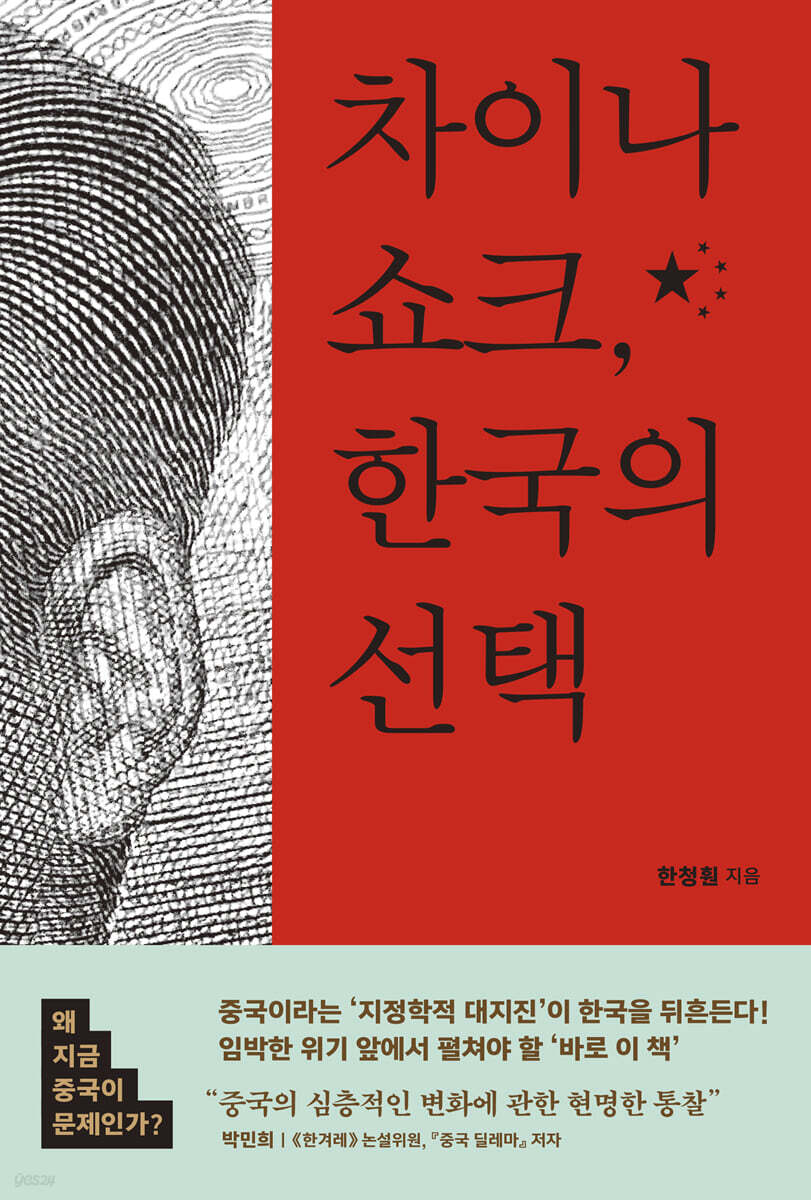
China Shock, Korea's Choice
 |
Description
Book Introduction
Why has China become such a dangerous country? A 'completely different China' from the China of the past is coming! Now that the 'geopolitical earthquake' called China is shaking Korea, This is the book that must be unfolded in the face of an impending crisis. "A wise insight into China's profound transformation." Park Min-hee (Editorial Writer, The Hankyoreh, Author of The China Dilemma) The country of China is like a 'shock' to South Korea right now. China's threats and expansionist moves are crashing down on us like a gigantic tidal wave. This is because China has clearly been dreaming of the ‘return of the Chinese Empire’ since Xi Jinping came to power. "China Shock, Korea's Choice" is a book that provides a three-dimensional and in-depth analysis of why China has chosen the path of a hegemonic empire and continues to clash with the world. The author, who has observed China from the industrial field for nearly 15 years, has sharply summarized the country's current pressing issues, including its industrial rise, cutting-edge industries and semiconductor technology, the hegemonic competition with the United States and the Taiwan issue, and the rural, population, debt, and political risks lurking within China. Based on this analysis and insight, the author presents a roadmap to help us prepare for the "China Shock." Author Han Cheong-hwan, who has been recognized for his outstanding knowledge and interpretation of China and has contributed commentary and columns to various media outlets, emphasizes that we must face "China at this moment" with a cool-headed and calm mind. For Korea, China is a real threat and a huge risk, but emotional anti-China sentiment and hatred cannot solve the problem. The author meticulously revisits the history of modern Chinese politics, economic development, and socio-cultural trends since Mao Zedong and Deng Xiaoping, focusing on the process and specificity of the formation of the China Shock. It is expected that President Xi Jinping will finally secure a third term at the 20th Party Congress in the fall of 2022. His long-term rule and concentration of power in a "one-man world" are closely linked to China's tragic modern history and the fatal risks accumulating in China's political and economic systems. Han Cheong-hwan's message is that only by looking squarely at these risks can our society have a vision for dealing with them. In 2022, China chose the path of a "completely different China" from the China of the past, promoting the "return of the empire" and the "Chinese dream." That choice could be called a geopolitical earthquake that will determine our future. The first China Shock, which erupted in 2016 following the THAAD incident and the subsequent THAAD ban, may be just the beginning. So, was South Korea, the country closest to China geographically and economically and most closely connected to it, adequately prepared for the impending China Shock? If not, how should we prepare now? "China Shock, Korea's Choice" is a book that accurately assesses the "elephant known as China" at this very moment in the new Cold War era of the 21st century, devising solutions to its impending crisis and developing a robust and systematic "China theory." |
- You can preview some of the book's contents.
Preview
index
introduction
Part 1: Beside the Storm Called China
Chapter 1 | The Return of the Empire
Chapter 2 | The THAAD Restrictions: The Beginning of the China Shock
Chapter 3 | China's Industrial Rise, Undermining the Korean Economy
Chapter 4 | China Risks Digging into Everyday Life
Chapter 5 | Will Xi Jinping Follow in Putin's Footsteps?
Chapter 6 | Why China is a Shock
Part 2: The Origins and Accumulation of China Risk
Chapter 1 | Between 2008 and 2012
Chapter 2 | Xi Jinping's Beginning
Chapter 3: A Socialist Market Economy with Chinese Characteristics
Chapter 4 | The Rising Red Dragon
Chapter 5 | China's Self-Prophecy of the End of the West
Chapter 6 | The Bo Xilai Rebellion
Chapter 7 | Xi Jinping's Eradication of Corruption
Chapter 8 | Empire of Contradictions, The Emperor's Dream
Part 3: The Pursued Empire, the Sleepless Emperor
Chapter 1 | The Sleepless Empire
Chapter 2 | Visible and Invisible China
Chapter 3 | Twilight of the Empire
Chapter 4 | The Great Wall of Debt 1
Chapter 5 | The Great Wall of Debt 2
Chapter 6 | The Empire's One Sharpening Sword 1
Chapter 7 | The Empire's One Sharpening Sword 2
Chapter 8 | The Emperor's Shadow
Part 4: What Should We Do?
Chapter 1 | Acknowledging the Uncertainty of China
Chapter 2 | Finding South Korea's Center in the New Cold War
Chapter 3 | Building Allies and Protecting Semiconductors:
The Importance of Continuing the New Southern Policy and Maintaining the Semiconductor Super Gap
Chapter 4 | Exploring a Strategic Partnership Between Korea and Japan for the Future
Chapter 5 | Is an All-Out Conflict with China Really Inevitable?
Chapter 6 | Adapting to China's New Normal
main
Part 1: Beside the Storm Called China
Chapter 1 | The Return of the Empire
Chapter 2 | The THAAD Restrictions: The Beginning of the China Shock
Chapter 3 | China's Industrial Rise, Undermining the Korean Economy
Chapter 4 | China Risks Digging into Everyday Life
Chapter 5 | Will Xi Jinping Follow in Putin's Footsteps?
Chapter 6 | Why China is a Shock
Part 2: The Origins and Accumulation of China Risk
Chapter 1 | Between 2008 and 2012
Chapter 2 | Xi Jinping's Beginning
Chapter 3: A Socialist Market Economy with Chinese Characteristics
Chapter 4 | The Rising Red Dragon
Chapter 5 | China's Self-Prophecy of the End of the West
Chapter 6 | The Bo Xilai Rebellion
Chapter 7 | Xi Jinping's Eradication of Corruption
Chapter 8 | Empire of Contradictions, The Emperor's Dream
Part 3: The Pursued Empire, the Sleepless Emperor
Chapter 1 | The Sleepless Empire
Chapter 2 | Visible and Invisible China
Chapter 3 | Twilight of the Empire
Chapter 4 | The Great Wall of Debt 1
Chapter 5 | The Great Wall of Debt 2
Chapter 6 | The Empire's One Sharpening Sword 1
Chapter 7 | The Empire's One Sharpening Sword 2
Chapter 8 | The Emperor's Shadow
Part 4: What Should We Do?
Chapter 1 | Acknowledging the Uncertainty of China
Chapter 2 | Finding South Korea's Center in the New Cold War
Chapter 3 | Building Allies and Protecting Semiconductors:
The Importance of Continuing the New Southern Policy and Maintaining the Semiconductor Super Gap
Chapter 4 | Exploring a Strategic Partnership Between Korea and Japan for the Future
Chapter 5 | Is an All-Out Conflict with China Really Inevitable?
Chapter 6 | Adapting to China's New Normal
main
Detailed image

Into the book
I want to make this clear.
I believe that China is a real threat and a huge risk to Korea.
There are also concerns that the "China Shock," which has formed from the country's mounting problems, will have an increasingly serious impact on our society over time.
If we fail to properly respond to the growing China Shock, I believe we cannot guarantee a bright future for South Korea in the 21st century.
---From the "Preface"
But in contrast to these brighter aspects, China has also been the greatest source of security threats that the countries of the Korean Peninsula have periodically faced.
To reiterate, modern Koreans associate Japan with the representative foreign power that has been invading the Korean Peninsula, but Japan emerged as the representative player in the invasion of the Korean Peninsula approximately 400 years ago, following the Imjin War.
At that time, Japan, having ended the division of the long Warring States Period, projected its condensed internal power externally for the first time and on a large scale, and the target was none other than Joseon.
Until the Imjin War, the front line of national security for the dynasties of the Korean Peninsula was not the Korea Strait in the south, but the northern border area.
---From "Part 1, Chapter 1 | The Return of the Empire"
So the difficulty of selling products in China continues to increase.
The biggest reason was the dramatic leap in China's manufacturing technological competitiveness while Korea stagnated.
This trend can be easily confirmed in various research surveys.
According to a survey by the Korea Institute of Industrial Technology Evaluation and Planning, the technology gap between Korea and China in 13 key industries, including smart electronics, smart cars, and system semiconductors, has been continuously decreasing from 1.1 years in 2013 to 0.9 years in 2017.
According to the Competitiveness Index of Leading Countries (CIP) published by the United Nations Industrial Development Organization (UNIDO), China is believed to have already surpassed Korea in the mid-2010s.
---From "Part 1, Chapter 3 | China's Industrial Rise Encroaching on the Korean Economy"
Only after all this chaos did people begin to take notice of the essential raw materials they were so heavily dependent on from China.
According to a survey conducted by the Korea International Trade Association in November 2021, China accounts for nearly half (1,850) of the 80% of our import items that depend on a single country.
Among these, manganese and graphite, which are essential core materials for secondary batteries, a representative next-generation food source for Korea, were included, which also means that China can stop Korea's backbone industries if it wants to.
---From "Part 1, Chapter 4 | China Risk Digging into Everyday Life"
First of all, for Sinocentrism, the core of national identity that maintains the unity of modern China, Taiwan is like a religious goal.
In the Chinese nationalist narrative, the "recovery of Taiwan" would be a sacred and decisive event that would officially mark the end of the humiliating period of Western domination that had begun in the 19th century and the revival of the great Chinese Empire of the past.
That is why in China, any depiction of Taiwan as an independent country provokes a reaction close to shock.
---From "Part 1, Chapter 5 | Will Xi Jinping Follow in Putin's Footsteps?"
Let's start with his 'worldview'.
Xi Jinping's worldview has two axes, and only by properly understanding them can we face the dangerous reality China is presenting today.
So what are Xi Jinping's two pillars? He is a neo-Maoist who believes in inheriting the positive legacy of the Mao Zedong era and overcoming the negative aspects and shortcomings of the Deng Xiaoping era. At the same time, he is an anti-Western, traditional conservative who believes the decline of the United States and the West and the rise of China are fait accompli.
Neo-Maoism and traditional conservatism.
These are the two axes that most fundamentally encapsulate Xi Jinping's worldview.
---From "Part 2, Chapter 1 | Between 2008 and 2012"
I think Xi Jinping accepted the trials that Mao Zedong gave him as a valuable training ground that helped him transform from a “childish Xi Jinping” into a “personally mature adult Xi Jinping.”
Just as in Stockholm syndrome, the victim affirms and internalizes the perpetrator's actions and intentions.
In fact, Xi Jinping's conclusion was exactly in line with Mao Zedong's intentions in launching the Cultural Revolution and sending his revolutionary comrades down.
When Mao Zedong decided to send his comrades and closest subordinates to remote mountainous areas, remote villages, and factories, he hoped that after taking power, they would lose their revolutionary spirit and turn right-wing, and they would reflect on their actions and become revolutionary again by joining forces with the common people.
---From "Part 2, Chapter 2 | Xi Jinping's Beginning"
Of course, Xi Jinping was not the only one who lived a life of extremes; it was a paradox experienced by many of Xi Jinping's generation.
This paradox cannot be explained without mentioning the great wave of reform and opening up in 1978.
The past 60 years of modern Chinese history have been a fundamental turning point due to reform and opening up, and the 30 years before and after reform and opening up have been marked by a strong sense of head-on conflict.
This attempt to affirm both the “two 30 years” before and after reform and opening up can be said to be an essential characteristic of Xi Jinping’s presidency.
---From "Part 2, Chapter 3 | A Socialist Market Economy with Chinese Characteristics"
In this way, China was able to develop and reorganize its domestic industries from simple low-wage, low-value-added industries to technology-dependent, high-value-added industries through investment, support, and advice from the U.S. government, U.S. financial capital, and global corporations.
In other words, it is clear that China has been the biggest beneficiary of the globalization, information revolution, and neoliberal era that have been sweeping the nation since the 1980s.
In his book, Why We've Become More Unequal, Branko Milanovic identifies middle-income earners, those between the 40th and 60th percentiles, concentrated in China and India, as one of the groups that have experienced the greatest income expansion globally over the past 30 years.
---From "Part 2, Chapter 4 | The Rising Red Dragon"
According to Henry Paulson's memoir, Wang Qishan met with Henry Paulson, who had been his longtime advisor, and said to him, who was in the midst of a financial crisis, "You were my mentor, but look at your system now.
He is reported to have said, “I don’t know what more we have to learn from you.”
This statement also represented the Chinese Communist Party's true intentions: "The nearly 30 years of learning from and admiring the United States for economic development have effectively ended."
China, watching the collapse of the extreme laissez-faire neoliberalism advocated by the United States, has concluded that unconditional marketization is not a panacea.
This leads to the world highlighting the Chinese economic model, which is a hybrid of a market economy and strong government intervention in the market, as an alternative to the American model.
---From "Part 2, Chapter 5 | China's Self-Prophecy of the End of the West"
The Chinese Communist Party's oligarchy, based on a power-sharing model, functioned successfully during the period of economic development under Deng Xiaoping's reform and opening-up model, but the moment China began to show off its success to the outside world, it exposed serious flaws and became dysfunctional.
And, as we will see in detail in the next chapter, if we consider that this dysfunction of the political system has provided Xi Jinping, who will soon seize power, with a justification and opportunity to realize his ideals, then the "Bo Xilai Coup," which we will discuss from now on, can be said to be directly connected to the true origins of the China Shock.
---From "Part 2, Chapter 6 | The Boshirai Rebellion"
It is safe to say that if the Xi Jinping administration fails to address rural issues, China will fail to escape the middle-income trap.
Of course, the potential risks in China, such as population, debt, social polarization, and power leadership, which will be introduced later, are each serious problems. However, what makes the rural issue special is that it is closely connected to each of these risks, and is "the problem at the center of all problems."
---From "Part 3, Chapter 2 | Visible and Invisible China"
Of course, the problems of ultra-low birth rates, aging population, and population decline that China is experiencing are common problems faced by all East Asian countries, including Japan, Korea, and Taiwan.
But as mentioned earlier, other East Asian countries are facing population decline problems despite their relatively high incomes, and crucially, they have no ambitions or desires for global hegemony like China.
China is rapidly aging as a nation, with national ambitions to surpass the United States, which is younger yet much wealthier.
In short, the population problem is the biggest Achilles' heel for China, which is staging the return of the empire.
---From "Part 3, Chapter 3 | Twilight of the Empire"
If Korea's leading conglomerates like Samsung, Hyundai Motors, LG, SK, and POSCO had continuously received and relied on government financial support, would they have grown into the global corporations they are today? This is all the more significant considering that the 1997 IMF financial crisis was caused by the reckless management practices of these conglomerates, which led to inefficient expansion through excessive borrowing.
However, even in 2022, when China's economy has reached the level of a middle-income country, it has not let up on its financial controls.
---From "Part 3, Chapter 5 | The Great Wall of Debt 2"
South Korea, a representative country among such countries, was already struggling with challenges from China in many industries, including steel, shipbuilding, and displays.
Moreover, semiconductors are an item on which our economy is highly dependent, accounting for a whopping 18% of Korea's total exports and ranking first in terms of export share.
So, it would be impossible not to feel anxious and fearful at the news of China's semiconductor boom.
According to the "Made in China 2025" policy roadmap officially announced at the 2015 Chinese People's Congress, China's semiconductor self-sufficiency rate was planned to reach 40% in 2020, five years from the current level of less than 10%, and 70% in 2025, ten years from now.
And to achieve this, China decided to pour a whopping 1 trillion yuan, or about 185 trillion won in Korean currency, into semiconductors over the next 10 years.
---From "Part 3, Chapter 6 | The Empire's Only Sharpening Sword 1"
Above all, isn't the fear that one of China's structural problems listed above will erupt to the surface, permanently robbing Beijing of the chance and fortune to recapture its past glory? Observing China's growing impatience, gripped by this sense of being pressed for time, I believe the next five years, or even longer, ten years, will be the most critical period surrounding the realization of a "China Shock."
---From "Part 3, Chapter 8 | The Emperor's Shadow"
But China has fused two disparate systems: political authoritarianism derived from communism and a limited free-market economy.
Moreover, this unique hybrid system has achieved unprecedented success, and it is still aspiring to become a superpower through this system.
China is conducting an unprecedented experiment with unpredictable results: a challenge for global hegemony through the "Chinese development model."
---From "Part 4, Chapter 1 | Acknowledging the Uncertainty of Uncertain China"
The historic joint statement from the 2021 South Korea-U.S. summit was a clear signal that South Korea's fears of China were significantly exaggerated.
Currently, China has no other cards to play against Korea other than the measures it used during the THAAD retaliation, and above all, it cannot afford to engage in friction with Korea, which would incur significant losses for itself.
That's why I don't think China will resort to unilateral economic retaliation like the THAAD ban, at least for the time being.
---From "Part 4, Chapter 2 | Finding the Center of the Republic of Korea in the New Cold War Era"
Now, the Cold War is over and a new Cold War is coming.
We have now entered an era in which international political, diplomatic, and security issues can impact trade and investment activities with other countries.
Against this backdrop, I view the New Southern Policy as a strategy for diversifying and avoiding risks in economic and industrial terms.
ASEAN and India have a combined population of over 2 billion, with labor costs much lower than China's. Furthermore, both countries have maintained very friendly relations with Korea, with virtually no diplomatic conflicts.
By strengthening strategic ties with ASEAN and South Asian countries, including India, through the New Southern Policy and gradually increasing trade and investment with these countries, Southeast Asia and South Asia can provide breathing space for Korea amidst the suffocating US-China hegemony competition.
---From "Part 4, Chapter 3 | Building Allies and Protecting Semiconductors"
In addition, we have the most exemplary experience in East Asia of achieving, realizing, and developing liberal democracy through the people themselves.
Our country, more than any other country, has the appeal and the qualifications to persuade local communities based on values like democracy and peace.
If the United States were to withdraw from East Asia at some point in the future, forcing Southeast Asian nations to choose between China's vision and the vision of a partnership between South Korea and Japan, the outcome would be self-evident as to which would be more attractive.
If both countries could turn their gaze from the past to this future, why couldn't Korea and Japan become the France and Germany of East Asia?
---From "Part 4, Chapter 4 | Seeking a Strategic Partnership between Korea and Japan for the Future"
China, the epicenter of the China Shock, surpasses Korea in terms of its physical size and the efficiency of its governance and government mobilization.
However, in this respect, the importance of Korea's strengths increases even more.
This is because the free and open social atmosphere, the flexibility and adaptability that utilizes it, the ability for mutual feedback, and the ability to respond quickly are precisely what China lacks.
Perhaps the most representative example that highlights Korea's strengths is the comparison between Korea and China's quarantine response during the recent COVID-19 pandemic.
I believe that China is a real threat and a huge risk to Korea.
There are also concerns that the "China Shock," which has formed from the country's mounting problems, will have an increasingly serious impact on our society over time.
If we fail to properly respond to the growing China Shock, I believe we cannot guarantee a bright future for South Korea in the 21st century.
---From the "Preface"
But in contrast to these brighter aspects, China has also been the greatest source of security threats that the countries of the Korean Peninsula have periodically faced.
To reiterate, modern Koreans associate Japan with the representative foreign power that has been invading the Korean Peninsula, but Japan emerged as the representative player in the invasion of the Korean Peninsula approximately 400 years ago, following the Imjin War.
At that time, Japan, having ended the division of the long Warring States Period, projected its condensed internal power externally for the first time and on a large scale, and the target was none other than Joseon.
Until the Imjin War, the front line of national security for the dynasties of the Korean Peninsula was not the Korea Strait in the south, but the northern border area.
---From "Part 1, Chapter 1 | The Return of the Empire"
So the difficulty of selling products in China continues to increase.
The biggest reason was the dramatic leap in China's manufacturing technological competitiveness while Korea stagnated.
This trend can be easily confirmed in various research surveys.
According to a survey by the Korea Institute of Industrial Technology Evaluation and Planning, the technology gap between Korea and China in 13 key industries, including smart electronics, smart cars, and system semiconductors, has been continuously decreasing from 1.1 years in 2013 to 0.9 years in 2017.
According to the Competitiveness Index of Leading Countries (CIP) published by the United Nations Industrial Development Organization (UNIDO), China is believed to have already surpassed Korea in the mid-2010s.
---From "Part 1, Chapter 3 | China's Industrial Rise Encroaching on the Korean Economy"
Only after all this chaos did people begin to take notice of the essential raw materials they were so heavily dependent on from China.
According to a survey conducted by the Korea International Trade Association in November 2021, China accounts for nearly half (1,850) of the 80% of our import items that depend on a single country.
Among these, manganese and graphite, which are essential core materials for secondary batteries, a representative next-generation food source for Korea, were included, which also means that China can stop Korea's backbone industries if it wants to.
---From "Part 1, Chapter 4 | China Risk Digging into Everyday Life"
First of all, for Sinocentrism, the core of national identity that maintains the unity of modern China, Taiwan is like a religious goal.
In the Chinese nationalist narrative, the "recovery of Taiwan" would be a sacred and decisive event that would officially mark the end of the humiliating period of Western domination that had begun in the 19th century and the revival of the great Chinese Empire of the past.
That is why in China, any depiction of Taiwan as an independent country provokes a reaction close to shock.
---From "Part 1, Chapter 5 | Will Xi Jinping Follow in Putin's Footsteps?"
Let's start with his 'worldview'.
Xi Jinping's worldview has two axes, and only by properly understanding them can we face the dangerous reality China is presenting today.
So what are Xi Jinping's two pillars? He is a neo-Maoist who believes in inheriting the positive legacy of the Mao Zedong era and overcoming the negative aspects and shortcomings of the Deng Xiaoping era. At the same time, he is an anti-Western, traditional conservative who believes the decline of the United States and the West and the rise of China are fait accompli.
Neo-Maoism and traditional conservatism.
These are the two axes that most fundamentally encapsulate Xi Jinping's worldview.
---From "Part 2, Chapter 1 | Between 2008 and 2012"
I think Xi Jinping accepted the trials that Mao Zedong gave him as a valuable training ground that helped him transform from a “childish Xi Jinping” into a “personally mature adult Xi Jinping.”
Just as in Stockholm syndrome, the victim affirms and internalizes the perpetrator's actions and intentions.
In fact, Xi Jinping's conclusion was exactly in line with Mao Zedong's intentions in launching the Cultural Revolution and sending his revolutionary comrades down.
When Mao Zedong decided to send his comrades and closest subordinates to remote mountainous areas, remote villages, and factories, he hoped that after taking power, they would lose their revolutionary spirit and turn right-wing, and they would reflect on their actions and become revolutionary again by joining forces with the common people.
---From "Part 2, Chapter 2 | Xi Jinping's Beginning"
Of course, Xi Jinping was not the only one who lived a life of extremes; it was a paradox experienced by many of Xi Jinping's generation.
This paradox cannot be explained without mentioning the great wave of reform and opening up in 1978.
The past 60 years of modern Chinese history have been a fundamental turning point due to reform and opening up, and the 30 years before and after reform and opening up have been marked by a strong sense of head-on conflict.
This attempt to affirm both the “two 30 years” before and after reform and opening up can be said to be an essential characteristic of Xi Jinping’s presidency.
---From "Part 2, Chapter 3 | A Socialist Market Economy with Chinese Characteristics"
In this way, China was able to develop and reorganize its domestic industries from simple low-wage, low-value-added industries to technology-dependent, high-value-added industries through investment, support, and advice from the U.S. government, U.S. financial capital, and global corporations.
In other words, it is clear that China has been the biggest beneficiary of the globalization, information revolution, and neoliberal era that have been sweeping the nation since the 1980s.
In his book, Why We've Become More Unequal, Branko Milanovic identifies middle-income earners, those between the 40th and 60th percentiles, concentrated in China and India, as one of the groups that have experienced the greatest income expansion globally over the past 30 years.
---From "Part 2, Chapter 4 | The Rising Red Dragon"
According to Henry Paulson's memoir, Wang Qishan met with Henry Paulson, who had been his longtime advisor, and said to him, who was in the midst of a financial crisis, "You were my mentor, but look at your system now.
He is reported to have said, “I don’t know what more we have to learn from you.”
This statement also represented the Chinese Communist Party's true intentions: "The nearly 30 years of learning from and admiring the United States for economic development have effectively ended."
China, watching the collapse of the extreme laissez-faire neoliberalism advocated by the United States, has concluded that unconditional marketization is not a panacea.
This leads to the world highlighting the Chinese economic model, which is a hybrid of a market economy and strong government intervention in the market, as an alternative to the American model.
---From "Part 2, Chapter 5 | China's Self-Prophecy of the End of the West"
The Chinese Communist Party's oligarchy, based on a power-sharing model, functioned successfully during the period of economic development under Deng Xiaoping's reform and opening-up model, but the moment China began to show off its success to the outside world, it exposed serious flaws and became dysfunctional.
And, as we will see in detail in the next chapter, if we consider that this dysfunction of the political system has provided Xi Jinping, who will soon seize power, with a justification and opportunity to realize his ideals, then the "Bo Xilai Coup," which we will discuss from now on, can be said to be directly connected to the true origins of the China Shock.
---From "Part 2, Chapter 6 | The Boshirai Rebellion"
It is safe to say that if the Xi Jinping administration fails to address rural issues, China will fail to escape the middle-income trap.
Of course, the potential risks in China, such as population, debt, social polarization, and power leadership, which will be introduced later, are each serious problems. However, what makes the rural issue special is that it is closely connected to each of these risks, and is "the problem at the center of all problems."
---From "Part 3, Chapter 2 | Visible and Invisible China"
Of course, the problems of ultra-low birth rates, aging population, and population decline that China is experiencing are common problems faced by all East Asian countries, including Japan, Korea, and Taiwan.
But as mentioned earlier, other East Asian countries are facing population decline problems despite their relatively high incomes, and crucially, they have no ambitions or desires for global hegemony like China.
China is rapidly aging as a nation, with national ambitions to surpass the United States, which is younger yet much wealthier.
In short, the population problem is the biggest Achilles' heel for China, which is staging the return of the empire.
---From "Part 3, Chapter 3 | Twilight of the Empire"
If Korea's leading conglomerates like Samsung, Hyundai Motors, LG, SK, and POSCO had continuously received and relied on government financial support, would they have grown into the global corporations they are today? This is all the more significant considering that the 1997 IMF financial crisis was caused by the reckless management practices of these conglomerates, which led to inefficient expansion through excessive borrowing.
However, even in 2022, when China's economy has reached the level of a middle-income country, it has not let up on its financial controls.
---From "Part 3, Chapter 5 | The Great Wall of Debt 2"
South Korea, a representative country among such countries, was already struggling with challenges from China in many industries, including steel, shipbuilding, and displays.
Moreover, semiconductors are an item on which our economy is highly dependent, accounting for a whopping 18% of Korea's total exports and ranking first in terms of export share.
So, it would be impossible not to feel anxious and fearful at the news of China's semiconductor boom.
According to the "Made in China 2025" policy roadmap officially announced at the 2015 Chinese People's Congress, China's semiconductor self-sufficiency rate was planned to reach 40% in 2020, five years from the current level of less than 10%, and 70% in 2025, ten years from now.
And to achieve this, China decided to pour a whopping 1 trillion yuan, or about 185 trillion won in Korean currency, into semiconductors over the next 10 years.
---From "Part 3, Chapter 6 | The Empire's Only Sharpening Sword 1"
Above all, isn't the fear that one of China's structural problems listed above will erupt to the surface, permanently robbing Beijing of the chance and fortune to recapture its past glory? Observing China's growing impatience, gripped by this sense of being pressed for time, I believe the next five years, or even longer, ten years, will be the most critical period surrounding the realization of a "China Shock."
---From "Part 3, Chapter 8 | The Emperor's Shadow"
But China has fused two disparate systems: political authoritarianism derived from communism and a limited free-market economy.
Moreover, this unique hybrid system has achieved unprecedented success, and it is still aspiring to become a superpower through this system.
China is conducting an unprecedented experiment with unpredictable results: a challenge for global hegemony through the "Chinese development model."
---From "Part 4, Chapter 1 | Acknowledging the Uncertainty of Uncertain China"
The historic joint statement from the 2021 South Korea-U.S. summit was a clear signal that South Korea's fears of China were significantly exaggerated.
Currently, China has no other cards to play against Korea other than the measures it used during the THAAD retaliation, and above all, it cannot afford to engage in friction with Korea, which would incur significant losses for itself.
That's why I don't think China will resort to unilateral economic retaliation like the THAAD ban, at least for the time being.
---From "Part 4, Chapter 2 | Finding the Center of the Republic of Korea in the New Cold War Era"
Now, the Cold War is over and a new Cold War is coming.
We have now entered an era in which international political, diplomatic, and security issues can impact trade and investment activities with other countries.
Against this backdrop, I view the New Southern Policy as a strategy for diversifying and avoiding risks in economic and industrial terms.
ASEAN and India have a combined population of over 2 billion, with labor costs much lower than China's. Furthermore, both countries have maintained very friendly relations with Korea, with virtually no diplomatic conflicts.
By strengthening strategic ties with ASEAN and South Asian countries, including India, through the New Southern Policy and gradually increasing trade and investment with these countries, Southeast Asia and South Asia can provide breathing space for Korea amidst the suffocating US-China hegemony competition.
---From "Part 4, Chapter 3 | Building Allies and Protecting Semiconductors"
In addition, we have the most exemplary experience in East Asia of achieving, realizing, and developing liberal democracy through the people themselves.
Our country, more than any other country, has the appeal and the qualifications to persuade local communities based on values like democracy and peace.
If the United States were to withdraw from East Asia at some point in the future, forcing Southeast Asian nations to choose between China's vision and the vision of a partnership between South Korea and Japan, the outcome would be self-evident as to which would be more attractive.
If both countries could turn their gaze from the past to this future, why couldn't Korea and Japan become the France and Germany of East Asia?
---From "Part 4, Chapter 4 | Seeking a Strategic Partnership between Korea and Japan for the Future"
China, the epicenter of the China Shock, surpasses Korea in terms of its physical size and the efficiency of its governance and government mobilization.
However, in this respect, the importance of Korea's strengths increases even more.
This is because the free and open social atmosphere, the flexibility and adaptability that utilizes it, the ability for mutual feedback, and the ability to respond quickly are precisely what China lacks.
Perhaps the most representative example that highlights Korea's strengths is the comparison between Korea and China's quarantine response during the recent COVID-19 pandemic.
---From "Part 4, Chapter 6 | Adapting to the New Normal in China"
Publisher's Review
The US-China conflict, Xi Jinping's long-term rule, and the rise of Chinese nationalism.
Semiconductor and Taiwan issues, cultural conflict between Korea and China… .
What is South Korea like now?
Are we adequately prepared to deal with the shock from China?
What does the 'return of the Chinese Empire' mean?
China's Turbulent Situation: Dissecting the Origins and Nature of Its Crisis
Korea-China relations are the hottest issue in our country's international politics and diplomacy.
Anti-China energy is burning like an active volcano everywhere.
The rift between the two countries that arose after the THAAD deployment in 2016 is not easily mended, and many in South Korea are gripped by the Chinese Communist Party's undemocratic and oppressive behavior.
South Korea, where friendly sentiment toward China outweighed hostile sentiment until 2015, has rapidly transformed into a country where public opinion is overwhelmingly negative toward China in just seven years.
It is a change like a sea of green waters.
We now mock and despise China, which adheres to a "zero-corona" policy, has imposed complete lockdowns on its megacities, and is passionate about the personality cult of its supreme leader, Xi Jinping.
We are also outraged by the fierce nationalism of the Chinese, who make a member of a Korean girl group of Taiwanese origin shed tears and apologize, and who claim that kimchi and hanbok are part of their traditional culture.
At the same time, we are zealously protecting our domestic industries, condemning or even looking with concern at the Chinese market, which is making Korean exporters struggle, and we are ostensibly shocked by research results showing that China has already surpassed Korea's competitiveness in most key industries.
Han Cheong-hwan, author of “China Shock, Korea’s Choice,” who has worked in trade with China for nearly 15 years in areas such as semiconductors and electric vehicles, says:
The 'China Shock', which we first experienced during the THAAD retaliation in 2016 and which is becoming increasingly evident as the new Cold War between the US and China intensifies, is like a huge tidal wave that could shake the future of South Korea.
The current historical event of 'the return of the Chinese empire' is like a geopolitical earthquake for us.
But according to Han Cheong-hwan, there is something more important than exploding anti-Chinese sentiment like this.
We must face up to why China has become such a dangerous country.
We must thoroughly understand the background and context of the "Chinese Dream"—the pursuit of regaining past glory—as well as the unique characteristics of China's modern political history and economic system. We must also comprehensively examine the contradictions and risks that have accumulated within its society.
In other words, South Korea must take a clear and objective look at the 'elephant called China.'
Only then can Korean society develop the constitution and capacity to prepare for the China Shock.
It is certain that President Xi Jinping will be re-elected for a third term at the 20th Party Congress in the fall of 2022.
He had already secured a foundation for long-term rule by passing the abolition of presidential term limits in 2018, and in 2021, he successfully implemented the third historical resolution in the history of the Chinese Communist Party, officially placing himself alongside Mao Zedong and Deng Xiaoping in the history of the party.
China now dreams of the 'return of the Chinese Empire' and has chosen the path of a 'completely different China' from the China of the past.
"China Shock, Korea's Choice" delves deeply into the crisis wrought by such a turbulent China and fiercely explores the path Korea must take in the coming era of the new Cold War, the US-China hegemony competition.
As the country closest to China geographically and economically and most closely connected to it, was South Korea adequately prepared for the impending China Shock? If not, how should we prepare now?
Why "Anti-China" Became the Spirit of the Times
Yet, why China's misfortune cannot become Korea's happiness
A 2020 Pew Research Center survey reveals why the phrase "anti-China is the zeitgeist" is now being used worldwide.
This is because a survey of the general public in 14 major advanced countries, including Korea, found that anti-China sentiment reached an all-time high in almost all countries.
Our country shows the most dramatic results among them.
In 2021, for the first time ever, a public opinion poll showed that South Korea had a higher level of dislike for China than Japan.
Moreover, it is shocking that the level of antipathy toward China among young people in their 20s in our country is almost twice as high as that of people in their 50s and 60s.
For the 30 years since the establishment of diplomatic ties between South Korea and China in 1992, the two countries have been able to cooperate closely economically and pursue their own interests. However, the inflection points of the Xi Jinping administration in 2013 and the outbreak of the THAAD crisis in 2016 changed everything.
It could be said that we are currently in a period of transition, where Koreans' intuitive and instinctive thoughts about China are undergoing a major transformation.
What on earth has been happening in China over the past decade? Part 1 of this book, "Beside the Storm Called China," comprehensively analyzes the near-shock threats facing our society from China, as well as the most critical aspects of the China risks facing South Korea.
In this chapter, the author meticulously examines the shock to Korea at the time of the implementation of the THAAD ban, the cultural conflict between Korea and China in the popular culture sector, and China's industrial development policy that was encroaching on the Korean economy.
The author reflects on how Korea's representative growth industries, such as the secondary battery industry for electric vehicles, the automobile industry, smartphones, and display industries, are struggling in China, and points out that Korea is being overtaken by China in almost all major industries where Korea and China compete.
Moreover, the fact that our economy is absolutely dependent on China is fatal.
China remains Korea's largest export destination and top trading partner, with China still accounting for a quarter of Korea's total exports.
Because of this situation, the Xi Jinping administration's hasty mismanagement will soon become a huge risk that South Korea will have to face.
The author analyzes the impact of the "elemental water crisis" and the massive aftershock caused by "common wealth" in Korean society in 2021, as well as the crash of the Chinese stock market, on us, and meticulously argues that "China's misfortune cannot be Korea's happiness."
The most notable of these is the ‘Taiwan issue.’
International security experts unanimously call Taiwan “the most dangerous place on Earth.”
Why are the US and China clashing so sharply over Taiwan, and why is China so obsessed with the cause of cross-strait unification? Above all, at the heart of the Taiwan issue lies a key issue that determines the direction of global industry: semiconductor technology.
According to the author, the dependence of leading American technology companies on Taiwanese semiconductor technology is beyond imagination, and it is no exaggeration to say that the lifeline of American high-tech industries depends on the ecosystem of Taiwan's semiconductor industry.
On the other hand, from China's perspective, Taiwan can be said to be a geopolitical stronghold that can extend directly into the vast Western Pacific, and at the same time, in the Chinese nationalist narrative, the 'recovery of Taiwan' can be an event that announces the end of the humiliating era of Western expansion that began in the 19th century and the revival of the great Chinese Empire of the past.
The author meticulously examines scenarios before and after China's invasion of Taiwan, and coolly analyzes how lazy and dangerous it can be for our society to regard this issue as "someone else's problem."
Why does Xi Jinping dream of becoming an emperor?
Between 2008 and 2012, when China's future changed.
China is now openly demonstrating its power to its neighbors and the world.
It is a challenge to the hegemony of the United States, which can be said to be the world's only superpower, and is no different from declaring the intention to abandon Deng Xiaoping's last teaching of "hide your true feelings and cultivate strength" (韜光養晦, conceal your true feelings and cultivate strength) that has persisted for 30 years since the reform and opening up in 1978.
However, the overwhelming consensus is that China's actions are having very negative consequences, and that they have prematurely triggered a new Cold War between the US and China, leading to international isolation and a diplomatic crisis.
Furthermore, Xi Jinping is seeking to dismantle the succession system that Deng Xiaoping worked so hard to build and has maintained a relatively stable system, and to secure a third consecutive term as General Secretary, that is, to remain in power for a long time.
Why on earth is the Xi Jinping regime taking such extreme measures? Why does it so readily incite internal and external conflict and friction? In 2022, we cannot truly understand China without a thorough understanding of the man himself, Xi Jinping.
Because Xi Jinping is in the midst of the geopolitical earthquake that is China, making the tectonic movement even more intense.
In Part 2, "The Origins and Accumulation of China's Risk," the author delves into the ideological origins of Xi Jinping, which are currently driving China into a "runaway" state, and the unique characteristics of the Xi Jinping regime.
Xi Jinping's rise and political ascent are directly linked to the narrative that has run through China's modern history over the past half-century.
The author dynamically illustrates the process from the time when Xi Jinping was a young man forced to live in the rural village of Liangjiahe in Yan'an for seven years due to the downward policy of the Cultural Revolution, to his rise as an administrator in China's coastal cities that were experiencing explosive growth through reform and opening up, and to his rise as a "star of central politics."
The period in which Xi Jinping emerged as a prominent politician coincided with the period in which Deng Xiaoping's reform and opening-up policy met with the spread of globalization and the global information and communications technology revolution in the 1990s, turning China into the "world's factory" and the Chinese economy into a remarkable leap forward.
And right here lies the crucial contradiction within Xi Jinping.
Unlike other Chinese leaders, he was proud of the downfall of Mao Zedong as the fundamental energy of his life, but he also experienced firsthand how much China had become economically prosperous through its connection to the global economy.
He is brimming with the determination to fulfill the "historic mission of the Chinese nation," with the precarious goal of affirming both Mao Zedong and Deng Xiaoping.
This attempt to affirm both the “two 30 years” of China’s reform and opening-up, both before and after, can be said to be an essential characteristic of Xi Jinping’s presidency.
Among these, the ‘neo-Maoist’ line shown by Xi Jinping is particularly important.
Why does he strive to inherit the positive legacy of the Mao Zedong era, which resulted in the tragedies of the Great Leap Forward and the Cultural Revolution? The author focuses on the negative consequences of Deng Xiaoping's reforms and opening-up policies over the next three decades.
Reform and opening up have led to the rapid development of China's private sector and market economy, which has inevitably led to a huge gap between rich and poor in China and the weakening of the Chinese Communist Party.
At this time, it was clear that China's authoritarian communist regime was gradually losing power under the influence of Western liberal democracy and market economy.
However, the 2008 global financial crisis and the 2012 Bo Xilai coup crisis, two major events that occurred just before Xi Jinping took power, completely changed China's future.
During the 2008 financial crisis that originated in the United States, China emerged as the "savior of the world economy," which directly led China to believe that its political and economic system was superior to that of the West.
Furthermore, the Bo Xilai Coup, which exposed the weakness of the Communist Party's collective leadership system, which can be considered Deng Xiaoping's legacy, gave Xi Jinping unparalleled power to purge millions of people after taking power.
Xi Jinping was thus able to ascend to the throne as if he were the emperor of an empire.
In short, the two ideologies that have been buried deep within Xi Jinping's mind - Mao Zedong's worldview advocating for a "great Chinese Communist Party and communism" and the self-prophecy of "the West will decline and China will rise" - are the ideological roots of the current China Shock.
What exactly is China so obsessed with?
Long-Accumulated Risks in China and the Shadow of "Man-Rule"
But the author asks here:
The recent intensification of the China Shock felt by Koreans is not simply due to China and Xi Jinping's confidence, but rather a more pressing psychological factor. Could China's abandonment of Deng Xiaoping's "Taoguang Yanghui" and its hasty attempt at hegemony stem from an internal sense of "running against time," a deep-seated anxiety and a sense of peril that permeates Chinese society? In September 2021, Hal Brenz, a distinguished professor at Johns Hopkins University and Michael Beckley, a professor of political science at Tufts University, contributed an article to Foreign Policy titled "China's Declining Power: The Problem."
They argue that when emerging powers (like China) reach a point where their growth reaches its limits and they are surrounded by hegemons and their allies and face a period of decline, they are prone to falling into a "war trap" by trying to secure what they can before it is too late.
The author begins the third part of the book, "Empire on the Run, Emperors Without Sleep," by citing the writings of Professors Brendan and Beckley, and begins to analyze in detail the risks within China that lie behind the confidence of the Xi Jinping regime.
We examine how the individual risks that had been slowly accumulating in China's "blind spots" intensified into a force that drove the "China Shock."
Among them, the author first focuses on rural China.
China's countryside can be described as "invisible China," and the problems of rural areas in Chinese society can be said to be "the problem at the center of all problems."
China's rural areas are still home to approximately 600 million peasants, nearly 36% of the total population.
These 600 million peasants, whose lives are somewhere between those of the poorest and developing countries, show just how polarized China's society is and expose the seriousness of the harm caused by the hukou system, which can be called "China's version of the caste system."
The author goes so far as to say, “If the Xi Jinping administration fails to address rural issues, China will fail to escape the middle-income trap.”
In addition to rural problems, China's population problem is fundamentally shaking China's blueprint for global hegemony.
As of 2021, China has become an older country than the United States, and its total population appears to have already begun declining substantially around 2020-2021.
Moreover, the reason why China's situation is much more serious than that of Korea or Japan, which are facing the same problem, is that China is still a relatively poor country with too low an income to be considered a developed country.
As the popular saying goes, "If Japan got rich before it got old, and Korea got rich as it got old, then China got old before it got rich."
And that's not all.
China's debt problems and the weakness of its semiconductor industry are noteworthy because they expose fundamental risks to the country's economic structure and system.
What does the recent spate of civil servant wage arrears in Shanghai, the heart of China's economy, and Shenzhen in Guangdong Province, home to cutting-edge high-tech companies, reveal? The author argues that the staggering scale and rapid growth of China's national debt are in no way unrelated to the country's long-standing tradition of state-controlled financial practices, preferential treatment of state-owned enterprises, and "state interference in the economy."
However, market reform measures that fundamentally change this structure would mean weakening the Chinese Communist Party's control, and the Xi Jinping regime is unlikely to choose that.
Instead of improving the constitution of the Chinese economy, Xi Jinping has chosen to actively foster the country's high value-added manufacturing industries.
The semiconductor industry is a representative example.
However, the bankruptcy of Tsinghua Unigroup, a leading Chinese semiconductor company, and the HSMC fraud case clearly showed the limitations and side effects of China's strategic industry development policy, and the semiconductor industry's uniquely high threshold is frustrating China's 'semiconductor rise'.
The author argues that China's debt problem and the chaos in semiconductor technology reveal that China's central government can never be perfect, exposing the flaws of "Chinese exceptionalism" and meritocracy.
This is an institutional weakness that is bound to repeat itself as long as China insists on rule by the Communist Party elite based on bloodlines and abilities, rather than rule by law based on the Constitution and laws.
So again, the question inevitably points to Xi Jinping, who sits at the very top of the Chinese Communist Party.
How will we adapt to the 'new normal called China'?
"Cold-headed pragmatism and flexible positioning are key."
"China Shock, Korea's Choice" comprehensively analyzes the keywords of domestic and international risks to China, as well as the origins and aspects of the "China Shock," across parts 1 to 3.
So now it's time to consider South Korea's response strategy.
Part 4 of the book, "What Should We Do," presents various strategies for how Korean society can respond to and overcome the "return of the Chinese empire."
The author's first suggestion for the future of Korea-China relations is that we should view the geopolitical risk posed by China from the international political perspective of the "new Cold War era."
The days when the simple logic of “security depends on the United States, economy depends on China” was valid are long gone.
The author argues that, after the end of the Cold War, South Korea must recognize that it will increasingly face "demands of choice" from both the United States and China, and urges Korean society and citizens to take a more active interest in various international issues.
South Korea desperately needs an "objective self-awareness" of its national status and its strategic value, so that it is no longer a weak nation.
As the comparison between the 2017 THAAD retaliation incident and Japan's 2019 export restrictions on key semiconductor materials demonstrates, underestimated self-awareness weakens our ability to respond to threats and retaliatory actions from surrounding powers.
China still accounts for about a quarter of Korea's total trade volume, and a significant portion of our trade surplus still comes from trade with China.
This excessive economic focus on China will inevitably remain a persistent risk.
Therefore, we must continue our efforts to gradually reduce our excessive economic dependence on China while minimizing the damage to our companies and industries.
The author praises the Moon Jae-in administration's "New Southern Policy" and explains in detail why increasing trade with ASEAN and India is crucial.
Furthermore, the author argues that it is no coincidence that the new Cold War between the US and China began with the "semiconductor issue," and that it is impossible to properly discuss our security without considering Korea's overwhelming industrial dominance in the memory semiconductor sector.
We must not stop considering concrete measures to maintain the current semiconductor gap, especially with China.
Furthermore, to prepare for the "American vacuum" resulting from the new Cold War and isolationism, it is also crucial to explore a long-term strategic partnership between Korea and Japan.
To achieve this, the Japanese government must first make efforts to resolve universal and ethical issues entangled with its past. However, it is crucial to recognize that a groundbreaking improvement in relations between Korea and Japan, in response to China's rise as a regional hegemon, is essential for the future of both countries.
The author argues that this could create a broader geopolitical space for Korea to operate beyond simply maintaining the Korea-Japan alliance and peace in East Asia.
Ultimately, what the author emphasizes is flexibility to quickly respond and adapt to the changing international situation.
China, the epicenter of the China Shock, surpasses Korea in terms of its physical size and the efficiency of its governance and government mobilization.
However, in this respect, the importance of Korea's strengths increases even more.
This is because the free and open social atmosphere, the flexibility and adaptability that utilizes it, the ability for mutual feedback, and the ability to respond quickly are precisely what China lacks.
The author argues that cool-headed pragmatism is the right approach, rather than an explosion of anti-Chinese sentiment, and emphasizes the need for nuanced positioning and rhetoric in public diplomacy to strengthen the alliance with the United States and pursue pragmatic interests with China.
It is also essential to establish a bipartisan consensus on public diplomacy, based strictly on national interests, and to follow and consistently maintain it regardless of which party is in power or which administration comes into power.
Despite the mounting factors that could inevitably lead to a worsening of Korea-China relations, it is crucial to continuously manage them to prevent them from deteriorating to the worst.
This is also why the Yoon Seok-yeol administration must consistently uphold the principles of pragmatism that stem from the perspective of prioritizing national interests.
In this way, demonstrating our ability to adapt quickly, be flexible, and possess the power of new positioning in response to the "new normal called China" is a challenge of our time.
China's modern history and socio-economic issues
The power of insight through consistent problem awareness and in-depth perspective
Han Cheong-hwan, author of “China Shock, Korea’s Choice,” majored in Chinese language and literature in college, and after studying abroad in China, he started his first job there.
The author is a China expert who has worked in the field of China's industrial development for nearly 15 years. He has carried out collaborative projects with many large Chinese companies to develop the Greater China market, mainly in the fields of electric vehicles, displays, and semiconductors.
The author's field experience in business shines brightly in this book's analysis of China's high-value-added, cutting-edge industries, including electric vehicle batteries, automobiles, smartphones, and semiconductors.
The author has already built a reputation as a China expert in Korea for several years, and has contributed Chinese commentary and columns at the request of various media outlets, including The Huffington Post, Biz Korea, and OhmyNews.
Above all, the author lived in China for five years, met his current wife, who was Chinese, and made a promise to marry her.
As he wrote in the book's preface, the author himself is Korean, but he is also a Chinese husband, a Chinese son-in-law, and a member of a Chinese family. Therefore, he is clearly in a position to approach current Chinese issues from a multi-layered perspective, better than anyone else, both inside and outside China.
Over the past few years, books addressing current issues related to China have been continuously published in our publishing industry.
This is because the risk from China is an urgent issue for us.
However, it is true that it is difficult to find a book that deals with China's current issues as comprehensively and holistically as 『China Shock, Korea's Choice』.
This book is not only a comprehensive analysis of keywords surrounding China both domestically and internationally.
Han Cheong-hwan predicts the future of Korea-China relations with solid depth, weaving together the past and present of China with a consistent context and awareness of its problems.
The uniqueness of this book lies in its dense and profound consistency and the author's profound insight.
As Park Min-hee, a columnist at the Hankyoreh and author of “The China Dilemma,” wrote in her recommendation, this book contains “the power to look at China through the author’s own eyes.”
Han Qingxuan discovers the grand patterns of Chinese history spanning thousands of years, the geopolitical essence and implications of China, the rapid development of China's modern economy since the reform and opening up in 1978, which has been intertwined with the great currents of the global economic system, and the connection between the two "giants" of modern Chinese history, Mao Zedong and Deng Xiaoping, and Xi Jinping, who now dreams of lifelong rule.
Within this three-dimensional context, he keenly grasps the country's pressing issues, including its industrial development, cutting-edge industries and semiconductor technology, the hegemonic rivalry with the United States and the Taiwan issue, and the rural, population, debt, and political risks lurking within China.
This book is filled with the author's firsthand experience in China, his observations from outside China, the literary evidence he has painstakingly built over many years, and the power of his objective analysis and reasoning about China.
Why is China the problem now? Why is it becoming a completely different China than it was in the past, and why is it so vocally calling for the "return of the Chinese Empire"? Why does Xi Jinping, following in the footsteps of Mao Zedong, strive to become China's "Father of the Nation"? To find the answer, we must understand the seven years Xi Jinping spent in a cave village in Yan'an Province at the age of sixteen, and the crucial role that the Taiwanese and South Korean semiconductor industries play in the global high-tech industry.
We must understand the weaknesses of Deng Xiaoping's legacy of collective leadership and how they led to Bo Xilai's military coup.
We must understand the inherent flaws and limitations of China's hukou system, and the process by which the Chinese economy emerged as a "soaring red dragon" as it encountered the flow of globalization.
That's not all.
To answer these questions, we need to understand the rise of Chinese nationalism and the belief in cross-strait reunification, the conflict between China's state-owned and private sectors, the dire plight of China's rural areas, the rise and failure of China's cutting-edge industries, and the "middle-income trap" that China faces.
You can't miss a single one.
Everyone must know accurately and be able to see things from one perspective.
This is the message the author conveys in "China Shock, Korea's Choice," and it is a unique achievement that only this book can achieve.
Semiconductor and Taiwan issues, cultural conflict between Korea and China… .
What is South Korea like now?
Are we adequately prepared to deal with the shock from China?
What does the 'return of the Chinese Empire' mean?
China's Turbulent Situation: Dissecting the Origins and Nature of Its Crisis
Korea-China relations are the hottest issue in our country's international politics and diplomacy.
Anti-China energy is burning like an active volcano everywhere.
The rift between the two countries that arose after the THAAD deployment in 2016 is not easily mended, and many in South Korea are gripped by the Chinese Communist Party's undemocratic and oppressive behavior.
South Korea, where friendly sentiment toward China outweighed hostile sentiment until 2015, has rapidly transformed into a country where public opinion is overwhelmingly negative toward China in just seven years.
It is a change like a sea of green waters.
We now mock and despise China, which adheres to a "zero-corona" policy, has imposed complete lockdowns on its megacities, and is passionate about the personality cult of its supreme leader, Xi Jinping.
We are also outraged by the fierce nationalism of the Chinese, who make a member of a Korean girl group of Taiwanese origin shed tears and apologize, and who claim that kimchi and hanbok are part of their traditional culture.
At the same time, we are zealously protecting our domestic industries, condemning or even looking with concern at the Chinese market, which is making Korean exporters struggle, and we are ostensibly shocked by research results showing that China has already surpassed Korea's competitiveness in most key industries.
Han Cheong-hwan, author of “China Shock, Korea’s Choice,” who has worked in trade with China for nearly 15 years in areas such as semiconductors and electric vehicles, says:
The 'China Shock', which we first experienced during the THAAD retaliation in 2016 and which is becoming increasingly evident as the new Cold War between the US and China intensifies, is like a huge tidal wave that could shake the future of South Korea.
The current historical event of 'the return of the Chinese empire' is like a geopolitical earthquake for us.
But according to Han Cheong-hwan, there is something more important than exploding anti-Chinese sentiment like this.
We must face up to why China has become such a dangerous country.
We must thoroughly understand the background and context of the "Chinese Dream"—the pursuit of regaining past glory—as well as the unique characteristics of China's modern political history and economic system. We must also comprehensively examine the contradictions and risks that have accumulated within its society.
In other words, South Korea must take a clear and objective look at the 'elephant called China.'
Only then can Korean society develop the constitution and capacity to prepare for the China Shock.
It is certain that President Xi Jinping will be re-elected for a third term at the 20th Party Congress in the fall of 2022.
He had already secured a foundation for long-term rule by passing the abolition of presidential term limits in 2018, and in 2021, he successfully implemented the third historical resolution in the history of the Chinese Communist Party, officially placing himself alongside Mao Zedong and Deng Xiaoping in the history of the party.
China now dreams of the 'return of the Chinese Empire' and has chosen the path of a 'completely different China' from the China of the past.
"China Shock, Korea's Choice" delves deeply into the crisis wrought by such a turbulent China and fiercely explores the path Korea must take in the coming era of the new Cold War, the US-China hegemony competition.
As the country closest to China geographically and economically and most closely connected to it, was South Korea adequately prepared for the impending China Shock? If not, how should we prepare now?
Why "Anti-China" Became the Spirit of the Times
Yet, why China's misfortune cannot become Korea's happiness
A 2020 Pew Research Center survey reveals why the phrase "anti-China is the zeitgeist" is now being used worldwide.
This is because a survey of the general public in 14 major advanced countries, including Korea, found that anti-China sentiment reached an all-time high in almost all countries.
Our country shows the most dramatic results among them.
In 2021, for the first time ever, a public opinion poll showed that South Korea had a higher level of dislike for China than Japan.
Moreover, it is shocking that the level of antipathy toward China among young people in their 20s in our country is almost twice as high as that of people in their 50s and 60s.
For the 30 years since the establishment of diplomatic ties between South Korea and China in 1992, the two countries have been able to cooperate closely economically and pursue their own interests. However, the inflection points of the Xi Jinping administration in 2013 and the outbreak of the THAAD crisis in 2016 changed everything.
It could be said that we are currently in a period of transition, where Koreans' intuitive and instinctive thoughts about China are undergoing a major transformation.
What on earth has been happening in China over the past decade? Part 1 of this book, "Beside the Storm Called China," comprehensively analyzes the near-shock threats facing our society from China, as well as the most critical aspects of the China risks facing South Korea.
In this chapter, the author meticulously examines the shock to Korea at the time of the implementation of the THAAD ban, the cultural conflict between Korea and China in the popular culture sector, and China's industrial development policy that was encroaching on the Korean economy.
The author reflects on how Korea's representative growth industries, such as the secondary battery industry for electric vehicles, the automobile industry, smartphones, and display industries, are struggling in China, and points out that Korea is being overtaken by China in almost all major industries where Korea and China compete.
Moreover, the fact that our economy is absolutely dependent on China is fatal.
China remains Korea's largest export destination and top trading partner, with China still accounting for a quarter of Korea's total exports.
Because of this situation, the Xi Jinping administration's hasty mismanagement will soon become a huge risk that South Korea will have to face.
The author analyzes the impact of the "elemental water crisis" and the massive aftershock caused by "common wealth" in Korean society in 2021, as well as the crash of the Chinese stock market, on us, and meticulously argues that "China's misfortune cannot be Korea's happiness."
The most notable of these is the ‘Taiwan issue.’
International security experts unanimously call Taiwan “the most dangerous place on Earth.”
Why are the US and China clashing so sharply over Taiwan, and why is China so obsessed with the cause of cross-strait unification? Above all, at the heart of the Taiwan issue lies a key issue that determines the direction of global industry: semiconductor technology.
According to the author, the dependence of leading American technology companies on Taiwanese semiconductor technology is beyond imagination, and it is no exaggeration to say that the lifeline of American high-tech industries depends on the ecosystem of Taiwan's semiconductor industry.
On the other hand, from China's perspective, Taiwan can be said to be a geopolitical stronghold that can extend directly into the vast Western Pacific, and at the same time, in the Chinese nationalist narrative, the 'recovery of Taiwan' can be an event that announces the end of the humiliating era of Western expansion that began in the 19th century and the revival of the great Chinese Empire of the past.
The author meticulously examines scenarios before and after China's invasion of Taiwan, and coolly analyzes how lazy and dangerous it can be for our society to regard this issue as "someone else's problem."
Why does Xi Jinping dream of becoming an emperor?
Between 2008 and 2012, when China's future changed.
China is now openly demonstrating its power to its neighbors and the world.
It is a challenge to the hegemony of the United States, which can be said to be the world's only superpower, and is no different from declaring the intention to abandon Deng Xiaoping's last teaching of "hide your true feelings and cultivate strength" (韜光養晦, conceal your true feelings and cultivate strength) that has persisted for 30 years since the reform and opening up in 1978.
However, the overwhelming consensus is that China's actions are having very negative consequences, and that they have prematurely triggered a new Cold War between the US and China, leading to international isolation and a diplomatic crisis.
Furthermore, Xi Jinping is seeking to dismantle the succession system that Deng Xiaoping worked so hard to build and has maintained a relatively stable system, and to secure a third consecutive term as General Secretary, that is, to remain in power for a long time.
Why on earth is the Xi Jinping regime taking such extreme measures? Why does it so readily incite internal and external conflict and friction? In 2022, we cannot truly understand China without a thorough understanding of the man himself, Xi Jinping.
Because Xi Jinping is in the midst of the geopolitical earthquake that is China, making the tectonic movement even more intense.
In Part 2, "The Origins and Accumulation of China's Risk," the author delves into the ideological origins of Xi Jinping, which are currently driving China into a "runaway" state, and the unique characteristics of the Xi Jinping regime.
Xi Jinping's rise and political ascent are directly linked to the narrative that has run through China's modern history over the past half-century.
The author dynamically illustrates the process from the time when Xi Jinping was a young man forced to live in the rural village of Liangjiahe in Yan'an for seven years due to the downward policy of the Cultural Revolution, to his rise as an administrator in China's coastal cities that were experiencing explosive growth through reform and opening up, and to his rise as a "star of central politics."
The period in which Xi Jinping emerged as a prominent politician coincided with the period in which Deng Xiaoping's reform and opening-up policy met with the spread of globalization and the global information and communications technology revolution in the 1990s, turning China into the "world's factory" and the Chinese economy into a remarkable leap forward.
And right here lies the crucial contradiction within Xi Jinping.
Unlike other Chinese leaders, he was proud of the downfall of Mao Zedong as the fundamental energy of his life, but he also experienced firsthand how much China had become economically prosperous through its connection to the global economy.
He is brimming with the determination to fulfill the "historic mission of the Chinese nation," with the precarious goal of affirming both Mao Zedong and Deng Xiaoping.
This attempt to affirm both the “two 30 years” of China’s reform and opening-up, both before and after, can be said to be an essential characteristic of Xi Jinping’s presidency.
Among these, the ‘neo-Maoist’ line shown by Xi Jinping is particularly important.
Why does he strive to inherit the positive legacy of the Mao Zedong era, which resulted in the tragedies of the Great Leap Forward and the Cultural Revolution? The author focuses on the negative consequences of Deng Xiaoping's reforms and opening-up policies over the next three decades.
Reform and opening up have led to the rapid development of China's private sector and market economy, which has inevitably led to a huge gap between rich and poor in China and the weakening of the Chinese Communist Party.
At this time, it was clear that China's authoritarian communist regime was gradually losing power under the influence of Western liberal democracy and market economy.
However, the 2008 global financial crisis and the 2012 Bo Xilai coup crisis, two major events that occurred just before Xi Jinping took power, completely changed China's future.
During the 2008 financial crisis that originated in the United States, China emerged as the "savior of the world economy," which directly led China to believe that its political and economic system was superior to that of the West.
Furthermore, the Bo Xilai Coup, which exposed the weakness of the Communist Party's collective leadership system, which can be considered Deng Xiaoping's legacy, gave Xi Jinping unparalleled power to purge millions of people after taking power.
Xi Jinping was thus able to ascend to the throne as if he were the emperor of an empire.
In short, the two ideologies that have been buried deep within Xi Jinping's mind - Mao Zedong's worldview advocating for a "great Chinese Communist Party and communism" and the self-prophecy of "the West will decline and China will rise" - are the ideological roots of the current China Shock.
What exactly is China so obsessed with?
Long-Accumulated Risks in China and the Shadow of "Man-Rule"
But the author asks here:
The recent intensification of the China Shock felt by Koreans is not simply due to China and Xi Jinping's confidence, but rather a more pressing psychological factor. Could China's abandonment of Deng Xiaoping's "Taoguang Yanghui" and its hasty attempt at hegemony stem from an internal sense of "running against time," a deep-seated anxiety and a sense of peril that permeates Chinese society? In September 2021, Hal Brenz, a distinguished professor at Johns Hopkins University and Michael Beckley, a professor of political science at Tufts University, contributed an article to Foreign Policy titled "China's Declining Power: The Problem."
They argue that when emerging powers (like China) reach a point where their growth reaches its limits and they are surrounded by hegemons and their allies and face a period of decline, they are prone to falling into a "war trap" by trying to secure what they can before it is too late.
The author begins the third part of the book, "Empire on the Run, Emperors Without Sleep," by citing the writings of Professors Brendan and Beckley, and begins to analyze in detail the risks within China that lie behind the confidence of the Xi Jinping regime.
We examine how the individual risks that had been slowly accumulating in China's "blind spots" intensified into a force that drove the "China Shock."
Among them, the author first focuses on rural China.
China's countryside can be described as "invisible China," and the problems of rural areas in Chinese society can be said to be "the problem at the center of all problems."
China's rural areas are still home to approximately 600 million peasants, nearly 36% of the total population.
These 600 million peasants, whose lives are somewhere between those of the poorest and developing countries, show just how polarized China's society is and expose the seriousness of the harm caused by the hukou system, which can be called "China's version of the caste system."
The author goes so far as to say, “If the Xi Jinping administration fails to address rural issues, China will fail to escape the middle-income trap.”
In addition to rural problems, China's population problem is fundamentally shaking China's blueprint for global hegemony.
As of 2021, China has become an older country than the United States, and its total population appears to have already begun declining substantially around 2020-2021.
Moreover, the reason why China's situation is much more serious than that of Korea or Japan, which are facing the same problem, is that China is still a relatively poor country with too low an income to be considered a developed country.
As the popular saying goes, "If Japan got rich before it got old, and Korea got rich as it got old, then China got old before it got rich."
And that's not all.
China's debt problems and the weakness of its semiconductor industry are noteworthy because they expose fundamental risks to the country's economic structure and system.
What does the recent spate of civil servant wage arrears in Shanghai, the heart of China's economy, and Shenzhen in Guangdong Province, home to cutting-edge high-tech companies, reveal? The author argues that the staggering scale and rapid growth of China's national debt are in no way unrelated to the country's long-standing tradition of state-controlled financial practices, preferential treatment of state-owned enterprises, and "state interference in the economy."
However, market reform measures that fundamentally change this structure would mean weakening the Chinese Communist Party's control, and the Xi Jinping regime is unlikely to choose that.
Instead of improving the constitution of the Chinese economy, Xi Jinping has chosen to actively foster the country's high value-added manufacturing industries.
The semiconductor industry is a representative example.
However, the bankruptcy of Tsinghua Unigroup, a leading Chinese semiconductor company, and the HSMC fraud case clearly showed the limitations and side effects of China's strategic industry development policy, and the semiconductor industry's uniquely high threshold is frustrating China's 'semiconductor rise'.
The author argues that China's debt problem and the chaos in semiconductor technology reveal that China's central government can never be perfect, exposing the flaws of "Chinese exceptionalism" and meritocracy.
This is an institutional weakness that is bound to repeat itself as long as China insists on rule by the Communist Party elite based on bloodlines and abilities, rather than rule by law based on the Constitution and laws.
So again, the question inevitably points to Xi Jinping, who sits at the very top of the Chinese Communist Party.
How will we adapt to the 'new normal called China'?
"Cold-headed pragmatism and flexible positioning are key."
"China Shock, Korea's Choice" comprehensively analyzes the keywords of domestic and international risks to China, as well as the origins and aspects of the "China Shock," across parts 1 to 3.
So now it's time to consider South Korea's response strategy.
Part 4 of the book, "What Should We Do," presents various strategies for how Korean society can respond to and overcome the "return of the Chinese empire."
The author's first suggestion for the future of Korea-China relations is that we should view the geopolitical risk posed by China from the international political perspective of the "new Cold War era."
The days when the simple logic of “security depends on the United States, economy depends on China” was valid are long gone.
The author argues that, after the end of the Cold War, South Korea must recognize that it will increasingly face "demands of choice" from both the United States and China, and urges Korean society and citizens to take a more active interest in various international issues.
South Korea desperately needs an "objective self-awareness" of its national status and its strategic value, so that it is no longer a weak nation.
As the comparison between the 2017 THAAD retaliation incident and Japan's 2019 export restrictions on key semiconductor materials demonstrates, underestimated self-awareness weakens our ability to respond to threats and retaliatory actions from surrounding powers.
China still accounts for about a quarter of Korea's total trade volume, and a significant portion of our trade surplus still comes from trade with China.
This excessive economic focus on China will inevitably remain a persistent risk.
Therefore, we must continue our efforts to gradually reduce our excessive economic dependence on China while minimizing the damage to our companies and industries.
The author praises the Moon Jae-in administration's "New Southern Policy" and explains in detail why increasing trade with ASEAN and India is crucial.
Furthermore, the author argues that it is no coincidence that the new Cold War between the US and China began with the "semiconductor issue," and that it is impossible to properly discuss our security without considering Korea's overwhelming industrial dominance in the memory semiconductor sector.
We must not stop considering concrete measures to maintain the current semiconductor gap, especially with China.
Furthermore, to prepare for the "American vacuum" resulting from the new Cold War and isolationism, it is also crucial to explore a long-term strategic partnership between Korea and Japan.
To achieve this, the Japanese government must first make efforts to resolve universal and ethical issues entangled with its past. However, it is crucial to recognize that a groundbreaking improvement in relations between Korea and Japan, in response to China's rise as a regional hegemon, is essential for the future of both countries.
The author argues that this could create a broader geopolitical space for Korea to operate beyond simply maintaining the Korea-Japan alliance and peace in East Asia.
Ultimately, what the author emphasizes is flexibility to quickly respond and adapt to the changing international situation.
China, the epicenter of the China Shock, surpasses Korea in terms of its physical size and the efficiency of its governance and government mobilization.
However, in this respect, the importance of Korea's strengths increases even more.
This is because the free and open social atmosphere, the flexibility and adaptability that utilizes it, the ability for mutual feedback, and the ability to respond quickly are precisely what China lacks.
The author argues that cool-headed pragmatism is the right approach, rather than an explosion of anti-Chinese sentiment, and emphasizes the need for nuanced positioning and rhetoric in public diplomacy to strengthen the alliance with the United States and pursue pragmatic interests with China.
It is also essential to establish a bipartisan consensus on public diplomacy, based strictly on national interests, and to follow and consistently maintain it regardless of which party is in power or which administration comes into power.
Despite the mounting factors that could inevitably lead to a worsening of Korea-China relations, it is crucial to continuously manage them to prevent them from deteriorating to the worst.
This is also why the Yoon Seok-yeol administration must consistently uphold the principles of pragmatism that stem from the perspective of prioritizing national interests.
In this way, demonstrating our ability to adapt quickly, be flexible, and possess the power of new positioning in response to the "new normal called China" is a challenge of our time.
China's modern history and socio-economic issues
The power of insight through consistent problem awareness and in-depth perspective
Han Cheong-hwan, author of “China Shock, Korea’s Choice,” majored in Chinese language and literature in college, and after studying abroad in China, he started his first job there.
The author is a China expert who has worked in the field of China's industrial development for nearly 15 years. He has carried out collaborative projects with many large Chinese companies to develop the Greater China market, mainly in the fields of electric vehicles, displays, and semiconductors.
The author's field experience in business shines brightly in this book's analysis of China's high-value-added, cutting-edge industries, including electric vehicle batteries, automobiles, smartphones, and semiconductors.
The author has already built a reputation as a China expert in Korea for several years, and has contributed Chinese commentary and columns at the request of various media outlets, including The Huffington Post, Biz Korea, and OhmyNews.
Above all, the author lived in China for five years, met his current wife, who was Chinese, and made a promise to marry her.
As he wrote in the book's preface, the author himself is Korean, but he is also a Chinese husband, a Chinese son-in-law, and a member of a Chinese family. Therefore, he is clearly in a position to approach current Chinese issues from a multi-layered perspective, better than anyone else, both inside and outside China.
Over the past few years, books addressing current issues related to China have been continuously published in our publishing industry.
This is because the risk from China is an urgent issue for us.
However, it is true that it is difficult to find a book that deals with China's current issues as comprehensively and holistically as 『China Shock, Korea's Choice』.
This book is not only a comprehensive analysis of keywords surrounding China both domestically and internationally.
Han Cheong-hwan predicts the future of Korea-China relations with solid depth, weaving together the past and present of China with a consistent context and awareness of its problems.
The uniqueness of this book lies in its dense and profound consistency and the author's profound insight.
As Park Min-hee, a columnist at the Hankyoreh and author of “The China Dilemma,” wrote in her recommendation, this book contains “the power to look at China through the author’s own eyes.”
Han Qingxuan discovers the grand patterns of Chinese history spanning thousands of years, the geopolitical essence and implications of China, the rapid development of China's modern economy since the reform and opening up in 1978, which has been intertwined with the great currents of the global economic system, and the connection between the two "giants" of modern Chinese history, Mao Zedong and Deng Xiaoping, and Xi Jinping, who now dreams of lifelong rule.
Within this three-dimensional context, he keenly grasps the country's pressing issues, including its industrial development, cutting-edge industries and semiconductor technology, the hegemonic rivalry with the United States and the Taiwan issue, and the rural, population, debt, and political risks lurking within China.
This book is filled with the author's firsthand experience in China, his observations from outside China, the literary evidence he has painstakingly built over many years, and the power of his objective analysis and reasoning about China.
Why is China the problem now? Why is it becoming a completely different China than it was in the past, and why is it so vocally calling for the "return of the Chinese Empire"? Why does Xi Jinping, following in the footsteps of Mao Zedong, strive to become China's "Father of the Nation"? To find the answer, we must understand the seven years Xi Jinping spent in a cave village in Yan'an Province at the age of sixteen, and the crucial role that the Taiwanese and South Korean semiconductor industries play in the global high-tech industry.
We must understand the weaknesses of Deng Xiaoping's legacy of collective leadership and how they led to Bo Xilai's military coup.
We must understand the inherent flaws and limitations of China's hukou system, and the process by which the Chinese economy emerged as a "soaring red dragon" as it encountered the flow of globalization.
That's not all.
To answer these questions, we need to understand the rise of Chinese nationalism and the belief in cross-strait reunification, the conflict between China's state-owned and private sectors, the dire plight of China's rural areas, the rise and failure of China's cutting-edge industries, and the "middle-income trap" that China faces.
You can't miss a single one.
Everyone must know accurately and be able to see things from one perspective.
This is the message the author conveys in "China Shock, Korea's Choice," and it is a unique achievement that only this book can achieve.
GOODS SPECIFICS
- Date of issue: August 3, 2022
- Page count, weight, size: 304 pages | 536g | 152*225*18mm
- ISBN13: 9791191998085
- ISBN10: 1191998088
You may also like
카테고리
korean


korean

![GQ KOREA Mark (Monthly): December [2025]](http://librairie.coreenne.fr/cdn/shop/files/8ef265dbbfbf186523ed75ba7319009d.jpg?v=1765340328&width=3840)


