

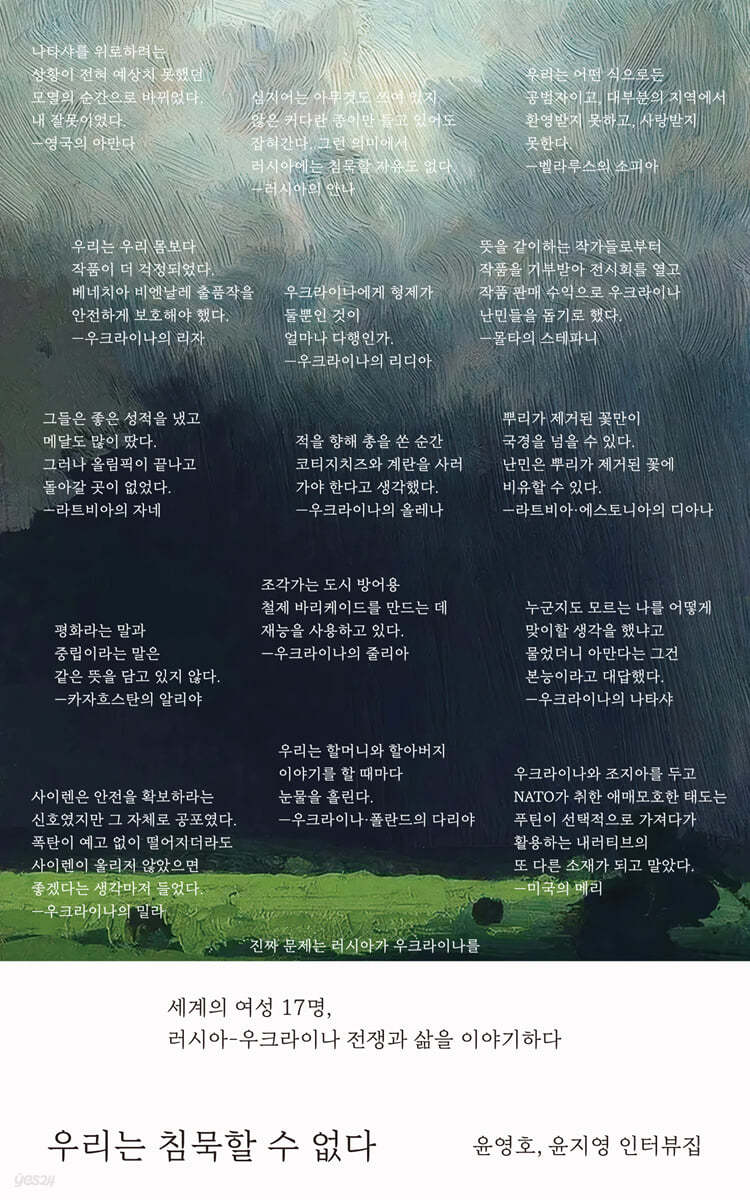
We cannot remain silent
 |
Description
Book Introduction
- A word from MD
-
17 Women's Voices on WarThe war that began with Russia's invasion of Ukraine has destroyed the daily lives of countless people.
Seventeen women, including a former national rhythmic gymnastics team member who became a refugee, a former journalist who worked as a sniper on the battlefield, and an anti-war protester forced to flee their homeland, refuse to remain silent and testify to the horrors of war.
August 12, 2022. Social and Political PD Son Min-gyu
Seventeen women from around the world, from Ukraine, Poland, Belarus, Latvia, Kazakhstan, Malta, Turkey, Russia, the UK, and the US, tell stories of the Russo-Ukrainian War and the disruption of their daily lives.
We still don't fully understand the wars ordinary people are fighting.
A former national rhythmic gymnastics team member who became a refugee, a sniper on Russia's target list in the battlefield, an office worker who escaped with only a small bag, a singer-songwriter who provided a home to a complete refugee, an anti-war protester who left her homeland while fighting against dictatorship, a famous writer and former politician who is wary of Russian literature, an official of the Latvian Olympic Committee who had to watch as Ukrainian disabled athletes were unable to return to their homeland, a violinist who protests against her native Russia, an amateur painter who created a sensation by holding an exhibition for Ukraine, an analyst from Mariupol who worries about the safety of her grandparents, an artist who recreated the story of her "flower smuggler" grandmother into a work of art, and directors of Ukrainian galleries who devoted themselves to art even while fleeing - these are just a few examples of the pain, sorrow, will, courage, and solidarity of women who faced the tragedy of war.
How will we remember this war in the future? Amidst the sensational reporting, propaganda, and gossip, who were overlooked, what was ignored, and what was taken for granted? This collection of interviews, a vivid historical record, may serve as a guide when the time comes to answer those difficult questions.
* A portion of the proceeds from the sale of this book will be donated to Ukraine.
This interview collection reached 499% of its funding goal in just two weeks through Yes24 Book Funding (Grajebonso).
We still don't fully understand the wars ordinary people are fighting.
A former national rhythmic gymnastics team member who became a refugee, a sniper on Russia's target list in the battlefield, an office worker who escaped with only a small bag, a singer-songwriter who provided a home to a complete refugee, an anti-war protester who left her homeland while fighting against dictatorship, a famous writer and former politician who is wary of Russian literature, an official of the Latvian Olympic Committee who had to watch as Ukrainian disabled athletes were unable to return to their homeland, a violinist who protests against her native Russia, an amateur painter who created a sensation by holding an exhibition for Ukraine, an analyst from Mariupol who worries about the safety of her grandparents, an artist who recreated the story of her "flower smuggler" grandmother into a work of art, and directors of Ukrainian galleries who devoted themselves to art even while fleeing - these are just a few examples of the pain, sorrow, will, courage, and solidarity of women who faced the tragedy of war.
How will we remember this war in the future? Amidst the sensational reporting, propaganda, and gossip, who were overlooked, what was ignored, and what was taken for granted? This collection of interviews, a vivid historical record, may serve as a guide when the time comes to answer those difficult questions.
* A portion of the proceeds from the sale of this book will be donated to Ukraine.
This interview collection reached 499% of its funding goal in just two weeks through Yes24 Book Funding (Grajebonso).
- You can preview some of the book's contents.
Preview
index
preface
Part 1: The moment when everyday life falls apart
1) Find a dress for your granddaughter
Ukraine/Poland/Darya Marchenko
A Mariupol-born analyst worries about the well-being of his grandparents.
2) Prosecco's humiliation
UK/ Amanda Gritorex
The singer-songwriter who gave his home to refugees
3) On top of the hamper basket
Ukraine/ Natalia Sheremet
A worker who fled to England with only a small bag
4) How fortunate we are to have only two brothers!
Ukraine/ Lidia Vinogradna
Former national rhythmic gymnastics team member who became a refugee
5) A hundred-day journey to an unfamiliar place
Ukraine/Ludmila Holodi
Aspiring lawyer refugee from Zaporizhzhia
6) There is no sentimentality in the trigger.
Ukraine/ Olena Bilozerska
A former journalist who now serves as a sniper on the battlefield
[Column 1] Can women be weak or give up?
Part 2: The War of Ordinary People
1) No one welcomes us anywhere
Belarus/ Sofia Marojava
Anti-war protesters forced to leave their hometown
2) There is no place to return with the medal.
Latvia/ Jane Skužina
Latvian Olympic Committee staff with disabilities participating in the Paralympics
3) I don't want to sit with them
Kazakhstan/ Aliya Kurmanbayeva
Employees of global companies with Ukrainian and Russian friends
4) There is no war that can be won.
Malta/Stephanie Midge
An amateur painter who planned the exhibition “Artists for Ukraine”
5) You can cross borders only if you have no roots.
Latvia/Estonia/Diana Tamane
The artist who recreated the story of the 'flower smuggler' grandmother into a work of art.
6) There is no freedom to remain silent.
Russia/UK/Anna Ovshanikova
Royal Opera House violinist protesting against the war
[Column 2] The idea that 'this is not war'
Part 3 Beyond the Savage World
1) There was no such promise as Putin mentioned.
United States/ Mary Ellis Sarotti
Johns Hopkins University professor who wrote the hit novel "Not One Inch"
2) The problem is that it is not attractive.
Turkmenistan/Kazakhstan/Anar Somunkulu
Professor at Hacettepe University, an expert in international politics and knowledgeable about Korea
3) A sculptor is creating a war barricade.
Ukraine/ Liza German and Julia Voloshina
The directors of The Naked Room and Voloshin Gallery, who dedicated themselves to art even during their time in exile.
4) There is no mysterious soul in Dostoevsky.
Ukraine/ Maria Matios
A famous Ukrainian writer and former politician who is wary of Russian literature.
[Appendix Interview] If you plan evil first, you can never achieve good.
Ukraine/Lubko Deresh
A young writer calls Russian literature an accomplice in the war.
Acknowledgements
Part 1: The moment when everyday life falls apart
1) Find a dress for your granddaughter
Ukraine/Poland/Darya Marchenko
A Mariupol-born analyst worries about the well-being of his grandparents.
2) Prosecco's humiliation
UK/ Amanda Gritorex
The singer-songwriter who gave his home to refugees
3) On top of the hamper basket
Ukraine/ Natalia Sheremet
A worker who fled to England with only a small bag
4) How fortunate we are to have only two brothers!
Ukraine/ Lidia Vinogradna
Former national rhythmic gymnastics team member who became a refugee
5) A hundred-day journey to an unfamiliar place
Ukraine/Ludmila Holodi
Aspiring lawyer refugee from Zaporizhzhia
6) There is no sentimentality in the trigger.
Ukraine/ Olena Bilozerska
A former journalist who now serves as a sniper on the battlefield
[Column 1] Can women be weak or give up?
Part 2: The War of Ordinary People
1) No one welcomes us anywhere
Belarus/ Sofia Marojava
Anti-war protesters forced to leave their hometown
2) There is no place to return with the medal.
Latvia/ Jane Skužina
Latvian Olympic Committee staff with disabilities participating in the Paralympics
3) I don't want to sit with them
Kazakhstan/ Aliya Kurmanbayeva
Employees of global companies with Ukrainian and Russian friends
4) There is no war that can be won.
Malta/Stephanie Midge
An amateur painter who planned the exhibition “Artists for Ukraine”
5) You can cross borders only if you have no roots.
Latvia/Estonia/Diana Tamane
The artist who recreated the story of the 'flower smuggler' grandmother into a work of art.
6) There is no freedom to remain silent.
Russia/UK/Anna Ovshanikova
Royal Opera House violinist protesting against the war
[Column 2] The idea that 'this is not war'
Part 3 Beyond the Savage World
1) There was no such promise as Putin mentioned.
United States/ Mary Ellis Sarotti
Johns Hopkins University professor who wrote the hit novel "Not One Inch"
2) The problem is that it is not attractive.
Turkmenistan/Kazakhstan/Anar Somunkulu
Professor at Hacettepe University, an expert in international politics and knowledgeable about Korea
3) A sculptor is creating a war barricade.
Ukraine/ Liza German and Julia Voloshina
The directors of The Naked Room and Voloshin Gallery, who dedicated themselves to art even during their time in exile.
4) There is no mysterious soul in Dostoevsky.
Ukraine/ Maria Matios
A famous Ukrainian writer and former politician who is wary of Russian literature.
[Appendix Interview] If you plan evil first, you can never achieve good.
Ukraine/Lubko Deresh
A young writer calls Russian literature an accomplice in the war.
Acknowledgements
Detailed image
.jpg)
Into the book
I haven't spoken to my maternal grandmother in 52 days, and all I've heard is that my grandfather has been taken away somewhere.
Right now, I don't know if he'll come back or not.
The people of Mariupol now have no food, no water, no light, and no means of communication.
My grandfather and grandmother on my father's side live in an area a little bit away from Mariupol, which is already occupied by Russia.
Grandpa struggles to find a way to call us, and somehow manages to get an update every three days.
To tell you that you are alive.
My grandparents are fighting to survive right now, but maybe they're just trying to survive to see my wedding.
We cry every time we talk about our grandparents.
Once I start crying, I can't stop for a while.
--- p.27
If you watch the movie "I, Daniel Blake," you'll see that everyone else is nice, except for the unemployment benefits officer.
I felt exactly the same way.
British people are all nice, but it seemed like the job centre staff weren't nice.
The center staff treated me like a refugee seeking government assistance.
He seemed to think that Ukrainian refugees should just go and work on farms.
--- p.67
I don't want to be seen as a refugee who only wants sympathy or help.
Here I am both an individual and something more.
My words and actions also reflect the image of all Ukrainian refugees.
I want to show how much I dream and how hard I work.
I want to show that I am not a rude person, that I am a person who can be considerate of others.
I am a hard-working person and I have pride in myself, so I never worried about my future in Ukraine.
There, tomorrow was not a worry, but a future with dreams.
But it's different here.
The only full-time job I can get at my current level is as a housekeeper.
It makes me sad to think that we are slowly moving further away from the future we dreamed of in Ukraine.
So today, I lowered my head several times.
Can I really show that I am a good person, someone who can help others?
--- pp.99~100
The French employee intervened just as the Norwegian employee was about to answer.
“I didn’t know there were Russians here.
If I had known, I wouldn't have attended this meeting.
I cannot meet with the invaders, and I do not want to sit with the invaders.
“I will never enter a meeting as long as a Russian employee is present.” The employee left the online meeting space.
I was embarrassed.
--- p.181
Everything was a first for Stephanie.
Stephanie was an amateur photographer and a painter with a short career, not a curator, and had no idea how to set up an exhibition space.
But an artist friend introduced me to famous artists, and those famous artists brought in other artists.
The artist was an assistant.
In a short period of time, 76 artists donated 84 works of art.
--- p.195
Many Russian artists leave the country because they cannot stand the silence they are forced to endure.
They leave with visas that only allow them to stay for a few months, after which they become no different from refugees.
I can't even go to Russia for a trip anymore.
Because his face is already publicly known and he continues to make anti-government statements, he will face at least three years in prison the moment he sets foot in Russia.
--- p.227
George Kennan, an American diplomat and historian, once said that women should not speak on international relations issues.
Because, he said, he was speaking too seriously.
Of course, I don't agree with Kennan's thinking.
The United States has had outstanding female secretaries of state, including Albright, and Europe has also had outstanding women leaders and foreign ministers.
The role of female leaders in international politics will grow in the future, and this will have significant implications for international politics.
--- p.260
The only employee who could transport the artwork was Boris.
However, since the outbreak of the war, men between the ages of 18 and 60 have been prohibited from leaving Ukraine.
Because you have to be organized as a reserve force whether you go to the battlefield or not.
Boris had to get special permission from the authorities to cross the border with his work.
Neither getting special permission, nor crossing the border, nor leaving behind a family to care for, none of this put Boris's mind at ease.
Still, Boris decided to help with the exhibition, and he crossed the border between Ukraine and Poland with the refugees carrying the artwork, then boarded a plane and arrived in Basel.
--- p.301
Some artists are working to move artifacts and artwork to a safe place.
Sculptors are creating iron barricades to defend cities, and digital artists are transforming museum exhibits into online resources.
They are using their talents to defend Ukraine.
Right now, I don't know if he'll come back or not.
The people of Mariupol now have no food, no water, no light, and no means of communication.
My grandfather and grandmother on my father's side live in an area a little bit away from Mariupol, which is already occupied by Russia.
Grandpa struggles to find a way to call us, and somehow manages to get an update every three days.
To tell you that you are alive.
My grandparents are fighting to survive right now, but maybe they're just trying to survive to see my wedding.
We cry every time we talk about our grandparents.
Once I start crying, I can't stop for a while.
--- p.27
If you watch the movie "I, Daniel Blake," you'll see that everyone else is nice, except for the unemployment benefits officer.
I felt exactly the same way.
British people are all nice, but it seemed like the job centre staff weren't nice.
The center staff treated me like a refugee seeking government assistance.
He seemed to think that Ukrainian refugees should just go and work on farms.
--- p.67
I don't want to be seen as a refugee who only wants sympathy or help.
Here I am both an individual and something more.
My words and actions also reflect the image of all Ukrainian refugees.
I want to show how much I dream and how hard I work.
I want to show that I am not a rude person, that I am a person who can be considerate of others.
I am a hard-working person and I have pride in myself, so I never worried about my future in Ukraine.
There, tomorrow was not a worry, but a future with dreams.
But it's different here.
The only full-time job I can get at my current level is as a housekeeper.
It makes me sad to think that we are slowly moving further away from the future we dreamed of in Ukraine.
So today, I lowered my head several times.
Can I really show that I am a good person, someone who can help others?
--- pp.99~100
The French employee intervened just as the Norwegian employee was about to answer.
“I didn’t know there were Russians here.
If I had known, I wouldn't have attended this meeting.
I cannot meet with the invaders, and I do not want to sit with the invaders.
“I will never enter a meeting as long as a Russian employee is present.” The employee left the online meeting space.
I was embarrassed.
--- p.181
Everything was a first for Stephanie.
Stephanie was an amateur photographer and a painter with a short career, not a curator, and had no idea how to set up an exhibition space.
But an artist friend introduced me to famous artists, and those famous artists brought in other artists.
The artist was an assistant.
In a short period of time, 76 artists donated 84 works of art.
--- p.195
Many Russian artists leave the country because they cannot stand the silence they are forced to endure.
They leave with visas that only allow them to stay for a few months, after which they become no different from refugees.
I can't even go to Russia for a trip anymore.
Because his face is already publicly known and he continues to make anti-government statements, he will face at least three years in prison the moment he sets foot in Russia.
--- p.227
George Kennan, an American diplomat and historian, once said that women should not speak on international relations issues.
Because, he said, he was speaking too seriously.
Of course, I don't agree with Kennan's thinking.
The United States has had outstanding female secretaries of state, including Albright, and Europe has also had outstanding women leaders and foreign ministers.
The role of female leaders in international politics will grow in the future, and this will have significant implications for international politics.
--- p.260
The only employee who could transport the artwork was Boris.
However, since the outbreak of the war, men between the ages of 18 and 60 have been prohibited from leaving Ukraine.
Because you have to be organized as a reserve force whether you go to the battlefield or not.
Boris had to get special permission from the authorities to cross the border with his work.
Neither getting special permission, nor crossing the border, nor leaving behind a family to care for, none of this put Boris's mind at ease.
Still, Boris decided to help with the exhibition, and he crossed the border between Ukraine and Poland with the refugees carrying the artwork, then boarded a plane and arrived in Basel.
--- p.301
Some artists are working to move artifacts and artwork to a safe place.
Sculptors are creating iron barricades to defend cities, and digital artists are transforming museum exhibits into online resources.
They are using their talents to defend Ukraine.
--- p.307
Publisher's Review
A week has passed since the war began.
The tone of my Russian friends' conversations began to change.
I started getting messages on my phone saying things like, “This is not a war against the Ukrainian people,” and “Why is the Ukrainian government calling this a Russian invasion?”
_Mila (a refugee from Zaporizhzhia who aspires to be a lawyer)
The Russian side has repeatedly declared that I killed civilians.
They claim my friend carved a swastika on a Russian corpse and bragged about it on his social media accounts.
My friend and I have never done anything like that.
_Olena (Sniper of the Battlefield)
Over the past several decades, Russia has invested unprecedented amounts of money in various structures – financial, political, cultural – to promote the uniqueness of Russian literature and give it universality.
I tried to create a myth related to Russian literature.
Are you asking about the "mysterious soul of Russia"? Are you asking about the "mysterious soul of Russia" that Tolstoy and Dostoevsky supposedly have a code to decipher? There's no such thing.
There is no such mystery.
_Maria (a famous Ukrainian writer and former politician who is wary of Russian literature)
If you ask, 'Did the United States promise the Soviet Union that NATO would not expand eastward even one inch?', there was no such promise.
The talk came out, but it was hushed up.
_Mary (Johns Hopkins University professor who wrote the hit book “Not One Inch”)
Some artists are working to move artifacts and artwork to a safe place.
Sculptors are creating iron barricades to defend cities, and digital artists are transforming museum exhibits into online resources.
They are using their talents to defend Ukraine.
Julia (Director of the Voloshin Gallery in Ukraine)
● We are still
The war that ordinary people are fighting
I don't know completely
Zaporizhzhia in Ukraine is located right next to Donbas.
Mila, a refugee woman from Zaporizhzhia, confessed that when Russian troops advanced just 20 kilometers away, she became so averse to even drinking coffee during her break from work.
I couldn't stand the stark contrast between the anxiety of not knowing what tomorrow would bring and the tranquility of coffee.
Until recently, people who used to use their iPhones to go to the movies or leisurely enjoy coffee at a cafe suddenly lost their livelihoods and had to leave in a hurry.
Refugee life isn't just for the extremely unfortunate, living in relatively poor, religiously and climatically unstable countries.
This collection of interviews not only confronts the tragedy of war, which drags human life to its lowest ebb, but also contains the voices of ordinary, great people who, despite being separated from one another in the midst of a chaotic and tragic history, empathize with the suffering of others and help them in their own ways.
By recording their very personal stories and emotions, we can also guess what changes have come to individuals around the world since the war, or what commonalities remain unchanged.
At the same time, it also covers some notable anecdotes about psychological distance.
How do global citizens react to war, and what emotions do they feel? Some sympathize with the plight of refugees and offer both material and spiritual aid, while others bluntly refuse to extend any kindness to them.
While some people turn away from or distance themselves from the war because they cannot emotionally endure it, others engage in heated discussions on Twitter and other platforms about the weapons and strategies used in the war.
Through these diverse human figures, we can accurately grasp what values our age holds supreme and what it means to preserve conscience and humanity.
Meanwhile, why do Ukraine's neighbors harbor such anxiety and worry, wondering, "Will they be next?" The interviews reveal the implications of being close to the powerful Russian state, and why, despite Russia's cultural and linguistic proximity, these countries prioritize European rather than Russian values.
Through the honest confessions and condemnations of citizens of Europe and Central Asia, we can see the impact of the geographical conditions of Europe and Central Asia on politics, economy, culture, and history.
Anar, a professor at Turkey's prestigious Hacettepe University, explains that Russia is not economically or culturally attractive to Ukraine, a country bordering Europe.
Russia cannot be an alternative to the West.
But for Central Asian countries, which have another superpower, China, nearby, Russia is an attractive alternative.
These vivid war-related experiences and analyses of the current situation shared by women from each country allow us to comprehensively understand and empathize with the distant roots and starting points of this inhumane war, as well as the tragedy that follows it.
● We have no freedom to remain silent.
Interviewers Youngho Yoon and Jiyoung Yoon, with extensive knowledge of international relations, have lived in various countries in Europe and Central Asia, speak Russian and English fluently, and currently reside in the United Kingdom.
They overcame all kinds of obstacles to collect the vivid voices of women from around the world in diverse situations and compiled them into a meticulous collection of interviews.
Yoon Young-ho and Yoon Ji-young stated that the reason so many people agreed to be interviewed despite their difficult circumstances was because they had stories that could not be expressed in silence, stories that absolutely had to be told.
□ On top of the hamper basket
Natasha, an ordinary office worker, hastily packed only a small bag and escaped her bombed hometown.
Despite her modest financial situation, single mother Amanda willingly offers Natasha her home and helps her rebuild her broken life.
What happens to these two women who live together in a shared home? What joys and sorrows await them? You'll hear a deeply moving story reminiscent of the film "I, Daniel Blake."
□ There is no sentiment on the trigger
Olena, who is currently working as a sniper on the battlefield, is a former journalist.
Having served since the Russian invasion in 2014, Olena is already at the top of Russia's target list.
So, they don't cover their faces or hide their identities.
In the interview, Olena refutes Russian claims that she killed civilians, denying that she ever did so.
What emotions does Olena feel as she pulls the trigger on her enemy? Olena's story of her activities as a sniper and her experiences as a female soldier on the battlefield evokes a wide range of emotions in the reader.
□ No one welcomes us anywhere
Sophia, a Belarusian, left her country after suffering hardships in prison for protesting against the war.
Sophia now confesses that her Belarusian passport is like a kind of stigma.
Because all Belarusians have become accomplices in this war in one way or another.
Belarus is currently ruled by both internal and external dictators, and Belarusians who oppose the war feel unsafe either at home or abroad.
Sophia begins her new life in a foreign land, gripped by the constant fear of being watched.
What kind of ordinary life does Sophia desire?
□ There is no mysterious soul in Dostoevsky.
The correlation between Russian literature and war is emerging as an issue.
Maria, a famous Ukrainian writer and former politician, rejects Dostoevsky's work, saying it contains a cult of war, a cult of great power, xenophobia, and contempt for small nations.
And in the decades since Russia has invested enormous amounts of money in promoting its own culture, how many people have been able to link Tolstoy, Dostoevsky, and Russian ballet with barbarism?
According to Maria, the savagery was well hidden.
The tone of my Russian friends' conversations began to change.
I started getting messages on my phone saying things like, “This is not a war against the Ukrainian people,” and “Why is the Ukrainian government calling this a Russian invasion?”
_Mila (a refugee from Zaporizhzhia who aspires to be a lawyer)
The Russian side has repeatedly declared that I killed civilians.
They claim my friend carved a swastika on a Russian corpse and bragged about it on his social media accounts.
My friend and I have never done anything like that.
_Olena (Sniper of the Battlefield)
Over the past several decades, Russia has invested unprecedented amounts of money in various structures – financial, political, cultural – to promote the uniqueness of Russian literature and give it universality.
I tried to create a myth related to Russian literature.
Are you asking about the "mysterious soul of Russia"? Are you asking about the "mysterious soul of Russia" that Tolstoy and Dostoevsky supposedly have a code to decipher? There's no such thing.
There is no such mystery.
_Maria (a famous Ukrainian writer and former politician who is wary of Russian literature)
If you ask, 'Did the United States promise the Soviet Union that NATO would not expand eastward even one inch?', there was no such promise.
The talk came out, but it was hushed up.
_Mary (Johns Hopkins University professor who wrote the hit book “Not One Inch”)
Some artists are working to move artifacts and artwork to a safe place.
Sculptors are creating iron barricades to defend cities, and digital artists are transforming museum exhibits into online resources.
They are using their talents to defend Ukraine.
Julia (Director of the Voloshin Gallery in Ukraine)
● We are still
The war that ordinary people are fighting
I don't know completely
Zaporizhzhia in Ukraine is located right next to Donbas.
Mila, a refugee woman from Zaporizhzhia, confessed that when Russian troops advanced just 20 kilometers away, she became so averse to even drinking coffee during her break from work.
I couldn't stand the stark contrast between the anxiety of not knowing what tomorrow would bring and the tranquility of coffee.
Until recently, people who used to use their iPhones to go to the movies or leisurely enjoy coffee at a cafe suddenly lost their livelihoods and had to leave in a hurry.
Refugee life isn't just for the extremely unfortunate, living in relatively poor, religiously and climatically unstable countries.
This collection of interviews not only confronts the tragedy of war, which drags human life to its lowest ebb, but also contains the voices of ordinary, great people who, despite being separated from one another in the midst of a chaotic and tragic history, empathize with the suffering of others and help them in their own ways.
By recording their very personal stories and emotions, we can also guess what changes have come to individuals around the world since the war, or what commonalities remain unchanged.
At the same time, it also covers some notable anecdotes about psychological distance.
How do global citizens react to war, and what emotions do they feel? Some sympathize with the plight of refugees and offer both material and spiritual aid, while others bluntly refuse to extend any kindness to them.
While some people turn away from or distance themselves from the war because they cannot emotionally endure it, others engage in heated discussions on Twitter and other platforms about the weapons and strategies used in the war.
Through these diverse human figures, we can accurately grasp what values our age holds supreme and what it means to preserve conscience and humanity.
Meanwhile, why do Ukraine's neighbors harbor such anxiety and worry, wondering, "Will they be next?" The interviews reveal the implications of being close to the powerful Russian state, and why, despite Russia's cultural and linguistic proximity, these countries prioritize European rather than Russian values.
Through the honest confessions and condemnations of citizens of Europe and Central Asia, we can see the impact of the geographical conditions of Europe and Central Asia on politics, economy, culture, and history.
Anar, a professor at Turkey's prestigious Hacettepe University, explains that Russia is not economically or culturally attractive to Ukraine, a country bordering Europe.
Russia cannot be an alternative to the West.
But for Central Asian countries, which have another superpower, China, nearby, Russia is an attractive alternative.
These vivid war-related experiences and analyses of the current situation shared by women from each country allow us to comprehensively understand and empathize with the distant roots and starting points of this inhumane war, as well as the tragedy that follows it.
● We have no freedom to remain silent.
Interviewers Youngho Yoon and Jiyoung Yoon, with extensive knowledge of international relations, have lived in various countries in Europe and Central Asia, speak Russian and English fluently, and currently reside in the United Kingdom.
They overcame all kinds of obstacles to collect the vivid voices of women from around the world in diverse situations and compiled them into a meticulous collection of interviews.
Yoon Young-ho and Yoon Ji-young stated that the reason so many people agreed to be interviewed despite their difficult circumstances was because they had stories that could not be expressed in silence, stories that absolutely had to be told.
□ On top of the hamper basket
Natasha, an ordinary office worker, hastily packed only a small bag and escaped her bombed hometown.
Despite her modest financial situation, single mother Amanda willingly offers Natasha her home and helps her rebuild her broken life.
What happens to these two women who live together in a shared home? What joys and sorrows await them? You'll hear a deeply moving story reminiscent of the film "I, Daniel Blake."
□ There is no sentiment on the trigger
Olena, who is currently working as a sniper on the battlefield, is a former journalist.
Having served since the Russian invasion in 2014, Olena is already at the top of Russia's target list.
So, they don't cover their faces or hide their identities.
In the interview, Olena refutes Russian claims that she killed civilians, denying that she ever did so.
What emotions does Olena feel as she pulls the trigger on her enemy? Olena's story of her activities as a sniper and her experiences as a female soldier on the battlefield evokes a wide range of emotions in the reader.
□ No one welcomes us anywhere
Sophia, a Belarusian, left her country after suffering hardships in prison for protesting against the war.
Sophia now confesses that her Belarusian passport is like a kind of stigma.
Because all Belarusians have become accomplices in this war in one way or another.
Belarus is currently ruled by both internal and external dictators, and Belarusians who oppose the war feel unsafe either at home or abroad.
Sophia begins her new life in a foreign land, gripped by the constant fear of being watched.
What kind of ordinary life does Sophia desire?
□ There is no mysterious soul in Dostoevsky.
The correlation between Russian literature and war is emerging as an issue.
Maria, a famous Ukrainian writer and former politician, rejects Dostoevsky's work, saying it contains a cult of war, a cult of great power, xenophobia, and contempt for small nations.
And in the decades since Russia has invested enormous amounts of money in promoting its own culture, how many people have been able to link Tolstoy, Dostoevsky, and Russian ballet with barbarism?
According to Maria, the savagery was well hidden.
GOODS SPECIFICS
- Publication date: August 12, 2022
- Page count, weight, size: 352 pages | 394g | 125*200*22mm
- ISBN13: 9791157062652
- ISBN10: 1157062652
You may also like
카테고리
korean


korean

![GQ KOREA Mark (Monthly): December [2025]](http://librairie.coreenne.fr/cdn/shop/files/8ef265dbbfbf186523ed75ba7319009d.jpg?v=1765340328&width=3840)


