

It's snowing
 |
Description
Book Introduction
- A word from MD
-
A master of Korean science fiction that has captured the world's attentionA new collection of short stories by Kim Bo-young, a leading Korean science fiction writer.
A total of nine science fiction stories give us a chilling warning, comfort our sorrow, and make us reflect on the meaning of death.
Even the terrifying ending of destruction becomes beautiful and wondrous when he draws it.
The title work was selected for The Best of World Science Fiction and was also nominated for the Rosetta Award.
May 23, 2025. Novel/Poetry PD Kim Yu-ri
Included in Rosetta Award nominee and Best of World SF selection "Whale's Eyes Are Falling"
Kim Bo-young's new novel collection, awaited by you and the world, after five years
“Kim Bo-young’s books will sit on the shelves next to Ray Bradbury, Ursula Le Guin, and Haruki Murakami” (Publisher’s Weekly)
Kim Bo-young, one of the representative Korean science fiction writers and a novelist who has been especially loved by readers around the world, has published a new collection of short stories five years after “How Similar Are We?”
While the author has been working on restoring early works and concluding existing ones, this book is a welcome addition to readers as it contains new works, mostly published in the 2020s.
This collection of short stories contains a total of nine short stories.
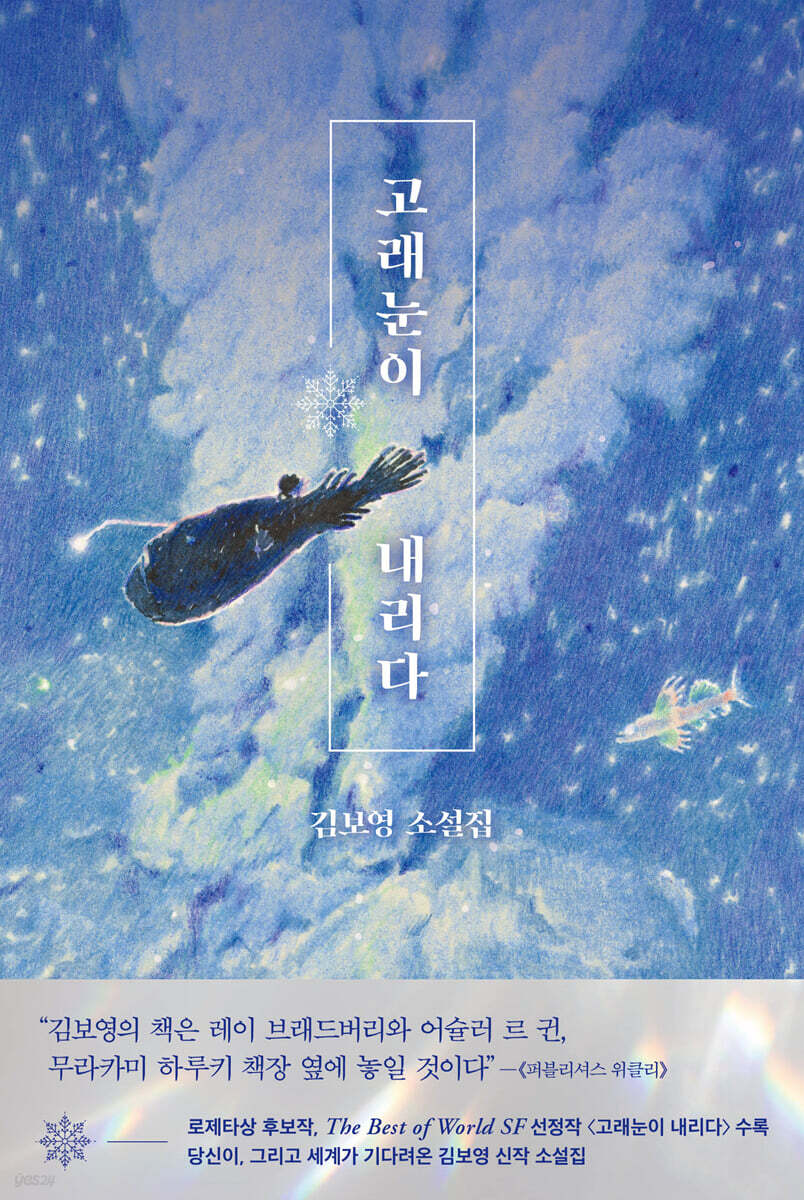
The title work, "Whale Eyes Fall," which was included in the "World's Great Science Fiction Anthology" and was nominated for the Rosetta Award, gives a voice to deep-sea creatures and expresses awareness of the problem of ecological destruction and the wish for the restoration of the Earth.
Paired with this work and sharing the same theme, "Ghost Forest Descends" evokes the powerful vitality of mushrooms and coral growing in an abandoned space habitat, evoking a sense of the power of recovery that can be found even in a world devastated by violence and pollution.
You can also enjoy postcards that are both timely and humorous, such as “The Crow Flies In,” which reveals the strong inner self of a woman resisting great violence through the myth of the lioness, and “Looking at the Rock,” which depicts those who stand up against the frequent attempts of humans who have migrated to servers to erase nature due to overdevelopment and indiscriminate consumption.
“The Door to Spring” and “Even If It’s Just a Shell,” which allow us to understand death as a transition to another world, also provide a strange comfort to those who have lost someone precious.
Also included is “Dawn Train,” which the author planned while working on the scenario settings and ideas for the movie “Snowpiercer” and devising his own story.
In this collection of short stories, Kim Bo-young unfolds her imagination by overturning the dualistic notions of superiority, inferiority, gender, and normality/abnormality, overcoming the human-centered worldview, and advancing to a new level.
I hope that the freshness of familiar questions evoked in this unfamiliar and majestic landscape can also inject vitality into our world.
Kim Bo-young's new novel collection, awaited by you and the world, after five years
“Kim Bo-young’s books will sit on the shelves next to Ray Bradbury, Ursula Le Guin, and Haruki Murakami” (Publisher’s Weekly)
Kim Bo-young, one of the representative Korean science fiction writers and a novelist who has been especially loved by readers around the world, has published a new collection of short stories five years after “How Similar Are We?”
While the author has been working on restoring early works and concluding existing ones, this book is a welcome addition to readers as it contains new works, mostly published in the 2020s.
This collection of short stories contains a total of nine short stories.
The title work, "Whale Eyes Fall," which was included in the "World's Great Science Fiction Anthology" and was nominated for the Rosetta Award, gives a voice to deep-sea creatures and expresses awareness of the problem of ecological destruction and the wish for the restoration of the Earth.
Paired with this work and sharing the same theme, "Ghost Forest Descends" evokes the powerful vitality of mushrooms and coral growing in an abandoned space habitat, evoking a sense of the power of recovery that can be found even in a world devastated by violence and pollution.
You can also enjoy postcards that are both timely and humorous, such as “The Crow Flies In,” which reveals the strong inner self of a woman resisting great violence through the myth of the lioness, and “Looking at the Rock,” which depicts those who stand up against the frequent attempts of humans who have migrated to servers to erase nature due to overdevelopment and indiscriminate consumption.
“The Door to Spring” and “Even If It’s Just a Shell,” which allow us to understand death as a transition to another world, also provide a strange comfort to those who have lost someone precious.
Also included is “Dawn Train,” which the author planned while working on the scenario settings and ideas for the movie “Snowpiercer” and devising his own story.
In this collection of short stories, Kim Bo-young unfolds her imagination by overturning the dualistic notions of superiority, inferiority, gender, and normality/abnormality, overcoming the human-centered worldview, and advancing to a new level.
I hope that the freshness of familiar questions evoked in this unfamiliar and majestic landscape can also inject vitality into our world.
- You can preview some of the book's contents.
Preview
index
It's snowing
low-budget project
Looking at the rock
Even if it's just the shell, it's fine
Loosely identical to you
A crow flies in
dawn train
Ghost Forest is coming down
Door to Spring
Author's Note | Acknowledgments | Included Works Announcement Page
low-budget project
Looking at the rock
Even if it's just the shell, it's fine
Loosely identical to you
A crow flies in
dawn train
Ghost Forest is coming down
Door to Spring
Author's Note | Acknowledgments | Included Works Announcement Page
Detailed image
.jpg)
Into the book
Our daily lives consist of drifting along the ocean currents, gaping and swallowing small, hungry things that think they'll eat the glowing filaments on our noses.
But on days like this when a blizzard is raging, we can't help but gather together and celebrate.
--- p.11 From "Whale Eyes Fall"
I will make you believe.
You are the main character of the world.
That you are a more important and special person than anyone else, capable of making heroic or foolish choices.
--- p.77 From “Low-Budget Project”
“You don’t think you can keep it?”
"yes.
That's right.
Rocks are useless.
And I can't even eat.
Without the rocks, the space could be used more effectively.
“In other neighborhoods, people call us selfish.”
“It’s a story we all know.
“You’re still coming, right?”
“That’s right.”
--- p.84 From “Looking at the Rock”
“I guess the server adjusted the taste right away.
“Then it wouldn’t matter how you cook it?”
“But I couldn’t have imagined it if I hadn’t cooked.”
“That might have been the case.”
--- p.102 From “Even if it’s just the shell, it’s okay”
I was thus caught between life and death.
Between the time my parents declared me dead and the time I didn't file for bankruptcy, my identity was in a suspended state, like Schrödinger's cat, a quantum probabilistically moving between existence and non-existence.
--- p.124 From “Loosely Identical You”
King Yeomra said that when you die, he will bring you a new messenger of the underworld.
I heard he's been keeping an eye on you for a while.
I said it was okay.
What good would it do to bring in a spiritless soul who would give up his life at a young age?
Of course, it's not easy to find new employees.
The souls of those who commit suicide are dark, those who die in accidents or murder have deep resentment, and those who die after their lifespan is full of sorrow.
But now I don't want to take you away for another reason.
A person like you still has a long way to go before reaching the afterlife.
You have to live a miserable life in this world.
--- p.179 From “The Crow Flies In”
Even as a child, I imagined all this, and while my imagination had a mythical quality, it wasn't absurd.
He would reach the end before us, and he knew it himself.
I was afraid of that helpless man running towards his inevitable end, and as far as I knew, we all were.
--- p.193 From "The Dawn Train"
I was covered in moss, eaten away, rusted, mushy, rotting, bug-eaten, and stinking.
People's happy laughter turned into grumbling, grumbling into cursing, and cursing into fear.
Morning comes again.
My haunted morning.
--- p.205 From "The Ghost Forest Comes Down"
The door was literally a door.
It was a rectangular passageway leading somewhere.
It wasn't captured on camera or reflected in the mirror.
When I turned back or peeked my head out, there was nothing there.
But on days like this when a blizzard is raging, we can't help but gather together and celebrate.
--- p.11 From "Whale Eyes Fall"
I will make you believe.
You are the main character of the world.
That you are a more important and special person than anyone else, capable of making heroic or foolish choices.
--- p.77 From “Low-Budget Project”
“You don’t think you can keep it?”
"yes.
That's right.
Rocks are useless.
And I can't even eat.
Without the rocks, the space could be used more effectively.
“In other neighborhoods, people call us selfish.”
“It’s a story we all know.
“You’re still coming, right?”
“That’s right.”
--- p.84 From “Looking at the Rock”
“I guess the server adjusted the taste right away.
“Then it wouldn’t matter how you cook it?”
“But I couldn’t have imagined it if I hadn’t cooked.”
“That might have been the case.”
--- p.102 From “Even if it’s just the shell, it’s okay”
I was thus caught between life and death.
Between the time my parents declared me dead and the time I didn't file for bankruptcy, my identity was in a suspended state, like Schrödinger's cat, a quantum probabilistically moving between existence and non-existence.
--- p.124 From “Loosely Identical You”
King Yeomra said that when you die, he will bring you a new messenger of the underworld.
I heard he's been keeping an eye on you for a while.
I said it was okay.
What good would it do to bring in a spiritless soul who would give up his life at a young age?
Of course, it's not easy to find new employees.
The souls of those who commit suicide are dark, those who die in accidents or murder have deep resentment, and those who die after their lifespan is full of sorrow.
But now I don't want to take you away for another reason.
A person like you still has a long way to go before reaching the afterlife.
You have to live a miserable life in this world.
--- p.179 From “The Crow Flies In”
Even as a child, I imagined all this, and while my imagination had a mythical quality, it wasn't absurd.
He would reach the end before us, and he knew it himself.
I was afraid of that helpless man running towards his inevitable end, and as far as I knew, we all were.
--- p.193 From "The Dawn Train"
I was covered in moss, eaten away, rusted, mushy, rotting, bug-eaten, and stinking.
People's happy laughter turned into grumbling, grumbling into cursing, and cursing into fear.
Morning comes again.
My haunted morning.
--- p.205 From "The Ghost Forest Comes Down"
The door was literally a door.
It was a rectangular passageway leading somewhere.
It wasn't captured on camera or reflected in the mirror.
When I turned back or peeked my head out, there was nothing there.
--- p.262 From “The Door to Spring”
Publisher's Review
“Whether it’s sadness or pain, it’s all the same here.
“May everyone become a beautiful snowflake.”
The wonders of an unfamiliar world, where you, long-awaited, are found.
The exquisite irony of finding use through abandonment and reunion through departure
Our End, or a Premonition of a New Beginning
Kim Bo-young is a representative writer who brought science fiction into the realm of universal novels, which fall under the category of full-fledged literature, and is a writer who is faithful to the basic poetics of science fiction.
(Woo Mi-young, researcher of modern Korean literature)
Eugenics, robotics, AI, and other theories of species evolution are overturned, expanding into disability, disease, and the queer world.
It can truly be called feminist SF.
(Literary critic Heo Yun)
“The writer who writes the most science fiction-like SF,” the novelist Kim Bo-young, who has been praised by readers and critics as the writer who inspired Korean science fiction in the 2000s, is ready to meet readers with her new short story collection, “Whale Eyes Fall.”
When asked about the success of Korean science fiction in the 2010s, he explained, “We’ve always been here, but we’ve only recently come into the public eye” (Hankyoreh, July 27, 2019). He is one of the main players who, along with Duna, Bae Myung-hoon, and Jeong Se-rang, have consistently published works within the public eye for the past 20 years, bringing modern science fiction into the realm of universal novels.
Not only in Korea, but also in the United States, she published the short story “Evolutionary Myths” (translated by Jihyun Park and God Sellers) in Clark’s World, a leading science fiction webzine, and in 2021, she became the first Korean science fiction writer to be nominated for the National Book Award in the translated literature category for “The Origin of Species and Other Stories” (edited by Seonyeong Park, translated by Sora Kim, Jeongmin Lee, et al.), demonstrating the potential of Korean literature to the world.
This collection of short stories includes eight new short stories published by the author over the past five years, as well as “Dawn Train,” published in 2013.
These stories are set in unfamiliar places like the deep sea, space, servers, and other worlds, and feature animals, machines, or data personalities as the main characters. However, each character's face resembles someone we know.
The extremely realistic issues presented through the voices of these simple and courageous people resonate deeply with us.
This book is filled with the most radical imagination of our time, breaking down the distinction between machines and organic life, animals and humans, and overturning human- and civilization-centered thinking.
Overturning fixed ideas
Questioning the standards of value
By my standards, that person is dead.
It was broken down into carbon, oxygen, hydrogen, and various other trace elements and was stored in a storage tank and disappeared.
Even if you come out of another transmitter as if nothing happened, you will be a different person with the same memories and body.
(〈Loosely Identical You〉, p.
116)
“The rock cannot protect.”
I whispered to Yeji.
“Don’t you think so?” (Looking at the Rock, p.
90)
Kim Bo-young's novels, which offer fresh twists and turns in a scientific yet mythical world and convey the wonder of science fiction, shine through in this collection.
"Loosely Identical You," which deals with teleportation, invokes the familiar "Ship of Theseus" paradox while simultaneously raising questions of faith and trust that transcend faith and doctrine.
The paradox of those who, although their own lives may seem insignificant, have sincere longings for others and ultimately come to save one another through this belief is refreshingly moving.
Meanwhile, in "Looking at the Rock", the question is asked, in a world where all of humanity has migrated to servers, what should be the target if a part of the world were to be erased due to a lack of data?
Through the people who fight to protect rocks that are in danger of being erased because they have failed to prove their usefulness, and through those who never give up even in a hopeless fight, we can once again think about the reason for the 'value' we think of.
Asking about the value of things thrown away yesterday
Believe in the power of things that come alive today
“It’s unfortunate for the people up there, but will the world become a better place now? Once the monsters that cover the soil are gone, will the children who die from eating things that don’t rot, and the children whose throats are choked by such things, also disappear?” (〈Whale’s Eyes Fall〉, p.
22)
In fact, there is no natural disaster on Earth that is as dangerous as human-caused disasters.
Even places covered in radiation after a nuclear power plant explosion, areas scorched by typhoons, and cities melted to glass by bombs, instead of becoming barren like deserts, are now covered in dense forests.
Whether it's lethal doses of radiation or highly toxic fallout, no disaster is as devastating to humanity.
Disasters, on the other hand, are the greatest disaster on earth, causing humans to leave and restoring the paradise of flora and fauna.
(〈Ghost Forest Descends〉, p.
226)
The appeal of Kim Bo-young's novels lies in the fact that non-human beings, such as deep-sea fish and machine life forms, not only become the center of the novels but also appear as the wisest protagonists.
They appear as the most accurate subjects with which readers can empathize.
Even though the deep sea has become sickened by humans who “excrete incorruptible substances,” and even though the waters are warming and mass deaths occur, there is an irony in the fact that we, who read “Whale Eyes Fall,” feel a strange sense of exhilaration, even though we are humans, as we feel the power of the Earth to recover at the end of all ends.
It's also about the prospect of new beings sprouting up after the apocalypse when an abandoned space colony, overgrown with all sorts of mutant mycelia, crashes to Earth, leaving everything burning and melting.
Kim Bo-young portrays this possibility of regeneration and recovery as snowflakes falling from the depths of the sea, or as colonies of coral and mushrooms tenaciously covering the land, unfolding a world of profound beauty.
Give a different ending to those who leave
Those who remain find deep comfort
I added the words "I love you" to the end of my will.
When I was discharged from the hospital, I decided to go on as many trips as I could with the kids that I hadn't been able to go on before.
There was a pretty mountain lodge that I had visited once when I was young but never went back to, so I decided to go there and enjoy the flowers to my heart's content.
So I decorated this place like that mountain lodge to complete the story.
Even though everything seems plausible on the surface… … .
(〈Even if it's just the shell, it's okay〉, p.
108)
Because novels are another reality, they can give a different ending and life to the person who has left.
It may comfort you and me.
(Author Interview, “Thank you always.
“I will continue to write.” (From “〉)
Another concept that is overturned in this book is 'death'.
A game that a dead old colleague could never release arrives before our eyes (Low Budget Project), a reunion with a younger sibling from whom we were separated early in a space where a digitized self temporarily stays to leave a will (Even If It's Just a Shell, That's Okay), and a story in which death itself is symbolized as a connection to 'another world' and the process of understanding one's life and the world through this (Door to Spring) metaphorically deals with life and death, acceptance and mourning that are closely related to our lives.
The story of Kim Bo-young, loved by us and the world, is so colorful, unfamiliar, and intimate.
His novels, which offer us the thrill of adventure through stories filled with mystery and wonder while simultaneously inviting deep reflection and imagination, continue to advance today as always.
“May everyone become a beautiful snowflake.”
The wonders of an unfamiliar world, where you, long-awaited, are found.
The exquisite irony of finding use through abandonment and reunion through departure
Our End, or a Premonition of a New Beginning
Kim Bo-young is a representative writer who brought science fiction into the realm of universal novels, which fall under the category of full-fledged literature, and is a writer who is faithful to the basic poetics of science fiction.
(Woo Mi-young, researcher of modern Korean literature)
Eugenics, robotics, AI, and other theories of species evolution are overturned, expanding into disability, disease, and the queer world.
It can truly be called feminist SF.
(Literary critic Heo Yun)
“The writer who writes the most science fiction-like SF,” the novelist Kim Bo-young, who has been praised by readers and critics as the writer who inspired Korean science fiction in the 2000s, is ready to meet readers with her new short story collection, “Whale Eyes Fall.”
When asked about the success of Korean science fiction in the 2010s, he explained, “We’ve always been here, but we’ve only recently come into the public eye” (Hankyoreh, July 27, 2019). He is one of the main players who, along with Duna, Bae Myung-hoon, and Jeong Se-rang, have consistently published works within the public eye for the past 20 years, bringing modern science fiction into the realm of universal novels.
Not only in Korea, but also in the United States, she published the short story “Evolutionary Myths” (translated by Jihyun Park and God Sellers) in Clark’s World, a leading science fiction webzine, and in 2021, she became the first Korean science fiction writer to be nominated for the National Book Award in the translated literature category for “The Origin of Species and Other Stories” (edited by Seonyeong Park, translated by Sora Kim, Jeongmin Lee, et al.), demonstrating the potential of Korean literature to the world.
This collection of short stories includes eight new short stories published by the author over the past five years, as well as “Dawn Train,” published in 2013.
These stories are set in unfamiliar places like the deep sea, space, servers, and other worlds, and feature animals, machines, or data personalities as the main characters. However, each character's face resembles someone we know.
The extremely realistic issues presented through the voices of these simple and courageous people resonate deeply with us.
This book is filled with the most radical imagination of our time, breaking down the distinction between machines and organic life, animals and humans, and overturning human- and civilization-centered thinking.
Overturning fixed ideas
Questioning the standards of value
By my standards, that person is dead.
It was broken down into carbon, oxygen, hydrogen, and various other trace elements and was stored in a storage tank and disappeared.
Even if you come out of another transmitter as if nothing happened, you will be a different person with the same memories and body.
(〈Loosely Identical You〉, p.
116)
“The rock cannot protect.”
I whispered to Yeji.
“Don’t you think so?” (Looking at the Rock, p.
90)
Kim Bo-young's novels, which offer fresh twists and turns in a scientific yet mythical world and convey the wonder of science fiction, shine through in this collection.
"Loosely Identical You," which deals with teleportation, invokes the familiar "Ship of Theseus" paradox while simultaneously raising questions of faith and trust that transcend faith and doctrine.
The paradox of those who, although their own lives may seem insignificant, have sincere longings for others and ultimately come to save one another through this belief is refreshingly moving.
Meanwhile, in "Looking at the Rock", the question is asked, in a world where all of humanity has migrated to servers, what should be the target if a part of the world were to be erased due to a lack of data?
Through the people who fight to protect rocks that are in danger of being erased because they have failed to prove their usefulness, and through those who never give up even in a hopeless fight, we can once again think about the reason for the 'value' we think of.
Asking about the value of things thrown away yesterday
Believe in the power of things that come alive today
“It’s unfortunate for the people up there, but will the world become a better place now? Once the monsters that cover the soil are gone, will the children who die from eating things that don’t rot, and the children whose throats are choked by such things, also disappear?” (〈Whale’s Eyes Fall〉, p.
22)
In fact, there is no natural disaster on Earth that is as dangerous as human-caused disasters.
Even places covered in radiation after a nuclear power plant explosion, areas scorched by typhoons, and cities melted to glass by bombs, instead of becoming barren like deserts, are now covered in dense forests.
Whether it's lethal doses of radiation or highly toxic fallout, no disaster is as devastating to humanity.
Disasters, on the other hand, are the greatest disaster on earth, causing humans to leave and restoring the paradise of flora and fauna.
(〈Ghost Forest Descends〉, p.
226)
The appeal of Kim Bo-young's novels lies in the fact that non-human beings, such as deep-sea fish and machine life forms, not only become the center of the novels but also appear as the wisest protagonists.
They appear as the most accurate subjects with which readers can empathize.
Even though the deep sea has become sickened by humans who “excrete incorruptible substances,” and even though the waters are warming and mass deaths occur, there is an irony in the fact that we, who read “Whale Eyes Fall,” feel a strange sense of exhilaration, even though we are humans, as we feel the power of the Earth to recover at the end of all ends.
It's also about the prospect of new beings sprouting up after the apocalypse when an abandoned space colony, overgrown with all sorts of mutant mycelia, crashes to Earth, leaving everything burning and melting.
Kim Bo-young portrays this possibility of regeneration and recovery as snowflakes falling from the depths of the sea, or as colonies of coral and mushrooms tenaciously covering the land, unfolding a world of profound beauty.
Give a different ending to those who leave
Those who remain find deep comfort
I added the words "I love you" to the end of my will.
When I was discharged from the hospital, I decided to go on as many trips as I could with the kids that I hadn't been able to go on before.
There was a pretty mountain lodge that I had visited once when I was young but never went back to, so I decided to go there and enjoy the flowers to my heart's content.
So I decorated this place like that mountain lodge to complete the story.
Even though everything seems plausible on the surface… … .
(〈Even if it's just the shell, it's okay〉, p.
108)
Because novels are another reality, they can give a different ending and life to the person who has left.
It may comfort you and me.
(Author Interview, “Thank you always.
“I will continue to write.” (From “〉)
Another concept that is overturned in this book is 'death'.
A game that a dead old colleague could never release arrives before our eyes (Low Budget Project), a reunion with a younger sibling from whom we were separated early in a space where a digitized self temporarily stays to leave a will (Even If It's Just a Shell, That's Okay), and a story in which death itself is symbolized as a connection to 'another world' and the process of understanding one's life and the world through this (Door to Spring) metaphorically deals with life and death, acceptance and mourning that are closely related to our lives.
The story of Kim Bo-young, loved by us and the world, is so colorful, unfamiliar, and intimate.
His novels, which offer us the thrill of adventure through stories filled with mystery and wonder while simultaneously inviting deep reflection and imagination, continue to advance today as always.
GOODS SPECIFICS
- Date of issue: May 19, 2025
- Page count, weight, size: 284 pages | 134*200*20mm
- ISBN13: 9791168342880
- ISBN10: 1168342880
You may also like
카테고리
korean


korean

![GQ KOREA Mark (Monthly): December [2025]](http://librairie.coreenne.fr/cdn/shop/files/8ef265dbbfbf186523ed75ba7319009d.jpg?v=1765340328&width=3840)


