

To the world that says I'm living wrong
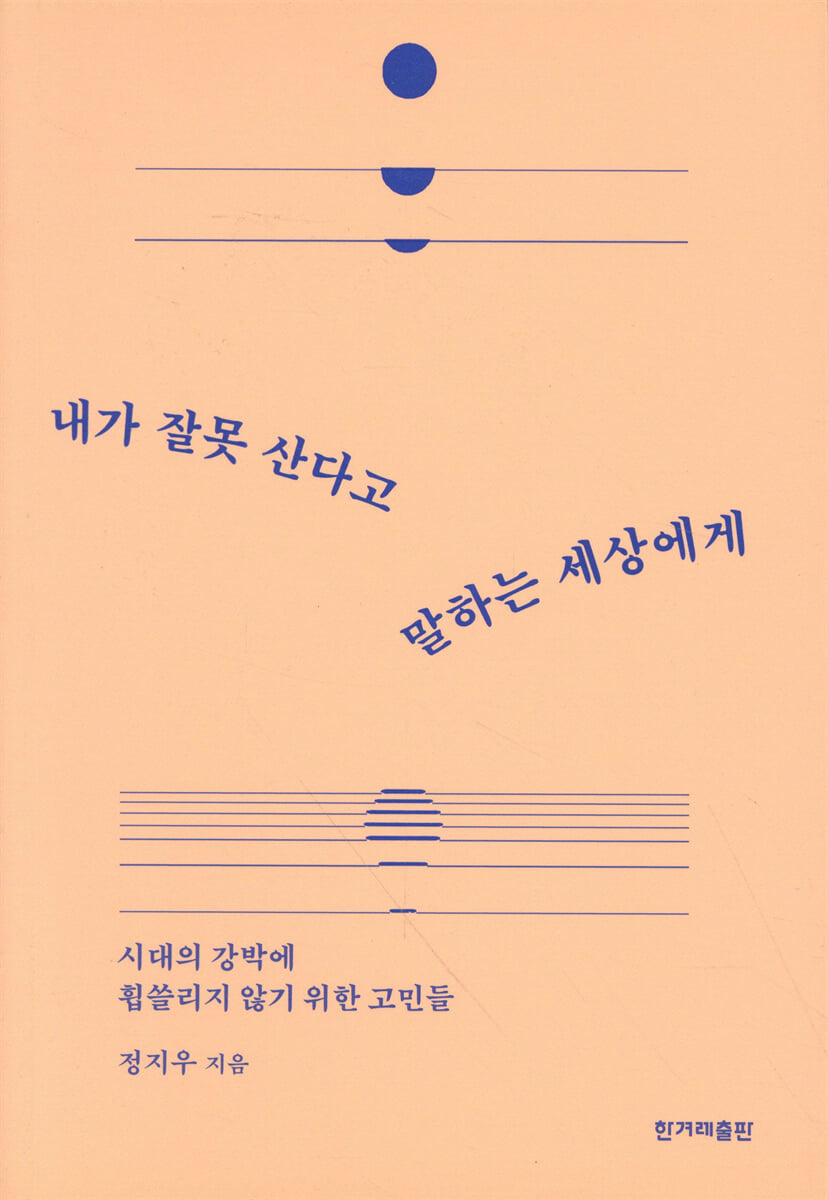 |
Description
Book Introduction
In a world that whispers, "If you live like that, you'll fail."
How to Drive Your Own Life
Author Jiwoo Jeong, who sharply analyzed how millennials understand Korean society in “There is no despair on Instagram,” has released a new social critique essay after two years.
The new book, "To the World That Says I'm Living Wrong," is a book that examines an era that constantly promotes envy, jealousy, relative deprivation, and alienation by setting "a standard that is not enviable to others" as if it were the correct answer.
In an age where the message, "This is how you live properly," is constantly whispered through social media and online communities, and where the standards of others become an obsession for individuals, knowingly or unknowingly, it is difficult to even know what my true choice is.
The author points out that in this era, rather than actively figuring out what is right and appropriate for oneself, the author is driven by the "normalization of criticism," in which stories that loudly point out what is wrong with the lives of others are given attention.
YouTube content overflowing with messages like, "If you live like this, you'll fail," the never-ending trend of venomous remarks, and sniping at others have already become so deeply ingrained in our daily lives that they've desensitized us.
"To the World That Says I'm Living Wrong" goes beyond criticizing this reality, captured in social media culture, consumption patterns, views on love and marriage, and the hatred and division in everyday life. It also discusses the attitude needed to overcome it and move forward, that is, the attitude of breaking free from the obsessions of the times and leading one's own life with dignity.
In particular, it differs from typical social criticism essays in that it calmly develops thoughts derived from the author's own experiences rather than relying on grand discourses on how to fully relate to others and protect one's own life in a world of 'distrust.'
“There are times when I feel like I live in a society that could be called an age of despair, a world gone mad.
But on the other hand, every era has its own despair, and every life has its own madness.
In the end, we have to pass through such times and societies on our own boat called life.
I think that what protects you in such times is your own standards and attitude towards everything.
Ultimately, what I wanted to say was about that attitude.” - From the introduction
How to Drive Your Own Life
Author Jiwoo Jeong, who sharply analyzed how millennials understand Korean society in “There is no despair on Instagram,” has released a new social critique essay after two years.
The new book, "To the World That Says I'm Living Wrong," is a book that examines an era that constantly promotes envy, jealousy, relative deprivation, and alienation by setting "a standard that is not enviable to others" as if it were the correct answer.
In an age where the message, "This is how you live properly," is constantly whispered through social media and online communities, and where the standards of others become an obsession for individuals, knowingly or unknowingly, it is difficult to even know what my true choice is.
The author points out that in this era, rather than actively figuring out what is right and appropriate for oneself, the author is driven by the "normalization of criticism," in which stories that loudly point out what is wrong with the lives of others are given attention.
YouTube content overflowing with messages like, "If you live like this, you'll fail," the never-ending trend of venomous remarks, and sniping at others have already become so deeply ingrained in our daily lives that they've desensitized us.
"To the World That Says I'm Living Wrong" goes beyond criticizing this reality, captured in social media culture, consumption patterns, views on love and marriage, and the hatred and division in everyday life. It also discusses the attitude needed to overcome it and move forward, that is, the attitude of breaking free from the obsessions of the times and leading one's own life with dignity.
In particular, it differs from typical social criticism essays in that it calmly develops thoughts derived from the author's own experiences rather than relying on grand discourses on how to fully relate to others and protect one's own life in a world of 'distrust.'
“There are times when I feel like I live in a society that could be called an age of despair, a world gone mad.
But on the other hand, every era has its own despair, and every life has its own madness.
In the end, we have to pass through such times and societies on our own boat called life.
I think that what protects you in such times is your own standards and attitude towards everything.
Ultimately, what I wanted to say was about that attitude.” - From the introduction
- You can preview some of the book's contents.
Preview
index
introduction
Even though I didn't know I would live in a world like this
Part 1: Relationships: Inviting Others in an Age of Distrust
Earthworms don't like rain.
That person must have been lonely.
How to Love with MBTI
"If you refute, you're right." Is this communication or a lack of communication?
What's Hidden in "Me?"
Fighting the old man inside me
A contemporary sense of what violence is
The cruelty of 'it's all your choice'
The lower limit that must be maintained as a human being
Another Background to the Literacy Crisis
Intention, the mind of the other
Breaking the cycle of life
If you ask me why I became a lawyer
The joys and sorrows of a test taker and the desperation of love
A person like porcelain
Is marriage 'perfection'?
A harsh marriage on one side
Sensitivity compatibility
The Practice of Faith in Resolving Dilemmas
The sea called 'here and now' that my child taught me
There is nothing that is expected of parents.
Beach Girl
Part 2: The Age Without Maps: How to Avoid Being a Spectator
An unprecedented society
Between Misery and Perfection: The Age of Bipolar Divide
Envy, jealousy, and deprivation
Beware of the culture of venom
Why duality is a concern
A system for creating squid games
Where did the stolen time go?
Timetable that defines failure
Laziness is not the problem
Hyper-realistic comedy
Ghosts watching
The pressure of collectivism
Supreme Court ruling defending 'individuals'
The right to rest, a self outside of work
From experience to material consumption
Fading romances
The Fall of the Era of Cost-Effectiveness
Doubting the happiness that money brings
Excessive evaluation and attention
For a society where no one is king
The world of civil law
In the face of the cost of chance
Part 3: Breakthrough and Recovery: Crossing the World We've Broken
When going through a time of betrayal
When the curtain is lifted, ruins are revealed.
When a Taekwondo gym closes, a flood of women take a break from their careers.
The sadness of seeing children's sadness
South Korea is a huge no-kids zone
Where to go and where to lean on
There is no wisest choice
The power of freedom given by appropriate restraint
If you do it, you'll do it
The answer that the shortcomings have found
Weapons I Didn't Know About Before Studying Law
A happy life and a worthwhile life
Against the obsession with happiness
Dopamine and Overindulgence
The moment of liberation, Epiphany
Writing that saves me
If you don't read books, do you mean you won't read articles?
To endure the vehement malice with the exact kindness
Distrust feelings
Self-efficacy from others
Time flows with space
Parting with an empty bag
Even though I didn't know I would live in a world like this
Part 1: Relationships: Inviting Others in an Age of Distrust
Earthworms don't like rain.
That person must have been lonely.
How to Love with MBTI
"If you refute, you're right." Is this communication or a lack of communication?
What's Hidden in "Me?"
Fighting the old man inside me
A contemporary sense of what violence is
The cruelty of 'it's all your choice'
The lower limit that must be maintained as a human being
Another Background to the Literacy Crisis
Intention, the mind of the other
Breaking the cycle of life
If you ask me why I became a lawyer
The joys and sorrows of a test taker and the desperation of love
A person like porcelain
Is marriage 'perfection'?
A harsh marriage on one side
Sensitivity compatibility
The Practice of Faith in Resolving Dilemmas
The sea called 'here and now' that my child taught me
There is nothing that is expected of parents.
Beach Girl
Part 2: The Age Without Maps: How to Avoid Being a Spectator
An unprecedented society
Between Misery and Perfection: The Age of Bipolar Divide
Envy, jealousy, and deprivation
Beware of the culture of venom
Why duality is a concern
A system for creating squid games
Where did the stolen time go?
Timetable that defines failure
Laziness is not the problem
Hyper-realistic comedy
Ghosts watching
The pressure of collectivism
Supreme Court ruling defending 'individuals'
The right to rest, a self outside of work
From experience to material consumption
Fading romances
The Fall of the Era of Cost-Effectiveness
Doubting the happiness that money brings
Excessive evaluation and attention
For a society where no one is king
The world of civil law
In the face of the cost of chance
Part 3: Breakthrough and Recovery: Crossing the World We've Broken
When going through a time of betrayal
When the curtain is lifted, ruins are revealed.
When a Taekwondo gym closes, a flood of women take a break from their careers.
The sadness of seeing children's sadness
South Korea is a huge no-kids zone
Where to go and where to lean on
There is no wisest choice
The power of freedom given by appropriate restraint
If you do it, you'll do it
The answer that the shortcomings have found
Weapons I Didn't Know About Before Studying Law
A happy life and a worthwhile life
Against the obsession with happiness
Dopamine and Overindulgence
The moment of liberation, Epiphany
Writing that saves me
If you don't read books, do you mean you won't read articles?
To endure the vehement malice with the exact kindness
Distrust feelings
Self-efficacy from others
Time flows with space
Parting with an empty bag
Detailed image

Into the book
I wanted to describe an era where people criticize and hate others while observing them, where envy, jealousy, relative deprivation, and alienation are constantly fostered, and where there are more negative examples than good examples to emulate.
However, I did not stop at describing such an era, but also wanted to talk about the attitude needed to live in such an era.
(…) This difference from the previous work, “There is no despair on Instagram,” can be seen as the fact that it not only describes society but also talks deeply about attitudes toward life.
--- p.8
I think the habit of saying “Me?” is a catchphrase that shows an era that contains both fear and longing for “attention.”
If you look at celebrities, there are many cases where they become popular in an instant, but then fall into the abyss due to some trivial information or past.
Almost any information can be attacked and could ruin a person's life.
Yet, our era is also a 'lonely' era that craves attention.
Many people display themselves on social media in the hopes of being 'admired', and some are waiting for that moment when someone will say, "Me?" with a bright expression.
--- p.34
The idea that choice is absolute, that choices are entirely personal, and that everyone is entirely responsible for their choices is quite frightening.
In fact, there are not many cases in life where a person can completely choose something.
This is because there are countless choices we are forced to make without realizing it, in situations that have accumulated over the course of our lives, wounds we have received without realizing it, limited choices given to us whether we wanted them or not, and positions we have been forced into without any choice.
--- pp.45~46
Lack of literacy or understanding means lacking the 'power' to imagine others.
Furthermore, the brain cannot learn the 'courage' to do so.
It is a closed-mindedness that remains trapped in a narcissistic way of understanding oneself and being accustomed to one's own position.
So, one of the core issues that is rarely mentioned when talking about literacy is the overabundance of extreme and provocative content.
--- pp.54~55
'Marriage is also a beginning, a cornerstone, and a process of becoming an adult.
The older generation's admonition that 'marriage is like practice for everyone, and childcare is also a new and unfamiliar experience for everyone, but that's how you learn' is almost meaningless.
In this era where life is filled with various installments, debt, interest, and all sorts of risks, the younger generation is reluctant to take such 'risks'.
--- p.80
Snipe at other people's lives always brings a certain pleasure.
Hidden within it is the idea of finding comfort in the fact that one's own life is okay by belittling the lives of others.
There is also no small amount of pleasure that comes from the 'confirmation of power' that I can define and evaluate the lives of others.
It's like feeling like you have power by evaluating and criticizing all life in the world like a corner judge.
Likewise, self-reproach can also be addictive and pleasurable.
The act of berating oneself gives one the 'pleasure of knowing' that one knows about a better life.
The reason why self-reproach is accompanied by a kind of masochistic pleasure is because, in the end, both the 'scolder' and the 'scolded' are themselves.
--- p.122
This trend of hyper-realism can also be seen as an extension of the ‘spectator culture’ of our time.
In an age where everything in the world has become a spectacle, our daily lives are also becoming more actively and realistically spectacled.
People watch, comment, laugh, and giggle.
(…) But sometimes there is something more than just a chuckle in it.
For example, when words like 'Tteulttakchung', 'Mamchung', and 'Gaedokgyo' are mentioned, it is a moment when a specific group is framed and hatred toward the group that has been confirmed as the target of ridicule is spread.
--- p.147
Anything that can be achieved with a little effort is not necessarily emphasized.
If there is something that the entire society is fanatically obsessed with, it is because it has become that much more difficult to obtain.
In other words, the key point is that it has become difficult to easily access the 'appropriate amount of money' necessary for life.
In addition to the growing class gap, the skyrocketing real estate prices over the past few years have made it virtually impossible for an individual to earn a decent living on their own.
And that impossibility is becoming a black hole that sucks in the longing, yearning, and yearning of an era.
--- p.177
I wonder if the COVID-19 era wasn't a time when the vulnerabilities that our society had barely managed to hold on to were exposed.
The closure of a Taekwondo gym is causing a surge in women who have taken a break from their careers.
The income structure of a household that has become so vulnerable further deepens the gap between the rich and the poor.
At that point, someone who owned a house might be better off, but a family that had worked hard to earn money and decided to own a house would have to give up even that minimal future plan.
While the crisis of an era may be a light breeze to some, it falls like a particularly severe storm to some families, groups, and classes.
--- p.209
When life is filled with a certain amount of constraints, we sometimes become desperate to fill the gaps in those constraints with more meaning.
In my case, that situation reached its peak when I was attending law school.
(…) People often ask me how I managed to write so many books while attending law school and raising children, and I often say that it actually helped me use my time more focused.
I had to pay my tuition and didn't want to give up my writing, so I dedicated the very little time I had each day to the things that mattered most in my life.
--- pp.230~231
The trendy saying these days, “‘Sseham’ is science,” the tendency to instantly like or dislike others, the consumption lifestyle that focuses on one’s own feelings, such as ‘shibalbiyol (expenses that one would not have spent if one were not stressed), ‘gasimbi’, and ‘shisimbi’, and the command to find the dream that best suits one’s heart within, all place a great deal of importance on one’s feelings.
Also, as far as I know, almost everyone says they are 'good at reading people', and this may not be unrelated to the fact that people are increasingly encouraged to trust their own feelings, intuition, and intuition.
However, I did not stop at describing such an era, but also wanted to talk about the attitude needed to live in such an era.
(…) This difference from the previous work, “There is no despair on Instagram,” can be seen as the fact that it not only describes society but also talks deeply about attitudes toward life.
--- p.8
I think the habit of saying “Me?” is a catchphrase that shows an era that contains both fear and longing for “attention.”
If you look at celebrities, there are many cases where they become popular in an instant, but then fall into the abyss due to some trivial information or past.
Almost any information can be attacked and could ruin a person's life.
Yet, our era is also a 'lonely' era that craves attention.
Many people display themselves on social media in the hopes of being 'admired', and some are waiting for that moment when someone will say, "Me?" with a bright expression.
--- p.34
The idea that choice is absolute, that choices are entirely personal, and that everyone is entirely responsible for their choices is quite frightening.
In fact, there are not many cases in life where a person can completely choose something.
This is because there are countless choices we are forced to make without realizing it, in situations that have accumulated over the course of our lives, wounds we have received without realizing it, limited choices given to us whether we wanted them or not, and positions we have been forced into without any choice.
--- pp.45~46
Lack of literacy or understanding means lacking the 'power' to imagine others.
Furthermore, the brain cannot learn the 'courage' to do so.
It is a closed-mindedness that remains trapped in a narcissistic way of understanding oneself and being accustomed to one's own position.
So, one of the core issues that is rarely mentioned when talking about literacy is the overabundance of extreme and provocative content.
--- pp.54~55
'Marriage is also a beginning, a cornerstone, and a process of becoming an adult.
The older generation's admonition that 'marriage is like practice for everyone, and childcare is also a new and unfamiliar experience for everyone, but that's how you learn' is almost meaningless.
In this era where life is filled with various installments, debt, interest, and all sorts of risks, the younger generation is reluctant to take such 'risks'.
--- p.80
Snipe at other people's lives always brings a certain pleasure.
Hidden within it is the idea of finding comfort in the fact that one's own life is okay by belittling the lives of others.
There is also no small amount of pleasure that comes from the 'confirmation of power' that I can define and evaluate the lives of others.
It's like feeling like you have power by evaluating and criticizing all life in the world like a corner judge.
Likewise, self-reproach can also be addictive and pleasurable.
The act of berating oneself gives one the 'pleasure of knowing' that one knows about a better life.
The reason why self-reproach is accompanied by a kind of masochistic pleasure is because, in the end, both the 'scolder' and the 'scolded' are themselves.
--- p.122
This trend of hyper-realism can also be seen as an extension of the ‘spectator culture’ of our time.
In an age where everything in the world has become a spectacle, our daily lives are also becoming more actively and realistically spectacled.
People watch, comment, laugh, and giggle.
(…) But sometimes there is something more than just a chuckle in it.
For example, when words like 'Tteulttakchung', 'Mamchung', and 'Gaedokgyo' are mentioned, it is a moment when a specific group is framed and hatred toward the group that has been confirmed as the target of ridicule is spread.
--- p.147
Anything that can be achieved with a little effort is not necessarily emphasized.
If there is something that the entire society is fanatically obsessed with, it is because it has become that much more difficult to obtain.
In other words, the key point is that it has become difficult to easily access the 'appropriate amount of money' necessary for life.
In addition to the growing class gap, the skyrocketing real estate prices over the past few years have made it virtually impossible for an individual to earn a decent living on their own.
And that impossibility is becoming a black hole that sucks in the longing, yearning, and yearning of an era.
--- p.177
I wonder if the COVID-19 era wasn't a time when the vulnerabilities that our society had barely managed to hold on to were exposed.
The closure of a Taekwondo gym is causing a surge in women who have taken a break from their careers.
The income structure of a household that has become so vulnerable further deepens the gap between the rich and the poor.
At that point, someone who owned a house might be better off, but a family that had worked hard to earn money and decided to own a house would have to give up even that minimal future plan.
While the crisis of an era may be a light breeze to some, it falls like a particularly severe storm to some families, groups, and classes.
--- p.209
When life is filled with a certain amount of constraints, we sometimes become desperate to fill the gaps in those constraints with more meaning.
In my case, that situation reached its peak when I was attending law school.
(…) People often ask me how I managed to write so many books while attending law school and raising children, and I often say that it actually helped me use my time more focused.
I had to pay my tuition and didn't want to give up my writing, so I dedicated the very little time I had each day to the things that mattered most in my life.
--- pp.230~231
The trendy saying these days, “‘Sseham’ is science,” the tendency to instantly like or dislike others, the consumption lifestyle that focuses on one’s own feelings, such as ‘shibalbiyol (expenses that one would not have spent if one were not stressed), ‘gasimbi’, and ‘shisimbi’, and the command to find the dream that best suits one’s heart within, all place a great deal of importance on one’s feelings.
Also, as far as I know, almost everyone says they are 'good at reading people', and this may not be unrelated to the fact that people are increasingly encouraged to trust their own feelings, intuition, and intuition.
--- pp.271~272
Publisher's Review
Talking to Others in an Age of Distrust
Part 1 of this book, "Relationships: Inviting Others in an Age of Distrust," examines aspects of a society rife with hatred and animosity, and explores whether there are ways to connect meaningfully and healthily with others.
For example, he points out that the MBTI personality test's unwavering popularity can sometimes be used as a tool to understand others, but can also be an 'active way to not love' others.
When we don't want to know someone deeply, we tend to confine them to a specific framework, fixating them as someone who no longer deserves careful consideration. The author's insight, which goes beyond the scientific basis of the MBTI and delves into the depths of its "craze," is also evident in the youth-friendly phrase, "If you refute me, you're right."
This is usually interpreted as an attitude of 'I just said what I thought, so I have no intention of refuting it if you disagree', which at first glance may seem like an avoidance of argument or discussion, but the real nuance can be more complex.
This is because it can be seen as an appeal to ‘please listen to me even if what I say is not logically perfect.’
According to the author, the younger generation believes that each other's 'differences' should be respected, but at the same time, they fear that their opinions will be rejected.
Meanwhile, it is painful to point out that in our society, the standard of 'it's your choice' has become absolute when it comes to criticizing others.
It is a way of thinking that says, “I don’t need to empathize with you, I don’t have a reason to pity you, I don’t have to worry about you, and I can even hate or criticize you because it is all your ‘choice’” (p. 44).
The author emphasizes that this way of thinking is quite dangerous, as it is rare for a human being to have complete choice over something in life.
It is also interesting to look at the 'literacy crisis', which has been a topic of interest for several years.
The author argues that the reason for this cannot be simply attributed to issues with school education or lack of reading, but also to the influence of the dichotomous oppositional structure that is widespread in the online world.
“Even on YouTube, which is used by most teenagers, videos of sniping between YouTubers are widely spread.
What these sniper videos usually do is divide the forces into friend and foe, generalizing and framing the opposing side, and labeling them as evil.
At first glance, it may seem like a matter of using insight to understand the target's intentions, but the core of this task lies in 'misinterpreting' the opponent's intentions.
(…) In other words, the core of this ‘intellectual activity’ is not to understand the other person’s intentions as accurately as possible.”_pp. 53-54
So how can we resolve the distortions in how we treat others and the immaturity in how we relate to them?
The author encourages readers to find their own way out by drawing on precious moments from his own daily experiences.
The 'method of inviting others in an age of distrust' is reflected in the way to combat the 'dad-like' attitude of talking only about oneself regardless of the interests of others, the skill of trust learned through raising children, and the importance of those who shared difficulties with one during the difficult days of studying for college entrance exams.
Things to Consider When Crossing a Mapless Era
Part 2, "The Age Without a Map: How to Avoid Being a Bystander to Life," provides a more incisive analysis of the reality in which collectivist culture still oppresses individuals despite the collapse of communities on which individuals could rely; the failure of the older generation to invite young people into their lives; the consumer culture driven by endless competition, each for himself, and "the rise and fall of money," and the social atmosphere that is turning into a sand pit due to relative deprivation.
It is particularly interesting that the current Korean society is viewed from the perspective of the 'age of the spectator.'
In a world where individualism has become extremely prevalent and each person for himself has become the truth, group conflicts between generations, genders, classes, occupations, and political forces are becoming increasingly sensitive and serious. In other words, this is about the paradox of groups becoming weaker while group conflicts intensify.
The author points out that in reality, it is the 'bystanders' rather than the 'members' who instigate group conflict.
“Rather than a fight between two groups, it is a realization of group conflict through the work of onlookers defining specific groups.”
“For example, when a mother of a child engages in problematic behavior on the subway, onlookers playfully spread the collective term ‘Momchung’ about her.
A particular incident is not defined as something created by a specific person, but as an attribute of the group of mothers themselves.
(...) The two camps that emerged in this way appear to be in fierce conflict at first glance, but in reality, what is happening is closer to a 'regulation game' for onlookers.
These spectators can move from place to place as much as they want, and when they lose interest, they can just leave the game.
They are not people with a group identity belonging to some place, but rather individualized ghosts who enjoy playing by designating and creating a specific group.”_pp. 150-151
The discussion of 'shisimbi', a term first used by the author in a column several years ago, is still valid.
The term "short-termism" refers to the phenomenon in which satisfaction that can be obtained in a short period of time is valued.
The author says that the trend toward increasingly shorter YouTube video playback times and drama series, the image-centric, time-saving social media culture like Instagram, and the trend toward thinner books with fewer characters reflect the trend toward content centered on poetry.
And it is noteworthy that the importance of timeliness continues to grow among the younger generation, that is, the absence of 'time' implies the absence of 'mental time'.
If you become accustomed to suffering from a lack of physical time, you will not be able to enjoy free time as a 'long time' even if you are given some free time by chance.
The author worries that a life without enough free time can change our mental structure and eventually take over our entire lives.
I believe that the root of this is the endless competition we have suffered from since childhood, the culture that evaluates everything in life based on specifications, and the obsession with growing up while competing with our senses.
"So, who owns the time that has been completely stolen from the younger generation? Who is enjoying the benefits of time? Who is living as a time rich person? Even if you don't know, they must be related to some class that doesn't have to devote time to the competition for survival.
(…) Time is labor and soon capital.
Therefore, we cannot ignore the fact that 'time' is at the core of inequality and polarization in this society.
We live in a society of time inequality._Page 136
Every age has its own despair,
Part 3, "Breakthrough and Recovery: Crossing the World We've Broken," explores the will and attitude we need to keep moving forward without giving up even in a reality that seems to have no answers at first glance. This is deeply embedded throughout the author's personal stories, in addition to the critical perspective maintained in Parts 1 and 2.
First, we examine what vulnerabilities in society have been revealed since the pandemic swept through, or what has been hidden under the guise of a return to normalcy. We then delve into the isolation and disintegration of that time, particularly the deprivation and sadness that growing children have had to endure.
As a father raising a young child, he criticizes the Korean society for its lack of consideration for the socially vulnerable, including children, and says that the Republic of Korea itself is becoming a giant 'no kids zone'.
“Even so, if there is room for even a small part of life to have meaning other than one’s own benefit or happiness, I hope that space will be left open to future children.
Because most of what we enjoy is built on the sacrifices of later generations.
“The ecological crisis, the real estate bubble, polarization, the growing national debt, the depletion of various pensions and funds, and the culture of discrimination and hatred are all like bombs left for future generations.”_Page 218
As the author notes in the preface, there are times when we feel we live in “a time that might be called an age of despair, a world gone mad,” but “on the other hand, every age has its own despair.”
In the end, he confesses that everyone has to pass through such times and societies on their own boat of life, and that he began to think earnestly about such things as 'life jackets', especially after he turned 30 and took on the field of law for the first time.
The fact that I had to study while earning tuition was a secondary issue, and when my child was born during my first year of law school, I began a routine of flipping through law books all night long and feeding formula milk every time the child woke up.
To make matters worse, when his wife returned to work in another region, he suffered from pressure, anxiety, and nervousness every night while he and his child slept together.
During those times, I wrote every single day about the values of life that sustain me, the urgency of living, and the strength of those who hold my hand and move forward.
“The same thing happened with my first job in life.
I was worried about whether I could do well, but I just kept running around and asking people questions every day, getting pointed out dozens of times, and still running around, so I was able to learn diligently and adapt.
People are always caught up in 'ideas' before doing anything.
There are many times when we are unable to take a single step forward because we are caught up in prejudices, preconceptions, and fears about something.
But when you actually get into it, when you actually face it, you somehow manage to do something, but after it passes, you wonder what all the fear of that time was.”_Page 235
In a world of frustration and cynicism, especially in an era where the frustration and cynicism of "youth" have become the norm, the sharp and calm writing of this young writer, father, and newcomer to the legal profession, who never turns away from positivity and faith in life, will bring to mind the poet's age-old adage, "Even if life deceives you, do not be sad or angry," anew in an age of hatred and division.
Part 1 of this book, "Relationships: Inviting Others in an Age of Distrust," examines aspects of a society rife with hatred and animosity, and explores whether there are ways to connect meaningfully and healthily with others.
For example, he points out that the MBTI personality test's unwavering popularity can sometimes be used as a tool to understand others, but can also be an 'active way to not love' others.
When we don't want to know someone deeply, we tend to confine them to a specific framework, fixating them as someone who no longer deserves careful consideration. The author's insight, which goes beyond the scientific basis of the MBTI and delves into the depths of its "craze," is also evident in the youth-friendly phrase, "If you refute me, you're right."
This is usually interpreted as an attitude of 'I just said what I thought, so I have no intention of refuting it if you disagree', which at first glance may seem like an avoidance of argument or discussion, but the real nuance can be more complex.
This is because it can be seen as an appeal to ‘please listen to me even if what I say is not logically perfect.’
According to the author, the younger generation believes that each other's 'differences' should be respected, but at the same time, they fear that their opinions will be rejected.
Meanwhile, it is painful to point out that in our society, the standard of 'it's your choice' has become absolute when it comes to criticizing others.
It is a way of thinking that says, “I don’t need to empathize with you, I don’t have a reason to pity you, I don’t have to worry about you, and I can even hate or criticize you because it is all your ‘choice’” (p. 44).
The author emphasizes that this way of thinking is quite dangerous, as it is rare for a human being to have complete choice over something in life.
It is also interesting to look at the 'literacy crisis', which has been a topic of interest for several years.
The author argues that the reason for this cannot be simply attributed to issues with school education or lack of reading, but also to the influence of the dichotomous oppositional structure that is widespread in the online world.
“Even on YouTube, which is used by most teenagers, videos of sniping between YouTubers are widely spread.
What these sniper videos usually do is divide the forces into friend and foe, generalizing and framing the opposing side, and labeling them as evil.
At first glance, it may seem like a matter of using insight to understand the target's intentions, but the core of this task lies in 'misinterpreting' the opponent's intentions.
(…) In other words, the core of this ‘intellectual activity’ is not to understand the other person’s intentions as accurately as possible.”_pp. 53-54
So how can we resolve the distortions in how we treat others and the immaturity in how we relate to them?
The author encourages readers to find their own way out by drawing on precious moments from his own daily experiences.
The 'method of inviting others in an age of distrust' is reflected in the way to combat the 'dad-like' attitude of talking only about oneself regardless of the interests of others, the skill of trust learned through raising children, and the importance of those who shared difficulties with one during the difficult days of studying for college entrance exams.
Things to Consider When Crossing a Mapless Era
Part 2, "The Age Without a Map: How to Avoid Being a Bystander to Life," provides a more incisive analysis of the reality in which collectivist culture still oppresses individuals despite the collapse of communities on which individuals could rely; the failure of the older generation to invite young people into their lives; the consumer culture driven by endless competition, each for himself, and "the rise and fall of money," and the social atmosphere that is turning into a sand pit due to relative deprivation.
It is particularly interesting that the current Korean society is viewed from the perspective of the 'age of the spectator.'
In a world where individualism has become extremely prevalent and each person for himself has become the truth, group conflicts between generations, genders, classes, occupations, and political forces are becoming increasingly sensitive and serious. In other words, this is about the paradox of groups becoming weaker while group conflicts intensify.
The author points out that in reality, it is the 'bystanders' rather than the 'members' who instigate group conflict.
“Rather than a fight between two groups, it is a realization of group conflict through the work of onlookers defining specific groups.”
“For example, when a mother of a child engages in problematic behavior on the subway, onlookers playfully spread the collective term ‘Momchung’ about her.
A particular incident is not defined as something created by a specific person, but as an attribute of the group of mothers themselves.
(...) The two camps that emerged in this way appear to be in fierce conflict at first glance, but in reality, what is happening is closer to a 'regulation game' for onlookers.
These spectators can move from place to place as much as they want, and when they lose interest, they can just leave the game.
They are not people with a group identity belonging to some place, but rather individualized ghosts who enjoy playing by designating and creating a specific group.”_pp. 150-151
The discussion of 'shisimbi', a term first used by the author in a column several years ago, is still valid.
The term "short-termism" refers to the phenomenon in which satisfaction that can be obtained in a short period of time is valued.
The author says that the trend toward increasingly shorter YouTube video playback times and drama series, the image-centric, time-saving social media culture like Instagram, and the trend toward thinner books with fewer characters reflect the trend toward content centered on poetry.
And it is noteworthy that the importance of timeliness continues to grow among the younger generation, that is, the absence of 'time' implies the absence of 'mental time'.
If you become accustomed to suffering from a lack of physical time, you will not be able to enjoy free time as a 'long time' even if you are given some free time by chance.
The author worries that a life without enough free time can change our mental structure and eventually take over our entire lives.
I believe that the root of this is the endless competition we have suffered from since childhood, the culture that evaluates everything in life based on specifications, and the obsession with growing up while competing with our senses.
"So, who owns the time that has been completely stolen from the younger generation? Who is enjoying the benefits of time? Who is living as a time rich person? Even if you don't know, they must be related to some class that doesn't have to devote time to the competition for survival.
(…) Time is labor and soon capital.
Therefore, we cannot ignore the fact that 'time' is at the core of inequality and polarization in this society.
We live in a society of time inequality._Page 136
Every age has its own despair,
Part 3, "Breakthrough and Recovery: Crossing the World We've Broken," explores the will and attitude we need to keep moving forward without giving up even in a reality that seems to have no answers at first glance. This is deeply embedded throughout the author's personal stories, in addition to the critical perspective maintained in Parts 1 and 2.
First, we examine what vulnerabilities in society have been revealed since the pandemic swept through, or what has been hidden under the guise of a return to normalcy. We then delve into the isolation and disintegration of that time, particularly the deprivation and sadness that growing children have had to endure.
As a father raising a young child, he criticizes the Korean society for its lack of consideration for the socially vulnerable, including children, and says that the Republic of Korea itself is becoming a giant 'no kids zone'.
“Even so, if there is room for even a small part of life to have meaning other than one’s own benefit or happiness, I hope that space will be left open to future children.
Because most of what we enjoy is built on the sacrifices of later generations.
“The ecological crisis, the real estate bubble, polarization, the growing national debt, the depletion of various pensions and funds, and the culture of discrimination and hatred are all like bombs left for future generations.”_Page 218
As the author notes in the preface, there are times when we feel we live in “a time that might be called an age of despair, a world gone mad,” but “on the other hand, every age has its own despair.”
In the end, he confesses that everyone has to pass through such times and societies on their own boat of life, and that he began to think earnestly about such things as 'life jackets', especially after he turned 30 and took on the field of law for the first time.
The fact that I had to study while earning tuition was a secondary issue, and when my child was born during my first year of law school, I began a routine of flipping through law books all night long and feeding formula milk every time the child woke up.
To make matters worse, when his wife returned to work in another region, he suffered from pressure, anxiety, and nervousness every night while he and his child slept together.
During those times, I wrote every single day about the values of life that sustain me, the urgency of living, and the strength of those who hold my hand and move forward.
“The same thing happened with my first job in life.
I was worried about whether I could do well, but I just kept running around and asking people questions every day, getting pointed out dozens of times, and still running around, so I was able to learn diligently and adapt.
People are always caught up in 'ideas' before doing anything.
There are many times when we are unable to take a single step forward because we are caught up in prejudices, preconceptions, and fears about something.
But when you actually get into it, when you actually face it, you somehow manage to do something, but after it passes, you wonder what all the fear of that time was.”_Page 235
In a world of frustration and cynicism, especially in an era where the frustration and cynicism of "youth" have become the norm, the sharp and calm writing of this young writer, father, and newcomer to the legal profession, who never turns away from positivity and faith in life, will bring to mind the poet's age-old adage, "Even if life deceives you, do not be sad or angry," anew in an age of hatred and division.
GOODS SPECIFICS
- Publication date: July 11, 2022
- Page count, weight, size: 288 pages | 384g | 130*190*18mm
- ISBN13: 9791160408416
- ISBN10: 1160408416
You may also like
카테고리
korean


korean

![GQ KOREA Mark (Monthly): December [2025]](http://librairie.coreenne.fr/cdn/shop/files/8ef265dbbfbf186523ed75ba7319009d.jpg?v=1765340328&width=3840)


