

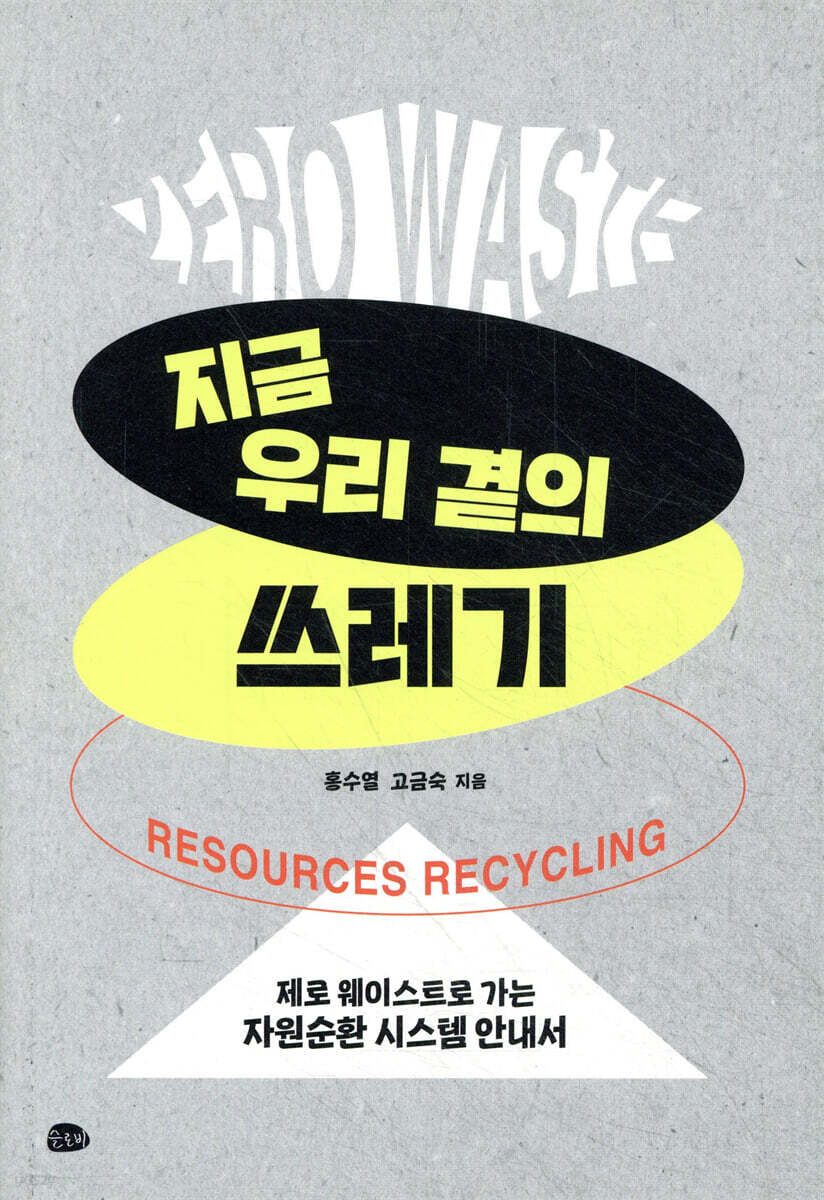
The trash around us now
 |
Description
Book Introduction
This is truly a trash world. As a result of our excessive consumption and waste, natural resources are depleted, waste is exploding, and ecosystems are being destroyed. This is the reality brought about by growth-ism, which believes that the economy can grow and people can live well only through consumption. All human activities are globally connected. My consumption is linked to the destruction of gorilla habitats in Africa across the globe due to resource mining, trash dumped in the West Sea is floating somewhere in the Pacific Ocean as microplastics, and dioxin, a toxic substance released when trash is burned, lingers around the world for hundreds of years. The crisis is fast approaching, and we, both the perpetrator and the victim, are trembling with anxiety. Shouldn't we do something? But what should we do? The author explains how to recycle resources through a 'circular economy' as a way to overcome the environmental crisis of this era. It systematically addresses the problem of waste by examining how the system that promotes consumer culture has been built within it and presents specific alternatives we must implement now. |
- You can preview some of the book's contents.
Preview
index
Entering.
Why isn't trash trash?
[Lecture 1] Waste is the Problem
What should I do and how should I do it?
The era of the circular economy has begun.
- What's the problem with burning or burying it?
- Trash is not trash
- How does waste become a resource?
The Challenges of a Circular Economy: Let's Create a New Game
[Vivid Story] What We Did to Solve the Waste Problem
:Consumer Behavior Case Study: Plastic Attack
[Lecture 2] The Future of Plastics
From dream material to Earth's nightmare, and then
Alternative or Corporate Greenwashing?
The Plastic Paradox: The Dilemma of a Plastic-Addicted Society
Could bioplastics be an alternative to plastic?
- Biodegradable plastics do not decompose.
- Can all plastic be recycled?
From Formal to Substantive Responsibility: Challenges of the EPR System
[Lecture 3] There is no such thing as an eco-friendly disposable product.
How can we reduce single-use plastics?
- Beyond light despair, in search of heavy hope
How disposable culture has permeated our daily lives.
Is a future where reusable containers become commonplace possible?
- A city of zero-waste stores in every neighborhood
How to eliminate disposable packaging
- To be dragged or to be dragged: Who to unite with and how to resist
[Vivid Story] Doing Business with Zero Waste
: A case study of the Korean-style refill station Almang Store
[Lecture 4] Is Righteous Consumption for the Earth Possible?
- Let's look at the other side of fast fashion.
- Stop the runaway train
- Microfibers are threatening us.
- Let's create a closed loop cyclic structure from fiber to fiber.
- 4R: Repair, Rent, Resell, Remake
[Lecture 5] Food Waste
What is the problem and how can I save it?
Food issues and the environment are inseparable.
- Food waste separation: Greater than now
- Reduce before throwing away and pay for what you throw away.
Food waste also needs upcycling.
[Vivid Story] Composting Food Waste at Home
:The case of Sam Villa next to Ongdal Spring in Mangwon-dong
[Lecture 6] Electronic Waste
The Shadow of a Smart World
- 3D World: Dirty and Dangerous Digital
- How is electronic waste being handled?
How smart is our e-waste management?
- How much do we throw away and how do we deal with it?
How to Manage Electronic Waste in the Digital Age
[Lecture 7] Construction Waste and Waste Disposal Facilities
The heaviness of building
- Until the carbon-fed stones become cement
Is construction waste being properly recycled?
- Design for disassembly, smart disassembly for reuse
- Where should the incinerator be built?
- There is no solution to the problem without the responsibility and sacrifice of the emitter.
Going out.
Garbage beyond garbage
[Bold Trash Talk] Zero-Waste Life: Traces of Its Evolution
* The direction of the garbage solidarity ① 'Business' section: Our garbage solidarity
* The direction of the garbage solidarity ② 'Activity' section: Plastic attack, citizen action, and small victories
Why isn't trash trash?
[Lecture 1] Waste is the Problem
What should I do and how should I do it?
The era of the circular economy has begun.
- What's the problem with burning or burying it?
- Trash is not trash
- How does waste become a resource?
The Challenges of a Circular Economy: Let's Create a New Game
[Vivid Story] What We Did to Solve the Waste Problem
:Consumer Behavior Case Study: Plastic Attack
[Lecture 2] The Future of Plastics
From dream material to Earth's nightmare, and then
Alternative or Corporate Greenwashing?
The Plastic Paradox: The Dilemma of a Plastic-Addicted Society
Could bioplastics be an alternative to plastic?
- Biodegradable plastics do not decompose.
- Can all plastic be recycled?
From Formal to Substantive Responsibility: Challenges of the EPR System
[Lecture 3] There is no such thing as an eco-friendly disposable product.
How can we reduce single-use plastics?
- Beyond light despair, in search of heavy hope
How disposable culture has permeated our daily lives.
Is a future where reusable containers become commonplace possible?
- A city of zero-waste stores in every neighborhood
How to eliminate disposable packaging
- To be dragged or to be dragged: Who to unite with and how to resist
[Vivid Story] Doing Business with Zero Waste
: A case study of the Korean-style refill station Almang Store
[Lecture 4] Is Righteous Consumption for the Earth Possible?
- Let's look at the other side of fast fashion.
- Stop the runaway train
- Microfibers are threatening us.
- Let's create a closed loop cyclic structure from fiber to fiber.
- 4R: Repair, Rent, Resell, Remake
[Lecture 5] Food Waste
What is the problem and how can I save it?
Food issues and the environment are inseparable.
- Food waste separation: Greater than now
- Reduce before throwing away and pay for what you throw away.
Food waste also needs upcycling.
[Vivid Story] Composting Food Waste at Home
:The case of Sam Villa next to Ongdal Spring in Mangwon-dong
[Lecture 6] Electronic Waste
The Shadow of a Smart World
- 3D World: Dirty and Dangerous Digital
- How is electronic waste being handled?
How smart is our e-waste management?
- How much do we throw away and how do we deal with it?
How to Manage Electronic Waste in the Digital Age
[Lecture 7] Construction Waste and Waste Disposal Facilities
The heaviness of building
- Until the carbon-fed stones become cement
Is construction waste being properly recycled?
- Design for disassembly, smart disassembly for reuse
- Where should the incinerator be built?
- There is no solution to the problem without the responsibility and sacrifice of the emitter.
Going out.
Garbage beyond garbage
[Bold Trash Talk] Zero-Waste Life: Traces of Its Evolution
* The direction of the garbage solidarity ① 'Business' section: Our garbage solidarity
* The direction of the garbage solidarity ② 'Activity' section: Plastic attack, citizen action, and small victories
Into the book
“Everyone, when you think of trash, what comes to mind?” When I ask this question in lectures, ten out of ten people talk about trash that goes into garbage bags.
As such, we tend to have a narrow perspective.
I wonder if this narrow perspective on the waste problem has contributed to today's environmental problems, including the climate crisis.
In fact, waste refers not only to solid materials thrown away in volume-based garbage bags, but also to all pollutants emitted by humans.
Carbon dioxide emitted into the atmosphere is gaseous waste, and water pollutants are liquid waste.
The sources of pollutants that end up in the sky, the ocean, and the trash can all come from what humans produce and consume.
--- p.16
Many people are curious about biodegradable plastics.
Cafes use biodegradable plastic cups, and convenience stores use biodegradable vinyl, promoting themselves as being environmentally friendly, but others call it greenwashing (marketing that deceives consumers by disguising itself as eco-friendly), which is confusing.
Moreover, plastic terminology contains many difficult technical terms, which creates a sense of distance.
To properly combat plastic, which is permeating all aspects of our lives, we need to understand what alternative plastics are.
The more you know, the more accurate you will be able to speak clearly without being swayed by corporate marketing.
--- p.54
When we think about the issues of disposable products and packaging, it ultimately goes beyond consumer practices and becomes a problem for companies.
Because if the system doesn't support it, individual efforts are limited.
Companies must take the initiative in designing specific systems to move toward a reusable society.
Even if it takes trial and error.
2018 was the year when consumers stepped up and strongly demanded that the government introduce a deposit system for disposable cups.
The bill was passed in 2020 and is scheduled to take effect in December 2022.
If this system is introduced, it will become inconvenient for both cafes and consumers to use disposable cups.
This is why companies started to implement reusable cup deposit systems without anyone forcing them to do so.
This is why Starbucks launched a reusable cup takeout business in 2021.
--- p.104
When washing 1 kilogram of clothes, acrylic fibers release about 170,000 microplastics, and polyester and cotton blends release about 500,000 microplastics.
This is not a problem of a distant country, but a problem we face right now.
According to the results of a survey conducted by Seoul Metropolitan University, 143 microplastics were detected per 20 liters of Han River water.
According to the Ellen MacArthur Foundation, about 35 percent of the microplastics released into the world's oceans each year come from the textile washing process.
--- p.125
Starting in 1998, Seoul City began a full-scale pilot project for food waste recycling, and a recycling system was established in stages starting with large cities.
In the beginning, the trend was to make livestock feed from food.
This is the result of a combination of the experience of raising livestock using leftover food and the contemporary need to save foreign currency by replacing feed that had been dependent on imported products.
Then, in 1999, an incident occurred at a farm in Pocheon, Gyeonggi Province, where cows died en masse after eating feed made from food waste.
At that time, as the mad cow disease problem became serious in Europe, concerns about the use of feed arose and the direction changed to expanding composting facilities.
Since there is no choice but to leave the private feed facilities that were already in operation alone, local government recycling facilities will be installed with a focus on composting facilities.
--- p.140
With about 2 billion tons of household waste generated worldwide each year, e-waste accounts for about 5 percent of that total.
In terms of quantity, it's not a huge problem compared to other waste, but there are reasons to pay attention.
This is precisely because of the qualitative characteristics of electronic waste.
Electronic waste has two conflicting faces.
Although the resource has high value, it contains hazardous substances.
Because the resource value is high, everyone is jumping into recycling, but if hazardous substances are handled incorrectly, it can lead to disaster.
Management is not easy, as it is necessary to block businesses that are only after money and do not have the ability to handle hazardous substances.
--- p.168
How is construction waste being recycled? According to statistics from the Ministry of Environment, the average recycling rate over the past five years has been a whopping 98 percent.
Even if you worry about the amount of waste generated, you can feel reassured when you look at the recycling rate.
Is construction waste truly being recycled as smoothly as the statistics suggest? We need to look beyond the numbers and not be swayed by them.
In statistics, what is counted as recycling refers to the amount brought into a recycler.
Construction waste is mostly chunks of concrete or asphalt.
Recyclers crush this material several times with machines and then recycle it into sand or gravel.
In technical terms, it is called recycled aggregate.
However, not everything that goes into a recycling company is recycled, and not everything made from recycled aggregate is used.
You can also see mountains of unused aggregates piled up around recycling companies.
As such, we tend to have a narrow perspective.
I wonder if this narrow perspective on the waste problem has contributed to today's environmental problems, including the climate crisis.
In fact, waste refers not only to solid materials thrown away in volume-based garbage bags, but also to all pollutants emitted by humans.
Carbon dioxide emitted into the atmosphere is gaseous waste, and water pollutants are liquid waste.
The sources of pollutants that end up in the sky, the ocean, and the trash can all come from what humans produce and consume.
--- p.16
Many people are curious about biodegradable plastics.
Cafes use biodegradable plastic cups, and convenience stores use biodegradable vinyl, promoting themselves as being environmentally friendly, but others call it greenwashing (marketing that deceives consumers by disguising itself as eco-friendly), which is confusing.
Moreover, plastic terminology contains many difficult technical terms, which creates a sense of distance.
To properly combat plastic, which is permeating all aspects of our lives, we need to understand what alternative plastics are.
The more you know, the more accurate you will be able to speak clearly without being swayed by corporate marketing.
--- p.54
When we think about the issues of disposable products and packaging, it ultimately goes beyond consumer practices and becomes a problem for companies.
Because if the system doesn't support it, individual efforts are limited.
Companies must take the initiative in designing specific systems to move toward a reusable society.
Even if it takes trial and error.
2018 was the year when consumers stepped up and strongly demanded that the government introduce a deposit system for disposable cups.
The bill was passed in 2020 and is scheduled to take effect in December 2022.
If this system is introduced, it will become inconvenient for both cafes and consumers to use disposable cups.
This is why companies started to implement reusable cup deposit systems without anyone forcing them to do so.
This is why Starbucks launched a reusable cup takeout business in 2021.
--- p.104
When washing 1 kilogram of clothes, acrylic fibers release about 170,000 microplastics, and polyester and cotton blends release about 500,000 microplastics.
This is not a problem of a distant country, but a problem we face right now.
According to the results of a survey conducted by Seoul Metropolitan University, 143 microplastics were detected per 20 liters of Han River water.
According to the Ellen MacArthur Foundation, about 35 percent of the microplastics released into the world's oceans each year come from the textile washing process.
--- p.125
Starting in 1998, Seoul City began a full-scale pilot project for food waste recycling, and a recycling system was established in stages starting with large cities.
In the beginning, the trend was to make livestock feed from food.
This is the result of a combination of the experience of raising livestock using leftover food and the contemporary need to save foreign currency by replacing feed that had been dependent on imported products.
Then, in 1999, an incident occurred at a farm in Pocheon, Gyeonggi Province, where cows died en masse after eating feed made from food waste.
At that time, as the mad cow disease problem became serious in Europe, concerns about the use of feed arose and the direction changed to expanding composting facilities.
Since there is no choice but to leave the private feed facilities that were already in operation alone, local government recycling facilities will be installed with a focus on composting facilities.
--- p.140
With about 2 billion tons of household waste generated worldwide each year, e-waste accounts for about 5 percent of that total.
In terms of quantity, it's not a huge problem compared to other waste, but there are reasons to pay attention.
This is precisely because of the qualitative characteristics of electronic waste.
Electronic waste has two conflicting faces.
Although the resource has high value, it contains hazardous substances.
Because the resource value is high, everyone is jumping into recycling, but if hazardous substances are handled incorrectly, it can lead to disaster.
Management is not easy, as it is necessary to block businesses that are only after money and do not have the ability to handle hazardous substances.
--- p.168
How is construction waste being recycled? According to statistics from the Ministry of Environment, the average recycling rate over the past five years has been a whopping 98 percent.
Even if you worry about the amount of waste generated, you can feel reassured when you look at the recycling rate.
Is construction waste truly being recycled as smoothly as the statistics suggest? We need to look beyond the numbers and not be swayed by them.
In statistics, what is counted as recycling refers to the amount brought into a recycler.
Construction waste is mostly chunks of concrete or asphalt.
Recyclers crush this material several times with machines and then recycle it into sand or gravel.
In technical terms, it is called recycled aggregate.
However, not everything that goes into a recycling company is recycled, and not everything made from recycled aggregate is used.
You can also see mountains of unused aggregates piled up around recycling companies.
--- p.197
Publisher's Review
“A mountain of garbage is always the first sign of a broken civilization.”
_ Romain Gary
In 2018, our society experienced a garbage crisis.
In 2019, illegal dumping created mountains of trash across the country in hundreds of places, and since 2020, the use of disposable products has skyrocketed due to the COVID-19 pandemic.
If landfilling of household waste in the metropolitan area is banned in 2026, waste in the metropolitan area may lose its place to go.
Where does our waste go? The crisis is much closer than we think.
It is time to accelerate the pace of change.
This book is the fruit of the trash-loving efforts of over 300 'otakus' who shared the despair and hope of trash across the Internet.
The opposite of despair is not hope, but action, practice.
The era of resource recycling has arrived.
What we need now is a shift in thinking about waste.
The climate crisis, resource crisis, and waste crisis are overlapping and engulfing the world we live in.
Globally, 2 billion tons of household waste are generated, of which only 19 percent is recycled, while 60 percent is discarded or landfilled unsanitarily.
What's surprising is that about 1 percent of the world's household waste comes from Korea.
Moreover, the amount of waste generated per person is showing an explosive increase.
If we continue to use it as we do now, the destruction of the ecosystem caused by natural resource extraction and environmental pollution caused by increased waste will continue to worsen.
This book began with the desperation to find a use for waste in a waste crisis and do something about it.
It explains how the throwaway culture has overtaken the reuse culture, and how we can properly reuse and recycle to reduce waste and save lives.
Now, we need to go beyond the level of interest in using a tumbler and delve deeper into the world of trash to understand and learn more about it.
Because the situation is so dire that we cannot simply wait for the system to change.
Trash Doctor Hong Su-yeol & Almang Store's Go Geum-sook tell the story
Vivid information for reading the present, a new perspective for looking into the future
The book contains everything each of us must know to become a subject of the system.
In relation to the basic necessities of life, such as food, clothing, and shelter, we covered issues such as fast fashion, food waste, construction waste, and serious international environmental problems such as plastic, electronic waste, and incinerators.
A waste expert who has focused on waste issues for a long time presents the framework of "resource circulation and circular economy" as a way to overcome the waste crisis and explains the importance of social infrastructure systems.
The core of a circular economy is to reduce total resource consumption and procure necessary resources from renewable raw materials.
It covers the basic concepts of waste, current status, problems, alternatives, and practical directions, as well as how to reduce waste generation and produce high-quality recycled raw materials needed by industry to move toward a circular economy.
Almang Store Geumja, who has sparked a surge in the number of zero-waste stores in Korea, shares her experiences of taking action and practicing "zero waste" from starting a store based on value consumption to attack activities and even decomposing food waste.
It contains the reasons why we need consumer resistance that goes beyond individual action to raise political voice, as an activist who holds producers accountable for what is not recycled, and as consumers who take responsibility for what is not recycled.
Who will we stand in solidarity with and how will we resist?
Solidarity trash fandom
In the appendix, the two authors invite 14 people involved in zero-waste activities to share their experiences of achieving small victories through community-based zero-waste movements, the birth of Korean-style zero-waste stores, reuse businesses, and civic action called Attack.
We explore what zero-waste activities can be done here and now, how to build on this as a stepping stone to pursue sustainable activities, and deliver a message of transcending consumer culture by strengthening social solidarity among trash lovers.
_ Romain Gary
In 2018, our society experienced a garbage crisis.
In 2019, illegal dumping created mountains of trash across the country in hundreds of places, and since 2020, the use of disposable products has skyrocketed due to the COVID-19 pandemic.
If landfilling of household waste in the metropolitan area is banned in 2026, waste in the metropolitan area may lose its place to go.
Where does our waste go? The crisis is much closer than we think.
It is time to accelerate the pace of change.
This book is the fruit of the trash-loving efforts of over 300 'otakus' who shared the despair and hope of trash across the Internet.
The opposite of despair is not hope, but action, practice.
The era of resource recycling has arrived.
What we need now is a shift in thinking about waste.
The climate crisis, resource crisis, and waste crisis are overlapping and engulfing the world we live in.
Globally, 2 billion tons of household waste are generated, of which only 19 percent is recycled, while 60 percent is discarded or landfilled unsanitarily.
What's surprising is that about 1 percent of the world's household waste comes from Korea.
Moreover, the amount of waste generated per person is showing an explosive increase.
If we continue to use it as we do now, the destruction of the ecosystem caused by natural resource extraction and environmental pollution caused by increased waste will continue to worsen.
This book began with the desperation to find a use for waste in a waste crisis and do something about it.
It explains how the throwaway culture has overtaken the reuse culture, and how we can properly reuse and recycle to reduce waste and save lives.
Now, we need to go beyond the level of interest in using a tumbler and delve deeper into the world of trash to understand and learn more about it.
Because the situation is so dire that we cannot simply wait for the system to change.
Trash Doctor Hong Su-yeol & Almang Store's Go Geum-sook tell the story
Vivid information for reading the present, a new perspective for looking into the future
The book contains everything each of us must know to become a subject of the system.
In relation to the basic necessities of life, such as food, clothing, and shelter, we covered issues such as fast fashion, food waste, construction waste, and serious international environmental problems such as plastic, electronic waste, and incinerators.
A waste expert who has focused on waste issues for a long time presents the framework of "resource circulation and circular economy" as a way to overcome the waste crisis and explains the importance of social infrastructure systems.
The core of a circular economy is to reduce total resource consumption and procure necessary resources from renewable raw materials.
It covers the basic concepts of waste, current status, problems, alternatives, and practical directions, as well as how to reduce waste generation and produce high-quality recycled raw materials needed by industry to move toward a circular economy.
Almang Store Geumja, who has sparked a surge in the number of zero-waste stores in Korea, shares her experiences of taking action and practicing "zero waste" from starting a store based on value consumption to attack activities and even decomposing food waste.
It contains the reasons why we need consumer resistance that goes beyond individual action to raise political voice, as an activist who holds producers accountable for what is not recycled, and as consumers who take responsibility for what is not recycled.
Who will we stand in solidarity with and how will we resist?
Solidarity trash fandom
In the appendix, the two authors invite 14 people involved in zero-waste activities to share their experiences of achieving small victories through community-based zero-waste movements, the birth of Korean-style zero-waste stores, reuse businesses, and civic action called Attack.
We explore what zero-waste activities can be done here and now, how to build on this as a stepping stone to pursue sustainable activities, and deliver a message of transcending consumer culture by strengthening social solidarity among trash lovers.
GOODS SPECIFICS
- Date of issue: June 30, 2022
- Page count, weight, size: 264 pages | 382g | 140*205*20mm
- ISBN13: 9791187135258
- ISBN10: 1187135259
You may also like
카테고리
korean


korean

![GQ KOREA Mark (Monthly): December [2025]](http://librairie.coreenne.fr/cdn/shop/files/8ef265dbbfbf186523ed75ba7319009d.jpg?v=1765340328&width=3840)


