

Even if life deceives us
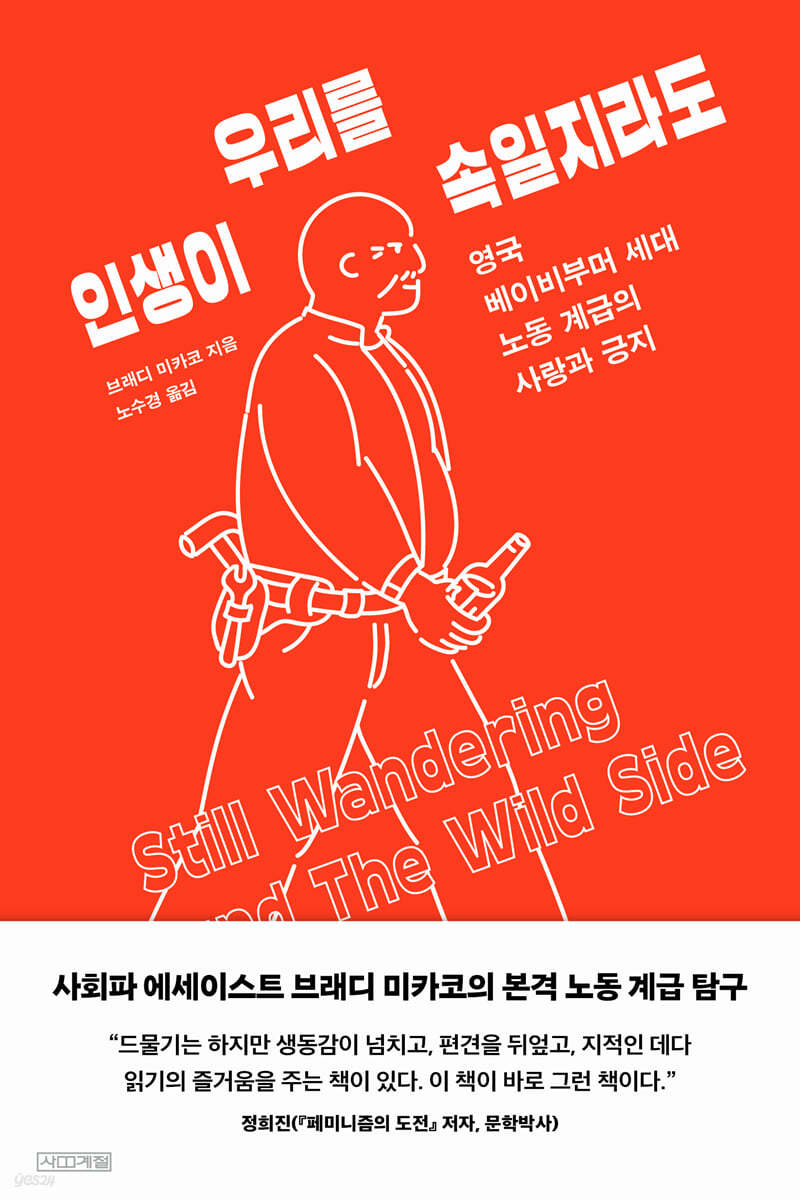 |
Description
Book Introduction
- A word from MD
- A large number of middle-aged working-class British people voted for Brexit and were criticised as far-right.
But the men Brady Mikako met respected the welfare state, unions, and diversity.
Although the author's perspective toward them is not entirely positive, this book questions the meaning of solidarity and class in today's world.
- Son Min-gyu, Social and Political MD
A full-fledged exploration of the working class by social essayist Brady Mikako.
Brady Mikako, who has unflinchingly shown in books such as “Children’s Class Struggle” and “I’m Yellow, White, and a Little Blue,” how the lives of children from poor families in Britain, where austerity policies have been prolonged, are subject to blatant discrimination and hatred, has now taken a closer look at the lives of the working-class baby boomer generation.
Just as there is a negative perception of so-called 'ajussi' in Korean society, there is widespread hatred and contempt for white working-class middle-aged men in British society.
How did the working class, once a driving force in British politics and the birthplace of popular culture, become a scourge on society, discriminating against women and immigrants, squandering taxes, stealing young people's jobs, and voting to leave the EU?
Brady Mikako, an immigrant and worker who has lived in the UK for over 25 years, has collected the stories of working-class people he has interacted with over the years, including auto mechanics, taxi drivers, supermarket clerks, painters, and delivery drivers, in twenty-one essays.
The world lumps them together and criticizes them, as if to say, "The root of all evil is the old man," but the author lays the foundation for understanding by describing in detail the life trajectories and changes in the workplace of each of these people.
In an era of austerity, when the government declared it would no longer take responsibility for the underprivileged, the stories of people living with the pride and self-esteem, resignation, and frustration of the working class reveal a complex and multifaceted landscape of daily life that generational or class theories cannot fully capture.
This book shines with the author's mature perspective, attempting to understand a specific generation or group in a way that doesn't erase their individual lives while examining the socio-political context behind the criticism.
Brady Mikako, who has unflinchingly shown in books such as “Children’s Class Struggle” and “I’m Yellow, White, and a Little Blue,” how the lives of children from poor families in Britain, where austerity policies have been prolonged, are subject to blatant discrimination and hatred, has now taken a closer look at the lives of the working-class baby boomer generation.
Just as there is a negative perception of so-called 'ajussi' in Korean society, there is widespread hatred and contempt for white working-class middle-aged men in British society.
How did the working class, once a driving force in British politics and the birthplace of popular culture, become a scourge on society, discriminating against women and immigrants, squandering taxes, stealing young people's jobs, and voting to leave the EU?
Brady Mikako, an immigrant and worker who has lived in the UK for over 25 years, has collected the stories of working-class people he has interacted with over the years, including auto mechanics, taxi drivers, supermarket clerks, painters, and delivery drivers, in twenty-one essays.
The world lumps them together and criticizes them, as if to say, "The root of all evil is the old man," but the author lays the foundation for understanding by describing in detail the life trajectories and changes in the workplace of each of these people.
In an era of austerity, when the government declared it would no longer take responsibility for the underprivileged, the stories of people living with the pride and self-esteem, resignation, and frustration of the working class reveal a complex and multifaceted landscape of daily life that generational or class theories cannot fully capture.
This book shines with the author's mature perspective, attempting to understand a specific generation or group in a way that doesn't erase their individual lives while examining the socio-political context behind the criticism.
- You can preview some of the book's contents.
Preview
index
Entering - You guys aren't dead yet, are you?
Main characters
Part 1: This Is England 2018–2019
1.
Tattoos and Peace
2.
Facing the cold early winter wind
3.
Brighton's Fairy Tale
4.
Working Class Heroes of 2018
5.
One Step Beyond
6.
Reality Bites
7.
No Surrender
8.
No Man, No Cry
9.
Uber, Black Cabs, and the Ghost of Blair
10.
Always look on the bright side of life
11.
Row the boat
12.
Burn, Simon
13.
There Generation, Baby
14.
Killing Me Softly - Our NHS
15.
you know me
16.
Heart-pounding Tonight
17.
Hear my roar
18.
I'm so sad I can't stand it
19.
Baby Maybe
20.
Listening to [Gran Torino]
21.
Phrase You - A Long, Long Road Together
Part 2 [Commentary] On Generations, Class, and Alcohol in Modern Britain
1.
Generational divide in the UK
2.
Current class divisions in Britain
3.
The last one is about the important alcohol
Coming Out - Living in the UK in a Snowstorm
Translator's Note
Main characters
Part 1: This Is England 2018–2019
1.
Tattoos and Peace
2.
Facing the cold early winter wind
3.
Brighton's Fairy Tale
4.
Working Class Heroes of 2018
5.
One Step Beyond
6.
Reality Bites
7.
No Surrender
8.
No Man, No Cry
9.
Uber, Black Cabs, and the Ghost of Blair
10.
Always look on the bright side of life
11.
Row the boat
12.
Burn, Simon
13.
There Generation, Baby
14.
Killing Me Softly - Our NHS
15.
you know me
16.
Heart-pounding Tonight
17.
Hear my roar
18.
I'm so sad I can't stand it
19.
Baby Maybe
20.
Listening to [Gran Torino]
21.
Phrase You - A Long, Long Road Together
Part 2 [Commentary] On Generations, Class, and Alcohol in Modern Britain
1.
Generational divide in the UK
2.
Current class divisions in Britain
3.
The last one is about the important alcohol
Coming Out - Living in the UK in a Snowstorm
Translator's Note
Detailed image

Into the book
The Welfare System's Failures: Neighborhood Otaku Experts
There are many people like this among the working class men in Britain.
I thought he was just a bad guy, but he actually has a secret otaku side and has a lot of useless knowledge about something.
From the Thatcher administration to the Brown administration, it was easier than expected to receive unemployment insurance and welfare benefits, so there were quite a few people in working-class cities who were just wandering around without working.
But this has borne an unexpectedly rich harvest.
One of the people who could be said to have been a victim of unemployment insurance was our neighborhood's 'community researcher', Steve.
--- p.27
Working-class men trying to cut off the path to class reproduction
In "The Hammertown Boys," the British working-class men, who are pointed out as "rebellious and resistant to authority, yet do not try to break out of the social class framework, but rather choose to live by 'hand labor,' thereby reproducing the existing class system," are finally trying to break this path of class reproduction.
There must have been many fathers in the past who tried to block the path to class reproduction by telling their children to become more successful than them.
But their recent comments had a desperate sense of reality: “What we do will no longer exist.”
--- p.45
The daily lives of the working class shattered by austerity
The wealthy do not use these public services, so even if austerity measures are implemented on a large scale, they do not experience any pain or inconvenience.
They use private hospitals and private schools and do not need welfare assistance.
It is the working class, us, who will have to bear the brunt of the impact of this policy.
(…) Even the library, which was considered the last bastion, was closed.
It really felt like the government was abandoning this slum.
Do the people up there really think that the foolish masses don't read books?
--- p.68~69
The Brexit referendum reveals the true feelings of the British people.
Watching Gemma express her emotions at that time, I thought that maybe the British people had buried their emotions deep inside, emotions that they usually didn't show, and that had all exploded at once.
How can we just sit back and watch a stranger come and harvest what we have grown with sweat and sorrow in England?
This feeling of anger, or rather, some emotion close to fear.
hatred.
Clearly, immigrants living in Britain are becoming hypersensitive about this these days.
That alone makes the Brexit vote a harmful one that should never have taken place.
The British people's true feelings have been revealed, and we immigrants cannot trust them as we did before the vote.
--- p.101~102
The Last Resisters
“So, this isn’t just a matter of health and money.
It's bigger.
I can't lose to Thatcher or global capitalism.
Of course I won't join in."
(…) As my husband said, this may not be just an NHS problem, but a bigger one.
Opposition to Thatcherism, opposition to globalism, and withdrawal from the EU are all connected and intertwined.
The older generation of Hammertown may be making their last stand against modern society.
--- p.151~153
The love story between a Vietnamese woman in her 20s and a British man in his 60s.
People fall in love faster than capital and labor move.
Even if the borders are closed.
People meet through FaceTime or Skype, talk, fall in love, and then fly away to Vietnam or Tong Buc Tu in Africa.
Love is madness.
Love is the ultimate weapon that cuts through xenophobia.
--- p.218~219
Today's working class
There is considerable diversity within the working class.
The common experiences of these diverse people as workers make them part of the same class.
The common experiences they share are economic hardship due to cuts in public services and welfare under the Conservative Party's austerity budget, and the deteriorating employment conditions and wages that make life difficult in a situation where the power of corporations has increased due to the weakening of labor unions.
(…) In modern times, when the power of the working class has weakened, the ideal working class would be a group of people of diverse races, genders, sexual orientations, religions, lifestyles, and cultures, yet connected by the single point of ‘money and employment.’
There are many people like this among the working class men in Britain.
I thought he was just a bad guy, but he actually has a secret otaku side and has a lot of useless knowledge about something.
From the Thatcher administration to the Brown administration, it was easier than expected to receive unemployment insurance and welfare benefits, so there were quite a few people in working-class cities who were just wandering around without working.
But this has borne an unexpectedly rich harvest.
One of the people who could be said to have been a victim of unemployment insurance was our neighborhood's 'community researcher', Steve.
--- p.27
Working-class men trying to cut off the path to class reproduction
In "The Hammertown Boys," the British working-class men, who are pointed out as "rebellious and resistant to authority, yet do not try to break out of the social class framework, but rather choose to live by 'hand labor,' thereby reproducing the existing class system," are finally trying to break this path of class reproduction.
There must have been many fathers in the past who tried to block the path to class reproduction by telling their children to become more successful than them.
But their recent comments had a desperate sense of reality: “What we do will no longer exist.”
--- p.45
The daily lives of the working class shattered by austerity
The wealthy do not use these public services, so even if austerity measures are implemented on a large scale, they do not experience any pain or inconvenience.
They use private hospitals and private schools and do not need welfare assistance.
It is the working class, us, who will have to bear the brunt of the impact of this policy.
(…) Even the library, which was considered the last bastion, was closed.
It really felt like the government was abandoning this slum.
Do the people up there really think that the foolish masses don't read books?
--- p.68~69
The Brexit referendum reveals the true feelings of the British people.
Watching Gemma express her emotions at that time, I thought that maybe the British people had buried their emotions deep inside, emotions that they usually didn't show, and that had all exploded at once.
How can we just sit back and watch a stranger come and harvest what we have grown with sweat and sorrow in England?
This feeling of anger, or rather, some emotion close to fear.
hatred.
Clearly, immigrants living in Britain are becoming hypersensitive about this these days.
That alone makes the Brexit vote a harmful one that should never have taken place.
The British people's true feelings have been revealed, and we immigrants cannot trust them as we did before the vote.
--- p.101~102
The Last Resisters
“So, this isn’t just a matter of health and money.
It's bigger.
I can't lose to Thatcher or global capitalism.
Of course I won't join in."
(…) As my husband said, this may not be just an NHS problem, but a bigger one.
Opposition to Thatcherism, opposition to globalism, and withdrawal from the EU are all connected and intertwined.
The older generation of Hammertown may be making their last stand against modern society.
--- p.151~153
The love story between a Vietnamese woman in her 20s and a British man in his 60s.
People fall in love faster than capital and labor move.
Even if the borders are closed.
People meet through FaceTime or Skype, talk, fall in love, and then fly away to Vietnam or Tong Buc Tu in Africa.
Love is madness.
Love is the ultimate weapon that cuts through xenophobia.
--- p.218~219
Today's working class
There is considerable diversity within the working class.
The common experiences of these diverse people as workers make them part of the same class.
The common experiences they share are economic hardship due to cuts in public services and welfare under the Conservative Party's austerity budget, and the deteriorating employment conditions and wages that make life difficult in a situation where the power of corporations has increased due to the weakening of labor unions.
(…) In modern times, when the power of the working class has weakened, the ideal working class would be a group of people of diverse races, genders, sexual orientations, religions, lifestyles, and cultures, yet connected by the single point of ‘money and employment.’
--- p.269~271
Publisher's Review
“The heroes of the working class never fall.”
Love and Pride of the British Baby Boomer Working Class
Brady Mikako has written several books, including her seminal work, "Class Struggle: The Children of the World," which vividly portray the devastation of Britain's working class and the underclass caused by the Conservative government's austerity policies.
He himself came from a poor family in Japan, and while working part-time while wearing his school uniform during high school, he said to his homeroom teacher, “There is no way such a poor family exists in Japan these days.
When I heard the story, “You must need money to play,” I thought, “Poor people should not be in Japan.
I decided to go to England, the land of punk rock where people proudly sing about being poor workers, and settled in England in 1996.
Having worked in various jobs in England and lived with a working-class identity to the core, he decided to write about working-class men of the baby boomer generation, including his husband, at the editor's suggestion, "Mr. Brady, please write about the men."
Brady Mikako opens the book by mentioning Paul Willis's "The Hammertown Boys" (originally titled Learning to Labour: How Working Class Kids Get Working Class Jobs, introduced in Korea under the title "Schools and Class Reproduction").
Published in 1977, this book was a participant observation study of teenage boys in the industrial city of Hammertown, and it revealed why 'working-class children, who are rebellious and resist authority, choose manual labor of their own accord and end up becoming typical members of the working class.'
Over the past 40 years, what kind of adults did those boys become and what kind of lives did they live?
As her husband and his friends happen to be the same age as the "Guys from Hammertown," Brady Mikako retraces the past and present of the British working class by describing how each of their jobs, living environments, and life paths have changed.
This book, which can be read as an episode about old men from the outskirts who wear Levi's jeans and Dr. Martens boots, drink beer to their hearts' content, and fall in love with a young Asian beauty, is actually a story about the pride and self-esteem that sustains the lives of the British working class, and the strong will to survive in any situation.
“Well, I guess I won’t die though.
As the author's husband says, "We survived the Thatcher era" (p. 287), these people drove taxis, repaired cars, and worked as painters to keep their livelihoods going as Britain transitioned from a post-war "cradle-to-grave" welfare society to an era of austerity, and even carried out Brexit in the midst of the turbulent waves of global capitalism.
Despite criticism that they are blocking the future of the younger generation, they still believe in the power of labor unions, cherish the NHS (National Health Service), the last legacy of the welfare state, and protect their neighbors in need, such as the homeless and immigrants. In this way, we can see the specific face of the 'class consciousness' that has continued to permeate British society.
This book is a book that tells the story of class in a way that is not burdensome, adding rock, alcohol, and the sadness of middle-aged and older people to Korean society, which rarely brings up the topic of class.
Slipping between generational theory and class theory
A story about life and work, strength and vulnerability at the bottom of society.
Brady Mikako said, “Just because they are old men doesn’t mean they are all the same.
“If you look closely at working-class uncles, I know that there are many different types of people, so you can’t roughly lump them all together” (page 7), and he unfolds the story of the working-class ‘uncles (and aunties)’ that he has met and experienced for a long time.
Ray, a former car mechanic in his 60s, partners with Rachel, a 30-something businesswoman and mother of three, and they live together as stay-at-home parents until the Brexit referendum triggers a rift between them.
When Ray, who disliked the influx of immigrants and the blurring of borders and sovereignty, voted in favor, Rachel, who was burning with ambitions to expand her business by serving immigrants as customers, became furious.
Ray, a youth born into the welfare state, and Rachel, a child of neoliberalism, reveal completely different values about life and work, which is also part of the generational conflict currently experiencing in British society.
Eventually, Rachel leaves, and Ray wavers for a moment, but pulls himself together and finds a job, thinking, “Romantic things like despair are for upper-class people” (p. 132).
Brady Mikako describes this as a resignation that comes from “working-class rationality.”
Steve, who works at a supermarket, is concerned about the increase in immigration and is in favour of Brexit, but believes that immigrants already living in the UK should be respected.
So when the neighborhood teenagers start harassing the Chinese, he forms a night patrol to protect them.
We practice the spirit of mutual aid, saying that if the government neglects the slums, we will take care of ourselves.
Steve is also someone who finds pleasure in reading books in the library during his off-hours, and when austerity forces the closure of the library, leaving only a box of books in a corner of the children's playroom, he sits there and steadfastly uses the city's book delivery service.
The author is amazed at the sight of a man with a bushy haircut and sharp eyes, wearing skinny jeans and Dr. Martens boots, sitting in a corner of a children's playroom reading a book, and exclaims, "This is truly the image of the people protesting against austerity" (p. 72).
Steve, who takes care of the children and mothers who visit the playroom during the protest, shows the complex and diverse aspects of a person who cannot be simply described as a 'pro-Brexit conservative idiot'.
Simon, a hard-line Brexiteer who insists on limiting the influx of EU immigrants, teaches his nephew and his French immigrant lover, who are about to embark on their first-ever labor strike, how to make placards and the power of unions; Jackie, a woman in her 60s who worked all kinds of manual labor to support her family, but then decided she couldn't die in a council housing estate and remodeled her entire house on her own; and Danny, a heavy drinker, soccer fanatic, and womanizer who, in his later years, brought a Vietnamese woman to the UK to stay with him until her death, is a "typical" uncle, but he cherishes his nephew with Down syndrome. None of the characters in this book are simple.
No one fits the mold of a Brexit-supporting xenophobe, a pensioner living comfortably, or a white male worker who drinks beer until he pukes before resorting to violence.
Through the joys and sorrows of these lovable characters, Brady Mikako vividly portrays the strengths and vulnerabilities of the underclass, a strength that generational and class-defining theories fail to capture.
This book can be said to be one in which the author fully demonstrates the 'empathy' he explored in detail in his previous work, 'Wearing Someone Else's Shoes'.
"Austerity is a sin."
British society yesterday and today, seen from the bottom
Why has generational conflict, working-class hatred, and the Brexit debate become so intense in British society?
The author argues that blaming a particular group is a consequence of the lack of leeway in society as a whole, a consequence of the austerity measures that Conservative governments have been enforcing since the Thatcher government.
The lives of the characters in Part 1 of this book are inevitably disrupted and derailed by the effects of austerity.
The author's husband's episode of waiting for NHS treatment despite suffering from unbearable headaches that lasted for months, saying he could never go to a private medical facility, shows the British working class's almost obsessive love for the NHS.
The NHS, with its finances depleted and pushing patients away in every way possible, has long since become incapable of functioning as a national healthcare system.
However, the British people's fervent desire for the NHS persisted, exerting a tremendous influence on the Brexit vote. Despite the Leave campaign's extensive campaign promise that Brexit would allow the NHS to receive its share of EU funding, many voters, regardless of their political affiliation, voted in favor.
It's not that they are xenophobic and far-right patriots, as the public perceives, but rather that they are people who have chosen to leave because their situation is so dire that they want to believe anything they hear about the NHS improving.
The conflict between London's iconic black cabs and the new ride-hailing service Uber also reveals the complex intertwining of race, class, globalism, and xenophobia in Britain's present.
The conflict between black cabs, which are mostly driven by white British people, and Uber, which has a majority of its drivers being immigrants, has led to racist remarks and the use of British flags, and the fact that most black cab drivers support leaving the EU has made black cabs a hotbed of xenophobia.
But surprisingly, the Labor Party, which calls itself progressive, opposes Uber, saying that it worsens the treatment of domestic workers.
This is a clear example of an era in which the distinction between right and left became difficult.
In Part 2 of the book, Brady Mikako thoroughly introduces the British generational and class theories that are used to explain this reality.
This book outlines the characteristics of the Baby Boomer generation, to which the main characters belong, as well as the generations preceding and following them, such as Generation X and Generation Z, and points out the points of conflict between them and the socioeconomic background that fueled it.
It also introduces how class divisions are still entrenched in British society, where class consciousness is still strong, and details the educational and cultural situation of the white working class, which is currently the most problematic issue in Britain.
The era of intellectual "working-class heroes" driving popular culture is over, and now the white working class has become the lowest-achieving, least ambitious, and most in need of social support.
However, the author also notes that as these discussions continue, the plight of non-white workers is often forgotten or ignored.
The habitual use of the word “white” in the term “working class” not only reinforces negative stereotypes such as “the working class is a bunch of tattooed racists,” but also excludes immigrants from the working class.
The author criticizes the working class by labeling them “white” and demonizing them by emphasizing their negative aspects, thereby making immigrants think of themselves as non-working class, as “the wisdom of those in power who thought that by encouraging division among the poor class and pitting them against each other, they would not turn their anger toward the government and politicians” (p. 271).
He argues that the future working class must unite based on its internal diversity, that is, on the common experience of workers among people of different races, religions, cultures, and genders.
If the rulers are 'DIVIDE & RULE', the working class presents a wonderful rhyme of 'UNITE & FIGHT'.
John Lennon, Madness, Lou Reed, The Who, Bob Marley… …
The fighting spirit and spirit of the working class woven through rock and pop classics.
Music and alcohol run through the book throughout.
Brady Mikako, who decided to immigrate because she loved British music, wrote each episode by closely weaving together rock and pop from the English-speaking world and Japanese popular music.
As British rock music has its roots in working-class culture, the background music and writing combine to create a consistent emotional tone.
If you listen to the song introduced and look at the lyrics, you will be able to feel the fighting spirit and spirit that the characters in this book showed in their lives even more clearly.
Just as 'pubs' cannot be left out when discussing British culture, beer appears in almost every episode of this book, and as if that weren't enough, the story of British drinking is the finale.
The author says that changes in British society can also be seen through changes in drinking culture.
The baby boomers, the main characters of this book, are now in their 60s and 70s and are drinking green smoothies instead of beer.
The younger generation drinks less alcohol in the first place and prefers sparkling wine to beer.
The author sadly depicts the twilight of a generation and an era, suggesting that perhaps who drinks and what kind of alcohol they prefer may reveal the changes in the underlying society more clearly than generational or class theory.
Love and Pride of the British Baby Boomer Working Class
Brady Mikako has written several books, including her seminal work, "Class Struggle: The Children of the World," which vividly portray the devastation of Britain's working class and the underclass caused by the Conservative government's austerity policies.
He himself came from a poor family in Japan, and while working part-time while wearing his school uniform during high school, he said to his homeroom teacher, “There is no way such a poor family exists in Japan these days.
When I heard the story, “You must need money to play,” I thought, “Poor people should not be in Japan.
I decided to go to England, the land of punk rock where people proudly sing about being poor workers, and settled in England in 1996.
Having worked in various jobs in England and lived with a working-class identity to the core, he decided to write about working-class men of the baby boomer generation, including his husband, at the editor's suggestion, "Mr. Brady, please write about the men."
Brady Mikako opens the book by mentioning Paul Willis's "The Hammertown Boys" (originally titled Learning to Labour: How Working Class Kids Get Working Class Jobs, introduced in Korea under the title "Schools and Class Reproduction").
Published in 1977, this book was a participant observation study of teenage boys in the industrial city of Hammertown, and it revealed why 'working-class children, who are rebellious and resist authority, choose manual labor of their own accord and end up becoming typical members of the working class.'
Over the past 40 years, what kind of adults did those boys become and what kind of lives did they live?
As her husband and his friends happen to be the same age as the "Guys from Hammertown," Brady Mikako retraces the past and present of the British working class by describing how each of their jobs, living environments, and life paths have changed.
This book, which can be read as an episode about old men from the outskirts who wear Levi's jeans and Dr. Martens boots, drink beer to their hearts' content, and fall in love with a young Asian beauty, is actually a story about the pride and self-esteem that sustains the lives of the British working class, and the strong will to survive in any situation.
“Well, I guess I won’t die though.
As the author's husband says, "We survived the Thatcher era" (p. 287), these people drove taxis, repaired cars, and worked as painters to keep their livelihoods going as Britain transitioned from a post-war "cradle-to-grave" welfare society to an era of austerity, and even carried out Brexit in the midst of the turbulent waves of global capitalism.
Despite criticism that they are blocking the future of the younger generation, they still believe in the power of labor unions, cherish the NHS (National Health Service), the last legacy of the welfare state, and protect their neighbors in need, such as the homeless and immigrants. In this way, we can see the specific face of the 'class consciousness' that has continued to permeate British society.
This book is a book that tells the story of class in a way that is not burdensome, adding rock, alcohol, and the sadness of middle-aged and older people to Korean society, which rarely brings up the topic of class.
Slipping between generational theory and class theory
A story about life and work, strength and vulnerability at the bottom of society.
Brady Mikako said, “Just because they are old men doesn’t mean they are all the same.
“If you look closely at working-class uncles, I know that there are many different types of people, so you can’t roughly lump them all together” (page 7), and he unfolds the story of the working-class ‘uncles (and aunties)’ that he has met and experienced for a long time.
Ray, a former car mechanic in his 60s, partners with Rachel, a 30-something businesswoman and mother of three, and they live together as stay-at-home parents until the Brexit referendum triggers a rift between them.
When Ray, who disliked the influx of immigrants and the blurring of borders and sovereignty, voted in favor, Rachel, who was burning with ambitions to expand her business by serving immigrants as customers, became furious.
Ray, a youth born into the welfare state, and Rachel, a child of neoliberalism, reveal completely different values about life and work, which is also part of the generational conflict currently experiencing in British society.
Eventually, Rachel leaves, and Ray wavers for a moment, but pulls himself together and finds a job, thinking, “Romantic things like despair are for upper-class people” (p. 132).
Brady Mikako describes this as a resignation that comes from “working-class rationality.”
Steve, who works at a supermarket, is concerned about the increase in immigration and is in favour of Brexit, but believes that immigrants already living in the UK should be respected.
So when the neighborhood teenagers start harassing the Chinese, he forms a night patrol to protect them.
We practice the spirit of mutual aid, saying that if the government neglects the slums, we will take care of ourselves.
Steve is also someone who finds pleasure in reading books in the library during his off-hours, and when austerity forces the closure of the library, leaving only a box of books in a corner of the children's playroom, he sits there and steadfastly uses the city's book delivery service.
The author is amazed at the sight of a man with a bushy haircut and sharp eyes, wearing skinny jeans and Dr. Martens boots, sitting in a corner of a children's playroom reading a book, and exclaims, "This is truly the image of the people protesting against austerity" (p. 72).
Steve, who takes care of the children and mothers who visit the playroom during the protest, shows the complex and diverse aspects of a person who cannot be simply described as a 'pro-Brexit conservative idiot'.
Simon, a hard-line Brexiteer who insists on limiting the influx of EU immigrants, teaches his nephew and his French immigrant lover, who are about to embark on their first-ever labor strike, how to make placards and the power of unions; Jackie, a woman in her 60s who worked all kinds of manual labor to support her family, but then decided she couldn't die in a council housing estate and remodeled her entire house on her own; and Danny, a heavy drinker, soccer fanatic, and womanizer who, in his later years, brought a Vietnamese woman to the UK to stay with him until her death, is a "typical" uncle, but he cherishes his nephew with Down syndrome. None of the characters in this book are simple.
No one fits the mold of a Brexit-supporting xenophobe, a pensioner living comfortably, or a white male worker who drinks beer until he pukes before resorting to violence.
Through the joys and sorrows of these lovable characters, Brady Mikako vividly portrays the strengths and vulnerabilities of the underclass, a strength that generational and class-defining theories fail to capture.
This book can be said to be one in which the author fully demonstrates the 'empathy' he explored in detail in his previous work, 'Wearing Someone Else's Shoes'.
"Austerity is a sin."
British society yesterday and today, seen from the bottom
Why has generational conflict, working-class hatred, and the Brexit debate become so intense in British society?
The author argues that blaming a particular group is a consequence of the lack of leeway in society as a whole, a consequence of the austerity measures that Conservative governments have been enforcing since the Thatcher government.
The lives of the characters in Part 1 of this book are inevitably disrupted and derailed by the effects of austerity.
The author's husband's episode of waiting for NHS treatment despite suffering from unbearable headaches that lasted for months, saying he could never go to a private medical facility, shows the British working class's almost obsessive love for the NHS.
The NHS, with its finances depleted and pushing patients away in every way possible, has long since become incapable of functioning as a national healthcare system.
However, the British people's fervent desire for the NHS persisted, exerting a tremendous influence on the Brexit vote. Despite the Leave campaign's extensive campaign promise that Brexit would allow the NHS to receive its share of EU funding, many voters, regardless of their political affiliation, voted in favor.
It's not that they are xenophobic and far-right patriots, as the public perceives, but rather that they are people who have chosen to leave because their situation is so dire that they want to believe anything they hear about the NHS improving.
The conflict between London's iconic black cabs and the new ride-hailing service Uber also reveals the complex intertwining of race, class, globalism, and xenophobia in Britain's present.
The conflict between black cabs, which are mostly driven by white British people, and Uber, which has a majority of its drivers being immigrants, has led to racist remarks and the use of British flags, and the fact that most black cab drivers support leaving the EU has made black cabs a hotbed of xenophobia.
But surprisingly, the Labor Party, which calls itself progressive, opposes Uber, saying that it worsens the treatment of domestic workers.
This is a clear example of an era in which the distinction between right and left became difficult.
In Part 2 of the book, Brady Mikako thoroughly introduces the British generational and class theories that are used to explain this reality.
This book outlines the characteristics of the Baby Boomer generation, to which the main characters belong, as well as the generations preceding and following them, such as Generation X and Generation Z, and points out the points of conflict between them and the socioeconomic background that fueled it.
It also introduces how class divisions are still entrenched in British society, where class consciousness is still strong, and details the educational and cultural situation of the white working class, which is currently the most problematic issue in Britain.
The era of intellectual "working-class heroes" driving popular culture is over, and now the white working class has become the lowest-achieving, least ambitious, and most in need of social support.
However, the author also notes that as these discussions continue, the plight of non-white workers is often forgotten or ignored.
The habitual use of the word “white” in the term “working class” not only reinforces negative stereotypes such as “the working class is a bunch of tattooed racists,” but also excludes immigrants from the working class.
The author criticizes the working class by labeling them “white” and demonizing them by emphasizing their negative aspects, thereby making immigrants think of themselves as non-working class, as “the wisdom of those in power who thought that by encouraging division among the poor class and pitting them against each other, they would not turn their anger toward the government and politicians” (p. 271).
He argues that the future working class must unite based on its internal diversity, that is, on the common experience of workers among people of different races, religions, cultures, and genders.
If the rulers are 'DIVIDE & RULE', the working class presents a wonderful rhyme of 'UNITE & FIGHT'.
John Lennon, Madness, Lou Reed, The Who, Bob Marley… …
The fighting spirit and spirit of the working class woven through rock and pop classics.
Music and alcohol run through the book throughout.
Brady Mikako, who decided to immigrate because she loved British music, wrote each episode by closely weaving together rock and pop from the English-speaking world and Japanese popular music.
As British rock music has its roots in working-class culture, the background music and writing combine to create a consistent emotional tone.
If you listen to the song introduced and look at the lyrics, you will be able to feel the fighting spirit and spirit that the characters in this book showed in their lives even more clearly.
Just as 'pubs' cannot be left out when discussing British culture, beer appears in almost every episode of this book, and as if that weren't enough, the story of British drinking is the finale.
The author says that changes in British society can also be seen through changes in drinking culture.
The baby boomers, the main characters of this book, are now in their 60s and 70s and are drinking green smoothies instead of beer.
The younger generation drinks less alcohol in the first place and prefers sparkling wine to beer.
The author sadly depicts the twilight of a generation and an era, suggesting that perhaps who drinks and what kind of alcohol they prefer may reveal the changes in the underlying society more clearly than generational or class theory.
GOODS SPECIFICS
- Publication date: June 17, 2022
- Page count, weight, size: 296 pages | 472g | 140*210*20mm
- ISBN13: 9791160949391
- ISBN10: 1160949395
You may also like
카테고리
korean


korean

![GQ KOREA Mark (Monthly): December [2025]](http://librairie.coreenne.fr/cdn/shop/files/8ef265dbbfbf186523ed75ba7319009d.jpg?v=1765340328&width=3840)


