

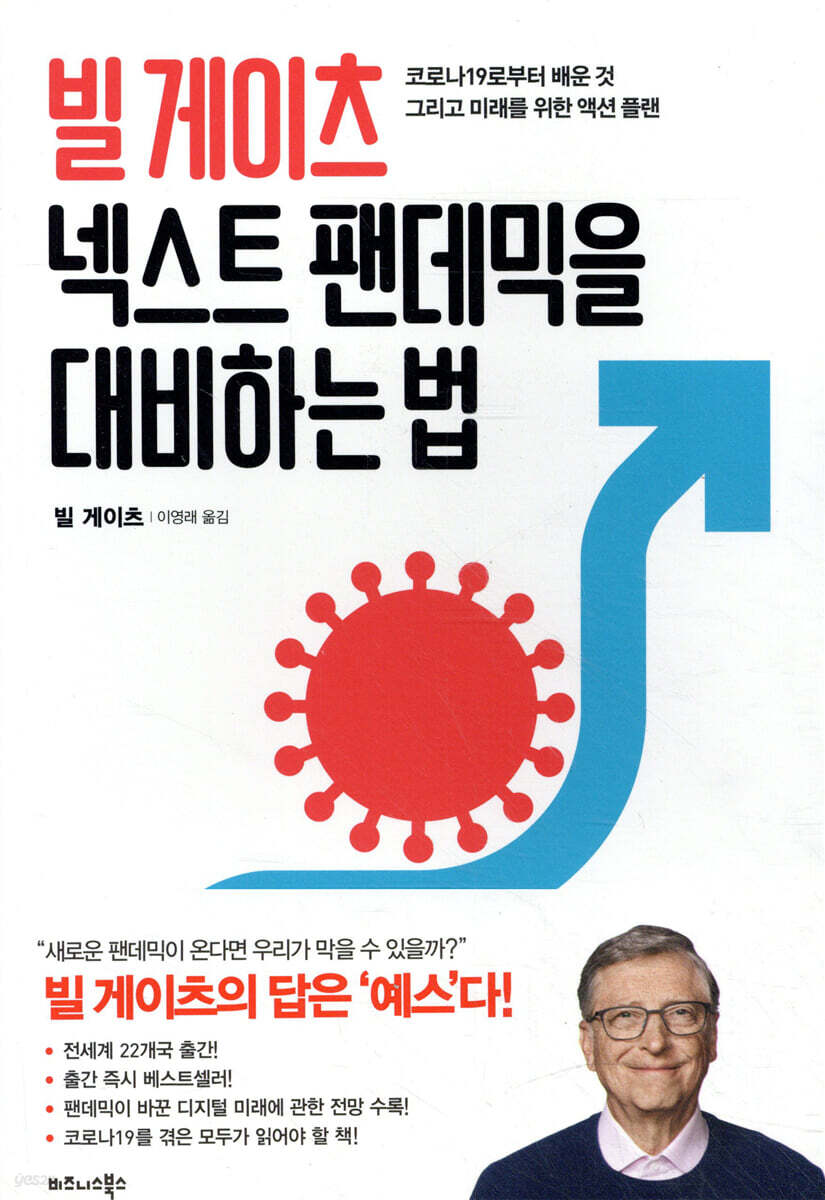
Bill Gates: How to Prepare for the Next Pandemic
 |
Description
Book Introduction
* Bill Gates' book, which was published in 22 countries around the world and became a hot topic even before its publication, is finally published in Korea! * Bill Gates' action plan to prepare for the 'next pandemic'! * From the lessons of COVID-19 to a vision for the digital future, this is a must-read for anyone who has experienced a pandemic! At the World Economic Forum (WEF) Annual Meeting (Davos Forum) held on the 25th, Bill Gates, co-chairman of the Bill & Melinda Gates Foundation, emphasized that “in order to prevent the next pandemic, it is important to suppress the initial spread.” He said, “If an outbreak is detected and the infection is controlled within 100 days, the mortality rate can be lowered to less than 2 percent.” In fact, since 2015, Bill Gates has consistently raised the possibility of a pandemic caused by a respiratory virus and urged governments around the world to prepare preventive measures. Because of this, when the COVID-19 pandemic hit, his pandemic warning remarks were re-examined and became a hot topic. Bill Gates identifies 'epidemics' as the greatest threat to humanity. He is particularly wary of respiratory virus epidemics, going so far as to say that the disaster he fears most is “not nuclear weapons or climate change, but the highly contagious influenza virus.” In fact, the most fatal event that took human lives in the 20th century was not war, but epidemic disease. The Spanish flu of 1918 killed approximately 50 million people. Moreover, the interval between pandemics is also shortening, from the Hong Kong flu in 1968, the swine flu in 2009, and COVID-19 in 2020. With the threat of such catastrophic epidemics continuing, can we prevent the next pandemic? Surprisingly, Bill Gates' answer is a resounding "yes." And the explanation and answer to that question are included in this new book. In this book, Bill Gates looks back on what the world has learned from COVID-19 and suggests an "action plan" we must implement to avoid another disaster like this. The book concludes with a look at how digital technology, accelerated by the coronavirus pandemic, has transformed our daily lives and what changes are likely to occur in the coming years. Bill Gates' new book attracted much attention as soon as he announced it on his blog in February, and was featured in domestic and international media outlets. As the book was published while the pandemic was still ongoing, its timeliness is by no means light. Let's take a look at Bill Gates' vision to save the world by using innovation as a "hammer" to consider questions like, "Who needs to do what to prevent future epidemics?" and "How can we develop vaccines and treatments more quickly?" |
- You can preview some of the book's contents.
Preview
index
Entering
Chapter 1: What We Learned from Corona
Learn from COVID
Chapter 2: How to Prepare for the Next Pandemic
Create a pandemic prevention team
Chapter 3: How to Detect and Contain Early Signs of a Pandemic
Get better at detecting outbreaks early
Chapter 4: Pandemic Basics: Wearing Masks and Social Distancing
Help people protect themselves right away
Chapter 5: The Fierce Challenges of Finding New Treatments
Find new treatments fast
Chapter 6: Make a vaccine within six months
Get ready to make vaccines
Chapter 7: The World Prepares Together
Practice, practice, practice
Chapter 8: Health Disparities: The Gap Between Rich and Poor Countries
Close the health gap between rich and poor countries
Chapter 9: Action Plan to Make COVID-19 the Last Pandemic
Make and fund a plan for preventing pandemics
Review: How COVID-19 Changed Our Digital Future
Glossary of Terms
Acknowledgements
annotation
Search
Chapter 1: What We Learned from Corona
Learn from COVID
Chapter 2: How to Prepare for the Next Pandemic
Create a pandemic prevention team
Chapter 3: How to Detect and Contain Early Signs of a Pandemic
Get better at detecting outbreaks early
Chapter 4: Pandemic Basics: Wearing Masks and Social Distancing
Help people protect themselves right away
Chapter 5: The Fierce Challenges of Finding New Treatments
Find new treatments fast
Chapter 6: Make a vaccine within six months
Get ready to make vaccines
Chapter 7: The World Prepares Together
Practice, practice, practice
Chapter 8: Health Disparities: The Gap Between Rich and Poor Countries
Close the health gap between rich and poor countries
Chapter 9: Action Plan to Make COVID-19 the Last Pandemic
Make and fund a plan for preventing pandemics
Review: How COVID-19 Changed Our Digital Future
Glossary of Terms
Acknowledgements
annotation
Search
Detailed image

Into the book
In fact, I want to do something more extraordinary than just stop bad things from happening.
In other words, we are trying to find an opportunity to eradicate the entire respiratory virus family.
This means the end of coronaviruses like this pandemic, and even the end of influenza.
Every year, influenza alone affects up to 1 billion people, of which 3 to 5 million develop severe illness requiring hospitalization, and more than 300,000 people die.
The benefits of fighting respiratory viruses would be enormous if we added the impact of coronaviruses, which cause common cold symptoms.
---From "Entering"
Most of the countries with the lowest excess mortality rates (close to zero or negative)—Australia, Vietnam, New Zealand, and South Korea—did three things well early in the pandemic.
We conducted rapid testing on a large number of people, and isolated those who tested positive and those who were exposed to the virus.
And we implemented a plan to identify, track, and manage cases that may have crossed the border.
(Omitted) But the most serious failure of all is that Americans were not properly tested.
There wasn't enough testing done and it took too long for the results to come back.
What if someone carrying the virus doesn't know it for seven days? That gives them a full week to infect others.
(Omitted) Chapter 1 can be summarized as follows.
The world is not investing in the tools needed to respond to a pandemic or in adequate pandemic preparedness.
The time has come to begin preparing for such a situation.
---From Chapter 1, What We Learned from Corona
What we need is a well-funded, global organization with a sufficient number of full-time experts in all the necessary fields, the credibility and authority of a public institution, and a clearly defined mandate for pandemic prevention.
I call it the GERM (Global Epidemic Response and Mobilization) Team (hereafter GERM).
(Omitted) They should be well-paid, receive regular training, and be prepared to organize a response to the next pandemic threat. GERM should have the authority to declare pandemics and, in collaboration with national governments and the World Bank, should be able to rapidly mobilize funding for the response.
According to my rough calculations, GERM needs 3,000 full-time employees.
We need talent across a wide range of fields, including epidemiology, genetics, drug and vaccine development, data systems, diplomacy, rapid response, logistics, computer modeling, and communications.
---From Chapter 2: How to Prepare for the Next Pandemic
The first step is to invest heavily in all elements of a robust health system that enables disease detection, reporting, and even treatment.
Greater investment is especially needed in low- and middle-income countries, where health systems often suffer from underfunding.
If doctors and epidemiologists don't have the tools they need, if they don't have the training they need, and if national health institutions are weak or nonexistent, disease outbreaks will continue to occur.
Every society in every country must detect and report an outbreak within seven days, initiate an investigation within a day, and implement effective control measures within a week (this is the goal for everyone in the health system and a benchmark for measuring progress).
---From Chapter 3, "How to Detect and Suppress Early Signs of a Pandemic"
The benefits of masks have now been proven worldwide.
Early in the pandemic, Japan took the issue of mask-wearing seriously and combined it with contact tracing.
As a result, the excess mortality rate remained extremely low at 70 per million people at the end of 2021.
In Bangladesh, researchers studied nearly 350,000 adults across 600 villages to determine the impact of public messaging about masks.
One group, about half of the study subjects, received free masks (some cloth, some medical), face-to-face information about the importance of mask use, and encouragement from religious and political leaders.
The second group was not given any of these prompts.
After two months, the first group's appropriate mask use rate was 42 percent, while the second group's was only 13 percent.
The first group also had lower rates of COVID-19 infection and were still more likely to use masks five months later.
---From Chapter 4, Basic Pandemic Measures: Wearing Masks and Social Distancing
Fortunately, the coronavirus was relatively easy to target with a vaccine.
This was partly because the surface spike protein's camouflage was not as severe as that of proteins from other viruses.
That's why the success rate of the coronavirus vaccine was unusually high.
But what's often underestimated about the miracle of the COVID-19 vaccine is not the fact that it was created and approved, but that it was created and approved "faster" than any other vaccine.
(Omitted) Unfortunately, as we saw with COVID, creating and getting a vaccine approved is one thing, but creating a system that doesn't divide the haves from the have-nots—making and distributing enough doses to quickly reach everyone who needs it, including people in low-income countries who are at high risk of developing severe disease—is a completely different matter.
---From Chapter 6, "Make a Vaccine in 6 Months"
So far, we have only discussed naturally occurring pathogens.
But there is a more disturbing scenario that must be kept in mind when conducting disease simulation training.
Biological terrorism is the intentional spread of a pathogen with the intent to kill or maim many people.
The use of viruses and bacteria as weapons has been around for centuries.
(Omitted) The natural pathogen that could become the most terrifying weapon today is smallpox.
Smallpox is particularly frightening because it spreads rapidly through the air and has an extremely high mortality rate, killing one in three people who are infected.
Moreover, since most vaccination programs were discontinued after smallpox was eradicated in 1980, no one is immune to smallpox anymore.
The United States has enough smallpox vaccine stockpiled to protect the entire population, but distributing the vaccine is no simple matter.
Not to mention in situations where people are in a state of panic in the face of an attack.
It is unclear whether it will be able to protect countries other than the United States.
---From Chapter 7, “The Whole World Must Prepare Together”
As of the end of March 2021, 18 percent of Americans had been fully vaccinated, compared with 0.67 percent in India and 0.44 percent in South Africa.
By late July, the U.S. had reached 50 percent fully vaccinated, while India had just 7 percent and South Africa 6 percent.
People in wealthier countries, who are less likely to develop severe illness, were being vaccinated before those in poorer countries, who are at much higher risk.
(Omitted) In other words, it means that health inequality is a common problem.
The reason so many people in wealthy countries are shocked by the inequalities in the response to the coronavirus isn't because it's out of the ordinary.
Because health inequalities were otherwise unnoticed.
The coronavirus pandemic (a disease the world is experiencing) has brought to everyone's attention the unequal distribution of resources.
I'm not trying to depress you or point a finger at people who don't dedicate their lives to global health.
The important thing is that all of this deserves more attention.
---From Chapter 8, Health Disparities: The Gap Between Rich and Poor Countries
Governments must continue to lead the way in securing new funding for the systems, tools, and teams the world needs to prevent pandemics.
As I discussed in Chapter 2, I believe GERM will require an annual budget of about $1 billion.
And I believe that the funds should be raised by governments of wealthy countries and some middle-income countries.
I estimate that over the next decade, every government will need to spend $15 to $20 billion to develop the necessary vaccines, anti-infectives, therapeutics, and diagnostics.
This is what could be achieved if the United States increased its health care spending by 25 percent (about $10 billion) and the rest of the world increased its spending by similar proportions.
Of course, in absolute terms, $10 billion is a huge amount of money.
But that's just over 1 percent of the U.S. defense budget, a drop in the bucket compared to the trillions of dollars lost during the coronavirus pandemic.
In other words, we are trying to find an opportunity to eradicate the entire respiratory virus family.
This means the end of coronaviruses like this pandemic, and even the end of influenza.
Every year, influenza alone affects up to 1 billion people, of which 3 to 5 million develop severe illness requiring hospitalization, and more than 300,000 people die.
The benefits of fighting respiratory viruses would be enormous if we added the impact of coronaviruses, which cause common cold symptoms.
---From "Entering"
Most of the countries with the lowest excess mortality rates (close to zero or negative)—Australia, Vietnam, New Zealand, and South Korea—did three things well early in the pandemic.
We conducted rapid testing on a large number of people, and isolated those who tested positive and those who were exposed to the virus.
And we implemented a plan to identify, track, and manage cases that may have crossed the border.
(Omitted) But the most serious failure of all is that Americans were not properly tested.
There wasn't enough testing done and it took too long for the results to come back.
What if someone carrying the virus doesn't know it for seven days? That gives them a full week to infect others.
(Omitted) Chapter 1 can be summarized as follows.
The world is not investing in the tools needed to respond to a pandemic or in adequate pandemic preparedness.
The time has come to begin preparing for such a situation.
---From Chapter 1, What We Learned from Corona
What we need is a well-funded, global organization with a sufficient number of full-time experts in all the necessary fields, the credibility and authority of a public institution, and a clearly defined mandate for pandemic prevention.
I call it the GERM (Global Epidemic Response and Mobilization) Team (hereafter GERM).
(Omitted) They should be well-paid, receive regular training, and be prepared to organize a response to the next pandemic threat. GERM should have the authority to declare pandemics and, in collaboration with national governments and the World Bank, should be able to rapidly mobilize funding for the response.
According to my rough calculations, GERM needs 3,000 full-time employees.
We need talent across a wide range of fields, including epidemiology, genetics, drug and vaccine development, data systems, diplomacy, rapid response, logistics, computer modeling, and communications.
---From Chapter 2: How to Prepare for the Next Pandemic
The first step is to invest heavily in all elements of a robust health system that enables disease detection, reporting, and even treatment.
Greater investment is especially needed in low- and middle-income countries, where health systems often suffer from underfunding.
If doctors and epidemiologists don't have the tools they need, if they don't have the training they need, and if national health institutions are weak or nonexistent, disease outbreaks will continue to occur.
Every society in every country must detect and report an outbreak within seven days, initiate an investigation within a day, and implement effective control measures within a week (this is the goal for everyone in the health system and a benchmark for measuring progress).
---From Chapter 3, "How to Detect and Suppress Early Signs of a Pandemic"
The benefits of masks have now been proven worldwide.
Early in the pandemic, Japan took the issue of mask-wearing seriously and combined it with contact tracing.
As a result, the excess mortality rate remained extremely low at 70 per million people at the end of 2021.
In Bangladesh, researchers studied nearly 350,000 adults across 600 villages to determine the impact of public messaging about masks.
One group, about half of the study subjects, received free masks (some cloth, some medical), face-to-face information about the importance of mask use, and encouragement from religious and political leaders.
The second group was not given any of these prompts.
After two months, the first group's appropriate mask use rate was 42 percent, while the second group's was only 13 percent.
The first group also had lower rates of COVID-19 infection and were still more likely to use masks five months later.
---From Chapter 4, Basic Pandemic Measures: Wearing Masks and Social Distancing
Fortunately, the coronavirus was relatively easy to target with a vaccine.
This was partly because the surface spike protein's camouflage was not as severe as that of proteins from other viruses.
That's why the success rate of the coronavirus vaccine was unusually high.
But what's often underestimated about the miracle of the COVID-19 vaccine is not the fact that it was created and approved, but that it was created and approved "faster" than any other vaccine.
(Omitted) Unfortunately, as we saw with COVID, creating and getting a vaccine approved is one thing, but creating a system that doesn't divide the haves from the have-nots—making and distributing enough doses to quickly reach everyone who needs it, including people in low-income countries who are at high risk of developing severe disease—is a completely different matter.
---From Chapter 6, "Make a Vaccine in 6 Months"
So far, we have only discussed naturally occurring pathogens.
But there is a more disturbing scenario that must be kept in mind when conducting disease simulation training.
Biological terrorism is the intentional spread of a pathogen with the intent to kill or maim many people.
The use of viruses and bacteria as weapons has been around for centuries.
(Omitted) The natural pathogen that could become the most terrifying weapon today is smallpox.
Smallpox is particularly frightening because it spreads rapidly through the air and has an extremely high mortality rate, killing one in three people who are infected.
Moreover, since most vaccination programs were discontinued after smallpox was eradicated in 1980, no one is immune to smallpox anymore.
The United States has enough smallpox vaccine stockpiled to protect the entire population, but distributing the vaccine is no simple matter.
Not to mention in situations where people are in a state of panic in the face of an attack.
It is unclear whether it will be able to protect countries other than the United States.
---From Chapter 7, “The Whole World Must Prepare Together”
As of the end of March 2021, 18 percent of Americans had been fully vaccinated, compared with 0.67 percent in India and 0.44 percent in South Africa.
By late July, the U.S. had reached 50 percent fully vaccinated, while India had just 7 percent and South Africa 6 percent.
People in wealthier countries, who are less likely to develop severe illness, were being vaccinated before those in poorer countries, who are at much higher risk.
(Omitted) In other words, it means that health inequality is a common problem.
The reason so many people in wealthy countries are shocked by the inequalities in the response to the coronavirus isn't because it's out of the ordinary.
Because health inequalities were otherwise unnoticed.
The coronavirus pandemic (a disease the world is experiencing) has brought to everyone's attention the unequal distribution of resources.
I'm not trying to depress you or point a finger at people who don't dedicate their lives to global health.
The important thing is that all of this deserves more attention.
---From Chapter 8, Health Disparities: The Gap Between Rich and Poor Countries
Governments must continue to lead the way in securing new funding for the systems, tools, and teams the world needs to prevent pandemics.
As I discussed in Chapter 2, I believe GERM will require an annual budget of about $1 billion.
And I believe that the funds should be raised by governments of wealthy countries and some middle-income countries.
I estimate that over the next decade, every government will need to spend $15 to $20 billion to develop the necessary vaccines, anti-infectives, therapeutics, and diagnostics.
This is what could be achieved if the United States increased its health care spending by 25 percent (about $10 billion) and the rest of the world increased its spending by similar proportions.
Of course, in absolute terms, $10 billion is a huge amount of money.
But that's just over 1 percent of the U.S. defense budget, a drop in the bucket compared to the trillions of dollars lost during the coronavirus pandemic.
---From Chapter 9, “Action Plan to Make COVID-19 the Last Pandemic”
Publisher's Review
“Still not ready!”
Does 'K-Quarantine' have an action plan to prepare for the next pandemic?
Even before the aftermath of the coronavirus pandemic has subsided, more than 200 cases of monkeypox have been confirmed in over 20 countries.
Although the smallpox vaccine is said to be 85 percent effective, people who have experienced the pandemic over the past two years are anxious about whether a "second wave of coronavirus" has arrived.
“In short, the problem wasn’t that the system wasn’t working properly, but that ‘the system itself barely existed.’” (pp. 19-20)
Bill Gates' assessment of each country's response to the coronavirus pandemic can be summarized in this one sentence.
They pointed out that not only low-income countries with weak health systems, but even wealthy countries like the United States failed to properly respond initially as a control tower, such as by issuing lockdowns, rapidly testing and isolating confirmed cases, and mandating mask-wearing, and revealed that the “absence of a system” was the main reason why more lives were not saved.
Of course, there are countries (Australia, Vietnam, New Zealand, and South Korea) that have assessed their initial response as successful.
However, continuing that success has presented many challenges, including limited vaccine supply, the emergence of virus variants, breakthrough infections, and the problem of tracking superspreaders.
Now, the world is trying to take off its masks and return to pre-pandemic routines.
But as Bill Gates repeatedly emphasizes in his book, that is precisely why we must begin preparing for the 'next pandemic.'
Just as K-Quarantine quickly responded to the SARS outbreak by establishing a system, if we learn from the COVID-19 pandemic, the world's public health system will also improve.
Now is the time to ask this question.
“Do we have an action plan now to prepare for the 'next pandemic'?” “What should governments, scientists, businesses, and individuals do to prevent another pandemic?”
“If a new pandemic comes, can we stop it?”
Why Bill Gates Confidently Says 'Yes'
This coronavirus pandemic has not only left humanity with homework.
There have been studies and challenges around the world to overcome the threat of infectious diseases and save people.
This has led to unprecedented achievements such as ‘mRNA technology’ and ‘vaccine development in one year’ (the previous record was four years).
The book also reveals how effective social distancing and masks are.
It also provides scientific and medical explanations of the entire process from vaccine development and approval to production, the development of therapeutic drugs, and the internal workings of the pharmaceutical industry and global distribution market, covering areas that cannot be covered simply through news or articles.
Bill Gates also proposes an 'action plan' that the world must begin immediately.
First, once an epidemic is detected, all countries and all societies must begin control measures within seven days.
The second is to prevent the epidemic from becoming a pandemic within 100 days (according to his blog, if the pandemic had been prevented in April 2020, around 100 days after the outbreak, 98 percent of deaths could have been prevented).
The third is to produce and supply enough vaccines for everyone within six months.
Above all, he emphasizes that for this to happen, the government, funders, and private companies must make appropriate choices and investments.
If we do that, we will have a plan in place to defeat the pandemic that threatens humanity and reduce the likelihood of another COVID-19 outbreak.
That's why Bill Gates confidently answers "yes" to the most important question of all: "If a new pandemic comes, can we stop it?"
How has COVID-19 changed our digital future?
Bill Gates' outlook on the 'post-pandemic' world that is just around the corner!
Bill Gates describes March 2020 as an unprecedented moment, with a huge leap forward in "digitization" across many sectors.
He says that we are now at the beginning of a digital future.
I believe that in a few years, we will be able to communicate more realistically through the 'metaverse', and that much more convenient virtual reality tools (including lightweight glasses and contact lenses) will be available.
Various flexible changes, such as telemedicine, remote education, and remote work, will become the norm.
For him, technology is a tool that will put us in a better position to prevent the next pandemic.
Thus, he presents an optimistic outlook, saying that this pandemic period will be evaluated as a time that has triggered tremendous change toward a better future.
Does 'K-Quarantine' have an action plan to prepare for the next pandemic?
Even before the aftermath of the coronavirus pandemic has subsided, more than 200 cases of monkeypox have been confirmed in over 20 countries.
Although the smallpox vaccine is said to be 85 percent effective, people who have experienced the pandemic over the past two years are anxious about whether a "second wave of coronavirus" has arrived.
“In short, the problem wasn’t that the system wasn’t working properly, but that ‘the system itself barely existed.’” (pp. 19-20)
Bill Gates' assessment of each country's response to the coronavirus pandemic can be summarized in this one sentence.
They pointed out that not only low-income countries with weak health systems, but even wealthy countries like the United States failed to properly respond initially as a control tower, such as by issuing lockdowns, rapidly testing and isolating confirmed cases, and mandating mask-wearing, and revealed that the “absence of a system” was the main reason why more lives were not saved.
Of course, there are countries (Australia, Vietnam, New Zealand, and South Korea) that have assessed their initial response as successful.
However, continuing that success has presented many challenges, including limited vaccine supply, the emergence of virus variants, breakthrough infections, and the problem of tracking superspreaders.
Now, the world is trying to take off its masks and return to pre-pandemic routines.
But as Bill Gates repeatedly emphasizes in his book, that is precisely why we must begin preparing for the 'next pandemic.'
Just as K-Quarantine quickly responded to the SARS outbreak by establishing a system, if we learn from the COVID-19 pandemic, the world's public health system will also improve.
Now is the time to ask this question.
“Do we have an action plan now to prepare for the 'next pandemic'?” “What should governments, scientists, businesses, and individuals do to prevent another pandemic?”
“If a new pandemic comes, can we stop it?”
Why Bill Gates Confidently Says 'Yes'
This coronavirus pandemic has not only left humanity with homework.
There have been studies and challenges around the world to overcome the threat of infectious diseases and save people.
This has led to unprecedented achievements such as ‘mRNA technology’ and ‘vaccine development in one year’ (the previous record was four years).
The book also reveals how effective social distancing and masks are.
It also provides scientific and medical explanations of the entire process from vaccine development and approval to production, the development of therapeutic drugs, and the internal workings of the pharmaceutical industry and global distribution market, covering areas that cannot be covered simply through news or articles.
Bill Gates also proposes an 'action plan' that the world must begin immediately.
First, once an epidemic is detected, all countries and all societies must begin control measures within seven days.
The second is to prevent the epidemic from becoming a pandemic within 100 days (according to his blog, if the pandemic had been prevented in April 2020, around 100 days after the outbreak, 98 percent of deaths could have been prevented).
The third is to produce and supply enough vaccines for everyone within six months.
Above all, he emphasizes that for this to happen, the government, funders, and private companies must make appropriate choices and investments.
If we do that, we will have a plan in place to defeat the pandemic that threatens humanity and reduce the likelihood of another COVID-19 outbreak.
That's why Bill Gates confidently answers "yes" to the most important question of all: "If a new pandemic comes, can we stop it?"
How has COVID-19 changed our digital future?
Bill Gates' outlook on the 'post-pandemic' world that is just around the corner!
Bill Gates describes March 2020 as an unprecedented moment, with a huge leap forward in "digitization" across many sectors.
He says that we are now at the beginning of a digital future.
I believe that in a few years, we will be able to communicate more realistically through the 'metaverse', and that much more convenient virtual reality tools (including lightweight glasses and contact lenses) will be available.
Various flexible changes, such as telemedicine, remote education, and remote work, will become the norm.
For him, technology is a tool that will put us in a better position to prevent the next pandemic.
Thus, he presents an optimistic outlook, saying that this pandemic period will be evaluated as a time that has triggered tremendous change toward a better future.
GOODS SPECIFICS
- Publication date: June 10, 2022
- Page count, weight, size: 368 pages | 652g | 152*225*30mm
- ISBN13: 9791162542804
- ISBN10: 1162542802
You may also like
카테고리
korean


korean

![GQ KOREA Mark (Monthly): December [2025]](http://librairie.coreenne.fr/cdn/shop/files/8ef265dbbfbf186523ed75ba7319009d.jpg?v=1765340328&width=3840)


