

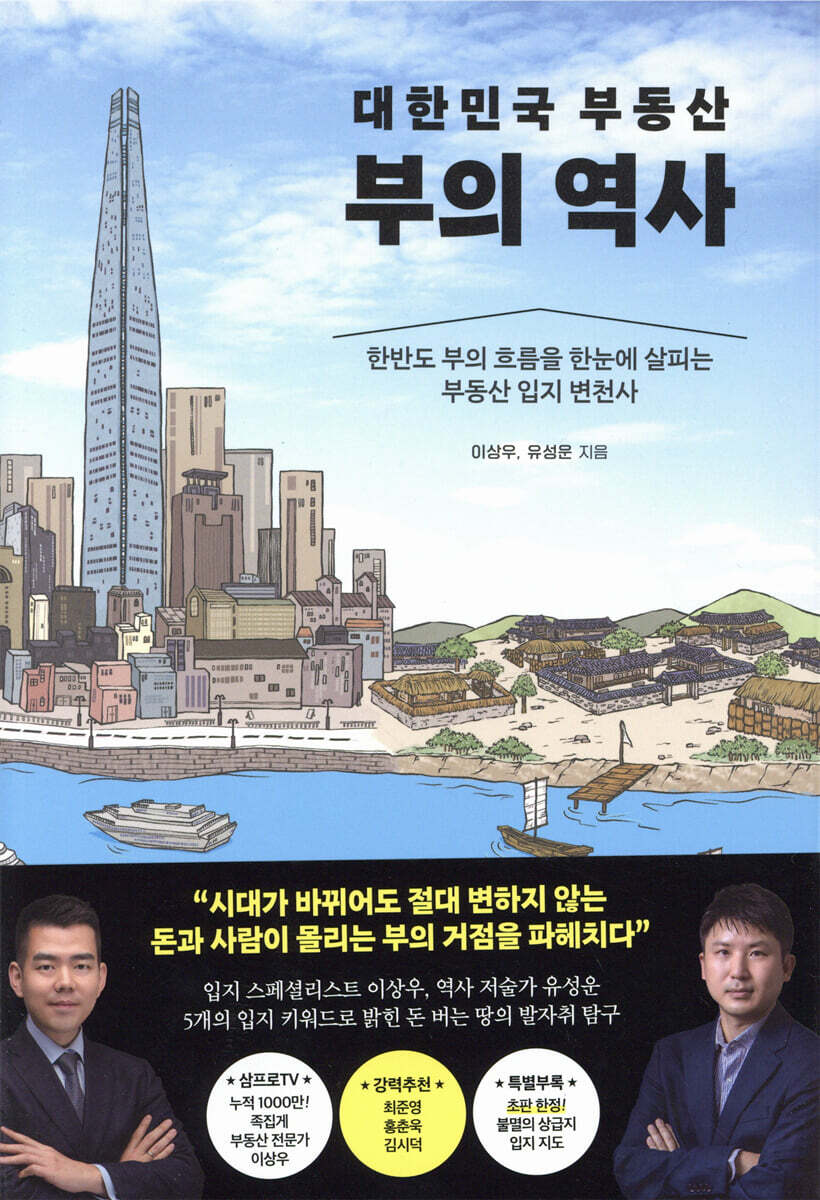
The History of Real Estate Wealth in South Korea
 |
Description
Book Introduction
- A word from MD
-
Real Estate Stories Seen Through Location KeywordsIt contains the history of real estate on the Korean Peninsula, focusing on location, from the Three Kingdoms period to the Joseon Dynasty and modern times.
This book shows the history of real estate location changes through historical events centered on five keywords, from educational environment to urban planning, and allows you to see at a glance how it has changed in modern times.
October 5, 2022. Economics and Management PD Kim Sang-geun
“Even if times change, it never changes
“Exploring the wealthy centers where money and people gather”
Location specialist Lee Sang-woo and history writer Yoo Seong-un
Exploring the Footsteps of Profitable Land Revealed Through Five Location Keywords
"The History of Real Estate Wealth in the Republic of Korea" analyzes in detail the factors that determine real estate value and how these factors operate in modern times, focusing on various historical events from the Three Kingdoms period to the Joseon Dynasty.
This book contains answers to questions such as, "Why was Seoul chosen as the capital of Baekje, Joseon, and Korea?", "Why did Hanyang's commercial district develop in Jongno?", "How were new towns developed in ancient times?", "How did the relocation of public institutions to the provinces actually affect housing prices in provincial cities?", "How did the value of reservoirs, landfills, and mountainous areas change?", and "How did the once-shunned industrial areas and areas around train stations become high-end neighborhoods close to work?"
Location specialist Lee Sang-woo and historical writer Yoo Seong-un have joined forces to analyze and reveal the timeless location conditions that attract money and people across time, transcending the past and present.
Readers of this book will develop the insight to discern the strongholds of wealth that will continue to grow and ultimately develop regardless of market trends.
“Exploring the wealthy centers where money and people gather”
Location specialist Lee Sang-woo and history writer Yoo Seong-un
Exploring the Footsteps of Profitable Land Revealed Through Five Location Keywords
"The History of Real Estate Wealth in the Republic of Korea" analyzes in detail the factors that determine real estate value and how these factors operate in modern times, focusing on various historical events from the Three Kingdoms period to the Joseon Dynasty.
This book contains answers to questions such as, "Why was Seoul chosen as the capital of Baekje, Joseon, and Korea?", "Why did Hanyang's commercial district develop in Jongno?", "How were new towns developed in ancient times?", "How did the relocation of public institutions to the provinces actually affect housing prices in provincial cities?", "How did the value of reservoirs, landfills, and mountainous areas change?", and "How did the once-shunned industrial areas and areas around train stations become high-end neighborhoods close to work?"
Location specialist Lee Sang-woo and historical writer Yoo Seong-un have joined forces to analyze and reveal the timeless location conditions that attract money and people across time, transcending the past and present.
Readers of this book will develop the insight to discern the strongholds of wealth that will continue to grow and ultimately develop regardless of market trends.
- You can preview some of the book's contents.
Preview
index
preface
Real estate is the ever-flowing flow of human life_Lee Sang-woo
Where do people live from ancient times to the present day?_Yoo Seong-un
Part 1.
The first keyword for developing a discerning eye for real estate: educational environment.
Chapter 1.
Good school districts are, and always have been, the number one preferred area.
Gaeseong Gujaedong, the number one place for passing the civil service examination in the past
Hanyang was the "Sillim-dong of Goryeo civil service exam takers."
How did Seonsan, once a quiet rural area, become a prestigious local school?
Hanyang, firmly established as one of the eight school districts of Joseon
If Seoul doesn't work, then at least the Han River Network
Chapter 2.
The goal of education is ultimately to create networks.
The key is networking
What does 'Seoul National University' mean to us living in the present age?
If you graduated from an undergraduate school, that's fine. What about graduate school?
Specialized high schools and general high schools in popular school districts
The Balloon Effect of High School Standardization: The Birth of Popular School Districts
School districts also follow the rules of rise and fall.
Part 2.
The second keyword for developing a discerning eye for real estate: proximity to work
Chapter 3.
It's only natural that money flows to places with lots of jobs.
Why are places near the palace expensive?
Jongno, where Joseon's money gathered
The transformation of Namchon, who had neither power nor money.
It's not Mayongseong, it's Mayongseo
Banchon, which monopolized Hanyang's beef
Chapter 4.
Let's pay attention to where high-paying jobs are moving.
Never lose a good seat
Where are the companies whose stock prices are soaring?
The swallow that went to Pangyo returns to Gangnam.
How has the special institutional supply brought about changes in the innovation city?
Even in the metaverse, people seek out city centers.
Part 3.
The third keyword to develop a discerning eye for real estate: transportation windfalls.
Chapter 5.
Where there is a road, there is a first-class city.
Gimhae, a logistics route in ancient East Asia
If Chungju is blocked, the national treasury will be emptied.
All roads lead through Nanjing
Jeongju, which demonstrated the power of National Route 1
Chapter 6.
Investing isn't difficult if you just follow the road.
Highways: The blood vessels of the nation that keep money flowing
Railroad: Just connecting existing lines can have a significant positive impact.
High-Speed Rail: Changing the Concept of Commuting
Highway Undergrounding: Solving Noise and Dust Problems in One Step
Part 4.
The fourth keyword to develop a discerning eye for real estate: natural environment.
Chapter 7.
Nature Changes the Landscape of Real Estate and Wealth
Why was Seoul chosen the most?
Why did Neolithic people leave behind shell mounds?
Ulsan, the city of iron more precious than gold
Jiksan, Joseon's gold rush era
A neglected mountain area becomes a paradise
Chapter 8.
Now, we live in an era where even natural environments are artificially created.
Reclaimed land has become a goldmine.
New Towns of the 1st and 2nd Generation: The Era of Creating Lakes and Central Parks
If it doesn't exist, create it ①: Private Park Special Project
If it doesn't exist, make it ②: A perfect park created in a complex
The relocation site of the US military base in Korea has become a neat and tidy place.
Part 5.
The fifth keyword to develop a discerning eye for real estate: urban planning.
Chapter 9.
The pioneer of the new town project, Yi Seong-gye's move of the capital to Hanyang
How can Shinsoo save Hanyang?
Housing supply failure and the sub-urban area of Seongjeosipni
Buying a house in Seoul has always been difficult.
The Rise and Fall of Joseon's Ambitious New Cities: Four Guns and Six Jins
Jeongjo's upgraded new city plan, Hwaseong
Chapter 10.
Work that breathes life into the city
The amazing transformation of an industrial area
Not subway, but train station area
Are you building another new town?
Relocation to a rural area, not even a new city in the metropolitan area?
That's why complex development is even more necessary.
Conclusion
Let's focus on five keywords, especially education. Lee Sang-woo
There is no one in the world who is not interested in real estate._Yoo Seong-un
References
Real estate is the ever-flowing flow of human life_Lee Sang-woo
Where do people live from ancient times to the present day?_Yoo Seong-un
Part 1.
The first keyword for developing a discerning eye for real estate: educational environment.
Chapter 1.
Good school districts are, and always have been, the number one preferred area.
Gaeseong Gujaedong, the number one place for passing the civil service examination in the past
Hanyang was the "Sillim-dong of Goryeo civil service exam takers."
How did Seonsan, once a quiet rural area, become a prestigious local school?
Hanyang, firmly established as one of the eight school districts of Joseon
If Seoul doesn't work, then at least the Han River Network
Chapter 2.
The goal of education is ultimately to create networks.
The key is networking
What does 'Seoul National University' mean to us living in the present age?
If you graduated from an undergraduate school, that's fine. What about graduate school?
Specialized high schools and general high schools in popular school districts
The Balloon Effect of High School Standardization: The Birth of Popular School Districts
School districts also follow the rules of rise and fall.
Part 2.
The second keyword for developing a discerning eye for real estate: proximity to work
Chapter 3.
It's only natural that money flows to places with lots of jobs.
Why are places near the palace expensive?
Jongno, where Joseon's money gathered
The transformation of Namchon, who had neither power nor money.
It's not Mayongseong, it's Mayongseo
Banchon, which monopolized Hanyang's beef
Chapter 4.
Let's pay attention to where high-paying jobs are moving.
Never lose a good seat
Where are the companies whose stock prices are soaring?
The swallow that went to Pangyo returns to Gangnam.
How has the special institutional supply brought about changes in the innovation city?
Even in the metaverse, people seek out city centers.
Part 3.
The third keyword to develop a discerning eye for real estate: transportation windfalls.
Chapter 5.
Where there is a road, there is a first-class city.
Gimhae, a logistics route in ancient East Asia
If Chungju is blocked, the national treasury will be emptied.
All roads lead through Nanjing
Jeongju, which demonstrated the power of National Route 1
Chapter 6.
Investing isn't difficult if you just follow the road.
Highways: The blood vessels of the nation that keep money flowing
Railroad: Just connecting existing lines can have a significant positive impact.
High-Speed Rail: Changing the Concept of Commuting
Highway Undergrounding: Solving Noise and Dust Problems in One Step
Part 4.
The fourth keyword to develop a discerning eye for real estate: natural environment.
Chapter 7.
Nature Changes the Landscape of Real Estate and Wealth
Why was Seoul chosen the most?
Why did Neolithic people leave behind shell mounds?
Ulsan, the city of iron more precious than gold
Jiksan, Joseon's gold rush era
A neglected mountain area becomes a paradise
Chapter 8.
Now, we live in an era where even natural environments are artificially created.
Reclaimed land has become a goldmine.
New Towns of the 1st and 2nd Generation: The Era of Creating Lakes and Central Parks
If it doesn't exist, create it ①: Private Park Special Project
If it doesn't exist, make it ②: A perfect park created in a complex
The relocation site of the US military base in Korea has become a neat and tidy place.
Part 5.
The fifth keyword to develop a discerning eye for real estate: urban planning.
Chapter 9.
The pioneer of the new town project, Yi Seong-gye's move of the capital to Hanyang
How can Shinsoo save Hanyang?
Housing supply failure and the sub-urban area of Seongjeosipni
Buying a house in Seoul has always been difficult.
The Rise and Fall of Joseon's Ambitious New Cities: Four Guns and Six Jins
Jeongjo's upgraded new city plan, Hwaseong
Chapter 10.
Work that breathes life into the city
The amazing transformation of an industrial area
Not subway, but train station area
Are you building another new town?
Relocation to a rural area, not even a new city in the metropolitan area?
That's why complex development is even more necessary.
Conclusion
Let's focus on five keywords, especially education. Lee Sang-woo
There is no one in the world who is not interested in real estate._Yoo Seong-un
References
Detailed image

Into the book
My previous work focused on "high-income jobs," which clearly distinguished it from other real estate books. Adding history to this, I wondered which aspect I should focus on more.
After much deliberation, the conclusion I reached was 'education'.
So, I was obsessed with how to express this, and the result was the formation of a 'network'.
In fact, in modern society, it is undeniable that networks can be created to some extent with money, so the connection between popular residential areas and education based on "high-income jobs," as discussed in the previous work, is bound to increase.
I think this "Modern History of Real Estate Wealth in the Republic of Korea" will be easier to understand if read from this perspective.
---From "Preface - Real Estate is the Continuous Flow of Human Life"
It is not just yesterday that housing prices in Seoul were high, and even during the Joseon Dynasty, people were troubled by the soaring housing prices in Hanyang.
Some managed to secure housing through private loans and "Daddy Chance," but those without these lifelines were forced to flee to the outskirts of Hanyang.
One of the reasons I wanted to live in Hanyang so badly was the educational infrastructure.
Because living in Hanyang meant better education and more opportunities.
This phenomenon has been confirmed since the Goryeo Dynasty, which preceded it.
The phenomenon of the 8th school district in Gangnam has such a long history.
---From "Preface - Where do people live from ancient times to the present"
After the move, Joseon was faced with great difficulties.
This is because the noble families living in Gaegyeong did not follow the court to Hanyang.
It would have been better to live in Gaeseong, a 400-year-old capital with abundant infrastructure, rather than in the new capital, Hanyang, which lacked infrastructure.
Meanwhile, four schools were established in Hanyang.
Perhaps one of the ways to revitalize the new capital, Hanyang, was to focus on education. A similar scene unfolded during the development of Gangnam in the 1970s.
Since the residents living in Gangbuk were unwilling to move down, apartments were built and forcibly sold to government officials. When even this did not work, traditionally prestigious high schools such as Gyeonggi High School, Whimoon High School, and Gyeonggi Girls' High School were relocated to Gangnam, opening the Gangnam era.
---「Chapter 1.
Good school districts are, and always have been, the number one most preferred area.
For the rich, the first goal of education (better schools) is not very important.
They would rather focus on the second (networking with good people).
You don't necessarily have to go through the 'hard' process of getting into a better school.
Access to a network of good people is readily available through various channels, and with enough money, it's not that difficult. Therefore, seeking a good education and heading to places where the "too" wealthy live is a misguided decision.
Places where people who dream of social mobility live together are likely to be densely populated middle-class neighborhoods.
However, the middle class here does not mean people with a medium level of income, but rather the 'upper class who pretend to be middle class.'
That person is you, the one reading this book right now.
---「Chapter 2.
The goal of education is ultimately to create a network.
Why is Gangnam given such a high value?
There are likely many factors, but wouldn't education, infrastructure, convenient transportation, and commuting distance be the key factors? So, what would the educational and commuting environment have been like during the dynasty, when it was different from today?
Hundreds of years ago, the most important criterion for determining the value of a neighborhood in Hanyang was its distance from the palace.
In other words, the price of a house was determined by how close one was to the king.
It overpowered all other factors.
For example, the yolk of the Goryeo capital, Gaeseong, was a place called Jeongseung-dong inside Naedongdaemun.
It was located to the east and south of Manwoldae, and was considered the best place to commute to work because it was right in front of the palace.
Because many ministers lived there, the name of the neighborhood was Jeongseung-dong.
And right above Jeongseung-dong was Yudong, which was also right next to the palace, so it is said that many high-ranking officials, including Yi Saek, lived there.
---「Chapter 3.
It is natural that money flows to places with many jobs.
Where else should you go to find rapidly growing companies, aside from large corporations? Pangyo is the answer.
Companies that are growing rapidly and seeing their stock prices soar are concentrated here.
In addition to Seongnam, where Pangyo is located, Yongin and Hwaseong are also transforming into such regions.
Twenty years ago, emerging companies that were concentrated on Teheran-ro in Gangnam moved to Pangyo, and now another movement is emerging.
Looking at the graph, we can see that the increase in total salaries of the three major IT companies and the increase in apartment prices in Gyeonggi Province are surprisingly close together.
The reason for the movement of housing prices, which I consider most important, is ‘increasing wages’, which is being applied as is.
In other words, the reason why housing prices in Gyeonggi-do have risen is because the number of companies that have successfully settled in the province has increased.
It would be premature to interpret this as simply the result of 'speculation' or 'excessive interest'.
---「Chapter 4.
Let's pay attention to where high-income jobs are moving.
Chungju was important because it was located at a hub for both waterways and land transportation on the Han River. Taxes from Gimhae, Changwon, Miryang, Yangsan, Jinhae, and Uiryeong were transported to Sangju along the Nakdong River, then transported overland to Gyeongwonchang in Chungju, and then transported by ship from Chungju to Seoul via the Namhan River.
In other words, if there is a problem in Chungju, the tax payments from Gyeongsang-do, Chungcheongbuk-do, and Gangwon-do will all be blocked, putting them in a serious situation.
Looking at the 『Hogu Census』 written in 1789 (the 13th year of King Jeongjo's reign), we can see that many people lived in Chungju.
At that time, Hanyang had the largest population with 189,153 people, followed by Pyongyang (107,590 people), Uiju (89,970 people), Chungju (87,731 people), and Jeonju (72,505 people).
Chungju had a population about twice that of the nearby major cities of Cheongju and Andong.
---「Chapter 5.
From "Where there is a road, there is a first-class city"
To get a sense of how the expansion of highways in the northern metropolitan area has drastically transformed the region, look no further than Pocheon, Yangju, and Paju.
The opening of the Guri-Pocheon Expressway and the Seoul-Munsan Expressway has greatly improved accessibility to these areas.
The northern part of the old Gyeonggi Province was only considered a 'road to the front'.
Anyone who has ever visited a friend in the military will recall how difficult it was to return home on the same day, but this has been dramatically improved.
Since the opening of these roads, the results of apartment sales in the relevant areas have also clearly changed.
---「Chapter 6.
"Investing is not difficult if you just follow the road"
Ulsan is famous for having a cost of living and standard of living that is just as high as that of Seoul.
When outsiders think of Ulsan, the first thing that comes to mind is probably the steel industry, such as Hyundai Motor Company or Hyundai Steel.
Many people think of it as an industrial city that experienced rapid growth thanks to the influx of prominent companies and the rise of the iron industry.
However, Ulsan's history of making and eating iron goes back a very long time.
In 2008, mining sites and artifacts discovered in Dalcheon-dong, Buk-gu, Ulsan surprised the academic world.
This is because the investigation results confirmed that it was from between the 1st and 3rd centuries BC.
This is evidence that the Dalcheon Mine here has been developed since the Three Kingdoms Period.
----「Chapter 7.
From "Nature Changes the Landscape of Real Estate and Wealth"
Did you know that many popular areas in Seoul are actually landfills? Jamsil-dong and Seobuichon-dong are prime examples.
Let's take a look at the Jamsil District Development Plan from 1971.
In Jamsildo, ‘do’ literally means island.
All the places that were surrounded by water and separated were turned into land.
If you drive along Olympic-daero, you will come across Cheongdam Bridge, which was an island, and the area that was once filled with water was filled to create the current Jamsil.
The development of Seobuichon-dong was carried out even before Jamsil-dong.
This is the current site of the Seobinggo Shindonga Apartment.
It is a large apartment complex built by reclaiming land from the Han River, and is currently undergoing reconstruction, but there is no disparaging atmosphere at all about it being a reclaimed land.
Ultimately, it all comes down to whether or not an attractive product is in the right location, regardless of whether it's a landfill or not.
This is the ‘scarcity’ that is created by technological development.
Land that would have been unseen in the past has been transformed into gold by technology removing all its weaknesses.
----「Chapter 8.
In this era where even the natural environment is artificially created,
As the area within the four gates became saturated, it became difficult for the government to maintain control of Hanyang.
That's how Seongjeosipni (Castle Ten Li) was created.
Seongjeosipni, officially included in Hanyang on February 27, 1461, was the area within 4 kilometers outside the city walls, including the present-day Gangbuk-gu, Dongdaemun-gu, Mapo-gu, Seodaemun-gu, Seongdong-gu, Seongbuk-gu, Yongsan-gu, Eunpyeong-gu, Yeouido, and the areas of Gwangjin-gu and Jungnang-gu.
It can be said to be the first 'sub-city center' in our history.
It is no exaggeration to say that the original form of Seoul was established during the Park Chung-hee administration before Gangnam was developed.
The expanded area of Hanyang included Cheongnyangni to the east, the Han River to the south, and Mapo-gu to the west.
So, when Jeong Yak-yong emphasized to his sons that he would make them live within 10 li of Hanyang, he meant that they had to live at least in the secondary city center of Hanyang, if not within the four great gates.
----「Chapter 9.
From "The Origin of the New Town Project, Yi Seong-gye's Move of the Capital to Hanyang"
Consumers' housing needs have evolved to include wanting to do most of their work near their homes.
They want to address not only housing-related factors such as education, transportation, and natural environment, but also proximity to work, shopping, and leisure all at once.
However, there are not many places that satisfy this need.
Because each piece of land has a specific purpose.
But in the 21st century, it is quite ridiculous to divide land into 'this land is for agricultural use, this land is for residential use, that land is for commercial use.'
Officetels are usually built in commercial areas, but people don't realize how awkward it is to talk about building an officetel for residential purposes in a commercial area.
Conversely, it is not awkward to consider housing in places with strong commercial functions, such as department stores or shopping malls.
The market demand is already known, but administrative functions are not keeping up.
After much deliberation, the conclusion I reached was 'education'.
So, I was obsessed with how to express this, and the result was the formation of a 'network'.
In fact, in modern society, it is undeniable that networks can be created to some extent with money, so the connection between popular residential areas and education based on "high-income jobs," as discussed in the previous work, is bound to increase.
I think this "Modern History of Real Estate Wealth in the Republic of Korea" will be easier to understand if read from this perspective.
---From "Preface - Real Estate is the Continuous Flow of Human Life"
It is not just yesterday that housing prices in Seoul were high, and even during the Joseon Dynasty, people were troubled by the soaring housing prices in Hanyang.
Some managed to secure housing through private loans and "Daddy Chance," but those without these lifelines were forced to flee to the outskirts of Hanyang.
One of the reasons I wanted to live in Hanyang so badly was the educational infrastructure.
Because living in Hanyang meant better education and more opportunities.
This phenomenon has been confirmed since the Goryeo Dynasty, which preceded it.
The phenomenon of the 8th school district in Gangnam has such a long history.
---From "Preface - Where do people live from ancient times to the present"
After the move, Joseon was faced with great difficulties.
This is because the noble families living in Gaegyeong did not follow the court to Hanyang.
It would have been better to live in Gaeseong, a 400-year-old capital with abundant infrastructure, rather than in the new capital, Hanyang, which lacked infrastructure.
Meanwhile, four schools were established in Hanyang.
Perhaps one of the ways to revitalize the new capital, Hanyang, was to focus on education. A similar scene unfolded during the development of Gangnam in the 1970s.
Since the residents living in Gangbuk were unwilling to move down, apartments were built and forcibly sold to government officials. When even this did not work, traditionally prestigious high schools such as Gyeonggi High School, Whimoon High School, and Gyeonggi Girls' High School were relocated to Gangnam, opening the Gangnam era.
---「Chapter 1.
Good school districts are, and always have been, the number one most preferred area.
For the rich, the first goal of education (better schools) is not very important.
They would rather focus on the second (networking with good people).
You don't necessarily have to go through the 'hard' process of getting into a better school.
Access to a network of good people is readily available through various channels, and with enough money, it's not that difficult. Therefore, seeking a good education and heading to places where the "too" wealthy live is a misguided decision.
Places where people who dream of social mobility live together are likely to be densely populated middle-class neighborhoods.
However, the middle class here does not mean people with a medium level of income, but rather the 'upper class who pretend to be middle class.'
That person is you, the one reading this book right now.
---「Chapter 2.
The goal of education is ultimately to create a network.
Why is Gangnam given such a high value?
There are likely many factors, but wouldn't education, infrastructure, convenient transportation, and commuting distance be the key factors? So, what would the educational and commuting environment have been like during the dynasty, when it was different from today?
Hundreds of years ago, the most important criterion for determining the value of a neighborhood in Hanyang was its distance from the palace.
In other words, the price of a house was determined by how close one was to the king.
It overpowered all other factors.
For example, the yolk of the Goryeo capital, Gaeseong, was a place called Jeongseung-dong inside Naedongdaemun.
It was located to the east and south of Manwoldae, and was considered the best place to commute to work because it was right in front of the palace.
Because many ministers lived there, the name of the neighborhood was Jeongseung-dong.
And right above Jeongseung-dong was Yudong, which was also right next to the palace, so it is said that many high-ranking officials, including Yi Saek, lived there.
---「Chapter 3.
It is natural that money flows to places with many jobs.
Where else should you go to find rapidly growing companies, aside from large corporations? Pangyo is the answer.
Companies that are growing rapidly and seeing their stock prices soar are concentrated here.
In addition to Seongnam, where Pangyo is located, Yongin and Hwaseong are also transforming into such regions.
Twenty years ago, emerging companies that were concentrated on Teheran-ro in Gangnam moved to Pangyo, and now another movement is emerging.
Looking at the graph, we can see that the increase in total salaries of the three major IT companies and the increase in apartment prices in Gyeonggi Province are surprisingly close together.
The reason for the movement of housing prices, which I consider most important, is ‘increasing wages’, which is being applied as is.
In other words, the reason why housing prices in Gyeonggi-do have risen is because the number of companies that have successfully settled in the province has increased.
It would be premature to interpret this as simply the result of 'speculation' or 'excessive interest'.
---「Chapter 4.
Let's pay attention to where high-income jobs are moving.
Chungju was important because it was located at a hub for both waterways and land transportation on the Han River. Taxes from Gimhae, Changwon, Miryang, Yangsan, Jinhae, and Uiryeong were transported to Sangju along the Nakdong River, then transported overland to Gyeongwonchang in Chungju, and then transported by ship from Chungju to Seoul via the Namhan River.
In other words, if there is a problem in Chungju, the tax payments from Gyeongsang-do, Chungcheongbuk-do, and Gangwon-do will all be blocked, putting them in a serious situation.
Looking at the 『Hogu Census』 written in 1789 (the 13th year of King Jeongjo's reign), we can see that many people lived in Chungju.
At that time, Hanyang had the largest population with 189,153 people, followed by Pyongyang (107,590 people), Uiju (89,970 people), Chungju (87,731 people), and Jeonju (72,505 people).
Chungju had a population about twice that of the nearby major cities of Cheongju and Andong.
---「Chapter 5.
From "Where there is a road, there is a first-class city"
To get a sense of how the expansion of highways in the northern metropolitan area has drastically transformed the region, look no further than Pocheon, Yangju, and Paju.
The opening of the Guri-Pocheon Expressway and the Seoul-Munsan Expressway has greatly improved accessibility to these areas.
The northern part of the old Gyeonggi Province was only considered a 'road to the front'.
Anyone who has ever visited a friend in the military will recall how difficult it was to return home on the same day, but this has been dramatically improved.
Since the opening of these roads, the results of apartment sales in the relevant areas have also clearly changed.
---「Chapter 6.
"Investing is not difficult if you just follow the road"
Ulsan is famous for having a cost of living and standard of living that is just as high as that of Seoul.
When outsiders think of Ulsan, the first thing that comes to mind is probably the steel industry, such as Hyundai Motor Company or Hyundai Steel.
Many people think of it as an industrial city that experienced rapid growth thanks to the influx of prominent companies and the rise of the iron industry.
However, Ulsan's history of making and eating iron goes back a very long time.
In 2008, mining sites and artifacts discovered in Dalcheon-dong, Buk-gu, Ulsan surprised the academic world.
This is because the investigation results confirmed that it was from between the 1st and 3rd centuries BC.
This is evidence that the Dalcheon Mine here has been developed since the Three Kingdoms Period.
----「Chapter 7.
From "Nature Changes the Landscape of Real Estate and Wealth"
Did you know that many popular areas in Seoul are actually landfills? Jamsil-dong and Seobuichon-dong are prime examples.
Let's take a look at the Jamsil District Development Plan from 1971.
In Jamsildo, ‘do’ literally means island.
All the places that were surrounded by water and separated were turned into land.
If you drive along Olympic-daero, you will come across Cheongdam Bridge, which was an island, and the area that was once filled with water was filled to create the current Jamsil.
The development of Seobuichon-dong was carried out even before Jamsil-dong.
This is the current site of the Seobinggo Shindonga Apartment.
It is a large apartment complex built by reclaiming land from the Han River, and is currently undergoing reconstruction, but there is no disparaging atmosphere at all about it being a reclaimed land.
Ultimately, it all comes down to whether or not an attractive product is in the right location, regardless of whether it's a landfill or not.
This is the ‘scarcity’ that is created by technological development.
Land that would have been unseen in the past has been transformed into gold by technology removing all its weaknesses.
----「Chapter 8.
In this era where even the natural environment is artificially created,
As the area within the four gates became saturated, it became difficult for the government to maintain control of Hanyang.
That's how Seongjeosipni (Castle Ten Li) was created.
Seongjeosipni, officially included in Hanyang on February 27, 1461, was the area within 4 kilometers outside the city walls, including the present-day Gangbuk-gu, Dongdaemun-gu, Mapo-gu, Seodaemun-gu, Seongdong-gu, Seongbuk-gu, Yongsan-gu, Eunpyeong-gu, Yeouido, and the areas of Gwangjin-gu and Jungnang-gu.
It can be said to be the first 'sub-city center' in our history.
It is no exaggeration to say that the original form of Seoul was established during the Park Chung-hee administration before Gangnam was developed.
The expanded area of Hanyang included Cheongnyangni to the east, the Han River to the south, and Mapo-gu to the west.
So, when Jeong Yak-yong emphasized to his sons that he would make them live within 10 li of Hanyang, he meant that they had to live at least in the secondary city center of Hanyang, if not within the four great gates.
----「Chapter 9.
From "The Origin of the New Town Project, Yi Seong-gye's Move of the Capital to Hanyang"
Consumers' housing needs have evolved to include wanting to do most of their work near their homes.
They want to address not only housing-related factors such as education, transportation, and natural environment, but also proximity to work, shopping, and leisure all at once.
However, there are not many places that satisfy this need.
Because each piece of land has a specific purpose.
But in the 21st century, it is quite ridiculous to divide land into 'this land is for agricultural use, this land is for residential use, that land is for commercial use.'
Officetels are usually built in commercial areas, but people don't realize how awkward it is to talk about building an officetel for residential purposes in a commercial area.
Conversely, it is not awkward to consider housing in places with strong commercial functions, such as department stores or shopping malls.
The market demand is already known, but administrative functions are not keeping up.
----「Chapter 10.
From “The work of breathing life into the city”
From “The work of breathing life into the city”
Publisher's Review
“The 2,000-year history of the Korean Peninsula,
“A glance at the flow of wealth in this land”
What kind of locational conditions did the representative wealth center of the eight provinces have to have to revive?
"The History of Real Estate Wealth in Korea" examines five location keywords: educational environment, proximity to work, transportation, natural environment, and urban planning, each divided into sections.
Author Yoo Seong-un is in charge of explaining the past analysis of the relevant location keyword, and author Lee Sang-woo is in charge of explaining the present analysis of the relevant location keyword.
Part 1, "Educational Environment," is divided into two parts: "Chapter 1: Good School Districts Are the Most Preferred Areas, Past and Present" and "Chapter 2: The Goal of Education Is Ultimately to Create a Network (Contemporary Edition)."
Chapter 1, Past, tells the story of how Gaeseong became the center of educational location due to the influx of people to Gujae Hakdang founded by Choi Chung, who was active as the first instructor during the Goryeo Dynasty, and the reason why Dasan Jeong Yak-yong had no choice but to emphasize "In Hanyang" in letters to his children, and the process of Hanyang becoming established as one of the eight school districts of Joseon. It also sheds light on the influence of the educational fervor of the time on the formation of location.
Chapter 2, Modern Times, covers the significance of Seoul National University in our society and its impact on educational standing, the significance and role of specialized graduate schools, the background to the emergence of specialized high schools and popular school districts, the rise and fall of apartment prices driven by school districts, and the rules of rise and fall that popular school districts follow.
Part 2, "Workplace-Home Proximity," is divided into two parts: "Chapter 3: It's Natural That Money Is Gathered Where There Are Many Jobs (Past Edition)" and "Chapter 4: Let's Pay Attention to Where High-Income Jobs Are Moving (Modern Edition)".
Chapter 3, Past, explains why the powerful had no choice but to flock to Bukchon in Hanyang, where one house was worth 50 years of a 9th-grade salary; how Jeungchon (present-day Jongno), the largest commercial town in Joseon, suddenly emerged as Gangnam during the Joseon Dynasty; the stories of Yi Sun-sin and Won Gyun, who grew up in Namchon, which became a symbol of the non-mainstream, and Heo Gyun, who lived a generation later; the background of the location of the Mayongseo (Mapo-Yongsan-Seogang) area, which prospered when local immigrants gathered and worked as unloaders; and the story of Banchon, which monopolized the distribution of Hanyang beef.
Chapter 4, "Modern" explores where companies with rapidly rising stock prices are currently located, where emerging growth companies are locating their headquarters, how rising incomes affect housing prices, why companies that moved to Pangyo are returning to Gangnam, how institutional special supply has affected innovation cities, and why people continue to flock to city centers even during the COVID-19 pandemic.
Part 3, "Transportation Windfall," is divided into two sections: "Chapter 5: Where There's a Road, There's a First-Class City (Past Edition)" and "Chapter 6: Investing Isn't Difficult Just by Following the Road (Modern Edition)".
Chapter 5, Past, covers the process and aftermath of Gimhae, a hub city for maritime logistics in ancient East Asia, changing into an inland city; Chungju, which flourished as a hub city in both the Goryeo and Joseon Dynasties as a key point of land and waterway transportation and a route for transporting grain; Yangju (especially the area around 'Gwangnaru'), a strategic point in Goryeo; and Jeongju in North Pyongan Province (No. 1 region producing the highest number of successful candidates in the civil service examination) which flourished through Joseon's National Route 1, Uiju.
2) It deals with the back.
Chapter 6, Modern Times, covers the role of highways in circulating money across the country, the impact of new roads on neighboring areas, the railways that can significantly increase housing prices simply by extending their routes, the high-speed rail and GTX that changed the concept of commuting range, and the locational effects of undergrounding highways that solve noise and dust problems and improve the surrounding environment.
Part 4, "Natural Environment," is divided into 'Chapter 7: Nature Changes the Landscape of Real Estate and Wealth (Past Edition)' and 'Chapter 8: Now, Even the Natural Environment is Created Artificially (Modern Edition)'.
Chapter 7, Past, delves into the reasons why Seoul was the most frequently chosen capital on the Korean Peninsula, the correlation between the shell mounds left by Neolithic people and salt fields, why Ulsan was able to prosper with minerals more valuable than gold, the prosperity of Jiksan and the literary collaboration that thrilled even China while heralding the Joseon gold rush, and the secrets of Neo-Confucian scholar Toegye Yi Hwang's concept-breaking financial management.
Chapter 8, Modern Times, covers the transformation of previously uninhabitable areas such as reservoirs, landfills, and station areas into valuable land; the 1st and 2nd new town areas that increased in value by creating artificial parks such as lake parks and central parks; areas that saw their value increase due to special private park projects; large-scale apartment complexes that revolutionized their brand value with exceptional landscaping; and areas that experienced rapid growth due to the relocation of military bases.
Part 5, "Urban Planning," is divided into two parts: 'Chapter 9: The Origin of the New Town Project, Yi Seong-gye's Move to Hanyang (Past)' and 'Chapter 10: The Work of Breathing Life into the City (Modern)'.
Chapter 9, Past, covers the story of how Hanyang, the new capital launched by Yi Seong-gye, was pushed out by the infrastructure of the existing capital, Gaegyeong, and was on the verge of collapse, but succeeded with the special measure of 'closing stores in Gaeseong'; the Joseon version of the 'Gwangju Complex' incident where Hanyang's original inhabitants were pushed out to a secondary city; the story of the Cheonggyecheon area suffering from floods; the skyrocketing housing prices brought about by King Yeongjo's policy of restricting sales to stabilize housing prices; the turbulent real estate transaction diaries of Hwang Yun-seok, who failed to buy a house in Hanyang, and Yu Man-ju, who went from a jeonse tenant to a landlord through 'Yeonggeul'; Lee Yun-seon, who amassed wealth through six moves; the story of the '4-gun 6-jin' new city launch that also failed in Sejong; and Jeongjo's Hwaseong, which unfortunately failed despite making every effort to create demand for money, people, and education.
Chapter 10, Modern Times, covers the transformation of Guro Industrial Complex from an industrial zone to a mecca of cutting-edge industries, the Munrae-dong ironworks area transformed into a cultural space, and the transformation of Suseo Station and Pangyo Station areas from shunned areas to popular places for living and working. It also looks back on the numerous trials and errors of the first and second new towns that must be reviewed for the success of the third new towns.
“Regardless of the times
“There is a fixed place where wealth accumulates.”
What is different about the wealthy neighborhoods where money and people flock?
It is not just yesterday that housing prices in Seoul were high, and even during the Joseon Dynasty, people were troubled by the soaring housing prices in Hanyang.
Some managed to secure housing through private loans and "Daddy Chance," but those without these lifelines were forced to flee to the outskirts of Hanyang.
One of the reasons why people wanted to live in Hanyang was the educational infrastructure.
Because living in Hanyang meant access to a quality education and greater opportunities for success.
This phenomenon has been confirmed since the Goryeo Dynasty, which preceded it.
The phenomenon of the 8th school district in Gangnam has such a long history.
The way people view real estate is not much different now than it was then.
The way people live does not change much over time, but only becomes more refined little by little.
We need to learn how to reflect this point in the real estate market.
From that perspective, the author recommends examining the value of real estate through the five keywords covered in this book.
In particular, we must remember that education has always been the most powerful position regardless of the era.
I hope that readers of this book will develop the insight to recognize the wealthy neighborhoods and centers of wealth where money and people gather, and enjoy an unparalleled abundance of life.
“A glance at the flow of wealth in this land”
What kind of locational conditions did the representative wealth center of the eight provinces have to have to revive?
"The History of Real Estate Wealth in Korea" examines five location keywords: educational environment, proximity to work, transportation, natural environment, and urban planning, each divided into sections.
Author Yoo Seong-un is in charge of explaining the past analysis of the relevant location keyword, and author Lee Sang-woo is in charge of explaining the present analysis of the relevant location keyword.
Part 1, "Educational Environment," is divided into two parts: "Chapter 1: Good School Districts Are the Most Preferred Areas, Past and Present" and "Chapter 2: The Goal of Education Is Ultimately to Create a Network (Contemporary Edition)."
Chapter 1, Past, tells the story of how Gaeseong became the center of educational location due to the influx of people to Gujae Hakdang founded by Choi Chung, who was active as the first instructor during the Goryeo Dynasty, and the reason why Dasan Jeong Yak-yong had no choice but to emphasize "In Hanyang" in letters to his children, and the process of Hanyang becoming established as one of the eight school districts of Joseon. It also sheds light on the influence of the educational fervor of the time on the formation of location.
Chapter 2, Modern Times, covers the significance of Seoul National University in our society and its impact on educational standing, the significance and role of specialized graduate schools, the background to the emergence of specialized high schools and popular school districts, the rise and fall of apartment prices driven by school districts, and the rules of rise and fall that popular school districts follow.
Part 2, "Workplace-Home Proximity," is divided into two parts: "Chapter 3: It's Natural That Money Is Gathered Where There Are Many Jobs (Past Edition)" and "Chapter 4: Let's Pay Attention to Where High-Income Jobs Are Moving (Modern Edition)".
Chapter 3, Past, explains why the powerful had no choice but to flock to Bukchon in Hanyang, where one house was worth 50 years of a 9th-grade salary; how Jeungchon (present-day Jongno), the largest commercial town in Joseon, suddenly emerged as Gangnam during the Joseon Dynasty; the stories of Yi Sun-sin and Won Gyun, who grew up in Namchon, which became a symbol of the non-mainstream, and Heo Gyun, who lived a generation later; the background of the location of the Mayongseo (Mapo-Yongsan-Seogang) area, which prospered when local immigrants gathered and worked as unloaders; and the story of Banchon, which monopolized the distribution of Hanyang beef.
Chapter 4, "Modern" explores where companies with rapidly rising stock prices are currently located, where emerging growth companies are locating their headquarters, how rising incomes affect housing prices, why companies that moved to Pangyo are returning to Gangnam, how institutional special supply has affected innovation cities, and why people continue to flock to city centers even during the COVID-19 pandemic.
Part 3, "Transportation Windfall," is divided into two sections: "Chapter 5: Where There's a Road, There's a First-Class City (Past Edition)" and "Chapter 6: Investing Isn't Difficult Just by Following the Road (Modern Edition)".
Chapter 5, Past, covers the process and aftermath of Gimhae, a hub city for maritime logistics in ancient East Asia, changing into an inland city; Chungju, which flourished as a hub city in both the Goryeo and Joseon Dynasties as a key point of land and waterway transportation and a route for transporting grain; Yangju (especially the area around 'Gwangnaru'), a strategic point in Goryeo; and Jeongju in North Pyongan Province (No. 1 region producing the highest number of successful candidates in the civil service examination) which flourished through Joseon's National Route 1, Uiju.
2) It deals with the back.
Chapter 6, Modern Times, covers the role of highways in circulating money across the country, the impact of new roads on neighboring areas, the railways that can significantly increase housing prices simply by extending their routes, the high-speed rail and GTX that changed the concept of commuting range, and the locational effects of undergrounding highways that solve noise and dust problems and improve the surrounding environment.
Part 4, "Natural Environment," is divided into 'Chapter 7: Nature Changes the Landscape of Real Estate and Wealth (Past Edition)' and 'Chapter 8: Now, Even the Natural Environment is Created Artificially (Modern Edition)'.
Chapter 7, Past, delves into the reasons why Seoul was the most frequently chosen capital on the Korean Peninsula, the correlation between the shell mounds left by Neolithic people and salt fields, why Ulsan was able to prosper with minerals more valuable than gold, the prosperity of Jiksan and the literary collaboration that thrilled even China while heralding the Joseon gold rush, and the secrets of Neo-Confucian scholar Toegye Yi Hwang's concept-breaking financial management.
Chapter 8, Modern Times, covers the transformation of previously uninhabitable areas such as reservoirs, landfills, and station areas into valuable land; the 1st and 2nd new town areas that increased in value by creating artificial parks such as lake parks and central parks; areas that saw their value increase due to special private park projects; large-scale apartment complexes that revolutionized their brand value with exceptional landscaping; and areas that experienced rapid growth due to the relocation of military bases.
Part 5, "Urban Planning," is divided into two parts: 'Chapter 9: The Origin of the New Town Project, Yi Seong-gye's Move to Hanyang (Past)' and 'Chapter 10: The Work of Breathing Life into the City (Modern)'.
Chapter 9, Past, covers the story of how Hanyang, the new capital launched by Yi Seong-gye, was pushed out by the infrastructure of the existing capital, Gaegyeong, and was on the verge of collapse, but succeeded with the special measure of 'closing stores in Gaeseong'; the Joseon version of the 'Gwangju Complex' incident where Hanyang's original inhabitants were pushed out to a secondary city; the story of the Cheonggyecheon area suffering from floods; the skyrocketing housing prices brought about by King Yeongjo's policy of restricting sales to stabilize housing prices; the turbulent real estate transaction diaries of Hwang Yun-seok, who failed to buy a house in Hanyang, and Yu Man-ju, who went from a jeonse tenant to a landlord through 'Yeonggeul'; Lee Yun-seon, who amassed wealth through six moves; the story of the '4-gun 6-jin' new city launch that also failed in Sejong; and Jeongjo's Hwaseong, which unfortunately failed despite making every effort to create demand for money, people, and education.
Chapter 10, Modern Times, covers the transformation of Guro Industrial Complex from an industrial zone to a mecca of cutting-edge industries, the Munrae-dong ironworks area transformed into a cultural space, and the transformation of Suseo Station and Pangyo Station areas from shunned areas to popular places for living and working. It also looks back on the numerous trials and errors of the first and second new towns that must be reviewed for the success of the third new towns.
“Regardless of the times
“There is a fixed place where wealth accumulates.”
What is different about the wealthy neighborhoods where money and people flock?
It is not just yesterday that housing prices in Seoul were high, and even during the Joseon Dynasty, people were troubled by the soaring housing prices in Hanyang.
Some managed to secure housing through private loans and "Daddy Chance," but those without these lifelines were forced to flee to the outskirts of Hanyang.
One of the reasons why people wanted to live in Hanyang was the educational infrastructure.
Because living in Hanyang meant access to a quality education and greater opportunities for success.
This phenomenon has been confirmed since the Goryeo Dynasty, which preceded it.
The phenomenon of the 8th school district in Gangnam has such a long history.
The way people view real estate is not much different now than it was then.
The way people live does not change much over time, but only becomes more refined little by little.
We need to learn how to reflect this point in the real estate market.
From that perspective, the author recommends examining the value of real estate through the five keywords covered in this book.
In particular, we must remember that education has always been the most powerful position regardless of the era.
I hope that readers of this book will develop the insight to recognize the wealthy neighborhoods and centers of wealth where money and people gather, and enjoy an unparalleled abundance of life.
GOODS SPECIFICS
- Publication date: October 11, 2022
- Page count, weight, size: 466 pages | 806g | 153*225*26mm
- ISBN13: 9791192625034
- ISBN10: 119262503X
You may also like
카테고리
korean


korean

![ELLE 엘르 스페셜 에디션 A형 : 12월 [2025]](http://librairie.coreenne.fr/cdn/shop/files/b8e27a3de6c9538896439686c6b0e8fb.jpg?v=1766436872&width=3840)


