

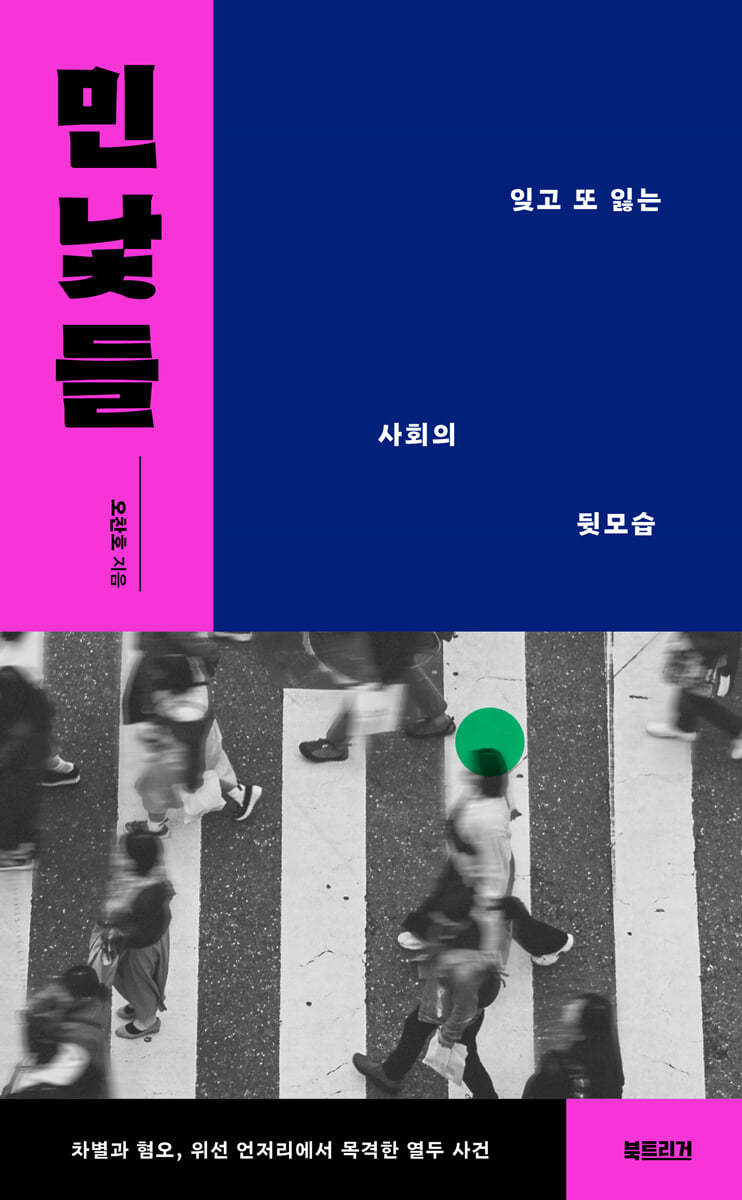
Bare faces
 |
Description
Book Introduction
- A word from MD
-
South Korea is not yet safeSociologist Oh Chan-ho, who has been contemplating inequality and social justice, has focused on today's South Korea.
We analyzed 12 incidents that revealed the contradictions of South Korea, from the Sewol ferry disaster in 2014, the late Kim Yong-gyun in 2018, the Nth Room incident, and the recent Cho Kuk incident.
The more I read, the more bitter it becomes, but it is our true face that we must face.
May 10, 2022. Social and Political PD Son Min-gyu
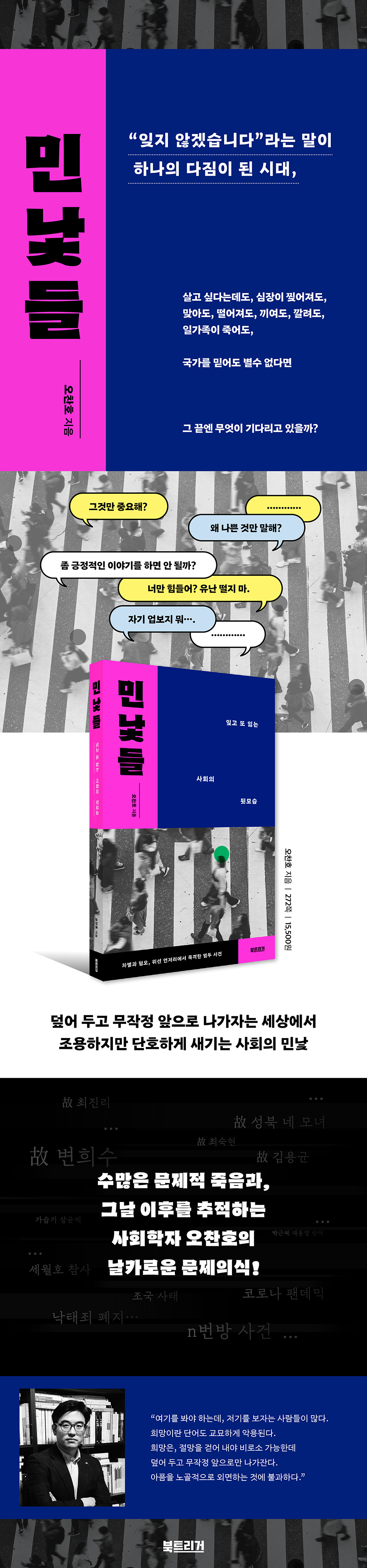
In an era where the words “I will not forget” have become a pledge,
Do we properly remember the social pain and absurdity?
Let's look back at twelve incidents that revealed the true face of Korean society!
When the Sewol ferry sank in 2014, killing 304 passengers, when Kim Yong-gyun, a non-regular worker at a subcontractor, died after being caught in a machine in 2018, and when Sergeant Byun Hee-soo, who came out as transgender, made an extreme choice after being forcibly discharged from the military in 2020, there was a saying that countless people recited.
“I won’t forget.” But we quickly forget any shocking event as we go about our daily lives.
The result is an endless cycle of suffering.
It is a tragedy that is expected, as it is a pain that is usually borne by powerless individuals.
"Bare Faces" is a book containing twelve incidents that we have vowed countless times not to forget.
We look at the problematic deaths of the late Byun Hee-soo, the late Choi Jin-ri, the late Choi Sook-hyun, the late Kim Yong-gyun, the four Seongbuk women, and ○○○○ victims of the humidifier disinfectant (Part 1), and expose the true face of Korean society by looking back on major disasters and issues such as the COVID-19 pandemic, the Nth room case, the Sewol ferry disaster, the abolition of the abortion law, the impeachment of Park Geun-hye, and the Cho Kuk incident (Part 2).
This book seriously asks what questions we miss while repeating the declaration, “I will not forget,” like a round song.
Do we properly remember the social pain and absurdity?
Let's look back at twelve incidents that revealed the true face of Korean society!
When the Sewol ferry sank in 2014, killing 304 passengers, when Kim Yong-gyun, a non-regular worker at a subcontractor, died after being caught in a machine in 2018, and when Sergeant Byun Hee-soo, who came out as transgender, made an extreme choice after being forcibly discharged from the military in 2020, there was a saying that countless people recited.
“I won’t forget.” But we quickly forget any shocking event as we go about our daily lives.
The result is an endless cycle of suffering.
It is a tragedy that is expected, as it is a pain that is usually borne by powerless individuals.
"Bare Faces" is a book containing twelve incidents that we have vowed countless times not to forget.
We look at the problematic deaths of the late Byun Hee-soo, the late Choi Jin-ri, the late Choi Sook-hyun, the late Kim Yong-gyun, the four Seongbuk women, and ○○○○ victims of the humidifier disinfectant (Part 1), and expose the true face of Korean society by looking back on major disasters and issues such as the COVID-19 pandemic, the Nth room case, the Sewol ferry disaster, the abolition of the abortion law, the impeachment of Park Geun-hye, and the Cho Kuk incident (Part 2).
This book seriously asks what questions we miss while repeating the declaration, “I will not forget,” like a round song.
- You can preview some of the book's contents.
Preview
index
Prologue - People who say to look here but look there
Part 1, Ellipsis
Death is not an option
First bare face, I want to live, but I can't help it
―Sexual minorities are here, the late Byun Hee-soo
Second bare face, even if my heart is torn, there's nothing I can do
When Words Become Swords, by the late Choi Jin-ri
Third time, I can't help it even if I get hit
To those who believe that a teacher who hits is real, the late Choi Suk-hyeon
The fourth bare face, even if it falls, gets stuck, or gets crushed, there's nothing I can do about it.
―You are me, the late Kim Yong-gyun
Fifth Face: Even if my entire family dies, I can't help it.
―May poverty not become a source of guilt, the late Seongbuk mother and daughter
Sixth Face: Trusting the Nation Doesn't Help
― My body is the proof, ○○○○ people died from the humidifier disinfectant.
Part 2, Dodol-i-pyo
We are accustomed to forgetting
Seventh Face, We Will Be Sharper
― We're all in the same boat: the COVID-19 pandemic.
The Eighth Bare Face: We Will Become Insensitive Again
― I grew up eating lenient verdicts, the Nth Room case
The ninth bare face, we will continue to chatter
―I am not a tool of childbirth, abolish the crime of abortion.
The tenth bare face, we will be endlessly sad.
― Memory, Responsibility, and Promise: The Sewol Ferry Disaster
The Eleventh Bare Face, We Always Forget
― The struggle of memory against oblivion, the impeachment of President Park Geun-hye
The twelfth bare face, we still naively believe
― The illusion of fairness, the situation in the fatherland
Epilogue - Here and Now, This is Our Result
Part 1, Ellipsis
Death is not an option
First bare face, I want to live, but I can't help it
―Sexual minorities are here, the late Byun Hee-soo
Second bare face, even if my heart is torn, there's nothing I can do
When Words Become Swords, by the late Choi Jin-ri
Third time, I can't help it even if I get hit
To those who believe that a teacher who hits is real, the late Choi Suk-hyeon
The fourth bare face, even if it falls, gets stuck, or gets crushed, there's nothing I can do about it.
―You are me, the late Kim Yong-gyun
Fifth Face: Even if my entire family dies, I can't help it.
―May poverty not become a source of guilt, the late Seongbuk mother and daughter
Sixth Face: Trusting the Nation Doesn't Help
― My body is the proof, ○○○○ people died from the humidifier disinfectant.
Part 2, Dodol-i-pyo
We are accustomed to forgetting
Seventh Face, We Will Be Sharper
― We're all in the same boat: the COVID-19 pandemic.
The Eighth Bare Face: We Will Become Insensitive Again
― I grew up eating lenient verdicts, the Nth Room case
The ninth bare face, we will continue to chatter
―I am not a tool of childbirth, abolish the crime of abortion.
The tenth bare face, we will be endlessly sad.
― Memory, Responsibility, and Promise: The Sewol Ferry Disaster
The Eleventh Bare Face, We Always Forget
― The struggle of memory against oblivion, the impeachment of President Park Geun-hye
The twelfth bare face, we still naively believe
― The illusion of fairness, the situation in the fatherland
Epilogue - Here and Now, This is Our Result
Detailed image
Into the book
It is a world where the ground beneath our feet shakes, and where we are filled with the determination to somehow prevent the troublesome things of the earth from intruding upon the tranquility and peace of the sky.
For example, there is a banner proudly displayed that says, “Why is there a special school for the disabled in front of my front door?”
In a place where hate is packaged as freedom of expression, there are bound to be those who get angry at disabled people protesting on the subway demanding the right to mobility, saying, “Stop interfering with my commute!”
I want to look here where there is no hope, but I only see there where despair is ignored.
---From the "Prologue"
People cheered every time an athlete won a gold medal.
The media ran dozens of feature articles, and even the player's elementary school teacher appeared on the news, sharing heartwarming stories.
Gold medalists are often spotlighted in various places and become advertising models for companies.
The sight of an athlete who suddenly turns his life around becomes a significant reason for other athletes to endure the 'injustice of the present.'
When you are wandering, you force yourself to believe that the teacher who 'beats you' is the true teacher.
If you keep repeating it, you start to think it's real and don't care about worse things.
Because if you just win the gold medal, your life will change 'in one go'.
---From "The Third Face, Even If I Get Hit, There's Nothing I Can Do"
A person is sucked into a machine, his body is torn apart, and he dies.
The human body is not a Lego block, so the actual situation is not something that can be gently expressed with the word 'separation'.
Such a thing happened not in the Joseon Dynasty, but in 2018, in a country that was one of the world's top 10 economies and had Wi-Fi everywhere.
In a digital world where people deposit and withdraw money using their fingerprints, there was no system where machines could detect human danger and automatically stop.
What's horrifying is that such incidents are commonplace, and this one was even more horrific, which is why it drew public attention.
Here, two perspectives on society are clearly distinguished.
Some ask if we should just leave this situation as it is, but others say there is nothing they can do and don't ask any questions.
These two branches cannot be said to be simply different perspectives.
The former is right, the latter is wrong.
A society where the former is impossible and a society that induces the latter are both bad societies.
---From "The Fourth Bare Face, Even if I Fall, Get Stuck, or Get Crushed, There's Nothing I Can Do"
Paying utility bills on the verge of death? It seems that he never gave up his duties as a citizen or a neighbor until the moment he gave up on life.
The note from the three mothers and daughters was nothing less than a message that welfare should not be thought of as just giving pocket money to those who have fallen to the bottom of life and are unable to do anything.
It is a mistake to think that welfare can be achieved with just documents and a few numbers printed on paper.
Some poverty is difficult to prove with just a few documents or simple numbers.
The three women in Songpa-gu made us realize that ordinary people in front of us may actually be in a precarious situation, and that the system may not be able to detect their crisis.
---From "The Fifth Bare Face, Even If My Family Dies, There's Nothing I Can Do"
The media has treated the Nth Room incident as if it were the work of evildoers from outer space, using expressions like “unprecedented” and “unprecedented.” However, we must keep in mind that the poisonous mushroom grew from the ground.
Only by starting with the fact that they were not born particularly evil, only by accepting that they are not demons you would encounter in the normal world, but ordinary people who often appear on attendance sheets, can we acknowledge that our society has been passive in its response to digital sex crimes so far.
If you treat one side as a pervert, paradoxically you become insensitive to the other side's problems.
Everyone, from those who created and operated the Nth Room to those who opened the door and entered, grew up within Korean culture.
It does not have a special DNA structure.
---From "The Eighth Bare Face, We Will Become Insensitive Again"
The incident, known as the 'Binge Eating Fight', was heavily criticized on several fronts.
There was a flood of articles describing them as devils, traitors, etc.
It seemed like he wanted to say that they were a part of the Republic of Korea that did not fit in.
Could that really be true? The uneasiness I felt wasn't simply the discomfort of witnessing their antics.
It was a chilling experience to be confronted once again with the limitations of mourning and the inadequacy of empathizing with grief in Korean society.
Because 'we' were revealed above them.
I'm talking about immature figures who haven't learned the proper emotions of mourning.
We used to take the expression 'chaos on the way to work due to subway suicide' lightly.
Even if a friend at school committed suicide, we were quick to just cover it up and hear, "Don't be upset, just study."
Who is free from the 'structural' emotional state that confines mourning to a frame of boredom, saying, 'Shouldn't the living live on?' when the story of the dead is repeated several times?
The gluttony struggle was just a strange tree that grew on that soil.
---From "The Tenth Bare Face, We Will Be Endlessly Sad"
We turned our attention to those who fell seven times and never got back up.
Our concept of 'justice' was formed on the basis of this law of survival of the fittest.
People perceived 'justice' not as everyone enjoying equal, substantively equal rights, but as something where the point at which each person reaches inevitably differs depending on the size of their efforts.
Even if the results are unequal, I thought it was fair because it was proportional to the effort put in.
Modern public education, which took shape alongside the growth of capitalism, constantly taught the logic of ‘fair inequality.’
They packaged it as if opportunities were equal because everyone could go to school regardless of class.
So, I cast a spell to make him accept the test results.
In a world where the saying “Prove it with results!” floats around, it was considered unfair to doubt the results.
The situation in the fatherland is not broken.
This was a testament to the precision, sturdiness, and terrifying violence of this board.
Inequality was not just a side effect of capitalist society, but a very sophisticated system.
In it we are deceived every day.
For example, there is a banner proudly displayed that says, “Why is there a special school for the disabled in front of my front door?”
In a place where hate is packaged as freedom of expression, there are bound to be those who get angry at disabled people protesting on the subway demanding the right to mobility, saying, “Stop interfering with my commute!”
I want to look here where there is no hope, but I only see there where despair is ignored.
---From the "Prologue"
People cheered every time an athlete won a gold medal.
The media ran dozens of feature articles, and even the player's elementary school teacher appeared on the news, sharing heartwarming stories.
Gold medalists are often spotlighted in various places and become advertising models for companies.
The sight of an athlete who suddenly turns his life around becomes a significant reason for other athletes to endure the 'injustice of the present.'
When you are wandering, you force yourself to believe that the teacher who 'beats you' is the true teacher.
If you keep repeating it, you start to think it's real and don't care about worse things.
Because if you just win the gold medal, your life will change 'in one go'.
---From "The Third Face, Even If I Get Hit, There's Nothing I Can Do"
A person is sucked into a machine, his body is torn apart, and he dies.
The human body is not a Lego block, so the actual situation is not something that can be gently expressed with the word 'separation'.
Such a thing happened not in the Joseon Dynasty, but in 2018, in a country that was one of the world's top 10 economies and had Wi-Fi everywhere.
In a digital world where people deposit and withdraw money using their fingerprints, there was no system where machines could detect human danger and automatically stop.
What's horrifying is that such incidents are commonplace, and this one was even more horrific, which is why it drew public attention.
Here, two perspectives on society are clearly distinguished.
Some ask if we should just leave this situation as it is, but others say there is nothing they can do and don't ask any questions.
These two branches cannot be said to be simply different perspectives.
The former is right, the latter is wrong.
A society where the former is impossible and a society that induces the latter are both bad societies.
---From "The Fourth Bare Face, Even if I Fall, Get Stuck, or Get Crushed, There's Nothing I Can Do"
Paying utility bills on the verge of death? It seems that he never gave up his duties as a citizen or a neighbor until the moment he gave up on life.
The note from the three mothers and daughters was nothing less than a message that welfare should not be thought of as just giving pocket money to those who have fallen to the bottom of life and are unable to do anything.
It is a mistake to think that welfare can be achieved with just documents and a few numbers printed on paper.
Some poverty is difficult to prove with just a few documents or simple numbers.
The three women in Songpa-gu made us realize that ordinary people in front of us may actually be in a precarious situation, and that the system may not be able to detect their crisis.
---From "The Fifth Bare Face, Even If My Family Dies, There's Nothing I Can Do"
The media has treated the Nth Room incident as if it were the work of evildoers from outer space, using expressions like “unprecedented” and “unprecedented.” However, we must keep in mind that the poisonous mushroom grew from the ground.
Only by starting with the fact that they were not born particularly evil, only by accepting that they are not demons you would encounter in the normal world, but ordinary people who often appear on attendance sheets, can we acknowledge that our society has been passive in its response to digital sex crimes so far.
If you treat one side as a pervert, paradoxically you become insensitive to the other side's problems.
Everyone, from those who created and operated the Nth Room to those who opened the door and entered, grew up within Korean culture.
It does not have a special DNA structure.
---From "The Eighth Bare Face, We Will Become Insensitive Again"
The incident, known as the 'Binge Eating Fight', was heavily criticized on several fronts.
There was a flood of articles describing them as devils, traitors, etc.
It seemed like he wanted to say that they were a part of the Republic of Korea that did not fit in.
Could that really be true? The uneasiness I felt wasn't simply the discomfort of witnessing their antics.
It was a chilling experience to be confronted once again with the limitations of mourning and the inadequacy of empathizing with grief in Korean society.
Because 'we' were revealed above them.
I'm talking about immature figures who haven't learned the proper emotions of mourning.
We used to take the expression 'chaos on the way to work due to subway suicide' lightly.
Even if a friend at school committed suicide, we were quick to just cover it up and hear, "Don't be upset, just study."
Who is free from the 'structural' emotional state that confines mourning to a frame of boredom, saying, 'Shouldn't the living live on?' when the story of the dead is repeated several times?
The gluttony struggle was just a strange tree that grew on that soil.
---From "The Tenth Bare Face, We Will Be Endlessly Sad"
We turned our attention to those who fell seven times and never got back up.
Our concept of 'justice' was formed on the basis of this law of survival of the fittest.
People perceived 'justice' not as everyone enjoying equal, substantively equal rights, but as something where the point at which each person reaches inevitably differs depending on the size of their efforts.
Even if the results are unequal, I thought it was fair because it was proportional to the effort put in.
Modern public education, which took shape alongside the growth of capitalism, constantly taught the logic of ‘fair inequality.’
They packaged it as if opportunities were equal because everyone could go to school regardless of class.
So, I cast a spell to make him accept the test results.
In a world where the saying “Prove it with results!” floats around, it was considered unfair to doubt the results.
The situation in the fatherland is not broken.
This was a testament to the precision, sturdiness, and terrifying violence of this board.
Inequality was not just a side effect of capitalist society, but a very sophisticated system.
In it we are deceived every day.
---From "The Twelfth Bare Face, We Still Believe Naively"
Publisher's Review
“It’s a shame…” “It’s resentful…”
Society doesn't change, so there's nothing we can do?
Wrong! Society has changed for the worse.
"Bare Faces" briefly stops a society where the declaration "I will not forget" is just lip service.
Sociologist Chan-ho Oh takes a deep look at our true nature, which is to consume and discard pain by repeating declarations over and over again.
I feel a mixture of bewilderment and frustration at the indifference that stops at “I resent society, but that’s it” and “It’s a shame, but that’s it.”
As the pain is slowly flowing away, the author sees the harsh language of hatred and prejudice creeping in.
“Is that all that matters?” “Why do you only talk about the bad things?” “Can’t you talk about something more positive?” “Are you the only one having a hard time? Don’t be so upset.” “It’s just your own karma...” People easily get angry and then forget about it as if it never happened.
One incident is buried under another, bigger incident, and an old incident is forgotten over and over again by a hot, recent incident.
Because society does not change, the cries of vulnerable individuals are constantly blocked by a wall.
Even after the tragic death of the late Sergeant Byun Hee-soo, sexual minorities still have to struggle to survive in a society where they cannot reveal their sexual identity.
Despite the death of the late singer Choi Jin-ri, malicious comments on the Internet are becoming increasingly vicious.
Even after the industrial accident that killed the late Kim Yong-gyun, the situation of irregular workers at subcontractors who have to work precariously, risking their lives, has not changed.
We have been, and will continue to be, too quick to forget.
It may not feel real now, but when the COVID-19 pandemic is over and we can take off our masks and breathe freely, we will erase the memory of the pandemic.
We will completely forget how the weak links in society were broken, how disgust and hatred became normal.
The twelve incidents that appear in this book are nothing less than signals of crisis thrown at our society.
This is a natural consequence of a society obsessed with pre-modern stereotypes and a society where the philosophy of each for himself is prevalent.
What is bleak is that even though the individual's endless suffering has accumulated to the point of explosion, there is no hopeful prospect of a better future.
Does frequent despair dull the viewer's senses? People's reactions rarely go beyond a fleeting expression of resentment and regret.
The author suggests that we go one step further from that regret and resentment.
If we do not properly examine these strange things, society will not just remain stagnant, but will continue to regress and regress.
In a society where 'how to survive' is a matter of
There is no interest in 'those who did not survive'.
What awaits at the end?
Part 1, “Ellipsis,” deals with six tragic deaths.
Their deaths are extremely social, as society stands by and watches with no concern until an individual is driven to death.
Those who live painful lives in situations where human dignity is not guaranteed and then suddenly have an accident or die are no different from victims of 'social murder.'
The late Byeon Hee-soo.
They are victims of Korean society, which divides people into normal and abnormal and takes discrimination and hatred against sexual minorities for granted.
The late Choi Jin-ri.
It's like being driven to death by malicious commenters who hide behind the anonymity of the Internet and spew hateful words.
The late Kim Yong-gyun.
They are victims of terrible accidents that occur 'regularly' within the system of subcontracting to reduce corporate costs.
The late Choi Suk-hyeon.
He was caught up in a typical violent incident in the closed sports world, and ended up losing his life while the few protective measures that existed were useless and the bystanders watched.
The late Seongbuk mother and daughter.
It is a cliff-edge death that occurred in a blind spot of selective welfare.
○○○○ victims of the late humidifier disinfectant.
These are innocent victims of a murder against the people, the number of which is still unknown, and their lives were lost due to the country's dereliction of duty and corporate arrogance.
The subtitle of Part 1 is “Death is not an option.”
How did Korean society come to adopt such a cold and indifferent attitude, even death being an inevitability? The author confronts us, who are often indifferent to the deaths of innocent people, with the pain of the victims, constantly reminding us that their suffering is not a matter of personal concern.
“Because it is so common, some people understand such unfortunate deaths as just another inevitable part of the world.
But we must ask what structures are constantly generating this commonality.” The book emphasizes that we are all deeply implicated in their deaths.
No one can be free from the structural problems of a society overflowing with narrow-minded views that try to disparage any attempt to find blind spots in human rights, the illusion that extreme and rude language is cool, and the words "if you're wronged, you should get ahead".
Despair is accurately called despair and is not muddled.
Sociologist Oh Chan-ho's sharp sense of problem!
“If the problem is ‘here,’ then we must start ‘from here.’”
Part 2, “Dodolli Pyo,” reviews six major disasters and issues that have heated up Korean society over the past few years.
Looking back, there have been many similar incidents before, and although the social repercussions and details may have been very different, similar controversies have been repeated each time.
Online sex crimes are not the first of their kind, and major disasters like the Sewol Ferry disaster have been repeated over and over again.
Even the COVID-19 pandemic, considered an unprecedented public health crisis, was merely an opportunity to expose the true face of polarized Korean society. The virus did not plunge society into a new crisis.
This means that the conditions that allow discrimination and hatred to flourish were already in place before the virus struck.
The events reflected in this book are a kind of trigger that brings to light the contradictions that have been latent throughout society.
The author reveals the contradictions amplified by the trigger and the background of each of the six incidents.
It shows that at the root of some incidents lies the ruthless contradiction of a society that focuses only on the "survivors" and has no regard for those who "failed." It points out that at the root of other incidents lies a firmly entrenched sexist perspective, and deep within yet other incidents lies the terrifying violence of an unequal system.
These events, in order, refer to the COVID-19 pandemic, the abolition of abortion laws, and the Cho Kuk crisis, but it is not enough to simply examine the exact cause and effect.
If the mentioned contradiction is not resolved, it will come back to us in a different form at any time and make society noisy.
The subtitle of Part 2 is “We are accustomed to forgetting.”
The reason why the author chews over and ruminates on the structural contradictions and absurdities hidden within the incident, rather than its outer surface, is well expressed in the subtitle.
As the subtitle points out, we easily forget the bad news or the extraordinary misfortune and repeat our mistakes.
The author makes this request to us, who will “become sharper” toward one another without raising any particular issues about the weakened community even after painfully going through the COVID-19 pandemic, who will “become desensitized” to online sex crimes even after the Nth Room incident, who will “continue to gossip” about abortion even after the abolition of the abortion law, and who will “endlessly feel sad” as yet another tragedy repeats itself after the Sewol Ferry disaster.
“It must not collapse.
We must not forget that this society was created by people and that it is also people who change it.
Even if you don't want to face it, you have to face it to make change possible.
“Only by being shocked, lamenting that such things still happen, remembering the victims, and seeking ways to prevent recurrence, can society move forward.”
Society doesn't change, so there's nothing we can do?
Wrong! Society has changed for the worse.
"Bare Faces" briefly stops a society where the declaration "I will not forget" is just lip service.
Sociologist Chan-ho Oh takes a deep look at our true nature, which is to consume and discard pain by repeating declarations over and over again.
I feel a mixture of bewilderment and frustration at the indifference that stops at “I resent society, but that’s it” and “It’s a shame, but that’s it.”
As the pain is slowly flowing away, the author sees the harsh language of hatred and prejudice creeping in.
“Is that all that matters?” “Why do you only talk about the bad things?” “Can’t you talk about something more positive?” “Are you the only one having a hard time? Don’t be so upset.” “It’s just your own karma...” People easily get angry and then forget about it as if it never happened.
One incident is buried under another, bigger incident, and an old incident is forgotten over and over again by a hot, recent incident.
Because society does not change, the cries of vulnerable individuals are constantly blocked by a wall.
Even after the tragic death of the late Sergeant Byun Hee-soo, sexual minorities still have to struggle to survive in a society where they cannot reveal their sexual identity.
Despite the death of the late singer Choi Jin-ri, malicious comments on the Internet are becoming increasingly vicious.
Even after the industrial accident that killed the late Kim Yong-gyun, the situation of irregular workers at subcontractors who have to work precariously, risking their lives, has not changed.
We have been, and will continue to be, too quick to forget.
It may not feel real now, but when the COVID-19 pandemic is over and we can take off our masks and breathe freely, we will erase the memory of the pandemic.
We will completely forget how the weak links in society were broken, how disgust and hatred became normal.
The twelve incidents that appear in this book are nothing less than signals of crisis thrown at our society.
This is a natural consequence of a society obsessed with pre-modern stereotypes and a society where the philosophy of each for himself is prevalent.
What is bleak is that even though the individual's endless suffering has accumulated to the point of explosion, there is no hopeful prospect of a better future.
Does frequent despair dull the viewer's senses? People's reactions rarely go beyond a fleeting expression of resentment and regret.
The author suggests that we go one step further from that regret and resentment.
If we do not properly examine these strange things, society will not just remain stagnant, but will continue to regress and regress.
In a society where 'how to survive' is a matter of
There is no interest in 'those who did not survive'.
What awaits at the end?
Part 1, “Ellipsis,” deals with six tragic deaths.
Their deaths are extremely social, as society stands by and watches with no concern until an individual is driven to death.
Those who live painful lives in situations where human dignity is not guaranteed and then suddenly have an accident or die are no different from victims of 'social murder.'
The late Byeon Hee-soo.
They are victims of Korean society, which divides people into normal and abnormal and takes discrimination and hatred against sexual minorities for granted.
The late Choi Jin-ri.
It's like being driven to death by malicious commenters who hide behind the anonymity of the Internet and spew hateful words.
The late Kim Yong-gyun.
They are victims of terrible accidents that occur 'regularly' within the system of subcontracting to reduce corporate costs.
The late Choi Suk-hyeon.
He was caught up in a typical violent incident in the closed sports world, and ended up losing his life while the few protective measures that existed were useless and the bystanders watched.
The late Seongbuk mother and daughter.
It is a cliff-edge death that occurred in a blind spot of selective welfare.
○○○○ victims of the late humidifier disinfectant.
These are innocent victims of a murder against the people, the number of which is still unknown, and their lives were lost due to the country's dereliction of duty and corporate arrogance.
The subtitle of Part 1 is “Death is not an option.”
How did Korean society come to adopt such a cold and indifferent attitude, even death being an inevitability? The author confronts us, who are often indifferent to the deaths of innocent people, with the pain of the victims, constantly reminding us that their suffering is not a matter of personal concern.
“Because it is so common, some people understand such unfortunate deaths as just another inevitable part of the world.
But we must ask what structures are constantly generating this commonality.” The book emphasizes that we are all deeply implicated in their deaths.
No one can be free from the structural problems of a society overflowing with narrow-minded views that try to disparage any attempt to find blind spots in human rights, the illusion that extreme and rude language is cool, and the words "if you're wronged, you should get ahead".
Despair is accurately called despair and is not muddled.
Sociologist Oh Chan-ho's sharp sense of problem!
“If the problem is ‘here,’ then we must start ‘from here.’”
Part 2, “Dodolli Pyo,” reviews six major disasters and issues that have heated up Korean society over the past few years.
Looking back, there have been many similar incidents before, and although the social repercussions and details may have been very different, similar controversies have been repeated each time.
Online sex crimes are not the first of their kind, and major disasters like the Sewol Ferry disaster have been repeated over and over again.
Even the COVID-19 pandemic, considered an unprecedented public health crisis, was merely an opportunity to expose the true face of polarized Korean society. The virus did not plunge society into a new crisis.
This means that the conditions that allow discrimination and hatred to flourish were already in place before the virus struck.
The events reflected in this book are a kind of trigger that brings to light the contradictions that have been latent throughout society.
The author reveals the contradictions amplified by the trigger and the background of each of the six incidents.
It shows that at the root of some incidents lies the ruthless contradiction of a society that focuses only on the "survivors" and has no regard for those who "failed." It points out that at the root of other incidents lies a firmly entrenched sexist perspective, and deep within yet other incidents lies the terrifying violence of an unequal system.
These events, in order, refer to the COVID-19 pandemic, the abolition of abortion laws, and the Cho Kuk crisis, but it is not enough to simply examine the exact cause and effect.
If the mentioned contradiction is not resolved, it will come back to us in a different form at any time and make society noisy.
The subtitle of Part 2 is “We are accustomed to forgetting.”
The reason why the author chews over and ruminates on the structural contradictions and absurdities hidden within the incident, rather than its outer surface, is well expressed in the subtitle.
As the subtitle points out, we easily forget the bad news or the extraordinary misfortune and repeat our mistakes.
The author makes this request to us, who will “become sharper” toward one another without raising any particular issues about the weakened community even after painfully going through the COVID-19 pandemic, who will “become desensitized” to online sex crimes even after the Nth Room incident, who will “continue to gossip” about abortion even after the abolition of the abortion law, and who will “endlessly feel sad” as yet another tragedy repeats itself after the Sewol Ferry disaster.
“It must not collapse.
We must not forget that this society was created by people and that it is also people who change it.
Even if you don't want to face it, you have to face it to make change possible.
“Only by being shocked, lamenting that such things still happen, remembering the victims, and seeking ways to prevent recurrence, can society move forward.”
GOODS SPECIFICS
- Date of issue: May 10, 2022
- Page count, weight, size: 272 pages | 402g | 130*210*17mm
- ISBN13: 9791189799700
- ISBN10: 1189799707
You may also like
카테고리
korean


korean

![GQ KOREA Mark (Monthly): December [2025]](http://librairie.coreenne.fr/cdn/shop/files/8ef265dbbfbf186523ed75ba7319009d.jpg?v=1765340328&width=3840)


