

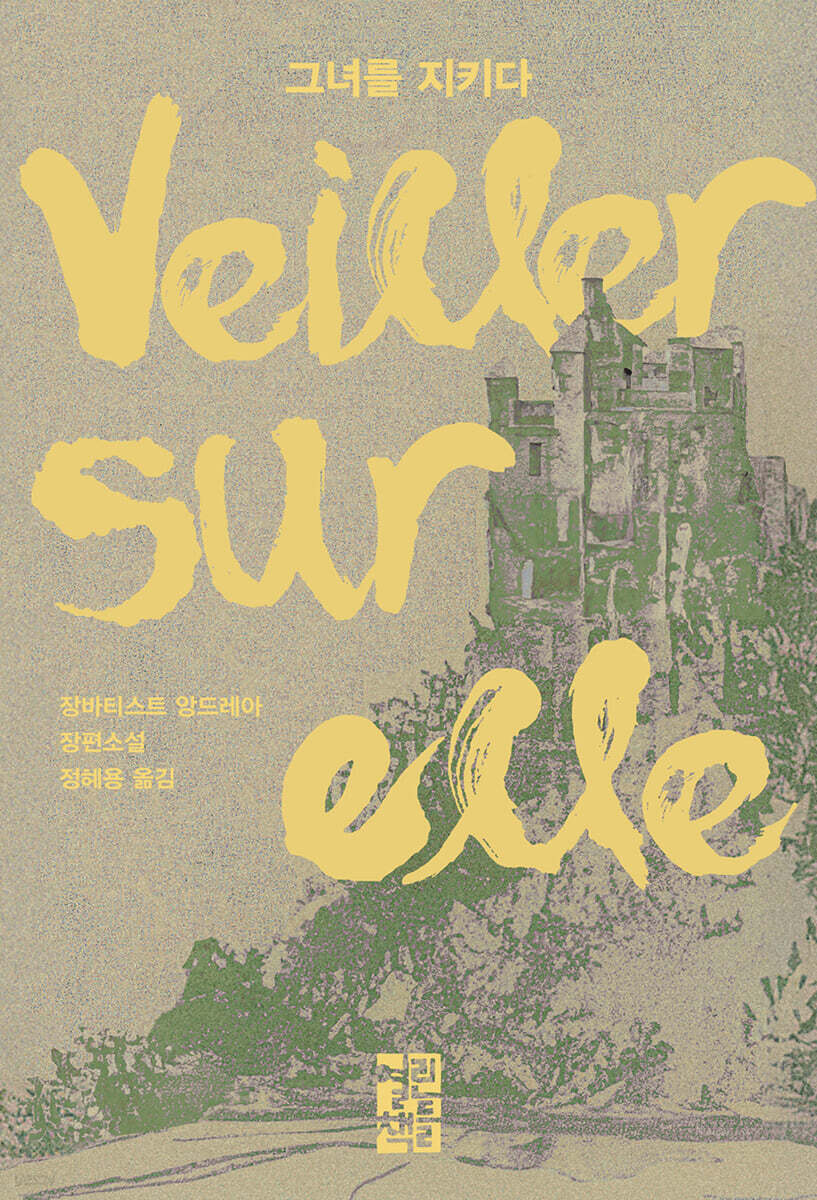
Protect her
 |
Description
Book Introduction
- A word from MD
-
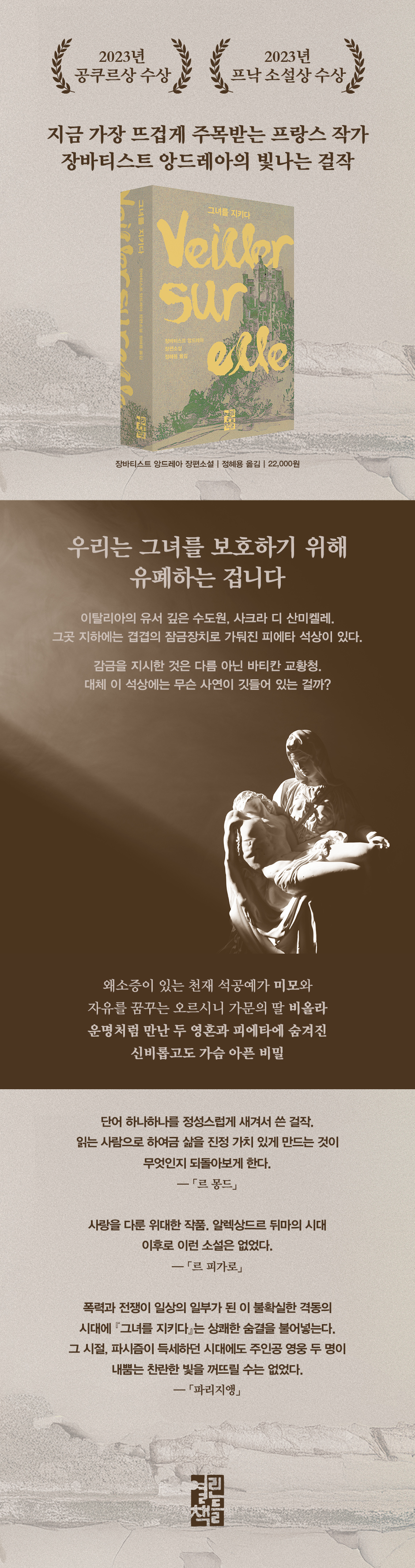
2023 Goncourt Prize WinnerIn the basement of a monastery in Italy, there is a stone Pieta statue hidden by order of the Vatican.
The stonemason who created this, Mimo, was a genius with dwarfism.
When he accidentally encounters Viola, a noble girl from a prestigious family, their fates are thrown into turmoil.
A masterpiece that unfolds a yearning for the sublime of art and a beautiful solidarity.
April 1, 2025. Novel/Poetry PD Kim Yu-ri
★★★ 2023 Goncourt Prize Winner
★★★ Winner of the 2023 Fnak Novel Prize
Since his debut, he has won 19 major French literary awards with only four novels.
A brilliant masterpiece by Jean-Baptiste André, the most talked-about writer of the moment.
Jean-Baptiste Andréa's novel, "Protect Her," which has been creating explosive buzz by sweeping major French literary awards with every novel he publishes, has been published by Open Books with a translation by Jeong Hye-yong.
This work, which won the Prix Goncourt, one of the world's three most prestigious literary awards, unravels the secrets hidden in the Pietà stone statue imprisoned in the basement of a monastery through the twisted life of a beautiful stonemason. It delicately depicts the Italian landscape at the time when fascism was on the rise, and within it, it convincingly shows the beauty of the human spirit that is not broken by innate limitations and social difficulties.
Jean-Baptiste André, who is both a film director and a screenwriter, fully demonstrated his talents by capturing each scene of the novel vividly as if it were a single cut from a movie.
From the secret story that forced the Vatican to lock the Pietà in the monastery's basement, to the trials and tribulations of a genius stonecarver born with dwarfism, to the struggle for freedom for Viola, the youngest daughter of the Orsini family, his destiny.
As we turn the pages, we breathe in the rich scent of cypress amidst the orange-tree-filled landscape of the small Italian town of Pietras d'Alba, hear the musical sound of a stonemason's splitting stone, and feel as if we have lived a lifetime alongside the protagonist's beauty.
It is a precious and rare masterpiece for which the honor of the Prix Goncourt is by no means heavy.
★★★ Winner of the 2023 Fnak Novel Prize
Since his debut, he has won 19 major French literary awards with only four novels.
A brilliant masterpiece by Jean-Baptiste André, the most talked-about writer of the moment.
Jean-Baptiste Andréa's novel, "Protect Her," which has been creating explosive buzz by sweeping major French literary awards with every novel he publishes, has been published by Open Books with a translation by Jeong Hye-yong.
This work, which won the Prix Goncourt, one of the world's three most prestigious literary awards, unravels the secrets hidden in the Pietà stone statue imprisoned in the basement of a monastery through the twisted life of a beautiful stonemason. It delicately depicts the Italian landscape at the time when fascism was on the rise, and within it, it convincingly shows the beauty of the human spirit that is not broken by innate limitations and social difficulties.
Jean-Baptiste André, who is both a film director and a screenwriter, fully demonstrated his talents by capturing each scene of the novel vividly as if it were a single cut from a movie.
From the secret story that forced the Vatican to lock the Pietà in the monastery's basement, to the trials and tribulations of a genius stonecarver born with dwarfism, to the struggle for freedom for Viola, the youngest daughter of the Orsini family, his destiny.
As we turn the pages, we breathe in the rich scent of cypress amidst the orange-tree-filled landscape of the small Italian town of Pietras d'Alba, hear the musical sound of a stonemason's splitting stone, and feel as if we have lived a lifetime alongside the protagonist's beauty.
It is a precious and rare masterpiece for which the honor of the Prix Goncourt is by no means heavy.
- You can preview some of the book's contents.
Preview
Detailed image
Into the book
I never resented my parents.
Even if the stone made me who I am today, even if black magic worked, the stone filled me up just as much as it took from me.
Stones have always spoken to me, whether limestone, metamorphic rock, or the gravestone where I will soon lie to hear the stories of those who lie underground.
--- p.32
We are confining her to protect her.
The priest does not miss the irony in those words.
Don't worry, she's there, she's doing amazingly well.
Except that no one has the right to see her.
--- p.47
Listening to stories of dead people was the boy's favorite distraction.
Viola told me that when she was five, she accidentally fell asleep on a grave while burying her grandmother, and she was obsessed with it ever since.
When I woke up, my head was full of stories that weren't my own, stories that I couldn't help but think were whispered to me from below.
--- p.109
"Beautiful Vitaliani, if there is a God, do you swear before him that you will help Viola Orsini fly and never let her fall?"
"I swear."
“And I, Viola Orsini, swear that I will help the beautiful Vitaliani to become the greatest sculptor in the world, comparable to his namesake, Michelangelo, and that I will never let him fall.”
--- p.148
If that is indeed the case, and if there is a work of art on earth more sacred than Michelangelo's Pietà, then it is a weapon.
And the men in the Vatican will probably think this way.
You did a really good job of hiding that.
--- p.166
Instead of a unified kingdom, power was still wielded by a jumble of local lords, small-time bosses, gangsters, and judges.
On October 28th of that year, the most powerful among them - the fascists, fascist activists, and former partisans - tried their luck.
A motley band marched on Rome, intent on threatening the current government.
--- p.289
I went into the room.
What immediately struck me was the colors that unfolded before my eyes, and the face of the Virgin Mary, which revealed a gentleness I had never seen before.
No, that was a lie, because I saw the exact same Madonna in the first book Viola lent me.
--- p.292
I had to look at the viola intently, really, to understand.
Her eyes were doors to another world, to a knowledge bordering on madness.
“I didn’t know you’d come,” she finally said.
“Because I haven’t forgotten.
We promised to meet again in ten years on June 24, 1918.
I admit you're right.
"You are time traveling."
--- pp.362-363
I pointed out to Viola that I wasn't working only for the fascists, and that they hadn't done anything to me.
Viola brought up the Jewish question in Germany, naming cities and people, places and murders, all of which were right before my eyes but which I preferred not to see, and thus added another quarrel to the countless quarrels that had adorned those years.
Our discontents are perfectly symmetrical, like great cosmic twins.
Viola accused me of being involved in the birth of a new world, of being one of its main actors.
--- p.408
One day in 1951, after placing Vitaliani's work in the cellar, the door to the cellar was closed, and the story ends there.
From then on, as word spread that the piece was there, a series of increasingly stringent security measures were put in place.
--- p.549
“Nothing changes if you leave.
The worst violence, that's custom.
A woman like me, a smart woman, I think I'm smart, a convention that prevents such a woman from acting independently.
After hearing that so many times, I started to think that they knew something I didn't, that they had some kind of secret.
The only secret is that they don't know anything.
That's what my brothers, and the Gambale people, and everyone else are trying to protect."
Even if the stone made me who I am today, even if black magic worked, the stone filled me up just as much as it took from me.
Stones have always spoken to me, whether limestone, metamorphic rock, or the gravestone where I will soon lie to hear the stories of those who lie underground.
--- p.32
We are confining her to protect her.
The priest does not miss the irony in those words.
Don't worry, she's there, she's doing amazingly well.
Except that no one has the right to see her.
--- p.47
Listening to stories of dead people was the boy's favorite distraction.
Viola told me that when she was five, she accidentally fell asleep on a grave while burying her grandmother, and she was obsessed with it ever since.
When I woke up, my head was full of stories that weren't my own, stories that I couldn't help but think were whispered to me from below.
--- p.109
"Beautiful Vitaliani, if there is a God, do you swear before him that you will help Viola Orsini fly and never let her fall?"
"I swear."
“And I, Viola Orsini, swear that I will help the beautiful Vitaliani to become the greatest sculptor in the world, comparable to his namesake, Michelangelo, and that I will never let him fall.”
--- p.148
If that is indeed the case, and if there is a work of art on earth more sacred than Michelangelo's Pietà, then it is a weapon.
And the men in the Vatican will probably think this way.
You did a really good job of hiding that.
--- p.166
Instead of a unified kingdom, power was still wielded by a jumble of local lords, small-time bosses, gangsters, and judges.
On October 28th of that year, the most powerful among them - the fascists, fascist activists, and former partisans - tried their luck.
A motley band marched on Rome, intent on threatening the current government.
--- p.289
I went into the room.
What immediately struck me was the colors that unfolded before my eyes, and the face of the Virgin Mary, which revealed a gentleness I had never seen before.
No, that was a lie, because I saw the exact same Madonna in the first book Viola lent me.
--- p.292
I had to look at the viola intently, really, to understand.
Her eyes were doors to another world, to a knowledge bordering on madness.
“I didn’t know you’d come,” she finally said.
“Because I haven’t forgotten.
We promised to meet again in ten years on June 24, 1918.
I admit you're right.
"You are time traveling."
--- pp.362-363
I pointed out to Viola that I wasn't working only for the fascists, and that they hadn't done anything to me.
Viola brought up the Jewish question in Germany, naming cities and people, places and murders, all of which were right before my eyes but which I preferred not to see, and thus added another quarrel to the countless quarrels that had adorned those years.
Our discontents are perfectly symmetrical, like great cosmic twins.
Viola accused me of being involved in the birth of a new world, of being one of its main actors.
--- p.408
One day in 1951, after placing Vitaliani's work in the cellar, the door to the cellar was closed, and the story ends there.
From then on, as word spread that the piece was there, a series of increasingly stringent security measures were put in place.
--- p.549
“Nothing changes if you leave.
The worst violence, that's custom.
A woman like me, a smart woman, I think I'm smart, a convention that prevents such a woman from acting independently.
After hearing that so many times, I started to think that they knew something I didn't, that they had some kind of secret.
The only secret is that they don't know anything.
That's what my brothers, and the Gambale people, and everyone else are trying to protect."
--- p.595
Publisher's Review
★★★ 2023 Goncourt Prize Winner
★★★ 2023 Fnak Novel Prize
Since his debut, he has won 19 major French literary awards with only four novels.
A brilliant masterpiece by Jean-Baptiste André, the most talked-about writer of the moment.
Jean-Baptiste Andréa's novel, "Protect Her," which has been creating explosive buzz by sweeping major French literary awards with every novel he publishes, has been published by Open Books with a translation by Jeong Hye-yong.
This work, which won the Prix Goncourt, one of the world's three most prestigious literary awards, unravels the secrets hidden in the Pietà stone statue imprisoned in the basement of a monastery through the twisted life of a beautiful stonemason. It delicately depicts the Italian landscape at the time when fascism was on the rise, and within it, it convincingly shows the beauty of the human spirit that is not broken by innate limitations and social difficulties.
Jean-Baptiste André, who is both a film director and a screenwriter, fully demonstrated his talents by capturing each scene of the novel vividly as if it were a single cut from a movie.
From the secret story that forced the Vatican to lock the Pietà in the monastery's basement, to the trials and tribulations of a genius stonecarver born with dwarfism, to the struggle for freedom for Viola, the youngest daughter of the Orsini family, his destiny.
As we turn the pages, we breathe in the rich scent of cypress amidst the orange-tree-filled landscape of the small Italian town of Pietras d'Alba, hear the musical sound of a stonemason's splitting stone, and feel as if we have lived a lifetime alongside the protagonist's beauty.
It is a precious and rare masterpiece for which the honor of the Prix Goncourt is by no means heavy.
The Pietà, locked in the basement of the monastery so that no one can see it,
The mysterious and heartbreaking secret hidden in the statue
The Sacra Monastery in Italy, a living, breathing monastery with a thousand years of history, holds countless secrets, and now one more is about to be added.
It is the Pieta statue that was locked up underground by the strict order of the Vatican.
The space containing the stone statue is inaccessible due to multiple locks, and only the abbot has the key to enter.
What on earth is the story behind this statue? The story goes back to the birth of the stonemason Mimo, who sculpted the Pietà.
The local women who saw the newborn beauty with dwarfism muttered "Il diavolo" (devil) and made the sign of the cross.
Mimo was left in the care of a stonemason when his father died at the young age of twelve, and went to work for the Orsini family, a prestigious Italian family, where he met Viola, a girl who would become his lifelong destiny.
Viola possesses a genius mind that can memorize anything she sees and can understand international affairs while sitting down, but as a noblewoman, she is not even allowed the freedom to read a single book.
Viola has one dream: to fly freely in the sky.
And Mimo has a wish to become a sculptor greater than Michelangelo.
Bound by the limitations of being a woman, Viola and trapped by the disability of dwarfism, they pledge to work together to break the chains that oppress them and achieve their dreams.
Meanwhile, chaos begins to unfold in the peaceful Italian town of Pietras d'Alba, where they live, as the dark shadow of fascism begins to fall.
Protected or imprisoned?
To overcome the closed world that prevents me from living as “me”
“We are confining her to protect her,” the Vatican says, ordering the Pietà to be confined in the monastery’s basement.
But as he gazes at the statue glowing softly in the darkness, the abbot begins to doubt.
Could it be that those who imprisoned the Pieta there truly wanted to protect the statue itself? Perhaps they were imprisoning it to protect themselves?
The situation of the Pietà resembles that of the viola.
Born into the wealthy marquis family of Orsini, Viola, unlike many of the commoners of Pietras d'Alba, does not have to worry about hunger, sweat, or fall victim to the injustices of those in power.
But what she wants is not a safe and comfortable life.
Freedom is visualized as “wings that can fly high in the sky,” the freedom to live as one’s own self by making full use of one’s innate intellectual talents.
Mimo is a physically disabled man who works as an apprentice under a violent stonemason and endures hunger, but he has the freedom to lead his own life as he wishes.
Once you realize this, the relationship between Viola and Mimo looks different, and the confinement of the Pieta, which hides its secrets, feels more meaningful.
What is the one precious thing humans must hold onto in life? The shocking twist at the end of the novel, coupled with the thrill of the experience, poses a question readers will carry with them for the rest of their lives, leaving a large question mark.
★★★ 2023 Fnak Novel Prize
Since his debut, he has won 19 major French literary awards with only four novels.
A brilliant masterpiece by Jean-Baptiste André, the most talked-about writer of the moment.
Jean-Baptiste Andréa's novel, "Protect Her," which has been creating explosive buzz by sweeping major French literary awards with every novel he publishes, has been published by Open Books with a translation by Jeong Hye-yong.
This work, which won the Prix Goncourt, one of the world's three most prestigious literary awards, unravels the secrets hidden in the Pietà stone statue imprisoned in the basement of a monastery through the twisted life of a beautiful stonemason. It delicately depicts the Italian landscape at the time when fascism was on the rise, and within it, it convincingly shows the beauty of the human spirit that is not broken by innate limitations and social difficulties.
Jean-Baptiste André, who is both a film director and a screenwriter, fully demonstrated his talents by capturing each scene of the novel vividly as if it were a single cut from a movie.
From the secret story that forced the Vatican to lock the Pietà in the monastery's basement, to the trials and tribulations of a genius stonecarver born with dwarfism, to the struggle for freedom for Viola, the youngest daughter of the Orsini family, his destiny.
As we turn the pages, we breathe in the rich scent of cypress amidst the orange-tree-filled landscape of the small Italian town of Pietras d'Alba, hear the musical sound of a stonemason's splitting stone, and feel as if we have lived a lifetime alongside the protagonist's beauty.
It is a precious and rare masterpiece for which the honor of the Prix Goncourt is by no means heavy.
The Pietà, locked in the basement of the monastery so that no one can see it,
The mysterious and heartbreaking secret hidden in the statue
The Sacra Monastery in Italy, a living, breathing monastery with a thousand years of history, holds countless secrets, and now one more is about to be added.
It is the Pieta statue that was locked up underground by the strict order of the Vatican.
The space containing the stone statue is inaccessible due to multiple locks, and only the abbot has the key to enter.
What on earth is the story behind this statue? The story goes back to the birth of the stonemason Mimo, who sculpted the Pietà.
The local women who saw the newborn beauty with dwarfism muttered "Il diavolo" (devil) and made the sign of the cross.
Mimo was left in the care of a stonemason when his father died at the young age of twelve, and went to work for the Orsini family, a prestigious Italian family, where he met Viola, a girl who would become his lifelong destiny.
Viola possesses a genius mind that can memorize anything she sees and can understand international affairs while sitting down, but as a noblewoman, she is not even allowed the freedom to read a single book.
Viola has one dream: to fly freely in the sky.
And Mimo has a wish to become a sculptor greater than Michelangelo.
Bound by the limitations of being a woman, Viola and trapped by the disability of dwarfism, they pledge to work together to break the chains that oppress them and achieve their dreams.
Meanwhile, chaos begins to unfold in the peaceful Italian town of Pietras d'Alba, where they live, as the dark shadow of fascism begins to fall.
Protected or imprisoned?
To overcome the closed world that prevents me from living as “me”
“We are confining her to protect her,” the Vatican says, ordering the Pietà to be confined in the monastery’s basement.
But as he gazes at the statue glowing softly in the darkness, the abbot begins to doubt.
Could it be that those who imprisoned the Pieta there truly wanted to protect the statue itself? Perhaps they were imprisoning it to protect themselves?
The situation of the Pietà resembles that of the viola.
Born into the wealthy marquis family of Orsini, Viola, unlike many of the commoners of Pietras d'Alba, does not have to worry about hunger, sweat, or fall victim to the injustices of those in power.
But what she wants is not a safe and comfortable life.
Freedom is visualized as “wings that can fly high in the sky,” the freedom to live as one’s own self by making full use of one’s innate intellectual talents.
Mimo is a physically disabled man who works as an apprentice under a violent stonemason and endures hunger, but he has the freedom to lead his own life as he wishes.
Once you realize this, the relationship between Viola and Mimo looks different, and the confinement of the Pieta, which hides its secrets, feels more meaningful.
What is the one precious thing humans must hold onto in life? The shocking twist at the end of the novel, coupled with the thrill of the experience, poses a question readers will carry with them for the rest of their lives, leaving a large question mark.
GOODS SPECIFICS
- Date of issue: March 20, 2025
- Page count, weight, size: 632 pages | 662g | 128*188*35mm
- ISBN13: 9788932924984
- ISBN10: 8932924988
You may also like
카테고리
korean


korean

![GQ KOREA Mark (Monthly): December [2025]](http://librairie.coreenne.fr/cdn/shop/files/8ef265dbbfbf186523ed75ba7319009d.jpg?v=1765340328&width=3840)


