

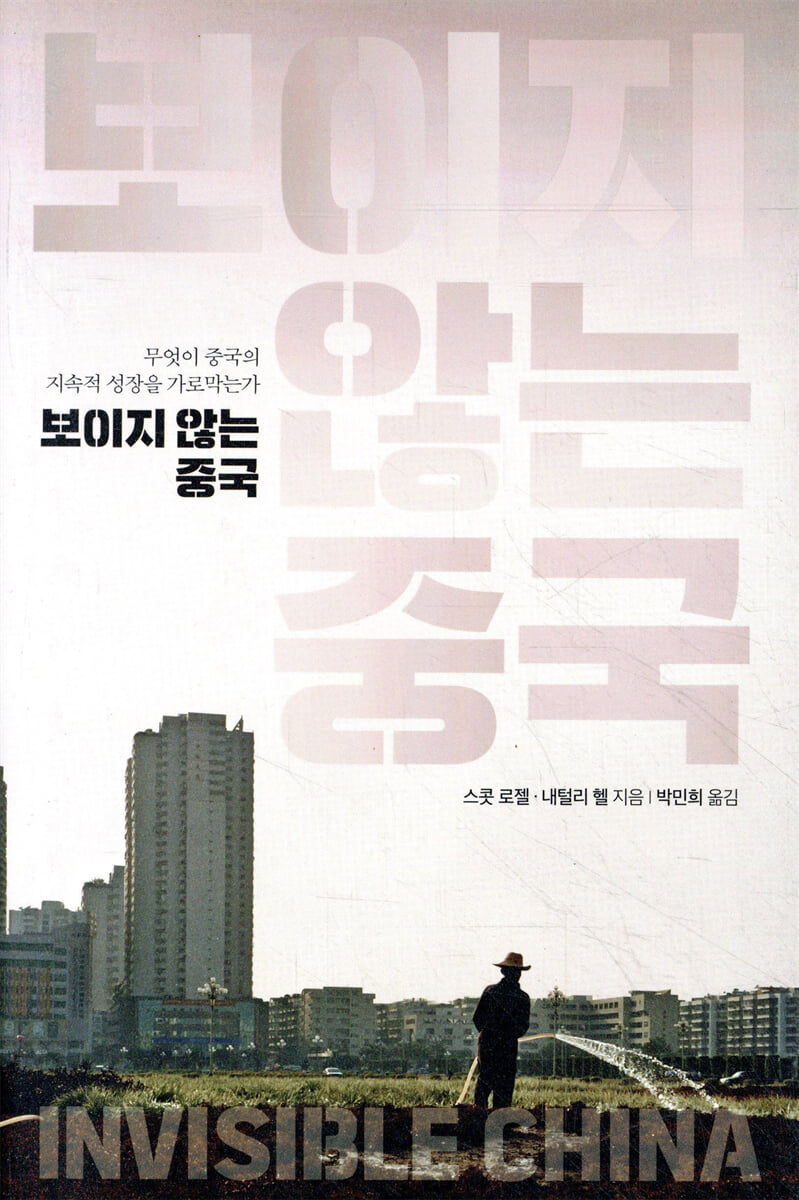
Invisible China
 |
Description
Book Introduction
Extreme urban-rural disparities and huge educational and health inequalities
China faces the crisis of the "middle-income trap"!
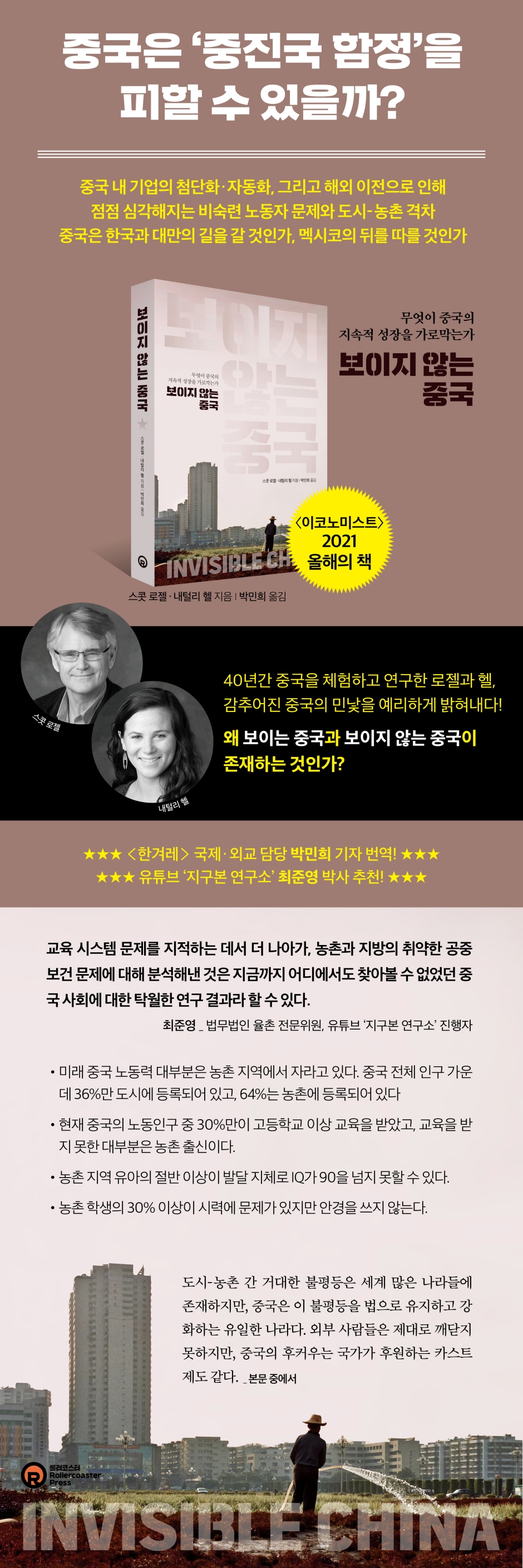
Can China truly avoid the "middle-income trap"? The authors, who have traveled across China for 40 years conducting diverse research on education, economy, and agriculture, conclude that China is at a crossroads: either achieving high-income status or falling into the "middle-income trap."
He points out that the extreme inequality between urban and rural areas is an obstacle to China's rise to a high-income country, and that the 'Hukou system' that separates rural and urban areas is the biggest cause of this.
The hukou system has created huge gaps between urban and rural areas, including education and health, and is creating major social problems that threaten China's continued growth.
This book, which observes China today from the closest possible perspective, contains vivid reporting that could only be achieved through extensive firsthand experience in China, a broad perspective that understands China's relationship with the world, and sharp criticism grounded in affection for the Chinese people.
China faces the crisis of the "middle-income trap"!
Can China truly avoid the "middle-income trap"? The authors, who have traveled across China for 40 years conducting diverse research on education, economy, and agriculture, conclude that China is at a crossroads: either achieving high-income status or falling into the "middle-income trap."
He points out that the extreme inequality between urban and rural areas is an obstacle to China's rise to a high-income country, and that the 'Hukou system' that separates rural and urban areas is the biggest cause of this.
The hukou system has created huge gaps between urban and rural areas, including education and health, and is creating major social problems that threaten China's continued growth.
This book, which observes China today from the closest possible perspective, contains vivid reporting that could only be achieved through extensive firsthand experience in China, a broad perspective that understands China's relationship with the world, and sharp criticism grounded in affection for the Chinese people.
- You can preview some of the book's contents.
Preview
index
Recommendation
preface
introduction
Chapter 1: The Middle-Income Trap
Chapter 2: China's Imminent Transition
Chapter 3: Worst Case Scenario
Chapter 4: How China Got Here
Chapter 5: Unstable Foundation
Chapter 6: The Invisible Barrier
Chapter 7: The Early Problems of Life
conclusion
Acknowledgements
Appendix: REAP Team
Translator's Note
annotation
Search
preface
introduction
Chapter 1: The Middle-Income Trap
Chapter 2: China's Imminent Transition
Chapter 3: Worst Case Scenario
Chapter 4: How China Got Here
Chapter 5: Unstable Foundation
Chapter 6: The Invisible Barrier
Chapter 7: The Early Problems of Life
conclusion
Acknowledgements
Appendix: REAP Team
Translator's Note
annotation
Search
Detailed image
Into the book
If China wants to transform into a stable, high-wage, high-income country, it will need a workforce capable of performing more complex, constantly changing, and non-uniform work.
New employers, both domestically and internationally, will want workers who can read critically, perform basic math, make careful, logical decisions, use a computer, and speak English.
China's arable land is small, and the average allocated farmland size is barely enough to support the caloric intake of a family of four.
For many unemployed Chinese, their only options are joining the informal workforce, selling fried noodles on the street, washing car windows at intersections, or working as waiters in restaurants.
---From the "Preface"
China has grown very successfully and become a middle-income country.
But now we've entered a zone where there are different ways to grow and different ways to stagnate or decline.
---From "The Middle Income Trap"
Over the past few decades, China has served as a growth engine for the rest of the world.
Chinese workers power entire industries, and Chinese consumers sustain businesses around the world.
If the Chinese economy slows down, China will no longer be able to play that role.
---From "Worst Case Scenario"
Under the hukou system, every citizen is assigned a rural or urban status from the moment of birth.
This status fundamentally affects every moment of life in China, and it is extremely difficult to change.
---From "How China Got Here"
Simply put, children in rural areas are not learning because they are sick.
As long as this problem is not solved, it doesn't matter how much rural schools develop.
If children continue to be sick, students in rural areas will remain stuck in their places.
Millions of children are doomed to a future far below their potential.
With two-thirds of China's future workforce growing up in "invisible China," improving the health and quality of education for these children is a national concern.
---From "The Invisible Barrier"
Massive urban-rural inequalities exist in many countries around the world, but China is the only country that maintains and reinforces this inequality through law.
Outsiders may not fully realize it, but China's hukou system is like a state-sponsored caste system.
New employers, both domestically and internationally, will want workers who can read critically, perform basic math, make careful, logical decisions, use a computer, and speak English.
China's arable land is small, and the average allocated farmland size is barely enough to support the caloric intake of a family of four.
For many unemployed Chinese, their only options are joining the informal workforce, selling fried noodles on the street, washing car windows at intersections, or working as waiters in restaurants.
---From the "Preface"
China has grown very successfully and become a middle-income country.
But now we've entered a zone where there are different ways to grow and different ways to stagnate or decline.
---From "The Middle Income Trap"
Over the past few decades, China has served as a growth engine for the rest of the world.
Chinese workers power entire industries, and Chinese consumers sustain businesses around the world.
If the Chinese economy slows down, China will no longer be able to play that role.
---From "Worst Case Scenario"
Under the hukou system, every citizen is assigned a rural or urban status from the moment of birth.
This status fundamentally affects every moment of life in China, and it is extremely difficult to change.
---From "How China Got Here"
Simply put, children in rural areas are not learning because they are sick.
As long as this problem is not solved, it doesn't matter how much rural schools develop.
If children continue to be sick, students in rural areas will remain stuck in their places.
Millions of children are doomed to a future far below their potential.
With two-thirds of China's future workforce growing up in "invisible China," improving the health and quality of education for these children is a national concern.
---From "The Invisible Barrier"
Massive urban-rural inequalities exist in many countries around the world, but China is the only country that maintains and reinforces this inequality through law.
Outsiders may not fully realize it, but China's hukou system is like a state-sponsored caste system.
---From "Conclusion"
Publisher's Review
China is beginning to lose its past growth momentum.
Can we avoid the 'middle-income trap'?
In 2015-2016, the authors of this book noticed "strange signs" in rural China.
Young, healthy people, who had previously been hard to find in rural areas, were now a common sight.
People who had been working in the city lost their jobs and returned to their hometowns.
For over 30 years since the 1980s, China has achieved rapid economic growth despite its massive population and low wages.
Factories from global corporations as well as domestic Chinese companies have sprung up everywhere, and workers from all over the country have flocked there.
As their wages rose, their spending power grew, and demand for construction, services, and manufactured goods soared.
This created a virtuous cycle that fueled China's continued economic growth.
But this virtuous cycle of growth could not last forever.
As workers' wages rose and globalization progressed, companies began to move to other countries in search of cheaper labor or to install automated systems such as robots, and no longer sought out low-skilled workers.
The reason these workers are unable to find new jobs and are being ignored by companies is because the Chinese government has neglected to invest in human resources.
According to a World Bank report, among the 101 countries that were middle-income in 1960, only 13, including Korea, Ireland, and Taiwan, had become high-income countries by 2008.
As of 2015, only about 30% of China's working population had a high school education or higher, a rate significantly lower than the 72% recorded in South Korea, Taiwan, Ireland, and Israel before they transitioned to high-income status.
No country has escaped the middle-income trap with a high school enrollment rate below 50%.
Massive education and health inequalities
The problem isn't simply that China's workforce is poorly educated.
Looking at the difference in education rates between urban and rural areas, as of 2010, 44% of China's urban workforce had a high school education or higher, while only 11% in rural areas.
There are also significant differences in the quality of education.
Many rural students attend low-quality vocational schools, and in fact, achievement tests comparing rural fourth-graders across grade levels show that rural fourth-graders lag behind their urban counterparts by more than two grade levels.
With 75% of children under the age of three born and raised in rural areas, there is no choice but to be deeply concerned about China's future workforce and economy.
The urban-rural gap doesn't stop at education.
More than half of newborns in rural areas are malnourished, and 40% of schoolchildren in many communities in southern China have been found to have roundworms in their intestines.
Additionally, more than 30% of rural students (4th grade to 8th grade) have vision problems, but do not wear glasses.
Many rural students are unable to advance to high school due to poverty and cognitive deficits.
The book's authors warn that if the Chinese government neglects this problem, workers could be pushed out of the system.
Working in the 'informal sector', outside of state control, means you won't be able to access welfare benefits, and in extreme cases, crime may even increase.
This would lead to lower taxes and a worsening social safety net across the Chinese economy.
Is China's failure a success for some?
What the authors particularly emphasize is reforming the hukou (residential registration) system, which assigns citizens urban or rural status and controls their residential relocation.
The urban-rural gap is widening and conflict is intensifying due to the hukou system, which labels people as either urban or rural, and makes it nearly impossible to change their status midway.
This book points out that because of this, there exist simultaneously in China a 'rural China Republic' and an 'urban China Republic', or a 'visible China' and an 'invisible China'.
In addition to reforming the Hukou issue, we propose significantly expanding investment in education, that is, in "people," and even implementing a universal basic income.
China's problems are not limited to China's problems; they have significant political and economic implications for the entire world.
China accounts for 30% of global trade, and 95% of the world's major companies have part of their supply chains in China.
If China's supply chain collapses, prices will rise globally, and if the Chinese economy slows down, global companies will lose countless customers.
Especially, as we have China as our largest trading partner, we cannot help but be sensitive to changes in China.
Furthermore, the problems of China, which are highlighted in "Invisible China," are intertwined with other social problems that we are also currently facing, such as a declining working-age population, an aging population, and regional imbalances, and therefore deserve closer attention.
Finally, it is necessary to take another look at our society, where social mobility is becoming increasingly difficult and inequality is worsening.
This is because inequality, which shows no signs of being resolved, will cause each and every member of society to lose hope and hinder the development of all sectors of society.
Can we avoid the 'middle-income trap'?
In 2015-2016, the authors of this book noticed "strange signs" in rural China.
Young, healthy people, who had previously been hard to find in rural areas, were now a common sight.
People who had been working in the city lost their jobs and returned to their hometowns.
For over 30 years since the 1980s, China has achieved rapid economic growth despite its massive population and low wages.
Factories from global corporations as well as domestic Chinese companies have sprung up everywhere, and workers from all over the country have flocked there.
As their wages rose, their spending power grew, and demand for construction, services, and manufactured goods soared.
This created a virtuous cycle that fueled China's continued economic growth.
But this virtuous cycle of growth could not last forever.
As workers' wages rose and globalization progressed, companies began to move to other countries in search of cheaper labor or to install automated systems such as robots, and no longer sought out low-skilled workers.
The reason these workers are unable to find new jobs and are being ignored by companies is because the Chinese government has neglected to invest in human resources.
According to a World Bank report, among the 101 countries that were middle-income in 1960, only 13, including Korea, Ireland, and Taiwan, had become high-income countries by 2008.
As of 2015, only about 30% of China's working population had a high school education or higher, a rate significantly lower than the 72% recorded in South Korea, Taiwan, Ireland, and Israel before they transitioned to high-income status.
No country has escaped the middle-income trap with a high school enrollment rate below 50%.
Massive education and health inequalities
The problem isn't simply that China's workforce is poorly educated.
Looking at the difference in education rates between urban and rural areas, as of 2010, 44% of China's urban workforce had a high school education or higher, while only 11% in rural areas.
There are also significant differences in the quality of education.
Many rural students attend low-quality vocational schools, and in fact, achievement tests comparing rural fourth-graders across grade levels show that rural fourth-graders lag behind their urban counterparts by more than two grade levels.
With 75% of children under the age of three born and raised in rural areas, there is no choice but to be deeply concerned about China's future workforce and economy.
The urban-rural gap doesn't stop at education.
More than half of newborns in rural areas are malnourished, and 40% of schoolchildren in many communities in southern China have been found to have roundworms in their intestines.
Additionally, more than 30% of rural students (4th grade to 8th grade) have vision problems, but do not wear glasses.
Many rural students are unable to advance to high school due to poverty and cognitive deficits.
The book's authors warn that if the Chinese government neglects this problem, workers could be pushed out of the system.
Working in the 'informal sector', outside of state control, means you won't be able to access welfare benefits, and in extreme cases, crime may even increase.
This would lead to lower taxes and a worsening social safety net across the Chinese economy.
Is China's failure a success for some?
What the authors particularly emphasize is reforming the hukou (residential registration) system, which assigns citizens urban or rural status and controls their residential relocation.
The urban-rural gap is widening and conflict is intensifying due to the hukou system, which labels people as either urban or rural, and makes it nearly impossible to change their status midway.
This book points out that because of this, there exist simultaneously in China a 'rural China Republic' and an 'urban China Republic', or a 'visible China' and an 'invisible China'.
In addition to reforming the Hukou issue, we propose significantly expanding investment in education, that is, in "people," and even implementing a universal basic income.
China's problems are not limited to China's problems; they have significant political and economic implications for the entire world.
China accounts for 30% of global trade, and 95% of the world's major companies have part of their supply chains in China.
If China's supply chain collapses, prices will rise globally, and if the Chinese economy slows down, global companies will lose countless customers.
Especially, as we have China as our largest trading partner, we cannot help but be sensitive to changes in China.
Furthermore, the problems of China, which are highlighted in "Invisible China," are intertwined with other social problems that we are also currently facing, such as a declining working-age population, an aging population, and regional imbalances, and therefore deserve closer attention.
Finally, it is necessary to take another look at our society, where social mobility is becoming increasingly difficult and inequality is worsening.
This is because inequality, which shows no signs of being resolved, will cause each and every member of society to lose hope and hinder the development of all sectors of society.
GOODS SPECIFICS
- Publication date: April 15, 2022
- Page count, weight, size: 356 pages | 460g | 140*210*30mm
- ISBN13: 9791191311143
- ISBN10: 1191311147
You may also like
카테고리
korean


korean

![GQ KOREA Mark (Monthly): December [2025]](http://librairie.coreenne.fr/cdn/shop/files/8ef265dbbfbf186523ed75ba7319009d.jpg?v=1765340328&width=3840)


