

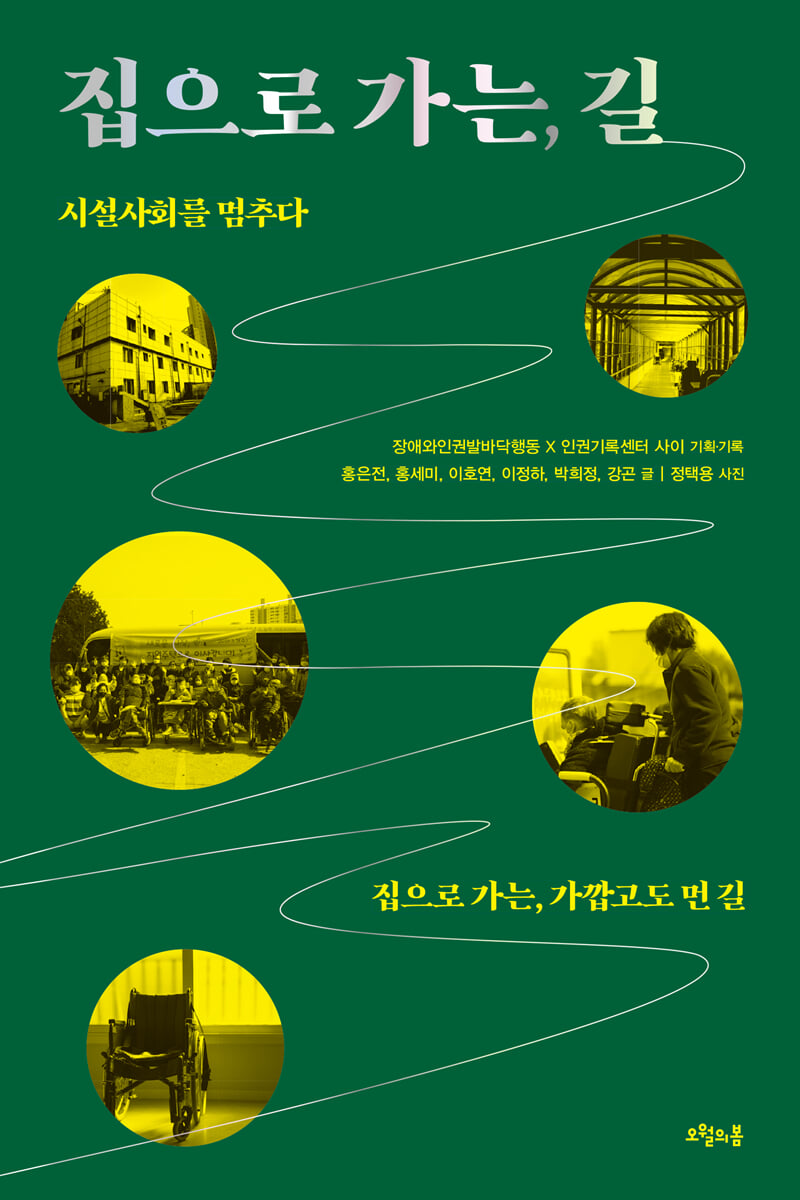
On the way home
 |
Description
Book Introduction
“Don’t keep us locked up in the facility any longer.
“I will live here with you.” On April 30, 2021, the first residential facility for the disabled in Korean society closed its doors.
It was a 'voluntary closure' carried out solely by the facility/corporation's own will, not due to external pressure from the local government or other sources.
This facility, which is no longer in operation, is called 'Hyangyu's House' located in Gimpo, Gyeonggi Province.
The starting point was an incident in which a disabled resident (Han Gyu-seon) first reported and made public corruption within the facility.
It was revealed that the Seokam Foundation, which operates the facility, had been stealing disability benefits paid to individual residents for a long time.
Upon learning of this, some residents ask the staff (rehabilitation instructors) with whom they spend most of their daily lives to join them in exposing the corruption. As the residents and staff work together to gather evidence to prove the various corruptions of the foundation, the wave of struggle spreads rapidly.
Employees contact external disability activist groups, such as the Disability and Human Rights Movement and the National Coalition for the Elimination of Discrimination against Persons with Disabilities (NCAD), and activists in deinstitutionalization, to bring corruption issues to light.
Residents staged a one-person protest in front of the Yangcheon-gu Office, the local government under the jurisdiction of Hyangyu House, and staged a sit-in protest at Seoul City Hall and Marronnier Park, marking the beginning of a full-scale struggle.
The initial struggle to root out corruption within the facility expanded into a movement to deinstitutionalize, and the role of deinstitutionalization activists for the disabled was significant until the facility closed of its own volition.
They emphasized that the struggle should not stop at simply exposing corruption but should go as far as abolishing the facility itself, and in fact, to achieve that goal, they did not hesitate to go inside the facility and become executives/managers.
This book fully captures the fierce, beautiful, and arduous process of solidarity between the facility management team (disability activists), residents, and staff who came to dismantle the facility, relying on each other to achieve 'deinstitutionalization' and 'independence.'
This unprecedented event, the first voluntary closure of a facility in Korean society, is shaking up dichotomies such as 'institutional society,' 'institution vs. deinstitutionalization,' and 'family vs. facility,' and is causing a major shift in the deinstitutionalization movement.
It is time to break the cartel of silence that the state and conglomerate social welfare corporations have solidified, and the premise it has created ('If you are disabled, you should naturally live in a facility').
The passionate struggle demonstrated by the residents and staff of Hyangyu House will create countless deinstitutionalization projects in the future.
“I will live here with you.” On April 30, 2021, the first residential facility for the disabled in Korean society closed its doors.
It was a 'voluntary closure' carried out solely by the facility/corporation's own will, not due to external pressure from the local government or other sources.
This facility, which is no longer in operation, is called 'Hyangyu's House' located in Gimpo, Gyeonggi Province.
The starting point was an incident in which a disabled resident (Han Gyu-seon) first reported and made public corruption within the facility.
It was revealed that the Seokam Foundation, which operates the facility, had been stealing disability benefits paid to individual residents for a long time.
Upon learning of this, some residents ask the staff (rehabilitation instructors) with whom they spend most of their daily lives to join them in exposing the corruption. As the residents and staff work together to gather evidence to prove the various corruptions of the foundation, the wave of struggle spreads rapidly.
Employees contact external disability activist groups, such as the Disability and Human Rights Movement and the National Coalition for the Elimination of Discrimination against Persons with Disabilities (NCAD), and activists in deinstitutionalization, to bring corruption issues to light.
Residents staged a one-person protest in front of the Yangcheon-gu Office, the local government under the jurisdiction of Hyangyu House, and staged a sit-in protest at Seoul City Hall and Marronnier Park, marking the beginning of a full-scale struggle.
The initial struggle to root out corruption within the facility expanded into a movement to deinstitutionalize, and the role of deinstitutionalization activists for the disabled was significant until the facility closed of its own volition.
They emphasized that the struggle should not stop at simply exposing corruption but should go as far as abolishing the facility itself, and in fact, to achieve that goal, they did not hesitate to go inside the facility and become executives/managers.
This book fully captures the fierce, beautiful, and arduous process of solidarity between the facility management team (disability activists), residents, and staff who came to dismantle the facility, relying on each other to achieve 'deinstitutionalization' and 'independence.'
This unprecedented event, the first voluntary closure of a facility in Korean society, is shaking up dichotomies such as 'institutional society,' 'institution vs. deinstitutionalization,' and 'family vs. facility,' and is causing a major shift in the deinstitutionalization movement.
It is time to break the cartel of silence that the state and conglomerate social welfare corporations have solidified, and the premise it has created ('If you are disabled, you should naturally live in a facility').
The passionate struggle demonstrated by the residents and staff of Hyangyu House will create countless deinstitutionalization projects in the future.
- You can preview some of the book's contents.
Preview
index
Opening Remarks: They Are Coming _ Hong Eun-jeon | 032
Glossary of Terms | 042
Narrator Introduction | 047
Employees Speak Out
Until one facility disappears
Kim Jeong-ha, a deinstitutionalization activist who became Freewell's chairman | 054
There is no such thing as failed independence.
: Secretary-General Kang Min-jeong, who remained in the place where everyone else had left | 102
When you try to overcome fear
Park Jong-sun, a 20-year veteran rehabilitation instructor | 132
The struggle that changed them and me
: Kim Man-sun, a 20-year veteran rehabilitation instructor | 144
The attitude of listening until you hear it
: Kwon Young-ja, a life rehabilitation instructor who worked as a nursing assistant | 154
The path shown by the deinstitutionalized party
: Jeong Yeong-mi, a social rehabilitation teacher who supported deinstitutionalization | 164
The starting point of deinstitutionalization
Park Sook-kyung, a social welfare researcher who became the first president of Freewell | 178
Drawing on the deinstitutionalization of facility workers
: Jeong Jae-won, the last director of Hyangyu House | 196
Residents speak
What moved me was anger
Han Gyu-seon, the first whistleblower of facility corruption | 212
The facility looked really small and shabby.
Kim Dong-rim, who joined the fight against corruption and advocated for the right to deinstitutionalization | 230
Independent living also requires community.
: Hwang In-hyeon, a 10-year independent living veteran | 242
I like getting out of here
Moon Young-sun, a resident facing deinstitutionalization | 260
I'm half-and-half about facilities and deinstitutionalization.
: Yang Nam-yeon, the last runner to leave the facility | 270
I guess it was better when I was there
Lee Jeong-ja, a resident who opposed deinstitutionalization | 286
supplement
History | 311
The Closure of the House of Hyangyu and What Happened After | 314
A map of the deinstitutionalization projected by the Freewell people _ Jeon Geun-bae | 336
Glossary of Terms | 042
Narrator Introduction | 047
Employees Speak Out
Until one facility disappears
Kim Jeong-ha, a deinstitutionalization activist who became Freewell's chairman | 054
There is no such thing as failed independence.
: Secretary-General Kang Min-jeong, who remained in the place where everyone else had left | 102
When you try to overcome fear
Park Jong-sun, a 20-year veteran rehabilitation instructor | 132
The struggle that changed them and me
: Kim Man-sun, a 20-year veteran rehabilitation instructor | 144
The attitude of listening until you hear it
: Kwon Young-ja, a life rehabilitation instructor who worked as a nursing assistant | 154
The path shown by the deinstitutionalized party
: Jeong Yeong-mi, a social rehabilitation teacher who supported deinstitutionalization | 164
The starting point of deinstitutionalization
Park Sook-kyung, a social welfare researcher who became the first president of Freewell | 178
Drawing on the deinstitutionalization of facility workers
: Jeong Jae-won, the last director of Hyangyu House | 196
Residents speak
What moved me was anger
Han Gyu-seon, the first whistleblower of facility corruption | 212
The facility looked really small and shabby.
Kim Dong-rim, who joined the fight against corruption and advocated for the right to deinstitutionalization | 230
Independent living also requires community.
: Hwang In-hyeon, a 10-year independent living veteran | 242
I like getting out of here
Moon Young-sun, a resident facing deinstitutionalization | 260
I'm half-and-half about facilities and deinstitutionalization.
: Yang Nam-yeon, the last runner to leave the facility | 270
I guess it was better when I was there
Lee Jeong-ja, a resident who opposed deinstitutionalization | 286
supplement
History | 311
The Closure of the House of Hyangyu and What Happened After | 314
A map of the deinstitutionalization projected by the Freewell people _ Jeon Geun-bae | 336
Into the book
I'm not saying that I want to change the director and live outside the facility just for the sake of my body.
Like everyone else, I want to live my life taking responsibility for my share of life's natural tasks.
--- p.5
I've seen many amazing transformations in my time working in disability activism, but I've never seen a drama as wonderful and beautiful as this one.
Hyangyu House, where 120 people once lived together, is now empty.
They would all be back in their communities, living their own lives, free and precarious, joyful and sad, in their own homes.
--- p.38
The relationship between residents and staff in a facility is the same as the relationship between people with disabilities and people without disabilities in our society.
That relationship is changing, which means that the relationships in society as a whole are changing.
The deinstitutionalization movement is a movement that seeks to radically change this discriminatory relationship.
--- p.39
One time, when I went to Hyangyu's house, I saw a person tied to a bed.
He keeps pulling out his nose thread.
The staff tied him up, saying that the doctor said it was okay to tie him up because it was dangerous to take him off.
Such people are now independent and receiving personal services, and are now able to live without being tied down.
--- p.97~98
I thought it would be hard, but I was able to live like that, and it was possible because the activity support worker was there to help me.
When people see more electric wheelchairs in their community, people without disabilities become aware of them.
Those people also come out and walk around.
--- p.117
If you stay at the facility, you will only see the people at the facility.
When people with disabilities meet with outside activists and counselors and have various experiences, things definitely get better.
As we gain more experience, we come to know more.
Because facilities provide residents with only a limited range of experiences and information, staff also see people with disabilities only within that framework.
We are accustomed to seeing residents as disabled people confined within the facility.
--- p.120
Isn't it also violence to tell people they have to live in a facility until the problem is resolved simply because the conditions aren't right or because there aren't enough staff? It's crucial for people with disabilities to assert their rights and create opportunities by living in their communities.
It doesn't make sense to tell someone not to go out because the conditions aren't right yet, without even giving them a chance.
--- p.127
At that time, I tried to somehow adapt to the facility and live diligently.
But what meaning would such a life have? In a place without dreams or a future, where only death could lead to escape…
--- p.216
I thought the most important thing after leaving the facility was a home and activity support workers.
As you live, you realize that being active is important.
In the past, I was very active and traveled a lot.
I feel lethargic because I don't work.
I'm annoyed with myself because I can't do anything.
Like everyone else, I want to live my life taking responsibility for my share of life's natural tasks.
--- p.5
I've seen many amazing transformations in my time working in disability activism, but I've never seen a drama as wonderful and beautiful as this one.
Hyangyu House, where 120 people once lived together, is now empty.
They would all be back in their communities, living their own lives, free and precarious, joyful and sad, in their own homes.
--- p.38
The relationship between residents and staff in a facility is the same as the relationship between people with disabilities and people without disabilities in our society.
That relationship is changing, which means that the relationships in society as a whole are changing.
The deinstitutionalization movement is a movement that seeks to radically change this discriminatory relationship.
--- p.39
One time, when I went to Hyangyu's house, I saw a person tied to a bed.
He keeps pulling out his nose thread.
The staff tied him up, saying that the doctor said it was okay to tie him up because it was dangerous to take him off.
Such people are now independent and receiving personal services, and are now able to live without being tied down.
--- p.97~98
I thought it would be hard, but I was able to live like that, and it was possible because the activity support worker was there to help me.
When people see more electric wheelchairs in their community, people without disabilities become aware of them.
Those people also come out and walk around.
--- p.117
If you stay at the facility, you will only see the people at the facility.
When people with disabilities meet with outside activists and counselors and have various experiences, things definitely get better.
As we gain more experience, we come to know more.
Because facilities provide residents with only a limited range of experiences and information, staff also see people with disabilities only within that framework.
We are accustomed to seeing residents as disabled people confined within the facility.
--- p.120
Isn't it also violence to tell people they have to live in a facility until the problem is resolved simply because the conditions aren't right or because there aren't enough staff? It's crucial for people with disabilities to assert their rights and create opportunities by living in their communities.
It doesn't make sense to tell someone not to go out because the conditions aren't right yet, without even giving them a chance.
--- p.127
At that time, I tried to somehow adapt to the facility and live diligently.
But what meaning would such a life have? In a place without dreams or a future, where only death could lead to escape…
--- p.216
I thought the most important thing after leaving the facility was a home and activity support workers.
As you live, you realize that being active is important.
In the past, I was very active and traveled a lot.
I feel lethargic because I don't work.
I'm annoyed with myself because I can't do anything.
--- p.257
Publisher's Review
Closed the door only by one's own will
Until it became the first facility,
Residents and staff of 'Hyangyu House' passed together
A record of a remarkable, fierce, beautiful, and arduous era
“Don’t keep us locked up in the facility any longer.
“I will live here with you.” On April 30, 2021, the first residential facility for the disabled in Korean society closed its doors.
It was a 'voluntary closure' carried out solely by the facility/corporation's own will, not due to external pressure from the local government or other sources.
This facility, which is no longer in operation, is called 'Hyangyu's House' located in Gimpo, Gyeonggi Province.
The starting point was an incident in which a disabled resident (Han Gyu-seon) first reported and made public corruption within the facility.
It was revealed that the Seokam Foundation, which operates the facility, had been stealing disability benefits paid to individual residents for a long time.
Upon learning of this, some residents ask the staff (rehabilitation instructors) with whom they spend most of their daily lives to join them in exposing the corruption. As the residents and staff work together to gather evidence to prove the various corruptions of the foundation, the wave of struggle spreads rapidly.
Employees contact external disability activist groups, such as the Disability and Human Rights Movement and the National Coalition for the Elimination of Discrimination against Persons with Disabilities (NCAD), and activists in deinstitutionalization, to bring corruption issues to light.
Residents staged a one-person protest in front of the Yangcheon-gu Office, the local government under the jurisdiction of Hyangyu House, and staged a sit-in protest at Seoul City Hall and Marronnier Park, marking the beginning of a full-scale struggle.
The initial struggle to root out corruption within the facility expanded into a movement to deinstitutionalize, and the role of deinstitutionalization activists for the disabled was significant until the facility closed of its own volition.
They emphasized that the struggle should not stop at simply exposing corruption but should go as far as abolishing the facility itself, and in fact, to achieve that goal, they did not hesitate to go inside the facility and become executives/managers.
This book fully captures the fierce, beautiful, and arduous process of solidarity between the facility management team (disability activists), residents, and staff who came to dismantle the facility and relied on each other to achieve 'deinstitutionalization' and 'independence.'
This unprecedented event, the first voluntary closure of a facility in Korean society, is shaking up dichotomies such as 'institutional society,' 'institution vs. deinstitutionalization,' and 'family vs. facility,' and is causing a major shift in the deinstitutionalization movement.
It is time to break the cartel of silence that the state and conglomerate social welfare corporations have solidified, and the premise it has created ('If you are disabled, you should naturally live in a facility').
The passionate struggle demonstrated by the residents and staff of Hyangyu House will create countless deinstitutionalization projects in the future.
The first case of abolishing a residential facility for the disabled in Korea: From reporting corruption and human rights violations to the movement to deinstitutionalize.
Before becoming the first facility in Korean society to voluntarily close its doors, the residents and staff of Hyangyu House (formerly Seokam Bethesda Nursing Home), a facility under the social welfare corporation Freewell (formerly Seokam Foundation), went through a struggle that lasted a full 12 years.
As a result, all residents were discharged from the facility on March 3, 2021, and on April 30, Hyangyu House disappeared into history after 36 years of establishment.
(Before closing the House of Hyangyu) In 2009, activists for the disabled who had deinstitutionalized the Seokam Foundation transformed it into the social welfare corporation Freewell in an effort to drive out the old corrupt forces.
Those who took over the new management rights went into the facility and actively supported the residents' move out.
It wasn't just 'deinstitutionalization'.
Residents, as well as staff who have been with them for a long time, have struggled to realize a 'deinstitutionalization that excludes no one.'
The path to closing a large facility that once housed more than 120 residents was a surprising and arduous one.
At first, no one knew.
That this fight is the beginning of a long struggle to reject the facility itself.
The typical scenario was for the foundation to return to the facility once its corruption, embezzlement, and human rights abuses were resolved to some extent.
In fact, between 2007 and 2008, residents and staff at Seokam Bethesda Nursing Home successfully ousted the Seokam Foundation management family, who had been stealing residents' disability benefits for a long time and engaging in various abusive acts.
Internally, the 'Emergency Response Committee for the Human Rights of Seokam Foundation Residents' (Seokam Emergency Response Committee), an organization of people with disabilities, and the employee organization 'Seokam Foundation Branch of the Public Service and Transport Federation of the Korean Confederation of Trade Unions, Social Welfare Branch of the Public Service and Transport Workers' Union' (Seokam Union) were formed, and externally, the 'Joint Response Committee for the Eradication of Corruption and Securing Human Rights at Seokam Foundation' (Seokam Joint Response Committee), a civil society solidarity organization, was formed and reported 13 people responsible for corruption to the prosecution.
But the world surrounding the residents was already changing beyond control.
In 2009, some residents who had been fighting for the eradication of corruption, the guarantee of human rights, and the replacement of all board members of the foundation, stormed out of the facility as soon as the problem was resolved.
The story, which was expected to end with the conclusion, “The facility was reborn as a place where human rights were guaranteed, and the disabled people began to live happily…”, took a sharp turn starting from this day.
Thus began their real struggle to leave the facility and live independently.
A Time to Change the World: The Fight to Build a Home Begins
“At that time, we were starting to think that we couldn’t allow our brothers to continue living in the facility.
No matter how much you fight, your life won't fundamentally change.
“The more I struggled, the more I realized that the alternative was not found in the facility.” (Kim Jeong-ha)
On June 4, 2009, eight disabled people living at Seokam Bethesda Nursing Home left the facility and headed to Marronnier Park in Daehangno.
It was to prepare for a sit-in protest to deinstitutionalize the facility.
It wasn't just disability activists who welcomed them.
Hundreds of plainclothes police officers surrounded the park.
But that was only for a moment, as the police, having checked their belongings, quickly retreated.
A shabby world, consisting of two wardrobes, a small refrigerator, a microwave, a chest of drawers, and cardboard boxes containing clothes, blankets, and small household items, was dragged into the middle of the park.
It was a life that testified to the harsh life in the facility.
The names of these people, who would later be called the 'Marronnier Eight' and be talked about for a long time, are Kim Dong-rim (48 years old), Kim Yong-nam (51 years old), Kim Jin-su (59 years old), Bang Sang-yeon (38 years old), Joo Ki-ok (63 years old), Ha Sang-yoon (37 years old), Hong Seong-ho (56 years old), and Hwang Jeong-yong (53 years old).
Most of them had lived in the facility for more than 20 years.
Kim Jeong-ha, a disability and human rights activist and chairman of Freewell Corporation who organized the Marronnier Park sit-in in 2009, emphasizes that the deinstitutionalization movement is a 'housing rights movement.'
For people with disabilities living in facilities to return to the community, the three essential things they need are activity support services, income, and housing. However, the most important and yet unresolved issue was housing.
Activist Kim Jeong-ha, who decided to join forces with the Jeonjangyeon, proposes to the Seokam Foundation struggle parties a fight to build that 'home' together.
The Marronnier Park sit-in in 2009 was a product of that solidarity.
At the same time, it was a reckless and unprecedented struggle in which every little thing in daily life, such as eating, sleeping, and washing, became a problem.
However, everyone's will to do it until it is done eventually creates a 'miracle'.
They contact Mayor Oh Se-hoon and establish the first deinstitutionalization policy in Korean society.
With this, a plan to introduce an experience home where people who have left the facility can prepare for independence and an independent living home where they can live for up to five years has been announced, and eight severely disabled people will officially be admitted to Pyeongwonjae, an independent living home operated by the Social Welfare Foundation.
It was a great achievement achieved after two months of homeless protests by people with disabilities and non-disabled activists, who cooked and ate meals together every day.
The Birth of a Facility Leading Deinstitutionalization: From the Seokam Foundation to the Social Welfare Corporation Freewell
While these changes were taking place outside, a fierce struggle continued inside the facility where the Marronniers had kicked out the eight.
After the continuous raising of issues and exerting influence by the deinstitutionalization activists, in 2009, the Seokam Foundation changed its name to 'Freewell Social Welfare Corporation' and was able to break away from its past history.
It was in 2013 that the progressive management, which championed the human rights and social integration of people with disabilities, succeeded in completely driving out the corrupt forces within the Seokam Foundation.
After that, Freewell began to actively support residents' deinstitutionalization.
Kim Jeong-ha, an activist who led the deinstitutionalization movement at the forefront, announced a plan to quickly and safely deinstitutionalize all residents of Hyangyu House (formerly Seokam Bethesda Nursing Home) under his control as soon as he took office as chairman in 2018.
In 2021, three years later, that plan became a reality.
In two interviews conducted from just before the closure of Hyangyu House to after, the residents appeared to be more free and lively.
Hwang In-hyeon confessed that when Han Gyu-seon, a resident who had fought alongside him, and the Marronnier Eight (including Kim Dong-rim) left on their own, he felt sad but also understood.
He took on the challenge of independent living through the experience home under the Hyangyu House in 2010 and is currently living in a rental apartment in Gimpo.
It is difficult to live comfortably with only about 1.01 million won, which is the basic living allowance and disability pension combined, but I am satisfied with being able to do what I want, when I want, with 24-hour activity support.
In 2011, he and his colleagues led the expansion of call taxis for the disabled in Gimpo City through activities at the Gimpo Center for Independent Living for the Disabled.
Yang Nam-yeon (71 years old) and Moon Young-sun (60s), who joined the last group of people to leave the Hyangyu House facility on March 3, 2021, are now living independently in a supportive housing unit for the disabled.
Yang Nam-yeon says he still needs to adjust to living in the community, but he clearly states, “I’m not living in confinement.”
Moon Young-soon was also very happy that she had her own space, something she could not have in the noisy facility.
He was drawing a scene where he invited his family and had a great time chatting.
Deinstitutionalization Without Excluding Anyone: Stories from Deinstitutionalization Workers
Behind this great transformation, there was also the pain of those who could not simply happily accept deinstitutionalization.
This was the case with facility staff who had lived with residents for decades.
In 2008, when some residents (the Marronnier Eight) left the facility without returning even after the struggle with the Seokam Foundation ended, and when Freewell, which had been reborn in 2009 after ousting the corrupt forces of the Seokam Foundation, announced a plan to deinstitutionalize all residents, the staff could not help but feel great despair.
As the world of the residents changed drastically, the world of the employees fell apart.
Kang Min-jeong, the last office manager who completed the process of closing down the facility after all residents had left, joined Hyangyu House in 2002 when it was still called Seokam Bethesda Nursing Home.
He started his career as a life rehabilitation instructor and was a veteran who had been supporting the lives of residents from the very beginning, including meals, bathing, and leisure activities.
For him, the word ‘deinstitutionalization’ brought about a sense of self-loathing.
"I'm sure you don't have only bad memories, but did you really hate Hyangyu House that much? Seeing that the place I work is a place some people desperately want to escape from makes me feel guilty as an employee.
“Are we trapping the residents?”
The same was true for Park Jong-sun and Kim Man-sun, both of whom have been rehabilitation instructors for 20 years.
They were the ones who supported the residents with all their strength and heart, even while having to watch their step in the oppressive facility environment.
They took the long-standing abuse and human rights violations against residents very seriously and worked tirelessly to stop such behavior.
When the residents began their fight against the Seokam Foundation, the reason I went to the scene of the struggle and helped them both materially and spiritually was because of my deep respect, affection, and solidarity with the residents.
By joining the residents' struggle, the staff were able to form a union, and through their activities, they were able to uncover the dark truths about the foundation.
However, as the struggle targeting the foundation's board of directors expanded into a movement to deinstitutionalize, the staff were no longer able to join the residents' fight.
Kim Jeong-ha, an activist who led the residents' deinstitutionalization and became the chairman of Freewell in 2018, says that the division and conflict were inevitable.
“The more you fight, the more your sense of rights grows, and so what you see changes.
“It may seem like we’ve become divided and distant due to specific incidents and triggers, but in reality, I think we’ve entered a period where people with disabilities can no longer be on the same level as facility staff as their awareness of their rights has grown.”
Despite this, the deinstitutionalization activists and facility staff did not give up on each other.
The deinstitutionalization activists asked the staff to stand by and watch over them, rather than join the fight. As the staff witnessed the lives of the independent residents change, they began to reflect on their own skepticism about deinstitutionalization.
This was also a process of reflecting on the entire facility life that the person and the resident had experienced together for a long time.
At a meeting held after the closure of the Hyangyu House, staff members unanimously said that they had seen expressions on the residents they had never seen before, and that he had become a completely different person.
The employees who exchanged such updates had smiles on their faces.
“The social worker who works with him said that his expression has changed.
You know what that means? Living in the house I signed a contract for, the way I want, is a whole other life.
“There are things you can tell just by looking at his facial expression.” (Kang Min-jeong)
Freewell never gave up on his employees.
Chairman Kim Jeong-ha worked hard to ensure that employees would continue to work while the facility was being closed, and all but three employees were able to start new jobs.
Most of the rehabilitation instructors have transitioned to activities support positions outside the facility, and many have moved to other facilities, experience homes, or supportive housing under Freewell.
Freewell achieved deinstitutionalization without excluding anyone, solely through his own strength and will.
The Real Reasons for Opposition or Fear: Beyond the Dichotomy of ‘Institutionalization-Deinstitutionalization’
《The Road Home》 also paid attention to the voices of residents who opposed deinstitutionalization until the very end, and of residents who achieved independence through deinstitutionalization but still had mixed feelings about both the institution and deinstitutionalization.
Their utterances require a more careful and complex reading.
For example, what implications does the story of Lee Jeong-ja, a person with a disability who freely admits, "I think I was better off in the facility," hold for us? Should we interpret this as a literal opposition to deinstitutionalization or a celebration of the institution? To answer this question, we must first examine his life.
Lee Jeong-ja, who became disabled after being involved in a train accident, entered Seokam Bethesda Nursing Home at the age of 46.
He excessively praises the former corrupt Chairman/Chairman Lee Bu-il, who is the main culprit in making the facility a place rife with corruption, violence, and human rights abuses, while distancing himself from the residents who organized a struggle to bring this to light, calling them scary and bleak.
“If the chairman hadn’t built this nursing home, where would we have lived?” “After receiving that money (disability allowance), my family members became very mean and left.
The kids were getting cocky and weird.
scared."
But ironically, this kind of praise for Chairman Lee Bu-il stems from the long-standing labor exploitation he endured.
The facility relieved him of his workload by having him, a moderately disabled person, care for more severely disabled people. They also registered him as an employee without actually paying him a salary, and used his future salary to pay other employees for errands.
All he was given was some supplies and food sponsored by outside companies.
In other words, in his statement that he 'worked willingly without thinking about money,' we paradoxically see the behavior of the facility that exploited his care work for free.
It may be only natural that he, who believed that the facility offered him, who was paralyzed from the waist down and unable to move, a chance to recover through work, would perceive leaving the facility as a scary and burdensome change.
This is a serious human rights issue that must be addressed separately from his pride in his work.
On the other hand, the fear of deinstitutionalization is linked to the nature of the community outside the facility, and even the society itself in which we live.
People often say, 'The facility is a prison.'
But this statement is only half true, unless the following fact is added:
Before the facility, the community, that is, society itself, is a prison.
It was the local community that created the facility in the first place, and the separation and control imposed on the weak and minorities, including the disabled, are for 'us', not 'them.'
The oppression and violence that occurs within the facility is none other than the attitude of society outside the facility toward them.
A movement to change 'relationships' rather than 'living spaces': For the countless de-institutionalized buildings that will emerge in the future.
“The relationship between residents and staff in a facility is the same as the relationship between people with disabilities and people without disabilities in our society.
“The fact that that relationship is changing means that the relationships in society as a whole are changing.” (Hong Eun-jeon)
Ultimately, deinstitutionalization is not just a matter of moving living spaces.
Deinstitutionalization is a movement that seeks to fundamentally change the discriminatory relationship between people with and without disabilities.
《The Road Home》 is also a book about that very relationship.
The story of a disabled person who bravely attempted to leave the facility despite harsh conditions, as well as the story of a disabled person who refused to leave the facility until the moment they left, the story of a staff member who supported the independence and happiness of residents but felt a sense of guilt at the word “deinstitutionalization” and could not accept the closure of the facility in the end, and the story of a deinstitutionalization activist and facility manager who coordinated all of these conflicts and led changes inside and outside the facility unfolds in a diverse spectrum.
This configuration allows us to think of the facility not simply as a 'prison' but as a place where complex relationships operate within it.
Furthermore, we can visualize the evolving nature of that relationship in three dimensions.
That is precisely why the voices of facility staff are as valuable as the voices of people with disabilities.
What the resident changed was not only his own life, but also the countless relationships surrounding him.
First of all, the employees who worked at the facility changed.
After seeing independent disabled people living in the community as fellow citizens, they wholeheartedly supported the residents' deinstitutionalization and joyfully realized how much prejudice they themselves had been surrounded by.
Thus, one of the strongholds of discrimination and oppression was finally torn down.
It was none other than relationships that made the dream come true in just 12 years, something that was thought to take 200 years to achieve.
As the relationships within the facility changed, the facility also changed.
The abolition of the Hyangyu House will cause even bigger waves in the future.
Now it's up to our fellow citizens.
Let's embark on a "journey of adventure and freedom" following the path pioneered by eight disabled people.
A 'way home' and a 'journey back to oneself'.
“No one lives in Hyangyu House, where 120 people once lived together.
“They will all return to their communities and live their own lives, free, precarious, joyful, and sad, in their own homes.” (Hong Eun-jeon)
Until it became the first facility,
Residents and staff of 'Hyangyu House' passed together
A record of a remarkable, fierce, beautiful, and arduous era
“Don’t keep us locked up in the facility any longer.
“I will live here with you.” On April 30, 2021, the first residential facility for the disabled in Korean society closed its doors.
It was a 'voluntary closure' carried out solely by the facility/corporation's own will, not due to external pressure from the local government or other sources.
This facility, which is no longer in operation, is called 'Hyangyu's House' located in Gimpo, Gyeonggi Province.
The starting point was an incident in which a disabled resident (Han Gyu-seon) first reported and made public corruption within the facility.
It was revealed that the Seokam Foundation, which operates the facility, had been stealing disability benefits paid to individual residents for a long time.
Upon learning of this, some residents ask the staff (rehabilitation instructors) with whom they spend most of their daily lives to join them in exposing the corruption. As the residents and staff work together to gather evidence to prove the various corruptions of the foundation, the wave of struggle spreads rapidly.
Employees contact external disability activist groups, such as the Disability and Human Rights Movement and the National Coalition for the Elimination of Discrimination against Persons with Disabilities (NCAD), and activists in deinstitutionalization, to bring corruption issues to light.
Residents staged a one-person protest in front of the Yangcheon-gu Office, the local government under the jurisdiction of Hyangyu House, and staged a sit-in protest at Seoul City Hall and Marronnier Park, marking the beginning of a full-scale struggle.
The initial struggle to root out corruption within the facility expanded into a movement to deinstitutionalize, and the role of deinstitutionalization activists for the disabled was significant until the facility closed of its own volition.
They emphasized that the struggle should not stop at simply exposing corruption but should go as far as abolishing the facility itself, and in fact, to achieve that goal, they did not hesitate to go inside the facility and become executives/managers.
This book fully captures the fierce, beautiful, and arduous process of solidarity between the facility management team (disability activists), residents, and staff who came to dismantle the facility and relied on each other to achieve 'deinstitutionalization' and 'independence.'
This unprecedented event, the first voluntary closure of a facility in Korean society, is shaking up dichotomies such as 'institutional society,' 'institution vs. deinstitutionalization,' and 'family vs. facility,' and is causing a major shift in the deinstitutionalization movement.
It is time to break the cartel of silence that the state and conglomerate social welfare corporations have solidified, and the premise it has created ('If you are disabled, you should naturally live in a facility').
The passionate struggle demonstrated by the residents and staff of Hyangyu House will create countless deinstitutionalization projects in the future.
The first case of abolishing a residential facility for the disabled in Korea: From reporting corruption and human rights violations to the movement to deinstitutionalize.
Before becoming the first facility in Korean society to voluntarily close its doors, the residents and staff of Hyangyu House (formerly Seokam Bethesda Nursing Home), a facility under the social welfare corporation Freewell (formerly Seokam Foundation), went through a struggle that lasted a full 12 years.
As a result, all residents were discharged from the facility on March 3, 2021, and on April 30, Hyangyu House disappeared into history after 36 years of establishment.
(Before closing the House of Hyangyu) In 2009, activists for the disabled who had deinstitutionalized the Seokam Foundation transformed it into the social welfare corporation Freewell in an effort to drive out the old corrupt forces.
Those who took over the new management rights went into the facility and actively supported the residents' move out.
It wasn't just 'deinstitutionalization'.
Residents, as well as staff who have been with them for a long time, have struggled to realize a 'deinstitutionalization that excludes no one.'
The path to closing a large facility that once housed more than 120 residents was a surprising and arduous one.
At first, no one knew.
That this fight is the beginning of a long struggle to reject the facility itself.
The typical scenario was for the foundation to return to the facility once its corruption, embezzlement, and human rights abuses were resolved to some extent.
In fact, between 2007 and 2008, residents and staff at Seokam Bethesda Nursing Home successfully ousted the Seokam Foundation management family, who had been stealing residents' disability benefits for a long time and engaging in various abusive acts.
Internally, the 'Emergency Response Committee for the Human Rights of Seokam Foundation Residents' (Seokam Emergency Response Committee), an organization of people with disabilities, and the employee organization 'Seokam Foundation Branch of the Public Service and Transport Federation of the Korean Confederation of Trade Unions, Social Welfare Branch of the Public Service and Transport Workers' Union' (Seokam Union) were formed, and externally, the 'Joint Response Committee for the Eradication of Corruption and Securing Human Rights at Seokam Foundation' (Seokam Joint Response Committee), a civil society solidarity organization, was formed and reported 13 people responsible for corruption to the prosecution.
But the world surrounding the residents was already changing beyond control.
In 2009, some residents who had been fighting for the eradication of corruption, the guarantee of human rights, and the replacement of all board members of the foundation, stormed out of the facility as soon as the problem was resolved.
The story, which was expected to end with the conclusion, “The facility was reborn as a place where human rights were guaranteed, and the disabled people began to live happily…”, took a sharp turn starting from this day.
Thus began their real struggle to leave the facility and live independently.
A Time to Change the World: The Fight to Build a Home Begins
“At that time, we were starting to think that we couldn’t allow our brothers to continue living in the facility.
No matter how much you fight, your life won't fundamentally change.
“The more I struggled, the more I realized that the alternative was not found in the facility.” (Kim Jeong-ha)
On June 4, 2009, eight disabled people living at Seokam Bethesda Nursing Home left the facility and headed to Marronnier Park in Daehangno.
It was to prepare for a sit-in protest to deinstitutionalize the facility.
It wasn't just disability activists who welcomed them.
Hundreds of plainclothes police officers surrounded the park.
But that was only for a moment, as the police, having checked their belongings, quickly retreated.
A shabby world, consisting of two wardrobes, a small refrigerator, a microwave, a chest of drawers, and cardboard boxes containing clothes, blankets, and small household items, was dragged into the middle of the park.
It was a life that testified to the harsh life in the facility.
The names of these people, who would later be called the 'Marronnier Eight' and be talked about for a long time, are Kim Dong-rim (48 years old), Kim Yong-nam (51 years old), Kim Jin-su (59 years old), Bang Sang-yeon (38 years old), Joo Ki-ok (63 years old), Ha Sang-yoon (37 years old), Hong Seong-ho (56 years old), and Hwang Jeong-yong (53 years old).
Most of them had lived in the facility for more than 20 years.
Kim Jeong-ha, a disability and human rights activist and chairman of Freewell Corporation who organized the Marronnier Park sit-in in 2009, emphasizes that the deinstitutionalization movement is a 'housing rights movement.'
For people with disabilities living in facilities to return to the community, the three essential things they need are activity support services, income, and housing. However, the most important and yet unresolved issue was housing.
Activist Kim Jeong-ha, who decided to join forces with the Jeonjangyeon, proposes to the Seokam Foundation struggle parties a fight to build that 'home' together.
The Marronnier Park sit-in in 2009 was a product of that solidarity.
At the same time, it was a reckless and unprecedented struggle in which every little thing in daily life, such as eating, sleeping, and washing, became a problem.
However, everyone's will to do it until it is done eventually creates a 'miracle'.
They contact Mayor Oh Se-hoon and establish the first deinstitutionalization policy in Korean society.
With this, a plan to introduce an experience home where people who have left the facility can prepare for independence and an independent living home where they can live for up to five years has been announced, and eight severely disabled people will officially be admitted to Pyeongwonjae, an independent living home operated by the Social Welfare Foundation.
It was a great achievement achieved after two months of homeless protests by people with disabilities and non-disabled activists, who cooked and ate meals together every day.
The Birth of a Facility Leading Deinstitutionalization: From the Seokam Foundation to the Social Welfare Corporation Freewell
While these changes were taking place outside, a fierce struggle continued inside the facility where the Marronniers had kicked out the eight.
After the continuous raising of issues and exerting influence by the deinstitutionalization activists, in 2009, the Seokam Foundation changed its name to 'Freewell Social Welfare Corporation' and was able to break away from its past history.
It was in 2013 that the progressive management, which championed the human rights and social integration of people with disabilities, succeeded in completely driving out the corrupt forces within the Seokam Foundation.
After that, Freewell began to actively support residents' deinstitutionalization.
Kim Jeong-ha, an activist who led the deinstitutionalization movement at the forefront, announced a plan to quickly and safely deinstitutionalize all residents of Hyangyu House (formerly Seokam Bethesda Nursing Home) under his control as soon as he took office as chairman in 2018.
In 2021, three years later, that plan became a reality.
In two interviews conducted from just before the closure of Hyangyu House to after, the residents appeared to be more free and lively.
Hwang In-hyeon confessed that when Han Gyu-seon, a resident who had fought alongside him, and the Marronnier Eight (including Kim Dong-rim) left on their own, he felt sad but also understood.
He took on the challenge of independent living through the experience home under the Hyangyu House in 2010 and is currently living in a rental apartment in Gimpo.
It is difficult to live comfortably with only about 1.01 million won, which is the basic living allowance and disability pension combined, but I am satisfied with being able to do what I want, when I want, with 24-hour activity support.
In 2011, he and his colleagues led the expansion of call taxis for the disabled in Gimpo City through activities at the Gimpo Center for Independent Living for the Disabled.
Yang Nam-yeon (71 years old) and Moon Young-sun (60s), who joined the last group of people to leave the Hyangyu House facility on March 3, 2021, are now living independently in a supportive housing unit for the disabled.
Yang Nam-yeon says he still needs to adjust to living in the community, but he clearly states, “I’m not living in confinement.”
Moon Young-soon was also very happy that she had her own space, something she could not have in the noisy facility.
He was drawing a scene where he invited his family and had a great time chatting.
Deinstitutionalization Without Excluding Anyone: Stories from Deinstitutionalization Workers
Behind this great transformation, there was also the pain of those who could not simply happily accept deinstitutionalization.
This was the case with facility staff who had lived with residents for decades.
In 2008, when some residents (the Marronnier Eight) left the facility without returning even after the struggle with the Seokam Foundation ended, and when Freewell, which had been reborn in 2009 after ousting the corrupt forces of the Seokam Foundation, announced a plan to deinstitutionalize all residents, the staff could not help but feel great despair.
As the world of the residents changed drastically, the world of the employees fell apart.
Kang Min-jeong, the last office manager who completed the process of closing down the facility after all residents had left, joined Hyangyu House in 2002 when it was still called Seokam Bethesda Nursing Home.
He started his career as a life rehabilitation instructor and was a veteran who had been supporting the lives of residents from the very beginning, including meals, bathing, and leisure activities.
For him, the word ‘deinstitutionalization’ brought about a sense of self-loathing.
"I'm sure you don't have only bad memories, but did you really hate Hyangyu House that much? Seeing that the place I work is a place some people desperately want to escape from makes me feel guilty as an employee.
“Are we trapping the residents?”
The same was true for Park Jong-sun and Kim Man-sun, both of whom have been rehabilitation instructors for 20 years.
They were the ones who supported the residents with all their strength and heart, even while having to watch their step in the oppressive facility environment.
They took the long-standing abuse and human rights violations against residents very seriously and worked tirelessly to stop such behavior.
When the residents began their fight against the Seokam Foundation, the reason I went to the scene of the struggle and helped them both materially and spiritually was because of my deep respect, affection, and solidarity with the residents.
By joining the residents' struggle, the staff were able to form a union, and through their activities, they were able to uncover the dark truths about the foundation.
However, as the struggle targeting the foundation's board of directors expanded into a movement to deinstitutionalize, the staff were no longer able to join the residents' fight.
Kim Jeong-ha, an activist who led the residents' deinstitutionalization and became the chairman of Freewell in 2018, says that the division and conflict were inevitable.
“The more you fight, the more your sense of rights grows, and so what you see changes.
“It may seem like we’ve become divided and distant due to specific incidents and triggers, but in reality, I think we’ve entered a period where people with disabilities can no longer be on the same level as facility staff as their awareness of their rights has grown.”
Despite this, the deinstitutionalization activists and facility staff did not give up on each other.
The deinstitutionalization activists asked the staff to stand by and watch over them, rather than join the fight. As the staff witnessed the lives of the independent residents change, they began to reflect on their own skepticism about deinstitutionalization.
This was also a process of reflecting on the entire facility life that the person and the resident had experienced together for a long time.
At a meeting held after the closure of the Hyangyu House, staff members unanimously said that they had seen expressions on the residents they had never seen before, and that he had become a completely different person.
The employees who exchanged such updates had smiles on their faces.
“The social worker who works with him said that his expression has changed.
You know what that means? Living in the house I signed a contract for, the way I want, is a whole other life.
“There are things you can tell just by looking at his facial expression.” (Kang Min-jeong)
Freewell never gave up on his employees.
Chairman Kim Jeong-ha worked hard to ensure that employees would continue to work while the facility was being closed, and all but three employees were able to start new jobs.
Most of the rehabilitation instructors have transitioned to activities support positions outside the facility, and many have moved to other facilities, experience homes, or supportive housing under Freewell.
Freewell achieved deinstitutionalization without excluding anyone, solely through his own strength and will.
The Real Reasons for Opposition or Fear: Beyond the Dichotomy of ‘Institutionalization-Deinstitutionalization’
《The Road Home》 also paid attention to the voices of residents who opposed deinstitutionalization until the very end, and of residents who achieved independence through deinstitutionalization but still had mixed feelings about both the institution and deinstitutionalization.
Their utterances require a more careful and complex reading.
For example, what implications does the story of Lee Jeong-ja, a person with a disability who freely admits, "I think I was better off in the facility," hold for us? Should we interpret this as a literal opposition to deinstitutionalization or a celebration of the institution? To answer this question, we must first examine his life.
Lee Jeong-ja, who became disabled after being involved in a train accident, entered Seokam Bethesda Nursing Home at the age of 46.
He excessively praises the former corrupt Chairman/Chairman Lee Bu-il, who is the main culprit in making the facility a place rife with corruption, violence, and human rights abuses, while distancing himself from the residents who organized a struggle to bring this to light, calling them scary and bleak.
“If the chairman hadn’t built this nursing home, where would we have lived?” “After receiving that money (disability allowance), my family members became very mean and left.
The kids were getting cocky and weird.
scared."
But ironically, this kind of praise for Chairman Lee Bu-il stems from the long-standing labor exploitation he endured.
The facility relieved him of his workload by having him, a moderately disabled person, care for more severely disabled people. They also registered him as an employee without actually paying him a salary, and used his future salary to pay other employees for errands.
All he was given was some supplies and food sponsored by outside companies.
In other words, in his statement that he 'worked willingly without thinking about money,' we paradoxically see the behavior of the facility that exploited his care work for free.
It may be only natural that he, who believed that the facility offered him, who was paralyzed from the waist down and unable to move, a chance to recover through work, would perceive leaving the facility as a scary and burdensome change.
This is a serious human rights issue that must be addressed separately from his pride in his work.
On the other hand, the fear of deinstitutionalization is linked to the nature of the community outside the facility, and even the society itself in which we live.
People often say, 'The facility is a prison.'
But this statement is only half true, unless the following fact is added:
Before the facility, the community, that is, society itself, is a prison.
It was the local community that created the facility in the first place, and the separation and control imposed on the weak and minorities, including the disabled, are for 'us', not 'them.'
The oppression and violence that occurs within the facility is none other than the attitude of society outside the facility toward them.
A movement to change 'relationships' rather than 'living spaces': For the countless de-institutionalized buildings that will emerge in the future.
“The relationship between residents and staff in a facility is the same as the relationship between people with disabilities and people without disabilities in our society.
“The fact that that relationship is changing means that the relationships in society as a whole are changing.” (Hong Eun-jeon)
Ultimately, deinstitutionalization is not just a matter of moving living spaces.
Deinstitutionalization is a movement that seeks to fundamentally change the discriminatory relationship between people with and without disabilities.
《The Road Home》 is also a book about that very relationship.
The story of a disabled person who bravely attempted to leave the facility despite harsh conditions, as well as the story of a disabled person who refused to leave the facility until the moment they left, the story of a staff member who supported the independence and happiness of residents but felt a sense of guilt at the word “deinstitutionalization” and could not accept the closure of the facility in the end, and the story of a deinstitutionalization activist and facility manager who coordinated all of these conflicts and led changes inside and outside the facility unfolds in a diverse spectrum.
This configuration allows us to think of the facility not simply as a 'prison' but as a place where complex relationships operate within it.
Furthermore, we can visualize the evolving nature of that relationship in three dimensions.
That is precisely why the voices of facility staff are as valuable as the voices of people with disabilities.
What the resident changed was not only his own life, but also the countless relationships surrounding him.
First of all, the employees who worked at the facility changed.
After seeing independent disabled people living in the community as fellow citizens, they wholeheartedly supported the residents' deinstitutionalization and joyfully realized how much prejudice they themselves had been surrounded by.
Thus, one of the strongholds of discrimination and oppression was finally torn down.
It was none other than relationships that made the dream come true in just 12 years, something that was thought to take 200 years to achieve.
As the relationships within the facility changed, the facility also changed.
The abolition of the Hyangyu House will cause even bigger waves in the future.
Now it's up to our fellow citizens.
Let's embark on a "journey of adventure and freedom" following the path pioneered by eight disabled people.
A 'way home' and a 'journey back to oneself'.
“No one lives in Hyangyu House, where 120 people once lived together.
“They will all return to their communities and live their own lives, free, precarious, joyful, and sad, in their own homes.” (Hong Eun-jeon)
GOODS SPECIFICS
- Publication date: April 20, 2022
- Page count, weight, size: 352 pages | 442g | 140*210*30mm
- ISBN13: 9791168730120
- ISBN10: 1168730120
You may also like
카테고리
korean


korean

![GQ KOREA Mark (Monthly): December [2025]](http://librairie.coreenne.fr/cdn/shop/files/8ef265dbbfbf186523ed75ba7319009d.jpg?v=1765340328&width=3840)


