

All About Spring Nights
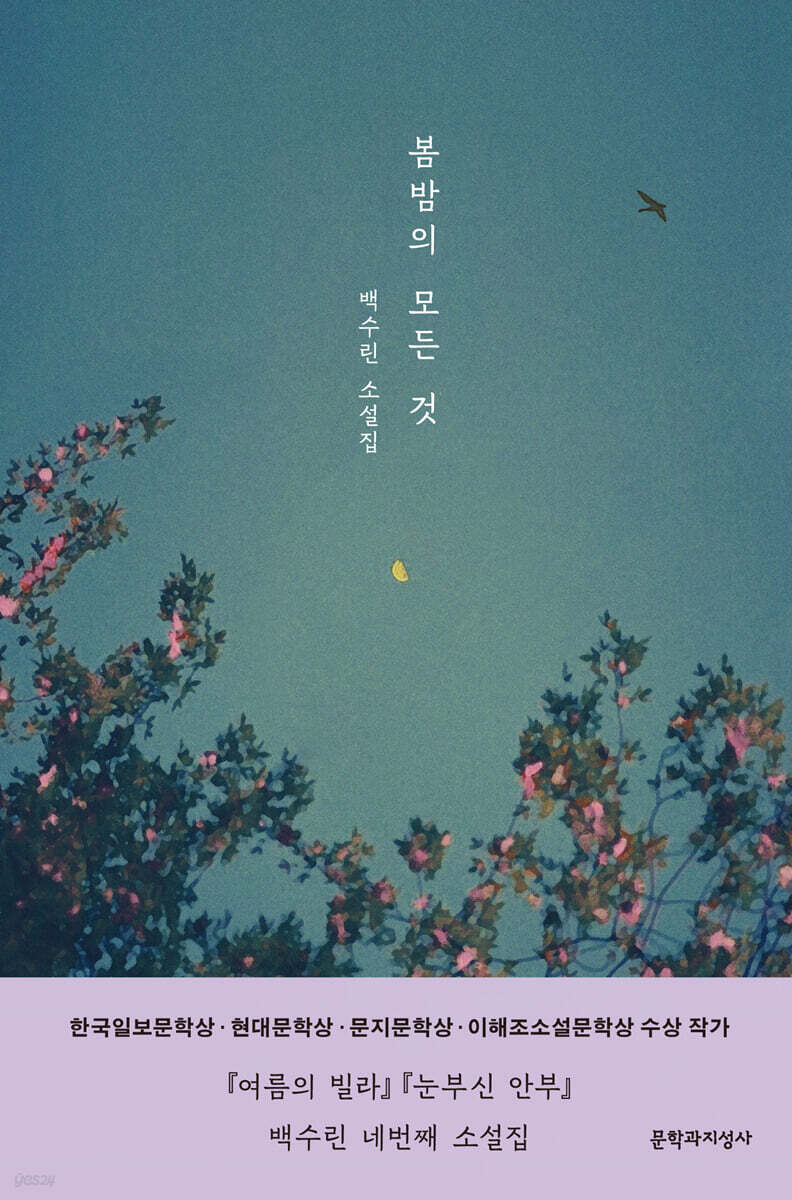 |
Description
Book Introduction
- A word from MD
-
With the heart of reading the spring called 'Baeksurin'The fourth collection of novels by novelist Baek Su-rin, which will be read sparingly as we wait for spring, has been published.
His intimate and beautiful sentences, which carefully warm the winter chill, seep in like spring sunshine.
A novel that shines with characters who quietly but boldly move forward without being consumed by despair even amid the ruins of loss.
March 7, 2025. Novel/Poetry PD Kim Yu-ri
“That sunlight that seemed to whisper hope to us, still young.”
A small miracle that flew into time that was thought to be frozen
A new season of white sage, filled with soft white light
The fourth novel collection by Baek Su-rin, winner of the Hankook Ilbo Literary Award, the Contemporary Literary Award, and the Munji Literary Award.
Baek Su-rin, who has established herself as a representative Korean literary writer by unfolding her own beautiful world with delicate and thoughtful perspectives and elegant and neat sentences, has published her fourth collection of short stories, “All About Spring Nights,” by Munhak-kwa-Jiseongsa.
Baek Su-rin, who was praised by literary critic Kim Yun-sik at the beginning of her debut as “a thing,” has consistently captured “the most intimate inner self” in each of her subsequent works, creating “the most universal events” (Kim Seong-jung, novelist, 10th Young Writer’s Award judge’s commentary).
This unique style received support from both literary circles and readers, leading to awards such as the Hankook Ilbo Literary Award, the Contemporary Literary Award, the Munji Literary Award, and the Lee Hae-jo Novel Literary Award.
‘Light’ has been present in his novels, including ‘The Dismal Light,’ ‘The Summer Villa,’ and ‘Dazzling Greetings.’
When he won the 8th Munji Literary Award, the literary critic Kang Dong-ho praised him as a writer who “remembers and rewrites the faint signs of hope that shine like flashes in the midst of disappearing things”, giving us an idea of why he is called the “novelist of light.”
This collection of short stories is also filled with the author's unique light, but each work displays a slightly different color.
Seven stories that capture the moments when a ray of light reaches the speakers in their days without hope for new things, as they spend time with someone who was once closest to them but has now left them forever. “Even if our lives, this world, are in the middle of winter, we can choose to wait for spring” (p.
266) conveys the warmth of “everything about a spring night” to hearts that are frozen and ready to break in the face of loss and death, as in the ‘author’s note.’
A small miracle that flew into time that was thought to be frozen
A new season of white sage, filled with soft white light
The fourth novel collection by Baek Su-rin, winner of the Hankook Ilbo Literary Award, the Contemporary Literary Award, and the Munji Literary Award.
Baek Su-rin, who has established herself as a representative Korean literary writer by unfolding her own beautiful world with delicate and thoughtful perspectives and elegant and neat sentences, has published her fourth collection of short stories, “All About Spring Nights,” by Munhak-kwa-Jiseongsa.
Baek Su-rin, who was praised by literary critic Kim Yun-sik at the beginning of her debut as “a thing,” has consistently captured “the most intimate inner self” in each of her subsequent works, creating “the most universal events” (Kim Seong-jung, novelist, 10th Young Writer’s Award judge’s commentary).
This unique style received support from both literary circles and readers, leading to awards such as the Hankook Ilbo Literary Award, the Contemporary Literary Award, the Munji Literary Award, and the Lee Hae-jo Novel Literary Award.
‘Light’ has been present in his novels, including ‘The Dismal Light,’ ‘The Summer Villa,’ and ‘Dazzling Greetings.’
When he won the 8th Munji Literary Award, the literary critic Kang Dong-ho praised him as a writer who “remembers and rewrites the faint signs of hope that shine like flashes in the midst of disappearing things”, giving us an idea of why he is called the “novelist of light.”
This collection of short stories is also filled with the author's unique light, but each work displays a slightly different color.
Seven stories that capture the moments when a ray of light reaches the speakers in their days without hope for new things, as they spend time with someone who was once closest to them but has now left them forever. “Even if our lives, this world, are in the middle of winter, we can choose to wait for spring” (p.
266) conveys the warmth of “everything about a spring night” to hearts that are frozen and ready to break in the face of loss and death, as in the ‘author’s note.’
- You can preview some of the book's contents.
Preview
index
Very bright days
When the light comes
Us on a Spring Night
White Snow and Dog
Heavy rain
It's snowing
What could it have been?
Commentary | Well-Adapted Nihilism · Park Hye-jin
Author's Note
When the light comes
Us on a Spring Night
White Snow and Dog
Heavy rain
It's snowing
What could it have been?
Commentary | Well-Adapted Nihilism · Park Hye-jin
Author's Note
Detailed image

Into the book
She closed her eyes and waded through the memories like someone wading through weeds to find her way.
And finally, I was able to go back to those days.
Back to the days when she still had a parrot that would suddenly appear from somewhere and peek at her, a parrot that would sit quietly when placed on her shoulder and watch a soap opera with her while rubbing its round beak against her neck, a tiny bird that would follow her with thudding footsteps as she waddled away with a bucket full of water to water the plants.
Do people know?
When a parrot sleeps, its little feet get warmer.
--- p.35 From “Very Bright Days”
Her facial features, silhouette, the pitch of her voice, and even her name were erased by time.
But I remember a special light that shone on her face, a light that only the face of someone in love can see.
The light in your eyes when the person you're in love looks at you with rapture.
A mixture of absurd aspirations, anxiety, and expectations.
The reason I still remember it to this day is because I saw that light in my sister's face as she watched Gary from next to her.
--- p.65 From "When the Light Comes"
“Being able to spend every day with my mom, clinging so tightly to her, was a blessing that others didn’t have.” My sister also said this.
As we walked, my sister would describe the scenery she saw for my aunt.
“If I had walked here with my mother, I would have struggled to describe this beauty.
The surroundings were incredibly bright, and everything was a soft white light.
“The sunlight falling on the snow is a very pale yellow.” After describing it like that, my aunt would say, “Now it’s my turn.”
And my aunt, using the other keen senses she had acquired after losing her sight, described to my sister the scenery she saw.
The wind is softer and lighter than yesterday.
Maybe it's because of the snow, but the scent of watermelon we split and ate last summer is everywhere.
The magpies' cries sound closer than usual.
“The world my mother described was truly beautiful.”
--- p.69 From "When the Light Comes"
Then his daughter called him with a low moan.
Where the daughter's gaze stopped was the black dog and the old couple standing there.
They were talking to each other, adjusting their gloves, and the black dog was running around like crazy, rolling around in the snow.
How can you be that excited?
“Dad, did you see it?” said the daughter.
A vitality that jumps with your whole body.
And as he looks at the innocent dog, he realizes why his daughter is so absorbed in the scene.
That his daughter had already discovered what he was trying to show her.
So that means the dog is jumping around on only three legs.
--- p.141 From “White Snow and the Dog”
It was after a long time had passed and I was watching the scenery regain its lost colors, and feeling a little sorry for not being able to see the sunrise, that Jumi broke the silence and said that to me.
In the past, if someone had told me that was a possibility, I would have laughed, but now I believe that the absurd thing could have happened, that pigeon, after struggling for two days, managed to escape through the narrow passage into which it had fallen.
That dove might have actually flown away after many attempts.
“Without a single scratch, like a miracle?”
“Without a single scratch, like a miracle.”
And finally, I was able to go back to those days.
Back to the days when she still had a parrot that would suddenly appear from somewhere and peek at her, a parrot that would sit quietly when placed on her shoulder and watch a soap opera with her while rubbing its round beak against her neck, a tiny bird that would follow her with thudding footsteps as she waddled away with a bucket full of water to water the plants.
Do people know?
When a parrot sleeps, its little feet get warmer.
--- p.35 From “Very Bright Days”
Her facial features, silhouette, the pitch of her voice, and even her name were erased by time.
But I remember a special light that shone on her face, a light that only the face of someone in love can see.
The light in your eyes when the person you're in love looks at you with rapture.
A mixture of absurd aspirations, anxiety, and expectations.
The reason I still remember it to this day is because I saw that light in my sister's face as she watched Gary from next to her.
--- p.65 From "When the Light Comes"
“Being able to spend every day with my mom, clinging so tightly to her, was a blessing that others didn’t have.” My sister also said this.
As we walked, my sister would describe the scenery she saw for my aunt.
“If I had walked here with my mother, I would have struggled to describe this beauty.
The surroundings were incredibly bright, and everything was a soft white light.
“The sunlight falling on the snow is a very pale yellow.” After describing it like that, my aunt would say, “Now it’s my turn.”
And my aunt, using the other keen senses she had acquired after losing her sight, described to my sister the scenery she saw.
The wind is softer and lighter than yesterday.
Maybe it's because of the snow, but the scent of watermelon we split and ate last summer is everywhere.
The magpies' cries sound closer than usual.
“The world my mother described was truly beautiful.”
--- p.69 From "When the Light Comes"
Then his daughter called him with a low moan.
Where the daughter's gaze stopped was the black dog and the old couple standing there.
They were talking to each other, adjusting their gloves, and the black dog was running around like crazy, rolling around in the snow.
How can you be that excited?
“Dad, did you see it?” said the daughter.
A vitality that jumps with your whole body.
And as he looks at the innocent dog, he realizes why his daughter is so absorbed in the scene.
That his daughter had already discovered what he was trying to show her.
So that means the dog is jumping around on only three legs.
--- p.141 From “White Snow and the Dog”
It was after a long time had passed and I was watching the scenery regain its lost colors, and feeling a little sorry for not being able to see the sunrise, that Jumi broke the silence and said that to me.
In the past, if someone had told me that was a possibility, I would have laughed, but now I believe that the absurd thing could have happened, that pigeon, after struggling for two days, managed to escape through the narrow passage into which it had fallen.
That dove might have actually flown away after many attempts.
“Without a single scratch, like a miracle?”
“Without a single scratch, like a miracle.”
--- pp.244-245 From "What Was It?"
Publisher's Review
“Nothing could compare to the warmth and touch they shared with each other,
“The fact that the density and fragrance of that spring cannot be taken away.”
A handful of clear warmth poured between misunderstanding and understanding
When you open the novel collection, the first work you encounter is “Very Bright Days.”
This novel, which seems like a sarcastic expression of a dark day or a foreshadowing of hope that embraces a defenseless light, unfolds as a gift-like time that slowly comes to Ok-mi, a woman in her seventies.
Her son-in-law suddenly comes to visit her, who has been living alone and estranged from her daughter for a long time, holding a parrot.
We brought it into our home because our children wanted to raise animals, but they were scared of it, so we asked them to keep it until they were ready to raise it.
Ok-mi, who started living with such an unfamiliar parrot, feels “warmth the size of the place the bird touched” (p.
36) Expresses a feeling delicately.
“His daughter was walking far away from him” (p.
As the first sentence (109) suggests, “White Snow and the Dog” is a story that begins with a relationship with a daughter that is not on good terms.
Even though they met after almost 8 years, 'he', the father, is still unhappy that his beloved daughter is living a life he does not want.
The daughter also invited her parents to Switzerland to show them that she was doing well, but she resented her father for not understanding her.
They only fight on the snowy field, as if going back to the years that passed when they left each other's places empty due to misunderstandings.
Then their emotions melt away like snow, and in the gap between the climax and the ending, “the vitality that leaps with the whole body” (p.
141) from the moment I witnessed it.
In that snow-covered place where seemingly impossible things unfold without a hitch, there is a yearning for each other that erases the rift in relationships.
“When the Light Comes” and “Us on a Spring Night” are novels filled with friendship and love.
It also shows us the way to grasp the sparkling thing that we didn't know at the time but only came to know as time passed, that life is something we find in fragments of memories.
This journey of realizing that things I had assumed were incomprehensible were not so different from my own situation was “a journey where I did not know whether it was a rapid current that would sweep me away if I just dipped my feet in it, or a raindrop that would slowly make me wet” (p.
88) I will gladly let you fall into Baek Su-rin's love.
And we will realize that our emotions are not lost or forgotten, but always hidden within us, and that we can put aside all misunderstandings and meet the bright light and warmth again at any time.
Now, the spring night that contains all of that falls like flower petals with a rich fragrance.
“How sweet that would have been.
“How painful it must have been”
A drama in the mind drawn by the absence of a life that once existed
Baek Su-rin captures the wondrous moments when people who have adapted well to the void rediscover the meaning of life through small events.
When the uncomfortable memories, complex emotions, and rigid conflicts that were once considered impurities that hindered the course of life unravel, Baek Su-rin weaves those threads to learn how to desire again, how to grieve again, and in short, how to love again, weaving a brilliant life on the other side of life.
[… … ] This light does not disappear.
Because it is not a given light, but a light that you create yourself.
Baek Su-rin, who creates a light that never fades, is a new realm in Korean literature.
It is a precious white night that revives the dark heart.
- Park Hye-jin, commentary on “Well-adapted Nihilism” (pp.
263~64)
Each of the speakers in “All About Spring Night” carries a great loss.
Conflict with the daughter who should be the closest person in the world, family and neighbors who will never be seen again due to death, friends who naturally grow distant due to their own lives, separation from a lover who was loved.
In the latter half of the collection, the three stories “Heavy Rain,” “It’s Snowing,” and “What Was It?” were reconstructed as a series of short stories, further deepening the sense of loss that permeates the entire collection.
Sohee from "Heavy Rain" is a housewife who enjoys going to the library and looking at the scenery as the seasons change.
For him, who loves books and has a rich imagination to the point where he once dreamed of becoming a writer, and enjoys getting lost in imaginary stories, death is a scary but attractive subject.
Perhaps the reason Sohee tosses and turns all night, imagining the old man's death after seeing everything disappear from the blue-doored house in the shabby residential area outside the apartment complex where she lives, is because death is everywhere and loss is like a shadow that always lingers nearby.
The next song, "Snow is Falling," begins with Sohee's college friend Dahye reminiscing about her twenties.
Dahye, who started her passionate college life by staying at the boarding house of her maternal aunt, a distant relative of her mother, is enthusiastic about dating, classes, and club activities at school.
When I returned home, I lived with my 70-year-old great-aunt who had difficulty hearing and couldn't sleep in the morning. My aunt, who told me to go to bed early, was nothing more than a spoiler of love for Dahye, who had just started dating. However, as time passed, “there came a day when I suddenly realized that my youth was passing me by” (p.
201) Dahye remembers the last day she was with her grandmother.
As we pass through the passionate period of youth and enter the middle stage of life, the feelings that can no longer easily accept death are clearly revealed along with the blueprint of absence and loss drawn by the author.
"What Was It?" is an impressive work set in a tourist resort where the main characters of the two previous novels gather, and densely packed with episodes about their pasts and deaths.
Jumi, Sohee, Dahye, and Hwajain, 'I', are now in their late forties.
Stories from their college club days take them back to their youth for a moment, but they also make them realize how far away youth has become.
For those who have lost a family member or whose child is about to enter college, Jumi tells them about a mysterious incident that happened in Germany 11 years ago.
At the end, they leave the void and emptiness of life, which is increasingly approaching death, “without a single wound, like a miracle” (p.
245) Plant the hope that you can fly.
A more upright, clearer and “rigid light” (Commentary, p.
263) Baek Su-rin's novels will bring a new spring to all who walk through the long night of loss and emptiness.
Author's Note
When I read novels I wrote a long time ago, I sometimes feel like I'm reading a diary again.
It's not because I actually experienced the big and small events that unfold in the fictional novel, but because the emotions and questions that once so intensely captivated me come back to life so vividly while reading the novel.
The seven short stories included in this collection were written over a period of four years, from immediately after the publication of 『Summer Villa』 (Munhakdongne, 2020) to last summer.
Between the spring when I wrote "White Snow and Dog," the first of these, and the present when I am putting together this collection of short stories, so many things have happened in my personal life and in our society that, apart from the vividness of the feelings I had when I wrote the novel, while reading the proofs, I also felt as if I were rereading novels written in the very distant past.
I knew that many of the novels I'd written over the past few years had scenes of loss or post-loss, but it wasn't until I was reading the proofs that I realized there were so many scenes of snow falling or piling up.
That is why I spent a long time pondering over words and sentences containing snow and winter while deciding on a title that would encompass the entire collection of short stories.
But in the end, the title of this collection of short stories became 'All About Spring Nights'.
As I give this collection of short stories, which is unusually rich in winter scenery, a title that includes the word "spring," I would like to modify a phrase from a recent prose piece I wrote (“Even in the middle of winter, we can choose to be people who seek the sun”) and write it here.
Even if our lives, this world, are in the middle of winter, we can choose to wait for spring.
You can choose to believe that spring is coming.
It was with that in mind that I wrote these novels.
As long as I am a novelist, I want to continue writing with that mindset.
[… … ]
This is already my fourth novel collection.
Writing a novel is never easy, but fortunately, the joy of writing it never diminishes.
Waiting for spring
Baek Su-rin
“The fact that the density and fragrance of that spring cannot be taken away.”
A handful of clear warmth poured between misunderstanding and understanding
When you open the novel collection, the first work you encounter is “Very Bright Days.”
This novel, which seems like a sarcastic expression of a dark day or a foreshadowing of hope that embraces a defenseless light, unfolds as a gift-like time that slowly comes to Ok-mi, a woman in her seventies.
Her son-in-law suddenly comes to visit her, who has been living alone and estranged from her daughter for a long time, holding a parrot.
We brought it into our home because our children wanted to raise animals, but they were scared of it, so we asked them to keep it until they were ready to raise it.
Ok-mi, who started living with such an unfamiliar parrot, feels “warmth the size of the place the bird touched” (p.
36) Expresses a feeling delicately.
“His daughter was walking far away from him” (p.
As the first sentence (109) suggests, “White Snow and the Dog” is a story that begins with a relationship with a daughter that is not on good terms.
Even though they met after almost 8 years, 'he', the father, is still unhappy that his beloved daughter is living a life he does not want.
The daughter also invited her parents to Switzerland to show them that she was doing well, but she resented her father for not understanding her.
They only fight on the snowy field, as if going back to the years that passed when they left each other's places empty due to misunderstandings.
Then their emotions melt away like snow, and in the gap between the climax and the ending, “the vitality that leaps with the whole body” (p.
141) from the moment I witnessed it.
In that snow-covered place where seemingly impossible things unfold without a hitch, there is a yearning for each other that erases the rift in relationships.
“When the Light Comes” and “Us on a Spring Night” are novels filled with friendship and love.
It also shows us the way to grasp the sparkling thing that we didn't know at the time but only came to know as time passed, that life is something we find in fragments of memories.
This journey of realizing that things I had assumed were incomprehensible were not so different from my own situation was “a journey where I did not know whether it was a rapid current that would sweep me away if I just dipped my feet in it, or a raindrop that would slowly make me wet” (p.
88) I will gladly let you fall into Baek Su-rin's love.
And we will realize that our emotions are not lost or forgotten, but always hidden within us, and that we can put aside all misunderstandings and meet the bright light and warmth again at any time.
Now, the spring night that contains all of that falls like flower petals with a rich fragrance.
“How sweet that would have been.
“How painful it must have been”
A drama in the mind drawn by the absence of a life that once existed
Baek Su-rin captures the wondrous moments when people who have adapted well to the void rediscover the meaning of life through small events.
When the uncomfortable memories, complex emotions, and rigid conflicts that were once considered impurities that hindered the course of life unravel, Baek Su-rin weaves those threads to learn how to desire again, how to grieve again, and in short, how to love again, weaving a brilliant life on the other side of life.
[… … ] This light does not disappear.
Because it is not a given light, but a light that you create yourself.
Baek Su-rin, who creates a light that never fades, is a new realm in Korean literature.
It is a precious white night that revives the dark heart.
- Park Hye-jin, commentary on “Well-adapted Nihilism” (pp.
263~64)
Each of the speakers in “All About Spring Night” carries a great loss.
Conflict with the daughter who should be the closest person in the world, family and neighbors who will never be seen again due to death, friends who naturally grow distant due to their own lives, separation from a lover who was loved.
In the latter half of the collection, the three stories “Heavy Rain,” “It’s Snowing,” and “What Was It?” were reconstructed as a series of short stories, further deepening the sense of loss that permeates the entire collection.
Sohee from "Heavy Rain" is a housewife who enjoys going to the library and looking at the scenery as the seasons change.
For him, who loves books and has a rich imagination to the point where he once dreamed of becoming a writer, and enjoys getting lost in imaginary stories, death is a scary but attractive subject.
Perhaps the reason Sohee tosses and turns all night, imagining the old man's death after seeing everything disappear from the blue-doored house in the shabby residential area outside the apartment complex where she lives, is because death is everywhere and loss is like a shadow that always lingers nearby.
The next song, "Snow is Falling," begins with Sohee's college friend Dahye reminiscing about her twenties.
Dahye, who started her passionate college life by staying at the boarding house of her maternal aunt, a distant relative of her mother, is enthusiastic about dating, classes, and club activities at school.
When I returned home, I lived with my 70-year-old great-aunt who had difficulty hearing and couldn't sleep in the morning. My aunt, who told me to go to bed early, was nothing more than a spoiler of love for Dahye, who had just started dating. However, as time passed, “there came a day when I suddenly realized that my youth was passing me by” (p.
201) Dahye remembers the last day she was with her grandmother.
As we pass through the passionate period of youth and enter the middle stage of life, the feelings that can no longer easily accept death are clearly revealed along with the blueprint of absence and loss drawn by the author.
"What Was It?" is an impressive work set in a tourist resort where the main characters of the two previous novels gather, and densely packed with episodes about their pasts and deaths.
Jumi, Sohee, Dahye, and Hwajain, 'I', are now in their late forties.
Stories from their college club days take them back to their youth for a moment, but they also make them realize how far away youth has become.
For those who have lost a family member or whose child is about to enter college, Jumi tells them about a mysterious incident that happened in Germany 11 years ago.
At the end, they leave the void and emptiness of life, which is increasingly approaching death, “without a single wound, like a miracle” (p.
245) Plant the hope that you can fly.
A more upright, clearer and “rigid light” (Commentary, p.
263) Baek Su-rin's novels will bring a new spring to all who walk through the long night of loss and emptiness.
Author's Note
When I read novels I wrote a long time ago, I sometimes feel like I'm reading a diary again.
It's not because I actually experienced the big and small events that unfold in the fictional novel, but because the emotions and questions that once so intensely captivated me come back to life so vividly while reading the novel.
The seven short stories included in this collection were written over a period of four years, from immediately after the publication of 『Summer Villa』 (Munhakdongne, 2020) to last summer.
Between the spring when I wrote "White Snow and Dog," the first of these, and the present when I am putting together this collection of short stories, so many things have happened in my personal life and in our society that, apart from the vividness of the feelings I had when I wrote the novel, while reading the proofs, I also felt as if I were rereading novels written in the very distant past.
I knew that many of the novels I'd written over the past few years had scenes of loss or post-loss, but it wasn't until I was reading the proofs that I realized there were so many scenes of snow falling or piling up.
That is why I spent a long time pondering over words and sentences containing snow and winter while deciding on a title that would encompass the entire collection of short stories.
But in the end, the title of this collection of short stories became 'All About Spring Nights'.
As I give this collection of short stories, which is unusually rich in winter scenery, a title that includes the word "spring," I would like to modify a phrase from a recent prose piece I wrote (“Even in the middle of winter, we can choose to be people who seek the sun”) and write it here.
Even if our lives, this world, are in the middle of winter, we can choose to wait for spring.
You can choose to believe that spring is coming.
It was with that in mind that I wrote these novels.
As long as I am a novelist, I want to continue writing with that mindset.
[… … ]
This is already my fourth novel collection.
Writing a novel is never easy, but fortunately, the joy of writing it never diminishes.
Waiting for spring
Baek Su-rin
GOODS SPECIFICS
- Date of issue: February 28, 2025
- Page count, weight, size: 268 pages | 286g | 124*188*17mm
- ISBN13: 9788932043500
- ISBN10: 8932043507
You may also like
카테고리
korean


korean

![GQ KOREA Mark (Monthly): December [2025]](http://librairie.coreenne.fr/cdn/shop/files/8ef265dbbfbf186523ed75ba7319009d.jpg?v=1765340328&width=3840)


