

I am human
 |
Description
Book Introduction
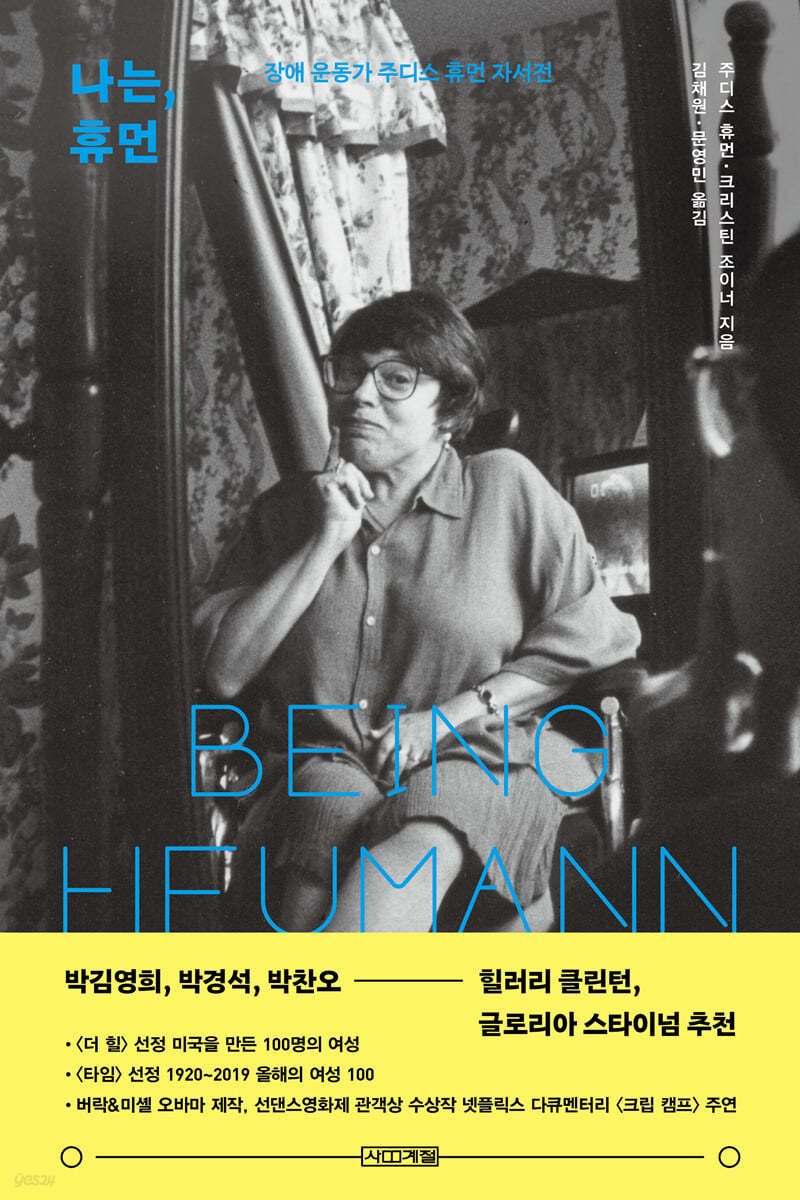
Elevators in subway stations, ramps at building entrances, sign language interpretation and subtitles on television broadcasts, Braille paving, and support systems for the disabled were not introduced overnight due to a sudden increase in human rights awareness in society. It was only after countless disabled people and activists risked their lives and fought against all kinds of criticism and insults that they were finally able to obtain it one by one. Judith Heumann is a disability rights activist who fought on the front lines, through lawsuits, protests, organizing, and occupations, from the struggle for Section 504 of the Rehabilitation Act in the 1970s to the enactment of the Americans with Disabilities Act in 1990. She is also a disability rights administrator who worked under the Clinton and Obama administrations and at the World Bank to realize the rights of people with disabilities through laws and systems. She is also a woman who has had to overcome layers of discrimination and exclusion in all struggles and workplaces, and is from a Jewish immigrant family. "I, Human" is an autobiography written in Judith Human's own words, chronicling her life from her childhood, when she was unable to attend school because she was in a wheelchair, to her current role as a voice for creating a place for people with disabilities in all areas of society and protecting the civil rights of the marginalized. This book clearly demonstrates that the awareness of disability, civil rights, and equality we have today are the result of countless people's resistance, solidarity, and cooperation over a long period of time. It also serves as a testimony that gives us confidence that the entrenched walls of discrimination and exclusion can ultimately be torn down through the power of citizens. |
- You can preview some of the book's contents.
Preview
index
Preface to the Korean edition
Judy's Note
Entering
Part 1 Brooklyn, New York, 1953
Chapter 1 Butterfly
Chapter 2 The Rebel
Chapter 3: To Fight or Not to Fight
Chapter 4: Fear of Flying
Part 2 Berkeley, California, 1977
Chapter 5 Detention
Chapter 6: Occupying Forces
Chapter 7: Soldiers on the Battlefield
Chapter 8 The White House
Part 3, Berkeley, California, 1981
Chapter 9 Fruition
Chapter 10: Chingona, Competent and Bad Women
Chapter 11 People
Chapter 12 Our Story
Acknowledgements
main
Translator's Note
A letter of recommendation?
Judith Heumann Chronology?
Looking for it?
Judy's Note
Entering
Part 1 Brooklyn, New York, 1953
Chapter 1 Butterfly
Chapter 2 The Rebel
Chapter 3: To Fight or Not to Fight
Chapter 4: Fear of Flying
Part 2 Berkeley, California, 1977
Chapter 5 Detention
Chapter 6: Occupying Forces
Chapter 7: Soldiers on the Battlefield
Chapter 8 The White House
Part 3, Berkeley, California, 1981
Chapter 9 Fruition
Chapter 10: Chingona, Competent and Bad Women
Chapter 11 People
Chapter 12 Our Story
Acknowledgements
main
Translator's Note
A letter of recommendation?
Judith Heumann Chronology?
Looking for it?
Detailed image
Into the book
I was a butterfly and became a caterpillar.
The whole world thought I was sick.
The sick person is lying in bed at home.
Sick people don't play outside or go to school.
No one expects them to play outside, be part of a group, or be part of the world.
People didn't think I would become a part of the world.
I suddenly realized this fact.
It was as if that fact had been present in every corner of my body for a long time.
I felt so humiliated that I almost felt sick to my stomach, thinking that everyone else already knew.
Had people been hiding something from me all along? I could feel the shame settle like a cold lump deep in my stomach, spreading through my limbs.
Was the weather clear or cloudy?
I don't know.
Alin pushed my wheelchair, and we went to the store together, bought candy, and chatted.
And I, who was a butterfly, became a caterpillar.
--- p.35~36
Disability is a social problem, not a medical problem.
Our parents' generation associated disability with President Franklin Roosevelt.
(…) said that disability is something that an individual must fight against or conquer.
We did not agree on this fact.
We didn't see our problems as medical problems that could be solved by 'fixing' them.
We began to see the lack of accessibility as a society's problem, not ours.
From our perspective, disability is something that can happen to anyone at any time, and because it is, it is right for society to design its infrastructure and systems around this truth of life.
We grew up with the civil rights movement.
I was eight years old when Rosa Parks protested against being denied a seat in the whites-only section of the bus, and I was just starting college when the Civil Rights Act of 1964 was passed.
Isn't it the government's responsibility to ensure that everyone can participate equally in society?
--- p.74~75
If I don't fight, who will?
Many people will be watching, wondering how well a woman in a wheelchair can teach.
If I am judged to be a poor teacher after winning this fight, my failure will be revealed to the world.
What if, because I'm not doing a good job at teaching, people start to think that people with disabilities can't teach anyone? Wouldn't that ultimately be detrimental to many people? If there are thousands of teachers with disabilities, one incompetent teacher won't stand out.
But if I failed as the only teacher with a disability, what would people's perception of people with disabilities be like? The very thought made me sick.
(…) But if I don’t fight, who will?
--- p.88~89
The government's failure to consider people with disabilities is a violation of their civil rights.
I decided to use my story to make it clear that the life barriers people with disabilities face in education, employment, and transportation access are not isolated issues.
Our disability was not a medical problem that could be treated with rehabilitation.
I never thought I would overcome the nerve damage from polio and walk, and that was never my life's goal.
The arms and legs of disabled veterans returning from the Vietnam War do not grow back, and spinal cord treatment does not enable them to walk again.
There is no way for my friends with muscular dystrophy to be reborn without disabilities.
Accidents, illness, genetic factors, neurological disorders, and aging are fundamental human conditions, just like gender or race.
Therefore, allowing schools, employers, and city councils to create policies, build buildings, and design buses in ways that make it inaccessible to people with disabilities is tantamount to allowing our civil rights to be violated.
The government had a responsibility to protect our rights.
--- p.91~92
Crippled Occupying Forces Occupy San Francisco Federal Building
Despite all these inconveniences, people began to enjoy living there.
I raced in my wheelchair in the hallway, played games, played guitar, and sang.
There was little privacy.
While everyone else was doing everything else, I changed my clothes and took care of what needed to be done.
And in the process, a sense of camaraderie was formed.
People sat in a circle for hours, talking and talking.
A friendship was formed.
(…) There, you don’t have to feel inferior because you’re slow or different.
It was okay to be a burden.
There was no need to apologize.
Inside the building, we could easily find each other and spend time together, as if we were at camp, without having to rely on family, friends, or unreliable public transportation.
The unreachable outside world that often isolated us felt like a distant story.
(…) We were becoming something bigger than ourselves.
--- p.178~180
Equality doesn't mean treating everyone the same.
Equality is about fairness.
It's a story about equality of access.
People like me, the tens of millions of us who cannot live the same way as others, cannot help but view equity in access to housing, health, education, employment, and other issues differently than the majority.
We should also consider ramps, wider doorways, handrails, sign language interpreters, captioning, accessible technology, audio guidance, Braille documentation, and personal assistants for people with intellectual and physical disabilities.
Without understanding these things, we end up being labeled as "disgruntled" or "selfish" even when we demand the same rights as others.
This happens especially to women.
We are called 'the ones who never back down' and 'the ones who are persistent' if we don't back down.
Labeling us as 'demanding' or 'persistent' is just another way of trying to 'make us give in'.
--- p.221~222
The Power of Disability Identity
Because I have had a disability since I was young, I have a unique perspective and unique skills for our work.
I was a beneficiary of special education and rehabilitation, and a leader in the independent living movement.
I was also well aware of disability issues around the world.
My year and a half in the Senate, though brief, was undoubtedly a very valuable experience.
That period allowed me to learn how congressional hearings and testimony were conducted, as well as to get to know the staff and politicians. I didn't fully realize it until I took the position of Assistant Secretary of OSERS, but this was the culmination of all the experiences that had prepared me.
(…) I pushed the door open and opened the window with all my might to let more people in.
My goal was to share power.
And listening, and collaborating.
--- p.259~263
Disability is a natural part of human life.
“Let’s address the educational issues of non-disabled children first.
Then let's worry about children with disabilities.”
(…) But what kind of logic is this? It assumes that people with disabilities have a reduced potential to learn, are less able to contribute to society, and are less competent.
That means we are less equal.
Do we really believe that? Disability is a natural part of human history.
As human lifespans increase, as we wage more wars, and as medicine advances, people who would have died in earlier times will live longer and longer.
Perhaps with a disability.
We have to accept this.
We need to prepare for this.
We need to design society around it.
--- p.280~281
What is our vision for our society?
Do you want our communities to be towns and cities where our loved ones choose to stay as they grow older? Do you want them to be places where, should an accident strike us or our children, we can continue to live our lives, attend the same schools, and work the same jobs? We must embrace our humanity and design our world around it.
We need to implement universal design, support personal assistants, and change our hiring practices.
We can design our cities and societies to foster belonging and community rather than separation and isolation.
You can move from thinking that such a thing could never happen to thinking that it could happen.
You can go from being a pessimist to a problem solver.
Like a child.
The whole world thought I was sick.
The sick person is lying in bed at home.
Sick people don't play outside or go to school.
No one expects them to play outside, be part of a group, or be part of the world.
People didn't think I would become a part of the world.
I suddenly realized this fact.
It was as if that fact had been present in every corner of my body for a long time.
I felt so humiliated that I almost felt sick to my stomach, thinking that everyone else already knew.
Had people been hiding something from me all along? I could feel the shame settle like a cold lump deep in my stomach, spreading through my limbs.
Was the weather clear or cloudy?
I don't know.
Alin pushed my wheelchair, and we went to the store together, bought candy, and chatted.
And I, who was a butterfly, became a caterpillar.
--- p.35~36
Disability is a social problem, not a medical problem.
Our parents' generation associated disability with President Franklin Roosevelt.
(…) said that disability is something that an individual must fight against or conquer.
We did not agree on this fact.
We didn't see our problems as medical problems that could be solved by 'fixing' them.
We began to see the lack of accessibility as a society's problem, not ours.
From our perspective, disability is something that can happen to anyone at any time, and because it is, it is right for society to design its infrastructure and systems around this truth of life.
We grew up with the civil rights movement.
I was eight years old when Rosa Parks protested against being denied a seat in the whites-only section of the bus, and I was just starting college when the Civil Rights Act of 1964 was passed.
Isn't it the government's responsibility to ensure that everyone can participate equally in society?
--- p.74~75
If I don't fight, who will?
Many people will be watching, wondering how well a woman in a wheelchair can teach.
If I am judged to be a poor teacher after winning this fight, my failure will be revealed to the world.
What if, because I'm not doing a good job at teaching, people start to think that people with disabilities can't teach anyone? Wouldn't that ultimately be detrimental to many people? If there are thousands of teachers with disabilities, one incompetent teacher won't stand out.
But if I failed as the only teacher with a disability, what would people's perception of people with disabilities be like? The very thought made me sick.
(…) But if I don’t fight, who will?
--- p.88~89
The government's failure to consider people with disabilities is a violation of their civil rights.
I decided to use my story to make it clear that the life barriers people with disabilities face in education, employment, and transportation access are not isolated issues.
Our disability was not a medical problem that could be treated with rehabilitation.
I never thought I would overcome the nerve damage from polio and walk, and that was never my life's goal.
The arms and legs of disabled veterans returning from the Vietnam War do not grow back, and spinal cord treatment does not enable them to walk again.
There is no way for my friends with muscular dystrophy to be reborn without disabilities.
Accidents, illness, genetic factors, neurological disorders, and aging are fundamental human conditions, just like gender or race.
Therefore, allowing schools, employers, and city councils to create policies, build buildings, and design buses in ways that make it inaccessible to people with disabilities is tantamount to allowing our civil rights to be violated.
The government had a responsibility to protect our rights.
--- p.91~92
Crippled Occupying Forces Occupy San Francisco Federal Building
Despite all these inconveniences, people began to enjoy living there.
I raced in my wheelchair in the hallway, played games, played guitar, and sang.
There was little privacy.
While everyone else was doing everything else, I changed my clothes and took care of what needed to be done.
And in the process, a sense of camaraderie was formed.
People sat in a circle for hours, talking and talking.
A friendship was formed.
(…) There, you don’t have to feel inferior because you’re slow or different.
It was okay to be a burden.
There was no need to apologize.
Inside the building, we could easily find each other and spend time together, as if we were at camp, without having to rely on family, friends, or unreliable public transportation.
The unreachable outside world that often isolated us felt like a distant story.
(…) We were becoming something bigger than ourselves.
--- p.178~180
Equality doesn't mean treating everyone the same.
Equality is about fairness.
It's a story about equality of access.
People like me, the tens of millions of us who cannot live the same way as others, cannot help but view equity in access to housing, health, education, employment, and other issues differently than the majority.
We should also consider ramps, wider doorways, handrails, sign language interpreters, captioning, accessible technology, audio guidance, Braille documentation, and personal assistants for people with intellectual and physical disabilities.
Without understanding these things, we end up being labeled as "disgruntled" or "selfish" even when we demand the same rights as others.
This happens especially to women.
We are called 'the ones who never back down' and 'the ones who are persistent' if we don't back down.
Labeling us as 'demanding' or 'persistent' is just another way of trying to 'make us give in'.
--- p.221~222
The Power of Disability Identity
Because I have had a disability since I was young, I have a unique perspective and unique skills for our work.
I was a beneficiary of special education and rehabilitation, and a leader in the independent living movement.
I was also well aware of disability issues around the world.
My year and a half in the Senate, though brief, was undoubtedly a very valuable experience.
That period allowed me to learn how congressional hearings and testimony were conducted, as well as to get to know the staff and politicians. I didn't fully realize it until I took the position of Assistant Secretary of OSERS, but this was the culmination of all the experiences that had prepared me.
(…) I pushed the door open and opened the window with all my might to let more people in.
My goal was to share power.
And listening, and collaborating.
--- p.259~263
Disability is a natural part of human life.
“Let’s address the educational issues of non-disabled children first.
Then let's worry about children with disabilities.”
(…) But what kind of logic is this? It assumes that people with disabilities have a reduced potential to learn, are less able to contribute to society, and are less competent.
That means we are less equal.
Do we really believe that? Disability is a natural part of human history.
As human lifespans increase, as we wage more wars, and as medicine advances, people who would have died in earlier times will live longer and longer.
Perhaps with a disability.
We have to accept this.
We need to prepare for this.
We need to design society around it.
--- p.280~281
What is our vision for our society?
Do you want our communities to be towns and cities where our loved ones choose to stay as they grow older? Do you want them to be places where, should an accident strike us or our children, we can continue to live our lives, attend the same schools, and work the same jobs? We must embrace our humanity and design our world around it.
We need to implement universal design, support personal assistants, and change our hiring practices.
We can design our cities and societies to foster belonging and community rather than separation and isolation.
You can move from thinking that such a thing could never happen to thinking that it could happen.
You can go from being a pessimist to a problem solver.
Like a child.
--- p.300~301
Publisher's Review
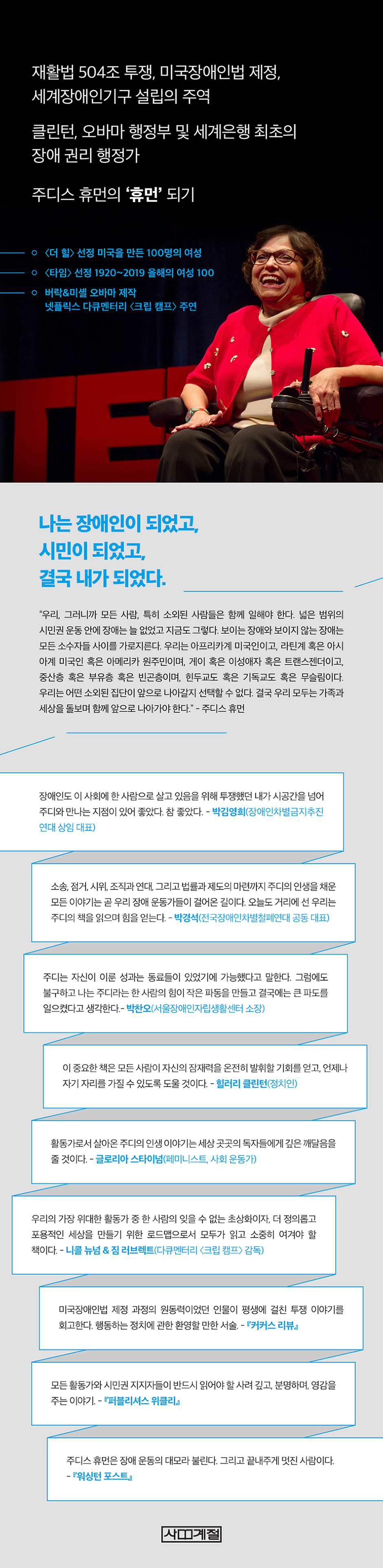
I became disabled, I became a citizen, and I became myself.
Born in Brooklyn, New York in 1947, Judith Heumann was left with quadriplegia as a result of polio, but her family and neighbors were unaware of her disability.
Her friends on the same block naturally pushed her wheelchair, and she didn't think there was anything Judy couldn't do with them.
However, because he uses a wheelchair, he is denied entry to kindergarten and school on the grounds that he is a "fire hazard," and is aggressively asked "Are you sick?" by a passing child. As he attends a special school for the disabled, he gradually comes to realize that he is different from others, and that there are things he cannot do and places he cannot go.
While attending a special school and then a regular high school and participating in a summer camp for the disabled, Human became more aware of his disability identity and opened his eyes to the fight for equal opportunities and rights for the disabled, and for a life where he could eat when he wanted and sleep when he wanted.
After graduating from Long Island University and wanting to become a teacher, he sued the New York City Board of Education in 1970 for denying him a teaching license due to his disability, and based on that experience, he founded the civil rights organization "Disabled People in Action," which is led by people with disabilities.
In 1972, along with fellow members of the group, they occupied a lane of Madison Avenue in Manhattan to protest President Richard Nixon's veto of an amendment to the Rehabilitation Act that stated that "no person shall, on the sole ground of disability, be excluded, denied the benefits of, or discriminated against under any program or activity receiving Federal financial assistance."
Later, at the suggestion of Ed Roberts, a leading disability activist in the western United States, Human joined the independent living movement that was growing in Berkeley, California at the time, and founded the American Coalition for People with Disabilities with fellow disabled people, urging the Secretary of Health, Education and Welfare to sign the regulations implementing Section 504 of the Rehabilitation Act.
When the signature was not obtained even during the transition from the Ford administration to the Carter administration, in April 1977, together with over 100 disabled colleagues, they occupied the San Francisco federal government building for 24 days and applied pressure from various sides, including hearings, press reports, and a visit to the White House, finally obtaining the signature of Joseph Califano, the Secretary of Health, Education, and Welfare.
However, even after signing, the lives of people with disabilities did not change much.
Humans have always been at the forefront of the struggle, leading to the enactment of the Americans with Disabilities Act, which prohibits discrimination against people with disabilities in a broader scope and guarantees the rights of people with disabilities within the framework of civil rights law.
In 1990, George H.
This is what Human wrote about the moment President W. Bush signed the Americans with Disabilities Act:
“At the age of forty-one, I finally became an equal citizen.” (p. 246)
Since then, Human has served as a disability rights administrator in the Clinton and Obama administrations, rising to the highest government positions as a person with a disability, and has been a leader in the global disability movement, serving as the World Bank's first Disability and Development Advisor.
He worked to improve systems and awareness to ensure that the rights of people with disabilities were not excluded from all government and institutional work, and he also worked to establish facilities and services that enabled people with disabilities, including himself, to work in any capacity.
Looking back on this whole process, Human said, “I am the person I wanted to be” (p. 289).
This long story of a child struggling to accept his differences, confronting an unjust society, becoming a citizen, and finally living as himself, gives us a glimpse into the direction of the struggles of disability activists and those involved in the struggle who still stand on the streets today.
It is about living as myself, raising my voice, and living as a citizen.
How to organize people and continue the struggle
A 24-day occupation and the culture of communication and respect that blossomed within it.
If Judith Heumann's life were to be made into a film, the narrative's climax would be the 24-day occupation of a federal building in San Francisco in 1977, which led to the Secretary of Health, Education and Welfare signing into law the regulations implementing Section 504 of the Rehabilitation Act.
Over 100 disabled people who entered the sit-in protest without any preparation became each other's eyes, ears, arms and legs to get through each day.
Considering each person's disability type, health condition, and available communication method, a committee was formed to handle things like procuring food and medicine, and media relations, and important decisions had to be made only after obtaining everyone's consent.
The meeting never began without a sign language interpreter, and it never ended until everyone had spoken.
Slow speed and awkward pronunciation were not a problem.
The scene where protesters, who were isolated with food and medicine prohibited and even hot water and phone service cut off, communicate with protesters outside their windows through sign language is a beautiful scene of people gathered under a common goal mobilizing their individual abilities and resources to cooperate.
Then an idea occurred to me.
We had a secret weapon.
It was sign language.
We gave all the presentation materials and messages to the hearing-impaired protesters and took them to a window overlooking the square where our supporters were holding an all-night vigil.
When the deaf protesters and sign language interpreters outside showed interest, they signed our message through the window.
Deaf protesters and sign language interpreters outside picked up the message and relayed it to those who needed to hear it.
It was a beautiful sight.
- Pages 167-168
Human was a man of unwavering conviction who never backed down from his goals, but he was also a man who sincerely persuaded and moved his colleagues.
Rather than making grand promises, he encouraged the protesters by saying, “Will you join us for just one more day? If we hold out for just one more day, we can make a difference” (p. 160). Ultimately, of the ten cities that began protests together, only the San Francisco protesters held out until the end, maintaining a force of over 100.
Having built strong bonds within the movement through communication and respect, Humane also recognized the need to connect the disability movement with other civil rights movements outside of it.
Unlike their parents, who grouped together by disability type or approached only limited topics such as the rehabilitation or education of children with disabilities, Human and his colleagues believed that their movement should be a solidarity of the weak against the powerful.
So, we actively collaborated with other civil rights groups, including black people, labor unions, the gay community, and churches, and emphasized that the rights of people with disabilities should also be treated as civil rights issues.
The Black Panthers, a black activist group, brought warm meals every night to the "crippled occupiers" inside the San Francisco federal building, symbolically showing how various civil rights movements must join hands to create a better world.
The Civil Rights Acts of 1964 included provisions to eliminate discrimination based on race, color, religion, and national origin, but did not address disability.
Disabled people are not included in the category of citizens.
After years of struggle, persuasion, and collaboration by human and colleagues, the Americans with Disabilities Act, the world's most comprehensive civil rights law guaranteeing the rights of people with disabilities, was finally enacted in July 1990.
This book is a biography of one person, Judith Heumann, but it can also be read as a history of the American disability movement, which grew at the intersection of several civil rights movements.
It could serve as a kind of mirror for the Korean disability movement, which has grown along a similar trajectory.
Disabled women have not received help from the women's movement.
The precarious tightrope walk of being a woman, disabled person, and activist
Judith Heumann had to fight not only as a person with a disability, but also as a woman.
Even when I made legitimate demands, I was told that I didn't know how to compromise or that I was selfish because I was a woman.
Even among disability activists who came together to create an equal world, they were often criticized and had their positions taken away without reason.
When the San Francisco protesters on the West Coast sent a delegation to Washington, D.C., during the Section 504 protests, the East Coast protesters were uncomfortable with the West Coast leadership, which was predominantly female, for being combative and ignoring the conventions of civil resistance.
Even when I founded the World Organization for People with Disabilities with fellow activists Ed Roberts and Joanne Leon as co-presidents, a few years later the board appointed Ed Roberts, a man, as sole president without any formalities or explanations.
A non-disabled male boss I met at the World Bank persistently harassed Human, a disabled woman who was the most vulnerable.
Humans realized that they were always facing the same problem, and that it was a very fundamental problem.
Just as her mother was a fighter for her disabled daughter to have equal opportunities, but relied on her father, Human herself was an uncompromising fighter and a good daughter at the same time.
As a leader of a social movement, she had to appear strong, but not so strong that she seemed unfriendly as a woman.
Although all women lived two truths, disabled women, including Human, did not receive support from the women's movement.
Even though 80 percent of women with disabilities experience sexual abuse in their lifetime, it is not treated as a women's issue.
We had to overcome multiple layers of discrimination.
As women, we have always done the right thing, done thousands of things right, and kept all our promises.
We led 150 people to occupy a federal building in San Francisco and change laws for people with disabilities.
But we were not in the position of responsibility.
People said we were pushing too hard.
I never once said that to Ed.
This situation had quite an impact on me.
Of course, my girlfriends who live in California took my side.
But I always felt like I was walking a tightrope.
Like we all, I had to grow internally.
As disabled women, we have not received any help from the women's movement.
We have always tried to ensure that our issues are given importance and supported by the women's movement, but they have generally been ignored.
We were basically just ourselves.
- Page 233
But Human says that only when all vulnerable and marginalized people join together can we move towards a more equal world.
Because we all have multiple identities, and we are all vulnerable and marginalized in some way.
Anyone who feels precariously torn between multiple intersecting identities may find a small escape in Human's story.
We, everyone, especially the marginalized, must work together.
There has always been and still is no barrier to the broader civil rights movement.
Visible and invisible disabilities cut across all minorities.
We are African American, Latino, Asian American, Native American, gay, straight, or transgender, middle class, rich, or poor, Hindu, Christian, or Muslim.
We cannot choose which marginalized groups will move forward.
Ultimately, we all need to move forward together, caring for our families and the world.
- Page 300
Cherish democratic government
Run for office and vote
'We' and 'together' are the words Judith Heumann uses most often.
As if he is trying not to forget the danger of an 'autobiography' that places himself at the center of the story, he constantly emphasizes that "any story that changes the world is always a story created by many people together" (p. 20).
It is true that the roles of several activists and politicians, such as Judith Heumann and Ed Roberts, stand out in the history of the American disability movement since the 1970s, which is covered in this book.
But behind their decisions and actions, there has always been the cooperation and dedication of countless people with disabilities and activists.
A leader like Human is born when people who believe that this fight is for them come together and take action.
Behind each name I mention in this book are thousands of others reaching outward.
We created a committee and created and created another committee.
Everyone had a role to play, and everyone was a master.
Why? Because I believed each and every one of us had a role to play in creating change.
We knew that our success depended on collaboration.
Our strength comes solely from people who feel a sense of unity with the movement and have a sense of ownership.
I still work this way today.
- Pages 299-300
It will take a long and arduous struggle to fully guarantee the rights of the weak and minorities in society, but it only takes a moment for them to be damaged and regress.
Immediately after being elected president, Donald Trump began to roll back laws and programs designed to support people with disabilities.
On his first day in office, he touched on Obamacare, then shut down the Americans with Disabilities Act page on the White House website.
His first attorney general attacked the Individuals with Disabilities Education Act, which supported the education of children with disabilities.
In response to this movement, disability activists launched a multifaceted resistance movement, including a "lying down protest" in front of the house of the Senate majority leader.
The attempt to repeal Obamacare ultimately failed.
Human describes a series of events that followed Trump's election, saying that it is up to each individual citizen to decide what kind of society they want and what kind of government they form.
And we emphasize that we have a means called 'democracy' to make society fair, give everyone a voice, and protect the rights of the marginalized.
Just as our human and disabled colleagues have gradually moved a society that seemed unmovable, making it what it is today, even if it seems like nothing will change right away, if we persistently raise our voices together, we can eventually create change.
This is what this book demonstrates and appeals to everyone who seeks to create a better world beyond the disability movement.
Our government is constantly changing.
Government is created by people, and changes are made by people.
This fact gives us a choice.
Will we be the ones creating trustworthy governments, or will we simply accept whatever comes our way? (…) If we cherish democratic government and invest consistently in it, we can solve the problem of inequality.
You must resist the temptation to give up when it feels complicated.
Because democracy is complex and the process necessarily takes time.
(…) run for election.
Take part in the vote.
“Vote as if your life depended on it.
“Because your life really depends on it!” - pp. 292-299
Born in Brooklyn, New York in 1947, Judith Heumann was left with quadriplegia as a result of polio, but her family and neighbors were unaware of her disability.
Her friends on the same block naturally pushed her wheelchair, and she didn't think there was anything Judy couldn't do with them.
However, because he uses a wheelchair, he is denied entry to kindergarten and school on the grounds that he is a "fire hazard," and is aggressively asked "Are you sick?" by a passing child. As he attends a special school for the disabled, he gradually comes to realize that he is different from others, and that there are things he cannot do and places he cannot go.
While attending a special school and then a regular high school and participating in a summer camp for the disabled, Human became more aware of his disability identity and opened his eyes to the fight for equal opportunities and rights for the disabled, and for a life where he could eat when he wanted and sleep when he wanted.
After graduating from Long Island University and wanting to become a teacher, he sued the New York City Board of Education in 1970 for denying him a teaching license due to his disability, and based on that experience, he founded the civil rights organization "Disabled People in Action," which is led by people with disabilities.
In 1972, along with fellow members of the group, they occupied a lane of Madison Avenue in Manhattan to protest President Richard Nixon's veto of an amendment to the Rehabilitation Act that stated that "no person shall, on the sole ground of disability, be excluded, denied the benefits of, or discriminated against under any program or activity receiving Federal financial assistance."
Later, at the suggestion of Ed Roberts, a leading disability activist in the western United States, Human joined the independent living movement that was growing in Berkeley, California at the time, and founded the American Coalition for People with Disabilities with fellow disabled people, urging the Secretary of Health, Education and Welfare to sign the regulations implementing Section 504 of the Rehabilitation Act.
When the signature was not obtained even during the transition from the Ford administration to the Carter administration, in April 1977, together with over 100 disabled colleagues, they occupied the San Francisco federal government building for 24 days and applied pressure from various sides, including hearings, press reports, and a visit to the White House, finally obtaining the signature of Joseph Califano, the Secretary of Health, Education, and Welfare.
However, even after signing, the lives of people with disabilities did not change much.
Humans have always been at the forefront of the struggle, leading to the enactment of the Americans with Disabilities Act, which prohibits discrimination against people with disabilities in a broader scope and guarantees the rights of people with disabilities within the framework of civil rights law.
In 1990, George H.
This is what Human wrote about the moment President W. Bush signed the Americans with Disabilities Act:
“At the age of forty-one, I finally became an equal citizen.” (p. 246)
Since then, Human has served as a disability rights administrator in the Clinton and Obama administrations, rising to the highest government positions as a person with a disability, and has been a leader in the global disability movement, serving as the World Bank's first Disability and Development Advisor.
He worked to improve systems and awareness to ensure that the rights of people with disabilities were not excluded from all government and institutional work, and he also worked to establish facilities and services that enabled people with disabilities, including himself, to work in any capacity.
Looking back on this whole process, Human said, “I am the person I wanted to be” (p. 289).
This long story of a child struggling to accept his differences, confronting an unjust society, becoming a citizen, and finally living as himself, gives us a glimpse into the direction of the struggles of disability activists and those involved in the struggle who still stand on the streets today.
It is about living as myself, raising my voice, and living as a citizen.
How to organize people and continue the struggle
A 24-day occupation and the culture of communication and respect that blossomed within it.
If Judith Heumann's life were to be made into a film, the narrative's climax would be the 24-day occupation of a federal building in San Francisco in 1977, which led to the Secretary of Health, Education and Welfare signing into law the regulations implementing Section 504 of the Rehabilitation Act.
Over 100 disabled people who entered the sit-in protest without any preparation became each other's eyes, ears, arms and legs to get through each day.
Considering each person's disability type, health condition, and available communication method, a committee was formed to handle things like procuring food and medicine, and media relations, and important decisions had to be made only after obtaining everyone's consent.
The meeting never began without a sign language interpreter, and it never ended until everyone had spoken.
Slow speed and awkward pronunciation were not a problem.
The scene where protesters, who were isolated with food and medicine prohibited and even hot water and phone service cut off, communicate with protesters outside their windows through sign language is a beautiful scene of people gathered under a common goal mobilizing their individual abilities and resources to cooperate.
Then an idea occurred to me.
We had a secret weapon.
It was sign language.
We gave all the presentation materials and messages to the hearing-impaired protesters and took them to a window overlooking the square where our supporters were holding an all-night vigil.
When the deaf protesters and sign language interpreters outside showed interest, they signed our message through the window.
Deaf protesters and sign language interpreters outside picked up the message and relayed it to those who needed to hear it.
It was a beautiful sight.
- Pages 167-168
Human was a man of unwavering conviction who never backed down from his goals, but he was also a man who sincerely persuaded and moved his colleagues.
Rather than making grand promises, he encouraged the protesters by saying, “Will you join us for just one more day? If we hold out for just one more day, we can make a difference” (p. 160). Ultimately, of the ten cities that began protests together, only the San Francisco protesters held out until the end, maintaining a force of over 100.
Having built strong bonds within the movement through communication and respect, Humane also recognized the need to connect the disability movement with other civil rights movements outside of it.
Unlike their parents, who grouped together by disability type or approached only limited topics such as the rehabilitation or education of children with disabilities, Human and his colleagues believed that their movement should be a solidarity of the weak against the powerful.
So, we actively collaborated with other civil rights groups, including black people, labor unions, the gay community, and churches, and emphasized that the rights of people with disabilities should also be treated as civil rights issues.
The Black Panthers, a black activist group, brought warm meals every night to the "crippled occupiers" inside the San Francisco federal building, symbolically showing how various civil rights movements must join hands to create a better world.
The Civil Rights Acts of 1964 included provisions to eliminate discrimination based on race, color, religion, and national origin, but did not address disability.
Disabled people are not included in the category of citizens.
After years of struggle, persuasion, and collaboration by human and colleagues, the Americans with Disabilities Act, the world's most comprehensive civil rights law guaranteeing the rights of people with disabilities, was finally enacted in July 1990.
This book is a biography of one person, Judith Heumann, but it can also be read as a history of the American disability movement, which grew at the intersection of several civil rights movements.
It could serve as a kind of mirror for the Korean disability movement, which has grown along a similar trajectory.
Disabled women have not received help from the women's movement.
The precarious tightrope walk of being a woman, disabled person, and activist
Judith Heumann had to fight not only as a person with a disability, but also as a woman.
Even when I made legitimate demands, I was told that I didn't know how to compromise or that I was selfish because I was a woman.
Even among disability activists who came together to create an equal world, they were often criticized and had their positions taken away without reason.
When the San Francisco protesters on the West Coast sent a delegation to Washington, D.C., during the Section 504 protests, the East Coast protesters were uncomfortable with the West Coast leadership, which was predominantly female, for being combative and ignoring the conventions of civil resistance.
Even when I founded the World Organization for People with Disabilities with fellow activists Ed Roberts and Joanne Leon as co-presidents, a few years later the board appointed Ed Roberts, a man, as sole president without any formalities or explanations.
A non-disabled male boss I met at the World Bank persistently harassed Human, a disabled woman who was the most vulnerable.
Humans realized that they were always facing the same problem, and that it was a very fundamental problem.
Just as her mother was a fighter for her disabled daughter to have equal opportunities, but relied on her father, Human herself was an uncompromising fighter and a good daughter at the same time.
As a leader of a social movement, she had to appear strong, but not so strong that she seemed unfriendly as a woman.
Although all women lived two truths, disabled women, including Human, did not receive support from the women's movement.
Even though 80 percent of women with disabilities experience sexual abuse in their lifetime, it is not treated as a women's issue.
We had to overcome multiple layers of discrimination.
As women, we have always done the right thing, done thousands of things right, and kept all our promises.
We led 150 people to occupy a federal building in San Francisco and change laws for people with disabilities.
But we were not in the position of responsibility.
People said we were pushing too hard.
I never once said that to Ed.
This situation had quite an impact on me.
Of course, my girlfriends who live in California took my side.
But I always felt like I was walking a tightrope.
Like we all, I had to grow internally.
As disabled women, we have not received any help from the women's movement.
We have always tried to ensure that our issues are given importance and supported by the women's movement, but they have generally been ignored.
We were basically just ourselves.
- Page 233
But Human says that only when all vulnerable and marginalized people join together can we move towards a more equal world.
Because we all have multiple identities, and we are all vulnerable and marginalized in some way.
Anyone who feels precariously torn between multiple intersecting identities may find a small escape in Human's story.
We, everyone, especially the marginalized, must work together.
There has always been and still is no barrier to the broader civil rights movement.
Visible and invisible disabilities cut across all minorities.
We are African American, Latino, Asian American, Native American, gay, straight, or transgender, middle class, rich, or poor, Hindu, Christian, or Muslim.
We cannot choose which marginalized groups will move forward.
Ultimately, we all need to move forward together, caring for our families and the world.
- Page 300
Cherish democratic government
Run for office and vote
'We' and 'together' are the words Judith Heumann uses most often.
As if he is trying not to forget the danger of an 'autobiography' that places himself at the center of the story, he constantly emphasizes that "any story that changes the world is always a story created by many people together" (p. 20).
It is true that the roles of several activists and politicians, such as Judith Heumann and Ed Roberts, stand out in the history of the American disability movement since the 1970s, which is covered in this book.
But behind their decisions and actions, there has always been the cooperation and dedication of countless people with disabilities and activists.
A leader like Human is born when people who believe that this fight is for them come together and take action.
Behind each name I mention in this book are thousands of others reaching outward.
We created a committee and created and created another committee.
Everyone had a role to play, and everyone was a master.
Why? Because I believed each and every one of us had a role to play in creating change.
We knew that our success depended on collaboration.
Our strength comes solely from people who feel a sense of unity with the movement and have a sense of ownership.
I still work this way today.
- Pages 299-300
It will take a long and arduous struggle to fully guarantee the rights of the weak and minorities in society, but it only takes a moment for them to be damaged and regress.
Immediately after being elected president, Donald Trump began to roll back laws and programs designed to support people with disabilities.
On his first day in office, he touched on Obamacare, then shut down the Americans with Disabilities Act page on the White House website.
His first attorney general attacked the Individuals with Disabilities Education Act, which supported the education of children with disabilities.
In response to this movement, disability activists launched a multifaceted resistance movement, including a "lying down protest" in front of the house of the Senate majority leader.
The attempt to repeal Obamacare ultimately failed.
Human describes a series of events that followed Trump's election, saying that it is up to each individual citizen to decide what kind of society they want and what kind of government they form.
And we emphasize that we have a means called 'democracy' to make society fair, give everyone a voice, and protect the rights of the marginalized.
Just as our human and disabled colleagues have gradually moved a society that seemed unmovable, making it what it is today, even if it seems like nothing will change right away, if we persistently raise our voices together, we can eventually create change.
This is what this book demonstrates and appeals to everyone who seeks to create a better world beyond the disability movement.
Our government is constantly changing.
Government is created by people, and changes are made by people.
This fact gives us a choice.
Will we be the ones creating trustworthy governments, or will we simply accept whatever comes our way? (…) If we cherish democratic government and invest consistently in it, we can solve the problem of inequality.
You must resist the temptation to give up when it feels complicated.
Because democracy is complex and the process necessarily takes time.
(…) run for election.
Take part in the vote.
“Vote as if your life depended on it.
“Because your life really depends on it!” - pp. 292-299
GOODS SPECIFICS
- Publication date: March 18, 2022
- Page count, weight, size: 336 pages | 510g | 140*210*30mm
- ISBN13: 9791160949117
- ISBN10: 1160949115
You may also like
카테고리
korean


korean

![GQ KOREA Mark (Monthly): December [2025]](http://librairie.coreenne.fr/cdn/shop/files/8ef265dbbfbf186523ed75ba7319009d.jpg?v=1765340328&width=3840)


