

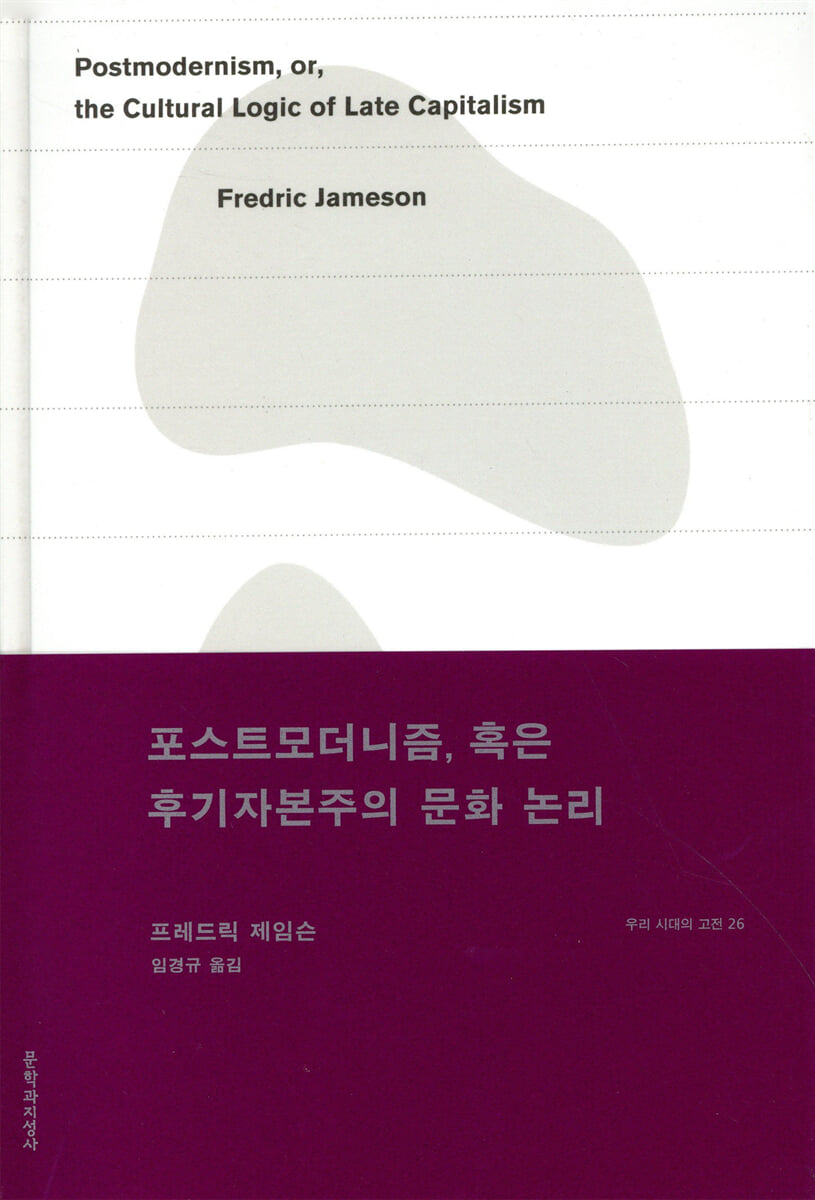
Postmodernism, or the cultural logic of late capitalism
 |
Description
Book Introduction
Postmodernism not as a cultural movement,
Establishing a horizon for political thinking
A monumental work by Jameson, the greatest living Marxist theorist.
First translation in 30 years since publication!
Postmodernism, or the Cultural Logic of Late Capitalism, is an intellectual blockbuster.
[…] a timely response to the trend-sensitive left-wing nihilists._Terry Eagleton (literary theorist)
I don't even remember a time before I read Jameson. —Clint Burnham (critic)
Fredric Jameson, considered the most important Marxist cultural critic in the English-speaking world today, has translated his monumental work, Postmodernism: The Cultural Logic of Late Capitalism, for the first time in 30 years.
This book, which includes the eponymous essay, known as “the most cited, discussed, and controversial text of the 1980s,” is considered the most distinctive work on postmodernism.
This book, which covers a wide range of fields, from philosophy to architecture, art, film, drama, music, science fiction, and experimental art, presents a dazzling analysis and fully displays Jameson's unique writing style, and is still considered a model book referenced by researchers and artists in various fields.
It also played a decisive role in establishing and popularizing the term "postmodernism" beyond the realms of art and philosophy as the most essential word to describe popular culture centered on the United States in the late 20th century.
Establishing a horizon for political thinking
A monumental work by Jameson, the greatest living Marxist theorist.
First translation in 30 years since publication!
Postmodernism, or the Cultural Logic of Late Capitalism, is an intellectual blockbuster.
[…] a timely response to the trend-sensitive left-wing nihilists._Terry Eagleton (literary theorist)
I don't even remember a time before I read Jameson. —Clint Burnham (critic)
Fredric Jameson, considered the most important Marxist cultural critic in the English-speaking world today, has translated his monumental work, Postmodernism: The Cultural Logic of Late Capitalism, for the first time in 30 years.
This book, which includes the eponymous essay, known as “the most cited, discussed, and controversial text of the 1980s,” is considered the most distinctive work on postmodernism.
This book, which covers a wide range of fields, from philosophy to architecture, art, film, drama, music, science fiction, and experimental art, presents a dazzling analysis and fully displays Jameson's unique writing style, and is still considered a model book referenced by researchers and artists in various fields.
It also played a decisive role in establishing and popularizing the term "postmodernism" beyond the realms of art and philosophy as the most essential word to describe popular culture centered on the United States in the late 20th century.
- You can preview some of the book's contents.
Preview
index
introduction
Chapter 1: Culture: The Cultural Logic of Post-Capitalism
Chapter 2: Ideology: Postmodern Theories
Chapter 3 Video_Surrealism Without the Unconscious
Chapter 4: Architecture: Spatial Equivalents of the World System
Chapter 5: Reading and Division of Labor
Chapter 6: Space: Utopianism After the End of Utopia
Chapter 7: Theory: Immanence and Nominalism in Postmodern Theoretical Discourse
Chapter 8: Economy: Postmodernism and the Market
Chapter 9: Film: Nostalgia for the Present
Chapter 10 Conclusion_Secondary Processing
Americas
Translator's Note
Search
Illustration
Chapter 1: Culture: The Cultural Logic of Post-Capitalism
Chapter 2: Ideology: Postmodern Theories
Chapter 3 Video_Surrealism Without the Unconscious
Chapter 4: Architecture: Spatial Equivalents of the World System
Chapter 5: Reading and Division of Labor
Chapter 6: Space: Utopianism After the End of Utopia
Chapter 7: Theory: Immanence and Nominalism in Postmodern Theoretical Discourse
Chapter 8: Economy: Postmodernism and the Market
Chapter 9: Film: Nostalgia for the Present
Chapter 10 Conclusion_Secondary Processing
Americas
Translator's Note
Search
Illustration
Into the book
If we define the concept of postmodernism very carefully, we can say that it is an attempt to think historically about the present time in an age that has forgotten how to think historically.
In this case, postmodernism can be said to either 'express' (albeit in a distorted way) a deeper and more irrepressible historical impulse, or it can be said to effectively 'repress' and avoid that impulse, and which side of this ambiguity we choose to take depends on our preferences.
---From the "Preface"
There once was a thing called parody.
But then a strange new thing called hybrid imitation appeared and slowly took his place.
Like parody, pastiche is an imitation of a unique and distinctive style.
It wears a linguistic mask and speaks in a dead language.
But it is nothing more than a neutral imitation.
It is a simple imitation that lacks even humor, neither a hidden motive like a parody nor a satirical impulse.
So there is no assurance that there will still be healthy linguistic norms, along with the borrowed, irregular language.
Therefore, hybrid imitation is an empty parody, a mere statue with a vacant look on its face.
--- p.64
In my view, the most symbolic work that most prominently expresses this new form of reasoning is Nam June Paik's work.
He stacks or scatters television screens among lush plants, or he mounts videos on the ceiling like new and magical stars, making them blink towards the audience.
[… … ] The audience of the postmodern era is asked to do the impossible.
That is, to see at a glance all the screens containing fundamental and random differences.
Such audiences must follow the evolutionary mutation of David Bowie (who was watching 57 television screens simultaneously) in "The Man Who Fell to Earth."
--- p.88~89
The building I will be analyzing is the Westin Bonaventure Hotel, a building built in the new downtown area of Los Angeles.
[… … ] Earlier I mentioned the populist aspect of the rhetoric of those who advocate postmodernism against the elitist (and utopian) strictness of great architectural modernism.
The general consensus is that these new buildings are, on the one hand, popular works, and on the other hand, a tribute to the uniqueness of American urban structure.
In other words, unlike the masterpieces and monumental buildings of authentic modernism, these buildings do not attempt to inject their own heterogeneous and exalted new utopian language into the cheap commercial sign system of the urban landscape that surrounds them.
Rather, they try to speak their own language, using the vocabulary and grammar of an American city, as symbolically expressed in the slogan “Learn from Las Vegas.”
--- p.102~103
If a new political art is possible, it must focus on the truth of postmodernism.
In other words, we must focus on the global space of multinational capital as its fundamental object.
At the same time, it must devise new, previously unimagined ways to break through reality and recreate this world's space.
Through this, we can begin to rediscover our own position as individual and collective subjects, and recover the capacity to act and struggle that has been neutralized by our current spatial and social dislocations.
If postmodernism has any political form, its calling will be to create and project a global cognitive map in social and spatial dimensions.
--- p.128
If temporality still has its place in the postmodern era, it would be more accurate to say that it refers to writing about time rather than the lived experience of it.
[… … ] Writing about time, rewriting time.
For example, J.
Such is the lesson of G. Ballard's unforgettable masterpiece, "The Voices of Time."
Its apocalyptic vision—of a universe frozen like an unwound clock and the imminent end of humanity, slumbering and rushing toward its end—at first seems to resemble either fin-de-siècle Wagnerian modernism or a grand, musical sociobiology.
But what Bellard was really linguistically devoting his heart and soul to was the multilayered seal of the capital letter Time, and that was what his writing was meant to read.
--- p.302~303
In the first article, he predicted a process of proletarianization on a global scale.
'Drawing cognitive maps' was in fact nothing less than a code for Korea.
Through it, it suggested the need for a new kind of class consciousness that had never been dreamed of before, and at the same time, it was refracted in the direction of a new spatiality inherent in postmodernism.
[… … ] The rhetorical strategies contained in the preceding discussions are related to an experiment.
That is, it was an attempt to see whether it was possible to bypass it by systematizing the unsystematic and historicizing the ahistorical, or at least to force a historical way of thinking about such matters.
“We have to name the system.” This phrase, one of the most interesting legacies of the 1960s, has found an unexpected revival in the postmodern debate.
In this case, postmodernism can be said to either 'express' (albeit in a distorted way) a deeper and more irrepressible historical impulse, or it can be said to effectively 'repress' and avoid that impulse, and which side of this ambiguity we choose to take depends on our preferences.
---From the "Preface"
There once was a thing called parody.
But then a strange new thing called hybrid imitation appeared and slowly took his place.
Like parody, pastiche is an imitation of a unique and distinctive style.
It wears a linguistic mask and speaks in a dead language.
But it is nothing more than a neutral imitation.
It is a simple imitation that lacks even humor, neither a hidden motive like a parody nor a satirical impulse.
So there is no assurance that there will still be healthy linguistic norms, along with the borrowed, irregular language.
Therefore, hybrid imitation is an empty parody, a mere statue with a vacant look on its face.
--- p.64
In my view, the most symbolic work that most prominently expresses this new form of reasoning is Nam June Paik's work.
He stacks or scatters television screens among lush plants, or he mounts videos on the ceiling like new and magical stars, making them blink towards the audience.
[… … ] The audience of the postmodern era is asked to do the impossible.
That is, to see at a glance all the screens containing fundamental and random differences.
Such audiences must follow the evolutionary mutation of David Bowie (who was watching 57 television screens simultaneously) in "The Man Who Fell to Earth."
--- p.88~89
The building I will be analyzing is the Westin Bonaventure Hotel, a building built in the new downtown area of Los Angeles.
[… … ] Earlier I mentioned the populist aspect of the rhetoric of those who advocate postmodernism against the elitist (and utopian) strictness of great architectural modernism.
The general consensus is that these new buildings are, on the one hand, popular works, and on the other hand, a tribute to the uniqueness of American urban structure.
In other words, unlike the masterpieces and monumental buildings of authentic modernism, these buildings do not attempt to inject their own heterogeneous and exalted new utopian language into the cheap commercial sign system of the urban landscape that surrounds them.
Rather, they try to speak their own language, using the vocabulary and grammar of an American city, as symbolically expressed in the slogan “Learn from Las Vegas.”
--- p.102~103
If a new political art is possible, it must focus on the truth of postmodernism.
In other words, we must focus on the global space of multinational capital as its fundamental object.
At the same time, it must devise new, previously unimagined ways to break through reality and recreate this world's space.
Through this, we can begin to rediscover our own position as individual and collective subjects, and recover the capacity to act and struggle that has been neutralized by our current spatial and social dislocations.
If postmodernism has any political form, its calling will be to create and project a global cognitive map in social and spatial dimensions.
--- p.128
If temporality still has its place in the postmodern era, it would be more accurate to say that it refers to writing about time rather than the lived experience of it.
[… … ] Writing about time, rewriting time.
For example, J.
Such is the lesson of G. Ballard's unforgettable masterpiece, "The Voices of Time."
Its apocalyptic vision—of a universe frozen like an unwound clock and the imminent end of humanity, slumbering and rushing toward its end—at first seems to resemble either fin-de-siècle Wagnerian modernism or a grand, musical sociobiology.
But what Bellard was really linguistically devoting his heart and soul to was the multilayered seal of the capital letter Time, and that was what his writing was meant to read.
--- p.302~303
In the first article, he predicted a process of proletarianization on a global scale.
'Drawing cognitive maps' was in fact nothing less than a code for Korea.
Through it, it suggested the need for a new kind of class consciousness that had never been dreamed of before, and at the same time, it was refracted in the direction of a new spatiality inherent in postmodernism.
[… … ] The rhetorical strategies contained in the preceding discussions are related to an experiment.
That is, it was an attempt to see whether it was possible to bypass it by systematizing the unsystematic and historicizing the ahistorical, or at least to force a historical way of thinking about such matters.
“We have to name the system.” This phrase, one of the most interesting legacies of the 1960s, has found an unexpected revival in the postmodern debate.
--- p.749~750
Publisher's Review
Marxists who jumped into the postmodernist debate
In the early and mid-1980s, as European theories, including deconstructionism and poststructuralism, post-Marxist discourses, and the fierce conservative backlash following the Reagan administration began to colonize American academia, ignoring the progressive achievements of the 1960s and proclaiming the ultimate triumph of capitalism and the end of class politics and ideology, a fierce debate was raging over postmodernism.
What kind of art can be called postmodern art?
Is postmodernism a continuation of modernism or a radical break?
Should we support or criticize postmodernism?
Then, Jameson jumped into this debate in 1984 with an article titled “Postmodernism, or the Cultural Logic of Late Capitalism” in the New Radical Review, bringing about a stronger ripple effect.
Until then, it was unimaginable to think of Marxism and postmodernism as linked together.
In essence, “Always historicize!” (Jameson) entered the “slaughterhouse of history” (Douglas Keller) under the banner of historical materialism.
On the one hand, Jameson was the target of intense fire from poststructuralists, and on the other hand, he was treated as a Marxist defector by the left.
After that, he published additional in-depth articles on postmodernism, focusing on interpretation, historicity, space, and utopia, which were compiled into this long-remembered book in 1991.
Building a Horizon for Politically Thinking About Postmodernism
The title of this book itself reveals Jameson's approach to postmodernism.
While other theorists have regarded postmodernism as an artistic style, Jameson views it as a cultural expression of a specific political and historical environment called “late capitalism,” that is, as “the cultural logic of late capitalism.”
The term “late capitalism” is borrowed from the economist Ernest Mandel (who distinguished between classical, monopoly, and late capitalism) and is associated with the idea that the current phase of multinational capitalism, far from contradicting Marx’s 19th-century analysis, represents the purest form of capitalism that has ever existed.
Thanks to this, we can understand postmodernism holistically in relation to the core contradictions of late capitalism.
As a result of the changes in the way capitalism operates, there have been profound changes in the way everyday life and culture are organized, not to mention the so-called realm of art.
Through Jameson, we realize that the aesthetics of postmodernism's superficiality, expressed as "depthlessness," "the decline of historicity," "the spatialization of time," and "simulacrum," and the theoretical discourse of poststructuralism emphasizing "textuality" and "immanence," were in fact part of late capitalism's ideological containment strategy, which blocked the encounter with capitalized History as its ultimate referent.
Drawing a cognitive map: the current situation
See it as both a catastrophe and progress.
Jameson also exposes the power of reification inherent in the spatial logic of postmodernism, citing the example of the Bonaventure Hotel in Los Angeles, designed by postmodern architect John Portman.
It is impossible to orient yourself in this self-enclosed building, whose surface is made of huge reflective glass.
Postmodern hyperspace transcends the ability of individual human bodies to locate themselves, organize their surroundings through sensory perception, and map their own location.
So, are we left with no other option than to become schizophrenic subjects who celebrate the eternal continuation of the present in the intense ecstasy of consumer society, or in the play of meaningless differences?
Following Marx, who urged us to think of the development of capitalism “both positively and negatively,” Jameson calls for a dialectical understanding of the cultural evolution of late capitalism, that is, a grasp of the current situation as “both catastrophe and progress.”
We must not return to aesthetic practices that were founded on historical circumstances and dilemmas that are no longer of our time.
A political and cultural model appropriate to our situation must focus on the truth contained in postmodernism and the global space of multinational capital.
Jameson argues that we must invent new, previously unimagined ways to break through reality and represent this world's space, and calls for "cognitive mapping" as an attempt to politically and aesthetically assess the subject's position within the global network of late capitalism.
This methodology, which would continue to be developed in Jameson's later work, is unrelated to any attempt to precisely map the real conditions of late capitalism, and paradoxically operates solely on the impossibility of a mimetic representation of late capitalism.
In other words, cognitive mapping is a way of connecting the two spaces of the subject's realm and late capitalism as reality through a fantasy structure, while simultaneously expressing the desire for change in the future, that is, the utopian impulse.
Meanwhile, in Chapter 10, "Secondary Processing," which synthesizes and expands the discussion so far, Jameson tells an interesting story: "Cognitive mapping" was actually a code word for "class consciousness," and through it he attempted to suggest the necessity of a new kind of class consciousness that had never been dreamed of before.
Jameson Revisit
Now that the term "postmodernism" has largely disappeared, after a period of great hype, the publication of this book may feel like a belated visit.
As the postmodern debate was replaced by theories such as postcolonialism, feminism, and sexuality that included the voices of minorities, and as differences, diversity, hybridity, and identity took over as keywords in humanities papers, the holistic thinking of Jameson's style tended to be taboo for a while.
However, as the struggles of micropolitics and identity politics, which seemed to guarantee infinite legitimacy, are transformed (and in some cases, conservative) into a “cultural struggle for recognition and tolerance of difference,” while capitalism continues its victorious march, the name “Jameson” is resurfacing.
In particular, the reflections on the relationship between new social movements and small-group movements and capitalism, and the emphasis on the need for harmony between local and global struggles, confirm the unexpected relevance of this book, which I visited after a detour of 30 years.
In the early and mid-1980s, as European theories, including deconstructionism and poststructuralism, post-Marxist discourses, and the fierce conservative backlash following the Reagan administration began to colonize American academia, ignoring the progressive achievements of the 1960s and proclaiming the ultimate triumph of capitalism and the end of class politics and ideology, a fierce debate was raging over postmodernism.
What kind of art can be called postmodern art?
Is postmodernism a continuation of modernism or a radical break?
Should we support or criticize postmodernism?
Then, Jameson jumped into this debate in 1984 with an article titled “Postmodernism, or the Cultural Logic of Late Capitalism” in the New Radical Review, bringing about a stronger ripple effect.
Until then, it was unimaginable to think of Marxism and postmodernism as linked together.
In essence, “Always historicize!” (Jameson) entered the “slaughterhouse of history” (Douglas Keller) under the banner of historical materialism.
On the one hand, Jameson was the target of intense fire from poststructuralists, and on the other hand, he was treated as a Marxist defector by the left.
After that, he published additional in-depth articles on postmodernism, focusing on interpretation, historicity, space, and utopia, which were compiled into this long-remembered book in 1991.
Building a Horizon for Politically Thinking About Postmodernism
The title of this book itself reveals Jameson's approach to postmodernism.
While other theorists have regarded postmodernism as an artistic style, Jameson views it as a cultural expression of a specific political and historical environment called “late capitalism,” that is, as “the cultural logic of late capitalism.”
The term “late capitalism” is borrowed from the economist Ernest Mandel (who distinguished between classical, monopoly, and late capitalism) and is associated with the idea that the current phase of multinational capitalism, far from contradicting Marx’s 19th-century analysis, represents the purest form of capitalism that has ever existed.
Thanks to this, we can understand postmodernism holistically in relation to the core contradictions of late capitalism.
As a result of the changes in the way capitalism operates, there have been profound changes in the way everyday life and culture are organized, not to mention the so-called realm of art.
Through Jameson, we realize that the aesthetics of postmodernism's superficiality, expressed as "depthlessness," "the decline of historicity," "the spatialization of time," and "simulacrum," and the theoretical discourse of poststructuralism emphasizing "textuality" and "immanence," were in fact part of late capitalism's ideological containment strategy, which blocked the encounter with capitalized History as its ultimate referent.
Drawing a cognitive map: the current situation
See it as both a catastrophe and progress.
Jameson also exposes the power of reification inherent in the spatial logic of postmodernism, citing the example of the Bonaventure Hotel in Los Angeles, designed by postmodern architect John Portman.
It is impossible to orient yourself in this self-enclosed building, whose surface is made of huge reflective glass.
Postmodern hyperspace transcends the ability of individual human bodies to locate themselves, organize their surroundings through sensory perception, and map their own location.
So, are we left with no other option than to become schizophrenic subjects who celebrate the eternal continuation of the present in the intense ecstasy of consumer society, or in the play of meaningless differences?
Following Marx, who urged us to think of the development of capitalism “both positively and negatively,” Jameson calls for a dialectical understanding of the cultural evolution of late capitalism, that is, a grasp of the current situation as “both catastrophe and progress.”
We must not return to aesthetic practices that were founded on historical circumstances and dilemmas that are no longer of our time.
A political and cultural model appropriate to our situation must focus on the truth contained in postmodernism and the global space of multinational capital.
Jameson argues that we must invent new, previously unimagined ways to break through reality and represent this world's space, and calls for "cognitive mapping" as an attempt to politically and aesthetically assess the subject's position within the global network of late capitalism.
This methodology, which would continue to be developed in Jameson's later work, is unrelated to any attempt to precisely map the real conditions of late capitalism, and paradoxically operates solely on the impossibility of a mimetic representation of late capitalism.
In other words, cognitive mapping is a way of connecting the two spaces of the subject's realm and late capitalism as reality through a fantasy structure, while simultaneously expressing the desire for change in the future, that is, the utopian impulse.
Meanwhile, in Chapter 10, "Secondary Processing," which synthesizes and expands the discussion so far, Jameson tells an interesting story: "Cognitive mapping" was actually a code word for "class consciousness," and through it he attempted to suggest the necessity of a new kind of class consciousness that had never been dreamed of before.
Jameson Revisit
Now that the term "postmodernism" has largely disappeared, after a period of great hype, the publication of this book may feel like a belated visit.
As the postmodern debate was replaced by theories such as postcolonialism, feminism, and sexuality that included the voices of minorities, and as differences, diversity, hybridity, and identity took over as keywords in humanities papers, the holistic thinking of Jameson's style tended to be taboo for a while.
However, as the struggles of micropolitics and identity politics, which seemed to guarantee infinite legitimacy, are transformed (and in some cases, conservative) into a “cultural struggle for recognition and tolerance of difference,” while capitalism continues its victorious march, the name “Jameson” is resurfacing.
In particular, the reflections on the relationship between new social movements and small-group movements and capitalism, and the emphasis on the need for harmony between local and global struggles, confirm the unexpected relevance of this book, which I visited after a detour of 30 years.
GOODS SPECIFICS
- Publication date: February 18, 2022
- Format: Hardcover book binding method guide
- Page count, weight, size: 814 pages | 1,228g | 152*223*40mm
- ISBN13: 9788932039046
- ISBN10: 8932039046
You may also like
카테고리
korean


korean

![GQ KOREA Mark (Monthly): December [2025]](http://librairie.coreenne.fr/cdn/shop/files/8ef265dbbfbf186523ed75ba7319009d.jpg?v=1765340328&width=3840)


