

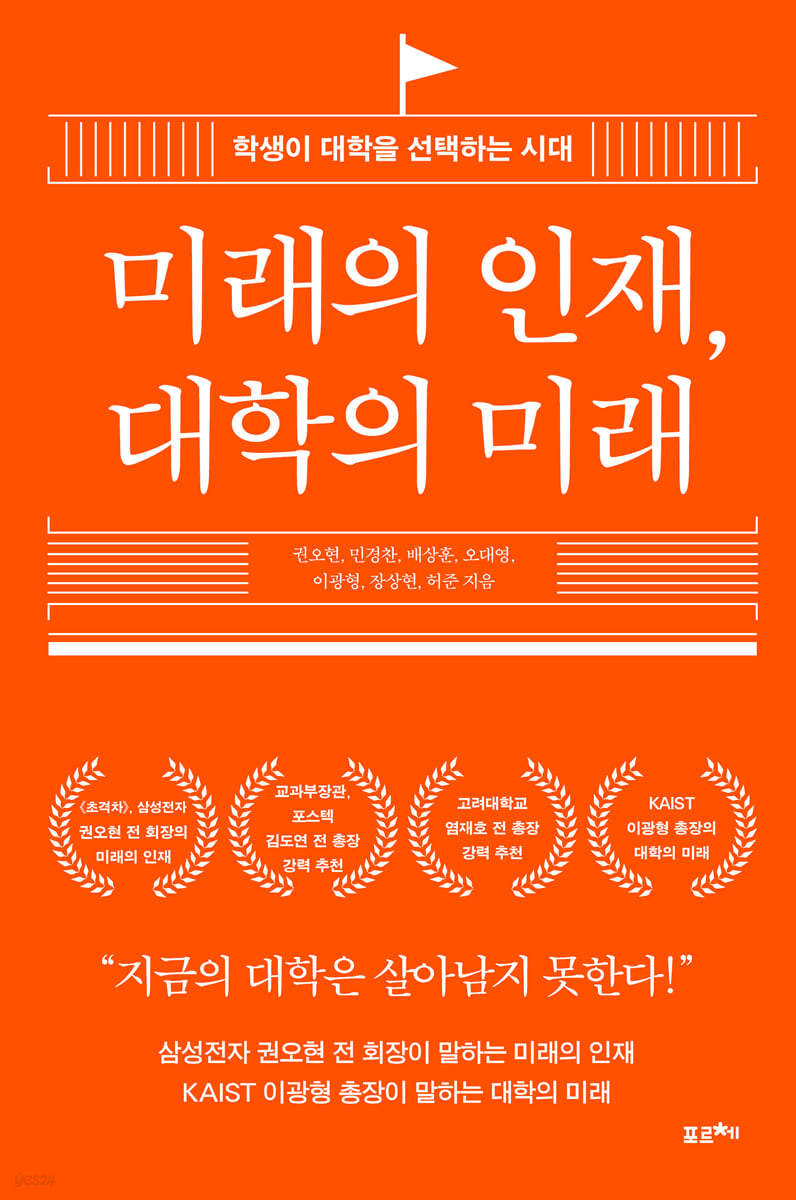
Talent of the future, the future of universities
 |
Description
Book Introduction
Get ready for a huge wave of change, right now!
What should future talents prepare for?
Former Samsung Electronics Chairman Kwon Oh-hyun and KAIST President Lee Kwang-hyung
Talking about talent after the third tech revolution, including AI and the metaverse!
AI, the metaverse, virtual humans, and even humans born from genetic editing technology, which may seem like a distant future, are soon to be accepted as a given.
"Future Talent, Future of Universities" is a book in which seven of Korea's top intellectuals put their heads together to find answers to the question of what "future talent" who will coexist with the new "humanity" should prepare for.
The digital age is developing at an unimaginably fast pace.
85% of college students have jobs that don't exist yet, and there's a joke that colleges will fail in the order that cherry blossoms bloom.
This book seeks answers to the questions of how universities, which drive the future of society, should change in this era of emerging new industries and challenged existing values and order, and what abilities the talents they cultivate should possess to lead society.
Former Samsung Electronics Chairman Kwon Oh-hyun discusses his concerns about how to cultivate talent in a rapidly changing world and the qualities and characteristics of future talent.
KAIST President Lee Kwang-hyung proposes a way for AI-embedded humans and society to coexist and create meaningful lives.
Professors Bae Sang-hoon, Oh Dae-young, Jang Sang-hyun, and Heo Jun, icons of university innovation, introduce online learning and shared universities based on AI and big data, emphasizing the need for personalized education for students.
Professor Emeritus Min Kyung-chan of Yonsei University proposes a new learning ecosystem that connects various social organizations, including the government, businesses, and the media.
What should future talents prepare for?
Former Samsung Electronics Chairman Kwon Oh-hyun and KAIST President Lee Kwang-hyung
Talking about talent after the third tech revolution, including AI and the metaverse!
AI, the metaverse, virtual humans, and even humans born from genetic editing technology, which may seem like a distant future, are soon to be accepted as a given.
"Future Talent, Future of Universities" is a book in which seven of Korea's top intellectuals put their heads together to find answers to the question of what "future talent" who will coexist with the new "humanity" should prepare for.
The digital age is developing at an unimaginably fast pace.
85% of college students have jobs that don't exist yet, and there's a joke that colleges will fail in the order that cherry blossoms bloom.
This book seeks answers to the questions of how universities, which drive the future of society, should change in this era of emerging new industries and challenged existing values and order, and what abilities the talents they cultivate should possess to lead society.
Former Samsung Electronics Chairman Kwon Oh-hyun discusses his concerns about how to cultivate talent in a rapidly changing world and the qualities and characteristics of future talent.
KAIST President Lee Kwang-hyung proposes a way for AI-embedded humans and society to coexist and create meaningful lives.
Professors Bae Sang-hoon, Oh Dae-young, Jang Sang-hyun, and Heo Jun, icons of university innovation, introduce online learning and shared universities based on AI and big data, emphasizing the need for personalized education for students.
Professor Emeritus Min Kyung-chan of Yonsei University proposes a new learning ecosystem that connects various social organizations, including the government, businesses, and the media.
- You can preview some of the book's contents.
Preview
index
Recommendation | Kim Do-yeon (Former Minister of Education, Science and Technology, Former President of POSTECH)
Yeom Jae-ho (Professor Emeritus, Korea University, 19th President)
Writing staff
Introduction | Dreaming of a new university that nurtures future talent
Part 1.
Future talents for a new era
Chapter 1.
A new leap forward for the future in a rapidly changing world
1.
The future embraced by those who are one step ahead
We are facing a major turning point in the history of civilization. We need a new formula for nurturing talent. 21st-century talent must be the best.
2.
The future that comes to changing talents
Don't be afraid of change | Specs no longer measure skill | The talent and leaders needed by future companies
Chapter 2. Future Talents for the AI Era
1. The era of working as a team with AI is coming.
The Era of Coexistence between Humans and AI | Why Future Talents Are Preparing for the AI Era | Training in AI Technologies is Necessary | The Competencies Required to Collaborate with AI
2.
The future of digital transformation is different for successful workers.
Digital Transformation of Education Post-Pandemic | What Will Future Talent Do? | The Standards for Successful Work Are Changing | Working with AI, Don't Lose Your Emotions | How Future Talent Sees the World
3.
Let's jump into a new era with new dreams.
Let's pursue our dreams while doing what we love to our heart's content | Students with fire in their hearts, professors who ignite those fires | A place of experience for growing into 21st-century talent | We still learn in college | Let's broaden our horizons and embrace change.
Part 2.
The university of the future that will nurture new talent
Chapter 3.
The Education Crisis and the Direction of Innovation
1.
The crisis and reality of Korean higher education
Our universities' competitiveness is lagging behind internationally | Worsening finances and deteriorating educational conditions | The proportion of private universities in our country is too high | Universities are being pushed to the brink by the declining school-age population | Universities with living values and a vision
2.
How has higher education around the world been innovating?
The Birth of the Modern University Model | The Uselessness of Unproductive and Impractical Universities | Case Studies of 21st-Century Higher Education Innovation | University Innovation Responding to the Call of Our Times | Focus on Diversity, Connection, and Platforms
Chapter 4.
A new educational platform for nurturing future talent
1.
Universities must now cultivate AI-convergence talent.
Future industries demand AI convergence talent and R&D experts | 100 students, 100 successful models | Preparing universities for the era of personalized learning | Scientific student support education services leveraging AI
2.
Reinventing education with no limits to learning
The Era of Online Learning: Transforming the Time and Space of Undergraduate Education | The Era of Diversified Providers: The End of the Higher Education Monopoly | The Era of Openness and Connectivity: The Shared University
Chapter 5.
A new university for future talent
1.
The future demands new talent and new universities.
An era that demands a shift in how we think and work | An era that demands new talent | A new university to cultivate new talent
2.
A university revolution has begun, focusing on student success.
A university that fosters individual student growth | An educational environment that fosters the development of students into the talents universities expect | Changes in the rapidly evolving university ecosystem
3.
Prepare for future changes
Preparing Talent to Change the Future and the World | Challenges and Hopes for Korean Higher Education
References
Yeom Jae-ho (Professor Emeritus, Korea University, 19th President)
Writing staff
Introduction | Dreaming of a new university that nurtures future talent
Part 1.
Future talents for a new era
Chapter 1.
A new leap forward for the future in a rapidly changing world
1.
The future embraced by those who are one step ahead
We are facing a major turning point in the history of civilization. We need a new formula for nurturing talent. 21st-century talent must be the best.
2.
The future that comes to changing talents
Don't be afraid of change | Specs no longer measure skill | The talent and leaders needed by future companies
Chapter 2. Future Talents for the AI Era
1. The era of working as a team with AI is coming.
The Era of Coexistence between Humans and AI | Why Future Talents Are Preparing for the AI Era | Training in AI Technologies is Necessary | The Competencies Required to Collaborate with AI
2.
The future of digital transformation is different for successful workers.
Digital Transformation of Education Post-Pandemic | What Will Future Talent Do? | The Standards for Successful Work Are Changing | Working with AI, Don't Lose Your Emotions | How Future Talent Sees the World
3.
Let's jump into a new era with new dreams.
Let's pursue our dreams while doing what we love to our heart's content | Students with fire in their hearts, professors who ignite those fires | A place of experience for growing into 21st-century talent | We still learn in college | Let's broaden our horizons and embrace change.
Part 2.
The university of the future that will nurture new talent
Chapter 3.
The Education Crisis and the Direction of Innovation
1.
The crisis and reality of Korean higher education
Our universities' competitiveness is lagging behind internationally | Worsening finances and deteriorating educational conditions | The proportion of private universities in our country is too high | Universities are being pushed to the brink by the declining school-age population | Universities with living values and a vision
2.
How has higher education around the world been innovating?
The Birth of the Modern University Model | The Uselessness of Unproductive and Impractical Universities | Case Studies of 21st-Century Higher Education Innovation | University Innovation Responding to the Call of Our Times | Focus on Diversity, Connection, and Platforms
Chapter 4.
A new educational platform for nurturing future talent
1.
Universities must now cultivate AI-convergence talent.
Future industries demand AI convergence talent and R&D experts | 100 students, 100 successful models | Preparing universities for the era of personalized learning | Scientific student support education services leveraging AI
2.
Reinventing education with no limits to learning
The Era of Online Learning: Transforming the Time and Space of Undergraduate Education | The Era of Diversified Providers: The End of the Higher Education Monopoly | The Era of Openness and Connectivity: The Shared University
Chapter 5.
A new university for future talent
1.
The future demands new talent and new universities.
An era that demands a shift in how we think and work | An era that demands new talent | A new university to cultivate new talent
2.
A university revolution has begun, focusing on student success.
A university that fosters individual student growth | An educational environment that fosters the development of students into the talents universities expect | Changes in the rapidly evolving university ecosystem
3.
Prepare for future changes
Preparing Talent to Change the Future and the World | Challenges and Hopes for Korean Higher Education
References
Detailed image
Into the book
In the past, it was thought that working hard and for a long time was what made one good at something.
In fact, the most important component that creates added value in a computer is the CPU, but it is no different from evaluating it based on the mouse and keyboard, which are the peripheral devices that work the hardest in terms of time.
To avoid straying from the essence of work, it is important for leaders to have an open mind.
Rather than focusing on the busyness of moving around like an ant, we should focus on the added value that the CPU creates.
--- p.60
There is another issue regarding the important changes that will come in the future.
It is a physical change caused by gene editing.
No parent would want to pass on bad genes to their children.
Who wouldn't want to use gene editing technology to correct genetic diseases or physical defects, resulting in healthy, beautiful children? While ethical and political issues currently prevent its implementation, if this technology continues to advance, wouldn't the world be vastly different in 50 years? Just looking at China's progress in this area gives us a glimpse into our future.
We will also have to coexist with new 'humans' created through genetic technology.
--- p.66
The era that emphasized sincerity is passing, and an era is coming in which those who are determined to do well are recognized.
Here, 'well' means using tools effectively and collaborating with those around you to solve problems quickly and accurately.
The rapid development of cutting-edge information and communication technologies (ICT), such as big data, AI, and the metaverse, is completely changing the way we work.
Therefore, the standard for a successful person will be someone who can solve problems by collaborating with experts or groups of experts using appropriate digital tools.
In other words, in the future, the ability to interact with people in a digital environment will be important, and it will also be essential to have knowledge of digital literacy and digital manners.
--- p.89~90
Finally, the most important thing in the journey of university innovation in the 21st century is for universities to regain the public's respect and trust.
Just as the United States presented a new educational system in response to criticism of its liberal arts-centered university education, we too must attempt structural changes that the public can accept and accept.
This could be called a complete rebirth of higher education.
Our country also needs professors like Thorstein Veblen and Upton Sinclair, who spoke out boldly about the crisis at American universities in the early 20th century.
We also need leadership like that of President Daniel Gilman of Johns Hopkins University and President Charles Eliot of Harvard University, who boldly spoke out against the university crisis and earned the public's respect.
We also need authoritative associations like the American Association of University Professors, which was founded under the leadership of scholars like John Dewey.
--- p.164~165
In the past, during the industrialization era, the pace of change in education was not so rapid, so universities could meet the needs of society to some extent with a traditional four-year curriculum.
However, in the era of the Fourth Industrial Revolution, the half-life of knowledge is rapidly shortening, and the four-year university education is not keeping up with social demands.
As a result, the existing traditional university system is disappearing, and new higher education institutions are emerging.
These are universities that have broken down the constraints of time and space and have quickly followed change.
--- p.185
Although the situation around us is so dire, everything in the world ultimately depends on ‘people.’
In the future, too, we must place our hopes on ‘people.’
The question is how to prepare talents who can confidently adapt to today's era of great transformation and lead new changes in the future era that will follow.
What kind of talent can we expect from a uniform and rigid educational environment that forces students to compete for grades from a young age and, from college onward, obsesses over grades and exam preparation? Today, we need global talent and leaders who can navigate the challenges of the US-China conflict, the conflicts of interest and values between nations, the digital age, sustainable societies, and other global challenges, and lead the future.
This is a matter of survival for the Republic of Korea.
In fact, the most important component that creates added value in a computer is the CPU, but it is no different from evaluating it based on the mouse and keyboard, which are the peripheral devices that work the hardest in terms of time.
To avoid straying from the essence of work, it is important for leaders to have an open mind.
Rather than focusing on the busyness of moving around like an ant, we should focus on the added value that the CPU creates.
--- p.60
There is another issue regarding the important changes that will come in the future.
It is a physical change caused by gene editing.
No parent would want to pass on bad genes to their children.
Who wouldn't want to use gene editing technology to correct genetic diseases or physical defects, resulting in healthy, beautiful children? While ethical and political issues currently prevent its implementation, if this technology continues to advance, wouldn't the world be vastly different in 50 years? Just looking at China's progress in this area gives us a glimpse into our future.
We will also have to coexist with new 'humans' created through genetic technology.
--- p.66
The era that emphasized sincerity is passing, and an era is coming in which those who are determined to do well are recognized.
Here, 'well' means using tools effectively and collaborating with those around you to solve problems quickly and accurately.
The rapid development of cutting-edge information and communication technologies (ICT), such as big data, AI, and the metaverse, is completely changing the way we work.
Therefore, the standard for a successful person will be someone who can solve problems by collaborating with experts or groups of experts using appropriate digital tools.
In other words, in the future, the ability to interact with people in a digital environment will be important, and it will also be essential to have knowledge of digital literacy and digital manners.
--- p.89~90
Finally, the most important thing in the journey of university innovation in the 21st century is for universities to regain the public's respect and trust.
Just as the United States presented a new educational system in response to criticism of its liberal arts-centered university education, we too must attempt structural changes that the public can accept and accept.
This could be called a complete rebirth of higher education.
Our country also needs professors like Thorstein Veblen and Upton Sinclair, who spoke out boldly about the crisis at American universities in the early 20th century.
We also need leadership like that of President Daniel Gilman of Johns Hopkins University and President Charles Eliot of Harvard University, who boldly spoke out against the university crisis and earned the public's respect.
We also need authoritative associations like the American Association of University Professors, which was founded under the leadership of scholars like John Dewey.
--- p.164~165
In the past, during the industrialization era, the pace of change in education was not so rapid, so universities could meet the needs of society to some extent with a traditional four-year curriculum.
However, in the era of the Fourth Industrial Revolution, the half-life of knowledge is rapidly shortening, and the four-year university education is not keeping up with social demands.
As a result, the existing traditional university system is disappearing, and new higher education institutions are emerging.
These are universities that have broken down the constraints of time and space and have quickly followed change.
--- p.185
Although the situation around us is so dire, everything in the world ultimately depends on ‘people.’
In the future, too, we must place our hopes on ‘people.’
The question is how to prepare talents who can confidently adapt to today's era of great transformation and lead new changes in the future era that will follow.
What kind of talent can we expect from a uniform and rigid educational environment that forces students to compete for grades from a young age and, from college onward, obsesses over grades and exam preparation? Today, we need global talent and leaders who can navigate the challenges of the US-China conflict, the conflicts of interest and values between nations, the digital age, sustainable societies, and other global challenges, and lead the future.
This is a matter of survival for the Republic of Korea.
--- p.209
Publisher's Review
"The top 1% feeds the nation."
Proposals from the nation's best leaders to foster talent in Korea!
Prepare for 'this', which is more important than 'knowledge' in the 20th century!
This book offers bold and unflinching advice on the direction in which our current education system must change for the sake of the future of Korean society.
The authors emphasize the need to read future changes and respond quickly.
It shows a new direction for change to young people who have lost hope and are frustrated, even calling themselves Hell Joseon, filled with chaos, and presents the type of talent that must thoroughly prepare for the future.
Human civilization is opening a new chapter with the emergence of machines-embedded humans, humans living as sub-characters and avatars, and humans living in virtual worlds like the metaverse.
20th century knowledge no longer guarantees high utility, and existing systems and customs are being forced to change.
This book tells us how our universities and our young people must change and respond today.
University and corporate leaders, keenly aware of new changes and leading their organizations, offer sharp insights into the realities and offer warm advice for the future of universities and their talents. This will serve as a beacon for young people and university officials preparing for tomorrow.
It deeply resonates with students, parents, universities, educational authorities, the media, and civic groups who are trapped in today's narrow reality and the university debate centered on entrance exams.
This book is recommended for anyone interested in the future of education today, as a new civilization unfolds through digital transformation.
We live in an era where we must coexist with AI and new humans born from gene editing technology.
Talents who collaborate well with AI will succeed.
Through the book "Post Metaverse," we can see that tremendous changes are taking place not only in the virtual reality world, including virtual space and avatars, but also in various fields, perhaps almost all fields, such as cultural heritage, society, humanities, music, performance, architecture, and art cities.
We will also see scenes of virtual humans, AIs that are indistinguishable from humans, roaming around the advertising market.
And that's not all! Although taboo in our country, a new species of human created through gene editing technology will soon appear.
It is currently under development in China.
Now, we will clearly have to coexist with new humans created through AI and gene editing technology.
This book talks about the type of talent that will live in the future.
In particular, KAIST President Lee Kwang-hyung firmly states, “Collaboration between humans is important now, but in the future, cooperation between humans and AI will become more important than competition with AI.”
In other words, those who effectively utilize AI achieve results and grow into leaders. They must understand AI's strengths and weaknesses and adapt accordingly.
At the same time, he emphasizes that we must fully demonstrate the creativity that only humans can have.
The Fourth Industrial Revolution and the COVID-19 Pandemic Change the Education and Job Landscape
Future talents and the future of universities fit for the new era
Are Korean universities equipped with the necessary environment to cultivate future talent? Experts believe that today's universities are no longer capable of nurturing future talent that meets the needs of future society.
Even the number of universities closing is increasing.
There are several reasons for this.
Reasons cited include reduced government financial support, a tuition freeze, and a declining school-age population.
But on the other hand, the reality of our country's universities is also extremely dismal.
According to statistics from a leading international university evaluation agency, Korean universities are having to settle for ranking in the top 500.
We are lagging behind in many areas and are completely unprepared for the Fourth Industrial Revolution, as we cannot attribute everything to financial reasons alone.
Rather, education suited to the era of the Fourth Industrial Revolution is being conducted on both online and offline platforms.
As a result, students who received education on the platform are even making self-deprecating assessments such as, “Universities are not keeping up with the pace of social development.”
This book presents several examples as alternatives.
One of them is Minerva University, which is called a model for the university of the future.
With over 20,000 applicants in just four years since its opening and an astonishing acceptance rate of approximately 1.9%, it is considered more difficult to get into than Harvard University.
Why? In the words of founder Ben Nelson, many students believe that "there's no need for a college life where professors talk alone in classrooms, a curriculum devoid of context where students can graduate by taking only the classes they like, or a life where students are confined to campus and study without ever going out into the world."
Of course, this university model is not the only answer.
There are several types, including Olin Polytechnic Institute and Ecole 42, and Erasmus, a student and faculty exchange program common in Europe, can also be an alternative.
The Bologna Process, which standardized systems such as establishing a credit exchange system, is also noteworthy.
In addition, it is worth considering innovations in space and time that are suitable for the era of shared universities and online learning.
What is clear is that the future demands new talent and new universities.
Students must change both the way they think and the way they work.
Universities must take the lead in fostering students into irreplaceable talents who can make a difference.
This is the challenge facing education today.
Proposals from the nation's best leaders to foster talent in Korea!
Prepare for 'this', which is more important than 'knowledge' in the 20th century!
This book offers bold and unflinching advice on the direction in which our current education system must change for the sake of the future of Korean society.
The authors emphasize the need to read future changes and respond quickly.
It shows a new direction for change to young people who have lost hope and are frustrated, even calling themselves Hell Joseon, filled with chaos, and presents the type of talent that must thoroughly prepare for the future.
Human civilization is opening a new chapter with the emergence of machines-embedded humans, humans living as sub-characters and avatars, and humans living in virtual worlds like the metaverse.
20th century knowledge no longer guarantees high utility, and existing systems and customs are being forced to change.
This book tells us how our universities and our young people must change and respond today.
University and corporate leaders, keenly aware of new changes and leading their organizations, offer sharp insights into the realities and offer warm advice for the future of universities and their talents. This will serve as a beacon for young people and university officials preparing for tomorrow.
It deeply resonates with students, parents, universities, educational authorities, the media, and civic groups who are trapped in today's narrow reality and the university debate centered on entrance exams.
This book is recommended for anyone interested in the future of education today, as a new civilization unfolds through digital transformation.
We live in an era where we must coexist with AI and new humans born from gene editing technology.
Talents who collaborate well with AI will succeed.
Through the book "Post Metaverse," we can see that tremendous changes are taking place not only in the virtual reality world, including virtual space and avatars, but also in various fields, perhaps almost all fields, such as cultural heritage, society, humanities, music, performance, architecture, and art cities.
We will also see scenes of virtual humans, AIs that are indistinguishable from humans, roaming around the advertising market.
And that's not all! Although taboo in our country, a new species of human created through gene editing technology will soon appear.
It is currently under development in China.
Now, we will clearly have to coexist with new humans created through AI and gene editing technology.
This book talks about the type of talent that will live in the future.
In particular, KAIST President Lee Kwang-hyung firmly states, “Collaboration between humans is important now, but in the future, cooperation between humans and AI will become more important than competition with AI.”
In other words, those who effectively utilize AI achieve results and grow into leaders. They must understand AI's strengths and weaknesses and adapt accordingly.
At the same time, he emphasizes that we must fully demonstrate the creativity that only humans can have.
The Fourth Industrial Revolution and the COVID-19 Pandemic Change the Education and Job Landscape
Future talents and the future of universities fit for the new era
Are Korean universities equipped with the necessary environment to cultivate future talent? Experts believe that today's universities are no longer capable of nurturing future talent that meets the needs of future society.
Even the number of universities closing is increasing.
There are several reasons for this.
Reasons cited include reduced government financial support, a tuition freeze, and a declining school-age population.
But on the other hand, the reality of our country's universities is also extremely dismal.
According to statistics from a leading international university evaluation agency, Korean universities are having to settle for ranking in the top 500.
We are lagging behind in many areas and are completely unprepared for the Fourth Industrial Revolution, as we cannot attribute everything to financial reasons alone.
Rather, education suited to the era of the Fourth Industrial Revolution is being conducted on both online and offline platforms.
As a result, students who received education on the platform are even making self-deprecating assessments such as, “Universities are not keeping up with the pace of social development.”
This book presents several examples as alternatives.
One of them is Minerva University, which is called a model for the university of the future.
With over 20,000 applicants in just four years since its opening and an astonishing acceptance rate of approximately 1.9%, it is considered more difficult to get into than Harvard University.
Why? In the words of founder Ben Nelson, many students believe that "there's no need for a college life where professors talk alone in classrooms, a curriculum devoid of context where students can graduate by taking only the classes they like, or a life where students are confined to campus and study without ever going out into the world."
Of course, this university model is not the only answer.
There are several types, including Olin Polytechnic Institute and Ecole 42, and Erasmus, a student and faculty exchange program common in Europe, can also be an alternative.
The Bologna Process, which standardized systems such as establishing a credit exchange system, is also noteworthy.
In addition, it is worth considering innovations in space and time that are suitable for the era of shared universities and online learning.
What is clear is that the future demands new talent and new universities.
Students must change both the way they think and the way they work.
Universities must take the lead in fostering students into irreplaceable talents who can make a difference.
This is the challenge facing education today.
GOODS SPECIFICS
- Publication date: March 16, 2022
- Page count, weight, size: 244 pages | 434g | 148*223*20mm
- ISBN13: 9791191393613
- ISBN10: 1191393615
You may also like
카테고리
korean


korean

![GQ KOREA Mark (Monthly): December [2025]](http://librairie.coreenne.fr/cdn/shop/files/8ef265dbbfbf186523ed75ba7319009d.jpg?v=1765340328&width=3840)


