

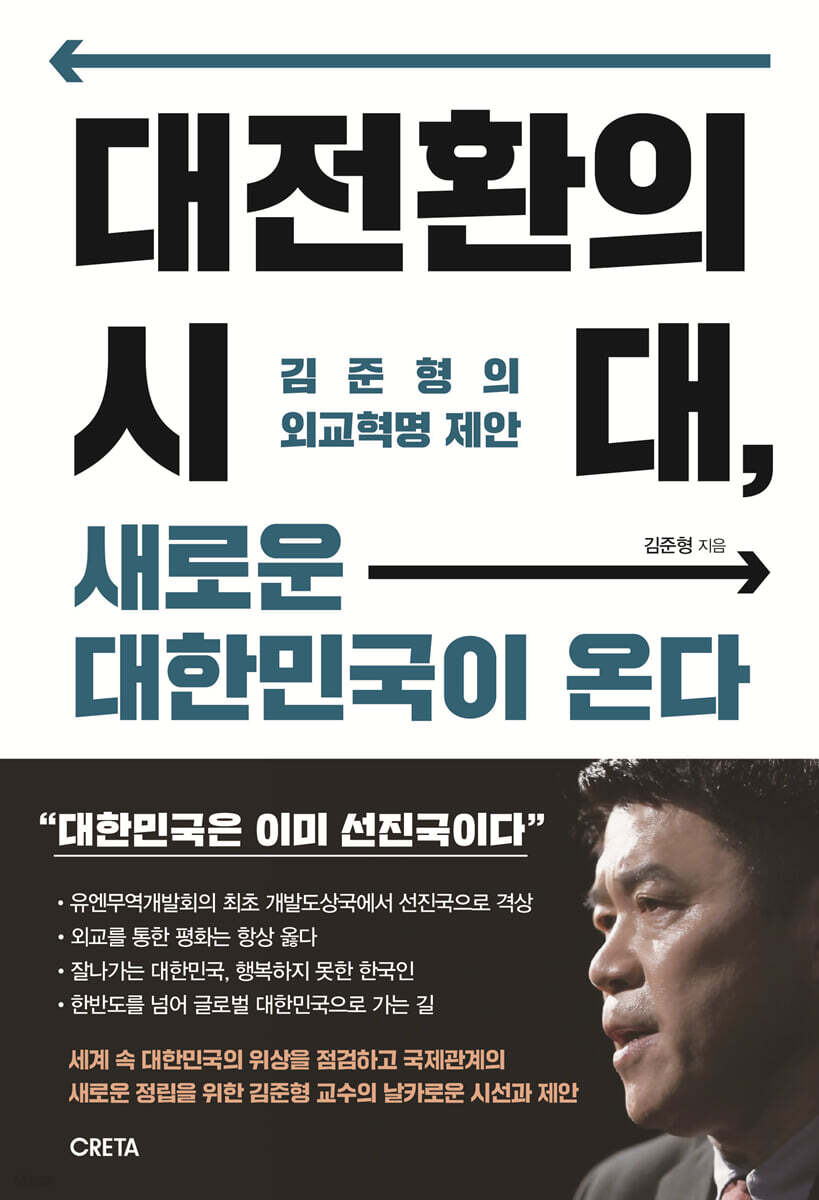
An era of great transformation, a new Republic of Korea is coming.
 |
Description
Book Introduction
Beyond the Korean Peninsula, in an era of great transformation Towards a global Korea The circumstances we are given are desperate. Because we are going through an ‘era of great change.’ We are in the midst of a pandemic, climate change, a technological race, and, above all, a power struggle between the United States and China. Kim Jun-hyung, an international political scientist and former director of the Korea National Diplomatic Academy, says that in times like these, “we must be sincere in diplomacy and ‘hard carry’ diplomacy.” This book examines the changing global status of South Korea and suggests a path for South Korea to move beyond the Korean Peninsula and become a global South Korea through the medium of a "diplomatic revolution" amidst the turbulent international situation. Korea's status has changed dramatically. In fact, things have been changing for a long time, but there hasn't been enough opportunity for the public to properly understand the changes. This is the biggest reason why this book was published. When you say that South Korea is a developed country, people are suspicious. Is that true? Isn't this just nationalism? The endless sense of victimization, that the Korean Peninsula, where we live, was merely a battleground for the powerful, has long solidified into a weak nation complex. The current division, coupled with the rigid power dynamics of the four major powers surrounding the Korean Peninsula, has further hindered a shift in perception. But the author says firmly: “We are worthy of waking up with strength and roaring, and it is time to boldly throw away the small-nation complex.” The author provides readers with a detailed overview of the global standing that South Korea has built. Korea is already an advanced country in both hard and soft power. As the first case in the history of the United Nations Conference on Trade and Development to enter the group of developed countries from a developing country, its national power and prestige have improved to the point where it has become a model that many countries aspire to. It also boasts global competitiveness in key fields of the 4th industrial revolution, including semiconductors, batteries, and bio. Above all, the Korean Wave, as well as the development and democratization achieved through long struggles and hardships, and the diplomacy that does not use threats or intimidation, unlike the existing superpowers, are gaining great popularity among people around the world. Moreover, the absence of peace due to division paradoxically gives greater sincerity to South Korea's cry for peace. |
- You can preview some of the book's contents.
Preview
index
Prologue: South Korea is already a developed country.
Chapter 1.
The shaky international order
What is the fate of the Korean Peninsula, the frontline of the US-China conflict?
An era where emotions take precedence over facts
Global crisis, cooperation rather than conflict
Chapter 2.
Successful Korea, Unhappy Koreans
Between advanced Korea and hell Joseon
An era of hatred and discrimination
The Light and Shadow of the Korean Wave
Chapter 3.
Turning crisis into opportunity
Between the United States and China
Peace through diplomacy is always right!
A new security order in Northeast Asia
Security, technology, and economy are inseparable.
Chapter 4.
Upgrading international relations
North Korea: A Step Away
America, looking through a "pragmatic lens"
China, using it 'coolly'
Russia, 'again' in the spotlight
Japan, treat it with a big heart
Europe, Joining Hands in Solidarity
India and ASEAN: Taking More
Chapter 5.
We are going to be among the top 5 in the world.
How to Deal with the Conflict Between Two Megatrends
A maritime and land-based nation leading Mega Asia
|Epilogue|To the dolphins who will swim together in the sea of peace
Chapter 1.
The shaky international order
What is the fate of the Korean Peninsula, the frontline of the US-China conflict?
An era where emotions take precedence over facts
Global crisis, cooperation rather than conflict
Chapter 2.
Successful Korea, Unhappy Koreans
Between advanced Korea and hell Joseon
An era of hatred and discrimination
The Light and Shadow of the Korean Wave
Chapter 3.
Turning crisis into opportunity
Between the United States and China
Peace through diplomacy is always right!
A new security order in Northeast Asia
Security, technology, and economy are inseparable.
Chapter 4.
Upgrading international relations
North Korea: A Step Away
America, looking through a "pragmatic lens"
China, using it 'coolly'
Russia, 'again' in the spotlight
Japan, treat it with a big heart
Europe, Joining Hands in Solidarity
India and ASEAN: Taking More
Chapter 5.
We are going to be among the top 5 in the world.
How to Deal with the Conflict Between Two Megatrends
A maritime and land-based nation leading Mega Asia
|Epilogue|To the dolphins who will swim together in the sea of peace
Detailed image
.jpg)
Into the book
South Korea's standing, confirmed by the May 2021 South Korea-U.S. summit between President Moon Jae-in and President Biden and the G7 summit in June, to which we were invited for the second consecutive year, was truly remarkable.
It was not a series of diplomatic investigations for consideration as in the past.
This is because Korea is a key power in two value areas that are hotly debated today.
One is hard power, the other is soft power.
First, in terms of hard power, we can mention the 'value chain', which refers to the global supply chain.
Experts say that in the era of the Fourth Industrial Revolution, there are still at least 10 and at most 15 countries that are competitive.
South Korea is not only included, but is also a leader.
The four critical areas that will determine success or failure are essential materials such as semiconductors, bio, batteries, and rare earth elements. Korea is emerging as a key country in all areas except the materials sector.
Even compared to Japan, which has no clear competitive edge in any of the four fields, our capabilities are attracting global attention.
So, not only the United States, but especially the United Kingdom, Australia, Germany, France, the Netherlands, and Spain are trying to cooperate and show solidarity with Korea.
---From the "Prologue"
The persistent inertia of the small-country complex is painful, but the point that Korea is doing well but the Koreans living there are not happy is painfully painful.
It's not like it's going to disappear just because we say we'll stop doing it today, but it can definitely change depending on whether we change our perception and how we make efforts going forward.
Instead of looking inward, let's break free from the self-pity that only licks our wounds and look at the world we're observing! If we fulfill the responsibilities the world expects of us, won't we be able to shed our complexes and unhappiness and experience pride and happiness?
The world wants to know how Korea, the so-called "small country of the East," which experienced loss and devastation, achieved the world's tenth-largest economy.
They are asking what kind of driving force led Korea to lead the semiconductor industry to become the world's number one exporter, join the "Artemis Agreement" with countries possessing cutting-edge space technology, and successfully launch the "Nuri," a Korean launch vehicle developed with indigenous technology.
I wonder how South Korea, once a climate bully, came to participate in environmental protection and sustainable development.
People are expressing surprise at how a densely populated and highly urbanized country was able to effectively respond to the pandemic, and at the institutions and civic consciousness of its citizens.
---From the "Prologue"
It certainly seems clear that in this era, emotions take precedence over facts.
We live in an age where propaganda is more popular than truth, and subjective opinions are more popular than objective facts.
Fake news is rampant, exposing rumors of "or else" are rampant, and unsubstantiated conspiracy theories are circulating on social media.
In the past, news was granted the authority to report the truth, but now even news outlets are leading the charge against the truth, and there is a laughable sight of them rushing to create new "fact-checking" sections to independently uncover the truth.
Everyone thinks that only their own opinions are right and that the other person's opinions are wrong.
So, I just throw out my words, there is no need to listen to the other person's story, and no one makes any effort to persuade the other person.
In such a situation, truth and facts are ignored and have no place to stand.
This phenomenon reaches its extreme during election time.
It is significant that post-truth was chosen as the word of the year in 2016, a year in which Trump, a master of deception and demagoguery, was elected in the United States and the UK decided to leave the EU, inciting separation rather than integration.
What could be more representative of post-truth than Trumpism, a system that deliberately divides the nation, is unabashedly racist, and rife with fake news propaganda?
---From Chapter 1
South Korea ranks 10th in GDP and 5th in manufacturing competitiveness among 242 countries worldwide.
And in 2019, South Korea became the seventh country to join the so-called '30-50' club, a milestone that only six countries in the world have historically achieved.
The 30-50 club of countries is made up of six countries: the United States, Japan, the United Kingdom, Germany, France, and Italy, which meet the conditions of a national income of over $30,000 and a population of over 50 million.
What is noteworthy is that, with the exception of South Korea, all of these countries are imperialist countries that once administered colonies, and South Korea is the only country that experienced colonialism.
Despite the COVID-19 pandemic, South Korea's exports in 2021 achieved a record high, with double-digit growth compared to the previous year.
If this trend continues, South Korea's exports are expected to reach $700 billion by 2024.
This is a record that has only been achieved by five countries so far: China, the United States, Germany, the Netherlands, and Japan.
---From Chapter 2
One of the biggest victims of the new normal is the young generation that will lead Korea's future.
Of course, those born with a silver spoon in their mouths and with a silver spoon in their mouth will be content with this distorted era and optimistic about the future.
However, for those born with poor parents, known as the 'N-po Generation', there is no alternative or hope.
Moreover, the dirt spoons who are victims of the structure do not have the spirit to resist.
They are simply filled with frustration and anger, but they do not try to change the unjust order that caused their anger.
In addition, they believe that it is impossible to change the tilted playing field, as they only try to climb to the top of the unfair discriminatory structure, and that fighting will only result in losses and nothing will change.
What is more tragic is that their anger sometimes manifests as hateful violence against the weaker, and the establishment incites this.
---From Chapter 2
Among them, Korea can be an alternative model with both a strong state and a strong civil society.
Although the country has a bad tradition of colonialism, war, division, and dictatorship, civil society, which has grown from the Gwangju Democratization Movement to the June Democracy Movement and the Candlelight Revolution, has kept the country in check whenever it crosses the line.
As a result, the country remained strong while maintaining the advantages of a public state that protects its citizens, and this can be said to have undoubtedly demonstrated its ability to prevent the spread of COVID-19.
While the resurgence of bad states remains a possibility, public states can play a significant role in the chaotic transitional order of deglobalization, decarbonization, denuclearization, deindustrialization, and post-truth.
If cooperation between the state and civil society is possible, models and alternatives that break away from the extreme forms of the two countries mentioned above can be presented to address emerging security challenges like the climate crisis and the inequality caused by neoliberalism.
---From Chapter 3
As the US-China technological hegemony competition prolongs and conflicts in diplomatic and military security are expected to intensify, the key question is what strategic choices South Korea, with its close ties to both countries, should make to survive and thrive.
If the US strongly demands that China halt its supply of semiconductors, how should South Korea respond?
The United States is the leading country in semiconductor design, and countries such as the United States, Japan, and the Netherlands monopolize the equipment market, so they are not in a position to refuse sanctions against China.
From our perspective, we cannot ignore the fact that China is the world's largest market, consuming 60% of the world's semiconductors.
In 2020, South Korea's semiconductor exports to China accounted for 26%, nearly double the 15% share of exports to the United States.
In the era of the Fourth Industrial Revolution and the US-China technological hegemony competition, we must consider the ROK-US alliance, political and security interests, and even economic and technological interests. However, we must also develop a comprehensive foreign policy strategy that simultaneously realizes economic benefits based on China's massive demand and security interests as a facilitator of the Korean Peninsula peace process.
---From Chapter 3
It is necessary to make clear that the ultimate goal of North Korea policy is the establishment of peace rather than denuclearization.
Moreover, while denuclearization is a crucial task in the peace process, it should not be an all-consuming prerequisite, but rather an integral part of the process.
Only then can South Korea proactively pursue both improved inter-Korean relations and denuclearization, and control the recurrence of arguments that prioritize denuclearization over denuclearization, such as “a declaration of the end of the war without denuclearization is meaningless.”
Considering that denuclearization is a long-term task, we must recognize that if we hold preemptive denuclearization hostage, there is little we can do to build peace in the long term other than join in sanctions against North Korea.
Finally, there is a need to further expand the scope of North Korea policy.
If we have so far been excessively pursuing cooperation with the United States and North Korea, we need to secure strategic leverage by strengthening multilateral solidarity and cooperation with China, Russia, Japan, and even Europe.
---From Chapter 4
Korea, too, must consider a new Korea-U.S. relationship based on the changing international situation and its increased capabilities.
Ultimately, we will have to consider how to use Korea's capabilities to persuade the US and China to ensure stability in the Asia-Pacific region.
Now, we are in a situation where we want stability on the Korean Peninsula and in the Asia-Pacific region more than ever, and regional instability directly harms us.
Now is the time to demand that the United States and China, the primary causes of regional instability stemming from the US-China competition, take steps to reduce the factors that undermine stability and to explore alternative solutions.
---From Chapter 4
Excessive dependence on China must be gradually reduced, as it can expose our vulnerability to China at any time.
While economic exchanges between our two countries should develop further, we must ensure that excessive dependence on China does not limit our diplomatic maneuvering and options.
However, South Korea's democracy and free-market economy are so strong that it is difficult to forcibly prevent business with China for profit, and even if there were a way to do so, it would be undesirable.
It is something that can only be achieved little by little over a long period of time.
---From Chapter 4
Europe can also be a solidarity partner, as it shares Korea's core goals, such as multilateralism.
Many European countries are seeking key partners in the Indo-Pacific, and South Korea, along with Japan, is considered the most suitable.
India is hardly a full democracy, Australia is too far away, and Taiwan has political constraints.
From a European perspective, Korea and Japan are countries with similar positions and are developed countries with democracy and economic power.
Japan is currently leaning too heavily toward the United States, and its love call toward Europe is a long-standing romanticism of Japanese diplomacy. However, since Abe's right-wing government's diplomatic line has been excessively tilted toward the United States, Korea is a relatively more attractive target for Europe, which is seeking a strategic balance between the United States and China.
---From Chapter 4
The fate of the Korean Peninsula will not be shaped by a structure where continent and ocean are in conflict, but rather by a close connection between these two spaces, and the integrated energy directed toward that connection will erupt in a mutually balanced manner.
Only by comprehensively building a vertical and horizontal belt of cooperation linking the Korean Peninsula beyond the narrow Northeast Asia, or Mega Asia, or Eurasia, within the vast space we call it, will we be able to overcome the difficulties stemming from the US-China strategic competition and open a new path and era.
---From Chapter 5
While the increasing intrusion of authoritarianism may seem to be leading to a decline in democracy, those who have experienced democratic systems will not long accept the barbarism inherent in the short-term efficiency promoted by authoritarianism.
The market, which allowed the infinite proliferation of capital, may reflect on the fatal consequences of the gap between rich and poor and accept correction through the return of a public state.
Here, South Korea can be a great alternative.
Between the Western system, where the state is emasculated by the market, and the Chinese system, where authoritarianism rages in the absence of civil society, South Korea has demonstrated that a dynamic balance between a free civil society and a public state is possible.
Korea has a bad past marked by war, division, and dictatorship. However, from the Donghak Peasant Revolution to the April 19 Revolution, the May 18 Gwangju Democratization Movement to the June Democracy Movement, and the Candlelight Revolution, civil society, which grew in strength, kept the bad state in check, rose up and drove it out whenever it crossed the line, and brought back a good state with democracy and publicness.
While we still have a long way to go, there is no need to be overly pessimistic about the future of the Republic of Korea, which is being shaped by the high level of civic consciousness demonstrated by the candlelight revolution and the COVID-19 response.
---From the "Epilogue"
Let us break away from the structure of choice within the US-China hegemonic order, which has forgotten its duty to lead a better world, and build a third zone by uniting with countries that share our positions and values.
We must overcome the weak nation complex and confidently declare that we are not a "shrimp that gets its back broken in a fight between whales," but a "dolphin that moves cleverly and plays an important role."
Moreover, dolphins do not travel alone.
Let's gather 'dolphins who will swim together in the sea of peace.'
Through solidarity, we must strive to create a space of value and cooperation amidst the isolation and disconnection of each individual, and help countries that are in blind spots without the means and capabilities.
It was not a series of diplomatic investigations for consideration as in the past.
This is because Korea is a key power in two value areas that are hotly debated today.
One is hard power, the other is soft power.
First, in terms of hard power, we can mention the 'value chain', which refers to the global supply chain.
Experts say that in the era of the Fourth Industrial Revolution, there are still at least 10 and at most 15 countries that are competitive.
South Korea is not only included, but is also a leader.
The four critical areas that will determine success or failure are essential materials such as semiconductors, bio, batteries, and rare earth elements. Korea is emerging as a key country in all areas except the materials sector.
Even compared to Japan, which has no clear competitive edge in any of the four fields, our capabilities are attracting global attention.
So, not only the United States, but especially the United Kingdom, Australia, Germany, France, the Netherlands, and Spain are trying to cooperate and show solidarity with Korea.
---From the "Prologue"
The persistent inertia of the small-country complex is painful, but the point that Korea is doing well but the Koreans living there are not happy is painfully painful.
It's not like it's going to disappear just because we say we'll stop doing it today, but it can definitely change depending on whether we change our perception and how we make efforts going forward.
Instead of looking inward, let's break free from the self-pity that only licks our wounds and look at the world we're observing! If we fulfill the responsibilities the world expects of us, won't we be able to shed our complexes and unhappiness and experience pride and happiness?
The world wants to know how Korea, the so-called "small country of the East," which experienced loss and devastation, achieved the world's tenth-largest economy.
They are asking what kind of driving force led Korea to lead the semiconductor industry to become the world's number one exporter, join the "Artemis Agreement" with countries possessing cutting-edge space technology, and successfully launch the "Nuri," a Korean launch vehicle developed with indigenous technology.
I wonder how South Korea, once a climate bully, came to participate in environmental protection and sustainable development.
People are expressing surprise at how a densely populated and highly urbanized country was able to effectively respond to the pandemic, and at the institutions and civic consciousness of its citizens.
---From the "Prologue"
It certainly seems clear that in this era, emotions take precedence over facts.
We live in an age where propaganda is more popular than truth, and subjective opinions are more popular than objective facts.
Fake news is rampant, exposing rumors of "or else" are rampant, and unsubstantiated conspiracy theories are circulating on social media.
In the past, news was granted the authority to report the truth, but now even news outlets are leading the charge against the truth, and there is a laughable sight of them rushing to create new "fact-checking" sections to independently uncover the truth.
Everyone thinks that only their own opinions are right and that the other person's opinions are wrong.
So, I just throw out my words, there is no need to listen to the other person's story, and no one makes any effort to persuade the other person.
In such a situation, truth and facts are ignored and have no place to stand.
This phenomenon reaches its extreme during election time.
It is significant that post-truth was chosen as the word of the year in 2016, a year in which Trump, a master of deception and demagoguery, was elected in the United States and the UK decided to leave the EU, inciting separation rather than integration.
What could be more representative of post-truth than Trumpism, a system that deliberately divides the nation, is unabashedly racist, and rife with fake news propaganda?
---From Chapter 1
South Korea ranks 10th in GDP and 5th in manufacturing competitiveness among 242 countries worldwide.
And in 2019, South Korea became the seventh country to join the so-called '30-50' club, a milestone that only six countries in the world have historically achieved.
The 30-50 club of countries is made up of six countries: the United States, Japan, the United Kingdom, Germany, France, and Italy, which meet the conditions of a national income of over $30,000 and a population of over 50 million.
What is noteworthy is that, with the exception of South Korea, all of these countries are imperialist countries that once administered colonies, and South Korea is the only country that experienced colonialism.
Despite the COVID-19 pandemic, South Korea's exports in 2021 achieved a record high, with double-digit growth compared to the previous year.
If this trend continues, South Korea's exports are expected to reach $700 billion by 2024.
This is a record that has only been achieved by five countries so far: China, the United States, Germany, the Netherlands, and Japan.
---From Chapter 2
One of the biggest victims of the new normal is the young generation that will lead Korea's future.
Of course, those born with a silver spoon in their mouths and with a silver spoon in their mouth will be content with this distorted era and optimistic about the future.
However, for those born with poor parents, known as the 'N-po Generation', there is no alternative or hope.
Moreover, the dirt spoons who are victims of the structure do not have the spirit to resist.
They are simply filled with frustration and anger, but they do not try to change the unjust order that caused their anger.
In addition, they believe that it is impossible to change the tilted playing field, as they only try to climb to the top of the unfair discriminatory structure, and that fighting will only result in losses and nothing will change.
What is more tragic is that their anger sometimes manifests as hateful violence against the weaker, and the establishment incites this.
---From Chapter 2
Among them, Korea can be an alternative model with both a strong state and a strong civil society.
Although the country has a bad tradition of colonialism, war, division, and dictatorship, civil society, which has grown from the Gwangju Democratization Movement to the June Democracy Movement and the Candlelight Revolution, has kept the country in check whenever it crosses the line.
As a result, the country remained strong while maintaining the advantages of a public state that protects its citizens, and this can be said to have undoubtedly demonstrated its ability to prevent the spread of COVID-19.
While the resurgence of bad states remains a possibility, public states can play a significant role in the chaotic transitional order of deglobalization, decarbonization, denuclearization, deindustrialization, and post-truth.
If cooperation between the state and civil society is possible, models and alternatives that break away from the extreme forms of the two countries mentioned above can be presented to address emerging security challenges like the climate crisis and the inequality caused by neoliberalism.
---From Chapter 3
As the US-China technological hegemony competition prolongs and conflicts in diplomatic and military security are expected to intensify, the key question is what strategic choices South Korea, with its close ties to both countries, should make to survive and thrive.
If the US strongly demands that China halt its supply of semiconductors, how should South Korea respond?
The United States is the leading country in semiconductor design, and countries such as the United States, Japan, and the Netherlands monopolize the equipment market, so they are not in a position to refuse sanctions against China.
From our perspective, we cannot ignore the fact that China is the world's largest market, consuming 60% of the world's semiconductors.
In 2020, South Korea's semiconductor exports to China accounted for 26%, nearly double the 15% share of exports to the United States.
In the era of the Fourth Industrial Revolution and the US-China technological hegemony competition, we must consider the ROK-US alliance, political and security interests, and even economic and technological interests. However, we must also develop a comprehensive foreign policy strategy that simultaneously realizes economic benefits based on China's massive demand and security interests as a facilitator of the Korean Peninsula peace process.
---From Chapter 3
It is necessary to make clear that the ultimate goal of North Korea policy is the establishment of peace rather than denuclearization.
Moreover, while denuclearization is a crucial task in the peace process, it should not be an all-consuming prerequisite, but rather an integral part of the process.
Only then can South Korea proactively pursue both improved inter-Korean relations and denuclearization, and control the recurrence of arguments that prioritize denuclearization over denuclearization, such as “a declaration of the end of the war without denuclearization is meaningless.”
Considering that denuclearization is a long-term task, we must recognize that if we hold preemptive denuclearization hostage, there is little we can do to build peace in the long term other than join in sanctions against North Korea.
Finally, there is a need to further expand the scope of North Korea policy.
If we have so far been excessively pursuing cooperation with the United States and North Korea, we need to secure strategic leverage by strengthening multilateral solidarity and cooperation with China, Russia, Japan, and even Europe.
---From Chapter 4
Korea, too, must consider a new Korea-U.S. relationship based on the changing international situation and its increased capabilities.
Ultimately, we will have to consider how to use Korea's capabilities to persuade the US and China to ensure stability in the Asia-Pacific region.
Now, we are in a situation where we want stability on the Korean Peninsula and in the Asia-Pacific region more than ever, and regional instability directly harms us.
Now is the time to demand that the United States and China, the primary causes of regional instability stemming from the US-China competition, take steps to reduce the factors that undermine stability and to explore alternative solutions.
---From Chapter 4
Excessive dependence on China must be gradually reduced, as it can expose our vulnerability to China at any time.
While economic exchanges between our two countries should develop further, we must ensure that excessive dependence on China does not limit our diplomatic maneuvering and options.
However, South Korea's democracy and free-market economy are so strong that it is difficult to forcibly prevent business with China for profit, and even if there were a way to do so, it would be undesirable.
It is something that can only be achieved little by little over a long period of time.
---From Chapter 4
Europe can also be a solidarity partner, as it shares Korea's core goals, such as multilateralism.
Many European countries are seeking key partners in the Indo-Pacific, and South Korea, along with Japan, is considered the most suitable.
India is hardly a full democracy, Australia is too far away, and Taiwan has political constraints.
From a European perspective, Korea and Japan are countries with similar positions and are developed countries with democracy and economic power.
Japan is currently leaning too heavily toward the United States, and its love call toward Europe is a long-standing romanticism of Japanese diplomacy. However, since Abe's right-wing government's diplomatic line has been excessively tilted toward the United States, Korea is a relatively more attractive target for Europe, which is seeking a strategic balance between the United States and China.
---From Chapter 4
The fate of the Korean Peninsula will not be shaped by a structure where continent and ocean are in conflict, but rather by a close connection between these two spaces, and the integrated energy directed toward that connection will erupt in a mutually balanced manner.
Only by comprehensively building a vertical and horizontal belt of cooperation linking the Korean Peninsula beyond the narrow Northeast Asia, or Mega Asia, or Eurasia, within the vast space we call it, will we be able to overcome the difficulties stemming from the US-China strategic competition and open a new path and era.
---From Chapter 5
While the increasing intrusion of authoritarianism may seem to be leading to a decline in democracy, those who have experienced democratic systems will not long accept the barbarism inherent in the short-term efficiency promoted by authoritarianism.
The market, which allowed the infinite proliferation of capital, may reflect on the fatal consequences of the gap between rich and poor and accept correction through the return of a public state.
Here, South Korea can be a great alternative.
Between the Western system, where the state is emasculated by the market, and the Chinese system, where authoritarianism rages in the absence of civil society, South Korea has demonstrated that a dynamic balance between a free civil society and a public state is possible.
Korea has a bad past marked by war, division, and dictatorship. However, from the Donghak Peasant Revolution to the April 19 Revolution, the May 18 Gwangju Democratization Movement to the June Democracy Movement, and the Candlelight Revolution, civil society, which grew in strength, kept the bad state in check, rose up and drove it out whenever it crossed the line, and brought back a good state with democracy and publicness.
While we still have a long way to go, there is no need to be overly pessimistic about the future of the Republic of Korea, which is being shaped by the high level of civic consciousness demonstrated by the candlelight revolution and the COVID-19 response.
---From the "Epilogue"
Let us break away from the structure of choice within the US-China hegemonic order, which has forgotten its duty to lead a better world, and build a third zone by uniting with countries that share our positions and values.
We must overcome the weak nation complex and confidently declare that we are not a "shrimp that gets its back broken in a fight between whales," but a "dolphin that moves cleverly and plays an important role."
Moreover, dolphins do not travel alone.
Let's gather 'dolphins who will swim together in the sea of peace.'
Through solidarity, we must strive to create a space of value and cooperation amidst the isolation and disconnection of each individual, and help countries that are in blind spots without the means and capabilities.
---From the "Epilogue"
Publisher's Review
Beyond the Korean Peninsula, in an era of great transformation
Towards a global Korea
The circumstances we are given are desperate.
Because we are going through an ‘era of great change.’
We are in the midst of a pandemic, climate change, a technological race, and, above all, a power struggle between the United States and China.
Kim Jun-hyung, an international political scientist and former director of the Korea National Diplomatic Academy, says that in times like these, “we must be sincere in diplomacy and ‘hard carry’ diplomacy.”
This book examines the changing global status of South Korea and suggests a path for South Korea to move beyond the Korean Peninsula and become a global South Korea through the medium of a "diplomatic revolution" amidst the turbulent international situation.
Korea's status has changed dramatically.
In fact, things have been changing for a long time, but there hasn't been enough opportunity for the public to properly understand the changes.
This is the biggest reason why this book was published.
When you say that South Korea is a developed country, people are suspicious.
Is that true? Isn't this just nationalism? The endless sense of victimization, that the Korean Peninsula, where we live, was merely a battleground for the powerful, has long solidified into a weak nation complex. The current division, coupled with the rigid power dynamics of the four major powers surrounding the Korean Peninsula, has further hindered a shift in perception.
But the author says firmly:
“We are worthy of waking up with strength and roaring, and it is time to boldly throw away the small-nation complex.”
The author provides readers with a detailed overview of the global standing that South Korea has built.
Korea is already an advanced country in both hard and soft power.
As the first case in the history of the United Nations Conference on Trade and Development to enter the group of developed countries from a developing country, its national power and prestige have improved to the point where it has become an aspirational model for many countries.
It also boasts global competitiveness in key fields of the 4th industrial revolution, including semiconductors, batteries, and bio.
Above all, the Korean Wave, as well as the development and democratization achieved through long struggles and hardships, and the diplomacy that does not use threats or intimidation, unlike the existing superpowers, are gaining great favor from people around the world.
Moreover, the absence of peace due to division paradoxically gives greater sincerity to South Korea's cry for peace.
The clash of two megatrends,
What is the path for the Korean Peninsula in the changing international order?
Having confirmed the Republic of Korea's changed status, our role and responsibilities must also change in the changing international order.
The world today is caught between two megatrends: globalization and fragmentation.
Amidst the fluctuating strategic competition between the US and China, the choice for the Korean Peninsula must be to build peace between North and South Korea.
If inter-Korean relations become tense amid worsening US-China relations, the confrontational structure between North Korea, China, and Russia and South Korea, the US, and Japan will be revived, and the South Korean economy, which is highly dependent on China, will face significant difficulties.
Accordingly, the author argues that resolving the hostile relationship between the South and the North is essential, but that "large-scale" diplomacy that extends beyond the Korean Peninsula is also necessary.
I propose a peaceful diplomacy that prioritizes national interests while also fostering coexistence with other countries.
The idea is to build a "third zone" by aligning with countries caught between the US-China strategic competition and refusing to take sides or conform to the fragmented international order of each country's survival, thereby buffering the US-China confrontational structure.
These countries are those that share Korea's circumstances and values, specifically those in Europe, India, ASEAN, and Australia.
The idea is to join forces with these countries to repair the collapsed international order through cooperation and leadership of the G2.
This third zone can also function as a platform for promoting prosperity and peace, along with life, the environment, human rights, and democracy, and can become a hotbed of collective leadership.
Mega Asia centered on the Korean Peninsula
Upgrading international relations
The author proposes that we no longer focus solely on Northeast Asia, but expand it into a vast cooperative zone called "Mega Asia," centered on the Korean Peninsula, linking the oceans and continents north and south, and vertically and horizontally, open to the outside world yet internally interconnected.
This can be said to be a new diplomatic horizon that inherits the Moon Jae-in administration's pledge of a "Northeast Asia Plus Responsible Community" and the New Northern Policy and New Southern Policy, which the author conceived, but overcomes their limitations and expands them to suit the changing circumstances.
Can we truly create this space and achieve a diplomatic revolution that "upgrades international relations"? The author urges us to shed the small-power complex.
The point that Korea is doing well but the Koreans living there are not happy is so painful.
Let's break free from self-pity and look at the world that is paying attention to Korea.
The world wants to know how Korea, a small country in the East that was once in ruins and loss, achieved the status of the world's tenth-largest economy.
The author argues that diplomacy must be reborn with a near-revolutionary innovation to achieve the values of peace that will make Koreans living here happy.
South Korea is no longer a 'shrimp that gets its back broken in a fight between whales', but rather a 'strong and attractive dolphin that can swim cleverly among the whales'.
The world is changing, and South Korea has also changed from before.
South Korea has made remarkable strides in national power, prestige, and national dignity, becoming a significant player capable of influencing the international order.
Now is the time to write our own story of peace and prosperity for ourselves and the world through the 'diplomatic revolution' proposed by Ja Ja.
Towards a global Korea
The circumstances we are given are desperate.
Because we are going through an ‘era of great change.’
We are in the midst of a pandemic, climate change, a technological race, and, above all, a power struggle between the United States and China.
Kim Jun-hyung, an international political scientist and former director of the Korea National Diplomatic Academy, says that in times like these, “we must be sincere in diplomacy and ‘hard carry’ diplomacy.”
This book examines the changing global status of South Korea and suggests a path for South Korea to move beyond the Korean Peninsula and become a global South Korea through the medium of a "diplomatic revolution" amidst the turbulent international situation.
Korea's status has changed dramatically.
In fact, things have been changing for a long time, but there hasn't been enough opportunity for the public to properly understand the changes.
This is the biggest reason why this book was published.
When you say that South Korea is a developed country, people are suspicious.
Is that true? Isn't this just nationalism? The endless sense of victimization, that the Korean Peninsula, where we live, was merely a battleground for the powerful, has long solidified into a weak nation complex. The current division, coupled with the rigid power dynamics of the four major powers surrounding the Korean Peninsula, has further hindered a shift in perception.
But the author says firmly:
“We are worthy of waking up with strength and roaring, and it is time to boldly throw away the small-nation complex.”
The author provides readers with a detailed overview of the global standing that South Korea has built.
Korea is already an advanced country in both hard and soft power.
As the first case in the history of the United Nations Conference on Trade and Development to enter the group of developed countries from a developing country, its national power and prestige have improved to the point where it has become an aspirational model for many countries.
It also boasts global competitiveness in key fields of the 4th industrial revolution, including semiconductors, batteries, and bio.
Above all, the Korean Wave, as well as the development and democratization achieved through long struggles and hardships, and the diplomacy that does not use threats or intimidation, unlike the existing superpowers, are gaining great favor from people around the world.
Moreover, the absence of peace due to division paradoxically gives greater sincerity to South Korea's cry for peace.
The clash of two megatrends,
What is the path for the Korean Peninsula in the changing international order?
Having confirmed the Republic of Korea's changed status, our role and responsibilities must also change in the changing international order.
The world today is caught between two megatrends: globalization and fragmentation.
Amidst the fluctuating strategic competition between the US and China, the choice for the Korean Peninsula must be to build peace between North and South Korea.
If inter-Korean relations become tense amid worsening US-China relations, the confrontational structure between North Korea, China, and Russia and South Korea, the US, and Japan will be revived, and the South Korean economy, which is highly dependent on China, will face significant difficulties.
Accordingly, the author argues that resolving the hostile relationship between the South and the North is essential, but that "large-scale" diplomacy that extends beyond the Korean Peninsula is also necessary.
I propose a peaceful diplomacy that prioritizes national interests while also fostering coexistence with other countries.
The idea is to build a "third zone" by aligning with countries caught between the US-China strategic competition and refusing to take sides or conform to the fragmented international order of each country's survival, thereby buffering the US-China confrontational structure.
These countries are those that share Korea's circumstances and values, specifically those in Europe, India, ASEAN, and Australia.
The idea is to join forces with these countries to repair the collapsed international order through cooperation and leadership of the G2.
This third zone can also function as a platform for promoting prosperity and peace, along with life, the environment, human rights, and democracy, and can become a hotbed of collective leadership.
Mega Asia centered on the Korean Peninsula
Upgrading international relations
The author proposes that we no longer focus solely on Northeast Asia, but expand it into a vast cooperative zone called "Mega Asia," centered on the Korean Peninsula, linking the oceans and continents north and south, and vertically and horizontally, open to the outside world yet internally interconnected.
This can be said to be a new diplomatic horizon that inherits the Moon Jae-in administration's pledge of a "Northeast Asia Plus Responsible Community" and the New Northern Policy and New Southern Policy, which the author conceived, but overcomes their limitations and expands them to suit the changing circumstances.
Can we truly create this space and achieve a diplomatic revolution that "upgrades international relations"? The author urges us to shed the small-power complex.
The point that Korea is doing well but the Koreans living there are not happy is so painful.
Let's break free from self-pity and look at the world that is paying attention to Korea.
The world wants to know how Korea, a small country in the East that was once in ruins and loss, achieved the status of the world's tenth-largest economy.
The author argues that diplomacy must be reborn with a near-revolutionary innovation to achieve the values of peace that will make Koreans living here happy.
South Korea is no longer a 'shrimp that gets its back broken in a fight between whales', but rather a 'strong and attractive dolphin that can swim cleverly among the whales'.
The world is changing, and South Korea has also changed from before.
South Korea has made remarkable strides in national power, prestige, and national dignity, becoming a significant player capable of influencing the international order.
Now is the time to write our own story of peace and prosperity for ourselves and the world through the 'diplomatic revolution' proposed by Ja Ja.
GOODS SPECIFICS
- Publication date: March 9, 2022
- Page count, weight, size: 372 pages | 566g | 145*212*30mm
- ISBN13: 9791197784224
- ISBN10: 1197784225
You may also like
카테고리
korean


korean

![GQ KOREA Mark (Monthly): December [2025]](http://librairie.coreenne.fr/cdn/shop/files/8ef265dbbfbf186523ed75ba7319009d.jpg?v=1765340328&width=3840)


