

Battleground
 |
Description
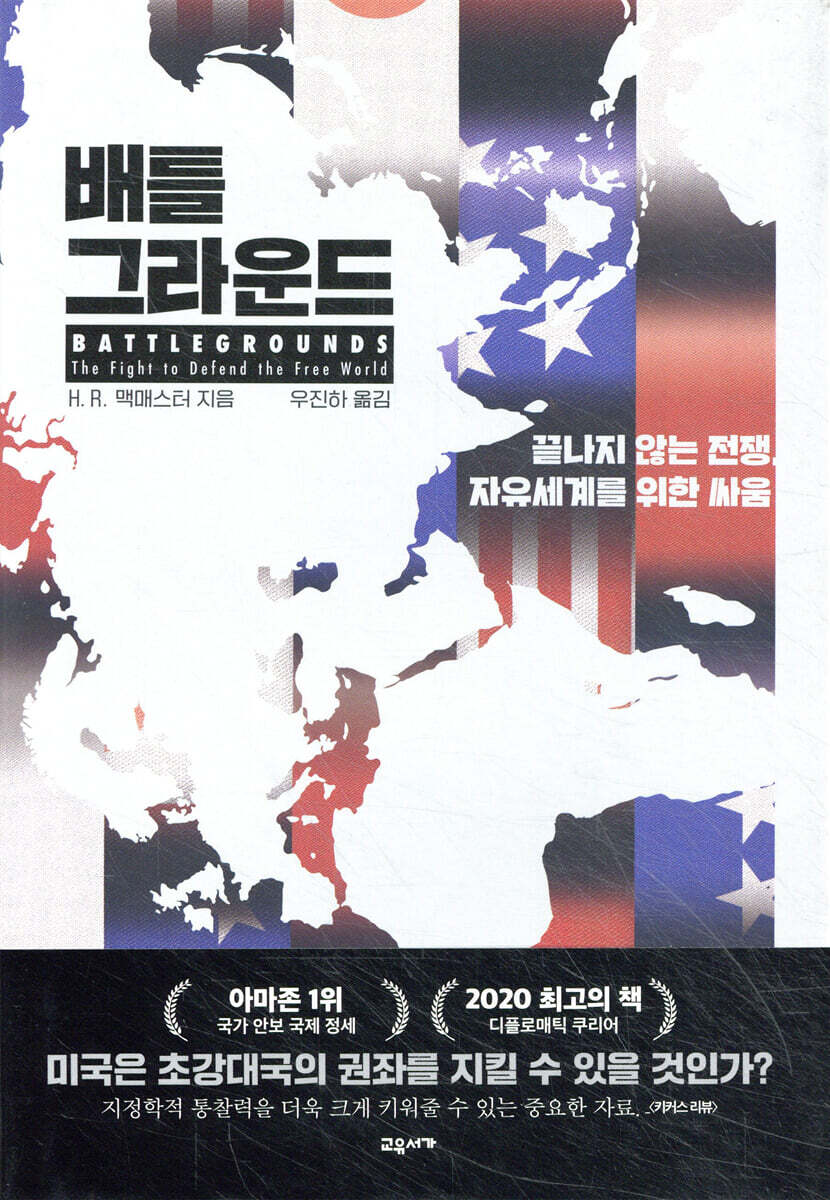
Book Introduction
In this era of multipolarity, where everyone is competing for the throne, rather than the bipolar system of great powers, a book has been published that soberly diagnoses the turbulent international situation and proposes a solution and awakening for the United States, the "lonely superpower lacking true power." Former White House National Security Advisor H.J., who is at the center of news coverage of the failure of U.S. foreign policy following the Taliban's return to power in Afghanistan, which shocked the world, That is Battlegrounds by R. McMaster. This book details the author's experiences on overseas battlefields during his 34 years of military service, including his time as National Security Advisor in the Donald Trump administration from February 2017 to April 2018, as well as the diplomatic conflicts, discussions, and decision-making processes he encountered during his 13 months as National Security Advisor in the White House. Furthermore, while logically analyzing the geopolitical landscape of the international community, which is increasingly driven by a competition for hegemony centered around Russia, China, South Asia, the Middle East, Iran, and North Korea, it argues that we must be wary of America's optimism, which is escapism from reality and strategic self-intoxication. |
- You can preview some of the book's contents.
Preview
index
Preface to the Korean edition
introduction
Introduction
Part 1 Russia
Chapter 1: Fear, Honor, and Ambition
Putin's strategy to grab the West's leash
Chapter 2: Responding to Putin's Script
Part 2 China
Chapter 3: The Obsession with Control
The Chinese Communist Party's Threat to Freedom and Security
Chapter 4: Turning Weaknesses into Strengths
Part 3 South Asia
Chapter 5: The war that has been going on for 20 years
_America's illusions about South Asia
Chapter 6: The Fight for Peace
Part 4 Middle East
Chapter 7 Who said it would end easily?
Optimism and Resignation About the Middle East
Chapter 8: Breaking the Vicious Cycle
Part 5 Iran
Chapter 9: Bad Deals
Iran's 40 Years of Proxy War and the Failure of an Agreement
Chapter 10: Forced Choice
Part 6 North Korea
Chapter 11: What is Madness?
Chapter 12: The Path to Maintaining Power
7th Division Stadium
Chapter 13 Entering the Stadium
conclusion
Acknowledgments | Notes | References | Recommended Reading | Index
introduction
Introduction
Part 1 Russia
Chapter 1: Fear, Honor, and Ambition
Putin's strategy to grab the West's leash
Chapter 2: Responding to Putin's Script
Part 2 China
Chapter 3: The Obsession with Control
The Chinese Communist Party's Threat to Freedom and Security
Chapter 4: Turning Weaknesses into Strengths
Part 3 South Asia
Chapter 5: The war that has been going on for 20 years
_America's illusions about South Asia
Chapter 6: The Fight for Peace
Part 4 Middle East
Chapter 7 Who said it would end easily?
Optimism and Resignation About the Middle East
Chapter 8: Breaking the Vicious Cycle
Part 5 Iran
Chapter 9: Bad Deals
Iran's 40 Years of Proxy War and the Failure of an Agreement
Chapter 10: Forced Choice
Part 6 North Korea
Chapter 11: What is Madness?
Chapter 12: The Path to Maintaining Power
7th Division Stadium
Chapter 13 Entering the Stadium
conclusion
Acknowledgments | Notes | References | Recommended Reading | Index
Into the book
From my first day as National Security Advisor, I have made it clear that the ROK-U.S. alliance is more important than ever.
The direct threat from North Korea, of course, was due to a more lethal threat to the principles and values of international peace and stability: the threat from the Chinese Communist Party, such as sabotage, intimidation, or cover-up.
Policy alignment between the Blue House and the White House has always been a priority for me.
---From the "Korean Edition Preface"
This book is not what people I know were hoping for.
---From the "Preface"
I thought we were now at the end of the beginning of a “new” era.
As the “past” era drew to a close, the United States and other free and open nations had reason to be confident.
The Cold War, which was fought against communist totalitarianism, ended with the victory of the West.
---From the "Introductory Note"
I have experienced the consequences of such strategic narcissism up close.
I've often been on the receiving end of flawed plans that seem to be trying to solve a problem on the surface, but are actually completely unrelated.
This happens because strategic narcissism ultimately leads to policies and strategies based solely on what the administrators want, regardless of the actual situation.
---From the "Introductory Note"
Regardless of the outcome of the U.S. presidential election, the Kremlin was perfectly positioned to undermine the American people's faith in our democratic processes and institutions and to erode public confidence in whoever won the election.
Factional politics, driven only by self-interest, have only exacerbated the Kremlin's manipulations, and the United States has been forced to continue to display its vulnerability by failing to properly adapt to Putin's playbook.
---From "Russia"
While our tour of the Forbidden City was likely intended to convey China's confidence in its return to the world stage as a truly central power, it seemed to me that the CCP was revealing a fear as much as a grand ambition, driving its efforts to expand China's influence beyond its borders and reclaim the prestige it had lost during the "century of humiliation."
---From "China"
Other Western companies, including those from the United States, are rarely or never seen in the Chinese market.
Through massive subsidies, illicit financing techniques, and industrial espionage, Chinese companies have gained monopoly control over the global telecommunications industry.
This phenomenon is another example of how the failure to defend against China's economic aggression has turned the strengths of the free market economy into weaknesses.
---From "China"
Ironically, the very idea of ending the war quickly deepened the conflict.
The war lasted nearly 20 years, but that doesn't mean the United States and its allies were at war for 20 years.
In Afghanistan, a one-year war has been raging on for 20 years.
---From "South Asia"
Tal Afar has set the example that all of Iraq needs.
It was a forum for political consultation between various communities and societies.
To bring about these agreements or negotiations, the United States needed something other than additional troops.
It was a fundamental change in strategy.
---From "The Middle East"
While President Trump wanted to reverse this “horrible deal,” I wanted to offer him a comprehensive set of options to address the wide range of challenges the Iranian regime poses to America’s security and prosperity.
It was also important to consider the repercussions of canceling a deal.
---From "Iran"
Until the Iranian regime's hostility toward the United States, Israel, the West, and the Arab world fades, the United States and its allies must strengthen their defenses against Iran's capabilities.
Iran's proxy war has become more dangerous both geographically and because of the increased number of participants.
---From "Iran"
I propose to reject two flawed assumptions that have plagued previous North Korea policies.
First, the Sunshine Policy's notion that North Korea's opening up would change the very nature of the regime; second, the fundamental premise of the policy of strategic patience, the assumption that the North Korean regime was unsustainable and on the verge of collapse, or at least would collapse before a nuclear-armed North Korea emerged.
---From "North Korea"
I still had deep reservations about the summit, but Kim Jong-un was willing to capitalize on the brief moment of alignment between a risk-taking, unconventional American president and a South Korean president seeking to pursue a fundamentally different approach to inter-Korean relations.
---From "North Korea"
While I disagreed with the President's decision, I concluded that as we learned more about the steps needed to protect the global environment, reduce carbon and methane emissions, ensure access to energy, protect people's health, and improve food and water security, there was a chance that America's tarnished reputation after its withdrawal from the agreement could be restored.
The direct threat from North Korea, of course, was due to a more lethal threat to the principles and values of international peace and stability: the threat from the Chinese Communist Party, such as sabotage, intimidation, or cover-up.
Policy alignment between the Blue House and the White House has always been a priority for me.
---From the "Korean Edition Preface"
This book is not what people I know were hoping for.
---From the "Preface"
I thought we were now at the end of the beginning of a “new” era.
As the “past” era drew to a close, the United States and other free and open nations had reason to be confident.
The Cold War, which was fought against communist totalitarianism, ended with the victory of the West.
---From the "Introductory Note"
I have experienced the consequences of such strategic narcissism up close.
I've often been on the receiving end of flawed plans that seem to be trying to solve a problem on the surface, but are actually completely unrelated.
This happens because strategic narcissism ultimately leads to policies and strategies based solely on what the administrators want, regardless of the actual situation.
---From the "Introductory Note"
Regardless of the outcome of the U.S. presidential election, the Kremlin was perfectly positioned to undermine the American people's faith in our democratic processes and institutions and to erode public confidence in whoever won the election.
Factional politics, driven only by self-interest, have only exacerbated the Kremlin's manipulations, and the United States has been forced to continue to display its vulnerability by failing to properly adapt to Putin's playbook.
---From "Russia"
While our tour of the Forbidden City was likely intended to convey China's confidence in its return to the world stage as a truly central power, it seemed to me that the CCP was revealing a fear as much as a grand ambition, driving its efforts to expand China's influence beyond its borders and reclaim the prestige it had lost during the "century of humiliation."
---From "China"
Other Western companies, including those from the United States, are rarely or never seen in the Chinese market.
Through massive subsidies, illicit financing techniques, and industrial espionage, Chinese companies have gained monopoly control over the global telecommunications industry.
This phenomenon is another example of how the failure to defend against China's economic aggression has turned the strengths of the free market economy into weaknesses.
---From "China"
Ironically, the very idea of ending the war quickly deepened the conflict.
The war lasted nearly 20 years, but that doesn't mean the United States and its allies were at war for 20 years.
In Afghanistan, a one-year war has been raging on for 20 years.
---From "South Asia"
Tal Afar has set the example that all of Iraq needs.
It was a forum for political consultation between various communities and societies.
To bring about these agreements or negotiations, the United States needed something other than additional troops.
It was a fundamental change in strategy.
---From "The Middle East"
While President Trump wanted to reverse this “horrible deal,” I wanted to offer him a comprehensive set of options to address the wide range of challenges the Iranian regime poses to America’s security and prosperity.
It was also important to consider the repercussions of canceling a deal.
---From "Iran"
Until the Iranian regime's hostility toward the United States, Israel, the West, and the Arab world fades, the United States and its allies must strengthen their defenses against Iran's capabilities.
Iran's proxy war has become more dangerous both geographically and because of the increased number of participants.
---From "Iran"
I propose to reject two flawed assumptions that have plagued previous North Korea policies.
First, the Sunshine Policy's notion that North Korea's opening up would change the very nature of the regime; second, the fundamental premise of the policy of strategic patience, the assumption that the North Korean regime was unsustainable and on the verge of collapse, or at least would collapse before a nuclear-armed North Korea emerged.
---From "North Korea"
I still had deep reservations about the summit, but Kim Jong-un was willing to capitalize on the brief moment of alignment between a risk-taking, unconventional American president and a South Korean president seeking to pursue a fundamentally different approach to inter-Korean relations.
---From "North Korea"
While I disagreed with the President's decision, I concluded that as we learned more about the steps needed to protect the global environment, reduce carbon and methane emissions, ensure access to energy, protect people's health, and improve food and water security, there was a chance that America's tarnished reputation after its withdrawal from the agreement could be restored.
---From "Stadium"
Publisher's Review
Can the United States maintain its position as a superpower?
China, Russia, Iran, Afghanistan, and North Korea…
In the midst of ongoing wars and international competition since 9/11,
The current state of the crisis facing the United States
Written by McMaster, former White House National Security Advisor and 'the brain of the US Army'
A cool-headed and intelligent analysis of the threat posed by the new hegemonic system in the new Cold War era.
#1 Amazon in 2022 (National Security and International Affairs)
Best Books of 2020
“Ironically, this book allows readers to see how foreign policy might have changed had the Trump administration been run more traditionally and had a functioning National Security Council.”
_〈Diplomatic Courier〉
"An important resource that will further enhance our geopolitical insight." _Kickers Review
“This book is a vivid memoir of McMaster’s time in the White House and a profoundly insightful and scholarly work on the broader security threats facing the United States and its allies.” _〈CNN.com〉
“Korea and the United States must regain confidence through history.
We must keep in mind that the psychological shock we are experiencing today is not the first.
Hasn't our society shown the ability to overcome shocks and emerge stronger through them?
(...) Those who fear that today's challenges are insurmountable might look to the experience of the Korean people, who overcame the scars of decades of brutal colonial rule and war to achieve the "Miracle on the Han River."
And those who have briefly knelt before authoritarians who manipulate the past and rationalize the current dictatorship, after witnessing the vibrant appearance of Korea, may come to realize something as they look at the North Korean side enveloped in darkness across the Military Demarcation Line.” _From the preface to the Korean edition
“This book is not what people I know were hoping for.” _From the “Preface”
Last August, when the United States withdrew from Afghanistan after 20 years, the Afghan government collapsed helplessly under the Taliban's advance.
The Afghan government forces, which the United States had invested enormous resources in training, surrendered to the guerrilla rebels without much resistance.
It was just four months after the Biden administration announced its plan to completely withdraw US troops from Afghanistan, and criticism of US diplomatic leadership poured in, with some mocking it as a strategic failure worse than a second Vietnam War.
The diagnosis that the United States, which once called itself a “nation of democracy” and a “bastion of the rule of law and human rights,” is in decline is not a new one.
The badge of the 'World Sheriff', which once dominated the international order as a superpower, has now lost its luster.
With the regression of democracy revealed by former President Trump's refusal to concede the election results and the true face of the United States exposed by the COVID-19 pandemic, some say that the only thing that is now protecting the United States' status as a superpower is its military power.
In this era of multipolarity, where everyone is competing for the throne, rather than the bipolar system of great powers, a book has been published that soberly diagnoses the turbulent international situation and proposes a solution and awakening for the United States, the "lonely superpower lacking true power."
Former White House National Security Advisor H.J., who is at the center of news coverage of the failure of U.S. foreign policy following the Taliban's return to power in Afghanistan, which shocked the world,
That is Battlegrounds by R. McMaster.
This book details the author's experiences on overseas battlefields during his 34 years of military service, including his time as National Security Advisor in the Donald Trump administration from February 2017 to April 2018, as well as the diplomatic conflicts, discussions, and decision-making processes he encountered during his 13 months as National Security Advisor in the White House.
Furthermore, while logically analyzing the geopolitical landscape of the international community, which is increasingly driven by a competition for hegemony centered around Russia, China, South Asia, the Middle East, Iran, and North Korea, it argues that we must be wary of America's optimism, which is escapism from reality and strategic self-intoxication.
The current state of the United States is the result of inconsistent foreign policy and complacency.
"America is in a state of strategic narcissism."
The author diagnoses that after the end of the Cold War, the United States was forced to become self-absorbed by its rise to the position of sole superpower.
In doing so, he presents three incorrect assumptions that the United States had at the time: first, the belief that the era of competition and fighting over ideology was over; second, the judgment that since the United States had become a superpower, all competition for hegemony among the great powers was a thing of the past; and third, the belief that the era of military competition was over, based on the military capabilities that the United States demonstrated during the 1991 Gulf War.
The author compares America at that time to Icarus from Greek mythology.
These overly optimistic assumptions in the United States have led to complacency and complacency about changes in the international order.
While the United States was complacent, the international situation was rapidly changing, and the post-World War II Cold War order, which had been centered on the economic system of "capitalism versus communism," was shifting to a new Cold War system centered on the value of "democracy versus authoritarianism."
In Russia, where market-oriented reforms had failed, Vladimir Putin was elected president, and in North Korea, despite numerous predictions of imminent collapse or downfall, Kim Il-sung handed over dictatorial power intact to Kim Jong-il.
The Islamic world further strengthened its theocratic dictatorship, and China's rapid economic growth further strengthened the People's Liberation Army.
Meanwhile, China began to challenge America's military superiority, sparking yet another hegemonic struggle among the newly emerging powers.
As the century turned, America experienced major crises, including 9/11 and the financial crisis, and optimism and confidence slowly faded. After 2008, a climate of pessimism and resignation began to spread.
The author harshly points out that the burden of international intervention, represented by Iraq and Afghanistan, the decline in status, increased debt, and economic difficulties have brought about a change in the tone of American foreign policy, but this time, it is like Icarus flying too low and crashing.
Analysis and outlook on the international situation from a general with 34 years of military service.
Unimplemented Security Diplomacy Strategy Report
This book is also a strategic report by McMaster, who served as the U.S. Army's think tank.
It includes analyses of the foreign policies of the United States and its allies supporting the free world, the factors threatening national security, and the plans he might have made had he met a president interested in strategic planning.
The author is the first active-duty general to be appointed National Security Advisor since Colin Powell, 30 years ago. He is known for his constant feud with President Trump during his time in the White House.
So when he said he was writing this book, everyone around him expected it to be a book full of revelations about Trump, like Michael Wolff's "Fire and Fury" or John Bolton's memoir "The Room Where It Happened."
But what he emphasizes in this book, published ahead of Trump's departure, is not emotional confession, but a retrospective of questions, analysis, and reflection.
Drawing on his extensive military experience and insight as a military historian, he reexamines the challenges facing America's foreign policy, its position in an international order spiraling toward hegemony, and its relationships with its allies.
He also addresses the many challenges associated with this issue and urges readers to work together to achieve security, freedom, and prosperity.
This book is divided into seven parts.
Part 1, “Russia,” analyzes Putin’s strategy to strangle the free world.
The author argues that Russia is at the center of the hegemonic competition among the great powers that are hostile to the United States.
It discusses Russia's sophisticated tactics and examples of attempts to divide American society by exacerbating racial/religious conflict and political polarization through the Internet and social media.
Part 2, “China,” discusses the threat posed by China through military expansion and economic aggression.
Like Russia, China is a closed and authoritarian system that tests and pressures the will of its allies.
Internally, it has further enslaved the Chinese people, and internationally, it is further expanding its diplomatic, economic, and military influence.
The author predicts that if the Chinese Communist Party succeeds in creating a new 21st-century chauvinistic system, freedom and prosperity in this world will regress.
Part 3, "South Asia," focuses on Afghanistan, Pakistan, and India, the battlegrounds of repeated one-year wars over the past 20 years, and covers the inconsistent military and foreign policy of the U.S. administration and the empty discussions that took place during the Obama and Trump administrations.
It emphasizes that we must abandon strategic narcissism, which involves changing attitudes according to the situation, and move toward strategic empathy.
Part 4, “Middle East,” focuses on Iraq and Syria.
Since 9/11, transnational terrorist organizations have grown in power.
They are armed with increasingly sophisticated technology and pose a lethal threat.
What fueled their power was their clever recruitment tactics and the constant wars and conflicts between sects.
The author recalls the example of efforts to break the cycle of violence in the Iraqi city of Tal Afar by helping sects understand each other and opening schools and markets.
Part 5, "Iran," sheds light on the 40-year conflict between the United States and Iran and analyzes the situation in Iran, which remains unchanged despite repeated expectations and gestures of reconciliation from the United States.
The author argues that the belief that easing sanctions on Iran will change not only its behavior but also the very nature of the regime is based on the narcissistic assumption that Iran's past attitudes and actions were ultimately due to US actions.
Part 6, "North Korea," examines North Korea's denuclearization, discussions on North Korea policy with the Moon Jae-in administration, the deployment of THAAD, and the two meetings between President Trump and Chairman Kim Jong-un.
Furthermore, while raising objections to the effectiveness of the Sunshine Policy, we emphasize that the alignment of South Korea, the United States, and Japan's policies toward North Korea is a starting point for gaining broad international support for denuclearization.
Part 7, "The Arena," explores new and complex areas of security threats, from cyber-information warfare taking place in the internet, the new "battleground" for superpowers, to the development of lethal technologies.
This also includes competition in space.
We also raise our voices on efforts to ensure the survival of the planet, such as arms control agreements and climate agreements, which require cooperation with competing nations.
To address these interconnected problems, the author once again emphasizes “strategic empathy.”
China, Russia, Iran, Afghanistan, and North Korea…
In the midst of ongoing wars and international competition since 9/11,
The current state of the crisis facing the United States
Written by McMaster, former White House National Security Advisor and 'the brain of the US Army'
A cool-headed and intelligent analysis of the threat posed by the new hegemonic system in the new Cold War era.
#1 Amazon in 2022 (National Security and International Affairs)
Best Books of 2020
“Ironically, this book allows readers to see how foreign policy might have changed had the Trump administration been run more traditionally and had a functioning National Security Council.”
_〈Diplomatic Courier〉
"An important resource that will further enhance our geopolitical insight." _Kickers Review
“This book is a vivid memoir of McMaster’s time in the White House and a profoundly insightful and scholarly work on the broader security threats facing the United States and its allies.” _〈CNN.com〉
“Korea and the United States must regain confidence through history.
We must keep in mind that the psychological shock we are experiencing today is not the first.
Hasn't our society shown the ability to overcome shocks and emerge stronger through them?
(...) Those who fear that today's challenges are insurmountable might look to the experience of the Korean people, who overcame the scars of decades of brutal colonial rule and war to achieve the "Miracle on the Han River."
And those who have briefly knelt before authoritarians who manipulate the past and rationalize the current dictatorship, after witnessing the vibrant appearance of Korea, may come to realize something as they look at the North Korean side enveloped in darkness across the Military Demarcation Line.” _From the preface to the Korean edition
“This book is not what people I know were hoping for.” _From the “Preface”
Last August, when the United States withdrew from Afghanistan after 20 years, the Afghan government collapsed helplessly under the Taliban's advance.
The Afghan government forces, which the United States had invested enormous resources in training, surrendered to the guerrilla rebels without much resistance.
It was just four months after the Biden administration announced its plan to completely withdraw US troops from Afghanistan, and criticism of US diplomatic leadership poured in, with some mocking it as a strategic failure worse than a second Vietnam War.
The diagnosis that the United States, which once called itself a “nation of democracy” and a “bastion of the rule of law and human rights,” is in decline is not a new one.
The badge of the 'World Sheriff', which once dominated the international order as a superpower, has now lost its luster.
With the regression of democracy revealed by former President Trump's refusal to concede the election results and the true face of the United States exposed by the COVID-19 pandemic, some say that the only thing that is now protecting the United States' status as a superpower is its military power.
In this era of multipolarity, where everyone is competing for the throne, rather than the bipolar system of great powers, a book has been published that soberly diagnoses the turbulent international situation and proposes a solution and awakening for the United States, the "lonely superpower lacking true power."
Former White House National Security Advisor H.J., who is at the center of news coverage of the failure of U.S. foreign policy following the Taliban's return to power in Afghanistan, which shocked the world,
That is Battlegrounds by R. McMaster.
This book details the author's experiences on overseas battlefields during his 34 years of military service, including his time as National Security Advisor in the Donald Trump administration from February 2017 to April 2018, as well as the diplomatic conflicts, discussions, and decision-making processes he encountered during his 13 months as National Security Advisor in the White House.
Furthermore, while logically analyzing the geopolitical landscape of the international community, which is increasingly driven by a competition for hegemony centered around Russia, China, South Asia, the Middle East, Iran, and North Korea, it argues that we must be wary of America's optimism, which is escapism from reality and strategic self-intoxication.
The current state of the United States is the result of inconsistent foreign policy and complacency.
"America is in a state of strategic narcissism."
The author diagnoses that after the end of the Cold War, the United States was forced to become self-absorbed by its rise to the position of sole superpower.
In doing so, he presents three incorrect assumptions that the United States had at the time: first, the belief that the era of competition and fighting over ideology was over; second, the judgment that since the United States had become a superpower, all competition for hegemony among the great powers was a thing of the past; and third, the belief that the era of military competition was over, based on the military capabilities that the United States demonstrated during the 1991 Gulf War.
The author compares America at that time to Icarus from Greek mythology.
These overly optimistic assumptions in the United States have led to complacency and complacency about changes in the international order.
While the United States was complacent, the international situation was rapidly changing, and the post-World War II Cold War order, which had been centered on the economic system of "capitalism versus communism," was shifting to a new Cold War system centered on the value of "democracy versus authoritarianism."
In Russia, where market-oriented reforms had failed, Vladimir Putin was elected president, and in North Korea, despite numerous predictions of imminent collapse or downfall, Kim Il-sung handed over dictatorial power intact to Kim Jong-il.
The Islamic world further strengthened its theocratic dictatorship, and China's rapid economic growth further strengthened the People's Liberation Army.
Meanwhile, China began to challenge America's military superiority, sparking yet another hegemonic struggle among the newly emerging powers.
As the century turned, America experienced major crises, including 9/11 and the financial crisis, and optimism and confidence slowly faded. After 2008, a climate of pessimism and resignation began to spread.
The author harshly points out that the burden of international intervention, represented by Iraq and Afghanistan, the decline in status, increased debt, and economic difficulties have brought about a change in the tone of American foreign policy, but this time, it is like Icarus flying too low and crashing.
Analysis and outlook on the international situation from a general with 34 years of military service.
Unimplemented Security Diplomacy Strategy Report
This book is also a strategic report by McMaster, who served as the U.S. Army's think tank.
It includes analyses of the foreign policies of the United States and its allies supporting the free world, the factors threatening national security, and the plans he might have made had he met a president interested in strategic planning.
The author is the first active-duty general to be appointed National Security Advisor since Colin Powell, 30 years ago. He is known for his constant feud with President Trump during his time in the White House.
So when he said he was writing this book, everyone around him expected it to be a book full of revelations about Trump, like Michael Wolff's "Fire and Fury" or John Bolton's memoir "The Room Where It Happened."
But what he emphasizes in this book, published ahead of Trump's departure, is not emotional confession, but a retrospective of questions, analysis, and reflection.
Drawing on his extensive military experience and insight as a military historian, he reexamines the challenges facing America's foreign policy, its position in an international order spiraling toward hegemony, and its relationships with its allies.
He also addresses the many challenges associated with this issue and urges readers to work together to achieve security, freedom, and prosperity.
This book is divided into seven parts.
Part 1, “Russia,” analyzes Putin’s strategy to strangle the free world.
The author argues that Russia is at the center of the hegemonic competition among the great powers that are hostile to the United States.
It discusses Russia's sophisticated tactics and examples of attempts to divide American society by exacerbating racial/religious conflict and political polarization through the Internet and social media.
Part 2, “China,” discusses the threat posed by China through military expansion and economic aggression.
Like Russia, China is a closed and authoritarian system that tests and pressures the will of its allies.
Internally, it has further enslaved the Chinese people, and internationally, it is further expanding its diplomatic, economic, and military influence.
The author predicts that if the Chinese Communist Party succeeds in creating a new 21st-century chauvinistic system, freedom and prosperity in this world will regress.
Part 3, "South Asia," focuses on Afghanistan, Pakistan, and India, the battlegrounds of repeated one-year wars over the past 20 years, and covers the inconsistent military and foreign policy of the U.S. administration and the empty discussions that took place during the Obama and Trump administrations.
It emphasizes that we must abandon strategic narcissism, which involves changing attitudes according to the situation, and move toward strategic empathy.
Part 4, “Middle East,” focuses on Iraq and Syria.
Since 9/11, transnational terrorist organizations have grown in power.
They are armed with increasingly sophisticated technology and pose a lethal threat.
What fueled their power was their clever recruitment tactics and the constant wars and conflicts between sects.
The author recalls the example of efforts to break the cycle of violence in the Iraqi city of Tal Afar by helping sects understand each other and opening schools and markets.
Part 5, "Iran," sheds light on the 40-year conflict between the United States and Iran and analyzes the situation in Iran, which remains unchanged despite repeated expectations and gestures of reconciliation from the United States.
The author argues that the belief that easing sanctions on Iran will change not only its behavior but also the very nature of the regime is based on the narcissistic assumption that Iran's past attitudes and actions were ultimately due to US actions.
Part 6, "North Korea," examines North Korea's denuclearization, discussions on North Korea policy with the Moon Jae-in administration, the deployment of THAAD, and the two meetings between President Trump and Chairman Kim Jong-un.
Furthermore, while raising objections to the effectiveness of the Sunshine Policy, we emphasize that the alignment of South Korea, the United States, and Japan's policies toward North Korea is a starting point for gaining broad international support for denuclearization.
Part 7, "The Arena," explores new and complex areas of security threats, from cyber-information warfare taking place in the internet, the new "battleground" for superpowers, to the development of lethal technologies.
This also includes competition in space.
We also raise our voices on efforts to ensure the survival of the planet, such as arms control agreements and climate agreements, which require cooperation with competing nations.
To address these interconnected problems, the author once again emphasizes “strategic empathy.”
GOODS SPECIFICS
- Date of issue: January 27, 2022
- Format: Hardcover book binding method guide
- Page count, weight, size: 704 pages | 1,048g | 149*216*40mm
- ISBN13: 9791191278989
- ISBN10: 1191278980
You may also like
카테고리
korean


korean

![GQ KOREA Mark (Monthly): December [2025]](http://librairie.coreenne.fr/cdn/shop/files/8ef265dbbfbf186523ed75ba7319009d.jpg?v=1765340328&width=3840)


