

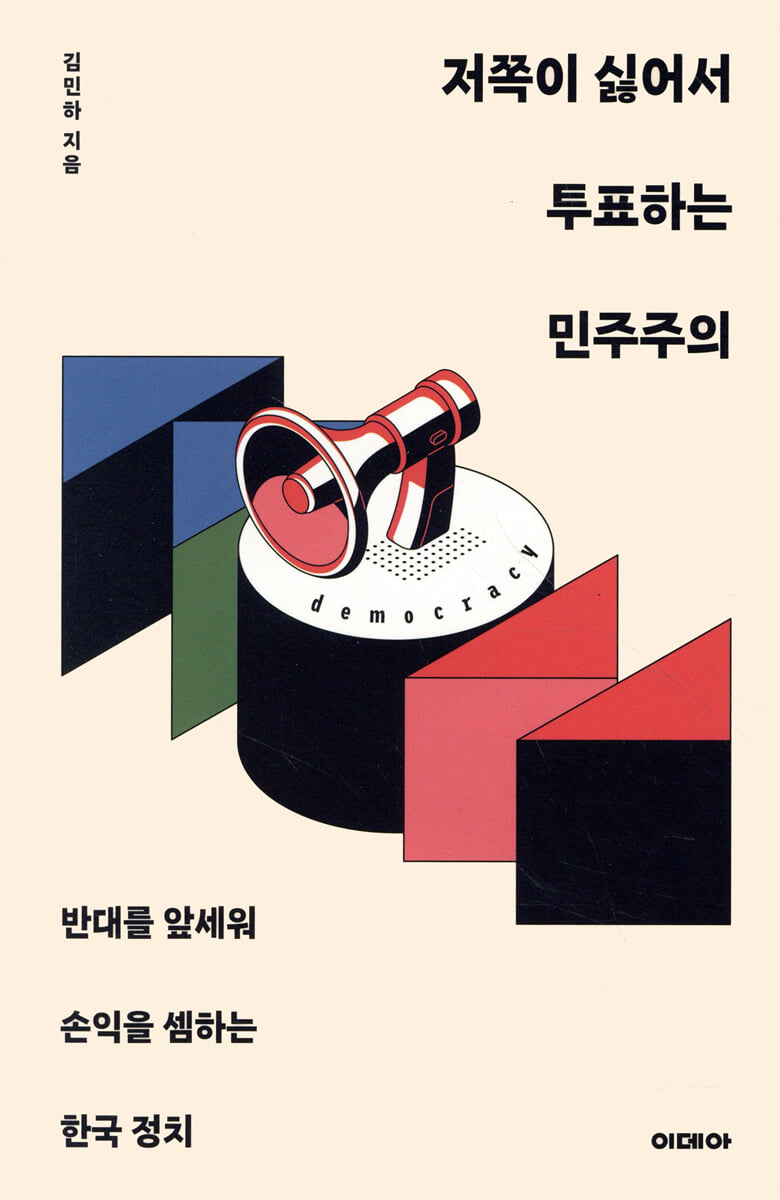
Democracy where you vote because you don't like the other side
 |
Description
Book Introduction
- A word from MD
-
Where Should Korean Politics Go?There is no one to elect, but we must prevent that person from being elected.
This is the current state of Korean politics, and a scene that repeats itself every election.
Author Kim Min-ha analyzed the conflicts that unfolded over major social issues, such as the Cho Kuk situation and the Korea-Japan diplomatic dispute.
Korean politics: What are the problems and where should we go next?
January 25, 2022. Social and Political PD Son Min-gyu
It's all the same... Is the world really unchanging?
Korean politics, where people vote not because they readily support it but because they want to block it.
Democracy, trapped in a "narrative of opposition," is unable to move forward.
The fundamental problems and alternatives of real politics that are repeated over and over again and that we are still facing today.
They say the world doesn't change.
In 2017, the incumbent president was impeached, and some even called it a "candlelight revolution," but now they say it is no different from the past ruling powers.
So where does this frustration we're experiencing now stem from? Is this truly the first step toward a profound change? Or are we simply being swayed by the pretense of those in power, who pretend to be the ones to bring about change? Is real change simply time, or a change in the ruling power? As someone once suggested, does the world only change when "20 years of democratic rule" are realized? If so, is our current uncertainty simply due to haste or political bias? This book begins with these questions.
Korean politics, where people vote not because they readily support it but because they want to block it.
Democracy, trapped in a "narrative of opposition," is unable to move forward.
The fundamental problems and alternatives of real politics that are repeated over and over again and that we are still facing today.
They say the world doesn't change.
In 2017, the incumbent president was impeached, and some even called it a "candlelight revolution," but now they say it is no different from the past ruling powers.
So where does this frustration we're experiencing now stem from? Is this truly the first step toward a profound change? Or are we simply being swayed by the pretense of those in power, who pretend to be the ones to bring about change? Is real change simply time, or a change in the ruling power? As someone once suggested, does the world only change when "20 years of democratic rule" are realized? If so, is our current uncertainty simply due to haste or political bias? This book begins with these questions.
- You can preview some of the book's contents.
Preview
index
Introduction: Why Doesn't the World Change? - Part 5
Chapter 1 Progressive or Conservative
White Paper vs. Black Paper - 15
Chapter 2: The World of Profit and Loss
The Unified Korean Team and Cryptocurrency, the "Seocho-dong Candlelight Vigil" and Refugees -47
Chapter 3: Fandom Politics and Technicians
An endless loop of being fooled, being fooled, being fooled, being fooled―71
Chapter 4: The Red Narrative and the Pro-Japanese Label
The Politics of Anti-Communism and Anti-Japan―99
Chapter 5 Variations on Progress and Regression
American Democracy—121
Chapter 6: One-sided pendulum motion
What Japanese Politics Shows—149
Chapter 7: The Power of True Change
A system in which "opposition" is already inherent―177
Chapter 8: Elitism and Populism
What Was 'Democratic Control'? - 201
Chapter 9: Parallax Perspective
The Moon Jae-in Administration's Governing Paradigm—223
How to Challenge the Chapter 10 System
Alternative Models—249
What kind of democracy is this? - 279
Chapter 1 Progressive or Conservative
White Paper vs. Black Paper - 15
Chapter 2: The World of Profit and Loss
The Unified Korean Team and Cryptocurrency, the "Seocho-dong Candlelight Vigil" and Refugees -47
Chapter 3: Fandom Politics and Technicians
An endless loop of being fooled, being fooled, being fooled, being fooled―71
Chapter 4: The Red Narrative and the Pro-Japanese Label
The Politics of Anti-Communism and Anti-Japan―99
Chapter 5 Variations on Progress and Regression
American Democracy—121
Chapter 6: One-sided pendulum motion
What Japanese Politics Shows—149
Chapter 7: The Power of True Change
A system in which "opposition" is already inherent―177
Chapter 8: Elitism and Populism
What Was 'Democratic Control'? - 201
Chapter 9: Parallax Perspective
The Moon Jae-in Administration's Governing Paradigm—223
How to Challenge the Chapter 10 System
Alternative Models—249
What kind of democracy is this? - 279
Detailed image
.jpg)
Into the book
Realpolitik is more about creating reasons to oppose your opponent than about actually discussing what real-world problems to fix.
Rather than serving as a forum for discussion to gather the consensus of sovereign people and make the world a better place, democracy is reduced to a tool for finding effective ways to organize "our side" through "opposition."
This is why, despite all the political events, the reality before our eyes remains unchanged.
--- p.9
It is impossible to compare the 'Cho Kuk White Paper', which was directly created by those close to power, with the 'Cho Kuk Black Paper', which was created by those who were not.
What I want to say here, however, is that both cases have something in common in the universal way of organizing ‘opposition’ as ‘narrative’.
--- p.30
Just because they are non-regular workers, they should not be easily converted to regular workers and should go through the same hiring process as regular workers, or demands that fair competition be made possible by expanding the regular college entrance exam and abolishing the comprehensive student record selection system... The formation of political slogans that substitute the interests of each individual for the problems that the community should solve and mobilize 'cause' to induce the most favorable results for themselves has become common.
--- p.66
‘Fandom politics’ is mobilized as a ‘technique’ to minimize partisan damage.
All of these processes are justified through the political view that politics is a matter of deception and the art of deception.
This is the reality of Korean politics.
--- p.86
This is why the phenomenon of supporters of conservative politics using the 'red' narrative without hesitation and supporters of liberal politics labeling conservative politics as 'pro-Japanese' continues to this day.
--- p.120
Some intellectuals who support the Moon Jae-in administration have used the concept of “democratic control” to mean, in effect, “submission to elected power.”… If the Prosecutor General tolerates an investigation that burdens the government against the will of the appointing authority, this would be a violation of the principles of democracy, and an “unelected power” resisting the “elected power.”
--- p.210
The Moon Jae-in administration's actual real estate policy can be summarized as a promise to ease access to the asset market for "real demanders" and reduce their tax burden and losses.
So, it led to the same conclusion as the policy model of the past administration, which was to ‘take out a loan to buy a house.’ It may have seemed like a ‘line drawing’ and ‘differentiation’ from the past administration, but in the end, it ended up being nothing more than pursuing the same thing.
--- p.240
It is about redefining ‘governance’ itself.
Rather than some competent representative coordinating the demands and interests of various sectors of society to enforce a 'philosophy of governance,' the very context of governance must be opened up to the participating public.
This should also include issues such as finance, diplomacy, and defense that require specialized knowledge.
--- p.268
The question we should be asking is not, "Who should we delegate power to in order to make the world a better place?"
What we should be asking the people of the world is, 'If you were ruler, how would you solve the problem?'
Of course, to find the right answer, everyone needs to have the same information as the ruler.
Is this possible? Not right now.
So how can this be made possible? The question again boils down to "what kind of democracy?"
Rather than serving as a forum for discussion to gather the consensus of sovereign people and make the world a better place, democracy is reduced to a tool for finding effective ways to organize "our side" through "opposition."
This is why, despite all the political events, the reality before our eyes remains unchanged.
--- p.9
It is impossible to compare the 'Cho Kuk White Paper', which was directly created by those close to power, with the 'Cho Kuk Black Paper', which was created by those who were not.
What I want to say here, however, is that both cases have something in common in the universal way of organizing ‘opposition’ as ‘narrative’.
--- p.30
Just because they are non-regular workers, they should not be easily converted to regular workers and should go through the same hiring process as regular workers, or demands that fair competition be made possible by expanding the regular college entrance exam and abolishing the comprehensive student record selection system... The formation of political slogans that substitute the interests of each individual for the problems that the community should solve and mobilize 'cause' to induce the most favorable results for themselves has become common.
--- p.66
‘Fandom politics’ is mobilized as a ‘technique’ to minimize partisan damage.
All of these processes are justified through the political view that politics is a matter of deception and the art of deception.
This is the reality of Korean politics.
--- p.86
This is why the phenomenon of supporters of conservative politics using the 'red' narrative without hesitation and supporters of liberal politics labeling conservative politics as 'pro-Japanese' continues to this day.
--- p.120
Some intellectuals who support the Moon Jae-in administration have used the concept of “democratic control” to mean, in effect, “submission to elected power.”… If the Prosecutor General tolerates an investigation that burdens the government against the will of the appointing authority, this would be a violation of the principles of democracy, and an “unelected power” resisting the “elected power.”
--- p.210
The Moon Jae-in administration's actual real estate policy can be summarized as a promise to ease access to the asset market for "real demanders" and reduce their tax burden and losses.
So, it led to the same conclusion as the policy model of the past administration, which was to ‘take out a loan to buy a house.’ It may have seemed like a ‘line drawing’ and ‘differentiation’ from the past administration, but in the end, it ended up being nothing more than pursuing the same thing.
--- p.240
It is about redefining ‘governance’ itself.
Rather than some competent representative coordinating the demands and interests of various sectors of society to enforce a 'philosophy of governance,' the very context of governance must be opened up to the participating public.
This should also include issues such as finance, diplomacy, and defense that require specialized knowledge.
--- p.268
The question we should be asking is not, "Who should we delegate power to in order to make the world a better place?"
What we should be asking the people of the world is, 'If you were ruler, how would you solve the problem?'
Of course, to find the right answer, everyone needs to have the same information as the ruler.
Is this possible? Not right now.
So how can this be made possible? The question again boils down to "what kind of democracy?"
--- p.268
Publisher's Review
Opposition for the sake of opposition, a 'narrative of opposition'?
The core language of Yeouido politics that we encounter in our daily lives seems to be geared solely towards opposing the opponent.
In the past, the so-called 'democratic forces' and liberal opposition parties claimed that 'the conservative government is a dictatorship.'
When the conservative party finds itself in the position of the opposition party, it argues that "the liberal regime is a dictatorship" and insists on protecting liberal democracy.
Although they both claim to be dictators, they didn't seem to be much different when they were in power.
He was only asserting the logic of regime change, which is nothing more than turning the palm of one's hand for one's own faction (camp).
Thanks to that, the system was maintained and the world where ‘those who have more earn more’ did not change.
This is the essence of the title of this book, 'Democracy: Voting Because You Hate The Other Side'.
It is natural that all political action begins with opposition to the status quo.
The problem is that this opposition remains a collective deception for self-justification.
Opposition must lead to social action that creates alternatives.
For this to happen, opposing arguments, logic, and evidence must be deposited in the public sphere.
But in a system like today, opposition just ends up being opposition and is forgotten.
When the logic mobilized to oppose the opponent is aimed at 'our side', that logic becomes the target of opposition again.
While both sides just switch places and repeat empty opposition, the existing social system remains intact.
The system is supposed to be updated, but it just resets.
The book says that all of these things are happening under the guise of democracy.
Is it just the current administration's fault?
However, this does not mean that the philosophies, policies, and values that the forces participating in Korean politics have advocated so far are meaningless.
What's important is why those claims were made.
For example, let's look at the Moon Jae-in administration's 'income-led growth'.
Considering that income-led growth had already fizzled out early in the administration, can we say that the philosophy and will to pursue income-led growth existed from the beginning? If so, why was income-led growth adopted? Was it because key figures in the administration were proponents of income-led growth?
“This situation can only be understood if we view it as emerging in the context of opposition to the Park Geun-hye administration’s ‘growth theory.’
This is not a unique characteristic of the Moon Jae-in administration.
“Similar cases have occurred constantly in every regime,” the author says.
Therefore, simply criticizing the current administration for deceiving the people or being a 'self-righteous man' cannot get to the heart of the problem.
The book emphasizes that we must confront the structure in which political agendas are mobilized only as a pretext for opposition to opposing political parties and forces, rather than the general public.
Is voting useless?
So, does that mean elections and voting, which occur only once every few years, are pointless? According to the author, voting is important in any case.
However, we need to think about what kind of voting system it is in and what meaning it contains.
The author argues that voting in today's representative democracy can be understood as a purchase or an investment.
Politicians also appeal for votes by comparing themselves to products and asking people to buy from them or invest in their own forces.
However, if the market itself is distorted, that is, if there are only low-quality products, consumers' purchasing power also weakens.
In other words, voting as a purchase or investment becomes merely a means of mobilization rather than an exercise of the voter's rights as the master of the world.
In real politics, there is not even a general shareholders' meeting.
That is why voting should function as a means for the public to intervene in the world.
That is why it is important to examine historical attempts to implement participatory democracy in various ways.
The book presents various examples, including 'Parecon', a participatory economy model, and citizen participation in self-government in Porto Alegre, Brazil.
However, not all attempts at participatory democracy to date have been successful.
Even a theoretically perfect solution is bound to encounter twists and turns and failures when applied in reality.
The important thing is to let failure become a stepping stone to a slightly better system.
This is why saying that the status quo is best or useless because the alternatives have failed is not the answer.
Are the United States and Japan different?
There is criticism that while the politics of advanced countries are exemplary, Korean politics is still 'Fujida'.
The author questions whether this criticism is entirely correct and historically compares and analyzes the political cases of the United States and Japan.
In the case of the United States, we examine the origins and process of the current Democratic-Republican two-party system.
People often carefully examine whether the notion that the Democratic Party is relatively "progressive" and the Republican Party is "conservative" is actually valid.
It is interesting to look at the birth of Donald Trump, the worst person in American history, not as a matter of 'species' but in historical context.
Japanese politics also raises the question of whether the Liberal Democratic Party's political course was conservative and far-right, or whether the Democratic Party's was progressive and reformist.
The author explains this by comparing it to a pendulum that moves only left and right without moving forward.
Through this, we compare what similarities there are with Korean politics (history).
In particular, Korea and these two countries have had a great influence on each other by exchanging core values of modernity: representative democracy as a political system, capitalism as an economic system, and liberalism as a socio-cultural code.
The book focuses on the fact that it was forming a common foundation for a global system.
Are there only two options?
“Participation in real politics usually begins with opposing the opposing camp.
When opposing the opponent, it seems like our side is absolutely right.
Then, at some point, you start to think that this isn't quite right.
It is the same whether it is liberal politics that is hostile to conservative politics or conservative politics that is hostile to liberal politics.
Even supporters of third-party politics who oppose two-party politics can experience the same moment.
At this time, if you uncritically accept the logic of the political party you support, there is a risk that politics will become similar to religion, and if you give up participation altogether, saying, "They're all the same," you could fall into political cynicism.
Rather than writing about this catastrophe, I wanted to write a story that could be helpful to those who still want to explore the legitimacy of political participation.
“I hope this book will be of some help to those who are surrounded by the logic of either/or, especially those who oppose both parties but believe that they can join regressive groups in order to change the government.” This is the main reason the author wrote this book.
The core language of Yeouido politics that we encounter in our daily lives seems to be geared solely towards opposing the opponent.
In the past, the so-called 'democratic forces' and liberal opposition parties claimed that 'the conservative government is a dictatorship.'
When the conservative party finds itself in the position of the opposition party, it argues that "the liberal regime is a dictatorship" and insists on protecting liberal democracy.
Although they both claim to be dictators, they didn't seem to be much different when they were in power.
He was only asserting the logic of regime change, which is nothing more than turning the palm of one's hand for one's own faction (camp).
Thanks to that, the system was maintained and the world where ‘those who have more earn more’ did not change.
This is the essence of the title of this book, 'Democracy: Voting Because You Hate The Other Side'.
It is natural that all political action begins with opposition to the status quo.
The problem is that this opposition remains a collective deception for self-justification.
Opposition must lead to social action that creates alternatives.
For this to happen, opposing arguments, logic, and evidence must be deposited in the public sphere.
But in a system like today, opposition just ends up being opposition and is forgotten.
When the logic mobilized to oppose the opponent is aimed at 'our side', that logic becomes the target of opposition again.
While both sides just switch places and repeat empty opposition, the existing social system remains intact.
The system is supposed to be updated, but it just resets.
The book says that all of these things are happening under the guise of democracy.
Is it just the current administration's fault?
However, this does not mean that the philosophies, policies, and values that the forces participating in Korean politics have advocated so far are meaningless.
What's important is why those claims were made.
For example, let's look at the Moon Jae-in administration's 'income-led growth'.
Considering that income-led growth had already fizzled out early in the administration, can we say that the philosophy and will to pursue income-led growth existed from the beginning? If so, why was income-led growth adopted? Was it because key figures in the administration were proponents of income-led growth?
“This situation can only be understood if we view it as emerging in the context of opposition to the Park Geun-hye administration’s ‘growth theory.’
This is not a unique characteristic of the Moon Jae-in administration.
“Similar cases have occurred constantly in every regime,” the author says.
Therefore, simply criticizing the current administration for deceiving the people or being a 'self-righteous man' cannot get to the heart of the problem.
The book emphasizes that we must confront the structure in which political agendas are mobilized only as a pretext for opposition to opposing political parties and forces, rather than the general public.
Is voting useless?
So, does that mean elections and voting, which occur only once every few years, are pointless? According to the author, voting is important in any case.
However, we need to think about what kind of voting system it is in and what meaning it contains.
The author argues that voting in today's representative democracy can be understood as a purchase or an investment.
Politicians also appeal for votes by comparing themselves to products and asking people to buy from them or invest in their own forces.
However, if the market itself is distorted, that is, if there are only low-quality products, consumers' purchasing power also weakens.
In other words, voting as a purchase or investment becomes merely a means of mobilization rather than an exercise of the voter's rights as the master of the world.
In real politics, there is not even a general shareholders' meeting.
That is why voting should function as a means for the public to intervene in the world.
That is why it is important to examine historical attempts to implement participatory democracy in various ways.
The book presents various examples, including 'Parecon', a participatory economy model, and citizen participation in self-government in Porto Alegre, Brazil.
However, not all attempts at participatory democracy to date have been successful.
Even a theoretically perfect solution is bound to encounter twists and turns and failures when applied in reality.
The important thing is to let failure become a stepping stone to a slightly better system.
This is why saying that the status quo is best or useless because the alternatives have failed is not the answer.
Are the United States and Japan different?
There is criticism that while the politics of advanced countries are exemplary, Korean politics is still 'Fujida'.
The author questions whether this criticism is entirely correct and historically compares and analyzes the political cases of the United States and Japan.
In the case of the United States, we examine the origins and process of the current Democratic-Republican two-party system.
People often carefully examine whether the notion that the Democratic Party is relatively "progressive" and the Republican Party is "conservative" is actually valid.
It is interesting to look at the birth of Donald Trump, the worst person in American history, not as a matter of 'species' but in historical context.
Japanese politics also raises the question of whether the Liberal Democratic Party's political course was conservative and far-right, or whether the Democratic Party's was progressive and reformist.
The author explains this by comparing it to a pendulum that moves only left and right without moving forward.
Through this, we compare what similarities there are with Korean politics (history).
In particular, Korea and these two countries have had a great influence on each other by exchanging core values of modernity: representative democracy as a political system, capitalism as an economic system, and liberalism as a socio-cultural code.
The book focuses on the fact that it was forming a common foundation for a global system.
Are there only two options?
“Participation in real politics usually begins with opposing the opposing camp.
When opposing the opponent, it seems like our side is absolutely right.
Then, at some point, you start to think that this isn't quite right.
It is the same whether it is liberal politics that is hostile to conservative politics or conservative politics that is hostile to liberal politics.
Even supporters of third-party politics who oppose two-party politics can experience the same moment.
At this time, if you uncritically accept the logic of the political party you support, there is a risk that politics will become similar to religion, and if you give up participation altogether, saying, "They're all the same," you could fall into political cynicism.
Rather than writing about this catastrophe, I wanted to write a story that could be helpful to those who still want to explore the legitimacy of political participation.
“I hope this book will be of some help to those who are surrounded by the logic of either/or, especially those who oppose both parties but believe that they can join regressive groups in order to change the government.” This is the main reason the author wrote this book.
GOODS SPECIFICS
- Date of issue: January 10, 2022
- Page count, weight, size: 288 pages | 382g | 140*215*20mm
- ISBN13: 9791189143268
- ISBN10: 1189143267
You may also like
카테고리
korean


korean

![GQ KOREA Mark (Monthly): December [2025]](http://librairie.coreenne.fr/cdn/shop/files/8ef265dbbfbf186523ed75ba7319009d.jpg?v=1765340328&width=3840)


