

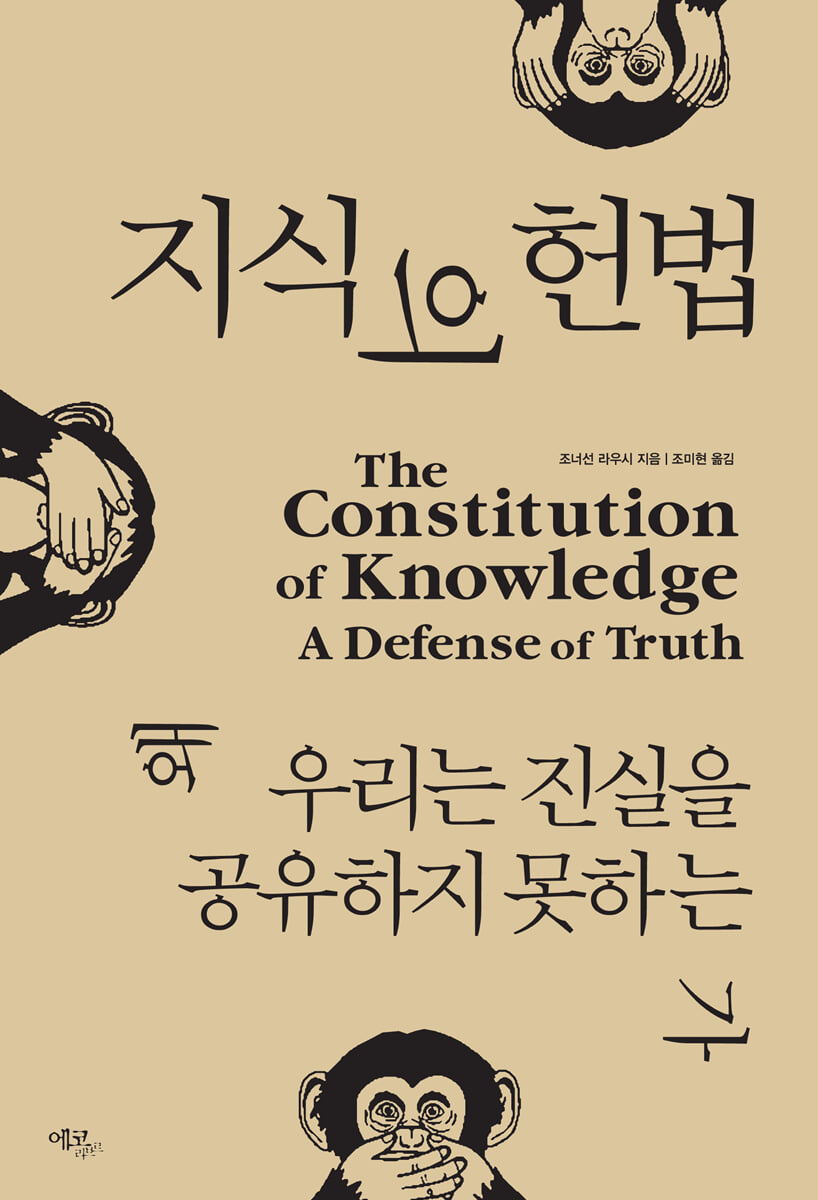
Constitution of Knowledge
 |
Description
Book Introduction
- A word from MD
-
In an age of post-truth, how to regain trust?We live in an age where truth has disappeared.
Fake news, anti-intellectualism, distrust of the media, and polarized politics are fueling distrust and hatred toward others.
Jonathan Rausch, who has worked in the media for 40 years, analyzes the root of the crisis and seeks solutions in this book.
January 7, 2022. Social and Political PD Son Min-gyu
A groundbreaking book that diagnoses and prescribes another pandemic of our time!
Fake news, conspiracy theories, trolling, cancel culture…
In an age of epistemological crisis, protecting freedom of expression and truth
"The mass vaccination campaign is a ploy by Bill Gates to implant microchips in people!" "Hillary Clinton is running a child sex ring out of a Washington, D.C. pizza place!" "Trump is the winner of the 2020 presidential election, so Donald Trump, not Joe Biden, will be sworn in at the inauguration!" Nonsense, you say? But how can we explain the fact that many Americans believed these claims, or were skeptical of them, and that some of them actually took political action? And what about the unprecedented storming of the Capitol, so surreal it was almost laughable?
The world is now suffering from another pandemic besides COVID-19.
In the 21st century, fake news, conspiracy theories, trolling, and cancel culture spread more rapidly through digital media, shaking up our daily lives.
No one can let their guard down.
Because you never know when you might be the next victim of this pandemic.
No, maybe we have unknowingly become accomplices in this pandemic.
In a battle where anger against everyone erupts daily, both online and offline, and political polarization rages, there is only one goal.
The question isn't who pursues the truth, but rather who defeats the perceived enemy! In this environment, our ability to distinguish between fact and fiction, real and fake, is weakening day by day.
A world where you can't believe in anything, but it seems like you can believe in anything.
We are now in an epistemological crisis.
Jonathan Rausch's The Constitution of Knowledge diagnoses this epistemological crisis and sharply analyzes its causes.
Fake news, conspiracy theories, trolling, cancel culture…
In an age of epistemological crisis, protecting freedom of expression and truth
"The mass vaccination campaign is a ploy by Bill Gates to implant microchips in people!" "Hillary Clinton is running a child sex ring out of a Washington, D.C. pizza place!" "Trump is the winner of the 2020 presidential election, so Donald Trump, not Joe Biden, will be sworn in at the inauguration!" Nonsense, you say? But how can we explain the fact that many Americans believed these claims, or were skeptical of them, and that some of them actually took political action? And what about the unprecedented storming of the Capitol, so surreal it was almost laughable?
The world is now suffering from another pandemic besides COVID-19.
In the 21st century, fake news, conspiracy theories, trolling, and cancel culture spread more rapidly through digital media, shaking up our daily lives.
No one can let their guard down.
Because you never know when you might be the next victim of this pandemic.
No, maybe we have unknowingly become accomplices in this pandemic.
In a battle where anger against everyone erupts daily, both online and offline, and political polarization rages, there is only one goal.
The question isn't who pursues the truth, but rather who defeats the perceived enemy! In this environment, our ability to distinguish between fact and fiction, real and fake, is weakening day by day.
A world where you can't believe in anything, but it seems like you can believe in anything.
We are now in an epistemological crisis.
Jonathan Rausch's The Constitution of Knowledge diagnoses this epistemological crisis and sharply analyzes its causes.
- You can preview some of the book's contents.
Preview
index
1 “That would be a terrible statement if you don’t get out safely.”
Chaos and conformity have led to an epistemological crisis.
2 The State of Nature: Tribal Truth
Bias, groupthink, and the epistemological war of all against all
3 Booting into Reality: The Rise of Network Knowledge
Entrusting reality to social networks is humanity's greatest innovation.
4 Constitution of Knowledge
Operating system of a reality-based community
5 Disinformation Technologies: The Challenge of Digital Media
Making the online world truth-friendly is difficult, but possible.
6 Troll Epistemology: "Let lies flood the area."
Disinformation is a long-standing enemy, armed with new weapons and powerful advocates.
7 Cancel Culture: The Tyranny of the Minority
Coercive conformity is corrupting reality-based communities.
8 Break the Silence: Rebuttal
Defending the Constitution of Knowledge Requires Confidence and Counter-Mobilization
Acknowledgements
main
Search
Chaos and conformity have led to an epistemological crisis.
2 The State of Nature: Tribal Truth
Bias, groupthink, and the epistemological war of all against all
3 Booting into Reality: The Rise of Network Knowledge
Entrusting reality to social networks is humanity's greatest innovation.
4 Constitution of Knowledge
Operating system of a reality-based community
5 Disinformation Technologies: The Challenge of Digital Media
Making the online world truth-friendly is difficult, but possible.
6 Troll Epistemology: "Let lies flood the area."
Disinformation is a long-standing enemy, armed with new weapons and powerful advocates.
7 Cancel Culture: The Tyranny of the Minority
Coercive conformity is corrupting reality-based communities.
8 Break the Silence: Rebuttal
Defending the Constitution of Knowledge Requires Confidence and Counter-Mobilization
Acknowledgements
main
Search
Publisher's Review
A system that transforms differences of opinion into knowledge within a network is an innovative solution that overcomes human cognitive errors.
This book begins by acknowledging that cognitive errors such as tribalism and bias are an essential part of human nature.
If bias is a shortcut to judging which direction an individual will go in an uncertain and complex world, then tribalism has been maintained because it is safest to share the bias of "us" rather than "me."
For hundreds of thousands of years, humans have practiced believing anything that will keep them in good standing with their tribe.
If beliefs serve the function of defining and uniting a group, they play the social role of sacred faith or religious belief for group members.
Therefore, when facts challenge their beliefs, believers will try to deny them, demonstrate solidarity with their own side, and publicize their antipathy toward their enemies.
That's why groups at opposite ends of the political spectrum often resemble cult fanatics.
This is also why wars of faith, big and small, have raged for centuries throughout history.
But humanity did not destroy itself.
It is thanks to the ‘Constitution of Knowledge’.
So, what is the "Constitution of Knowledge"? In short, it's a "social system that transforms differences of opinion into knowledge."
This includes the academic world, including science; institutions such as journalism, government agencies, and law; a dense network of norms and principles such as truth and fact-checking; the expertise of peer reviewers and experts; and systems such as social media platforms.
Moreover, the entire system relies on a shared understanding that there are right and wrong ways to create knowledge.
These values, rules, and systems are collectively called the ‘Constitution of Knowledge.’
Jonathan Rausch devotes a significant portion of the first half of this book to tracing the construction of the modern epistemological order, going back to the 17th and 18th centuries.
Beginning with the so-called triumvirate of modern liberalism—John Locke, Adam Smith, and James Madison—several generations of genius thinkers and scientists emerged, and the current "Constitution of Knowledge" was conceived amidst the great innovations that overturned existing economic, political, and epistemological thinking.
Knowledge is redefined not as a product of individual or collective effort, but as the emergent nature of interactions within social networks.
But this system is the product of hard-fought battles and hard-won norms and institutions, and many people suffered and shed blood in the process.
The 'Constitution of Knowledge' never existed on its own; it has been brought to its present state by those who have sought to re-understand, defend, and defend it in the face of constant challenge and threat.
And now the baton has been passed to our generation.
Can we avoid being swayed by the coercive conformity of the community to the agitators, scammers, and psychopaths of the internet?
While the first half focuses on history and theoretical background, the second half takes a sharp look at contemporary American society.
First, as the founder of Twitter confessed, the American commercial internet that gave birth to today's digital ecosystem started with an epistemological flaw from the beginning.
Because advertising was the business model, attention became the top priority, and the computer engine worked based on the number of views and followers, not meaning or value.
As a result, virality has become a system that thrives on anger and misinformation, rather than conversation and knowledge.
Digital media has gone in the opposite direction of the 'Constitution of Knowledge'.
Here, Jonathan Rausch pays particular attention to trolling (Chapter 6) and cancel culture (Chapter 7).
The former spreads misinformation and alternative (fake) realities, while the latter spreads coercive conformity and ideological blacklists.
The former is a strategy favored primarily by populist politicians and right-wing forces in the United States, while the latter is a strategy favored by elitist politicians and left-wing forces who call themselves progressive.
However, the two camps ultimately form a strange symbiotic relationship that reinforces each other.
If you look closely, they have the same goal.
The manipulation of the social and media environment for political (or economic or reputational) gain.
The trolling examples in this book are astounding.
It's not because it's original or sophisticated, but because it's sloppy and just made assumptions without any evidence.
But contrary to appearances, trolls are propagandists who meticulously and slowly exploit human cognitive and emotional vulnerabilities.
It's even organized now.
Trolling is no longer just the work of so-called attention seekers seeking fame or far-right politicians trying to inflame the public's political zeal.
Russian intelligence agencies have also joined the comment-spinning army with search bots and algorithms.
The American conservative journalism ecosystem also jumped in, launching a barrage of disinformation on an unprecedented scale.
It is truly a high-tech information war.
Meanwhile, cancel culture creates cracks within the reality-based community that upholds the "constitution of knowledge" by forcing conformity on its members.
Office workers and self-employed people who lose their livelihoods, reputations, and social connections overnight because of a thoughtless comment on Twitter aren't the only victims of cancel culture.
Lausi interviews college students and professors who say they avoid discussing certain topics like race, gender, and class on campus for fear of being ostracized by their peers or being judged by students.
Many others, like them, are victims who self-censor themselves for fear of being canceled the moment they express an opinion that differs from the dominant view within the group.
But this dominant view is often the tyranny of a minority manipulated to appear as if it were the majority.
Online propagandists can use algorithmic amplification and fictional characters to make small groups, such as anti-vaccine groups, appear as if they are large, believable groups.
People who follow the signals around them may misinterpret these fake opinion distributions, assume they are isolated, and ultimately choose to hide their thoughts and (pretend to) agree with the dominant view.
When this happens, the community degenerates into an epistemological bubble.
People within the bubble believe they are engaging in lively debate and critique, but in reality, they are merely repeating the process of confirming and reaffirming shared biases.
But Jonathan Rausch offers some optimism amidst this.
The rationale? Impressive commitments and innovations are already being made to help the digital media world overcome the onslaught of misinformation.
Among the many examples presented in the book are global platform companies that are widely blamed as the main culprits of this crisis.
Companies that are considering support measures rather than immediately firing employees targeted by cancel culture; universities that are campaigning for political depolarization and open debate, claiming to return to their original mission of pursuing truth; and organizations spontaneously organized by citizens who lost everything and were on the brink of life due to mass terrorism on social media.
The point is that groups can be confronted as groups, and valuelessness and structurelessness can be confronted through thorough product design and policy design.
The author's belief that the epistemological order of liberalism has always found a way forward is not an empty theory, but rather a moving one, born from the intense life experience of a lifelong journalist and LGBT activist.
His argument that we should respect and confront opposing opinions rather than ignoring and suppressing them, and that we should listen to even haters with wrong ideas and misinformation, may be the very pillars that have supported the "Constitution of Knowledge."
If you feel a warm feeling in your heart after reading this book, you too are undoubtedly a defender of the 'Constitution of Knowledge.'
This book begins by acknowledging that cognitive errors such as tribalism and bias are an essential part of human nature.
If bias is a shortcut to judging which direction an individual will go in an uncertain and complex world, then tribalism has been maintained because it is safest to share the bias of "us" rather than "me."
For hundreds of thousands of years, humans have practiced believing anything that will keep them in good standing with their tribe.
If beliefs serve the function of defining and uniting a group, they play the social role of sacred faith or religious belief for group members.
Therefore, when facts challenge their beliefs, believers will try to deny them, demonstrate solidarity with their own side, and publicize their antipathy toward their enemies.
That's why groups at opposite ends of the political spectrum often resemble cult fanatics.
This is also why wars of faith, big and small, have raged for centuries throughout history.
But humanity did not destroy itself.
It is thanks to the ‘Constitution of Knowledge’.
So, what is the "Constitution of Knowledge"? In short, it's a "social system that transforms differences of opinion into knowledge."
This includes the academic world, including science; institutions such as journalism, government agencies, and law; a dense network of norms and principles such as truth and fact-checking; the expertise of peer reviewers and experts; and systems such as social media platforms.
Moreover, the entire system relies on a shared understanding that there are right and wrong ways to create knowledge.
These values, rules, and systems are collectively called the ‘Constitution of Knowledge.’
Jonathan Rausch devotes a significant portion of the first half of this book to tracing the construction of the modern epistemological order, going back to the 17th and 18th centuries.
Beginning with the so-called triumvirate of modern liberalism—John Locke, Adam Smith, and James Madison—several generations of genius thinkers and scientists emerged, and the current "Constitution of Knowledge" was conceived amidst the great innovations that overturned existing economic, political, and epistemological thinking.
Knowledge is redefined not as a product of individual or collective effort, but as the emergent nature of interactions within social networks.
But this system is the product of hard-fought battles and hard-won norms and institutions, and many people suffered and shed blood in the process.
The 'Constitution of Knowledge' never existed on its own; it has been brought to its present state by those who have sought to re-understand, defend, and defend it in the face of constant challenge and threat.
And now the baton has been passed to our generation.
Can we avoid being swayed by the coercive conformity of the community to the agitators, scammers, and psychopaths of the internet?
While the first half focuses on history and theoretical background, the second half takes a sharp look at contemporary American society.
First, as the founder of Twitter confessed, the American commercial internet that gave birth to today's digital ecosystem started with an epistemological flaw from the beginning.
Because advertising was the business model, attention became the top priority, and the computer engine worked based on the number of views and followers, not meaning or value.
As a result, virality has become a system that thrives on anger and misinformation, rather than conversation and knowledge.
Digital media has gone in the opposite direction of the 'Constitution of Knowledge'.
Here, Jonathan Rausch pays particular attention to trolling (Chapter 6) and cancel culture (Chapter 7).
The former spreads misinformation and alternative (fake) realities, while the latter spreads coercive conformity and ideological blacklists.
The former is a strategy favored primarily by populist politicians and right-wing forces in the United States, while the latter is a strategy favored by elitist politicians and left-wing forces who call themselves progressive.
However, the two camps ultimately form a strange symbiotic relationship that reinforces each other.
If you look closely, they have the same goal.
The manipulation of the social and media environment for political (or economic or reputational) gain.
The trolling examples in this book are astounding.
It's not because it's original or sophisticated, but because it's sloppy and just made assumptions without any evidence.
But contrary to appearances, trolls are propagandists who meticulously and slowly exploit human cognitive and emotional vulnerabilities.
It's even organized now.
Trolling is no longer just the work of so-called attention seekers seeking fame or far-right politicians trying to inflame the public's political zeal.
Russian intelligence agencies have also joined the comment-spinning army with search bots and algorithms.
The American conservative journalism ecosystem also jumped in, launching a barrage of disinformation on an unprecedented scale.
It is truly a high-tech information war.
Meanwhile, cancel culture creates cracks within the reality-based community that upholds the "constitution of knowledge" by forcing conformity on its members.
Office workers and self-employed people who lose their livelihoods, reputations, and social connections overnight because of a thoughtless comment on Twitter aren't the only victims of cancel culture.
Lausi interviews college students and professors who say they avoid discussing certain topics like race, gender, and class on campus for fear of being ostracized by their peers or being judged by students.
Many others, like them, are victims who self-censor themselves for fear of being canceled the moment they express an opinion that differs from the dominant view within the group.
But this dominant view is often the tyranny of a minority manipulated to appear as if it were the majority.
Online propagandists can use algorithmic amplification and fictional characters to make small groups, such as anti-vaccine groups, appear as if they are large, believable groups.
People who follow the signals around them may misinterpret these fake opinion distributions, assume they are isolated, and ultimately choose to hide their thoughts and (pretend to) agree with the dominant view.
When this happens, the community degenerates into an epistemological bubble.
People within the bubble believe they are engaging in lively debate and critique, but in reality, they are merely repeating the process of confirming and reaffirming shared biases.
But Jonathan Rausch offers some optimism amidst this.
The rationale? Impressive commitments and innovations are already being made to help the digital media world overcome the onslaught of misinformation.
Among the many examples presented in the book are global platform companies that are widely blamed as the main culprits of this crisis.
Companies that are considering support measures rather than immediately firing employees targeted by cancel culture; universities that are campaigning for political depolarization and open debate, claiming to return to their original mission of pursuing truth; and organizations spontaneously organized by citizens who lost everything and were on the brink of life due to mass terrorism on social media.
The point is that groups can be confronted as groups, and valuelessness and structurelessness can be confronted through thorough product design and policy design.
The author's belief that the epistemological order of liberalism has always found a way forward is not an empty theory, but rather a moving one, born from the intense life experience of a lifelong journalist and LGBT activist.
His argument that we should respect and confront opposing opinions rather than ignoring and suppressing them, and that we should listen to even haters with wrong ideas and misinformation, may be the very pillars that have supported the "Constitution of Knowledge."
If you feel a warm feeling in your heart after reading this book, you too are undoubtedly a defender of the 'Constitution of Knowledge.'
GOODS SPECIFICS
- Publication date: December 30, 2021
- Page count, weight, size: 432 pages | 588g | 148*217*30mm
- ISBN13: 9788962632347
- ISBN10: 8962632349
You may also like
카테고리
korean


korean

![GQ KOREA Mark (Monthly): December [2025]](http://librairie.coreenne.fr/cdn/shop/files/8ef265dbbfbf186523ed75ba7319009d.jpg?v=1765340328&width=3840)


