

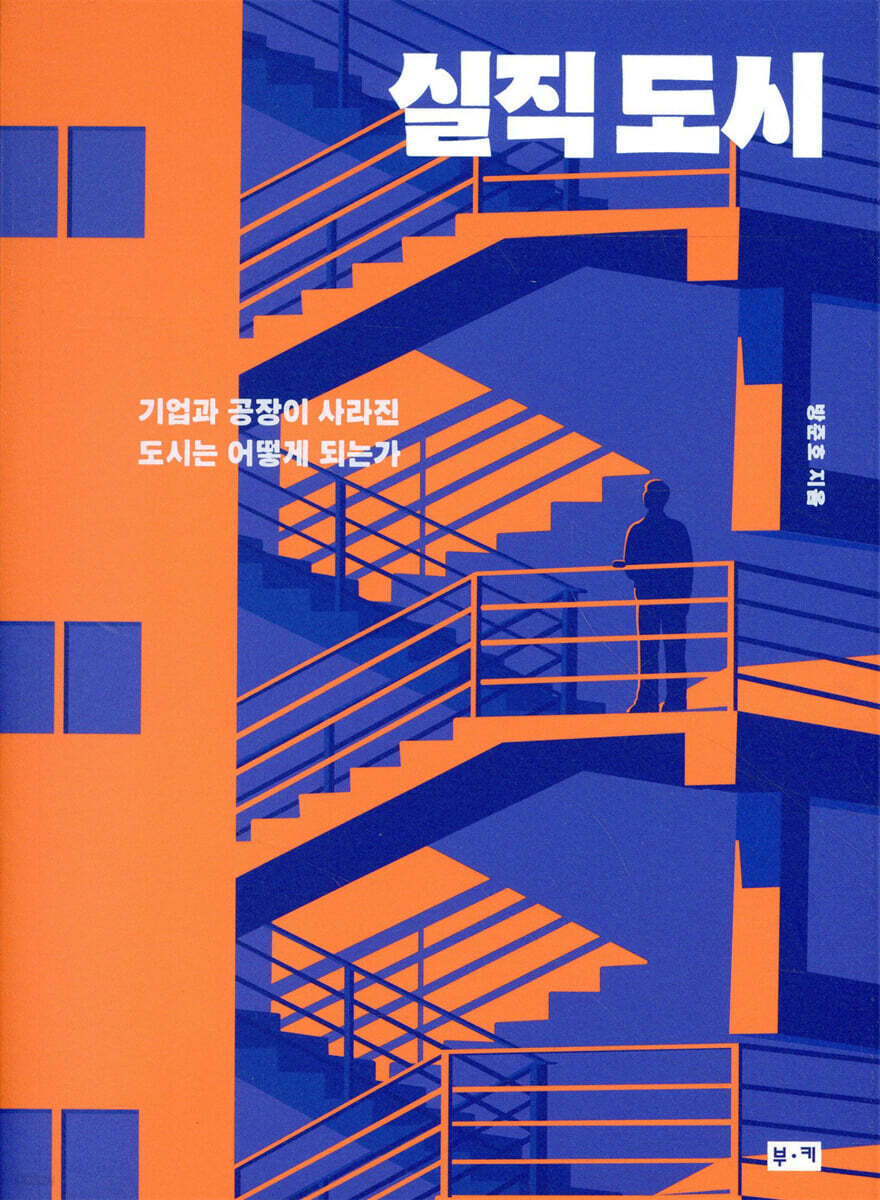
Unemployed city
 |
Description
Book Introduction
- A word from MD
- It documents what happened in Gunsan after the Hyundai Heavy Industries shipyard closed in July 2017 and the GM Korea plant closed in May 2018.
A story about a man who fails to find a new job and becomes self-employed, a wife who takes on the job search for her unemployed husband, and a quiet one-room apartment complex and commercial district.
This is our story, which is ongoing.
- Son Min-gyu, Social and Political MD
This is not just their story
This is the story of all of us right now.
A reportage that reveals a side of Gunsan we never knew about, famous for its oldest bakery in Korea and its hip tourist destination brimming with modern heritage.
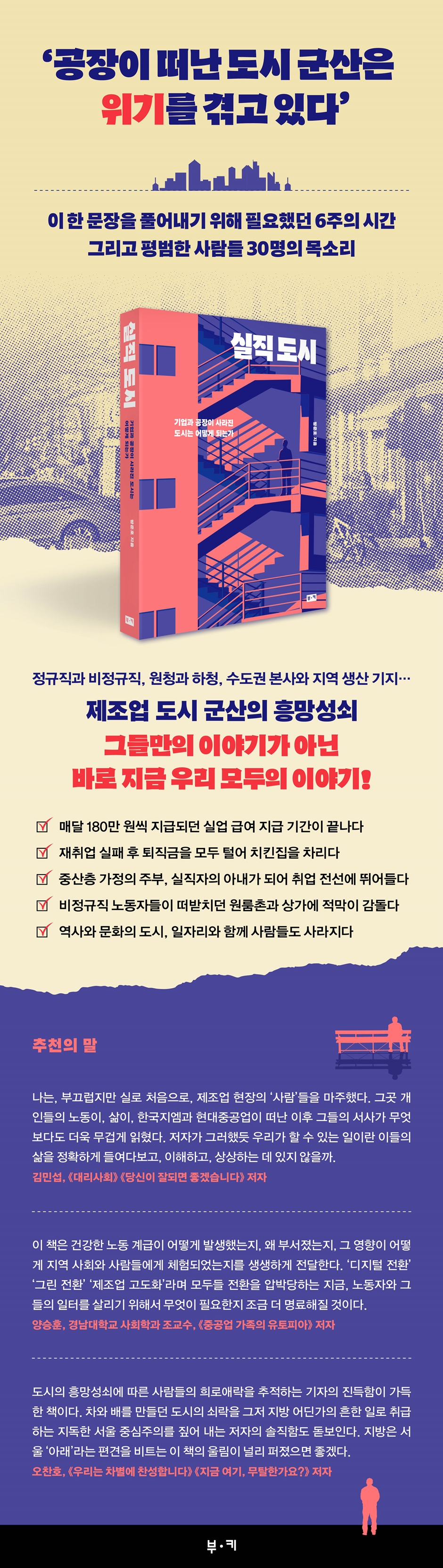
Following the shutdown of Hyundai Heavy Industries' Gunsan Shipyard in July 2017 and GM Korea's Gunsan plant in May 2018, the author headed to Gunsan with the question, "What happened to the people of this fallen city?"
Over the course of six weeks, I met and talked with about 30 ordinary people.
The lives of the people left behind after the factory left are recorded in brutally vivid detail.
The reality that when the 1.8 million won monthly unemployment benefit payment expired, people who had hoped to get re-employed ended up having no choice but to open a chicken restaurant, wives who jumped into the job market in place of their unemployed husbands, stray dogs left behind in the one-room apartment complexes and commercial districts supported by irregular workers, and people leaving the city of history and culture along with businesses—these are all too real to be dismissed as simply happening in a small town on the western edge.
Based on the July 2019 [Hankyoreh 21] cover article, “Gunsan, the City Where Factories Left,” this book includes subsequent changes and the author’s thoughts.
This is the story of all of us right now.
A reportage that reveals a side of Gunsan we never knew about, famous for its oldest bakery in Korea and its hip tourist destination brimming with modern heritage.
Following the shutdown of Hyundai Heavy Industries' Gunsan Shipyard in July 2017 and GM Korea's Gunsan plant in May 2018, the author headed to Gunsan with the question, "What happened to the people of this fallen city?"
Over the course of six weeks, I met and talked with about 30 ordinary people.
The lives of the people left behind after the factory left are recorded in brutally vivid detail.
The reality that when the 1.8 million won monthly unemployment benefit payment expired, people who had hoped to get re-employed ended up having no choice but to open a chicken restaurant, wives who jumped into the job market in place of their unemployed husbands, stray dogs left behind in the one-room apartment complexes and commercial districts supported by irregular workers, and people leaving the city of history and culture along with businesses—these are all too real to be dismissed as simply happening in a small town on the western edge.
Based on the July 2019 [Hankyoreh 21] cover article, “Gunsan, the City Where Factories Left,” this book includes subsequent changes and the author’s thoughts.
- You can preview some of the book's contents.
Preview
index
Prologue: On the way to Gunsan
1.
Natives: Unique and Passionate People
2.
Fates: Regular and Non-Regular Workers
3.
Chanran: Dreaming of a World City
4.
Crack: Anxious Leisure
5.
That Day: The Day the Factory Left
6.
Breakup: The one who stays and the one who leaves
7.
Scenes: Chicken restaurant and one-room apartment complex
8.
Identity: Where and What to Do
9.
Year 1: Transition and Hesitation
10.
A story of rest: In a familiar city
11.
Again: Just another day like any other
Epilogue: Woven with Confusion
1.
Natives: Unique and Passionate People
2.
Fates: Regular and Non-Regular Workers
3.
Chanran: Dreaming of a World City
4.
Crack: Anxious Leisure
5.
That Day: The Day the Factory Left
6.
Breakup: The one who stays and the one who leaves
7.
Scenes: Chicken restaurant and one-room apartment complex
8.
Identity: Where and What to Do
9.
Year 1: Transition and Hesitation
10.
A story of rest: In a familiar city
11.
Again: Just another day like any other
Epilogue: Woven with Confusion
Detailed image
Into the book
Hyundai Heavy Industries' Gunsan Shipyard 'suspended' operations in July 2017.
GM Korea's Gunsan plant was completely 'closed' on May 31, 2018.
If you add up the factory workers, subcontractors, and their families, it is a place where one in four people in Gunsan believed they earned, ate, and lived thanks to it.
---From the "Prologue"
Below Jayuro, a five-lane road that divides the industrial complex into north and south, is a Daewoo Motors partner company.
Our partner company, Changwon Metal Industry, built a factory in Gunsan in late 1995, just before the Daewoo Motors plant began operations.
The parent company, Changwon Co., Ltd., originally supplied parts to Daewoo Motors in Bupyeong, so it was natural for it to follow the large factory.
We manufactured and delivered car fenders and the like.
Even after the national industrial complex was established, the construction of factory sites by reclaiming the sea continued.
The Gunsan Second National Industrial Complex, which fills the area from Osikdo to Bieungdo, was built in the 2000s.
The representative company of Gunsan's second national industrial complex is Hyundai Heavy Industries Gunsan Shipyard.
It is the youngest of Hyundai Heavy Industries shipyards nationwide.
This time, ship block and equipment companies followed the shipyard.
Below that, the Saemangeum Industrial Complex was developed starting in the 2010s.
Still filling the ground.
The city is literally expanding physically.
---「1.
From "Natives: Unique and Heartbreaking People"
The lives and livelihoods of workers in small and medium-sized Korean cities, home to numerous production bases for global corporations, will be considered "costs" in planning.
It's not easy for the GM board of directors in Detroit to recall the faces of each and every worker and the relationship between the factory and the city.
The life and death of a factory, working conditions, and life prospects are determined by cost-effectiveness.
It's harsh.
The subtle conflicts and alienation that might arise within it were not considered very important.
It cannot be denied that Gunsan also grew rapidly within this order.
In general, things have improved.
Some people have improved as much as that growth, while others have improved less than that growth.
Of course, there were moments of crisis.
At times like that, there are people who are just as dizzy as the city's crisis, and there are also people who are even more devastated than the city's crisis.
The fate of the city and the fate of its people are intertwined.
But they are intertwined differently.
That's how it happened.
---「2.
From "Fates: Regular and Non-Regular Workers"
Gunsan's share of the total production of the Jeonbuk region also exceeded 20 percent for the first time around this time (21.2 percent in 2008).
A newspaper article from that time conveys the bustling atmosphere in Gunsan caused by the taxi driver's casual remark.
“I guess Hyundai Heavy Industries is a great company.
“The atmosphere of Gunsan has completely changed.” Finally, in the mid-2000s, the city acquired the distinction of being a shipbuilding powerhouse, following the automobile industry that represented Korea’s industrial powerhouses.
South Korea's shipbuilding industry has dominated the world since surpassing Japan in 2003.
In 2008, the shipbuilding industry surpassed semiconductors and automobiles in total exports for the first time.
It accounted for 10.1 percent of exports.
Since China joined the WTO in 2001, global trade in goods has grown rapidly.
The production process was distributed around the world, with each small component shipped across the ocean to be assembled.
The expansion of free trade was considered an inevitable trend.
It was only natural that the optimism surrounding shipbuilding reached its peak on a warm, sunny May day at the western end of Gunsan.
---「3.
From "Cheonran: Dreaming of a World City"
Jeong Sun-cheol's life was similar.
He was an employee, not a manager, so his wages were considerably lower in a factory where overtime and special work were not expected. However, he “basically valued time spent with people more than money.”
When I had some free time, I went to the club and played table tennis or badminton.
For fun, I even appeared as an extra in a movie being filmed in the neighborhood with my colleagues.
I took a picture with my face covered and dressed as a farmer from the Japanese colonial period.
He smiled so brightly.
“Even though we saw each other every day, we had so much to talk about, and just seeing each other’s faces made us laugh.” The movie I appeared in as an extra was a huge flop (I won’t reveal which movie it was), but that was what made me laugh.
“I’m screwed, I’m completely screwed.”
---「4.
From "Crack: Anxious Leisure"
It was on February 26th that Kang Min-woo, a non-regular worker at GM Korea, received a call from the head of the subcontractor he works for.
I went into the office of a partner company located in a corner of the factory that was already in chaos.
Members of the labor-management council, which was formed in place of the irregular workers' union, are gathered.
He is also one of the members.
“The company goes bankrupt and the contract is terminated.
“I will be fired as of March 31st,” he said.
He told me to tell the other non-regular workers.
The atmosphere became tense.
The other member next to him blushed.
“Instead of telling us to tell you, shouldn’t you tell all the employees one by one?” he shouted.
It was expected, but it was more dismal than I thought.
It was absurdly easy to say goodbye to the workplace where I had worked for over a decade.
---「5.
From "That Day: The Day the Factory Left"
My wife said she found a job in Jeonju.
I package meat at a meatpacking factory and earn about 1.5 million won a month.
After the Gunsan factory closed, my wife tried to save up and save money.
One thing I learned from that crisis is that you should save as much as you can while you can.
Seeing his wife like that, he vowed to eat at the company as much as possible.
There is no need to go out to the dazzling city center of Changwon, which is incomparable to Gunsan.
My colleagues are the same.
They are all similar.
I pushed the fishing rod and golf clubs I had brought with me, promising myself to live well, to one side of the room.
I have no intention of taking it out.
The family I thought I would see every week is now only seen once or twice a month, often by getting a ride from a colleague.
If I go home to Jeonju, I'll just sleep and come back.
---「6.
From "Farewell: The One Who Stays and the One Who Left"
Jeong Sun-cheol is also aware of the instability of self-employment.
Opening a chicken restaurant with severance pay? Isn't this the typical path of hardship for the unemployed, something we've seen countless times since the IMF crisis?
He also considered re-employment to be his top priority until just before he lost his job.
As expected, there were no suitable jobs to re-enter the workforce.
In a city where the manufacturing base has collapsed, it is not easy to find work that is comparable, if not at the same level, as before.
The service industry had a relatively low threshold.
First of all, a lump sum of money called voluntary retirement allowance has also arrived.
We paid a deposit of 80 million won and a key money of about 60 million won and settled in a commercial building behind Lotte Mart in Susong-dong.
The apartment in Jigok-dong where I originally lived was rented out.
I moved into a new apartment near the store on a lease.
When you look at working hours, there is no room for commuting times.
Adding the rent to the various expenses of the store, I ended up using up almost all of the severance pay I received when I left the company.
“I think the store is a bit expensive.
“Because I don’t know much about the ways of the world, I’ve never been able to compromise properly.”
---「7.
Scenes: Chicken House and One-Room Village
“While I was receiving training as a nursing assistant, I looked around and saw that I was the only middle-aged man there.
“I was embarrassed.” Whenever I felt embarrassed about my thick, hairy fingers, I tried to find a rational reason.
“They say that social welfare jobs will become more in demand as the population ages, and that there will be a shortage of men.” That’s right.
I endured the embarrassment and got my license, but I hesitated to change careers to become a nursing assistant.
“I had a colleague who was really happy and worked hard to serve the elderly.
That friend said he started working as a nursing assistant, earning about 2 million won.
I called yesterday and asked, "What are you doing?" and he said, "Changing poopy diapers."
The tone of voice is annoying.
It's painful because things are going well.
“It’s good when you do it as a service.”
---「8.
Identity: What to do and where to do it
What are the jobs for the region?
What is a job for a person?
Industries and jobs are constantly being brought in and out.
It passes through the city, caressing and scratching.
Even though the city's appearance may change depending on the industries and jobs that come and go, the city will inevitably remain in the same place.
And there are 250,000 people in the city who cannot bear to leave, who often express their passion for the city in an incomprehensible way, starting with, “I was born in Gunsan…”
There are hundreds of millions of relationships they weave.
For people, for these countless relationships, jobs could exist.
It was possible for the region to design jobs that suited it.
Professor Kim Hyeon-cheol is searching for something like that.
First, decide what to eliminate and what to keep in the military-type job.
---「9.
From "1 Year: Transition and Hesitation"
Lee Jeong-kwon left Changwon Metal Industry at the end of 2020 and started his own business.
It's more of an extension than a breakup.
He said that he founded a company called 'The Next' to further expand the automobile replacement parts business that he started at Changwon Metal Industry.
Identify the necessary replacement parts, reverse engineer them, and then contract manufacture them.
We support entrepreneurs who are new to this field.
“There’s been a lot going on,” he said, adding that the Lee administration, which had just launched its second replacement part, now resembles a cabal of businessmen, civil servants, and activists.
We received a budget and created a support center for alternative parts manufacturers.
Now, about 50 companies are involved in producing replacement parts.
Attend lectures to attract more participants.
The dream remains the same.
“The target for replacement parts is the global market.”
---「11.
Again: From "Just an Ordinary Day"
I just thought it would be nice to have at least one story like that.
Actually, I thought it would be nice if there were a bit more (regardless of quality).
When the order of space we believed in collapses without our will, when the collapse is simply because the world has changed, when everyone says that we and our space have lost meaning in this changed world, how do people grieve and what comforts them?
It's certainly unfortunate that you and I are experiencing similar confusion, but in this rapidly changing world, it may be the one common sense that binds us together.
There, their desolation may be here for us to look into.
I hope this story, tangled with unemployment, reflection, and vague hope, will reach you, who are feeling confused somewhere.
I hope that we can listen to their stories, empathize with them, and thus build solidarity.
I hope the possibility of that solidarity will be of some comfort.
GM Korea's Gunsan plant was completely 'closed' on May 31, 2018.
If you add up the factory workers, subcontractors, and their families, it is a place where one in four people in Gunsan believed they earned, ate, and lived thanks to it.
---From the "Prologue"
Below Jayuro, a five-lane road that divides the industrial complex into north and south, is a Daewoo Motors partner company.
Our partner company, Changwon Metal Industry, built a factory in Gunsan in late 1995, just before the Daewoo Motors plant began operations.
The parent company, Changwon Co., Ltd., originally supplied parts to Daewoo Motors in Bupyeong, so it was natural for it to follow the large factory.
We manufactured and delivered car fenders and the like.
Even after the national industrial complex was established, the construction of factory sites by reclaiming the sea continued.
The Gunsan Second National Industrial Complex, which fills the area from Osikdo to Bieungdo, was built in the 2000s.
The representative company of Gunsan's second national industrial complex is Hyundai Heavy Industries Gunsan Shipyard.
It is the youngest of Hyundai Heavy Industries shipyards nationwide.
This time, ship block and equipment companies followed the shipyard.
Below that, the Saemangeum Industrial Complex was developed starting in the 2010s.
Still filling the ground.
The city is literally expanding physically.
---「1.
From "Natives: Unique and Heartbreaking People"
The lives and livelihoods of workers in small and medium-sized Korean cities, home to numerous production bases for global corporations, will be considered "costs" in planning.
It's not easy for the GM board of directors in Detroit to recall the faces of each and every worker and the relationship between the factory and the city.
The life and death of a factory, working conditions, and life prospects are determined by cost-effectiveness.
It's harsh.
The subtle conflicts and alienation that might arise within it were not considered very important.
It cannot be denied that Gunsan also grew rapidly within this order.
In general, things have improved.
Some people have improved as much as that growth, while others have improved less than that growth.
Of course, there were moments of crisis.
At times like that, there are people who are just as dizzy as the city's crisis, and there are also people who are even more devastated than the city's crisis.
The fate of the city and the fate of its people are intertwined.
But they are intertwined differently.
That's how it happened.
---「2.
From "Fates: Regular and Non-Regular Workers"
Gunsan's share of the total production of the Jeonbuk region also exceeded 20 percent for the first time around this time (21.2 percent in 2008).
A newspaper article from that time conveys the bustling atmosphere in Gunsan caused by the taxi driver's casual remark.
“I guess Hyundai Heavy Industries is a great company.
“The atmosphere of Gunsan has completely changed.” Finally, in the mid-2000s, the city acquired the distinction of being a shipbuilding powerhouse, following the automobile industry that represented Korea’s industrial powerhouses.
South Korea's shipbuilding industry has dominated the world since surpassing Japan in 2003.
In 2008, the shipbuilding industry surpassed semiconductors and automobiles in total exports for the first time.
It accounted for 10.1 percent of exports.
Since China joined the WTO in 2001, global trade in goods has grown rapidly.
The production process was distributed around the world, with each small component shipped across the ocean to be assembled.
The expansion of free trade was considered an inevitable trend.
It was only natural that the optimism surrounding shipbuilding reached its peak on a warm, sunny May day at the western end of Gunsan.
---「3.
From "Cheonran: Dreaming of a World City"
Jeong Sun-cheol's life was similar.
He was an employee, not a manager, so his wages were considerably lower in a factory where overtime and special work were not expected. However, he “basically valued time spent with people more than money.”
When I had some free time, I went to the club and played table tennis or badminton.
For fun, I even appeared as an extra in a movie being filmed in the neighborhood with my colleagues.
I took a picture with my face covered and dressed as a farmer from the Japanese colonial period.
He smiled so brightly.
“Even though we saw each other every day, we had so much to talk about, and just seeing each other’s faces made us laugh.” The movie I appeared in as an extra was a huge flop (I won’t reveal which movie it was), but that was what made me laugh.
“I’m screwed, I’m completely screwed.”
---「4.
From "Crack: Anxious Leisure"
It was on February 26th that Kang Min-woo, a non-regular worker at GM Korea, received a call from the head of the subcontractor he works for.
I went into the office of a partner company located in a corner of the factory that was already in chaos.
Members of the labor-management council, which was formed in place of the irregular workers' union, are gathered.
He is also one of the members.
“The company goes bankrupt and the contract is terminated.
“I will be fired as of March 31st,” he said.
He told me to tell the other non-regular workers.
The atmosphere became tense.
The other member next to him blushed.
“Instead of telling us to tell you, shouldn’t you tell all the employees one by one?” he shouted.
It was expected, but it was more dismal than I thought.
It was absurdly easy to say goodbye to the workplace where I had worked for over a decade.
---「5.
From "That Day: The Day the Factory Left"
My wife said she found a job in Jeonju.
I package meat at a meatpacking factory and earn about 1.5 million won a month.
After the Gunsan factory closed, my wife tried to save up and save money.
One thing I learned from that crisis is that you should save as much as you can while you can.
Seeing his wife like that, he vowed to eat at the company as much as possible.
There is no need to go out to the dazzling city center of Changwon, which is incomparable to Gunsan.
My colleagues are the same.
They are all similar.
I pushed the fishing rod and golf clubs I had brought with me, promising myself to live well, to one side of the room.
I have no intention of taking it out.
The family I thought I would see every week is now only seen once or twice a month, often by getting a ride from a colleague.
If I go home to Jeonju, I'll just sleep and come back.
---「6.
From "Farewell: The One Who Stays and the One Who Left"
Jeong Sun-cheol is also aware of the instability of self-employment.
Opening a chicken restaurant with severance pay? Isn't this the typical path of hardship for the unemployed, something we've seen countless times since the IMF crisis?
He also considered re-employment to be his top priority until just before he lost his job.
As expected, there were no suitable jobs to re-enter the workforce.
In a city where the manufacturing base has collapsed, it is not easy to find work that is comparable, if not at the same level, as before.
The service industry had a relatively low threshold.
First of all, a lump sum of money called voluntary retirement allowance has also arrived.
We paid a deposit of 80 million won and a key money of about 60 million won and settled in a commercial building behind Lotte Mart in Susong-dong.
The apartment in Jigok-dong where I originally lived was rented out.
I moved into a new apartment near the store on a lease.
When you look at working hours, there is no room for commuting times.
Adding the rent to the various expenses of the store, I ended up using up almost all of the severance pay I received when I left the company.
“I think the store is a bit expensive.
“Because I don’t know much about the ways of the world, I’ve never been able to compromise properly.”
---「7.
Scenes: Chicken House and One-Room Village
“While I was receiving training as a nursing assistant, I looked around and saw that I was the only middle-aged man there.
“I was embarrassed.” Whenever I felt embarrassed about my thick, hairy fingers, I tried to find a rational reason.
“They say that social welfare jobs will become more in demand as the population ages, and that there will be a shortage of men.” That’s right.
I endured the embarrassment and got my license, but I hesitated to change careers to become a nursing assistant.
“I had a colleague who was really happy and worked hard to serve the elderly.
That friend said he started working as a nursing assistant, earning about 2 million won.
I called yesterday and asked, "What are you doing?" and he said, "Changing poopy diapers."
The tone of voice is annoying.
It's painful because things are going well.
“It’s good when you do it as a service.”
---「8.
Identity: What to do and where to do it
What are the jobs for the region?
What is a job for a person?
Industries and jobs are constantly being brought in and out.
It passes through the city, caressing and scratching.
Even though the city's appearance may change depending on the industries and jobs that come and go, the city will inevitably remain in the same place.
And there are 250,000 people in the city who cannot bear to leave, who often express their passion for the city in an incomprehensible way, starting with, “I was born in Gunsan…”
There are hundreds of millions of relationships they weave.
For people, for these countless relationships, jobs could exist.
It was possible for the region to design jobs that suited it.
Professor Kim Hyeon-cheol is searching for something like that.
First, decide what to eliminate and what to keep in the military-type job.
---「9.
From "1 Year: Transition and Hesitation"
Lee Jeong-kwon left Changwon Metal Industry at the end of 2020 and started his own business.
It's more of an extension than a breakup.
He said that he founded a company called 'The Next' to further expand the automobile replacement parts business that he started at Changwon Metal Industry.
Identify the necessary replacement parts, reverse engineer them, and then contract manufacture them.
We support entrepreneurs who are new to this field.
“There’s been a lot going on,” he said, adding that the Lee administration, which had just launched its second replacement part, now resembles a cabal of businessmen, civil servants, and activists.
We received a budget and created a support center for alternative parts manufacturers.
Now, about 50 companies are involved in producing replacement parts.
Attend lectures to attract more participants.
The dream remains the same.
“The target for replacement parts is the global market.”
---「11.
Again: From "Just an Ordinary Day"
I just thought it would be nice to have at least one story like that.
Actually, I thought it would be nice if there were a bit more (regardless of quality).
When the order of space we believed in collapses without our will, when the collapse is simply because the world has changed, when everyone says that we and our space have lost meaning in this changed world, how do people grieve and what comforts them?
It's certainly unfortunate that you and I are experiencing similar confusion, but in this rapidly changing world, it may be the one common sense that binds us together.
There, their desolation may be here for us to look into.
I hope this story, tangled with unemployment, reflection, and vague hope, will reach you, who are feeling confused somewhere.
I hope that we can listen to their stories, empathize with them, and thus build solidarity.
I hope the possibility of that solidarity will be of some comfort.
---From the "Epilogue"
Publisher's Review
Gunsan native Kim Seong-woo (pseudonym) recently signed a six-month contract.
Electric vehicle company 'Myeongshin' is my new workplace.
In fact, I had just finished an interview for a full-time position at a feed factory right before joining Myeongsin.
However, when he heard that Myeongsin was moving into the former GM Korea Gunsan plant where he had worked for over 20 years, he made up his mind.
For him, who was only thinking about somehow "getting back" to his original position after losing his job, things like "six months" and "contract work" didn't matter. (p. 282)
At the age of twenty-six, I got a job at the Daewoo Motors factory.
It was a time when working at Daewoo was considered the best groom-to-be, and in common parlance, it was treated like a public enterprise. (Page 70) The Gunsan plant of GM Korea (Daewoo Motors) has ceased operations.
It was because the economic structure had changed, and it was a decision made according to the logic of capital.
After much thought, Kim Seong-woo submitted his voluntary resignation letter.
And 10 months later, I started a cleaning business.
It wasn't easy.
After closing the business, he went on to work at a paint factory and a mask factory.
For him, who had only ever worked in clean factories, the small, shabby factory was unsatisfactory. (p. 281)
Kim Seong-woo's life resembles Gunsan, a once-glorious but now-decaying manufacturing city.
From a young age, I settled in my hometown and built a stable middle-class family. (Page 129) I worked hard without rest, but one day, my job disappeared.
I received my severance pay and looked for a new job, but it didn't work out.
I was ashamed to give up the new job I had desperately sought (page 222). Being thrown out into the world for the first time, I also thought about the squalor of work without dignity (page 234).
If there is any hope to be found in Kim Seong-woo's life and city, it is that he is the only one of the people the author met in Gunsan who returned to the manufacturing industry (p. 287).
This book examines the process of Gunsan becoming a manufacturing city and its decline through the eyes of several Kim Seong-woos.
Hyundai Heavy Industries and GM Korea (Daewoo Motors), which stand at the center of it all, show how the rise and fall of companies and factories affect cities and people.
By vividly depicting the process of establishing and collapsing order in Gunsan—regular and irregular workers, direct and subcontractors, headquarters in the metropolitan area and regional production bases—it brings before our eyes the raw reality of a small city that may become our own after the Fourth Industrial Revolution.
The Rise and Fall of Gunsan, a Manufacturing City
Gunsan, which had been spared from the development boom of the 1960s through the 1980s (p. 61), grew into a manufacturing city, riding the wave of "balanced growth" and the "West Coast Era." (p. 66) Daewoo, then the second-largest conglomerate, built an automobile factory in the Gunsan National Industrial Complex.
There was a crisis of group dissolution and final bankruptcy of Daewoo Motors, but it found a new owner in GM Korea.
Soon after, the Hyundai Heavy Industries Gunsan Shipyard was established in the Gunsan 2nd National Industrial Complex.
Following the shipyard, ship block and equipment companies also flocked to Gunsan. (pp. 69-71) This quantitative growth continued for about 30 years.
Autoworkers, rooted firmly in the city, built their lives on their faith in the factory. (p. 186) People dreamed of a global city, gazing at the massive cranes of the shipyard. (p. 110) Gunsan, with its unusually large population of natives, was a workplace, a home, and a playground for its residents. (p. 47)
Even when the global financial crisis hit in 2008, Gunsan's sense of crisis wasn't particularly acute. They had even weathered the IMF crisis.
Rather, thanks to high oil prices, compact cars produced at the Gunsan plant sold well. (p. 127) However, when soaring oil prices began to decline in 2013, Gunsan's fuel-efficient cars were no longer popular in the global market.
Production began to decline, and eventually GM headquarters decided to withdraw the Chevrolet brand from Europe.
Chevrolet cars sold in Europe were absolutely crucial to the survival of the Gunsan plant. (p. 132)
But I thought, 'It'll be okay, like always.'
From overtime to special work, these people, for whom the company and work were everything, tried to ignore the decline in production and enjoyed an elegant and peaceful daily life. (pp. 136-137) For fun, they appeared as extras in local movies, exercised, and spent time with friends.
Especially when I was with my family, I thought, "Ah, this is what life is like." (p. 135)
Tuesday, February 13, 2018, three days before Lunar New Year.
GM Korea's Gunsan plant officially announced that it would close in three and a half months (page 151). Factories have already closed, starting with the United States in 2008, followed by Russia and Indonesia in 2015, and Australia in 2017.
In the eyes of GM headquarters, the Gunsan plant was not a good place to work or a pillar of the local community.
It was simply an expense that exceeded profits, not faithful to shareholder interests.
In fact, Gunsan was a city that prospered and grew thanks to this efficiency and strict structure. (pp. 137-139) 2,044 GM Korea employees and 1,028 employees from 164 partner companies lost their jobs overnight.
A year ago, 4,859 jobs were already lost due to the shipyard's shutdown. (Page 185)
The tangled fates that followed the factory's departure
Go Hyun-chang (pseudonym) survived.
Instead of taking voluntary retirement, I stayed at the company and waited to be transferred.
The place he headed to was the Changwon factory, 210 kilometers away from Gunsan.
I decided to hold out for just six or seven years until my children entered college. (p. 183) But the anxiety continued even in the new city.
At some point, weekend overtime work disappeared from the Changwon factory.
It looks like the two-shift system will soon be replaced by a single-shift system.
Factories will lay off workers, starting with irregular workers, and working hours will be reduced.
This is exactly what Gunsan looked like before the factory left. (p. 188)
Jeong Sun-cheol (pseudonym) chose voluntary retirement.
In a city where the manufacturing base had collapsed, it wasn't easy to find work that was comparable to, if not better than, the previous level. (p. 197) As a second option, I opened a chicken restaurant.
I almost used up my retirement savings on various store expenses and rent (page 198). I always thought family and leisure were more important than money, but I gave up leisure for my family.
Giving up my leisure time felt like distancing myself from my family. (Page 199) Six months into my business, I started to feel unwell.
Unable to drive out customers and close the door, he held out until 1 a.m. and collapsed in the emergency room.
The next day, I went back to work and chopped onions to prepare for business. (p. 201)
After the factory left, regular workers envied the agility of irregular workers.
"When I came out into the world, I found that regular workers were completely left behind." Even within the factory, irregular workers did more of the difficult work that regular workers neglected, so they were better in terms of ability and had stronger survival skills. (p. 230) For the unemployed, finding a new job is a process of "lowering their standards." (p. 228) Regular workers hesitated.
Faced with new life as a caregiver, cleaning business owner, and billiard hall owner, the first things that came to mind were embarrassment, shame, past standards, self-esteem, and a minimal sense of dignity. (pp. 219-228)
While regular workers hesitated, irregular workers found new jobs as dock workers, apartment management office workers, and city bus drivers (p. 230). GM Korea's irregular workers, especially those in their 30s and 40s, are hailed as exemplary cases by the government and employment agencies.
They found new jobs on their own without any encouragement or supervision.
The analysis suggests that because they had previously worked as irregular workers, they were not picky about wages and treatment, were anxious about not receiving voluntary retirement benefits, and, above all, were accustomed to being transferred (p. 229). These workers, who can be seen as a product of the IMF foreign exchange crisis of 20 years ago, seem to have adapted well to the new economic crisis (p. 230).
However, the dismissal process was absolutely unacceptable.
The rude, unreasonable, and inexplicable dismissal brought back memories that had been severed.
The memory of being kicked out by a single word from a representative of a subcontractor, not GM Korea, was devastating. The shock of not receiving the severance pay or post-retirement care that regular employees who worked alongside them received was profound. (Page 232) They gave up the 10 million won severance pay belatedly provided by the company and pooled their funds together to file a lawsuit to confirm their worker status. (Page 233)
Gunsan, a city where factories have left, is facing a crisis.
A year after the factory left, voices calling for change began to be heard in earnest in Gunsan.
"The model where a region grows solely through large-scale production bases is a 10-year process." As industrial cycles evolve, regional production bases lacking core functions are the first to be eliminated.
Companies return during boom times and fill positions with non-regular workers (p. 241). Therefore, staying at the production bases of large corporations is not an option.
Industries that widen the gap between workers or companies are also unacceptable.
Local governments must be able to make decisions about management and labor.
Even small businesses with deep local roots must be self-sustaining (p. 247).
When we talk about economic crises, we often think of the IMF crisis or the global financial crisis.
We still pour out countless stories and analyses about that traumatic period.
Now, more than a decade later, the movement toward the Fourth Industrial Revolution heralds yet another major shift for the Korean economy, which has grown based on manufacturing.
This new, localized crisis presents a different picture from the previous one.
Cities that have relied on automobiles and shipbuilding as the backbone of their economies, including Gunsan, Geoje, Ulsan Dong-gu, Tongyeong, Goseong, Changwon Jinhae-gu, Mokpo, Yeongam, and Haenam, are all facing an employment crisis.
People who lost their jobs in an instant, fates divided between regular and non-regular workers, moments when anxiety and despair consume lives, memories of glory that cannot be let go, and vain scenes that mock forced hope fill the manufacturing city instead of the sound of metal and fireworks.
If Gunsan's reflection and efforts to avoid repeating the same mistakes become universal, not just a wish, it will become an experiment for Korean society as a whole, and perhaps even for global industry, labor, and urban policy in general, facing significant change. (p. 247)
"Gunsan, a city where factories have left, is facing a crisis." To unravel this one sentence, reporter Bang Jun-ho stayed in Gunsan for six weeks, listening to and recording the stories of ordinary people there.
It was featured as the cover article of [Hankyoreh 21] in the second week of July 2019.
Two and a half years have passed since then.
I came back again to see how the daily lives of the people there had changed.
This book contains the story behind it.
It also reflects on the indifference of Seoulites toward the countryside and the reporter's calculating attitude.
The author says, "It is unfortunate that someone else's confusion becomes my confusion, but it is a common sense that binds us together."
So, here we have a chance to look into the desolation of Gunsan.
This is not just their story.
This is the story of all of us right now.
Electric vehicle company 'Myeongshin' is my new workplace.
In fact, I had just finished an interview for a full-time position at a feed factory right before joining Myeongsin.
However, when he heard that Myeongsin was moving into the former GM Korea Gunsan plant where he had worked for over 20 years, he made up his mind.
For him, who was only thinking about somehow "getting back" to his original position after losing his job, things like "six months" and "contract work" didn't matter. (p. 282)
At the age of twenty-six, I got a job at the Daewoo Motors factory.
It was a time when working at Daewoo was considered the best groom-to-be, and in common parlance, it was treated like a public enterprise. (Page 70) The Gunsan plant of GM Korea (Daewoo Motors) has ceased operations.
It was because the economic structure had changed, and it was a decision made according to the logic of capital.
After much thought, Kim Seong-woo submitted his voluntary resignation letter.
And 10 months later, I started a cleaning business.
It wasn't easy.
After closing the business, he went on to work at a paint factory and a mask factory.
For him, who had only ever worked in clean factories, the small, shabby factory was unsatisfactory. (p. 281)
Kim Seong-woo's life resembles Gunsan, a once-glorious but now-decaying manufacturing city.
From a young age, I settled in my hometown and built a stable middle-class family. (Page 129) I worked hard without rest, but one day, my job disappeared.
I received my severance pay and looked for a new job, but it didn't work out.
I was ashamed to give up the new job I had desperately sought (page 222). Being thrown out into the world for the first time, I also thought about the squalor of work without dignity (page 234).
If there is any hope to be found in Kim Seong-woo's life and city, it is that he is the only one of the people the author met in Gunsan who returned to the manufacturing industry (p. 287).
This book examines the process of Gunsan becoming a manufacturing city and its decline through the eyes of several Kim Seong-woos.
Hyundai Heavy Industries and GM Korea (Daewoo Motors), which stand at the center of it all, show how the rise and fall of companies and factories affect cities and people.
By vividly depicting the process of establishing and collapsing order in Gunsan—regular and irregular workers, direct and subcontractors, headquarters in the metropolitan area and regional production bases—it brings before our eyes the raw reality of a small city that may become our own after the Fourth Industrial Revolution.
The Rise and Fall of Gunsan, a Manufacturing City
Gunsan, which had been spared from the development boom of the 1960s through the 1980s (p. 61), grew into a manufacturing city, riding the wave of "balanced growth" and the "West Coast Era." (p. 66) Daewoo, then the second-largest conglomerate, built an automobile factory in the Gunsan National Industrial Complex.
There was a crisis of group dissolution and final bankruptcy of Daewoo Motors, but it found a new owner in GM Korea.
Soon after, the Hyundai Heavy Industries Gunsan Shipyard was established in the Gunsan 2nd National Industrial Complex.
Following the shipyard, ship block and equipment companies also flocked to Gunsan. (pp. 69-71) This quantitative growth continued for about 30 years.
Autoworkers, rooted firmly in the city, built their lives on their faith in the factory. (p. 186) People dreamed of a global city, gazing at the massive cranes of the shipyard. (p. 110) Gunsan, with its unusually large population of natives, was a workplace, a home, and a playground for its residents. (p. 47)
Even when the global financial crisis hit in 2008, Gunsan's sense of crisis wasn't particularly acute. They had even weathered the IMF crisis.
Rather, thanks to high oil prices, compact cars produced at the Gunsan plant sold well. (p. 127) However, when soaring oil prices began to decline in 2013, Gunsan's fuel-efficient cars were no longer popular in the global market.
Production began to decline, and eventually GM headquarters decided to withdraw the Chevrolet brand from Europe.
Chevrolet cars sold in Europe were absolutely crucial to the survival of the Gunsan plant. (p. 132)
But I thought, 'It'll be okay, like always.'
From overtime to special work, these people, for whom the company and work were everything, tried to ignore the decline in production and enjoyed an elegant and peaceful daily life. (pp. 136-137) For fun, they appeared as extras in local movies, exercised, and spent time with friends.
Especially when I was with my family, I thought, "Ah, this is what life is like." (p. 135)
Tuesday, February 13, 2018, three days before Lunar New Year.
GM Korea's Gunsan plant officially announced that it would close in three and a half months (page 151). Factories have already closed, starting with the United States in 2008, followed by Russia and Indonesia in 2015, and Australia in 2017.
In the eyes of GM headquarters, the Gunsan plant was not a good place to work or a pillar of the local community.
It was simply an expense that exceeded profits, not faithful to shareholder interests.
In fact, Gunsan was a city that prospered and grew thanks to this efficiency and strict structure. (pp. 137-139) 2,044 GM Korea employees and 1,028 employees from 164 partner companies lost their jobs overnight.
A year ago, 4,859 jobs were already lost due to the shipyard's shutdown. (Page 185)
The tangled fates that followed the factory's departure
Go Hyun-chang (pseudonym) survived.
Instead of taking voluntary retirement, I stayed at the company and waited to be transferred.
The place he headed to was the Changwon factory, 210 kilometers away from Gunsan.
I decided to hold out for just six or seven years until my children entered college. (p. 183) But the anxiety continued even in the new city.
At some point, weekend overtime work disappeared from the Changwon factory.
It looks like the two-shift system will soon be replaced by a single-shift system.
Factories will lay off workers, starting with irregular workers, and working hours will be reduced.
This is exactly what Gunsan looked like before the factory left. (p. 188)
Jeong Sun-cheol (pseudonym) chose voluntary retirement.
In a city where the manufacturing base had collapsed, it wasn't easy to find work that was comparable to, if not better than, the previous level. (p. 197) As a second option, I opened a chicken restaurant.
I almost used up my retirement savings on various store expenses and rent (page 198). I always thought family and leisure were more important than money, but I gave up leisure for my family.
Giving up my leisure time felt like distancing myself from my family. (Page 199) Six months into my business, I started to feel unwell.
Unable to drive out customers and close the door, he held out until 1 a.m. and collapsed in the emergency room.
The next day, I went back to work and chopped onions to prepare for business. (p. 201)
After the factory left, regular workers envied the agility of irregular workers.
"When I came out into the world, I found that regular workers were completely left behind." Even within the factory, irregular workers did more of the difficult work that regular workers neglected, so they were better in terms of ability and had stronger survival skills. (p. 230) For the unemployed, finding a new job is a process of "lowering their standards." (p. 228) Regular workers hesitated.
Faced with new life as a caregiver, cleaning business owner, and billiard hall owner, the first things that came to mind were embarrassment, shame, past standards, self-esteem, and a minimal sense of dignity. (pp. 219-228)
While regular workers hesitated, irregular workers found new jobs as dock workers, apartment management office workers, and city bus drivers (p. 230). GM Korea's irregular workers, especially those in their 30s and 40s, are hailed as exemplary cases by the government and employment agencies.
They found new jobs on their own without any encouragement or supervision.
The analysis suggests that because they had previously worked as irregular workers, they were not picky about wages and treatment, were anxious about not receiving voluntary retirement benefits, and, above all, were accustomed to being transferred (p. 229). These workers, who can be seen as a product of the IMF foreign exchange crisis of 20 years ago, seem to have adapted well to the new economic crisis (p. 230).
However, the dismissal process was absolutely unacceptable.
The rude, unreasonable, and inexplicable dismissal brought back memories that had been severed.
The memory of being kicked out by a single word from a representative of a subcontractor, not GM Korea, was devastating. The shock of not receiving the severance pay or post-retirement care that regular employees who worked alongside them received was profound. (Page 232) They gave up the 10 million won severance pay belatedly provided by the company and pooled their funds together to file a lawsuit to confirm their worker status. (Page 233)
Gunsan, a city where factories have left, is facing a crisis.
A year after the factory left, voices calling for change began to be heard in earnest in Gunsan.
"The model where a region grows solely through large-scale production bases is a 10-year process." As industrial cycles evolve, regional production bases lacking core functions are the first to be eliminated.
Companies return during boom times and fill positions with non-regular workers (p. 241). Therefore, staying at the production bases of large corporations is not an option.
Industries that widen the gap between workers or companies are also unacceptable.
Local governments must be able to make decisions about management and labor.
Even small businesses with deep local roots must be self-sustaining (p. 247).
When we talk about economic crises, we often think of the IMF crisis or the global financial crisis.
We still pour out countless stories and analyses about that traumatic period.
Now, more than a decade later, the movement toward the Fourth Industrial Revolution heralds yet another major shift for the Korean economy, which has grown based on manufacturing.
This new, localized crisis presents a different picture from the previous one.
Cities that have relied on automobiles and shipbuilding as the backbone of their economies, including Gunsan, Geoje, Ulsan Dong-gu, Tongyeong, Goseong, Changwon Jinhae-gu, Mokpo, Yeongam, and Haenam, are all facing an employment crisis.
People who lost their jobs in an instant, fates divided between regular and non-regular workers, moments when anxiety and despair consume lives, memories of glory that cannot be let go, and vain scenes that mock forced hope fill the manufacturing city instead of the sound of metal and fireworks.
If Gunsan's reflection and efforts to avoid repeating the same mistakes become universal, not just a wish, it will become an experiment for Korean society as a whole, and perhaps even for global industry, labor, and urban policy in general, facing significant change. (p. 247)
"Gunsan, a city where factories have left, is facing a crisis." To unravel this one sentence, reporter Bang Jun-ho stayed in Gunsan for six weeks, listening to and recording the stories of ordinary people there.
It was featured as the cover article of [Hankyoreh 21] in the second week of July 2019.
Two and a half years have passed since then.
I came back again to see how the daily lives of the people there had changed.
This book contains the story behind it.
It also reflects on the indifference of Seoulites toward the countryside and the reporter's calculating attitude.
The author says, "It is unfortunate that someone else's confusion becomes my confusion, but it is a common sense that binds us together."
So, here we have a chance to look into the desolation of Gunsan.
This is not just their story.
This is the story of all of us right now.
GOODS SPECIFICS
- Publication date: December 20, 2021
- Page count, weight, size: 304 pages | 334g | 135*185*30mm
- ISBN13: 9788960519039
- ISBN10: 8960519030
You may also like
카테고리
korean


korean

![GQ KOREA Mark (Monthly): December [2025]](http://librairie.coreenne.fr/cdn/shop/files/8ef265dbbfbf186523ed75ba7319009d.jpg?v=1765340328&width=3840)


