

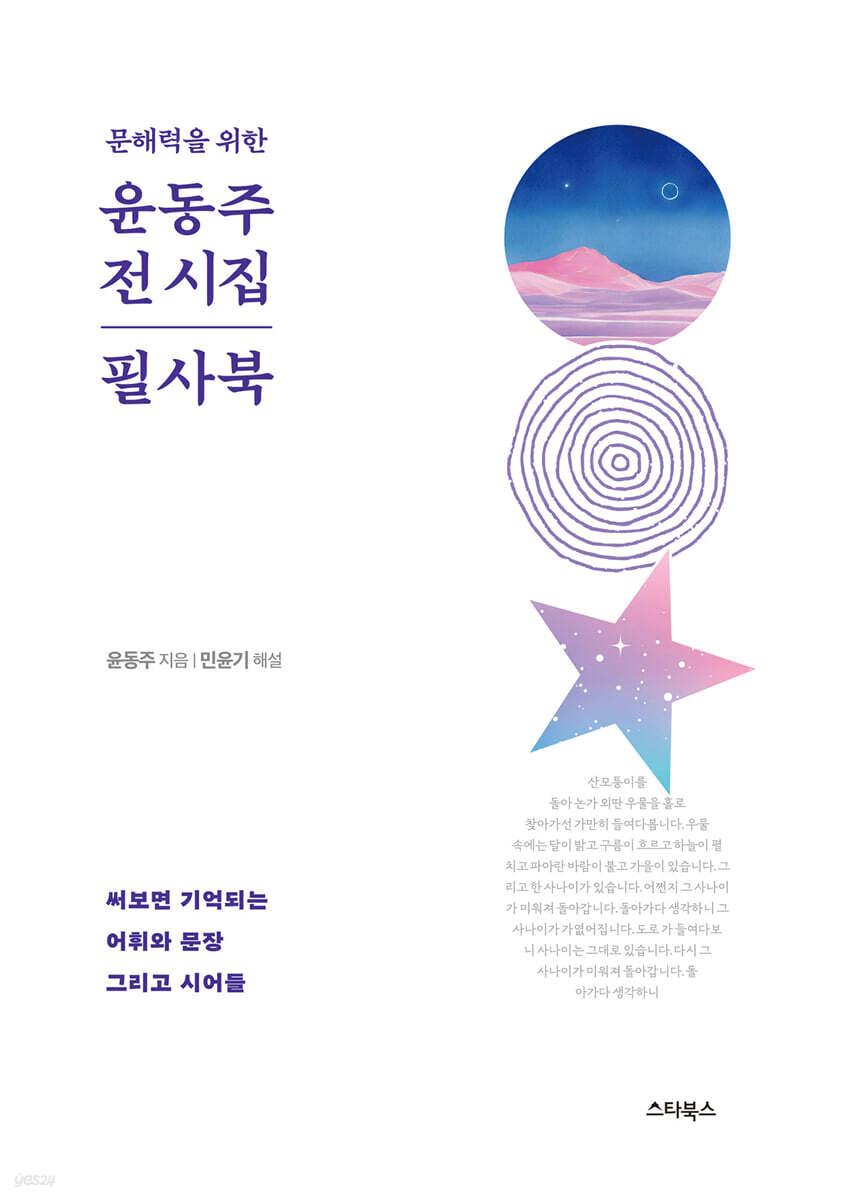
Yun Dong-ju's complete poetry collection manuscript book
 |
Description
Book Introduction
80th Anniversary of Yun Dong-ju's Death: A Book of Sky, Wind, Stars, and Poetry
A binding for manuscripts designed to be easy to write on and unfold naturally.
If you write, you are poet Yun Dong-ju.
There is a saying that if you try hard, you will win.
Famous writers of the past and present, such as Hemingway, Kim Hoon, and Kim Young-ha, have copied.
It is said that when Yun Dong-ju heard that his favorite poet Baek Seok's poetry collection, "Deer," had been published, he tried to get it before others, but was unable to, so he copied the entire collection and read it, recalling the poetic spirit.
If readers also transcribe the entire 『Complete Collection of Yun Dong-ju's Poetry』 and read the commentary on the poems, their comprehension of sentences and vocabulary will naturally improve.
Yun Dong-ju is now a poet and an honorary doctor.
The year 2025 marks the 80th anniversary of liberation and the 80th anniversary of the death of poet Yun Dong-ju after being subjected to vivisection at Fukuoka Prison.
Accordingly, Doshisha University in Japan, where Yun Dong-ju attended, even created an exception rule for 'awarding honorary degrees to the deceased', and decided to award an honorary doctorate on February 16, the anniversary of his death, with unanimous approval from all sixteen members of the deans' meeting.
Doshisha University President Katsuhiro Gohara said, “We are angry that we could not protect Yun Dong-ju from the military that suppressed freedom.
“The honorary doctorate is to remember him,” he said.
Even though it is not the 80th anniversary of his death, poet Yun Dong-ju has become a world-renowned poet, remembered by numerous organizations in Korea, Japan, China, the United States, Europe, and around the world.
A binding for manuscripts designed to be easy to write on and unfold naturally.
If you write, you are poet Yun Dong-ju.
There is a saying that if you try hard, you will win.
Famous writers of the past and present, such as Hemingway, Kim Hoon, and Kim Young-ha, have copied.
It is said that when Yun Dong-ju heard that his favorite poet Baek Seok's poetry collection, "Deer," had been published, he tried to get it before others, but was unable to, so he copied the entire collection and read it, recalling the poetic spirit.
If readers also transcribe the entire 『Complete Collection of Yun Dong-ju's Poetry』 and read the commentary on the poems, their comprehension of sentences and vocabulary will naturally improve.
Yun Dong-ju is now a poet and an honorary doctor.
The year 2025 marks the 80th anniversary of liberation and the 80th anniversary of the death of poet Yun Dong-ju after being subjected to vivisection at Fukuoka Prison.
Accordingly, Doshisha University in Japan, where Yun Dong-ju attended, even created an exception rule for 'awarding honorary degrees to the deceased', and decided to award an honorary doctorate on February 16, the anniversary of his death, with unanimous approval from all sixteen members of the deans' meeting.
Doshisha University President Katsuhiro Gohara said, “We are angry that we could not protect Yun Dong-ju from the military that suppressed freedom.
“The honorary doctorate is to remember him,” he said.
Even though it is not the 80th anniversary of his death, poet Yun Dong-ju has become a world-renowned poet, remembered by numerous organizations in Korea, Japan, China, the United States, Europe, and around the world.
- You can preview some of the book's contents.
Preview
index
The poem "Sky, Wind, Stars, and Poetry"
1.
Sky, wind, stars, and poetry
Self-portrait | Boy | Snowy Map | Night of Return | Hospital | New Road | Street without Signs | The Morning of the Beginning | Another Morning of the Beginning | Until Dawn | A Fearful Time | The Cross | The Wind Blows | A Sad People | I Close My Eyes and Go | Another Hometown | Road | Star-Counting Night
2.
white shadow
White Shadow | Loving Memories | Flowing Streets | Easily Written Poems | Spring
3.
night
Night | Testament | Portrait of a younger brother | Comfort | Liver | Mountain stream | Confession
4.
Eight Beatitudes
Eight Blessings | A Sleepless Night | Like the Moon | A Pepper Field | A Hall of Love | A Miracle | A Rainy Night | A Window | The Sea | Birobong | An Afternoon in a Mountain Valley | Meditation | A Shower | A Cold and Warm World | Scenery | A Moonlit Night | Chapter | When Twilight Becomes the Sea | Morning | Laundry | A Dream Is Broken | A Forest | A Day Like This | On the Mountain | Sunny Side | Chicken | Heart 1 | Heart 3 | Pigeon | Twilight | Southern Sky | The Blue Sky | On the Street | Life and Death | A Candle
5.
Sanulrim
Echoes of the Mountain | Sunflower Face | The Gwitturami and I | Baby's Dawn | Sunlight and Wind | Firefly | Both | Lie Beak | Snow | Sparrow | Sole Pattern | Letter | Spring | What Do We Eat? | Chimney | Sun Rain | Broom | Roof Tiles | Manneken Pis Map | Chick | Seashell | Winter
6.
meal ticket
Meal Ticket | Lark | Farewell | On Moranbong | Afternoon Field | Granary | That Woman | Sorrow | Cosmos | Sick Rose | Fantasy | No Tomorrow | Pocket | Dog | Hometown | Autumn Night | Airplane | Tree | Apple | Snow | Chicken | Grandfather | Mandoli
7.
prose
Turgenev's Hill | Shooting the Moon | Where a Shooting Star Falls | Flowers Bloom in the Garden | The End
8.
A poem excavated later
Chest 2 | Window Hole | Dog 2 | Depression | Night Walk | Behind the Rain | Mother | Street Tree
1.
Sky, wind, stars, and poetry
Self-portrait | Boy | Snowy Map | Night of Return | Hospital | New Road | Street without Signs | The Morning of the Beginning | Another Morning of the Beginning | Until Dawn | A Fearful Time | The Cross | The Wind Blows | A Sad People | I Close My Eyes and Go | Another Hometown | Road | Star-Counting Night
2.
white shadow
White Shadow | Loving Memories | Flowing Streets | Easily Written Poems | Spring
3.
night
Night | Testament | Portrait of a younger brother | Comfort | Liver | Mountain stream | Confession
4.
Eight Beatitudes
Eight Blessings | A Sleepless Night | Like the Moon | A Pepper Field | A Hall of Love | A Miracle | A Rainy Night | A Window | The Sea | Birobong | An Afternoon in a Mountain Valley | Meditation | A Shower | A Cold and Warm World | Scenery | A Moonlit Night | Chapter | When Twilight Becomes the Sea | Morning | Laundry | A Dream Is Broken | A Forest | A Day Like This | On the Mountain | Sunny Side | Chicken | Heart 1 | Heart 3 | Pigeon | Twilight | Southern Sky | The Blue Sky | On the Street | Life and Death | A Candle
5.
Sanulrim
Echoes of the Mountain | Sunflower Face | The Gwitturami and I | Baby's Dawn | Sunlight and Wind | Firefly | Both | Lie Beak | Snow | Sparrow | Sole Pattern | Letter | Spring | What Do We Eat? | Chimney | Sun Rain | Broom | Roof Tiles | Manneken Pis Map | Chick | Seashell | Winter
6.
meal ticket
Meal Ticket | Lark | Farewell | On Moranbong | Afternoon Field | Granary | That Woman | Sorrow | Cosmos | Sick Rose | Fantasy | No Tomorrow | Pocket | Dog | Hometown | Autumn Night | Airplane | Tree | Apple | Snow | Chicken | Grandfather | Mandoli
7.
prose
Turgenev's Hill | Shooting the Moon | Where a Shooting Star Falls | Flowers Bloom in the Garden | The End
8.
A poem excavated later
Chest 2 | Window Hole | Dog 2 | Depression | Night Walk | Behind the Rain | Mother | Street Tree
Detailed image
.jpg)
Into the book
As I return from the world, I now return to my small room and turn off the lights.
It's so tiring to keep the lights on.
Because it is an extension of the day -
Now I have to open the window to get some fresh air, but when I look outside, it's as dark as inside the room, just like the world outside, and the road I came from is still soaking wet in the rain.
When I close my eyes quietly, unable to wash away the day's frustration, the sound flowing in my mind, now, thoughts ripen on their own like a persimmon.
--- p.22 From "The Night I Return to See"
Cross the river and into the forest
Over the hill to the village
I went yesterday and I'm going today
My way, a new way
The chrysanthemums are blooming and the magpies are flying
The wind blew after the girl passed by
My path is always a new path
Today too… tomorrow too…
Cross the river and into the forest
Over the hill to the village
--- p.26 From "A New Path"
If you think about it, my childhood friends
One, two, I lost them all
What do I want
Am I just settling down alone?
They say life is hard to live
It's amazing how easy it is to write poetry
It's a shame.
The six-story room is a foreign country
Outside the window, the night rain is whispering,
Light a lamp and drive away the darkness,
The last me, waiting for the morning to come like the times,
I reach out to you with a little hand
The first handshake with tears and comfort.
--- pp.72-74 From "Easily Written Poems"
Tomorrow or the day after, or on any other happy day
I have to write another line of confession.
- At that young age
Why did you make such a shameful confession?
Every night, I look at my mirror
With the palm of your hand
Let's wipe it with the soles of our feet.
Then, walking alone under a meteorite
The back of a sad person
Appears in the mirror.
--- pp.96-98 From "Confessions"
I don't need to bother my brain with silly thoughts like, "I found myself in the garden, I climbed out the window, I opened the door, I came out."
However, just standing in front of Kotsumotsu, who is shy even when Guitram cries, and feeling sad like the shadow of the statue of Doctor Piringsu is enough.
I have no symbol to pass on this feeling to anyone.
The collar is sensitive, so it gets chilly even in the moonlight, and the autumn dew is so cold that it is like a man's tears.
When the footsteps move the body and place it on the edge of the pond, there is also autumn, the three watch of the night, trees, and the moon in the pond.
--- pp.292-294 From "Shooting the Moon"
I change the endpoint to the starting point.
Where I get off is my final destination.
Because where I ride becomes my point of view.
In this short moment, I am buried among so many people, and I become so superficial to them.
I don't have the talent to demonstrate my humanity to these people.
It is impossible for me to measure their joys, sorrows, and pains.
It's too vague.
People seem to become superficial too easily when things are frequent and the quantity is large.
The more that happens, the more busy you become in taking care of yourself.
Step on the signal and the train departs with a whoosh.
Even though it's not a car heading home, my heart is pounding for no reason.
Our train moves slowly and stops at makeshift stops when it gets out of breath.
It's so tiring to keep the lights on.
Because it is an extension of the day -
Now I have to open the window to get some fresh air, but when I look outside, it's as dark as inside the room, just like the world outside, and the road I came from is still soaking wet in the rain.
When I close my eyes quietly, unable to wash away the day's frustration, the sound flowing in my mind, now, thoughts ripen on their own like a persimmon.
--- p.22 From "The Night I Return to See"
Cross the river and into the forest
Over the hill to the village
I went yesterday and I'm going today
My way, a new way
The chrysanthemums are blooming and the magpies are flying
The wind blew after the girl passed by
My path is always a new path
Today too… tomorrow too…
Cross the river and into the forest
Over the hill to the village
--- p.26 From "A New Path"
If you think about it, my childhood friends
One, two, I lost them all
What do I want
Am I just settling down alone?
They say life is hard to live
It's amazing how easy it is to write poetry
It's a shame.
The six-story room is a foreign country
Outside the window, the night rain is whispering,
Light a lamp and drive away the darkness,
The last me, waiting for the morning to come like the times,
I reach out to you with a little hand
The first handshake with tears and comfort.
--- pp.72-74 From "Easily Written Poems"
Tomorrow or the day after, or on any other happy day
I have to write another line of confession.
- At that young age
Why did you make such a shameful confession?
Every night, I look at my mirror
With the palm of your hand
Let's wipe it with the soles of our feet.
Then, walking alone under a meteorite
The back of a sad person
Appears in the mirror.
--- pp.96-98 From "Confessions"
I don't need to bother my brain with silly thoughts like, "I found myself in the garden, I climbed out the window, I opened the door, I came out."
However, just standing in front of Kotsumotsu, who is shy even when Guitram cries, and feeling sad like the shadow of the statue of Doctor Piringsu is enough.
I have no symbol to pass on this feeling to anyone.
The collar is sensitive, so it gets chilly even in the moonlight, and the autumn dew is so cold that it is like a man's tears.
When the footsteps move the body and place it on the edge of the pond, there is also autumn, the three watch of the night, trees, and the moon in the pond.
--- pp.292-294 From "Shooting the Moon"
I change the endpoint to the starting point.
Where I get off is my final destination.
Because where I ride becomes my point of view.
In this short moment, I am buried among so many people, and I become so superficial to them.
I don't have the talent to demonstrate my humanity to these people.
It is impossible for me to measure their joys, sorrows, and pains.
It's too vague.
People seem to become superficial too easily when things are frequent and the quantity is large.
The more that happens, the more busy you become in taking care of yourself.
Step on the signal and the train departs with a whoosh.
Even though it's not a car heading home, my heart is pounding for no reason.
Our train moves slowly and stops at makeshift stops when it gets out of breath.
--- p.318 From "The End"
Publisher's Review
Awakening dormant vocabulary to lead intelligent conversations
The French national research institute, Collège de France, stated that “writing by hand creates a special neural circuit that operates automatically, making learning easier” as the transcription of “Yoon Dong-ju’s Complete Poetry Collection for Literacy” is the most reliable way to read slowly.
The hand is not only a motor organ that carries out commands from the brain, but also a sensory organ that provides the most information to the brain. Therefore, the more you use your hand, the greater the stimulation applied to the frontal lobe. In the process, the frontal lobe, which is the center of the brain, goes beyond interpreting the stimulation and engages in creative activities.
When it comes to writing, you can't leave out poet Yun Dong-ju.
When Yun Dong-ju heard that his favorite poet Baek Seok's poetry collection, "Deer," had been published, he tried to get it before others, but was unable to, so he transcribed the entire collection and read it to improve his literacy and reflect on the poetic ideas.
Yun Dong-ju's poetry collection was first published posthumously in 1948 by Jeong-eumsa under the title "Sky, Wind, Stars, and Poetry."
Yun Dong-ju's 31 poems are included in parts 1 to 3, and are included in chapters 1 to 3 of this book.
In 1955, an expanded edition of “Sky, Wind, Stars, and Poetry” was published to commemorate the 10th anniversary of Yun Dong-ju’s death.
In addition to the first edition, 62 poems and prose pieces were added, bringing the total to 93 pieces.
The added poems and prose are works that were made public in December 1948 when Yun Hye-won, Yun Dong-ju's younger sister, moved south to Seoul and brought all of her brother's manuscripts and favorite books from their hometown. (At the time, Yun Hye-won was under strict surveillance and was unable to bring a photo album.
I was afraid that if I did something wrong, I would be caught by the guards and have my precious manuscript stolen, so I left the album at a relative's house with the plan to retrieve it later, but something came up and I couldn't retrieve it.
It is said that Yun Hye-won regretted this for a long time and was heartbroken.) Of the 57 additional poems, 35 were included in the third part, “Confessions,” the remaining 22 were children’s songs and were included independently in the fourth part, and five prose pieces were included in the fifth part.
In this book, the poems added to Part 3 are divided into 4 chapters, the children's songs from Part 4 are divided into 5 chapters, and the five prose pieces are divided into 7 chapters.
The 1979 expanded edition included poems brought by Yun Hye-won from Yongjeong and 23 newly discovered works by Yun Dong-ju that had been withheld from inclusion to determine their authenticity.
It is included in Chapter 6 of this book.
Eight poems that were not included in existing Yun Dong-ju poetry collections, including poems that were incomplete or marked for deletion from the manuscript, are included in Chapter 8 of this book.
The notation of this poetry collection follows modern notation as much as possible, but as long as it does not interfere with reading, I tried to preserve the feeling of the original text as much as possible. Some words that were included differently depending on the year of publication, such as '얼골/얼굴' and '코쓰모쓰/코모스', were written as they were published at the time so that the changes can be conveyed.
All famous writers, including Hemingway, Kim Hoon, Kim Young-ha, Shin Kyung-sook, and Han Kang, wrote in manuscript.
It is said that if you sit quietly, read a sentence, and slowly write it down by hand, complicated matters will naturally be resolved, and the feeling of writing on paper helps relieve stress.
Readers will also improve their vocabulary and writing skills through transcription, as well as awaken their memories.
5 Ways to Improve Your Writing Skills by Writing
If you write it down, it's poet Yun Dong-ju!!
All famous writers have written manuscripts.
It is said that when Yun Dong-ju heard that his favorite poet Baek Seok's poetry collection, "Deer," had been published, he tried to get it before others, but was unable to, so he copied the entire collection and read it, recalling the poetic spirit.
If readers also transcribe the entire 『Complete Collection of Yun Dong-ju's Poetry』 and read the commentary on the poems, their comprehension of sentences will naturally improve.
Writing is the most precious time of immersion
There is a saying that if you try hard, you will win.
There are many differences in understanding the content of a text between reading it with your eyes and trying to write it out yourself.
As you keep writing, you will experience dormant vocabulary awakening and memories coming back to life.
Also, once you hold a writing instrument, the feeling of writing on paper that makes you want to keep writing and drawing helps relieve stress and even provides time for meditation.
Transcription broadens your understanding of sentences.
Transcription is the best way to learn vocabulary and sentences while also developing and practicing writing skills by copying beautiful lines from good poetry.
Furthermore, it can be said to be the fastest way to grow into a poet who writes good poetry.
Therefore, as you transcribe, your memory of vocabulary and sentences will improve explosively without you even realizing it, to a level that is incomparable to when you just read.
If you try one, you will know two, three.
There is an idiom in Chinese that says, “Hear one and know ten.”
The same goes for the proverbs, “See one and know ten,” and “Teach one and know ten.”
Therefore, if you concentrate on writing 『Yoon Dong-ju's Complete Poetry Collection』 with all your heart, your literacy and vocabulary will naturally improve, and your writing skills will naturally improve. This will give you confidence in your writing, and you will be able to write essays along with poetry easily.
Once you finish writing, it becomes your own special treasure.
After I have completely transcribed 『Yoon Dong-ju's Complete Poetry Collection』 'Sky, Wind, Stars and Poetry', I will have created a treasured book of my own.
Although it is a collection of Yun Dong-ju's poems, it is a book that I have carefully copied, so it has special meaning and is a treasure worth owning.
If the manuscript in which poet Yun Dong-ju copied Baek Seok's poetry collection had survived to this day, its value would be beyond imagination.
The French national research institute, Collège de France, stated that “writing by hand creates a special neural circuit that operates automatically, making learning easier” as the transcription of “Yoon Dong-ju’s Complete Poetry Collection for Literacy” is the most reliable way to read slowly.
The hand is not only a motor organ that carries out commands from the brain, but also a sensory organ that provides the most information to the brain. Therefore, the more you use your hand, the greater the stimulation applied to the frontal lobe. In the process, the frontal lobe, which is the center of the brain, goes beyond interpreting the stimulation and engages in creative activities.
When it comes to writing, you can't leave out poet Yun Dong-ju.
When Yun Dong-ju heard that his favorite poet Baek Seok's poetry collection, "Deer," had been published, he tried to get it before others, but was unable to, so he transcribed the entire collection and read it to improve his literacy and reflect on the poetic ideas.
Yun Dong-ju's poetry collection was first published posthumously in 1948 by Jeong-eumsa under the title "Sky, Wind, Stars, and Poetry."
Yun Dong-ju's 31 poems are included in parts 1 to 3, and are included in chapters 1 to 3 of this book.
In 1955, an expanded edition of “Sky, Wind, Stars, and Poetry” was published to commemorate the 10th anniversary of Yun Dong-ju’s death.
In addition to the first edition, 62 poems and prose pieces were added, bringing the total to 93 pieces.
The added poems and prose are works that were made public in December 1948 when Yun Hye-won, Yun Dong-ju's younger sister, moved south to Seoul and brought all of her brother's manuscripts and favorite books from their hometown. (At the time, Yun Hye-won was under strict surveillance and was unable to bring a photo album.
I was afraid that if I did something wrong, I would be caught by the guards and have my precious manuscript stolen, so I left the album at a relative's house with the plan to retrieve it later, but something came up and I couldn't retrieve it.
It is said that Yun Hye-won regretted this for a long time and was heartbroken.) Of the 57 additional poems, 35 were included in the third part, “Confessions,” the remaining 22 were children’s songs and were included independently in the fourth part, and five prose pieces were included in the fifth part.
In this book, the poems added to Part 3 are divided into 4 chapters, the children's songs from Part 4 are divided into 5 chapters, and the five prose pieces are divided into 7 chapters.
The 1979 expanded edition included poems brought by Yun Hye-won from Yongjeong and 23 newly discovered works by Yun Dong-ju that had been withheld from inclusion to determine their authenticity.
It is included in Chapter 6 of this book.
Eight poems that were not included in existing Yun Dong-ju poetry collections, including poems that were incomplete or marked for deletion from the manuscript, are included in Chapter 8 of this book.
The notation of this poetry collection follows modern notation as much as possible, but as long as it does not interfere with reading, I tried to preserve the feeling of the original text as much as possible. Some words that were included differently depending on the year of publication, such as '얼골/얼굴' and '코쓰모쓰/코모스', were written as they were published at the time so that the changes can be conveyed.
All famous writers, including Hemingway, Kim Hoon, Kim Young-ha, Shin Kyung-sook, and Han Kang, wrote in manuscript.
It is said that if you sit quietly, read a sentence, and slowly write it down by hand, complicated matters will naturally be resolved, and the feeling of writing on paper helps relieve stress.
Readers will also improve their vocabulary and writing skills through transcription, as well as awaken their memories.
5 Ways to Improve Your Writing Skills by Writing
If you write it down, it's poet Yun Dong-ju!!
All famous writers have written manuscripts.
It is said that when Yun Dong-ju heard that his favorite poet Baek Seok's poetry collection, "Deer," had been published, he tried to get it before others, but was unable to, so he copied the entire collection and read it, recalling the poetic spirit.
If readers also transcribe the entire 『Complete Collection of Yun Dong-ju's Poetry』 and read the commentary on the poems, their comprehension of sentences will naturally improve.
Writing is the most precious time of immersion
There is a saying that if you try hard, you will win.
There are many differences in understanding the content of a text between reading it with your eyes and trying to write it out yourself.
As you keep writing, you will experience dormant vocabulary awakening and memories coming back to life.
Also, once you hold a writing instrument, the feeling of writing on paper that makes you want to keep writing and drawing helps relieve stress and even provides time for meditation.
Transcription broadens your understanding of sentences.
Transcription is the best way to learn vocabulary and sentences while also developing and practicing writing skills by copying beautiful lines from good poetry.
Furthermore, it can be said to be the fastest way to grow into a poet who writes good poetry.
Therefore, as you transcribe, your memory of vocabulary and sentences will improve explosively without you even realizing it, to a level that is incomparable to when you just read.
If you try one, you will know two, three.
There is an idiom in Chinese that says, “Hear one and know ten.”
The same goes for the proverbs, “See one and know ten,” and “Teach one and know ten.”
Therefore, if you concentrate on writing 『Yoon Dong-ju's Complete Poetry Collection』 with all your heart, your literacy and vocabulary will naturally improve, and your writing skills will naturally improve. This will give you confidence in your writing, and you will be able to write essays along with poetry easily.
Once you finish writing, it becomes your own special treasure.
After I have completely transcribed 『Yoon Dong-ju's Complete Poetry Collection』 'Sky, Wind, Stars and Poetry', I will have created a treasured book of my own.
Although it is a collection of Yun Dong-ju's poems, it is a book that I have carefully copied, so it has special meaning and is a treasure worth owning.
If the manuscript in which poet Yun Dong-ju copied Baek Seok's poetry collection had survived to this day, its value would be beyond imagination.
GOODS SPECIFICS
- Date of issue: January 21, 2025
- Format: Hardcover book binding method guide
- Page count, weight, size: 344 pages | 572g | 138*196*25mm
- ISBN13: 9791157957552
- ISBN10: 1157957552
You may also like
카테고리
korean


korean

![GQ KOREA Mark (Monthly): December [2025]](http://librairie.coreenne.fr/cdn/shop/files/8ef265dbbfbf186523ed75ba7319009d.jpg?v=1765340328&width=3840)


