

Daechi-dong
 |
Description
Book Introduction
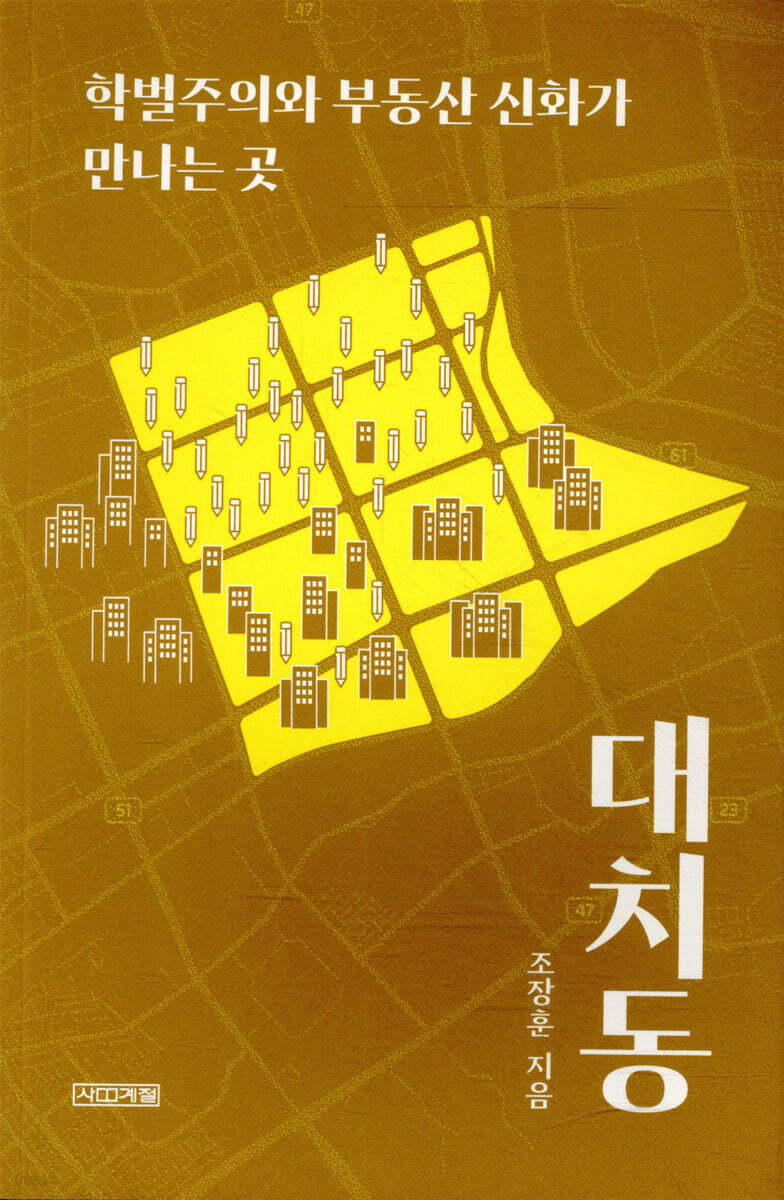
Daechi-dong is the front line of all desires in South Korea. Daechi-dong is the center of private education in Korea, where it analyzes all types of problems and entrance exam guidelines and responds quickly. It is also the peak of the real estate market, which drives up housing prices nationwide. Jo Jang-hoon, an entrance exam expert who has worked in this academy district for over 20 years, recorded the chaotic scene inside Daechi-dong, where people flock to get into prestigious universities and those calculating real estate price differences amidst the excitement. He added stories of people in the academy industry, including parents, students, academy directors, instructors, and counseling center directors, that he has seen, heard, and experienced, to the macroscopic structure of the university entrance exam system, which is constantly fluctuating as a result of the power struggle between classes, the private education system that plans and sells it as a product, and the housing prices that soar as private education develops. The author calls this place the "front line of desire" and traces the path that Koreans' worldly desires took toward academic elitism and the myth of real estate. It also depicts in detail the structure in which misfortune is amplified by looking into the inner lives of individuals struggling within it. Envisioning a better tomorrow begins with facing our present desires. This book dynamically depicts the intersection of institutional and policy changes, profit-driven markets, and the individual pursuit of upward mobility and wealth. It will provide a clear starting point for discussions for those contemplating the future of education and college entrance systems. |
- You can preview some of the book's contents.
Preview
index
Recommendation
Entering - College Entrance Exams and Daechi-dong: A Record of the Chaos
Part 1: Genealogy of Misfortune
Chapter 1: College Entrance Exams: A Rite of Passage on the Edge of a Cliff
Chapter 2: The College Scholastic Ability Test: The Twilight of the Oldest Exam
Chapter 3: The Golden Age of Argumentation and Its Suspicious Decline
Chapter 4: The Rose-Colored Blueprint of the Admissions Officer System and Its Hierarchical Misuse
Chapter 5: School Types: The Tragedy Caused by the Most Ideal College Entrance Exam System
Chapter 6: Why College Entrance Exams Lead to Unhappiness: Academic Esteem and Educational Fever
Part 2: The Daechi-dong Story: Surviving in a Society Focused on Academic Background and a Real Estate Republic
Chapter 1: The Secret of Eunma Apartment's Sold-Out Success and the Birth of the Gangnam Myth
Chapter 2: The Formation of Daechi-dong's Academy District and the Heyday of Speculators
Chapter 3: Academic Laundering and Falsification: The Class Reproduction of the Kkapitan Lees
Chapter 4: Real Estate No. 1, Fortune No. 1
Chapter 5: The Carousel of Fear Dreaming of Uneasy Happiness
Part 3: People of Daechi-dong
Chapter 1: Daechi-dong Moms ① - Pig Mom and Cafe Mom
Chapter 2: Daechi-dong Mothers ② - The Four Clans of Daechi-dong and Their Mothers
Chapter 3: Dads in Daechi-dong
Chapter 4: People of Daechi-dong Academy District ① - Academy Director
Chapter 5: People of Daechi-dong Academy District ② - Instructor
Chapter 6: People of Daechi-dong Academy District ③ - The Evolution of Counseling Center Managers and the Emergence of Entrance Exam Cafes
Chapter 7: Why We Should Pay Attention to the "People" of Daechi-dong
Part 4: For Better College Entrance Exams and Happier Education
Chapter 1: Private Education User Manual ① - Is Private Education a Social Evil?
Chapter 2: Private Education User Manual ② - How to Use Private Education at Private Academy
Chapter 3: For a Better College Entrance Exam System
Chapter 4: Can Education Make Us Happy?
Coming Out - A Song of Hope and a Country You Can't Go To
References
Entering - College Entrance Exams and Daechi-dong: A Record of the Chaos
Part 1: Genealogy of Misfortune
Chapter 1: College Entrance Exams: A Rite of Passage on the Edge of a Cliff
Chapter 2: The College Scholastic Ability Test: The Twilight of the Oldest Exam
Chapter 3: The Golden Age of Argumentation and Its Suspicious Decline
Chapter 4: The Rose-Colored Blueprint of the Admissions Officer System and Its Hierarchical Misuse
Chapter 5: School Types: The Tragedy Caused by the Most Ideal College Entrance Exam System
Chapter 6: Why College Entrance Exams Lead to Unhappiness: Academic Esteem and Educational Fever
Part 2: The Daechi-dong Story: Surviving in a Society Focused on Academic Background and a Real Estate Republic
Chapter 1: The Secret of Eunma Apartment's Sold-Out Success and the Birth of the Gangnam Myth
Chapter 2: The Formation of Daechi-dong's Academy District and the Heyday of Speculators
Chapter 3: Academic Laundering and Falsification: The Class Reproduction of the Kkapitan Lees
Chapter 4: Real Estate No. 1, Fortune No. 1
Chapter 5: The Carousel of Fear Dreaming of Uneasy Happiness
Part 3: People of Daechi-dong
Chapter 1: Daechi-dong Moms ① - Pig Mom and Cafe Mom
Chapter 2: Daechi-dong Mothers ② - The Four Clans of Daechi-dong and Their Mothers
Chapter 3: Dads in Daechi-dong
Chapter 4: People of Daechi-dong Academy District ① - Academy Director
Chapter 5: People of Daechi-dong Academy District ② - Instructor
Chapter 6: People of Daechi-dong Academy District ③ - The Evolution of Counseling Center Managers and the Emergence of Entrance Exam Cafes
Chapter 7: Why We Should Pay Attention to the "People" of Daechi-dong
Part 4: For Better College Entrance Exams and Happier Education
Chapter 1: Private Education User Manual ① - Is Private Education a Social Evil?
Chapter 2: Private Education User Manual ② - How to Use Private Education at Private Academy
Chapter 3: For a Better College Entrance Exam System
Chapter 4: Can Education Make Us Happy?
Coming Out - A Song of Hope and a Country You Can't Go To
References
Detailed image

Into the book
In fact, if we look at the numbers alone, it is correct to say that the Evaluation Institute has been quite successful in adjusting the level of difficulty for at least 15 years since the 2005 school year when the 7th curriculum was introduced.
The same goes for the accuracy of the questions.
Despite the number of objections exceeding 300 each year, only two cases were actually acknowledged as errors in the exam or multiple correct answers.
In fact, the CSAT is a fairly reliable test.
But this long-standing, well-managed test leaves our society feeling not secure, but fundamentally uneasy.
In a society where the term "impossible college entrance exam" is plastered all over the pages every year and parents and intellectuals alike attack the difficulty of college entrance exam questions, the exam preparation agencies have no choice but to pay attention to the public's opinion.
… … Our society’s interest in and criticism of the difficulty of the CSAT has clearly gone too far.
People find this test unsettling.
It's not easy to believe.
Why on earth are we so sensitive about the CSAT?
---From "The College Scholastic Ability Test, the Uneasy Twilight of the Oldest Exam"
There were certain parents who could support their children by pinning their hopes on this model.
… … The elite class of intellectuals who have studied abroad in the United States or who understand the American college admissions system not only fully sympathize with the educational significance and value of the admissions officer system, but also have some idea of what kind of preparation is necessary.
… … Meanwhile, the economic upper class had easy access to the cultural resources of these intellectual elites.
They could access the information they had through various forms of social gatherings and business relationships, and could even entrust their children with guidance whenever necessary.
… …
In the end, the Lee Myung-bak administration thoroughly represented the interests of its supporters.
This is clearly evident in the admissions policy of establishing 100 autonomous private high schools and the 300 Diversity High Schools Project.
This series of policies, wrapped in the plausible rhetoric of developing students' diverse talents and increasing educational efficiency through level-based education, were in fact faithful to the class ideal of providing better opportunities to those who could afford to pay more tuition.
---From "Why was the Lee Myung-bak government so obsessed with the admissions officer system?"
In a classroom filled with the excitement of presentations and group activities, two-thirds of the students are sleeping face down.
… … This time is meaningless to the children who receive a student record filled with copy-and-pasted words.
Are teachers' authority being restored? If some teachers feel that way, it's because students who have to take the exam need to present themselves well to their homeroom teachers and subject teachers.
… …
For the majority of 'abandoned' students, teachers are irrelevant.
Because you can't get good scores on the CSAT through school classes.
The class doesn't make the progress it should, and instead of presentations and group activities, the smart and talented kids just get together and talk about things that I can't understand.
These children feel that it is better to sleep at school and go to academies or take online classes in the evenings to get something out of it.
This is because the most efficient spoon-fed lectures are still being held there, kindly explaining the basic concepts and forcing students to memorize words and formulas.
To these people, their homeroom teacher is a 'damtang', but their academy instructor is a 'teacher'.
At least the academy instructor actually makes an effort to improve my grades… … .
---From "Can School Paper Save Public Education?"
People who own houses in Daechi-dong will never sell their houses and instead rent them out, because the price of houses will continue to rise thanks to the academy district, even if there is no longer a reason to live there.
And based on the skyrocketing housing prices, they raise the jeonse and monthly rent every year.
Then, residents of Daechi-dong who own their own homes in the outskirts of Seoul or Gyeonggi-do will raise the rent on their homes to afford the increased rent.
The owner of the house next door also raises the rent after seeing this.
The rise in monthly rent in Daechi-dong has led to a jeonse crisis in the entire metropolitan area.
In the midst of the chaos of that great turmoil, those who envied those who were successful in raising their children and making money with their own homes without doing anything else were all looking for better locations to make a profit from the price difference.
In this way, the entire country becomes a hotbed of real estate speculation.
---From "The Seoul Metropolitan Area Rental Crisis and Real Estate Speculation Fever That Started in Daechi-dong"
These academies provided self-study spaces by accommodating repeat students in classrooms while current students were at school.
And by maintaining the existing department system, we ensured that repeat test takers had the freedom to choose their own studies.
In addition, they filled in the gaps in self-study by hiring students from prestigious universities as part-time workers to answer questions during self-study time and provide study coaching.
This new system satisfied everyone's needs.
Students enjoyed being able to study subjects they were lacking through selective study and concentration, and the meticulous management structure of the self-study coaching system captivated parents.
… … The academies all recommended that I retake the exam.
The saying, "Take the exam a second time is essential, take the exam a third time is optional" began to spread among parents in Daechi-dong.
… … The rate of repeat students in Gangnam began to skyrocket.
… … The only reason so many people choose to retake the exam is to obtain a better education.
---From "The Seoul Metropolitan Area Rental Crisis and Real Estate Speculation Fever That Started in Daechi-dong"
Mothers who are obsessed with college entrance exams are such lonely people.
Despite being devoted to her children in her own way, she was not respected by any of her family members.
… … In this vicious cycle of neglect and alienation, the only place where mothers could find solace for their wounded inner selves would have been a cafe where they could meet other mothers.
There was a pig mother there who had succeeded in her child's college entrance exam in a similar situation to hers, and there were colleagues who listened to her story.
Even though they would dismiss these stories as mere rumors at home, the moms at the cafe would listen attentively and add their own valuable insights.
There, one could have one's existence and story acknowledged.
“The kids ignore us now, but they’ll be grateful when they get into prestigious universities,” the mothers said, comforting each other. They also harbored hopes that if their children got into good universities, they too might be treated like Pig Moms by others.
In short, Pig Mom was the role model of this world.
---From "The Anxious Psychological State of Daechi-dong Mothers"
The salmon tribe began to become a problematic group in 2008 when the admissions officer system was implemented and qualitative evaluation emerged.
When the initial admissions officer system admissions results were released and it was confirmed that external specifications and subjective evaluation factors had a greater influence than numerical grades, the salmon tribe devised a new strategy.
He mobilized his own and his parents' generation's connections to create numerous competitions for external qualifications and exerted influence to introduce academic experience and internship programs for high school students at universities, hospitals, and the legal profession.
In fact, their children have benefited greatly from the dozens of mock UN conferences and mock courts they have created.
These are the people who brought up the so-called 'Dad's Chance' and 'Mom's Chance'.
… … The salmon tribe’s strategy of attacking the admissions officer system based on information power and networks became an opportunity to clearly reveal the class and educational gaps that already existed in society.
---From "The Salmon Family's Spec Exchange, Dad's Chance or Mom's Chance"
Most of the instructors who shape and drive the academy culture and ecosystem in Daechi-dong are self-employed instructors who have contracts with various academies and offer courses in the form of short courses.
… … He boasts of his experience as a lecturer in Daechi-dong, and during the weekdays he lectures at a comprehensive preparatory school or boarding preparatory school in each region. On weekdays or weekends when he is not teaching in Daechi-dong, he lectures to more students in other regions.
… …
These are the people who truly embody the worldly desires of the Daechi-dong instructors.
Just like a salesperson, I strive to build a wider network by maintaining good relationships with the instructors, counselors, and directors I meet at the academy, and based on this, I strive to seize more opportunities.
He lives a surprisingly intense life, spending his own money to promote his lectures, sharing information about viral marketing companies that border on the illegal and unlawful, and maintaining various networks through private gatherings after his lectures.
Yet, they are people with superhuman energy who strive to develop and improve lecture content.
---From "The Real Stars of Daechi-dong's Academy District, Self-Employed Instructors"
The reason the counseling director was able to secure independent capabilities was because he was able to influence the instructor network and the parent network, the two axes that drive the Daechi-dong academy ecosystem.
The instructors could not help but be sympathetic to these counselors who supported and encouraged the instructors who had difficulty even eating properly amidst their hectic lecture schedules.
… … The same was true for parents.
The friendly counselor was able to treat the parents almost like a 'cook', so to speak.
… …
People who have worked as counseling directors for a long time are well-versed in laws and administration related to private academies and have also started various businesses.
Because they were well aware of the seasonal classroom conditions of each academy, some of them engaged in illegal sales activities, renting empty classrooms and connecting instructors and parents directly to arrange lectures.
Of course, since it was well known that this was illegal, this type of practice soon disappeared, and college entrance exam consulting firms that charged high consulting fees appeared.
… … It is no exaggeration to say that they are the founders of college entrance exam consulting, which is currently the core revenue model for private education in Daechi-dong and nationwide.
The same goes for the accuracy of the questions.
Despite the number of objections exceeding 300 each year, only two cases were actually acknowledged as errors in the exam or multiple correct answers.
In fact, the CSAT is a fairly reliable test.
But this long-standing, well-managed test leaves our society feeling not secure, but fundamentally uneasy.
In a society where the term "impossible college entrance exam" is plastered all over the pages every year and parents and intellectuals alike attack the difficulty of college entrance exam questions, the exam preparation agencies have no choice but to pay attention to the public's opinion.
… … Our society’s interest in and criticism of the difficulty of the CSAT has clearly gone too far.
People find this test unsettling.
It's not easy to believe.
Why on earth are we so sensitive about the CSAT?
---From "The College Scholastic Ability Test, the Uneasy Twilight of the Oldest Exam"
There were certain parents who could support their children by pinning their hopes on this model.
… … The elite class of intellectuals who have studied abroad in the United States or who understand the American college admissions system not only fully sympathize with the educational significance and value of the admissions officer system, but also have some idea of what kind of preparation is necessary.
… … Meanwhile, the economic upper class had easy access to the cultural resources of these intellectual elites.
They could access the information they had through various forms of social gatherings and business relationships, and could even entrust their children with guidance whenever necessary.
… …
In the end, the Lee Myung-bak administration thoroughly represented the interests of its supporters.
This is clearly evident in the admissions policy of establishing 100 autonomous private high schools and the 300 Diversity High Schools Project.
This series of policies, wrapped in the plausible rhetoric of developing students' diverse talents and increasing educational efficiency through level-based education, were in fact faithful to the class ideal of providing better opportunities to those who could afford to pay more tuition.
---From "Why was the Lee Myung-bak government so obsessed with the admissions officer system?"
In a classroom filled with the excitement of presentations and group activities, two-thirds of the students are sleeping face down.
… … This time is meaningless to the children who receive a student record filled with copy-and-pasted words.
Are teachers' authority being restored? If some teachers feel that way, it's because students who have to take the exam need to present themselves well to their homeroom teachers and subject teachers.
… …
For the majority of 'abandoned' students, teachers are irrelevant.
Because you can't get good scores on the CSAT through school classes.
The class doesn't make the progress it should, and instead of presentations and group activities, the smart and talented kids just get together and talk about things that I can't understand.
These children feel that it is better to sleep at school and go to academies or take online classes in the evenings to get something out of it.
This is because the most efficient spoon-fed lectures are still being held there, kindly explaining the basic concepts and forcing students to memorize words and formulas.
To these people, their homeroom teacher is a 'damtang', but their academy instructor is a 'teacher'.
At least the academy instructor actually makes an effort to improve my grades… … .
---From "Can School Paper Save Public Education?"
People who own houses in Daechi-dong will never sell their houses and instead rent them out, because the price of houses will continue to rise thanks to the academy district, even if there is no longer a reason to live there.
And based on the skyrocketing housing prices, they raise the jeonse and monthly rent every year.
Then, residents of Daechi-dong who own their own homes in the outskirts of Seoul or Gyeonggi-do will raise the rent on their homes to afford the increased rent.
The owner of the house next door also raises the rent after seeing this.
The rise in monthly rent in Daechi-dong has led to a jeonse crisis in the entire metropolitan area.
In the midst of the chaos of that great turmoil, those who envied those who were successful in raising their children and making money with their own homes without doing anything else were all looking for better locations to make a profit from the price difference.
In this way, the entire country becomes a hotbed of real estate speculation.
---From "The Seoul Metropolitan Area Rental Crisis and Real Estate Speculation Fever That Started in Daechi-dong"
These academies provided self-study spaces by accommodating repeat students in classrooms while current students were at school.
And by maintaining the existing department system, we ensured that repeat test takers had the freedom to choose their own studies.
In addition, they filled in the gaps in self-study by hiring students from prestigious universities as part-time workers to answer questions during self-study time and provide study coaching.
This new system satisfied everyone's needs.
Students enjoyed being able to study subjects they were lacking through selective study and concentration, and the meticulous management structure of the self-study coaching system captivated parents.
… … The academies all recommended that I retake the exam.
The saying, "Take the exam a second time is essential, take the exam a third time is optional" began to spread among parents in Daechi-dong.
… … The rate of repeat students in Gangnam began to skyrocket.
… … The only reason so many people choose to retake the exam is to obtain a better education.
---From "The Seoul Metropolitan Area Rental Crisis and Real Estate Speculation Fever That Started in Daechi-dong"
Mothers who are obsessed with college entrance exams are such lonely people.
Despite being devoted to her children in her own way, she was not respected by any of her family members.
… … In this vicious cycle of neglect and alienation, the only place where mothers could find solace for their wounded inner selves would have been a cafe where they could meet other mothers.
There was a pig mother there who had succeeded in her child's college entrance exam in a similar situation to hers, and there were colleagues who listened to her story.
Even though they would dismiss these stories as mere rumors at home, the moms at the cafe would listen attentively and add their own valuable insights.
There, one could have one's existence and story acknowledged.
“The kids ignore us now, but they’ll be grateful when they get into prestigious universities,” the mothers said, comforting each other. They also harbored hopes that if their children got into good universities, they too might be treated like Pig Moms by others.
In short, Pig Mom was the role model of this world.
---From "The Anxious Psychological State of Daechi-dong Mothers"
The salmon tribe began to become a problematic group in 2008 when the admissions officer system was implemented and qualitative evaluation emerged.
When the initial admissions officer system admissions results were released and it was confirmed that external specifications and subjective evaluation factors had a greater influence than numerical grades, the salmon tribe devised a new strategy.
He mobilized his own and his parents' generation's connections to create numerous competitions for external qualifications and exerted influence to introduce academic experience and internship programs for high school students at universities, hospitals, and the legal profession.
In fact, their children have benefited greatly from the dozens of mock UN conferences and mock courts they have created.
These are the people who brought up the so-called 'Dad's Chance' and 'Mom's Chance'.
… … The salmon tribe’s strategy of attacking the admissions officer system based on information power and networks became an opportunity to clearly reveal the class and educational gaps that already existed in society.
---From "The Salmon Family's Spec Exchange, Dad's Chance or Mom's Chance"
Most of the instructors who shape and drive the academy culture and ecosystem in Daechi-dong are self-employed instructors who have contracts with various academies and offer courses in the form of short courses.
… … He boasts of his experience as a lecturer in Daechi-dong, and during the weekdays he lectures at a comprehensive preparatory school or boarding preparatory school in each region. On weekdays or weekends when he is not teaching in Daechi-dong, he lectures to more students in other regions.
… …
These are the people who truly embody the worldly desires of the Daechi-dong instructors.
Just like a salesperson, I strive to build a wider network by maintaining good relationships with the instructors, counselors, and directors I meet at the academy, and based on this, I strive to seize more opportunities.
He lives a surprisingly intense life, spending his own money to promote his lectures, sharing information about viral marketing companies that border on the illegal and unlawful, and maintaining various networks through private gatherings after his lectures.
Yet, they are people with superhuman energy who strive to develop and improve lecture content.
---From "The Real Stars of Daechi-dong's Academy District, Self-Employed Instructors"
The reason the counseling director was able to secure independent capabilities was because he was able to influence the instructor network and the parent network, the two axes that drive the Daechi-dong academy ecosystem.
The instructors could not help but be sympathetic to these counselors who supported and encouraged the instructors who had difficulty even eating properly amidst their hectic lecture schedules.
… … The same was true for parents.
The friendly counselor was able to treat the parents almost like a 'cook', so to speak.
… …
People who have worked as counseling directors for a long time are well-versed in laws and administration related to private academies and have also started various businesses.
Because they were well aware of the seasonal classroom conditions of each academy, some of them engaged in illegal sales activities, renting empty classrooms and connecting instructors and parents directly to arrange lectures.
Of course, since it was well known that this was illegal, this type of practice soon disappeared, and college entrance exam consulting firms that charged high consulting fees appeared.
… … It is no exaggeration to say that they are the founders of college entrance exam consulting, which is currently the core revenue model for private education in Daechi-dong and nationwide.
---From "The Leading Figure of Change in Daechi-dong, the Counseling Center Director"
Publisher's Review
Fierce competition to acquire academic resources
Where the bustling movement toward real estate price arbitrage meets
An insider's perspective from an admissions expert
An Anthropological Exploration of the Daechi-dong Academy District
If there are two issues in Korean society that have never ceased to be hotly debated, they are college entrance exams and real estate.
In a society where college entrance exam scores and the university one attended follow one's entire life like labels, limiting one's employment, promotion, income, and all other possibilities, people are competitively obsessed with college entrance exams.
They pay a high price in the private education market, which boasts the best instructors and level-based entrance exam strategies, and build up their credentials by walking a fine line between illegal and unlawful practices.
It is considered natural to step on one's colleagues and rise above them, and the whole society rushes to add to a single question on the college entrance exam.
In places where this intense heat gathers, housing prices skyrocket, and those who move to help their children prepare for college reap huge profits.
Daechi-dong is where college entrance exams and real estate are closely intertwined, shaking up homes, schools, academies, and the real estate market across the country.
In the middle of it all is the academy, the driving force behind this massive structure.
The author, who started as an essay instructor in the late 1990s and worked as an admissions counselor and academy director in Daechi-dong's academy district until 2020, says that the Korean college entrance exam is neither a rite of passage for new members of society nor a gateway to the next stage of academic life.
Rather, it is a giant casino that controls individual lives from a very early age and further creates inequality and discrimination by dividing society into the deserving and the destitute, winners and losers.
This is why even people who are not currently involved in college entrance exams need to look inside and out.
At this point, Korea's college entrance exams should be the subject of social scientific inquiry.
As it turns out, I've spent a significant portion of my life on the front lines of college admissions.
From the perspective of anthropology, which was my major during my undergraduate years, I unintentionally conducted fieldwork for quite a long period of time.
From an investigator's perspective, Daechi-dong, a space representative of the private education scene in South Korea, is a kaleidoscope that starkly reveals a facet of Koreans' deepest desires.
… … A giant casino that creates a world of inequality and discrimination to the point where participants feel like they are standing on a cliff.
It is absurd to call this college entrance exam a rite of passage.
… … As we go through the college entrance exam, members of society are divided into winners and losers, upper and lower classes, those who can and those who cannot.
College entrance exams clearly define society.
The point where separation and discrimination begin may be the point where society disintegrates, but it cannot be the point where it is (re)constructed.
The college entrance exam, which has been considered a rite of passage for our children, is now hanging precariously in front of a precipice.
-Pages 13-35
This book is the first record to closely examine the Daechi-dong academy district from an insider's perspective and a social scientific perspective.
The author, having been part of this 'chaos of desires' himself, rather than criticizing anyone from a certain standpoint, depicted how systems and policies lost their original purpose and ran aground in a direction that reinforced existing contradictions and irrationality amidst individual desires, social structures, market logic, and the manipulation of the media.
In particular, the position of a private education director, who has access to almost all stakeholders including parents, students, teachers, academy management, and instructors at various levels, takes readers to the deepest part of the private education market that was previously difficult to access.
At a time when the harmful effects of academic elitism are becoming increasingly apparent, this book will provide an opportunity to comprehensively examine education, college admissions, and the inseparable real estate issue from the perspective of the private education market, which contributes to solidifying the structure of discrimination and inequality.
The CSAT has already been analyzed and dominated by private education.
The evolution of the college entrance exam system: a product of class struggles.
The repeated changes in the college entrance examination system, and in particular the decline of the College Scholastic Ability Test (CSAT), the oldest test in the history of Korean college entrance examinations, had a major impact on Daechi-dong becoming what it is today.
The CSAT was originally a qualification exam that was introduced with the premise of reviving the university-specific main exam to address the memorization-oriented education and uniform ranking that the original scholastic ability test had led to.
However, due to public backlash, the test was abolished after only three years of implementation, and the CSAT was forced to change into a knowledge-verification test to secure discrimination power, contrary to its original purpose.
The College Scholastic Ability Test (CSAT), which has been gradually refined in response to parental demands, university positions, and the influence of private education providers, can no longer present new types of questions and has become a test that is swayed by access to private education.
Private education companies do not hesitate to use any means necessary to win the competition.
Collect and analyze new types of problems in real time to create numerous similar problems.
It is difficult for the evaluation institute's ability to escape the palm of private education.
… … The CSAT is an exam that has already been analyzed and taken over by private education.
… … The process of repair was a continuous process of watching the mood due to the uncontrollable desires of parents swept up in educational fervor, and it was a time of regression in which the imagination for new education was lost under the crushing influence of private education.
The tattered college entrance exam, hastily put together with a few tricks, is a mirror and byproduct of our college entrance system and educational reality.
People are feeling anxious about the college entrance exam, which is like a giant exam that will soon be held at the age of 30.
Now, the CSAT has become an old test that demands change.
-Pages 53-55
The essay-based admissions process, which had emerged as a university-specific exam in the wake of the abolition of the main entrance exam, was branded as the main culprit in the expansion of private education under the Lee Myung-bak administration and was on the verge of being abolished or reduced.
The Lee Myung-bak government will provide large sums of money to universities that reduce essay requirements and introduce an admissions officer system, and will fully introduce the admissions officer system in the 2008 school year.
The admissions officer system was introduced with the good intention of selecting students with diverse talents and aptitudes rather than simply ranking them based on their CSAT scores. However, as schools, academies, and parents all rushed to create "specs" to fill out student records, it widened the gap between students with economic and cultural capital and those without.
This system was advantageous to the ruling class and elite, who were the government's supporters.
The admissions officer system drew public outrage, and a comprehensive student selection process (abbreviated as Hakjong) was introduced in 2015 to address the problems, but the results were not significantly different.
Schools became a kind of "broker," arranging extracurricular activities for students through professional parents, and private education companies opened up a market for college entrance consulting, suggesting activities that could be recorded on student records.
Students who could not fit into this structure had to silently endure times of discrimination and inequality, acting as sidekicks to top students.
The author argues that the school system, contrary to its original purpose, has brought class disparity and inequality into schools, and that it should not increase by more than a certain percentage in the entrance exam.
Furthermore, he says that no matter what system is introduced, unless the academic elitism in Korean society is alleviated, the system will reveal its contradictions in the power struggle between classes and will inevitably end up in chaos after undergoing repairs.
He points out that while recent criticisms of meritocracy provide an important reflective perspective for our society, they fail to directly address this reality.
The reason why academic background increases one's chances of employment, promotion, and acquisition of honor and prestige in Korean society is not because academic background guarantees ability, but because academic background is a massive cartel of prejudice and discrimination that operates based on eugenic determinism and nepotism.
This fixed prejudice against humans that those born with good intelligence will be good at studying, understanding situations, and working is a kind of eugenics.
Academic elitism is based on the deep-rooted prejudice that sees humans as biologically predetermined beings, and preserves the results of a single test by branding them on everyone's forehead.
… … Although academic background appears to be a device used to supplement meritocracy, it is actually the result of collectivist discrimination based on cognitive bias that has taken root as a cultural evil, the exact opposite of meritocracy.
… …
Therefore, when attempting to criticize academic backgroundism through the Western discourse of meritocracy, a gap in reality arises.
This is because our society has never properly implemented meritocracy in the process of selecting new students and new employees.
Because I have never been able to overcome pre-modern and nepotistic prejudices.
… … The reason why I try to challenge myself to a prestigious university even if it means repeating the year, repeating the year, and repeating the year three times is because in this society where meritocracy is nowhere to be found, no matter how hard I try, there is no way to create credentials that have the same influence as my academic background.
-Pages 117-119
How is Daechi-dong's unique efficiency and expertise created?
The Daechi-dong Academy Ecosystem: A Cross-Purchaser and Supplier Ecosystem
The most unique aspect of this book is its detailed portrayal of the historical process by which Daechi-dong became the number one private education hub, as well as the ecosystem of private academies where the actors within it closely coexist to achieve their respective goals.
The continued relocation of prestigious high schools to Gangnam throughout the 1970s and 1980s and the implementation of the complete school district system in 1980 resulted in a large influx of people into the Gangnam area.
Among these, the highly educated and high-income class, who had personally experienced the utility of academic background, took the lead in opening small private tutoring centers in small commercial buildings with low rents. These tutoring centers changed their names to private academies after private academy attendance was liberalized in the early 1990s.
The Daechi-dong academy district, which was characterized by small size and high density from the beginning, has since developed expertise that allows it to quickly respond to any type of problem or selection process amidst the upheaval in the university entrance system, including the introduction of the CSAT, the rise of essay writing, and the admissions officer system and school type.
Meanwhile, housing prices have risen from 100 to 190 times, and it is no longer meaningful to distinguish whether people moving into Daechi-dong are looking for academic credentials or are hoping for a real estate myth.
The author points out that the characteristics of the Daechi-dong private education ecosystem are that the boundaries between demanders and suppliers are frequently broken down, and that each actor constantly transforms into a new identity in response to rapidly changing systems and market conditions.
A representative example is the so-called pig mom, who gained influence among the "cafe moms" who gather at a Daechi-dong cafe to share information about college entrance exams after her child was accepted to a prestigious university.
Pig Mom has formed a powerful force in the academy world by moving between the parent community and the academy management, creating student groups and arranging lectures.
As the college entrance exam system became more complex, many of them lost their influence, but those who survived were absorbed into private academy sales organizations or opened their own private academies and worked as consultants.
The Daechi-dong academy district is also home to parents from various backgrounds. The author uses the academy district's slang to divide them into the Daewon tribe (original Daechi-dong residents from high-income, professional backgrounds), the Yeoneo tribe (children of Daewon-dong residents who returned to rebuilt apartments in Dogok-dong and the Hanti Station area), the Daejeon tribe (those who moved into Daechi-dong on a lease), and the Wonjeong tribe (people who live outside Daechi-dong and come to the Daechi-dong academy district every weekend), and carefully describes the characteristics and hardships of each.
On the other hand, there are people from the academy.
Private education principals meet with students and parents at entrance exam information sessions and various counseling sessions, speak about education and entrance exams, suggest strategies for education consumers to choose from, and design the structure of the private education business.
The author analyzes that these remarks are not only a source of information circulating among the Daechi-dong cafe moms, but also lie within the power structure of discourse that influences schools, academies, and even the government's college entrance exam policies across the country.
Next, it introduces various types of instructors, including so-called first-time instructors, star instructors from large academies, idol instructors trained through show business marketing methods, and self-employed instructors who teach numerous classes with the dream of becoming first-time instructors. It also shows the unique path of counseling room directors who have established their own positions by connecting them with the parent community and later transformed into college entrance exam cafe consultants.
The reason the author focuses on 'people' by describing the various aspects of each actor in this way is because, in the process of each of these people fiercely pursuing their own desires, the efficiency and expertise unique to Daechi-dong were created, but on the other hand, it also gave rise to the evils of excessive educational fervor and unequal distribution of social resources.
The author believes that only by examining this structure clearly can we begin to explore ways to ensure that more people can enjoy higher-quality, more diverse educational resources without suppressing individual desires or market efficiency.
"Expanding regular admissions and simplifying the college entrance exam process is a regression."
The Future of College Admissions and Education: Proposed from a Private Education Perspective
For a long time, Korean society has considered private education a social evil and has managed it by reducing or banning it through government intervention.
Education authorities and the media do not hesitate to point out private education as the main culprit behind the decline of public education and the cause of educational inequality.
However, the author argues that viewing private education and public education as opposing each other cannot solve any problems, and that we must clearly see that these problems are the result of the social contradiction of academic elitism.
In a society where the influence of academic background is gradually strengthening, if we only suppress private education, there is no way for public education to survive. Rather, it will only produce private education that is traded at high prices in secret places.
The author proposes that public education should focus on its original purpose of cultivating citizens with a certain level of intelligence and a willingness to participate in society, while introducing an efficient private education consulting and guidance system for college entrance exams and career paths.
The reason schools have lost trust is because parents are left with the burden of understanding and judging the complex college entrance exam system, which ultimately leads them to wander around the private education market.
If public education were to secure sufficient personnel to handle this task, rather than the current structure where many students are mere attendants, each student would be able to discover his or her own aptitude and receive assistance in choosing the right career path.
The goal of education policy should not be to block private transactions in quality educational services.
Rather, we should focus on increasing the supply of stable educational services and alleviating educational inequality by providing alternatives that can be provided at the public level.
To this end, absorbing human resources from private education into public education is more urgent than ever.
Those who plan and formulate educational policies must keep in mind that the defensive attitude they display in the name of protecting public education is more likely to reduce public education to a living corpse rather than protect it.
… …
No matter how good an entrance exam system is, if the human resources system to operate and apply it in the field is not established, all responsibility and benefits derived from it will be transferred to the private sector.
The private education market will eventually analyze and hack the contents of the system that public education has failed to faithfully guide, and plan and sell them as profit-seeking products.
The fatigue that each household will face in the face of these diverse products will lead to greater social deprivation.
-Pages 355-374
The author cautiously argues that future college entrance exam systems should be more diverse, based on changes in public education.
This is because the Moon Jae-in administration's policy of 'expanding regular admissions centered on the CSAT' and the 'simplification of college entrance exams' demanded by the public, who are tired of the complex system, are clearly regressions.
In the 21st century, when human life is expanding into previously unimaginable realms, is it a good idea to once again rank people based on their ability to solve multiple-choice questions?
Shouldn't the college entrance system serve as a gateway for people with diverse talents and potential to find the path that's right for them? What we should be demanding isn't simplification, but rather people and systems that help students choose their path among the many paths available.
The author hopes that public education will actively refer to the experiences of private education in the process of establishing this.
If the upheaval in the college entrance exam system described in this book were to cease, the ills of the private education market were to diminish, and the deficiencies of public education were to be addressed, or if a rapid population decline eased the competition for college admissions, would we live in a society free from the agonizing pain of the college entrance exam, a society where discrimination and inequality based on academic background were to be reduced? The author honestly expresses his feelings, saying that it still feels like "a country I can't go to."
Nevertheless, I am leaving this record because if we do not reflect on the current irrationality and contradictions, our lives will become a mess.
We need time for reflection and contemplation.
Could it be that we're obsessed with getting our children into prestigious universities because we've ourselves suffered from the ills of academic elitism, or perhaps benefited from the opportunities it opened up? Could it be because we've been victims of academic discrimination, or perhaps we've perpetrated it? Could it be that we're consumed by the anxiety that the injustice we've experienced will lead to our children's shortcomings? As long as we perceive the problem of academic elitism as something to be exploited rather than something to be solved, we won't even notice the opportunities to address it when they arise.
… …
If unrefined individual desires are pursued without restraint and without any consideration for the people we live with, our lives become a mess.
The lives of the next generation, whom we so desperately hope will be happy, will be indelibly traumatized in that chaos and lose even the song of hope.
I wish everyone would look back at this entire landscape at least once.
-Pages 408-409
Where the bustling movement toward real estate price arbitrage meets
An insider's perspective from an admissions expert
An Anthropological Exploration of the Daechi-dong Academy District
If there are two issues in Korean society that have never ceased to be hotly debated, they are college entrance exams and real estate.
In a society where college entrance exam scores and the university one attended follow one's entire life like labels, limiting one's employment, promotion, income, and all other possibilities, people are competitively obsessed with college entrance exams.
They pay a high price in the private education market, which boasts the best instructors and level-based entrance exam strategies, and build up their credentials by walking a fine line between illegal and unlawful practices.
It is considered natural to step on one's colleagues and rise above them, and the whole society rushes to add to a single question on the college entrance exam.
In places where this intense heat gathers, housing prices skyrocket, and those who move to help their children prepare for college reap huge profits.
Daechi-dong is where college entrance exams and real estate are closely intertwined, shaking up homes, schools, academies, and the real estate market across the country.
In the middle of it all is the academy, the driving force behind this massive structure.
The author, who started as an essay instructor in the late 1990s and worked as an admissions counselor and academy director in Daechi-dong's academy district until 2020, says that the Korean college entrance exam is neither a rite of passage for new members of society nor a gateway to the next stage of academic life.
Rather, it is a giant casino that controls individual lives from a very early age and further creates inequality and discrimination by dividing society into the deserving and the destitute, winners and losers.
This is why even people who are not currently involved in college entrance exams need to look inside and out.
At this point, Korea's college entrance exams should be the subject of social scientific inquiry.
As it turns out, I've spent a significant portion of my life on the front lines of college admissions.
From the perspective of anthropology, which was my major during my undergraduate years, I unintentionally conducted fieldwork for quite a long period of time.
From an investigator's perspective, Daechi-dong, a space representative of the private education scene in South Korea, is a kaleidoscope that starkly reveals a facet of Koreans' deepest desires.
… … A giant casino that creates a world of inequality and discrimination to the point where participants feel like they are standing on a cliff.
It is absurd to call this college entrance exam a rite of passage.
… … As we go through the college entrance exam, members of society are divided into winners and losers, upper and lower classes, those who can and those who cannot.
College entrance exams clearly define society.
The point where separation and discrimination begin may be the point where society disintegrates, but it cannot be the point where it is (re)constructed.
The college entrance exam, which has been considered a rite of passage for our children, is now hanging precariously in front of a precipice.
-Pages 13-35
This book is the first record to closely examine the Daechi-dong academy district from an insider's perspective and a social scientific perspective.
The author, having been part of this 'chaos of desires' himself, rather than criticizing anyone from a certain standpoint, depicted how systems and policies lost their original purpose and ran aground in a direction that reinforced existing contradictions and irrationality amidst individual desires, social structures, market logic, and the manipulation of the media.
In particular, the position of a private education director, who has access to almost all stakeholders including parents, students, teachers, academy management, and instructors at various levels, takes readers to the deepest part of the private education market that was previously difficult to access.
At a time when the harmful effects of academic elitism are becoming increasingly apparent, this book will provide an opportunity to comprehensively examine education, college admissions, and the inseparable real estate issue from the perspective of the private education market, which contributes to solidifying the structure of discrimination and inequality.
The CSAT has already been analyzed and dominated by private education.
The evolution of the college entrance exam system: a product of class struggles.
The repeated changes in the college entrance examination system, and in particular the decline of the College Scholastic Ability Test (CSAT), the oldest test in the history of Korean college entrance examinations, had a major impact on Daechi-dong becoming what it is today.
The CSAT was originally a qualification exam that was introduced with the premise of reviving the university-specific main exam to address the memorization-oriented education and uniform ranking that the original scholastic ability test had led to.
However, due to public backlash, the test was abolished after only three years of implementation, and the CSAT was forced to change into a knowledge-verification test to secure discrimination power, contrary to its original purpose.
The College Scholastic Ability Test (CSAT), which has been gradually refined in response to parental demands, university positions, and the influence of private education providers, can no longer present new types of questions and has become a test that is swayed by access to private education.
Private education companies do not hesitate to use any means necessary to win the competition.
Collect and analyze new types of problems in real time to create numerous similar problems.
It is difficult for the evaluation institute's ability to escape the palm of private education.
… … The CSAT is an exam that has already been analyzed and taken over by private education.
… … The process of repair was a continuous process of watching the mood due to the uncontrollable desires of parents swept up in educational fervor, and it was a time of regression in which the imagination for new education was lost under the crushing influence of private education.
The tattered college entrance exam, hastily put together with a few tricks, is a mirror and byproduct of our college entrance system and educational reality.
People are feeling anxious about the college entrance exam, which is like a giant exam that will soon be held at the age of 30.
Now, the CSAT has become an old test that demands change.
-Pages 53-55
The essay-based admissions process, which had emerged as a university-specific exam in the wake of the abolition of the main entrance exam, was branded as the main culprit in the expansion of private education under the Lee Myung-bak administration and was on the verge of being abolished or reduced.
The Lee Myung-bak government will provide large sums of money to universities that reduce essay requirements and introduce an admissions officer system, and will fully introduce the admissions officer system in the 2008 school year.
The admissions officer system was introduced with the good intention of selecting students with diverse talents and aptitudes rather than simply ranking them based on their CSAT scores. However, as schools, academies, and parents all rushed to create "specs" to fill out student records, it widened the gap between students with economic and cultural capital and those without.
This system was advantageous to the ruling class and elite, who were the government's supporters.
The admissions officer system drew public outrage, and a comprehensive student selection process (abbreviated as Hakjong) was introduced in 2015 to address the problems, but the results were not significantly different.
Schools became a kind of "broker," arranging extracurricular activities for students through professional parents, and private education companies opened up a market for college entrance consulting, suggesting activities that could be recorded on student records.
Students who could not fit into this structure had to silently endure times of discrimination and inequality, acting as sidekicks to top students.
The author argues that the school system, contrary to its original purpose, has brought class disparity and inequality into schools, and that it should not increase by more than a certain percentage in the entrance exam.
Furthermore, he says that no matter what system is introduced, unless the academic elitism in Korean society is alleviated, the system will reveal its contradictions in the power struggle between classes and will inevitably end up in chaos after undergoing repairs.
He points out that while recent criticisms of meritocracy provide an important reflective perspective for our society, they fail to directly address this reality.
The reason why academic background increases one's chances of employment, promotion, and acquisition of honor and prestige in Korean society is not because academic background guarantees ability, but because academic background is a massive cartel of prejudice and discrimination that operates based on eugenic determinism and nepotism.
This fixed prejudice against humans that those born with good intelligence will be good at studying, understanding situations, and working is a kind of eugenics.
Academic elitism is based on the deep-rooted prejudice that sees humans as biologically predetermined beings, and preserves the results of a single test by branding them on everyone's forehead.
… … Although academic background appears to be a device used to supplement meritocracy, it is actually the result of collectivist discrimination based on cognitive bias that has taken root as a cultural evil, the exact opposite of meritocracy.
… …
Therefore, when attempting to criticize academic backgroundism through the Western discourse of meritocracy, a gap in reality arises.
This is because our society has never properly implemented meritocracy in the process of selecting new students and new employees.
Because I have never been able to overcome pre-modern and nepotistic prejudices.
… … The reason why I try to challenge myself to a prestigious university even if it means repeating the year, repeating the year, and repeating the year three times is because in this society where meritocracy is nowhere to be found, no matter how hard I try, there is no way to create credentials that have the same influence as my academic background.
-Pages 117-119
How is Daechi-dong's unique efficiency and expertise created?
The Daechi-dong Academy Ecosystem: A Cross-Purchaser and Supplier Ecosystem
The most unique aspect of this book is its detailed portrayal of the historical process by which Daechi-dong became the number one private education hub, as well as the ecosystem of private academies where the actors within it closely coexist to achieve their respective goals.
The continued relocation of prestigious high schools to Gangnam throughout the 1970s and 1980s and the implementation of the complete school district system in 1980 resulted in a large influx of people into the Gangnam area.
Among these, the highly educated and high-income class, who had personally experienced the utility of academic background, took the lead in opening small private tutoring centers in small commercial buildings with low rents. These tutoring centers changed their names to private academies after private academy attendance was liberalized in the early 1990s.
The Daechi-dong academy district, which was characterized by small size and high density from the beginning, has since developed expertise that allows it to quickly respond to any type of problem or selection process amidst the upheaval in the university entrance system, including the introduction of the CSAT, the rise of essay writing, and the admissions officer system and school type.
Meanwhile, housing prices have risen from 100 to 190 times, and it is no longer meaningful to distinguish whether people moving into Daechi-dong are looking for academic credentials or are hoping for a real estate myth.
The author points out that the characteristics of the Daechi-dong private education ecosystem are that the boundaries between demanders and suppliers are frequently broken down, and that each actor constantly transforms into a new identity in response to rapidly changing systems and market conditions.
A representative example is the so-called pig mom, who gained influence among the "cafe moms" who gather at a Daechi-dong cafe to share information about college entrance exams after her child was accepted to a prestigious university.
Pig Mom has formed a powerful force in the academy world by moving between the parent community and the academy management, creating student groups and arranging lectures.
As the college entrance exam system became more complex, many of them lost their influence, but those who survived were absorbed into private academy sales organizations or opened their own private academies and worked as consultants.
The Daechi-dong academy district is also home to parents from various backgrounds. The author uses the academy district's slang to divide them into the Daewon tribe (original Daechi-dong residents from high-income, professional backgrounds), the Yeoneo tribe (children of Daewon-dong residents who returned to rebuilt apartments in Dogok-dong and the Hanti Station area), the Daejeon tribe (those who moved into Daechi-dong on a lease), and the Wonjeong tribe (people who live outside Daechi-dong and come to the Daechi-dong academy district every weekend), and carefully describes the characteristics and hardships of each.
On the other hand, there are people from the academy.
Private education principals meet with students and parents at entrance exam information sessions and various counseling sessions, speak about education and entrance exams, suggest strategies for education consumers to choose from, and design the structure of the private education business.
The author analyzes that these remarks are not only a source of information circulating among the Daechi-dong cafe moms, but also lie within the power structure of discourse that influences schools, academies, and even the government's college entrance exam policies across the country.
Next, it introduces various types of instructors, including so-called first-time instructors, star instructors from large academies, idol instructors trained through show business marketing methods, and self-employed instructors who teach numerous classes with the dream of becoming first-time instructors. It also shows the unique path of counseling room directors who have established their own positions by connecting them with the parent community and later transformed into college entrance exam cafe consultants.
The reason the author focuses on 'people' by describing the various aspects of each actor in this way is because, in the process of each of these people fiercely pursuing their own desires, the efficiency and expertise unique to Daechi-dong were created, but on the other hand, it also gave rise to the evils of excessive educational fervor and unequal distribution of social resources.
The author believes that only by examining this structure clearly can we begin to explore ways to ensure that more people can enjoy higher-quality, more diverse educational resources without suppressing individual desires or market efficiency.
"Expanding regular admissions and simplifying the college entrance exam process is a regression."
The Future of College Admissions and Education: Proposed from a Private Education Perspective
For a long time, Korean society has considered private education a social evil and has managed it by reducing or banning it through government intervention.
Education authorities and the media do not hesitate to point out private education as the main culprit behind the decline of public education and the cause of educational inequality.
However, the author argues that viewing private education and public education as opposing each other cannot solve any problems, and that we must clearly see that these problems are the result of the social contradiction of academic elitism.
In a society where the influence of academic background is gradually strengthening, if we only suppress private education, there is no way for public education to survive. Rather, it will only produce private education that is traded at high prices in secret places.
The author proposes that public education should focus on its original purpose of cultivating citizens with a certain level of intelligence and a willingness to participate in society, while introducing an efficient private education consulting and guidance system for college entrance exams and career paths.
The reason schools have lost trust is because parents are left with the burden of understanding and judging the complex college entrance exam system, which ultimately leads them to wander around the private education market.
If public education were to secure sufficient personnel to handle this task, rather than the current structure where many students are mere attendants, each student would be able to discover his or her own aptitude and receive assistance in choosing the right career path.
The goal of education policy should not be to block private transactions in quality educational services.
Rather, we should focus on increasing the supply of stable educational services and alleviating educational inequality by providing alternatives that can be provided at the public level.
To this end, absorbing human resources from private education into public education is more urgent than ever.
Those who plan and formulate educational policies must keep in mind that the defensive attitude they display in the name of protecting public education is more likely to reduce public education to a living corpse rather than protect it.
… …
No matter how good an entrance exam system is, if the human resources system to operate and apply it in the field is not established, all responsibility and benefits derived from it will be transferred to the private sector.
The private education market will eventually analyze and hack the contents of the system that public education has failed to faithfully guide, and plan and sell them as profit-seeking products.
The fatigue that each household will face in the face of these diverse products will lead to greater social deprivation.
-Pages 355-374
The author cautiously argues that future college entrance exam systems should be more diverse, based on changes in public education.
This is because the Moon Jae-in administration's policy of 'expanding regular admissions centered on the CSAT' and the 'simplification of college entrance exams' demanded by the public, who are tired of the complex system, are clearly regressions.
In the 21st century, when human life is expanding into previously unimaginable realms, is it a good idea to once again rank people based on their ability to solve multiple-choice questions?
Shouldn't the college entrance system serve as a gateway for people with diverse talents and potential to find the path that's right for them? What we should be demanding isn't simplification, but rather people and systems that help students choose their path among the many paths available.
The author hopes that public education will actively refer to the experiences of private education in the process of establishing this.
If the upheaval in the college entrance exam system described in this book were to cease, the ills of the private education market were to diminish, and the deficiencies of public education were to be addressed, or if a rapid population decline eased the competition for college admissions, would we live in a society free from the agonizing pain of the college entrance exam, a society where discrimination and inequality based on academic background were to be reduced? The author honestly expresses his feelings, saying that it still feels like "a country I can't go to."
Nevertheless, I am leaving this record because if we do not reflect on the current irrationality and contradictions, our lives will become a mess.
We need time for reflection and contemplation.
Could it be that we're obsessed with getting our children into prestigious universities because we've ourselves suffered from the ills of academic elitism, or perhaps benefited from the opportunities it opened up? Could it be because we've been victims of academic discrimination, or perhaps we've perpetrated it? Could it be that we're consumed by the anxiety that the injustice we've experienced will lead to our children's shortcomings? As long as we perceive the problem of academic elitism as something to be exploited rather than something to be solved, we won't even notice the opportunities to address it when they arise.
… …
If unrefined individual desires are pursued without restraint and without any consideration for the people we live with, our lives become a mess.
The lives of the next generation, whom we so desperately hope will be happy, will be indelibly traumatized in that chaos and lose even the song of hope.
I wish everyone would look back at this entire landscape at least once.
-Pages 408-409
GOODS SPECIFICS
- Publication date: November 24, 2021
- Page count, weight, size: 416 pages | 612g | 140*210*30mm
- ISBN13: 9791160948905
- ISBN10: 1160948909
You may also like
카테고리
korean


korean

![GQ KOREA Mark (Monthly): December [2025]](http://librairie.coreenne.fr/cdn/shop/files/8ef265dbbfbf186523ed75ba7319009d.jpg?v=1765340328&width=3840)


