

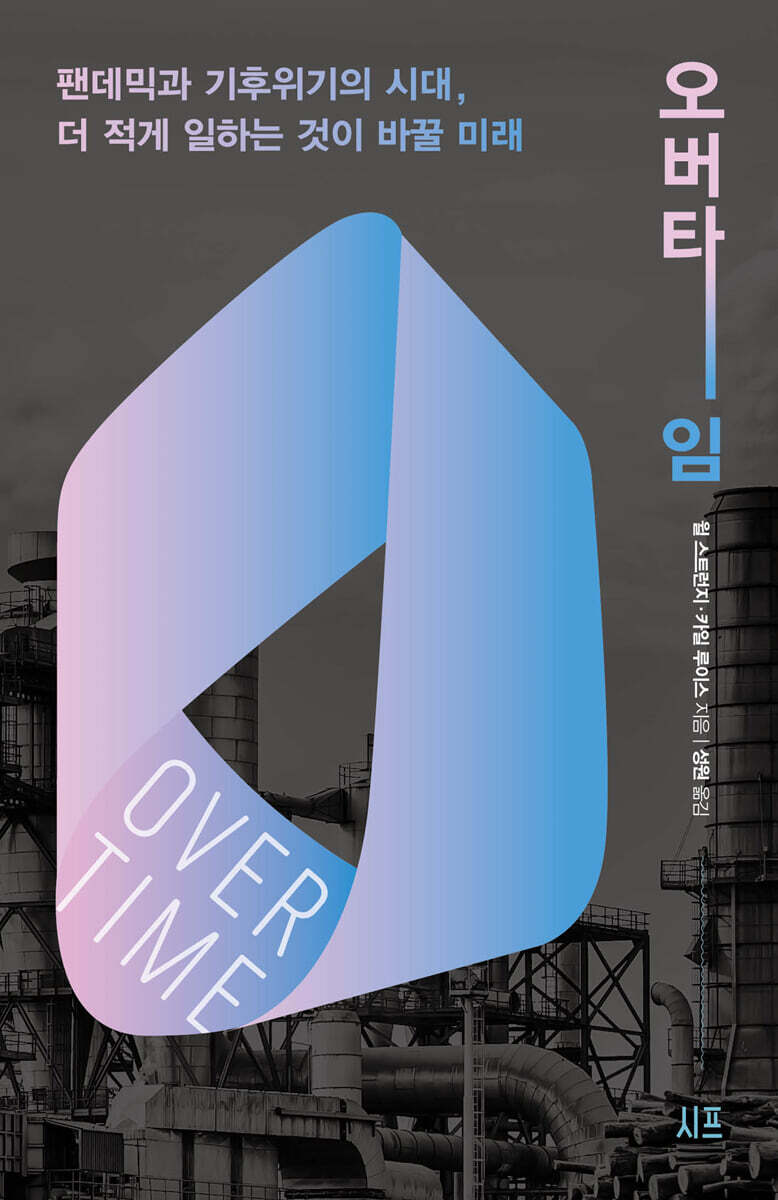
Overtime
 |
Description
Book Introduction
How would the world be different if we worked only four days a week?
If you only work 4 days a week,
Or if you leave work an hour or two early each day
What can we do?
Imagine working less than you do now.
How our lives, society, and the world will change.
“In this excellent book, Will Strunge and Kyle Lewis make a remarkably clear and compelling case for shorter working hours as a path to greater sustainability, equality, and freedom.”
Casey Weeks, author of Why We Work So Long and Hard
“In an attempt to improve the ‘quality of life,’ we lose the ‘foundation of life.’”
“If we try to implement a five-day workweek, the country will go bankrupt.”
These are headlines from articles when the five-day workweek was introduced in 2004.
The logic was that if people worked only five days a week, productivity would decline, including worsening Monday blues, and the national economy would ultimately collapse.
Now, 17 years later, ahead of the 20th presidential election, the hot topic is the four-day workweek.
Candidate Sim Sang-jung announced her pledge for a four-day workweek, saying, “South Korea is a time-poor society,” and candidate Lee Jae-myung also expressed his support for reducing statutory working hours, saying, “A four-day workweek is something that must be implemented someday to ensure a humane life and shorten working hours.”
As the pros and cons of this issue are being debated across all walks of life, can't we first ask one question?
Why is time such a huge area of conflict, negotiation, and debate?
'Time is gold.' This old adage, which directly reveals the preciousness of time, is more appropriate today than at any other time in history.
Because for us living in a capitalist society, time is truly gold.
Time is money not only for the worker (it is paid hourly, daily, monthly, and annually), but also for the employer (as long as it generates profit, the factory, warehouse, or restaurant must run 24 hours a day).
But what makes time truly valuable is that it is a precious resource for gaining freedom.
We need time to relax after work, time to be with loved ones, time to do things we choose to do ourselves rather than for our bosses—in other words, free time.
This is precisely why conflicts, tensions, and struggles surrounding time have been constant since the emergence of capitalism.
Yes, working hours are a long-standing topic.
From direct demands for shorter working hours to "life with evenings" and "work-life balance," the question of how many days a week and how many hours a day we work has always been a matter of debate, though the wording may vary.
Many people lament the start of another week on Monday and rush off work on Friday, but this isn't a common or ancient practice. In Korea, which consistently ranks first or second in terms of working hours among OECD countries, the five-day workweek was introduced only 17 years ago, and even this isn't implemented in all workplaces.
For some, taking weekends off is a given, but others still work six (or even seven) days a week.
Question again.
Why do we work so long?
This question is so familiar that some might say it's an old topic.
But there is some truth to this reaction.
Working hours have been a long-standing topic, but have never been properly discussed.
We have been forced to work long hours without even having time to imagine other options.
The alarm bells of the pandemic are ringing right here.
The global pandemic has rapidly changed the way we work, for better or worse.
As companies continue to declare that they will continue to implement remote work even after the pandemic ends, the new world of work represented by remote work sends the message that work must change as much as our lives have changed.
If we are no longer tied to working at specific times and locations, wouldn't the five-day workweek we've taken for granted change?
"Overtime" is a book that addresses precisely this point: what impact shorter working hours will have on us.
Working less is not just an intervention in labor.
It is a feminist issue in that it can help women living in unequal times, and it is also an eco-friendly policy in that it helps reduce the carbon footprint by moving away from the ideology of economic growth.
With the climate crisis looming, and the world realizing that economic growth alone cannot be our sole priority, we must be able to envision concretely what working less would mean for our future.
If you only work 4 days a week,
Or if you leave work an hour or two early each day
What can we do?
Imagine working less than you do now.
How our lives, society, and the world will change.
“In this excellent book, Will Strunge and Kyle Lewis make a remarkably clear and compelling case for shorter working hours as a path to greater sustainability, equality, and freedom.”
Casey Weeks, author of Why We Work So Long and Hard
“In an attempt to improve the ‘quality of life,’ we lose the ‘foundation of life.’”
“If we try to implement a five-day workweek, the country will go bankrupt.”
These are headlines from articles when the five-day workweek was introduced in 2004.
The logic was that if people worked only five days a week, productivity would decline, including worsening Monday blues, and the national economy would ultimately collapse.
Now, 17 years later, ahead of the 20th presidential election, the hot topic is the four-day workweek.
Candidate Sim Sang-jung announced her pledge for a four-day workweek, saying, “South Korea is a time-poor society,” and candidate Lee Jae-myung also expressed his support for reducing statutory working hours, saying, “A four-day workweek is something that must be implemented someday to ensure a humane life and shorten working hours.”
As the pros and cons of this issue are being debated across all walks of life, can't we first ask one question?
Why is time such a huge area of conflict, negotiation, and debate?
'Time is gold.' This old adage, which directly reveals the preciousness of time, is more appropriate today than at any other time in history.
Because for us living in a capitalist society, time is truly gold.
Time is money not only for the worker (it is paid hourly, daily, monthly, and annually), but also for the employer (as long as it generates profit, the factory, warehouse, or restaurant must run 24 hours a day).
But what makes time truly valuable is that it is a precious resource for gaining freedom.
We need time to relax after work, time to be with loved ones, time to do things we choose to do ourselves rather than for our bosses—in other words, free time.
This is precisely why conflicts, tensions, and struggles surrounding time have been constant since the emergence of capitalism.
Yes, working hours are a long-standing topic.
From direct demands for shorter working hours to "life with evenings" and "work-life balance," the question of how many days a week and how many hours a day we work has always been a matter of debate, though the wording may vary.
Many people lament the start of another week on Monday and rush off work on Friday, but this isn't a common or ancient practice. In Korea, which consistently ranks first or second in terms of working hours among OECD countries, the five-day workweek was introduced only 17 years ago, and even this isn't implemented in all workplaces.
For some, taking weekends off is a given, but others still work six (or even seven) days a week.
Question again.
Why do we work so long?
This question is so familiar that some might say it's an old topic.
But there is some truth to this reaction.
Working hours have been a long-standing topic, but have never been properly discussed.
We have been forced to work long hours without even having time to imagine other options.
The alarm bells of the pandemic are ringing right here.
The global pandemic has rapidly changed the way we work, for better or worse.
As companies continue to declare that they will continue to implement remote work even after the pandemic ends, the new world of work represented by remote work sends the message that work must change as much as our lives have changed.
If we are no longer tied to working at specific times and locations, wouldn't the five-day workweek we've taken for granted change?
"Overtime" is a book that addresses precisely this point: what impact shorter working hours will have on us.
Working less is not just an intervention in labor.
It is a feminist issue in that it can help women living in unequal times, and it is also an eco-friendly policy in that it helps reduce the carbon footprint by moving away from the ideology of economic growth.
With the climate crisis looming, and the world realizing that economic growth alone cannot be our sole priority, we must be able to envision concretely what working less would mean for our future.
- You can preview some of the book's contents.
Preview
index
Introduction: A fight as old as capitalism itself.
Chapter 1: Living in a Workaholic Society
Chapter 2: What Technology Can't Solve
Chapter 3: Women's Time Passes Faster
Chapter 4: Time for the Environment
Chapter 5: The Struggle to Reduce Weekly Working Hours
main
Chapter 1: Living in a Workaholic Society
Chapter 2: What Technology Can't Solve
Chapter 3: Women's Time Passes Faster
Chapter 4: Time for the Environment
Chapter 5: The Struggle to Reduce Weekly Working Hours
main
Detailed image

Into the book
Throughout this book, we will focus on how a shorter workweek would bring diverse benefits to our society.
Reducing working hours per week is not just an intervention in labor.
It is both a feminist issue and an environmentally friendly policy, as it helps to equalize the distribution of paid and unpaid labor, primarily within the home, where labor is often feminized.
By working less, we can lay one pillar for the rapid decarbonization of our economy, which could have profound implications for countless other areas.
--- p.19
However, the question of working hours and our relationship to them is not at all new, nor is it unrelated to the way our economy and labor markets are organized.
Marx was one of the first and sharpest critics of the economic system that binds us to long working hours, high-pressure workplaces, and rigid management protocols and maximized workloads.
Working hours are as central to life in capitalism today as they were in the 19th century.
Time is money, but it is also a valuable resource for gaining freedom.
The tug-of-war between time for ourselves and time for our employers has never ceased.
--- p.41
While reducing working hours should be a core goal of a progressive labor movement in the 21st century, achieving this goal requires serious consideration of the challenges of feminism in defining what constitutes a worker.
If our goal is equality in the workplace, we must understand the workplace as more than just an office, warehouse, or factory.
We must remember that the foundation of our economy, our families, and our lives is the unpaid or low-wage care work performed in the home, largely by women.
It is also important to keep in mind that women often find themselves in precarious jobs at the fringes of the labor market.
Ultimately, we must acknowledge the reality of double and triple labor and seek ways to redistribute this labor so that everyone can work less.
--- p.89
“Households that work long hours have significantly larger carbon footprints.” This shows a worrying correlation between increasingly unsustainable consumption patterns and high labor loads.
This study resonates with the everyday experience of leaving for work at the crack of dawn and returning home late at night, too tired to cook, so we resort to takeout, microwaveable convenience foods, or packaged foods wrapped in plastic.
These research findings highlight an important aspect of the argument for reducing working hours.
We need to drastically reduce working hours not only because the work we do is so carbon-intensive, but also because of the consumption that occurs at the very end of our working lives.
Reducing working hours per week is not just an intervention in labor.
It is both a feminist issue and an environmentally friendly policy, as it helps to equalize the distribution of paid and unpaid labor, primarily within the home, where labor is often feminized.
By working less, we can lay one pillar for the rapid decarbonization of our economy, which could have profound implications for countless other areas.
--- p.19
However, the question of working hours and our relationship to them is not at all new, nor is it unrelated to the way our economy and labor markets are organized.
Marx was one of the first and sharpest critics of the economic system that binds us to long working hours, high-pressure workplaces, and rigid management protocols and maximized workloads.
Working hours are as central to life in capitalism today as they were in the 19th century.
Time is money, but it is also a valuable resource for gaining freedom.
The tug-of-war between time for ourselves and time for our employers has never ceased.
--- p.41
While reducing working hours should be a core goal of a progressive labor movement in the 21st century, achieving this goal requires serious consideration of the challenges of feminism in defining what constitutes a worker.
If our goal is equality in the workplace, we must understand the workplace as more than just an office, warehouse, or factory.
We must remember that the foundation of our economy, our families, and our lives is the unpaid or low-wage care work performed in the home, largely by women.
It is also important to keep in mind that women often find themselves in precarious jobs at the fringes of the labor market.
Ultimately, we must acknowledge the reality of double and triple labor and seek ways to redistribute this labor so that everyone can work less.
--- p.89
“Households that work long hours have significantly larger carbon footprints.” This shows a worrying correlation between increasingly unsustainable consumption patterns and high labor loads.
This study resonates with the everyday experience of leaving for work at the crack of dawn and returning home late at night, too tired to cook, so we resort to takeout, microwaveable convenience foods, or packaged foods wrapped in plastic.
These research findings highlight an important aspect of the argument for reducing working hours.
We need to drastically reduce working hours not only because the work we do is so carbon-intensive, but also because of the consumption that occurs at the very end of our working lives.
--- p.98
GOODS SPECIFICS
- Publication date: December 7, 2021
- Page count, weight, size: 160 pages | 210g | 122*188*20mm
- ISBN13: 9791197563829
- ISBN10: 1197563822
You may also like
카테고리
korean


korean

![GQ KOREA Mark (Monthly): December [2025]](http://librairie.coreenne.fr/cdn/shop/files/8ef265dbbfbf186523ed75ba7319009d.jpg?v=1765340328&width=3840)


