

Question: Poverty Society
 |
Description
Book Introduction
- A word from MD
-
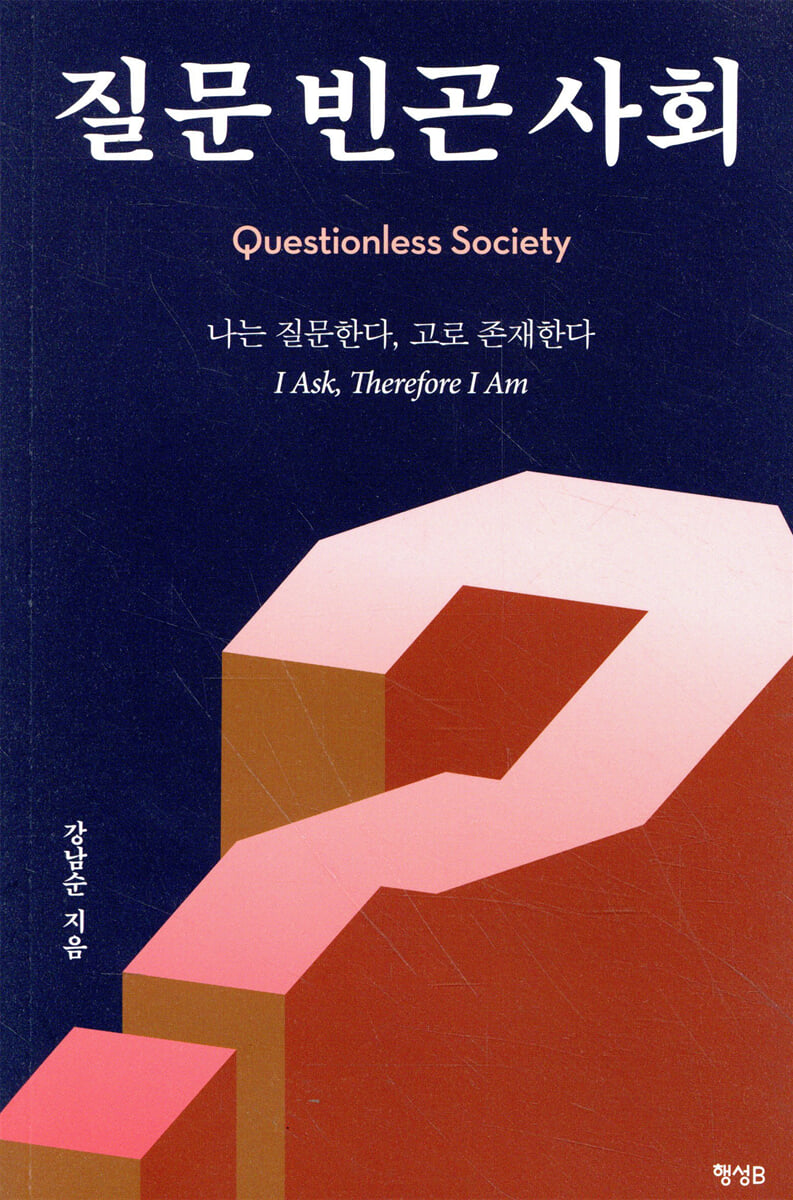
Questions that Korea needsA question posed to Korean society by Professor Kang Nam-soon, who has studied various fields including politics, philosophy, religion, and human rights.
It raises sharp questions about the overall social structure, including the polarized politics, the media that has lost objectivity, and religion that is in collusion with power.
Next, the individual explored how he should live.
November 5, 2021. Social and Political PD Son Min-gyu
Progress and change begin when we allow ourselves to ask the question, "Why?"
Professor Kang Nam-soon, who has researched various fields of humanities, including politics, philosophy, religion, and human rights, reflects on Korean society through 'Questions' and invites readers into a world of thought.
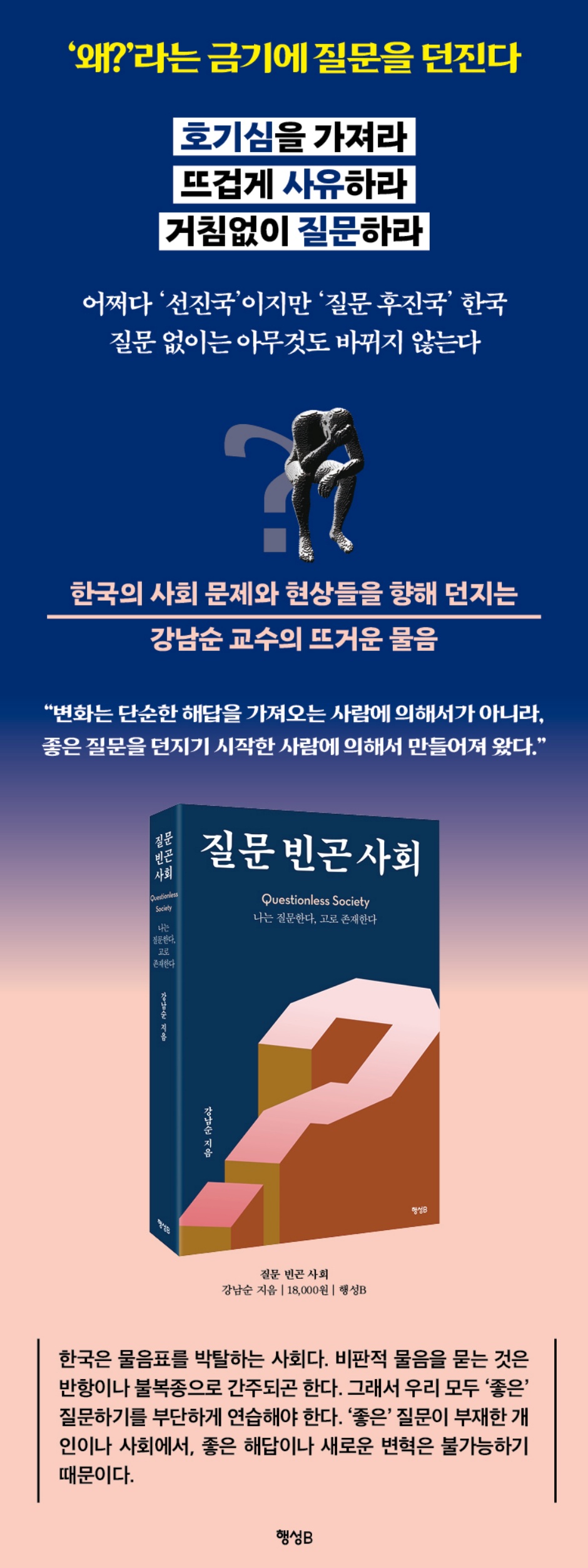
How does change begin? Where do justice and alternatives begin? The question is, "Why?"
Through questions, we encounter and discover facts and truth, the voices of the invisible, justice and alternatives.
However, Korea is a 'question-poor society' that considers "yes" a virtue in various fields.
This book raises burning questions about inciting politics, unfair media, human rights obscured by hate, wrong practices, and religion allied with power.
And I explore 'good' questions that will change me and the world I live in.
We also invite you to learn and practice asking “good questions” together and separately, while pointing out the dangers of “bad questions” that start from meaningless questions and faulty premises.
Professor Kang Nam-soon, who has researched various fields of humanities, including politics, philosophy, religion, and human rights, reflects on Korean society through 'Questions' and invites readers into a world of thought.
How does change begin? Where do justice and alternatives begin? The question is, "Why?"
Through questions, we encounter and discover facts and truth, the voices of the invisible, justice and alternatives.
However, Korea is a 'question-poor society' that considers "yes" a virtue in various fields.
This book raises burning questions about inciting politics, unfair media, human rights obscured by hate, wrong practices, and religion allied with power.
And I explore 'good' questions that will change me and the world I live in.
We also invite you to learn and practice asking “good questions” together and separately, while pointing out the dangers of “bad questions” that start from meaningless questions and faulty premises.
- You can preview some of the book's contents.
Preview
index
prolog
Humans as Questioning Beings: I question, therefore I am.
Part 1 - Questioning Power and the Media: In Search of Critical Questions
The Diary and the Barbarism of Power
Politics, Christianity, and the Media: A Destructive Triangle Alliance
A disease called 'addiction to lies and hate'
In the post-truth era, the trap of internal totalitarianism
The Second New Media: Tool or Weapon?
Three Dimensional Life, Those Who Have the Responsibility to Protect
The Art of Questioning: Why Asking Good Questions Matters
Part 2 - Asking the Typist's Face: What Kind of Person Are You to Him?
“We are not machines!” From a country of means to a country of ends
'Trump Mentality': Resisting with Maturity and Courage
Three Types of People: Which One Are You?
The dangers and backwardness of an age-obsessed society
“I can’t breathe”
My Epistemological Blind Spot
The crisis of humanity caused by the absence of kisses
Where do you seek wisdom for life?
Part 3: Questioning Practices and Alternatives: Uncomfortable Learnings Korean Society Needs
The Dangers of "Quick Fixes": Finding Alternatives as a Journey
The socio-political events of 'pregnancy, childbirth, and childcare'
Ginsburg's Legacy and Its Implications for Korean Society
The dangers of a meritocratic society
A virus called 'anti-intellectualism'
A university of bullying, hierarchy, and corporate credit cards
Education that rejects discomfort has no future.
Part 4: Questioning Being and Hatred: Do We Welcome Our Neighbors?
'Coming Out': Language as a Living Creature
Christianity: Where Are the Traces of Jesus?
Those driven to the cliff of death
Do you support the legalization of heterosexuality?
Transgender people are human too
The banality of hate: we must resist and overcome it together.
People with disabilities are not an issue, they are people.
Post-familialism, the birth of a new family
From the politics of hate to the politics of hospitality
Co-owners of the Earth: Refugees are fellow human beings
Justice doesn't wait
Part 5: Questions about Hope and Life: Living Well Together
Biden-Harris' Humanistic Values and Respect for Diversity
A person with four nationalities
Am I Happy? The Pursuit of Happiness as a Human Right
The New Normal: Five Values We Must Reclaim
A disease called 'a life of packaging and display'
In times of crisis, the politics of compassion and solidarity are desperately needed.
Responsibility of the Survivors
What is hope?
Solitude practice
The challenge of being alive
Invitation to a new birth
Humans as Questioning Beings: I question, therefore I am.
Part 1 - Questioning Power and the Media: In Search of Critical Questions
The Diary and the Barbarism of Power
Politics, Christianity, and the Media: A Destructive Triangle Alliance
A disease called 'addiction to lies and hate'
In the post-truth era, the trap of internal totalitarianism
The Second New Media: Tool or Weapon?
Three Dimensional Life, Those Who Have the Responsibility to Protect
The Art of Questioning: Why Asking Good Questions Matters
Part 2 - Asking the Typist's Face: What Kind of Person Are You to Him?
“We are not machines!” From a country of means to a country of ends
'Trump Mentality': Resisting with Maturity and Courage
Three Types of People: Which One Are You?
The dangers and backwardness of an age-obsessed society
“I can’t breathe”
My Epistemological Blind Spot
The crisis of humanity caused by the absence of kisses
Where do you seek wisdom for life?
Part 3: Questioning Practices and Alternatives: Uncomfortable Learnings Korean Society Needs
The Dangers of "Quick Fixes": Finding Alternatives as a Journey
The socio-political events of 'pregnancy, childbirth, and childcare'
Ginsburg's Legacy and Its Implications for Korean Society
The dangers of a meritocratic society
A virus called 'anti-intellectualism'
A university of bullying, hierarchy, and corporate credit cards
Education that rejects discomfort has no future.
Part 4: Questioning Being and Hatred: Do We Welcome Our Neighbors?
'Coming Out': Language as a Living Creature
Christianity: Where Are the Traces of Jesus?
Those driven to the cliff of death
Do you support the legalization of heterosexuality?
Transgender people are human too
The banality of hate: we must resist and overcome it together.
People with disabilities are not an issue, they are people.
Post-familialism, the birth of a new family
From the politics of hate to the politics of hospitality
Co-owners of the Earth: Refugees are fellow human beings
Justice doesn't wait
Part 5: Questions about Hope and Life: Living Well Together
Biden-Harris' Humanistic Values and Respect for Diversity
A person with four nationalities
Am I Happy? The Pursuit of Happiness as a Human Right
The New Normal: Five Values We Must Reclaim
A disease called 'a life of packaging and display'
In times of crisis, the politics of compassion and solidarity are desperately needed.
Responsibility of the Survivors
What is hope?
Solitude practice
The challenge of being alive
Invitation to a new birth
Detailed image
Into the book
Many people do not care or consider it important what the truth and facts are.
We live in the so-called 'post-truth era'.
When people who value only their own claims, not truth and facts, become the majority, a society may appear democratic on the surface, but inwardly, the trap of totalitarianism is everywhere.
The individual disappears, leaving only a group that moves only at someone's instigation.
--- p.46
Former President Obama's attempt to grant Korean reporters the right to ask questions during a press conference watched by the world in 2010, and President Moon's attempt to grant a Korean female reporter the right to ask questions in 2021, hold many implications for us.
Why don't we ask questions?
Even journalists, for whom questioning is a way of life, don't try to properly exercise their right to question.
--- p.65
If there is one thing that must come first in the process of finding an alternative, it is a critical reflection on the ‘now.’
This is because critical reflection shows what is lacking in the existing reality and what needs to be changed.
So raising critical questions about specific issues is an important starting point for all change.
Most 'alternatives' that lack critical questioning are often just status quo mechanisms for those in power to expand their power and gain.
--- p.128
A single concept, such as 'coming out', can be used in some contexts with a very positive connotation, and in others with a negative or cynical connotation.
When we fail to recognize that a single concept can have different implications in such diverse contexts and engage in unnecessary debate, sociopolitical energy is wasted in the wrong direction.
--- p.19
One day during break time, he came up to me and said, “Hi, Namsoon.”
If he had been a 'xenophobe' like I was a homophobe, he wouldn't have approached me.
Only then did I start talking to him while looking at his face.
As we spent that semester together, I came to realize that he was an equal human being just like me.
It wasn't some complicated theory about sexual orientation that finally allowed me to truly accept this seemingly obvious universal truth.
It was that person's 'face'.
--- p.228
There has never been a natural national consensus reached in the process of expanding and institutionalizing justice.
Institutional and legal transformations that systematically expanded the realization of various types of justice were made possible through the struggles of a small number of people with a transformative consciousness seeking to expand equality for all, not just certain individuals, those who stood in solidarity with those struggles, and the bold decisions of political leaders with decision-making power.
--- p.264
It wouldn't be that difficult to include your own family, relatives, and friends in the category of 'together'.
But if the people we have to live with include strangers we don't know at all, refugees, immigrants, or people who are objects of hatred and avoidance, like the Shincheonji followers who have been highlighted in the COVID-19 incident, then "living together" suddenly feels like an utterly "impossible" task.
--- p.311
The COVID-19 pandemic has brought to the forefront the problems of certain Christian groups.
But it is not only that group, but many distorted religious groups use the fear of isolation and loneliness that individuals experience as a tool to make them blindly follow the group.
“A lonely person always sees the worst in everything,” said the religious reformer Martin Luther.
Politicians and religious leaders who prioritize only power use people's fears and terrors as tools to expand their power.
We live in the so-called 'post-truth era'.
When people who value only their own claims, not truth and facts, become the majority, a society may appear democratic on the surface, but inwardly, the trap of totalitarianism is everywhere.
The individual disappears, leaving only a group that moves only at someone's instigation.
--- p.46
Former President Obama's attempt to grant Korean reporters the right to ask questions during a press conference watched by the world in 2010, and President Moon's attempt to grant a Korean female reporter the right to ask questions in 2021, hold many implications for us.
Why don't we ask questions?
Even journalists, for whom questioning is a way of life, don't try to properly exercise their right to question.
--- p.65
If there is one thing that must come first in the process of finding an alternative, it is a critical reflection on the ‘now.’
This is because critical reflection shows what is lacking in the existing reality and what needs to be changed.
So raising critical questions about specific issues is an important starting point for all change.
Most 'alternatives' that lack critical questioning are often just status quo mechanisms for those in power to expand their power and gain.
--- p.128
A single concept, such as 'coming out', can be used in some contexts with a very positive connotation, and in others with a negative or cynical connotation.
When we fail to recognize that a single concept can have different implications in such diverse contexts and engage in unnecessary debate, sociopolitical energy is wasted in the wrong direction.
--- p.19
One day during break time, he came up to me and said, “Hi, Namsoon.”
If he had been a 'xenophobe' like I was a homophobe, he wouldn't have approached me.
Only then did I start talking to him while looking at his face.
As we spent that semester together, I came to realize that he was an equal human being just like me.
It wasn't some complicated theory about sexual orientation that finally allowed me to truly accept this seemingly obvious universal truth.
It was that person's 'face'.
--- p.228
There has never been a natural national consensus reached in the process of expanding and institutionalizing justice.
Institutional and legal transformations that systematically expanded the realization of various types of justice were made possible through the struggles of a small number of people with a transformative consciousness seeking to expand equality for all, not just certain individuals, those who stood in solidarity with those struggles, and the bold decisions of political leaders with decision-making power.
--- p.264
It wouldn't be that difficult to include your own family, relatives, and friends in the category of 'together'.
But if the people we have to live with include strangers we don't know at all, refugees, immigrants, or people who are objects of hatred and avoidance, like the Shincheonji followers who have been highlighted in the COVID-19 incident, then "living together" suddenly feels like an utterly "impossible" task.
--- p.311
The COVID-19 pandemic has brought to the forefront the problems of certain Christian groups.
But it is not only that group, but many distorted religious groups use the fear of isolation and loneliness that individuals experience as a tool to make them blindly follow the group.
“A lonely person always sees the worst in everything,” said the religious reformer Martin Luther.
Politicians and religious leaders who prioritize only power use people's fears and terrors as tools to expand their power.
--- p.336
Publisher's Review
Korea, a "developed country" but a "questioning underdeveloped country"
Questioning the taboo of 'why'
In Korea, where saying "yes" is considered a virtue, asking questions is often taboo.
Students are not allowed to freely question their teachers, children are not allowed to freely question their parents, members of religious communities are not allowed to freely question their leaders, employees are not allowed to freely question their superiors, and citizens are not allowed to freely question their politicians.
If you ask critical questions, you are branded as a citizen who disrupts the community, an employee who ignores order, a church member who lacks faith, or a spoiled child.
So we don't know how to ask 'good' questions and we take someone's question as a provocation.
But questions are the starting point of all transformation and the key to seeing the truth.
Without asking the right questions, there will be no progress for me or the society I belong to.
"Questioning Poverty Society" is a question Professor Kang Nam-soon poses to Korean society, inviting readers into a world of thought, while also inviting readers into a world of reflection, having researched various fields of the humanities, including politics, philosophy, religion, and human rights.
The author poses burning questions with a critical eye toward politics, the media, and religion.
It also talks about people in various positions, practices that have become established as correct answers, and the hope of living together, guiding readers to reflect on themselves and create new questions.
Power, human rights, practices, hate, hope
Five Big Questions
"Question Poverty Society" is composed of five major questions.
Part 1.
In "Questions of Power and the Media: In Search of Critical Questions," we examine fake news, propaganda, and the religions allied with them, and examine the importance of "reason."
And we explore how to weed out bad questions and practice asking good ones.
Part 2.
In “Asking the Face of the Other: What Kind of Person Are You to Him,” I explore my own “face” through the other.
It leads me to reflect on my human rights sensitivity and humanity that I had not realized before through diverse workers, hierarchical culture, and the nature of perpetrators and victims.
Part 3.
In "Questioning Practices and Alternatives: Uncomfortable Learnings Korean Society Needs," we examine the true meaning of "alternatives" and various practices that hinder progress, such as bullying and hierarchy.
We also examine the new diseases of anti-intellectualism and a meritocratic society.
Part 4.
In "Questions about Being and Hatred: Do We Welcome Our Neighbors," we reflect on our unfamiliar neighbors and our attitudes toward them.
It introduces refugees, sexual minorities, foreign workers, people with disabilities, and diverse families, and emphasizes that we must live with them as “fellow human beings.”
Part 5.
In "Questions about Hope and Life: Living Well Together," we explore ways for Korean society to "live well together" with its various members.
It explores the politics of compassion and solidarity, the values that make up a truly advanced nation, and speaks of responsibility and hope for our time.
“What kind of ‘person’ am I?”
A bold journey that begins with questions
In this book, author Kang Nam-soon examines various issues in various fields.
But there is always a ‘person’ in it.
There are those who are mobilized for political agitation and those who mobilize, those who are the object of hatred and those who hate, workers who work silently and those who cannot see them.
And there are policymakers who stand up to injustice and a small number of people who quietly bring hope.
Through this, we realize that we live in a state of flux between these various forms.
And we are also faced with fundamental questions such as, ‘What kind of person am I?’ and ‘How do I want to live?’
So the author encourages readers to find the answers for themselves within their own circumstances.
“The writings in this book can be said to be my questions posed through a multi-layered perspective, looking at the events, individuals, and countless faces we all encounter in the everyday world we live in together.
I hope that my questions will become an 'invitation' that will lead to new and different questions for each person reading this article.
Moreover, the answers to the questions we encounter while reading are also a task each of us must continually seek within our own circumstances.”
- From the prologue
Questioning the taboo of 'why'
In Korea, where saying "yes" is considered a virtue, asking questions is often taboo.
Students are not allowed to freely question their teachers, children are not allowed to freely question their parents, members of religious communities are not allowed to freely question their leaders, employees are not allowed to freely question their superiors, and citizens are not allowed to freely question their politicians.
If you ask critical questions, you are branded as a citizen who disrupts the community, an employee who ignores order, a church member who lacks faith, or a spoiled child.
So we don't know how to ask 'good' questions and we take someone's question as a provocation.
But questions are the starting point of all transformation and the key to seeing the truth.
Without asking the right questions, there will be no progress for me or the society I belong to.
"Questioning Poverty Society" is a question Professor Kang Nam-soon poses to Korean society, inviting readers into a world of thought, while also inviting readers into a world of reflection, having researched various fields of the humanities, including politics, philosophy, religion, and human rights.
The author poses burning questions with a critical eye toward politics, the media, and religion.
It also talks about people in various positions, practices that have become established as correct answers, and the hope of living together, guiding readers to reflect on themselves and create new questions.
Power, human rights, practices, hate, hope
Five Big Questions
"Question Poverty Society" is composed of five major questions.
Part 1.
In "Questions of Power and the Media: In Search of Critical Questions," we examine fake news, propaganda, and the religions allied with them, and examine the importance of "reason."
And we explore how to weed out bad questions and practice asking good ones.
Part 2.
In “Asking the Face of the Other: What Kind of Person Are You to Him,” I explore my own “face” through the other.
It leads me to reflect on my human rights sensitivity and humanity that I had not realized before through diverse workers, hierarchical culture, and the nature of perpetrators and victims.
Part 3.
In "Questioning Practices and Alternatives: Uncomfortable Learnings Korean Society Needs," we examine the true meaning of "alternatives" and various practices that hinder progress, such as bullying and hierarchy.
We also examine the new diseases of anti-intellectualism and a meritocratic society.
Part 4.
In "Questions about Being and Hatred: Do We Welcome Our Neighbors," we reflect on our unfamiliar neighbors and our attitudes toward them.
It introduces refugees, sexual minorities, foreign workers, people with disabilities, and diverse families, and emphasizes that we must live with them as “fellow human beings.”
Part 5.
In "Questions about Hope and Life: Living Well Together," we explore ways for Korean society to "live well together" with its various members.
It explores the politics of compassion and solidarity, the values that make up a truly advanced nation, and speaks of responsibility and hope for our time.
“What kind of ‘person’ am I?”
A bold journey that begins with questions
In this book, author Kang Nam-soon examines various issues in various fields.
But there is always a ‘person’ in it.
There are those who are mobilized for political agitation and those who mobilize, those who are the object of hatred and those who hate, workers who work silently and those who cannot see them.
And there are policymakers who stand up to injustice and a small number of people who quietly bring hope.
Through this, we realize that we live in a state of flux between these various forms.
And we are also faced with fundamental questions such as, ‘What kind of person am I?’ and ‘How do I want to live?’
So the author encourages readers to find the answers for themselves within their own circumstances.
“The writings in this book can be said to be my questions posed through a multi-layered perspective, looking at the events, individuals, and countless faces we all encounter in the everyday world we live in together.
I hope that my questions will become an 'invitation' that will lead to new and different questions for each person reading this article.
Moreover, the answers to the questions we encounter while reading are also a task each of us must continually seek within our own circumstances.”
- From the prologue
GOODS SPECIFICS
- Publication date: October 29, 2021
- Page count, weight, size: 356 pages | 430g | 136*205*30mm
- ISBN13: 9791164711543
- ISBN10: 1164711547
You may also like
카테고리
korean


korean

![GQ KOREA Mark (Monthly): December [2025]](http://librairie.coreenne.fr/cdn/shop/files/8ef265dbbfbf186523ed75ba7319009d.jpg?v=1765340328&width=3840)


