

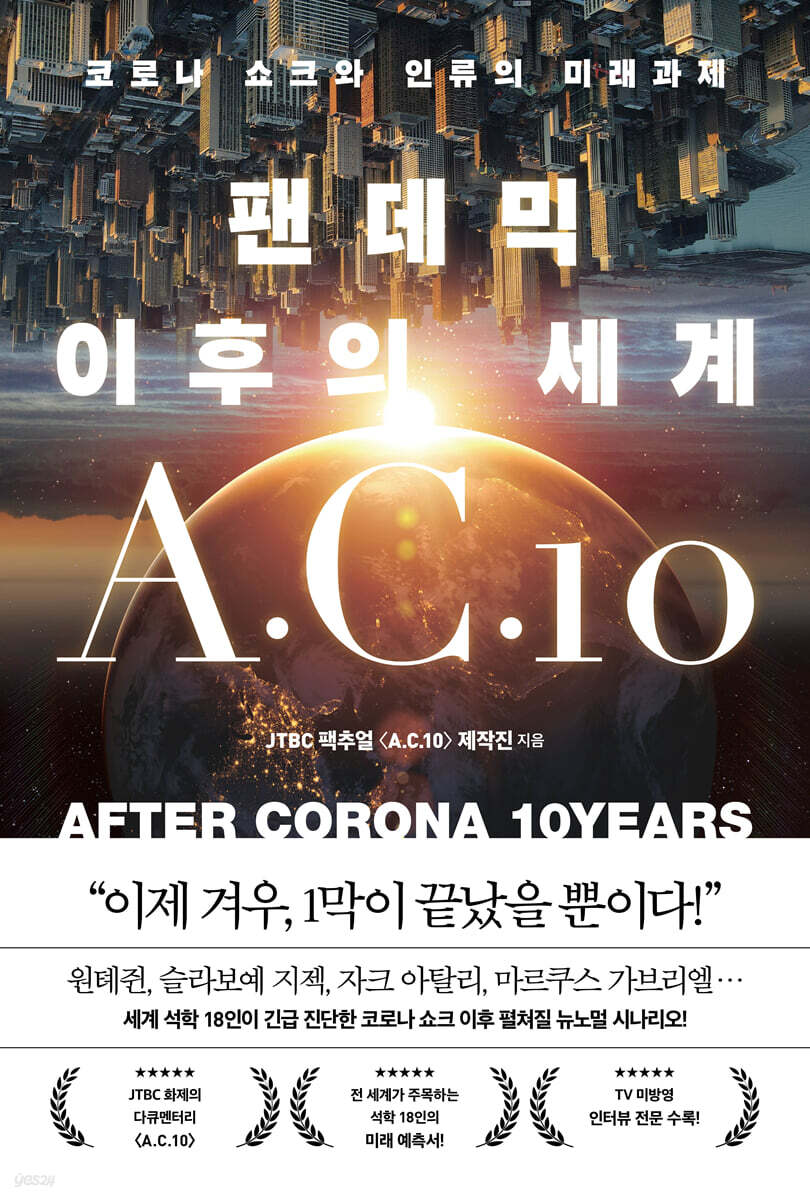
AC10: The Post-Pandemic World
 |
Description
Book Introduction
“Beyond the fear of mutations, into the era of Corona,
“The most unpredictable decade in history is now upon us!”
Markus Gabriel, Slavoj Zizek, Yuan Tiejun, Ha-Joon Chang, Jacques Attali, etc.
The future of humanity after the pandemic, predicted by 18 world-renowned scholars.
* Future predictions from 18 world-renowned scholars *
* Extended version of JTBC's popular documentary [AC10] *
* Includes full unaired TV interview *
As we enter the post-corona new normal era, a time that could be recorded as the year after Corona, we ask the world's leading scholars and global leaders.
"Was COVID-19, which brought the world to a standstill, a sudden and unexpected event? Was it expected?" "Will the dream of a universal vaccine ever come true?" "How will nations and individuals transform in the post-COVID-19 era?"
JTBC's documentary [AC10], which imagines the future 10 years after the COVID-19 pandemic and was produced in Korea's first XR (extended reality) studio, attracted attention even before its broadcast due to the appearance of many world-renowned scholars as interviewees.
This book, "The World After the Pandemic: AC10," is a new compilation of previously unaired footage, covering three future challenges humanity will face after the coronavirus shock (the current state of vaccines, AI and labor, and the role of the state), and delves into the reality of the new normal that the virus will bring about.
The world's youngest professor and genius philosopher Marcus Gabriel; the economist Jacques Attali, who has the sharpest foresight into the world's tectonic shifts; the economist Ha-Joon Chang, the youngest recipient of the Leontief Prize (an award given to an economist who has broadened the horizons of economics); Wen Tiejun, who is emerging as a leading Chinese intellectual; the philosopher Slavoj Zizek, who is considered the most important thinker of the 21st century; Guy Standing, a senior economist at the International Labour Organization; Jerome Kim, Director General of the International Vaccine Institute; and Richard Wilkinson, a social epidemiologist. Eighteen of today's leading intellectuals and global leaders will present diverse opinions and engage in insightful discussions about the future of society.
In particular, this volume includes unaired interviews with 18 world-renowned scholars that were unfortunately edited out of the broadcast due to scheduling issues.
In addition, we provide readers with even more upgraded content by faithfully including explanations of big data data completed with advice from the country's top experts.
“The most unpredictable decade in history is now upon us!”
Markus Gabriel, Slavoj Zizek, Yuan Tiejun, Ha-Joon Chang, Jacques Attali, etc.
The future of humanity after the pandemic, predicted by 18 world-renowned scholars.
* Future predictions from 18 world-renowned scholars *
* Extended version of JTBC's popular documentary [AC10] *
* Includes full unaired TV interview *
As we enter the post-corona new normal era, a time that could be recorded as the year after Corona, we ask the world's leading scholars and global leaders.
"Was COVID-19, which brought the world to a standstill, a sudden and unexpected event? Was it expected?" "Will the dream of a universal vaccine ever come true?" "How will nations and individuals transform in the post-COVID-19 era?"
JTBC's documentary [AC10], which imagines the future 10 years after the COVID-19 pandemic and was produced in Korea's first XR (extended reality) studio, attracted attention even before its broadcast due to the appearance of many world-renowned scholars as interviewees.
This book, "The World After the Pandemic: AC10," is a new compilation of previously unaired footage, covering three future challenges humanity will face after the coronavirus shock (the current state of vaccines, AI and labor, and the role of the state), and delves into the reality of the new normal that the virus will bring about.
The world's youngest professor and genius philosopher Marcus Gabriel; the economist Jacques Attali, who has the sharpest foresight into the world's tectonic shifts; the economist Ha-Joon Chang, the youngest recipient of the Leontief Prize (an award given to an economist who has broadened the horizons of economics); Wen Tiejun, who is emerging as a leading Chinese intellectual; the philosopher Slavoj Zizek, who is considered the most important thinker of the 21st century; Guy Standing, a senior economist at the International Labour Organization; Jerome Kim, Director General of the International Vaccine Institute; and Richard Wilkinson, a social epidemiologist. Eighteen of today's leading intellectuals and global leaders will present diverse opinions and engage in insightful discussions about the future of society.
In particular, this volume includes unaired interviews with 18 world-renowned scholars that were unfortunately edited out of the broadcast due to scheduling issues.
In addition, we provide readers with even more upgraded content by faithfully including explanations of big data data completed with advice from the country's top experts.
- You can preview some of the book's contents.
Preview
index
Recommendation ∥ The era of the 'big' new normal, which will never be reversed, is coming.
Prologue ∥ After Corona, Asking Scholars About the Future of Humanity in 2030
Part 1.
The desire for a vaccine
Chapter 1.
A world helpless in the face of the coronavirus
The coronavirus that swept the world
The world order is shaken
A world we've never experienced before
Chapter 2.
The nation's fortunes are mixed due to its "healthcare system."
Health insurance systems in South Korea and Europe
Homework still remains: Quarantine and healthcare are different.
Telemedicine is no longer irreversible
Chapter 3.
New variants emerge, can vaccines save us?
A vaccine developed more quickly than ever before in history
New threat: mutant viruses
The rise of vaccine nationalism
Are vaccines truly a public good?
Chapter 4.
The "With Corona" Declaration: Is Coexistence with the Virus Possible?
Humanity has already had successful experiences.
No one is safe until everyone is safe.
The pandemic will definitely come again.
Part 2.
Restructuring of Labor
Chapter 5.
Robot World: Utopia or Dystopia?
The Fourth Industrial Revolution Accelerated by the Pandemic
A school without school, a company without a company
How robots and humans can create powerful synergy
Chapter 6.
The era of platform labor is coming.
Precarious workers, the precariat
Platform Capitalism and Workers
Moravec's paradox
Essential workers: The value of labor that AI cannot replace.
Chapter 7.
Polarization and inequality deepened by COVID-19
Digital divide and income inequality
Equality is healthy
Capitalism, is this okay?
Will the Hongik Ingan spirit be the solution for the 21st century?
Part 3.
Reasons for the country
Chapter 8.
The state is watching you
A world where control is the norm
Will Big Brother become a reality?
The conflict between privacy and state control
Chapter 9.
How Conspiracy Theories and Fake News Mislead Us
Conspiracy theories and fake news that threaten the nation
The paradox of social media
The power of the media is stronger than the state
Chapter 10.
How far will the state go to control its citizens after the pandemic?
The Birth of a Digital Nation
Small government and big government
What to control
Epilogue ∥ We've only just finished Act 1
Behind the scenes
Prologue ∥ After Corona, Asking Scholars About the Future of Humanity in 2030
Part 1.
The desire for a vaccine
Chapter 1.
A world helpless in the face of the coronavirus
The coronavirus that swept the world
The world order is shaken
A world we've never experienced before
Chapter 2.
The nation's fortunes are mixed due to its "healthcare system."
Health insurance systems in South Korea and Europe
Homework still remains: Quarantine and healthcare are different.
Telemedicine is no longer irreversible
Chapter 3.
New variants emerge, can vaccines save us?
A vaccine developed more quickly than ever before in history
New threat: mutant viruses
The rise of vaccine nationalism
Are vaccines truly a public good?
Chapter 4.
The "With Corona" Declaration: Is Coexistence with the Virus Possible?
Humanity has already had successful experiences.
No one is safe until everyone is safe.
The pandemic will definitely come again.
Part 2.
Restructuring of Labor
Chapter 5.
Robot World: Utopia or Dystopia?
The Fourth Industrial Revolution Accelerated by the Pandemic
A school without school, a company without a company
How robots and humans can create powerful synergy
Chapter 6.
The era of platform labor is coming.
Precarious workers, the precariat
Platform Capitalism and Workers
Moravec's paradox
Essential workers: The value of labor that AI cannot replace.
Chapter 7.
Polarization and inequality deepened by COVID-19
Digital divide and income inequality
Equality is healthy
Capitalism, is this okay?
Will the Hongik Ingan spirit be the solution for the 21st century?
Part 3.
Reasons for the country
Chapter 8.
The state is watching you
A world where control is the norm
Will Big Brother become a reality?
The conflict between privacy and state control
Chapter 9.
How Conspiracy Theories and Fake News Mislead Us
Conspiracy theories and fake news that threaten the nation
The paradox of social media
The power of the media is stronger than the state
Chapter 10.
How far will the state go to control its citizens after the pandemic?
The Birth of a Digital Nation
Small government and big government
What to control
Epilogue ∥ We've only just finished Act 1
Behind the scenes
Detailed image

Into the book
Unfortunately, there are already cases of vaccines being countered.
So where do mutant viruses come from?
Mutant viruses emerge at the point and moment when the number of confirmed cases explodes.
How far will this new variant spread? (…) The urgent task now is to lower the infection rate in areas where confirmed cases are skyrocketing, and vaccines must be distributed to those areas.
If we fail to effectively contain the increase in confirmed cases in specific regions, mutant viruses will continue to emerge.
---「Chapter 3.
“New variants emerge, can vaccines save us?”
It's a bit of a cruel story, but it's one that must be told.
This is the story of humans who lost their jobs to robots.
In China, for example, 2 million workers lost their jobs to robots in just two years.
The same goes for the United States.
The McKinsey Global Institute predicts that 800 million jobs, or one-fifth of the global workforce, will disappear by 2030.
A report by the Brookings Institution predicts that 36 million jobs will be replaced by AI-based automated systems in the future.
This represents one-quarter of all jobs in the United States.
So what jobs will disappear?
---「Chapter 5.
Is the Robot World a Utopia or a Dystopia?
If we believe in the historical patterns we have lived through, then for every job that disappears, another will surely be created.
No, to be more precise, it must be made to come into existence.
We need to move workers from disappearing jobs to newly created jobs.
(…) The paradox is that the work we valued as ‘work’ and paid high wages is becoming automated, while the work we took for granted and did not treat as work is actually difficult to automate.
It is at this point that our existing notions of labor will change.
Things that were previously not considered 'work' may come to be recognized for their importance.
---「Chapter 6.
The era of platform labor is coming
In fact, no one is forcing us to provide information.
We provide it ourselves.
There is only one reason: it is very inconvenient to live without using these companies' systems.
(…) Google announced in August that it would no longer serve interest-based tailored advertising to children under 18.
As voices grow louder that social media is responsible for fake news, YouTube, Facebook, and Twitter have blocked fake news related to the coronavirus.
Movements to regulate global big tech companies are also taking place around the world.
In the United States, regulatory legislation has been introduced to prevent these companies from abusing their monopolistic positions.
The European Union began investigating monopolies of large platform companies in 2010.
So where do mutant viruses come from?
Mutant viruses emerge at the point and moment when the number of confirmed cases explodes.
How far will this new variant spread? (…) The urgent task now is to lower the infection rate in areas where confirmed cases are skyrocketing, and vaccines must be distributed to those areas.
If we fail to effectively contain the increase in confirmed cases in specific regions, mutant viruses will continue to emerge.
---「Chapter 3.
“New variants emerge, can vaccines save us?”
It's a bit of a cruel story, but it's one that must be told.
This is the story of humans who lost their jobs to robots.
In China, for example, 2 million workers lost their jobs to robots in just two years.
The same goes for the United States.
The McKinsey Global Institute predicts that 800 million jobs, or one-fifth of the global workforce, will disappear by 2030.
A report by the Brookings Institution predicts that 36 million jobs will be replaced by AI-based automated systems in the future.
This represents one-quarter of all jobs in the United States.
So what jobs will disappear?
---「Chapter 5.
Is the Robot World a Utopia or a Dystopia?
If we believe in the historical patterns we have lived through, then for every job that disappears, another will surely be created.
No, to be more precise, it must be made to come into existence.
We need to move workers from disappearing jobs to newly created jobs.
(…) The paradox is that the work we valued as ‘work’ and paid high wages is becoming automated, while the work we took for granted and did not treat as work is actually difficult to automate.
It is at this point that our existing notions of labor will change.
Things that were previously not considered 'work' may come to be recognized for their importance.
---「Chapter 6.
The era of platform labor is coming
In fact, no one is forcing us to provide information.
We provide it ourselves.
There is only one reason: it is very inconvenient to live without using these companies' systems.
(…) Google announced in August that it would no longer serve interest-based tailored advertising to children under 18.
As voices grow louder that social media is responsible for fake news, YouTube, Facebook, and Twitter have blocked fake news related to the coronavirus.
Movements to regulate global big tech companies are also taking place around the world.
In the United States, regulatory legislation has been introduced to prevent these companies from abusing their monopolistic positions.
The European Union began investigating monopolies of large platform companies in 2010.
---Chapter 9.
How Conspiracy Theories and Fake News Mislead Us
How Conspiracy Theories and Fake News Mislead Us
Publisher's Review
“The first act is only just over,
BC (Before Corona) is gone and AC (After Corona) is beginning!”
It has already been 23 months since the war against COVID-19 began.
Although a vaccine was developed with great effort by humanity, we still live under the threat of COVID-19 as another variant emerges.
Finally, with WHO Director-General Tedros Adhanom Ghebreyesus officially declaring, “We can never go back to the way things were, and we must prepare for a new normal,” humanity is now preparing for ‘With Corona.’
The era of 'new normal' coexistence with COVID-19 has begun.
At this turning point of historical transformation, global scholars unanimously predicted that the world would be divided into the pre-Corona era and the post-Corona era.
So what future awaits humanity after the pandemic?
First, Part 1 covers the process by which 'vaccines', which are currently the hottest topic, are produced and supplied.
While focusing on "vaccine nationalism," where a small number of countries monopolize vaccines, and addressing the imbalance in vaccine supply, we examine the remaining challenges facing the COVID-19 vaccine.
“I think we will continue to live with the coronavirus.
It will still be a strong threat, especially to vulnerable groups.
Change will be addressed at national, regional, and global levels, and will be a global priority for years to come.”
--- From the text
World-renowned scholars are strongly advocating for the elimination of vaccine patents, fearing that countries that develop vaccines will monopolize new power.
Pandemics will inevitably return, so only by distributing new technologies equally can we avoid a disaster like this one.
This is why we need to look at the imbalance in vaccine development and supply from a more holistic perspective.
Scholars emphasize that vaccines are not tools for killing people, but for saving them, and suggest a direction for global leadership and international cooperation to overcome the pandemic through cooperation, not competition.
“Anticipation of the drastic changes in the labor market brought about by AI and robots,
“Seize the future that no one has ever experienced before!”
The pandemic has led to a surge in online classes and increased use of delivery apps, leading to rapid advancements in AI technology, which has drastically changed the nature of labor and the market.
Platform companies were the first to respond to our increasingly non-face-to-face lives.
As these individuals earn huge profits, 'platform capitalism' has emerged, in which labor is traded through digital platforms such as apps and social media.
But behind it all, there was a dark shadow that we hadn't thought of.
First, the value of labor is rapidly shaking as inequality and polarization are becoming more severe due to COVID-19.
“I think structures will emerge within the platform as well.
In the future, many people who thought they were part of the salaryiat will find themselves part of the precariat.
And there will be countless sons and daughters of the precariat class.”
--- From the text
Scholars predicted that those who own platforms and those who use them well will occupy the upper class in the future society.
Therefore, in Part 2, we will examine what the best response we can make at an individual level to survive in the future class society.
Furthermore, amidst social concerns that robots may replace human jobs, scholars and AI experts are clearly suggesting ways for humans and robots to coexist by changing our perspective on work and labor and pursuing the value of labor that AI cannot replace.
“In this pandemic era, where every movement of the people is tracked,
“Is state control and surveillance truly justified?”
Part 3 focuses on state control and surveillance during the pandemic.
With the emergence of the power to control infectious diseases, dubbed "the most powerful state power since World War II," global scholars predict the end of the era of "small government," characterized by less government intervention in the market, and the return of big government.
“Surveillance capitalism is not only incompatible with democracy, but will also lead directly to digital dictatorship, regardless of our will.
Already, in several countries, we see security agencies and major corporations using the pandemic to create digitally controlled governments.”
--- From the text
Additionally, fears of epidemics and surveillance societies are giving rise to all sorts of conspiracy theories and fake news.
The so-called infodemic spreads across the globe in an instant through digital media, invading individuals' privacy and having a fatal impact on the nation's economy, politics, and security.
In this article, we examine the direction we should take amidst fake news and conspiracy theories, the leadership of leaders who can encourage active participation from the public, and the voluntary self-regulation of a healthy civil society.
The pandemic has brought the threat of infectious diseases, chaos, hatred, and conflict to humanity, but scholars unanimously say that it has also uncovered new possibilities.
The world, which had been focused solely on competition and development, is now facing the end of the neoliberal era and is now looking back at the various problems of marginalized societies.
Can the pandemic experience truly be an asset to humanity?
The post-corona new normal era, where the most radical history is being written.
In this book, "AC10: The Post-Pandemic World," we encourage you to ask yourself the questions posed by a group of world-renowned scholars, leaders, and experts.
The opportunities that will determine your and our next 10 years are hidden within the choices and changes of humanity that they speak of.
BC (Before Corona) is gone and AC (After Corona) is beginning!”
It has already been 23 months since the war against COVID-19 began.
Although a vaccine was developed with great effort by humanity, we still live under the threat of COVID-19 as another variant emerges.
Finally, with WHO Director-General Tedros Adhanom Ghebreyesus officially declaring, “We can never go back to the way things were, and we must prepare for a new normal,” humanity is now preparing for ‘With Corona.’
The era of 'new normal' coexistence with COVID-19 has begun.
At this turning point of historical transformation, global scholars unanimously predicted that the world would be divided into the pre-Corona era and the post-Corona era.
So what future awaits humanity after the pandemic?
First, Part 1 covers the process by which 'vaccines', which are currently the hottest topic, are produced and supplied.
While focusing on "vaccine nationalism," where a small number of countries monopolize vaccines, and addressing the imbalance in vaccine supply, we examine the remaining challenges facing the COVID-19 vaccine.
“I think we will continue to live with the coronavirus.
It will still be a strong threat, especially to vulnerable groups.
Change will be addressed at national, regional, and global levels, and will be a global priority for years to come.”
--- From the text
World-renowned scholars are strongly advocating for the elimination of vaccine patents, fearing that countries that develop vaccines will monopolize new power.
Pandemics will inevitably return, so only by distributing new technologies equally can we avoid a disaster like this one.
This is why we need to look at the imbalance in vaccine development and supply from a more holistic perspective.
Scholars emphasize that vaccines are not tools for killing people, but for saving them, and suggest a direction for global leadership and international cooperation to overcome the pandemic through cooperation, not competition.
“Anticipation of the drastic changes in the labor market brought about by AI and robots,
“Seize the future that no one has ever experienced before!”
The pandemic has led to a surge in online classes and increased use of delivery apps, leading to rapid advancements in AI technology, which has drastically changed the nature of labor and the market.
Platform companies were the first to respond to our increasingly non-face-to-face lives.
As these individuals earn huge profits, 'platform capitalism' has emerged, in which labor is traded through digital platforms such as apps and social media.
But behind it all, there was a dark shadow that we hadn't thought of.
First, the value of labor is rapidly shaking as inequality and polarization are becoming more severe due to COVID-19.
“I think structures will emerge within the platform as well.
In the future, many people who thought they were part of the salaryiat will find themselves part of the precariat.
And there will be countless sons and daughters of the precariat class.”
--- From the text
Scholars predicted that those who own platforms and those who use them well will occupy the upper class in the future society.
Therefore, in Part 2, we will examine what the best response we can make at an individual level to survive in the future class society.
Furthermore, amidst social concerns that robots may replace human jobs, scholars and AI experts are clearly suggesting ways for humans and robots to coexist by changing our perspective on work and labor and pursuing the value of labor that AI cannot replace.
“In this pandemic era, where every movement of the people is tracked,
“Is state control and surveillance truly justified?”
Part 3 focuses on state control and surveillance during the pandemic.
With the emergence of the power to control infectious diseases, dubbed "the most powerful state power since World War II," global scholars predict the end of the era of "small government," characterized by less government intervention in the market, and the return of big government.
“Surveillance capitalism is not only incompatible with democracy, but will also lead directly to digital dictatorship, regardless of our will.
Already, in several countries, we see security agencies and major corporations using the pandemic to create digitally controlled governments.”
--- From the text
Additionally, fears of epidemics and surveillance societies are giving rise to all sorts of conspiracy theories and fake news.
The so-called infodemic spreads across the globe in an instant through digital media, invading individuals' privacy and having a fatal impact on the nation's economy, politics, and security.
In this article, we examine the direction we should take amidst fake news and conspiracy theories, the leadership of leaders who can encourage active participation from the public, and the voluntary self-regulation of a healthy civil society.
The pandemic has brought the threat of infectious diseases, chaos, hatred, and conflict to humanity, but scholars unanimously say that it has also uncovered new possibilities.
The world, which had been focused solely on competition and development, is now facing the end of the neoliberal era and is now looking back at the various problems of marginalized societies.
Can the pandemic experience truly be an asset to humanity?
The post-corona new normal era, where the most radical history is being written.
In this book, "AC10: The Post-Pandemic World," we encourage you to ask yourself the questions posed by a group of world-renowned scholars, leaders, and experts.
The opportunities that will determine your and our next 10 years are hidden within the choices and changes of humanity that they speak of.
GOODS SPECIFICS
- Publication date: November 1, 2021
- Page count, weight, size: 288 pages | 530g | 152*225*20mm
- ISBN13: 9788927812616
- ISBN10: 8927812611
You may also like
카테고리
korean


korean

![GQ KOREA Mark (Monthly): December [2025]](http://librairie.coreenne.fr/cdn/shop/files/8ef265dbbfbf186523ed75ba7319009d.jpg?v=1765340328&width=3840)


