

Han River Special Edition
 |
Description
Book Introduction
- A word from MD
-
Han Kang's 30-Year WorksThe Nobel Prize in Literature awarded to novelist Han Kang, who brought us great joy.
Among the works he has written over the past 30 years, three novels that have become his 'joints' have been selected and reborn as a special edition.
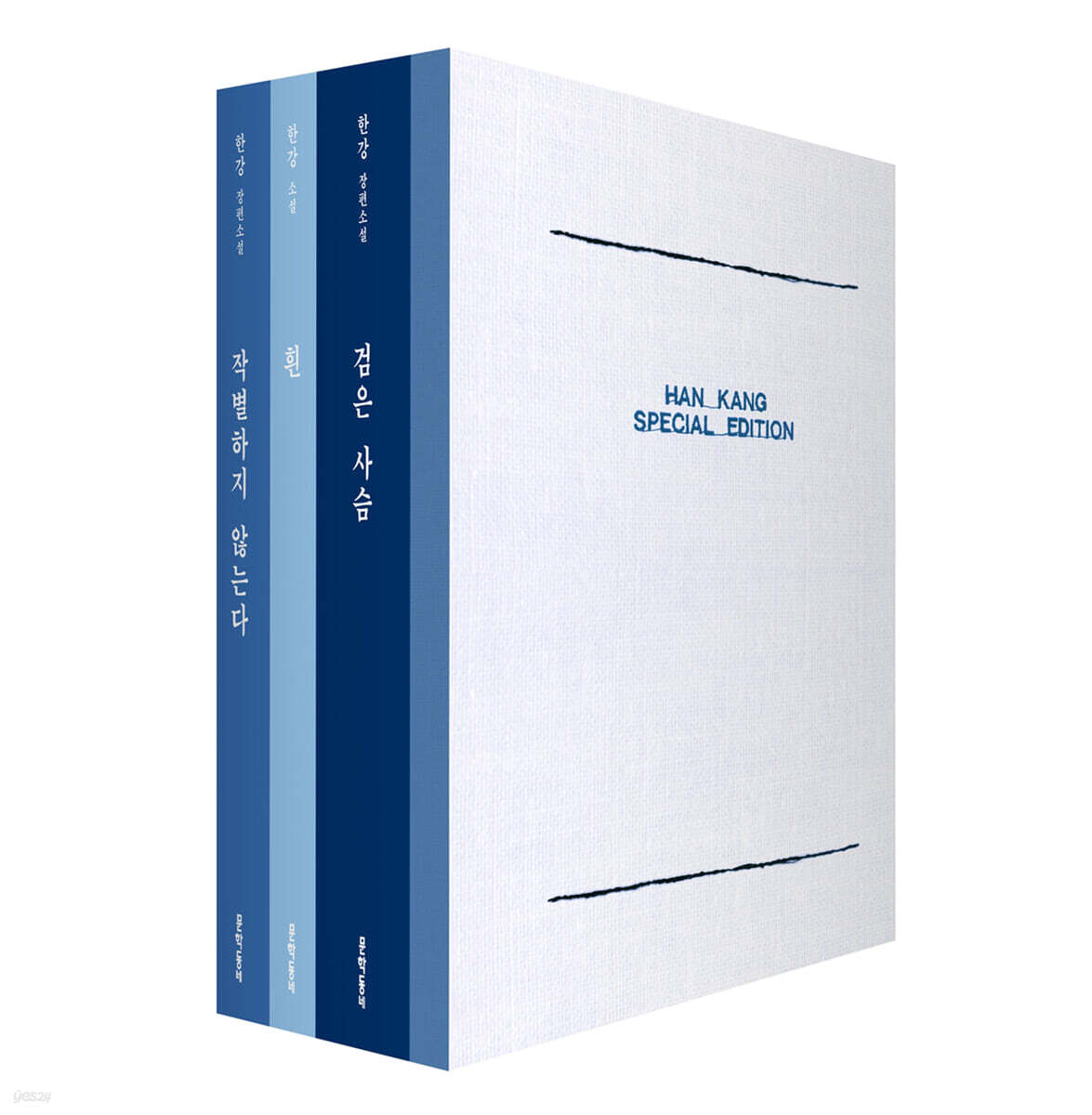
As author Han Kang expressed in her Nobel Prize in Literature lecture, “Language is the thread that connects us,” this edition specifically embodies the properties of thread through design.
December 17, 2024. Novel/Poetry PD Kim Yu-ri
The first Korean to win the Nobel Prize in Literature!
A special edition of Han Kang's brilliant achievements.
His latest novel, "No Farewell"
Autobiographical novel 『White』
His first full-length novel, "The Black Deer"
In October 2024, Han Kang was named the first Korean Nobel Prize winner in Literature, with the reason given being “her powerful and poetic prose that confronts historical trauma head-on and reveals the fragility of human life.”
It also holds new significance as she is the first Asian woman to win the Nobel Prize in Literature and the eighteenth female writer to do so.
We are delighted to celebrate author Han Kang's brilliant achievements and are publishing three novels that represent the core of her 30-year career in a special edition.
The design of the 'Han River Special Edition', which embodies the title of the work embroidered on white cotton, was inspired by the similarity between the properties of threads that connect, intertwine, break, and unravel, and the world created by the author's sentences and the collection of those sentences.
Spinning thread and composing sentences may seem like linear tasks at first glance, but I wanted to capture the fact that they can encompass everything from intimate explorations of life and death, human existence, to questions about the meaning of countless events that occur in this world.
I also wanted to add that our lives, which are inevitably temporal, are like that.
Limited edition manuscript notes were added to the three novels.
I would like to share with my readers the time spent carefully savoring the works, following the lines of 『No Farewell』, 『White』, and 『Black Deer』, and the time spent concluding this incredibly special year with the news of Han Kang's Nobel Prize in Literature.
A special edition of Han Kang's brilliant achievements.
His latest novel, "No Farewell"
Autobiographical novel 『White』
His first full-length novel, "The Black Deer"
In October 2024, Han Kang was named the first Korean Nobel Prize winner in Literature, with the reason given being “her powerful and poetic prose that confronts historical trauma head-on and reveals the fragility of human life.”
It also holds new significance as she is the first Asian woman to win the Nobel Prize in Literature and the eighteenth female writer to do so.
We are delighted to celebrate author Han Kang's brilliant achievements and are publishing three novels that represent the core of her 30-year career in a special edition.
The design of the 'Han River Special Edition', which embodies the title of the work embroidered on white cotton, was inspired by the similarity between the properties of threads that connect, intertwine, break, and unravel, and the world created by the author's sentences and the collection of those sentences.
Spinning thread and composing sentences may seem like linear tasks at first glance, but I wanted to capture the fact that they can encompass everything from intimate explorations of life and death, human existence, to questions about the meaning of countless events that occur in this world.
I also wanted to add that our lives, which are inevitably temporal, are like that.
Limited edition manuscript notes were added to the three novels.
I would like to share with my readers the time spent carefully savoring the works, following the lines of 『No Farewell』, 『White』, and 『Black Deer』, and the time spent concluding this incredibly special year with the news of Han Kang's Nobel Prize in Literature.
- You can preview some of the book's contents.
Preview
index
"I don't say goodbye"
Part 1 New
1 crystal
2 rooms
3 heavy snow
4 birds
5 remaining light
6 trees
Part 2 Night
1. No goodbye
2 Shadows
3 winds
4 static
5 drops
6 Under the Sea
Part 3 Fireworks
Author's Note
"white"
Chapter 1 Me
Chapter 2 Her
Chapter 3 All White
Commentary | How is it possible to fight the fact that we are human? _Kwon Hee-chul (literary critic)
Author's Note
Black Deer
dream
naked woman
old dog
scar
his sister
Winter in the Abandoned Mine
black deer
New Year's Eve National Highway
white spur
Land of Darkness
Heaven's Waiting Room
Valley of the Falling Lotus
Light of Silence
When the medicinal herbs bloom
She doesn't come back
Epilogue · Beyond the River of Darkness
Commentary | Persistent Pursuit Finally _ Baek Ji-eun (Literary Critic)
Part 1 New
1 crystal
2 rooms
3 heavy snow
4 birds
5 remaining light
6 trees
Part 2 Night
1. No goodbye
2 Shadows
3 winds
4 static
5 drops
6 Under the Sea
Part 3 Fireworks
Author's Note
"white"
Chapter 1 Me
Chapter 2 Her
Chapter 3 All White
Commentary | How is it possible to fight the fact that we are human? _Kwon Hee-chul (literary critic)
Author's Note
Black Deer
dream
naked woman
old dog
scar
his sister
Winter in the Abandoned Mine
black deer
New Year's Eve National Highway
white spur
Land of Darkness
Heaven's Waiting Room
Valley of the Falling Lotus
Light of Silence
When the medicinal herbs bloom
She doesn't come back
Epilogue · Beyond the River of Darkness
Commentary | Persistent Pursuit Finally _ Baek Ji-eun (Literary Critic)
Detailed image

Into the book
That's when I realized how fragile life is.
How easily those flesh, organs, bones, and lives can be broken and torn apart.
With just one choice.
---p.15 From "Not Saying Goodbye"
We know from experience that when some people leave, they take out the sharpest knife they have.
To cut the softest part of the opponent, knowing exactly where it is because they were close.
---p.17 From "Not Saying Goodbye"
The eyes almost always feel unreal.
Is it the speed or the beauty? As snowflakes fall through the air at what seems like an eternity, the distinction between important and unimportant suddenly becomes stark.
Some facts become frighteningly clear.
---pp.44~45 From "Not Saying Goodbye"
When it snows like this, I think of you.
There was a girl who wandered around the school playground until evening, even though I didn't see her myself.
A thirteen-year-old child who thought her seventeen-year-old sister was an adult and walked by hanging on to her arm, unable to open or close her eyes.
---p.87 From "Not Saying Goodbye"
Patience and resignation, sadness and imperfect reconciliation, strength and loneliness sometimes seem similar.
I thought it would be difficult to distinguish those emotions from someone's face and gestures, and perhaps even the person himself might not be able to separate them accurately.
---p.105 From "Not Saying Goodbye"
I don't know how birds sleep and die.
When the remaining light disappears, will life also end?
Does life, like an electric current, still flow until dawn?
---p.135 From "Not Saying Goodbye"
Everything I experience becomes a decision.
Nothing hurts anymore.
Hundreds and thousands of moments, like snowflakes unfolding in elaborate shapes, twinkle simultaneously.
I don't know how this is possible.
All the pain and joy, the overwhelming sadness and love, shine together as one mass, like a gigantic nebula, without mixing with each other.
---pp.137~138 From "Not Saying Goodbye"
I remember the warm feeling of love seeping through my skin.
My bones were sinking in and my heart was sinking… … That’s when I knew.
How terrible the pain of love is.
---p.311 From "Not Saying Goodbye"
But can death be this vivid?
Can snow touching my cheek be so cold and smile?
---p.323 From "Not Saying Goodbye"
We move forward at the sharp edge of time - the edge of a transparent cliff that is constantly being renewed.
After living for as long as I have, I take one precarious step, and without any time for my will to intervene, I step without hesitation into the air with the remaining foot.
Not because we are particularly brave, but because there is no other way.
Even at this moment, I feel that danger.
We recklessly walk into a time we have not yet lived through, into a book we have not yet written.
---p.11 From "White"
Now I'll give you something white.
Even if it gets dirty, white,
I'll only hand over white things.
I won't ask myself anymore.
Is it okay to hand this life over to you?
---p.39 From "White"
She continued walking, going against the snowflakes that were whirling fiercely against her face and body.
I couldn't figure it out.
What is this cold, hostile thing? At once fragile, fleeting, and overwhelmingly beautiful?
---p.60 From "White"
If you were still alive, I wouldn't be living this life right now.
If I were alive now, you wouldn't exist.
Only between darkness and light, only in that pale gap, do we barely see each other face to face.
---p.109 From "White"
After a long day, we need some time for silence.
It's time to reach out and open your hardened hands toward the faint warmth of silence, as you do in front of a fireplace without even realizing it.
---p.122 From "White"
I remember the thrill of all things being reborn anew, constantly and creatively.
I loved the world I saw through the viewfinder.
The world, shedding its previous shabby and stuffy shell, approached me as a fresh, living, breathing body.
Every time, I trembled with joy.
But what joy was it for?
I thought the photos I started taking were proof of my life.
But what exactly was the evidence for?
---p.98 From "Black Deer"
Myeongyun didn't believe in things like love that transcended death.
Love was so powerless that it lost the power to even perceive the other person's pain, illness, or death simply because they were far away.
He has no idea where Yi-seon is or what condition she is in right now, and no physical pain is being transmitted to him.
---p.141 From "Black Deer"
When one person's mind explodes, how much change can that event bring about?
---p.201 From "Black Deer"
I grew up in that darkness, and it was through that darkness that I became stronger little by little.
As I became accustomed to that divine blue light, I learned to remain silent instead of complaining or complaining of boredom.
I vaguely realized that peace can only be found when one stops longing for something.
---p.321 From "Black Deer"
Aren't there people in this world who slowly go mad? People who slowly become ill and then explode?
The stem stretches out, and it seems like it will stretch out endlessly, and then, as if by magic, a flower bursts out from the end...
How easily those flesh, organs, bones, and lives can be broken and torn apart.
With just one choice.
---p.15 From "Not Saying Goodbye"
We know from experience that when some people leave, they take out the sharpest knife they have.
To cut the softest part of the opponent, knowing exactly where it is because they were close.
---p.17 From "Not Saying Goodbye"
The eyes almost always feel unreal.
Is it the speed or the beauty? As snowflakes fall through the air at what seems like an eternity, the distinction between important and unimportant suddenly becomes stark.
Some facts become frighteningly clear.
---pp.44~45 From "Not Saying Goodbye"
When it snows like this, I think of you.
There was a girl who wandered around the school playground until evening, even though I didn't see her myself.
A thirteen-year-old child who thought her seventeen-year-old sister was an adult and walked by hanging on to her arm, unable to open or close her eyes.
---p.87 From "Not Saying Goodbye"
Patience and resignation, sadness and imperfect reconciliation, strength and loneliness sometimes seem similar.
I thought it would be difficult to distinguish those emotions from someone's face and gestures, and perhaps even the person himself might not be able to separate them accurately.
---p.105 From "Not Saying Goodbye"
I don't know how birds sleep and die.
When the remaining light disappears, will life also end?
Does life, like an electric current, still flow until dawn?
---p.135 From "Not Saying Goodbye"
Everything I experience becomes a decision.
Nothing hurts anymore.
Hundreds and thousands of moments, like snowflakes unfolding in elaborate shapes, twinkle simultaneously.
I don't know how this is possible.
All the pain and joy, the overwhelming sadness and love, shine together as one mass, like a gigantic nebula, without mixing with each other.
---pp.137~138 From "Not Saying Goodbye"
I remember the warm feeling of love seeping through my skin.
My bones were sinking in and my heart was sinking… … That’s when I knew.
How terrible the pain of love is.
---p.311 From "Not Saying Goodbye"
But can death be this vivid?
Can snow touching my cheek be so cold and smile?
---p.323 From "Not Saying Goodbye"
We move forward at the sharp edge of time - the edge of a transparent cliff that is constantly being renewed.
After living for as long as I have, I take one precarious step, and without any time for my will to intervene, I step without hesitation into the air with the remaining foot.
Not because we are particularly brave, but because there is no other way.
Even at this moment, I feel that danger.
We recklessly walk into a time we have not yet lived through, into a book we have not yet written.
---p.11 From "White"
Now I'll give you something white.
Even if it gets dirty, white,
I'll only hand over white things.
I won't ask myself anymore.
Is it okay to hand this life over to you?
---p.39 From "White"
She continued walking, going against the snowflakes that were whirling fiercely against her face and body.
I couldn't figure it out.
What is this cold, hostile thing? At once fragile, fleeting, and overwhelmingly beautiful?
---p.60 From "White"
If you were still alive, I wouldn't be living this life right now.
If I were alive now, you wouldn't exist.
Only between darkness and light, only in that pale gap, do we barely see each other face to face.
---p.109 From "White"
After a long day, we need some time for silence.
It's time to reach out and open your hardened hands toward the faint warmth of silence, as you do in front of a fireplace without even realizing it.
---p.122 From "White"
I remember the thrill of all things being reborn anew, constantly and creatively.
I loved the world I saw through the viewfinder.
The world, shedding its previous shabby and stuffy shell, approached me as a fresh, living, breathing body.
Every time, I trembled with joy.
But what joy was it for?
I thought the photos I started taking were proof of my life.
But what exactly was the evidence for?
---p.98 From "Black Deer"
Myeongyun didn't believe in things like love that transcended death.
Love was so powerless that it lost the power to even perceive the other person's pain, illness, or death simply because they were far away.
He has no idea where Yi-seon is or what condition she is in right now, and no physical pain is being transmitted to him.
---p.141 From "Black Deer"
When one person's mind explodes, how much change can that event bring about?
---p.201 From "Black Deer"
I grew up in that darkness, and it was through that darkness that I became stronger little by little.
As I became accustomed to that divine blue light, I learned to remain silent instead of complaining or complaining of boredom.
I vaguely realized that peace can only be found when one stops longing for something.
---p.321 From "Black Deer"
Aren't there people in this world who slowly go mad? People who slowly become ill and then explode?
The stem stretches out, and it seems like it will stretch out endlessly, and then, as if by magic, a flower bursts out from the end...
---p.346 From "Black Deer"
Publisher's Review
The first place in the ‘Han River Special Edition’ is ‘No Farewell’.
This latest full-length novel, which took seven years to complete, is the first Korean to win the Prix Médicis Foreign Literature, one of the four major French literary awards, in 2023, and subsequently won the Emile Guimet Asian Literature Award, presenting a universal emotion about memory and mourning, and above all, ultimate love, that transcends Korea.
At a press conference commemorating his Medici Award, the author explained, “This book is a story about going down to the bottom of humanity and lighting a candle underneath,” and “It is a story about people who never stop mourning and are determined to never say goodbye, and it is a story about those hearts.”
He also said in a recent interview with the Nobel Committee, “I think every writer likes his most recent book.
The most recent book I wrote is "No Farewell."
He expressed his special affection for this work, saying, “I think it would be a good idea to start with this book.”
“I hope this is a novel about extreme love.” _From the author’s note
The novel “White” begins with the sentence, “The first thing I did in the spring when I decided to write about white was to make a list.”
A list of things that go on and on: sackcloth, maternity clothes, salt, snow, ice, moon, breath, frost, white bones.
A baby whose mother gave birth when she was twenty-three, and who died two hours after birth.
Growing up where the baby died, 'I' resonate with the death of my older sister, who was 'as white and pretty as a mooncake', and the death of a six-year-old child in a Jewish ghetto.
The image of white things radiates both sublimity and fear, quietly shining at the border between the living and the dead.
It was shortlisted for the International Booker Prize with reviews calling it “a book about mourning, resurrection, and the strength of the human spirit.” In an interview with the Nobel Committee, author Han Kang said, “I recommend ‘White’ as a very personal book with many autobiographical elements.”
“Maybe I’m still connected to this book.
In moments when I feel shaken, cracked, or about to break, I think of you and the white things I wanted to give you.
“I have never believed in God, so these moments become my fervent prayers.” _From the author’s note
『Black Deer』(1995) is the first full-length novel that Han Kang completed after three years of writing following her literary debut in 1993. Its dense and flawless narrative and deeply resonant poetic sentences earned it praise at the time of its publication, saying, “It foreshadows the birth of a young master” (literary critic Seo Young-chae).
One day, a woman disappears while running naked down the street in the city center in broad daylight, and two men and women who know her set out to find her with only a few clues in hand.
"The Black Deer" darkly illuminates the deep abyss that each person faces on their journey.
Even if we never return to the world, in the journey of those who step into the abyss, we will paradoxically experience following the light rather than the darkness.
“There is a space between words and silence, darkness and light, dreams and reality, death and life, memory and reality.
The space is not only between them, but also surrounds them and fills them inside and out.
I desperately hoped that my words would truly penetrate that space.
“Like white roots that have dug their way through the dark soil, I hope to be able to raise this body of darkness and light up to the leaves.” _From the author’s note in the first edition in 1995
■Han River Special Edition Designer Comments■
When I imagined compiling Han Kang's books into a series, a truly connected picture came to mind.
In fact, it becomes a medium that connects and connects silently in an invisible place.
I hope that the artist's work can be approached with another kind of beauty through the process of the embroidery threads, which shine brilliantly, being woven one by one into letters.
Designer Kim Lee-jung
■Detailed introduction to each volume■
Don't say goodbye
novel
Medici Prize for Foreign Literature
Emile Guimet Prize for Asian Literature
Daesan Literary Award
Kim Man-jung Literary Award winner
“I think every writer likes his most recent book.
The most recent book I wrote is "No Farewell."
I think it would be a good idea to start with this book.”
_From an interview with the Nobel Committee
“The most powerful work that reaches the pinnacle of the author’s artistic world.”
_Le Monde
What can you bear to think about?
If there is no fire burning in your heart.
If you weren't there to come back and hug me.
From those who lived here, from those who live here
Memories of profound love seeping in like a dream
A new novel by author Han Kang, who won the International Booker Prize in 2016 for The Vegetarian and was shortlisted for the same prize in 2018 for White.
It attracted a lot of attention when the first half was serialized in the quarterly magazine 『Munhakdongne』 from the winter of 2019 to the spring of the following year, and after a year of writing the second half and working hard to polish the entire work, it was finally completed.
Originally conceived as the final work in the "Snow" trilogy, following "While a Snowflake Melts" (winner of the 2015 Hwang Sun-won Literary Award) and "Farewell" (winner of the 2018 Kim Yu-jeong Literary Award), it was compiled into a complete work in its own right, allowing us to grasp the special meaning of "No Farewell" in the literary trajectory of author Han Kang.
With this, we can clearly see the dazzling present of Han Kang's literature, which has depicted the struggles and dignity of humans moving toward a ray of light even in the darkness through recent works such as "The Boy Comes" (2014), "White" (2016), and the "Snow" series (2015, 2017).
Drawn from the memories of a tragic history not so long ago, this story of desperate and profound love that ultimately makes humans human is conveyed with stunningly vivid images and flowing, poetic prose, reaching audiences with overwhelming beauty.
Strange, the eyes.
How can something like that come down from the sky?
"I Don't Say Goodbye" begins with a dream scene from the protagonist, Kyung-ha, a novelist.
A snowy plain, thousands of black logs planted on the ridge like tombstones.
As he thinks about the graveyard, water rises beneath his feet, and he wakes up from his dream, thinking that he must move the bones before they are all washed away by the sea.
Kyung-ha thinks that it is a dream about the massacre discussed in the previous book, like other nightmares he had around that time, and he plans to make a video related to the dream with his friend In-seon, who used to work as a photographer and documentary filmmaker but went down to Jeju to take care of his mother and does carpentry work.
However, as he struggles through the next few years and barely manages to get his life back on track, the plan stalls, and Kyung-ha changes his mind, realizing he misunderstood the dream.
Then one winter day, Gyeong-ha receives an urgent call from In-seon at the hospital.
Inseon had an accident while working with logs and had two fingers cut off, requiring surgery.
In-seon suddenly asks Kyung-ha, who went straight to the hospital, to go to Jeju Island that day and rescue the bird that was left alone. Unable to refuse In-seon's earnest request, he hurries to Jeju Island.
However, Jeju was suddenly engulfed in heavy snow and strong winds, making it impossible to see even an inch ahead.
Suffering from chronic headaches that come and go in fits and starts, Gyeong-ha barely manages to catch the last bus to In-seon's village.
However, on the way up the mountain to Inseon's house, which is quite far from the bus stop, he gets caught in heavy snow and darkness and gets lost.
The eyes almost always feel unreal.
Is it the speed or the beauty? As snowflakes fall through the air at what seems like an eternity, the distinction between important and unimportant suddenly becomes stark.
Some facts become frighteningly clear (pp. 44-45)
My heart will beat again.
Yes, I will drink this water.
After much hardship, he arrives at Inseon's house and encounters Inseon's family history, which is intertwined with the massacre of civilians that occurred in Jeju seventy years ago.
The story of a father who lost his entire family and had to spend fifteen years in prison without even having time to grieve, and a mother who lost her parents and younger sibling on the same day and was left with her older sister without even knowing whether her older brother was alive or dead.
And with it, the quiet struggle of In-seon's mother, Jeong-shim, who lived through the aftermath of the massacre and dedicated decades to finding her brother's whereabouts, never giving up, comes to mind under the dim candlelight in the darkness of a remote house isolated by heavy snow.
Among the tens of thousands of indifferent snowflakes that descend slowly, as if forever, between light and darkness, a longing for someone who is no longer here seeps from Jeongsim to Inseon, and from Inseon to Gyeongha.
When it snows like this, I think of you.
There was a girl who wandered around the school playground until evening, even though I didn't see her myself.
A thirteen-year-old child, who thought her seventeen-year-old sister was an adult, hung on to her arm, unable to open or close her eyes, and walked. (Page 87)
But it's not all over.
We're not really broken up yet.
The author said that he hopes this novel will be “a novel about extreme love” (Author’s Note).
That love will first and foremost be in the heart of Inseon's mother, Jeongsim, who never lost faith in people and life until the very end.
It would have kept the light from being lost even in the vast darkness where one could not tell where the bottom was.
But we also learn that it's not just bright and warm.
The fact is that as much as that love is extreme and earnest, it is also a pain that is more terrifying than anything else.
I remember the warm feeling of love seeping through my skin.
My bones were sinking in and my heart was sinking… … That’s when I knew.
How terrible the pain of love is. (Page 311)
Just as In-seon's mother, Jeong-shim, has been like this all her life, In-seon cannot turn away from her mother's love even though she is in pain as her mother's life seeps into her, and Gyeong-ha also has a hard time as In-seon's heart overlaps with his own, but he cannot reject it.
The novel may be saying that the only way for humans to be human is to shake one's head and say, "I don't love that bird enough to go to her house tonight through this blizzard" (p. 88), and "I've never loved enough to feel this pain" (p. 152), but to reach out to that love and choose the pain.
That is the only way to save life from extinction.
Perhaps, in fact, the call has always been before us.
As if it were our job to recognize that love as love and hold its hand.
When you carefully reach out your hand in front of it, the place where your heart touches it is cold like a snowflake and at the same time hot like a flame, and is an experience that will never be forgotten. Isn't that an experience that only Han Kang's novels can convey?
In this way, Han Kang's novel comes before us.
I remember a few years ago when someone asked me, "What are you going to write next?" I answered that I hoped it would be a novel about love.
My feelings now are the same.
I hope this is a novel about ultimate love.
_From the author's note
Han Kang makes us think that it might not be the writer who chooses the material, but rather the other way around.
Following 'May in Gwangju', I came to believe that there was an area in 'Jeju April 3' that could only be expressed through Han Kang's words.
There is a narrative of the survivors' long, silent struggle to find their missing family members after the massacre.
Spatially, it spans from Jeju to Gyeongsan, and temporally, it spans over half a century.
Even when marred by violence and crushed by fear, humans do not give up.
It means that we cannot say goodbye.
All of this is conveyed through the daughter's eyes and mouth.
Violence seeks the annihilation of the body, but memory endures without the body.
You can't bring the dead back to life, but you can keep the dead alive.
It means that we will not say goodbye.
The novelist 'I' next to them hears their stories only after reaching the boundary between life and death or beyond it.
As if only this much pain could qualify one to reach the truth, as if the only way to reach pain was through pain.
Here is the most resolute answer to the ethics of reproduction.
From some point on, I became solemn in front of his new novel.
Everyone puts in effort, and of course writers do too.
But the Han River is giving its all every time.
Shin Hyeong-cheol (literary critic)
white
novel
International Booker Prize finalist
“I recommend ‘White’ as a very personal book with many autobiographical elements.”
_From an interview with the Nobel Committee
“A book about mourning and resurrection, and the strength of the human spirit.”
_Booker Prize Committee
Solitude, silence, and courage.
It was these things that breathed life into me in this book.
In April 2016, when the editor asked if I would write an "Author's Note" to be appended to the end of the book, I said no.
I remember laughing and saying that this entire book was the author's own words.
Now, two years later, as I prepare the revised edition, I finally feel like I want to quietly add something—that I can.
_From the author's note
The novel "White" by author Han Kang, whom I met again, is a book written with sweat counting like embroidery, a book stained with those drops of sweat.
If not for this moment, would I have been able to cling to the single word ‘white’ and examine the inside and outside of all the ‘white things’ in the world that he had derived?
As I stare intently at the single character 'white', a sticky sadness, like boiling soup, surges up from the shape and pronunciation of the single character 'white'.
‘White’, where does this feeling, which feels familiar and comfortable but then becomes unfamiliar and strange, come from?
In this strange and subtle world of 'whiteness', where one can neither say one knows nor say one does not know, the narrative that Han Kang has created is surprisingly broad and deep.
The thoughts that are sharply picked up with a unique sense that is both sensitive and delicate are as cold as ice and as hot as freshly ground bone powder.
Don't we all come from 'white' and return to 'white'?
The novel 『White』 written by Han Kang with all his might on a blank sheet of paper.
The novel "White" that talks about everything else that is white.
"White" is a story about something white that never gets dirty, something that can never be dirty.
“The first thing I did in the spring when I decided to write about white was to make a list.”
The list of white things that came out of the author in this way is derived from a total of 65 stories and is smeared under three chapters called 'Me', 'Her', and 'All White'.
Although it is a novel, it can also be read as a poetry collection containing 65 poems, as each story under each subheading boasts a dense and complete quality in itself.
This novel, with its relatively thin volume, is not an easy read.
I have them read very slowly, very slowly, then I have them pick up a dull pencil and mark sentences or words, and then I have them go back to the page they were reading before and start reading again from where they were before.
The white things that were called out to support the weight of the novel 『White』, which was becoming heavier and heavier as the lump in my heart seeped into the bookshelf.
For example, a blanket, a baby's underwear, a moon cake, fog, a white city, milk, grass, frost, sugar cubes, white stones, white bones, white hair, clouds, incandescent light bulbs, white nights, the white back of thin paper, white butterflies, rice and cooked meals, shrouds, mourning clothes, smoke, lower teeth, snow, snowflakes, eternal snow, waves, sleet, white dogs, blizzards, ash, salt, the moon, lace curtains, breath, white birds, handkerchiefs, the Milky Way, white magnolias, sugar-coated tablets... ... and so on. I try to softly pronounce the names of all the mercilessly white things.
This novel, in this way, reveals my true inner thoughts through two processes: reading with my eyes and reading with my mouth.
Wouldn't the process of recalling, calling out, calling out, and writing about white ultimately be healing for us who see and read white?
There is 'me' who suffers from "migraines, a familiar and terrible friend."
I have a story about my 'sister' who was born to my deceased mother when she was twenty-three and died two hours after birth.
Last spring someone asked me:
“When you were young, did you have any experiences that brought you closer to grief?” At that moment, I think of that death.
“The most helpless of the young beasts.
A baby as white and pretty as a mooncake.
“The story of how I was born and raised in the place where he died.”
Even after moving to an old city on the other side of the world, I am haunted by old memories that keep coming back to me.
Then, by chance, I came across a video of this city taken by a US military aircraft in the spring of 1945.
As I walk through the city, which was completely destroyed and shattered under Hitler's order to "wipe out this city, the only one in Europe that rose up against the Nazis, by all means possible, as an example," and which has been rebuilt seventy years later, I find myself pondering for the first time "the face of that man—someone like this city."
You would only hear voices.
Don't die.
Please don't die.
Those words, which he could not understand, were probably the only voices he heard.
So, it can neither be confirmed nor denied.
Did he come to me sometimes?
It must have lingered on my forehead and around my eyes for a while.
Among the sensations and vague feelings I felt as a child, were there some that came from him without me knowing?
Because everyone has moments when they feel cold while lying in a dark room.
Don't die.
Please don't die.
(Pages 32-33)
The story that started from me ends up shifting its gaze to her.
“Don’t die.
Please don't die.
“Because those words are engraved on her body like a talisman,” I come to think, “she came here in my place.”
And through her, we meet the white things of the world again.
Oh, the frozen white sea, Oh, the frosty time when the sunlight begins to grow a little paler, Oh, the wings of a dead butterfly becoming transparent, Oh, the pale fists that grow colder the more you clench them, Oh, the snow that lives for a second or two before settling on the sleeves of a black coat and melting away, Oh, the sleet that falls when you walk knowing that everything you have held on with all your might will eventually disappear, Oh, the white breath that escapes from our lips for the first time on a cold morning as proof that we are alive, proof that our bodies are warm, Oh, the white bird that never disappears from sight no matter how far it flies, Oh, the handkerchief that falls like a bird with half-folded wings, like a soul hesitantly looking for a place to land, Death like the white back of a thin piece of paper.
She knows that the people of this city are not just lighting candles and offering flowers in front of the wall for the souls.
I believe that being slaughtered is not a shame.
The idea is to prolong the mourning as long as possible.
She thought about what had happened in the country she had left behind, and about the mourning the dead had not fully received.
I thought about the possibility that those souls would be honored in the middle of the street like this, and realized that my homeland had never done that properly.
And more importantly, she learned what process she had been involved in to rebuild herself.
Of course, her body is not dead yet.
Her soul still resides in her body.
(…)
So, there are a few things left for her to do.
Stop lying.
(Open your eyes) I will lift the curtain.
I will light a candle for all the dead and souls I remember - including my own.
(Pages 108-109)
I think as I burn the white cotton skirt and jacket that my younger brother's bride, who is about to get married, had prepared as a share of her deceased mother's belongings.
“If you can come, come now.
“May you wear that dress made of smoke like a winged garment.” And I say:
“In all the white things you will take your last breath.”
The pain that I came to know and suffered under the name of 'All White', the pain that I endured and endured with my whole body, so this farewell greeting could be considered the best.
This could be called a true greeting.
“The movement of the great water that silently sways between this world and the next” is said to be mixed like that.
Don't die.
Please don't die.
I open my lips and mutter what you, who didn't know how to speak, heard with your dark eyes open.
Press hard on a blank piece of paper.
I believe that is the best way to say goodbye.
Don't die.
Live on.
(Page 133)
"White" is a novel that renders powerless the boundary between life and death.
It breaks down the walls of life and death with sand, softens the hardness of life and death, makes the obviousness of life and death strange, disperses the plane of life and death into three dimensions, and expands the finiteness of life and death into the infinity of the universe.
Crossing is a way to build flexibility in your body.
The embrace that flexible thinking creates is enough to build solidarity.
The solidarity of the living and the dead, after all, won't all the living become dead?
Just as “the baby’s diaper became a shroud and the swaddling clothes became a coffin.”
black deer
novel
“It is only when you stop longing for something that you find peace.
I was vaguely aware of it.”
『Black Deer』(1995), which meticulously depicts the pain that lies in the abyss of existence using all of the senses, is author Han Kang's first full-length novel, which she completed after three years of immersion in writing following her literary debut in 1993. At the time of its publication, it received praise for its dense and flawless narrative and deeply resonant poetic sentences, saying, "It foreshadows the birth of a young master" (literary critic Seo Young-chae).
The 'Black Deer', which is also the title of the work, is a fantastical beast that lives deep underground, in narrow crevices of rocks.
This beast, with its beautiful, strong horns and sharp teeth, wishes to see the sky at least once in its life.
However, when he asks the miner to show him the way out, the miner gives him the antlers and teeth of a black deer in exchange for it.
The life of a black deer, the more desperately it desires sunlight, the deeper it falls into darkness.
This is similar to the lives of the characters in the novel.
One day, a woman disappears while running naked down the street in the city center in broad daylight, and two men and women who know her set out to find her with only a few clues in hand.
"The Black Deer" darkly illuminates the deep abyss that each person faces on their journey.
Even if we never return to the world, in the journey of those who step into the abyss, we may paradoxically experience following the light rather than the darkness.
Han Kang's novels, filled with extinction, emptiness, and sorrow, force readers to turn their heads and confront the traces left behind in the pages of time.
Her first full-length novel, and undoubtedly one of the most outstanding literary achievements of the 1990s, "Black Deer" is a story of a soul drifting into a point in the past where personal wounds and the wounds of the times intersect.
In the writer's adventure of descending into a deep and dark abyss along the narrow path between oblivion and memory, we are, in turn, convinced of the bright future of our literature in the dawning next century.
Nam Jin-woo (poet, literary critic, professor of creative writing at Myongji University)
Where the Han River gazes, there are no tall, huge, flashy, or noisy things.
He persistently pursues the low, the small, the humble, and the quiet, deepening them and ultimately affirming them.
It doesn't mean to hug warmly and comfort sweetly.
It means confronting the darkness of the world not with disillusionment and resignation, but with tension and struggle.
So it's fierce but not warm, not conciliatory but fortunate.
『The Black Deer』 is a novel that does not turn back until the harshness of the world turns into human dignity, depression into passion, and frustration into courage.
This is a novel that transforms human weakness and the pain caused by weakness into the depths of fate.
And that makes us feel relieved and grateful that humans can do that.
Baek Ji-eun (literary critic)
This latest full-length novel, which took seven years to complete, is the first Korean to win the Prix Médicis Foreign Literature, one of the four major French literary awards, in 2023, and subsequently won the Emile Guimet Asian Literature Award, presenting a universal emotion about memory and mourning, and above all, ultimate love, that transcends Korea.
At a press conference commemorating his Medici Award, the author explained, “This book is a story about going down to the bottom of humanity and lighting a candle underneath,” and “It is a story about people who never stop mourning and are determined to never say goodbye, and it is a story about those hearts.”
He also said in a recent interview with the Nobel Committee, “I think every writer likes his most recent book.
The most recent book I wrote is "No Farewell."
He expressed his special affection for this work, saying, “I think it would be a good idea to start with this book.”
“I hope this is a novel about extreme love.” _From the author’s note
The novel “White” begins with the sentence, “The first thing I did in the spring when I decided to write about white was to make a list.”
A list of things that go on and on: sackcloth, maternity clothes, salt, snow, ice, moon, breath, frost, white bones.
A baby whose mother gave birth when she was twenty-three, and who died two hours after birth.
Growing up where the baby died, 'I' resonate with the death of my older sister, who was 'as white and pretty as a mooncake', and the death of a six-year-old child in a Jewish ghetto.
The image of white things radiates both sublimity and fear, quietly shining at the border between the living and the dead.
It was shortlisted for the International Booker Prize with reviews calling it “a book about mourning, resurrection, and the strength of the human spirit.” In an interview with the Nobel Committee, author Han Kang said, “I recommend ‘White’ as a very personal book with many autobiographical elements.”
“Maybe I’m still connected to this book.
In moments when I feel shaken, cracked, or about to break, I think of you and the white things I wanted to give you.
“I have never believed in God, so these moments become my fervent prayers.” _From the author’s note
『Black Deer』(1995) is the first full-length novel that Han Kang completed after three years of writing following her literary debut in 1993. Its dense and flawless narrative and deeply resonant poetic sentences earned it praise at the time of its publication, saying, “It foreshadows the birth of a young master” (literary critic Seo Young-chae).
One day, a woman disappears while running naked down the street in the city center in broad daylight, and two men and women who know her set out to find her with only a few clues in hand.
"The Black Deer" darkly illuminates the deep abyss that each person faces on their journey.
Even if we never return to the world, in the journey of those who step into the abyss, we will paradoxically experience following the light rather than the darkness.
“There is a space between words and silence, darkness and light, dreams and reality, death and life, memory and reality.
The space is not only between them, but also surrounds them and fills them inside and out.
I desperately hoped that my words would truly penetrate that space.
“Like white roots that have dug their way through the dark soil, I hope to be able to raise this body of darkness and light up to the leaves.” _From the author’s note in the first edition in 1995
■Han River Special Edition Designer Comments■
When I imagined compiling Han Kang's books into a series, a truly connected picture came to mind.
In fact, it becomes a medium that connects and connects silently in an invisible place.
I hope that the artist's work can be approached with another kind of beauty through the process of the embroidery threads, which shine brilliantly, being woven one by one into letters.
Designer Kim Lee-jung
■Detailed introduction to each volume■
Don't say goodbye
novel
Medici Prize for Foreign Literature
Emile Guimet Prize for Asian Literature
Daesan Literary Award
Kim Man-jung Literary Award winner
“I think every writer likes his most recent book.
The most recent book I wrote is "No Farewell."
I think it would be a good idea to start with this book.”
_From an interview with the Nobel Committee
“The most powerful work that reaches the pinnacle of the author’s artistic world.”
_Le Monde
What can you bear to think about?
If there is no fire burning in your heart.
If you weren't there to come back and hug me.
From those who lived here, from those who live here
Memories of profound love seeping in like a dream
A new novel by author Han Kang, who won the International Booker Prize in 2016 for The Vegetarian and was shortlisted for the same prize in 2018 for White.
It attracted a lot of attention when the first half was serialized in the quarterly magazine 『Munhakdongne』 from the winter of 2019 to the spring of the following year, and after a year of writing the second half and working hard to polish the entire work, it was finally completed.
Originally conceived as the final work in the "Snow" trilogy, following "While a Snowflake Melts" (winner of the 2015 Hwang Sun-won Literary Award) and "Farewell" (winner of the 2018 Kim Yu-jeong Literary Award), it was compiled into a complete work in its own right, allowing us to grasp the special meaning of "No Farewell" in the literary trajectory of author Han Kang.
With this, we can clearly see the dazzling present of Han Kang's literature, which has depicted the struggles and dignity of humans moving toward a ray of light even in the darkness through recent works such as "The Boy Comes" (2014), "White" (2016), and the "Snow" series (2015, 2017).
Drawn from the memories of a tragic history not so long ago, this story of desperate and profound love that ultimately makes humans human is conveyed with stunningly vivid images and flowing, poetic prose, reaching audiences with overwhelming beauty.
Strange, the eyes.
How can something like that come down from the sky?
"I Don't Say Goodbye" begins with a dream scene from the protagonist, Kyung-ha, a novelist.
A snowy plain, thousands of black logs planted on the ridge like tombstones.
As he thinks about the graveyard, water rises beneath his feet, and he wakes up from his dream, thinking that he must move the bones before they are all washed away by the sea.
Kyung-ha thinks that it is a dream about the massacre discussed in the previous book, like other nightmares he had around that time, and he plans to make a video related to the dream with his friend In-seon, who used to work as a photographer and documentary filmmaker but went down to Jeju to take care of his mother and does carpentry work.
However, as he struggles through the next few years and barely manages to get his life back on track, the plan stalls, and Kyung-ha changes his mind, realizing he misunderstood the dream.
Then one winter day, Gyeong-ha receives an urgent call from In-seon at the hospital.
Inseon had an accident while working with logs and had two fingers cut off, requiring surgery.
In-seon suddenly asks Kyung-ha, who went straight to the hospital, to go to Jeju Island that day and rescue the bird that was left alone. Unable to refuse In-seon's earnest request, he hurries to Jeju Island.
However, Jeju was suddenly engulfed in heavy snow and strong winds, making it impossible to see even an inch ahead.
Suffering from chronic headaches that come and go in fits and starts, Gyeong-ha barely manages to catch the last bus to In-seon's village.
However, on the way up the mountain to Inseon's house, which is quite far from the bus stop, he gets caught in heavy snow and darkness and gets lost.
The eyes almost always feel unreal.
Is it the speed or the beauty? As snowflakes fall through the air at what seems like an eternity, the distinction between important and unimportant suddenly becomes stark.
Some facts become frighteningly clear (pp. 44-45)
My heart will beat again.
Yes, I will drink this water.
After much hardship, he arrives at Inseon's house and encounters Inseon's family history, which is intertwined with the massacre of civilians that occurred in Jeju seventy years ago.
The story of a father who lost his entire family and had to spend fifteen years in prison without even having time to grieve, and a mother who lost her parents and younger sibling on the same day and was left with her older sister without even knowing whether her older brother was alive or dead.
And with it, the quiet struggle of In-seon's mother, Jeong-shim, who lived through the aftermath of the massacre and dedicated decades to finding her brother's whereabouts, never giving up, comes to mind under the dim candlelight in the darkness of a remote house isolated by heavy snow.
Among the tens of thousands of indifferent snowflakes that descend slowly, as if forever, between light and darkness, a longing for someone who is no longer here seeps from Jeongsim to Inseon, and from Inseon to Gyeongha.
When it snows like this, I think of you.
There was a girl who wandered around the school playground until evening, even though I didn't see her myself.
A thirteen-year-old child, who thought her seventeen-year-old sister was an adult, hung on to her arm, unable to open or close her eyes, and walked. (Page 87)
But it's not all over.
We're not really broken up yet.
The author said that he hopes this novel will be “a novel about extreme love” (Author’s Note).
That love will first and foremost be in the heart of Inseon's mother, Jeongsim, who never lost faith in people and life until the very end.
It would have kept the light from being lost even in the vast darkness where one could not tell where the bottom was.
But we also learn that it's not just bright and warm.
The fact is that as much as that love is extreme and earnest, it is also a pain that is more terrifying than anything else.
I remember the warm feeling of love seeping through my skin.
My bones were sinking in and my heart was sinking… … That’s when I knew.
How terrible the pain of love is. (Page 311)
Just as In-seon's mother, Jeong-shim, has been like this all her life, In-seon cannot turn away from her mother's love even though she is in pain as her mother's life seeps into her, and Gyeong-ha also has a hard time as In-seon's heart overlaps with his own, but he cannot reject it.
The novel may be saying that the only way for humans to be human is to shake one's head and say, "I don't love that bird enough to go to her house tonight through this blizzard" (p. 88), and "I've never loved enough to feel this pain" (p. 152), but to reach out to that love and choose the pain.
That is the only way to save life from extinction.
Perhaps, in fact, the call has always been before us.
As if it were our job to recognize that love as love and hold its hand.
When you carefully reach out your hand in front of it, the place where your heart touches it is cold like a snowflake and at the same time hot like a flame, and is an experience that will never be forgotten. Isn't that an experience that only Han Kang's novels can convey?
In this way, Han Kang's novel comes before us.
I remember a few years ago when someone asked me, "What are you going to write next?" I answered that I hoped it would be a novel about love.
My feelings now are the same.
I hope this is a novel about ultimate love.
_From the author's note
Han Kang makes us think that it might not be the writer who chooses the material, but rather the other way around.
Following 'May in Gwangju', I came to believe that there was an area in 'Jeju April 3' that could only be expressed through Han Kang's words.
There is a narrative of the survivors' long, silent struggle to find their missing family members after the massacre.
Spatially, it spans from Jeju to Gyeongsan, and temporally, it spans over half a century.
Even when marred by violence and crushed by fear, humans do not give up.
It means that we cannot say goodbye.
All of this is conveyed through the daughter's eyes and mouth.
Violence seeks the annihilation of the body, but memory endures without the body.
You can't bring the dead back to life, but you can keep the dead alive.
It means that we will not say goodbye.
The novelist 'I' next to them hears their stories only after reaching the boundary between life and death or beyond it.
As if only this much pain could qualify one to reach the truth, as if the only way to reach pain was through pain.
Here is the most resolute answer to the ethics of reproduction.
From some point on, I became solemn in front of his new novel.
Everyone puts in effort, and of course writers do too.
But the Han River is giving its all every time.
Shin Hyeong-cheol (literary critic)
white
novel
International Booker Prize finalist
“I recommend ‘White’ as a very personal book with many autobiographical elements.”
_From an interview with the Nobel Committee
“A book about mourning and resurrection, and the strength of the human spirit.”
_Booker Prize Committee
Solitude, silence, and courage.
It was these things that breathed life into me in this book.
In April 2016, when the editor asked if I would write an "Author's Note" to be appended to the end of the book, I said no.
I remember laughing and saying that this entire book was the author's own words.
Now, two years later, as I prepare the revised edition, I finally feel like I want to quietly add something—that I can.
_From the author's note
The novel "White" by author Han Kang, whom I met again, is a book written with sweat counting like embroidery, a book stained with those drops of sweat.
If not for this moment, would I have been able to cling to the single word ‘white’ and examine the inside and outside of all the ‘white things’ in the world that he had derived?
As I stare intently at the single character 'white', a sticky sadness, like boiling soup, surges up from the shape and pronunciation of the single character 'white'.
‘White’, where does this feeling, which feels familiar and comfortable but then becomes unfamiliar and strange, come from?
In this strange and subtle world of 'whiteness', where one can neither say one knows nor say one does not know, the narrative that Han Kang has created is surprisingly broad and deep.
The thoughts that are sharply picked up with a unique sense that is both sensitive and delicate are as cold as ice and as hot as freshly ground bone powder.
Don't we all come from 'white' and return to 'white'?
The novel 『White』 written by Han Kang with all his might on a blank sheet of paper.
The novel "White" that talks about everything else that is white.
"White" is a story about something white that never gets dirty, something that can never be dirty.
“The first thing I did in the spring when I decided to write about white was to make a list.”
The list of white things that came out of the author in this way is derived from a total of 65 stories and is smeared under three chapters called 'Me', 'Her', and 'All White'.
Although it is a novel, it can also be read as a poetry collection containing 65 poems, as each story under each subheading boasts a dense and complete quality in itself.
This novel, with its relatively thin volume, is not an easy read.
I have them read very slowly, very slowly, then I have them pick up a dull pencil and mark sentences or words, and then I have them go back to the page they were reading before and start reading again from where they were before.
The white things that were called out to support the weight of the novel 『White』, which was becoming heavier and heavier as the lump in my heart seeped into the bookshelf.
For example, a blanket, a baby's underwear, a moon cake, fog, a white city, milk, grass, frost, sugar cubes, white stones, white bones, white hair, clouds, incandescent light bulbs, white nights, the white back of thin paper, white butterflies, rice and cooked meals, shrouds, mourning clothes, smoke, lower teeth, snow, snowflakes, eternal snow, waves, sleet, white dogs, blizzards, ash, salt, the moon, lace curtains, breath, white birds, handkerchiefs, the Milky Way, white magnolias, sugar-coated tablets... ... and so on. I try to softly pronounce the names of all the mercilessly white things.
This novel, in this way, reveals my true inner thoughts through two processes: reading with my eyes and reading with my mouth.
Wouldn't the process of recalling, calling out, calling out, and writing about white ultimately be healing for us who see and read white?
There is 'me' who suffers from "migraines, a familiar and terrible friend."
I have a story about my 'sister' who was born to my deceased mother when she was twenty-three and died two hours after birth.
Last spring someone asked me:
“When you were young, did you have any experiences that brought you closer to grief?” At that moment, I think of that death.
“The most helpless of the young beasts.
A baby as white and pretty as a mooncake.
“The story of how I was born and raised in the place where he died.”
Even after moving to an old city on the other side of the world, I am haunted by old memories that keep coming back to me.
Then, by chance, I came across a video of this city taken by a US military aircraft in the spring of 1945.
As I walk through the city, which was completely destroyed and shattered under Hitler's order to "wipe out this city, the only one in Europe that rose up against the Nazis, by all means possible, as an example," and which has been rebuilt seventy years later, I find myself pondering for the first time "the face of that man—someone like this city."
You would only hear voices.
Don't die.
Please don't die.
Those words, which he could not understand, were probably the only voices he heard.
So, it can neither be confirmed nor denied.
Did he come to me sometimes?
It must have lingered on my forehead and around my eyes for a while.
Among the sensations and vague feelings I felt as a child, were there some that came from him without me knowing?
Because everyone has moments when they feel cold while lying in a dark room.
Don't die.
Please don't die.
(Pages 32-33)
The story that started from me ends up shifting its gaze to her.
“Don’t die.
Please don't die.
“Because those words are engraved on her body like a talisman,” I come to think, “she came here in my place.”
And through her, we meet the white things of the world again.
Oh, the frozen white sea, Oh, the frosty time when the sunlight begins to grow a little paler, Oh, the wings of a dead butterfly becoming transparent, Oh, the pale fists that grow colder the more you clench them, Oh, the snow that lives for a second or two before settling on the sleeves of a black coat and melting away, Oh, the sleet that falls when you walk knowing that everything you have held on with all your might will eventually disappear, Oh, the white breath that escapes from our lips for the first time on a cold morning as proof that we are alive, proof that our bodies are warm, Oh, the white bird that never disappears from sight no matter how far it flies, Oh, the handkerchief that falls like a bird with half-folded wings, like a soul hesitantly looking for a place to land, Death like the white back of a thin piece of paper.
She knows that the people of this city are not just lighting candles and offering flowers in front of the wall for the souls.
I believe that being slaughtered is not a shame.
The idea is to prolong the mourning as long as possible.
She thought about what had happened in the country she had left behind, and about the mourning the dead had not fully received.
I thought about the possibility that those souls would be honored in the middle of the street like this, and realized that my homeland had never done that properly.
And more importantly, she learned what process she had been involved in to rebuild herself.
Of course, her body is not dead yet.
Her soul still resides in her body.
(…)
So, there are a few things left for her to do.
Stop lying.
(Open your eyes) I will lift the curtain.
I will light a candle for all the dead and souls I remember - including my own.
(Pages 108-109)
I think as I burn the white cotton skirt and jacket that my younger brother's bride, who is about to get married, had prepared as a share of her deceased mother's belongings.
“If you can come, come now.
“May you wear that dress made of smoke like a winged garment.” And I say:
“In all the white things you will take your last breath.”
The pain that I came to know and suffered under the name of 'All White', the pain that I endured and endured with my whole body, so this farewell greeting could be considered the best.
This could be called a true greeting.
“The movement of the great water that silently sways between this world and the next” is said to be mixed like that.
Don't die.
Please don't die.
I open my lips and mutter what you, who didn't know how to speak, heard with your dark eyes open.
Press hard on a blank piece of paper.
I believe that is the best way to say goodbye.
Don't die.
Live on.
(Page 133)
"White" is a novel that renders powerless the boundary between life and death.
It breaks down the walls of life and death with sand, softens the hardness of life and death, makes the obviousness of life and death strange, disperses the plane of life and death into three dimensions, and expands the finiteness of life and death into the infinity of the universe.
Crossing is a way to build flexibility in your body.
The embrace that flexible thinking creates is enough to build solidarity.
The solidarity of the living and the dead, after all, won't all the living become dead?
Just as “the baby’s diaper became a shroud and the swaddling clothes became a coffin.”
black deer
novel
“It is only when you stop longing for something that you find peace.
I was vaguely aware of it.”
『Black Deer』(1995), which meticulously depicts the pain that lies in the abyss of existence using all of the senses, is author Han Kang's first full-length novel, which she completed after three years of immersion in writing following her literary debut in 1993. At the time of its publication, it received praise for its dense and flawless narrative and deeply resonant poetic sentences, saying, "It foreshadows the birth of a young master" (literary critic Seo Young-chae).
The 'Black Deer', which is also the title of the work, is a fantastical beast that lives deep underground, in narrow crevices of rocks.
This beast, with its beautiful, strong horns and sharp teeth, wishes to see the sky at least once in its life.
However, when he asks the miner to show him the way out, the miner gives him the antlers and teeth of a black deer in exchange for it.
The life of a black deer, the more desperately it desires sunlight, the deeper it falls into darkness.
This is similar to the lives of the characters in the novel.
One day, a woman disappears while running naked down the street in the city center in broad daylight, and two men and women who know her set out to find her with only a few clues in hand.
"The Black Deer" darkly illuminates the deep abyss that each person faces on their journey.
Even if we never return to the world, in the journey of those who step into the abyss, we may paradoxically experience following the light rather than the darkness.
Han Kang's novels, filled with extinction, emptiness, and sorrow, force readers to turn their heads and confront the traces left behind in the pages of time.
Her first full-length novel, and undoubtedly one of the most outstanding literary achievements of the 1990s, "Black Deer" is a story of a soul drifting into a point in the past where personal wounds and the wounds of the times intersect.
In the writer's adventure of descending into a deep and dark abyss along the narrow path between oblivion and memory, we are, in turn, convinced of the bright future of our literature in the dawning next century.
Nam Jin-woo (poet, literary critic, professor of creative writing at Myongji University)
Where the Han River gazes, there are no tall, huge, flashy, or noisy things.
He persistently pursues the low, the small, the humble, and the quiet, deepening them and ultimately affirming them.
It doesn't mean to hug warmly and comfort sweetly.
It means confronting the darkness of the world not with disillusionment and resignation, but with tension and struggle.
So it's fierce but not warm, not conciliatory but fortunate.
『The Black Deer』 is a novel that does not turn back until the harshness of the world turns into human dignity, depression into passion, and frustration into courage.
This is a novel that transforms human weakness and the pain caused by weakness into the depths of fate.
And that makes us feel relieved and grateful that humans can do that.
Baek Ji-eun (literary critic)
GOODS SPECIFICS
- Date of issue: December 10, 2024
- Format: Hardcover book binding method guide
- Page count, weight, size: 1,100 pages | 1,540g | 128*188*60mm
- ISBN13: 9791141601591
- ISBN10: 1141601591
You may also like
카테고리
korean


korean

![GQ KOREA Mark (Monthly): December [2025]](http://librairie.coreenne.fr/cdn/shop/files/8ef265dbbfbf186523ed75ba7319009d.jpg?v=1765340328&width=3840)


