

Unauthorized tomorrow
 |
Description
Book Introduction
- A word from MD
-
The voice of young workers todayThe deaths of young workers continue even today, including Kim Gun at Guui Station, Kim Yong-gyun at Taean Thermal Power Plant, and Kim Dong-jun, an intern.
This book, written by author Lee Han-sol, the younger brother of the late producer Lee Han-bit and an activist in the fields of labor, housing, and youth, begins with the traces left by his brother and contains the voices of young workers in various fields.
November 5, 2021. Social and Political PD Son Min-gyu
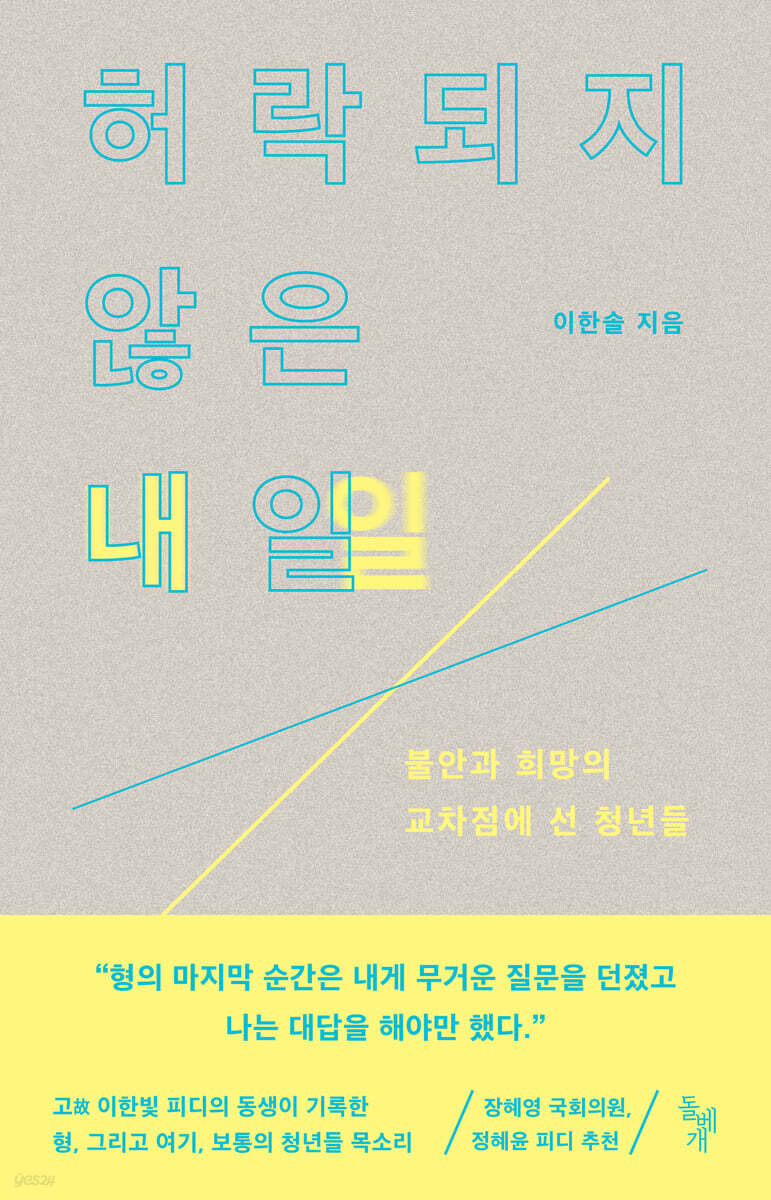
“My brother’s last moments raised heavy questions for me.
“I had to answer.”
Written by the younger brother of the late producer Lee Han-bit
Brother, and here, the voices of ordinary young men
Lee Han-bit, a twenty-eight-year-old drama producer who was tormented by the absurd practices of the broadcasting industry.
Writer Lee Han-sol, the younger brother of producer Lee Han-bit and an activist in the fields of labor, housing, and youth, traces his brother's life and death to shed light on Lee Han-bit as an ordinary young man with many worries.
We also meet 35 young people living their own lives and record how the concerns left behind by Lee Han-bit relate to our lives, and how the sincere, albeit time-lag-laden, responses to the questions he poses arrive.
A powerful reportage essay that asks what it means to fully mourn and commemorate the deceased, along with vivid stories of the anxieties, wounds, and hopes of young people living today.
“I had to answer.”
Written by the younger brother of the late producer Lee Han-bit
Brother, and here, the voices of ordinary young men
Lee Han-bit, a twenty-eight-year-old drama producer who was tormented by the absurd practices of the broadcasting industry.
Writer Lee Han-sol, the younger brother of producer Lee Han-bit and an activist in the fields of labor, housing, and youth, traces his brother's life and death to shed light on Lee Han-bit as an ordinary young man with many worries.
We also meet 35 young people living their own lives and record how the concerns left behind by Lee Han-bit relate to our lives, and how the sincere, albeit time-lag-laden, responses to the questions he poses arrive.
A powerful reportage essay that asks what it means to fully mourn and commemorate the deceased, along with vivid stories of the anxieties, wounds, and hopes of young people living today.
- You can preview some of the book's contents.
Preview
index
Introduction | A Conversation on Frustration and Hope
Interviewee Introduction
A Short Letter to Hanbit
1. The time the light stays
Fall 2016
Hanbit made a sound
Misconceptions about suicide
What the light leaves behind
2 A society where the ordinary is erased
Hanbit, an ordinary young man
Young people who have become squeamish, 80 percent of the context has been edited out.
The illusion of fairness
An uncertain tomorrow
3 Distorted perspective
Hanbit, just quit.
Are you really irresponsible?
The hypocrisy of 'nim'
The flaw of being young
4. Workplace that consumes energy
Hanbit, the loser
A workplace where nothing remains
A more dangerous workplace for some people
Workers who cannot be called workers
Eul's workplace where he can't even attend his mother's memorial service
5 Inequality between us
Hanbit, the place his heart wanted to reach
The world they live in
The impassable walls of university
Do I have to go to Seoul?
There are clear threats and discrimination.
6 Young People Who Need Connection
Hanbit, no colleagues
In the end, I choose to be alone
Manmanhyeop
I need a place to lean on
Again, community
7 Dreaming Young People
Hanbit, Dreams and Desires
Everyday burnout
Diversity and Respect
The world can become more beautiful
Going Out | I Want to Shine a Light Beyond Inequality
Preface | Let's start with something else _Jeong Hye-yoon (CBS producer, writer)
Detailed image

Into the book
What does it mean to fully commemorate death?
I pondered how to remember those who left in the places they left behind.
They say that when a person dies, they leave behind a name, but passing the deceased's name on to the next generation is not the only way to commemorate them.
My brother, in his final, most fearful moments before leaving this world, wanted to express his feelings through writing, and he probably hoped that his feelings would be remembered by people.
In the traces my brother left behind, I saw his hope that the world he dreamed of would come true for those he left behind, even if he himself could not enjoy it.
I dare not carelessly interpret the meaning of death, but at least one thing is clear: I hope that there will be no young people who are denied a tomorrow for the same reasons as I was.
--- p.6
“All my friends are getting older, but I feel like Lee Han-bit is always stuck in his 20s.
It makes me keep thinking about it.
What would Hanbit think? Of course, I wouldn't have blindly followed Hanbit's opinion (laughs).
“But I think he still remains a friend who can swear at me.” (Taemin)
--- p.31
It is very important to consider the feelings of the person who has passed away.
My older brother ended his life by suicide.
I am always careful not to overinterpret or overinterpret my brother's death.
But I try to look into my brother's mind carefully and persistently.
"How did he want to live?" "What did he love?" "Why did he want to rest?" Those around Lee Han-bit, who had seen him off, have been making their own efforts to interpret his death for the past five years.
--- p.34
The last story my brother left behind was a very simple wish that labor would be respected even a little in the broadcasting field.
The reason the countermeasure committee gathered so much support and received an apology from a major broadcasting station was because it was 'Ordinary Hanbit', which was not far away.
My brother's idea that my labor, and the labor of others, should also be respected, resonated widely with citizens.
Because it is not difficult and comes from ordinary concerns.
Hanbit, an ordinary young man, a single person.
I don't see my brother or any other young person differently.
My brother's desire to carry out various projects that comfort or excite people's hearts is the image of a young man we are familiar with.
In the death of Hanbit that we remember, his worries and wishes should remain as nothing special, rather than frustration and depression.
And even now, there are young people all over our society who are struggling with the same concerns.
--- p.34
The analysis of some who cut off all context and drag in the 'LH speculation suspicion' and lump this incident [Incheon International Airport Corporation irregular worker conversion to regular worker] together with the words 'youth' and 'fairness' is not only excessive, but it also leaves one with the feeling that they are trapped in their own world.
There are young people who did not participate in the competition to enter major universities, young people who were not close to the regular labor structure, and young people who live outside of Seoul.
There don't seem to be many young people who can directly connect their lives to current issues of justice.
At the very least, they need to play in the game to discuss whether the rules are fair, but as of now, the vast majority of them are not even registered players.
--- p.63
When you take on a title, the importance of your 'age card' becomes more evident.
Recently, I was appointed as the chairman of an organization called the Korea Social Housing Association.
(…) After many twists and turns, he started his term, but many unfortunate incidents occurred afterward.
When I arrived early to meet and discuss with key figures from public institutions or companies, I greeted them, and although we had clearly exchanged greetings, as the meeting time approached, they only asked similar questions as if they had made a prior arrangement.
“When is the chairman coming?” (…) It wasn’t just my experience.
At the performance sharing session of D Channel, which is evaluated to have opened a new horizon in new media, one of the questions posed to the young representative of this channel was, “Do you have a lover?”
If he wasn't in his 20s, would he have been asked that question at a formal event rather than a drinking party?
Ironically, a politician in his 30s who was elected leader of a major opposition party was also asked the same question in an interview.
--- p.104
"It seems possible for friends who came from good parents and got jobs at good corporations. Even within the MZ generation, there's polarization.
In '90s Generation is Coming', they say that these people are cheeky.
But I also think that only those who can get into big companies can do that.
The friends on the other side called themselves 'paper boats'.
Society changes really quickly and there are a lot of waves.
I just float around there and laugh at myself for living that life.
Doesn't that seem reasonable? 'What should I do next year?' is a big worry.
Because of COVID, my best friend had to give up his dream job after his job offer was canceled and he started delivering packages.
“That’s it.” (Seon-gyu)
--- p.145
“When I was a young adult, I worked in a public institution, and there were times when I had no choice but to abuse my power.
Because we are in a situation where the budget is being cut.
Before leaving work at 6 o'clock, at 5 o'clock, I insist on calling the company that did the work and asking for the results report by tonight.
When I asked if that wasn't too much of a request, the people above me would tell me to add something like, "We gave the orders we could as the superiors, and if you don't submit the report today, it will be your fault because you can't do your job."
That's not the case at all.
“When I was first asked to do this kind of bullying without any problem, I remember crying a lot because I wondered if I really had to do something like that.” (Junyoung)
--- p.180
"Why stay in the region? I even tried working at a venture company in Seoul, but I couldn't see any reason to survive in such a competitive environment.
The region certainly lacks resources, but I think it has the potential to make a completely new start.
I wanted to try something on my own.
(…) In reality, it is easier to launch in Jeonju than in Seoul.
Of course, everyone leaves because they feel the limits of continuity.
I'm still in the beginning stages and I want to try harder and expand my horizons.
If I can be sustainable here, I think anyone who comes can be sustainable.
So, there are things we try out.” (Sunmi)
--- p.168
“I think the biggest problem is not having anyone to lean on.
Having no one to lean on means having no one to lean on.
I can't fully rely on my friends or my family.
I did some consulting work.
When I meet young people, they all have the same concerns.
But we can't tell each other that.
I can't do it to my friends, I can't do it to my mom, so I have nowhere to turn.
Even if I have worries, it's burdensome to even look for them, and leaning on them makes me feel like a loser.
“The only thing we’ve been taught in our society to rely on is money.” (Eunjae)
--- p.200
I often get asked when I think of my departed brother the most.
Whenever I see our society unable to find 'newness' and losing 'warmth', I think of my brother.
(…) The reason why the sympathy and support from citizens was so great after my brother’s death is probably because we all have experienced the wear and tear of our dreams and desires.
Even today, nearly five years later, I still feel deeply saddened that people like my brother are not seeing the light of day in many organizations in Korea.
--- p.215
No philosopher has yet emerged who can logically explain the actions of those who attempt to solve social inequality and discrimination.
I can't even explain why I'm so sure of myself.
I just listened to people's stories and spoke, and everyone was not giving up hope.
Clearly, the world can become more beautiful and we can live together.
No matter how busy or difficult it may be, let's leave hope that we can live well together.
--- p.238
What Lee Han-sol learned through his brother's last days was not just the sadness of physical death.
It includes being erased from existence early on, having no one pay attention to the voice, becoming so withered and lifeless that it is accepted as reality and the law of life.
But what happens when we change our language and start telling different stories? What Lee Han-sol expected is clear.
Being alive.
Not just breathing, but breathing more refreshingly and warmly ('Refreshing' and 'warmth' were also words that Lee Han-bit liked).
Is this possible? How? First, let's change the language.
First, let's talk about something else. (Jeong Hye-yoon, from "Preface")
I pondered how to remember those who left in the places they left behind.
They say that when a person dies, they leave behind a name, but passing the deceased's name on to the next generation is not the only way to commemorate them.
My brother, in his final, most fearful moments before leaving this world, wanted to express his feelings through writing, and he probably hoped that his feelings would be remembered by people.
In the traces my brother left behind, I saw his hope that the world he dreamed of would come true for those he left behind, even if he himself could not enjoy it.
I dare not carelessly interpret the meaning of death, but at least one thing is clear: I hope that there will be no young people who are denied a tomorrow for the same reasons as I was.
--- p.6
“All my friends are getting older, but I feel like Lee Han-bit is always stuck in his 20s.
It makes me keep thinking about it.
What would Hanbit think? Of course, I wouldn't have blindly followed Hanbit's opinion (laughs).
“But I think he still remains a friend who can swear at me.” (Taemin)
--- p.31
It is very important to consider the feelings of the person who has passed away.
My older brother ended his life by suicide.
I am always careful not to overinterpret or overinterpret my brother's death.
But I try to look into my brother's mind carefully and persistently.
"How did he want to live?" "What did he love?" "Why did he want to rest?" Those around Lee Han-bit, who had seen him off, have been making their own efforts to interpret his death for the past five years.
--- p.34
The last story my brother left behind was a very simple wish that labor would be respected even a little in the broadcasting field.
The reason the countermeasure committee gathered so much support and received an apology from a major broadcasting station was because it was 'Ordinary Hanbit', which was not far away.
My brother's idea that my labor, and the labor of others, should also be respected, resonated widely with citizens.
Because it is not difficult and comes from ordinary concerns.
Hanbit, an ordinary young man, a single person.
I don't see my brother or any other young person differently.
My brother's desire to carry out various projects that comfort or excite people's hearts is the image of a young man we are familiar with.
In the death of Hanbit that we remember, his worries and wishes should remain as nothing special, rather than frustration and depression.
And even now, there are young people all over our society who are struggling with the same concerns.
--- p.34
The analysis of some who cut off all context and drag in the 'LH speculation suspicion' and lump this incident [Incheon International Airport Corporation irregular worker conversion to regular worker] together with the words 'youth' and 'fairness' is not only excessive, but it also leaves one with the feeling that they are trapped in their own world.
There are young people who did not participate in the competition to enter major universities, young people who were not close to the regular labor structure, and young people who live outside of Seoul.
There don't seem to be many young people who can directly connect their lives to current issues of justice.
At the very least, they need to play in the game to discuss whether the rules are fair, but as of now, the vast majority of them are not even registered players.
--- p.63
When you take on a title, the importance of your 'age card' becomes more evident.
Recently, I was appointed as the chairman of an organization called the Korea Social Housing Association.
(…) After many twists and turns, he started his term, but many unfortunate incidents occurred afterward.
When I arrived early to meet and discuss with key figures from public institutions or companies, I greeted them, and although we had clearly exchanged greetings, as the meeting time approached, they only asked similar questions as if they had made a prior arrangement.
“When is the chairman coming?” (…) It wasn’t just my experience.
At the performance sharing session of D Channel, which is evaluated to have opened a new horizon in new media, one of the questions posed to the young representative of this channel was, “Do you have a lover?”
If he wasn't in his 20s, would he have been asked that question at a formal event rather than a drinking party?
Ironically, a politician in his 30s who was elected leader of a major opposition party was also asked the same question in an interview.
--- p.104
"It seems possible for friends who came from good parents and got jobs at good corporations. Even within the MZ generation, there's polarization.
In '90s Generation is Coming', they say that these people are cheeky.
But I also think that only those who can get into big companies can do that.
The friends on the other side called themselves 'paper boats'.
Society changes really quickly and there are a lot of waves.
I just float around there and laugh at myself for living that life.
Doesn't that seem reasonable? 'What should I do next year?' is a big worry.
Because of COVID, my best friend had to give up his dream job after his job offer was canceled and he started delivering packages.
“That’s it.” (Seon-gyu)
--- p.145
“When I was a young adult, I worked in a public institution, and there were times when I had no choice but to abuse my power.
Because we are in a situation where the budget is being cut.
Before leaving work at 6 o'clock, at 5 o'clock, I insist on calling the company that did the work and asking for the results report by tonight.
When I asked if that wasn't too much of a request, the people above me would tell me to add something like, "We gave the orders we could as the superiors, and if you don't submit the report today, it will be your fault because you can't do your job."
That's not the case at all.
“When I was first asked to do this kind of bullying without any problem, I remember crying a lot because I wondered if I really had to do something like that.” (Junyoung)
--- p.180
"Why stay in the region? I even tried working at a venture company in Seoul, but I couldn't see any reason to survive in such a competitive environment.
The region certainly lacks resources, but I think it has the potential to make a completely new start.
I wanted to try something on my own.
(…) In reality, it is easier to launch in Jeonju than in Seoul.
Of course, everyone leaves because they feel the limits of continuity.
I'm still in the beginning stages and I want to try harder and expand my horizons.
If I can be sustainable here, I think anyone who comes can be sustainable.
So, there are things we try out.” (Sunmi)
--- p.168
“I think the biggest problem is not having anyone to lean on.
Having no one to lean on means having no one to lean on.
I can't fully rely on my friends or my family.
I did some consulting work.
When I meet young people, they all have the same concerns.
But we can't tell each other that.
I can't do it to my friends, I can't do it to my mom, so I have nowhere to turn.
Even if I have worries, it's burdensome to even look for them, and leaning on them makes me feel like a loser.
“The only thing we’ve been taught in our society to rely on is money.” (Eunjae)
--- p.200
I often get asked when I think of my departed brother the most.
Whenever I see our society unable to find 'newness' and losing 'warmth', I think of my brother.
(…) The reason why the sympathy and support from citizens was so great after my brother’s death is probably because we all have experienced the wear and tear of our dreams and desires.
Even today, nearly five years later, I still feel deeply saddened that people like my brother are not seeing the light of day in many organizations in Korea.
--- p.215
No philosopher has yet emerged who can logically explain the actions of those who attempt to solve social inequality and discrimination.
I can't even explain why I'm so sure of myself.
I just listened to people's stories and spoke, and everyone was not giving up hope.
Clearly, the world can become more beautiful and we can live together.
No matter how busy or difficult it may be, let's leave hope that we can live well together.
--- p.238
What Lee Han-sol learned through his brother's last days was not just the sadness of physical death.
It includes being erased from existence early on, having no one pay attention to the voice, becoming so withered and lifeless that it is accepted as reality and the law of life.
But what happens when we change our language and start telling different stories? What Lee Han-sol expected is clear.
Being alive.
Not just breathing, but breathing more refreshingly and warmly ('Refreshing' and 'warmth' were also words that Lee Han-bit liked).
Is this possible? How? First, let's change the language.
First, let's talk about something else. (Jeong Hye-yoon, from "Preface")
--- p.252
Publisher's Review
Recommended by Jang Hye-young (Justice Party National Assembly member) and Jeong Hye-yoon (CBS producer, writer)
The name of the late producer Lee Han-bit is itself a light in our society.
Lee Han-bit, who was endlessly troubled by the dark reality of having to exploit others to create a drama that comforts someone, dedicated all his life to sharing his worries with the world and became a light, just like his name.
The world Lee Han-bit illuminated, but how should we live in a world without him? His younger brother, author Lee Han-sol, carefully guides us through this book.
“Instead of easily flattening Lee Han-bit’s life with a clumsy interpretation,” he slowly looks back at his brother with affectionate eyes from where Lee Han-bit stopped and then heads out into the world again.
Whenever our society fails to find 'newness' and loses 'warmth', his gaze, which thinks of his brother, lingers on none other than our lives.
It's the life of ordinary young people who want to be ordinary and human.
Jang Hye-young (Justice Party member of the National Assembly)
The first thing Lee Han-sol did after holding a press conference to reveal his brother's death was to change his 'language'.
“There is no such thing!” was the new language he brought out in the name of Hanbit.
And this book, published five years after my brother passed away, is also about changing language.
This book, which throws away words like "Ewha Womans University," "Young-geul," and "MZ" and wanders around searching for the language that truly suits young people, is enveloped by a desperate and sorrowful atmosphere that says, "Life is too precious to just die, too precious to just live like this!"
Of course, he is writing with the utmost restraint, as is his custom, but I can only say that all the suggestions in this article are the voices of his heartbreaking experiences.
What runs through all of these arguments is nothing less than a suggestion that the story of our lives should not end this way.
(…) The word that appears in the title of the last chapter of this book is a word that I have loved my whole life.
I can't tell you how much I want to be a part of the story created with those words.
If you are curious, quickly browse the bookshelf… .
It's a really great word to put in our bowl.
_Jeong Hye-yoon (CBS producer, writer)
Lee Han-bit, and 'My Work' and 'Tomorrow'
A time of remembrance for the youth who were not permitted to attend
“Forcing workers to work more than 20 hours a day, letting them sleep for two or three hours, then calling them back to the site, urging and pushing already exhausted workers to produce the results we wanted. It was a life I despised the most, so it was difficult to continue.” This is part of the last will and testament left by Lee Han-bit, assistant director of the tvN drama [Drinking Solo], on October 26, 2016.
Lee Han-bit, who studied political science in college and was active in student activist groups, donated part of his salary to the Sewol Ferry tent and the workers' struggle site after getting a job.
A twenty-eight-year-old young man passed away just ten months after joining the broadcasting station, saying, “It is difficult to continue this life because it is the life I despised the most.”
What on earth happened to him? Why did this young man have to leave a will?
Decades have passed since the publication of 『A Biography of Jeon Tae-il』, which recorded and testified to the life and death of a young worker, but the deaths of young people in the workplace continue to this day.
There are Kim, who was repairing screen doors at Guui Station, Kim Yong-gyun, who was working as a subcontractor at Taean Thermal Power Plant, Kim Dong-jun and many other young people who were learning their first job as field trainees, Kim Tae-gyu, who was working at a construction site, Lee Seon-ho, who was working part-time at Pyeongtaek Port, and countless other young people who suffered accidents at work or took their own lives for various reasons.
There are young people who cannot imagine a future where they can continue their lives in a workplace where their dreams are frustrated and people are not respected.
"Unauthorized Tomorrow: Youth at the Crossroads of Anxiety and Hope" is a reportage essay that captures the voices of ordinary young people around us, starting with the work of writer Lee Han-sol, the younger brother of the late producer Lee Han-bit, who raised issues about the absurd practices of the broadcasting industry, and an activist in the fields of labor, housing, and youth, following in his brother's footsteps.
Lee Han-sol, who lost his beloved older brother, asks what it means to fully commemorate the deceased, writing, “My brother’s last moments posed a heavy question to me, and I had to answer it” (p. 7).
With questions like, "What kind of person was my brother? What kind of world did he dream of?" and "What did he want to protect until the end?", I trace the traces my brother left behind and meet his acquaintances to learn about him.
And by overlapping the story of an individual named Lee Han-bit with the story of Lee Han-sol himself and the stories of other young people who are directly or indirectly connected to Lee Han-bit, this book moves toward questions and answers about the working conditions and social reality that 'we, the young people' face.
“Countless Lee Han-bits may already be living in a reality that is harder to bear than death.
We have been overwhelmed by the edited definition of youth, and have been hesitant to talk about their true pain.
We haven't been able to properly look inside to talk about respect and hope.
We desperately need a message to protect someone right now.
So this book contains stories about the giving up, frustration, desire, and hope of my brother, and of me, a young man, living today.” (p. 8)
Responding to a young man who passed away
The most honest sincerity of us, the youth
"Unauthorized Tomorrow" mourns and commemorates the late Lee Han-bit, while also examining his life and dreams, restoring him as "an ordinary young man" and "a young man with many worries."
By connecting and overlapping the stories of friends who knew Lee Han-bit and other young people who learned of his existence later, this book shows that Lee Han-bit's worries are not unique.
The experiences Lee Han-bit encountered at work, the sorrows he felt, and the hopes he harbored are everywhere.
What makes us anxious and where do we get frustrated?
How can we maintain hope in a world where inequality prevails and anxiety is the norm? Thirty-five young people, each with different genders, educational backgrounds, occupations, employment types, regions, and household compositions, share a common thread: living in the present moment. Through Lee Han-sol, who began with Lee Han-bit and spoke to various young people, weaving together their stories, they resonate with Lee Han-bit's questions and concerns, albeit with a sadly time lag.
They all tell their stories with sincerity and honesty.
The story of young people responding to the young man who passed away is one of the most shining points in this book.
However, these stories drawn from within are neither flashy nor provocative at all.
Because these are words that come from the deepest part of the heart, after cutting off a lot of side branches and peeling off the thick wrapping.
Instead of the 'spicy' stories surrounding 'young-geul', 'fairness', 'Lee Dae-nam', 'YOLO', and the 'MZ generation', here are the very ordinary and simple words of young people who have been overlooked and not given proper opportunities to speak.
I want to live in a world where 'common sense' prevails, I want to be respected as a person, I want the organizational culture to be democratic, I want to imagine life after I turn 40, I want to connect with others and create change, let's ask ourselves what 'normal' is...
In particular, the words “normal” and “common sense” appear frequently in this book.
From Yeri's story (page 29) about how PD Lee Han-bit's raising of the issue made her rediscover what normality is in the broadcasting field, to the assertion that if the best option is to expect death, then it is abnormal, and that a normal world is one where there is no discrimination between people and the workplace (pages 124-126), to the anger and contempt toward the view that not one way of life is abnormal.
In this way, this book stimulates a very fundamental truth that we have always kept in our hearts, but which we have not taken seriously, thinking that it is just a habitual complaint or something from a moral textbook.
This must have been the most important question Lee Han-bit asked.
Why are I and my work, and other young people/workers and their work, not respected?
That is why radio producer Jeong Hye-yoon, who wrote the foreword to this book, said, “Ursula K.
Borrowing from Le Guin's story, he writes it as "The Story of the Sheller."
It is not a “mammoth hunting story,” a “killing story” with “action, thrills, death, and heroes,” a story that belongs to the “stabbing, killing, and weapon-picking culture.”
Even if this story doesn't seem particularly interesting at first glance, it's "another story, an untold story, a life story," and it's an activity that creates a different kind of life based on words like "Shouldn't I put the oats away somewhere for tomorrow morning? Or else I'll have to go to the oat field again" and the story of the vessel.
Therefore, this book is a work of “searching for the language that truly young people need” and is nothing less than “a proposal that the story of our lives not end like this.”
To live tomorrow
Youth agendas that need to be clearer
"Unauthorized Tomorrow" is a critique of existing youth discourse and policies, and also a work that asks what truly important youth agendas are in our society.
This book is a story that Lee Han-sol was able to write because he is a bereaved family member who has deeply contemplated ways to continue the legacy of Lee Han-bit, a young man living today, and an activist with extensive experience in the fields of youth, housing, and labor.
This whole story starts with Lee Han-bit, but according to Jang Hye-young, a young politician who wrote the recommendation, “From the place where Lee Han-bit stopped, he slowly looks back at his brother with affectionate eyes and then faces the world again.
(…) The place where his gaze lingers is none other than our lives.
“It’s about the lives of ordinary young people who want to be ordinary human beings.” In this way, Lee Han-sol directly records the vivid voices of young people who have often been objectified (most of the interviews with other young people recorded by young people are written in informal language), and rewrites the discourse on youth by unfolding not only stories about the workplace but also various issues that young people worry about in their daily lives.
Activist Lee Han-sol listens to the stories of young people brought up by Lee Han-bit, and instead of using provocative words like "young-geul," "fairness," and "Lee Dae-nam," he selects a few truly urgent issues and clearly reveals the agenda we must discuss here and now.
When we break away from the mainstream press, media, and politics that have erased 80% of young people, it all comes down to the question of 'tomorrow', a future that teeters between anxiety and hope.
Specifically, there is the distorted perspectives of the older generation toward young people, the problems faced in the workplace by a generation that “grew up being taught to dream and self-realization from a young age,” the deep-seated swamp of inequality along lines of class, education, school background, region, gender, and sexuality, the problems of isolation and community, and finally, the belief that “the world can become more beautiful” even in the midst of everyday burnout.
In particular, the parts that emphasize the youth generation and the issue of 'inequality' deserve closer attention.
“The diagnosis of inequality will be an important lens through which to view where the emotions of the younger generation, such as anxiety, sadness, and happiness, originate.
When the warning light came on, I should have thought carefully.
With so many young people turning their backs on the world in the face of inequality and discrimination, the entire society must sincerely seek out the causes and solutions to the problem.
Let's stop the 'youthful selling' that covers up the problems right in front of us with sweet mirages.
“Let’s start again with the story of young people who transcend inequality.” (p. 242)
Next year is a presidential election year.
Candidates already running for president are talking about "youth," but it is questionable whether they are willing to look into the lives of young people whose voices have been silenced in the public sphere.
The 'labor' agenda is barely mentioned, and one candidate even announced an 'economic' pledge to abolish the Serious Disaster Punishment Act.
That is why 『Unauthorized Tomorrow』, which responds to the young man who passed away while working and tells the story of the world he hoped for and the world that young people here hope for, is a book that we must read together right now.
This book will be a valuable gift to young people who are "holding out alone," the older generation who want to break free from "hypocrisy" and "old farts," those who dream of a different kind of politics, and youth policy makers.
The name of the late producer Lee Han-bit is itself a light in our society.
Lee Han-bit, who was endlessly troubled by the dark reality of having to exploit others to create a drama that comforts someone, dedicated all his life to sharing his worries with the world and became a light, just like his name.
The world Lee Han-bit illuminated, but how should we live in a world without him? His younger brother, author Lee Han-sol, carefully guides us through this book.
“Instead of easily flattening Lee Han-bit’s life with a clumsy interpretation,” he slowly looks back at his brother with affectionate eyes from where Lee Han-bit stopped and then heads out into the world again.
Whenever our society fails to find 'newness' and loses 'warmth', his gaze, which thinks of his brother, lingers on none other than our lives.
It's the life of ordinary young people who want to be ordinary and human.
Jang Hye-young (Justice Party member of the National Assembly)
The first thing Lee Han-sol did after holding a press conference to reveal his brother's death was to change his 'language'.
“There is no such thing!” was the new language he brought out in the name of Hanbit.
And this book, published five years after my brother passed away, is also about changing language.
This book, which throws away words like "Ewha Womans University," "Young-geul," and "MZ" and wanders around searching for the language that truly suits young people, is enveloped by a desperate and sorrowful atmosphere that says, "Life is too precious to just die, too precious to just live like this!"
Of course, he is writing with the utmost restraint, as is his custom, but I can only say that all the suggestions in this article are the voices of his heartbreaking experiences.
What runs through all of these arguments is nothing less than a suggestion that the story of our lives should not end this way.
(…) The word that appears in the title of the last chapter of this book is a word that I have loved my whole life.
I can't tell you how much I want to be a part of the story created with those words.
If you are curious, quickly browse the bookshelf… .
It's a really great word to put in our bowl.
_Jeong Hye-yoon (CBS producer, writer)
Lee Han-bit, and 'My Work' and 'Tomorrow'
A time of remembrance for the youth who were not permitted to attend
“Forcing workers to work more than 20 hours a day, letting them sleep for two or three hours, then calling them back to the site, urging and pushing already exhausted workers to produce the results we wanted. It was a life I despised the most, so it was difficult to continue.” This is part of the last will and testament left by Lee Han-bit, assistant director of the tvN drama [Drinking Solo], on October 26, 2016.
Lee Han-bit, who studied political science in college and was active in student activist groups, donated part of his salary to the Sewol Ferry tent and the workers' struggle site after getting a job.
A twenty-eight-year-old young man passed away just ten months after joining the broadcasting station, saying, “It is difficult to continue this life because it is the life I despised the most.”
What on earth happened to him? Why did this young man have to leave a will?
Decades have passed since the publication of 『A Biography of Jeon Tae-il』, which recorded and testified to the life and death of a young worker, but the deaths of young people in the workplace continue to this day.
There are Kim, who was repairing screen doors at Guui Station, Kim Yong-gyun, who was working as a subcontractor at Taean Thermal Power Plant, Kim Dong-jun and many other young people who were learning their first job as field trainees, Kim Tae-gyu, who was working at a construction site, Lee Seon-ho, who was working part-time at Pyeongtaek Port, and countless other young people who suffered accidents at work or took their own lives for various reasons.
There are young people who cannot imagine a future where they can continue their lives in a workplace where their dreams are frustrated and people are not respected.
"Unauthorized Tomorrow: Youth at the Crossroads of Anxiety and Hope" is a reportage essay that captures the voices of ordinary young people around us, starting with the work of writer Lee Han-sol, the younger brother of the late producer Lee Han-bit, who raised issues about the absurd practices of the broadcasting industry, and an activist in the fields of labor, housing, and youth, following in his brother's footsteps.
Lee Han-sol, who lost his beloved older brother, asks what it means to fully commemorate the deceased, writing, “My brother’s last moments posed a heavy question to me, and I had to answer it” (p. 7).
With questions like, "What kind of person was my brother? What kind of world did he dream of?" and "What did he want to protect until the end?", I trace the traces my brother left behind and meet his acquaintances to learn about him.
And by overlapping the story of an individual named Lee Han-bit with the story of Lee Han-sol himself and the stories of other young people who are directly or indirectly connected to Lee Han-bit, this book moves toward questions and answers about the working conditions and social reality that 'we, the young people' face.
“Countless Lee Han-bits may already be living in a reality that is harder to bear than death.
We have been overwhelmed by the edited definition of youth, and have been hesitant to talk about their true pain.
We haven't been able to properly look inside to talk about respect and hope.
We desperately need a message to protect someone right now.
So this book contains stories about the giving up, frustration, desire, and hope of my brother, and of me, a young man, living today.” (p. 8)
Responding to a young man who passed away
The most honest sincerity of us, the youth
"Unauthorized Tomorrow" mourns and commemorates the late Lee Han-bit, while also examining his life and dreams, restoring him as "an ordinary young man" and "a young man with many worries."
By connecting and overlapping the stories of friends who knew Lee Han-bit and other young people who learned of his existence later, this book shows that Lee Han-bit's worries are not unique.
The experiences Lee Han-bit encountered at work, the sorrows he felt, and the hopes he harbored are everywhere.
What makes us anxious and where do we get frustrated?
How can we maintain hope in a world where inequality prevails and anxiety is the norm? Thirty-five young people, each with different genders, educational backgrounds, occupations, employment types, regions, and household compositions, share a common thread: living in the present moment. Through Lee Han-sol, who began with Lee Han-bit and spoke to various young people, weaving together their stories, they resonate with Lee Han-bit's questions and concerns, albeit with a sadly time lag.
They all tell their stories with sincerity and honesty.
The story of young people responding to the young man who passed away is one of the most shining points in this book.
However, these stories drawn from within are neither flashy nor provocative at all.
Because these are words that come from the deepest part of the heart, after cutting off a lot of side branches and peeling off the thick wrapping.
Instead of the 'spicy' stories surrounding 'young-geul', 'fairness', 'Lee Dae-nam', 'YOLO', and the 'MZ generation', here are the very ordinary and simple words of young people who have been overlooked and not given proper opportunities to speak.
I want to live in a world where 'common sense' prevails, I want to be respected as a person, I want the organizational culture to be democratic, I want to imagine life after I turn 40, I want to connect with others and create change, let's ask ourselves what 'normal' is...
In particular, the words “normal” and “common sense” appear frequently in this book.
From Yeri's story (page 29) about how PD Lee Han-bit's raising of the issue made her rediscover what normality is in the broadcasting field, to the assertion that if the best option is to expect death, then it is abnormal, and that a normal world is one where there is no discrimination between people and the workplace (pages 124-126), to the anger and contempt toward the view that not one way of life is abnormal.
In this way, this book stimulates a very fundamental truth that we have always kept in our hearts, but which we have not taken seriously, thinking that it is just a habitual complaint or something from a moral textbook.
This must have been the most important question Lee Han-bit asked.
Why are I and my work, and other young people/workers and their work, not respected?
That is why radio producer Jeong Hye-yoon, who wrote the foreword to this book, said, “Ursula K.
Borrowing from Le Guin's story, he writes it as "The Story of the Sheller."
It is not a “mammoth hunting story,” a “killing story” with “action, thrills, death, and heroes,” a story that belongs to the “stabbing, killing, and weapon-picking culture.”
Even if this story doesn't seem particularly interesting at first glance, it's "another story, an untold story, a life story," and it's an activity that creates a different kind of life based on words like "Shouldn't I put the oats away somewhere for tomorrow morning? Or else I'll have to go to the oat field again" and the story of the vessel.
Therefore, this book is a work of “searching for the language that truly young people need” and is nothing less than “a proposal that the story of our lives not end like this.”
To live tomorrow
Youth agendas that need to be clearer
"Unauthorized Tomorrow" is a critique of existing youth discourse and policies, and also a work that asks what truly important youth agendas are in our society.
This book is a story that Lee Han-sol was able to write because he is a bereaved family member who has deeply contemplated ways to continue the legacy of Lee Han-bit, a young man living today, and an activist with extensive experience in the fields of youth, housing, and labor.
This whole story starts with Lee Han-bit, but according to Jang Hye-young, a young politician who wrote the recommendation, “From the place where Lee Han-bit stopped, he slowly looks back at his brother with affectionate eyes and then faces the world again.
(…) The place where his gaze lingers is none other than our lives.
“It’s about the lives of ordinary young people who want to be ordinary human beings.” In this way, Lee Han-sol directly records the vivid voices of young people who have often been objectified (most of the interviews with other young people recorded by young people are written in informal language), and rewrites the discourse on youth by unfolding not only stories about the workplace but also various issues that young people worry about in their daily lives.
Activist Lee Han-sol listens to the stories of young people brought up by Lee Han-bit, and instead of using provocative words like "young-geul," "fairness," and "Lee Dae-nam," he selects a few truly urgent issues and clearly reveals the agenda we must discuss here and now.
When we break away from the mainstream press, media, and politics that have erased 80% of young people, it all comes down to the question of 'tomorrow', a future that teeters between anxiety and hope.
Specifically, there is the distorted perspectives of the older generation toward young people, the problems faced in the workplace by a generation that “grew up being taught to dream and self-realization from a young age,” the deep-seated swamp of inequality along lines of class, education, school background, region, gender, and sexuality, the problems of isolation and community, and finally, the belief that “the world can become more beautiful” even in the midst of everyday burnout.
In particular, the parts that emphasize the youth generation and the issue of 'inequality' deserve closer attention.
“The diagnosis of inequality will be an important lens through which to view where the emotions of the younger generation, such as anxiety, sadness, and happiness, originate.
When the warning light came on, I should have thought carefully.
With so many young people turning their backs on the world in the face of inequality and discrimination, the entire society must sincerely seek out the causes and solutions to the problem.
Let's stop the 'youthful selling' that covers up the problems right in front of us with sweet mirages.
“Let’s start again with the story of young people who transcend inequality.” (p. 242)
Next year is a presidential election year.
Candidates already running for president are talking about "youth," but it is questionable whether they are willing to look into the lives of young people whose voices have been silenced in the public sphere.
The 'labor' agenda is barely mentioned, and one candidate even announced an 'economic' pledge to abolish the Serious Disaster Punishment Act.
That is why 『Unauthorized Tomorrow』, which responds to the young man who passed away while working and tells the story of the world he hoped for and the world that young people here hope for, is a book that we must read together right now.
This book will be a valuable gift to young people who are "holding out alone," the older generation who want to break free from "hypocrisy" and "old farts," those who dream of a different kind of politics, and youth policy makers.
GOODS SPECIFICS
- Publication date: October 26, 2021
- Page count, weight, size: 252 pages | 394g | 135*210*20mm
- ISBN13: 9791191438413
- ISBN10: 1191438414
You may also like
카테고리
korean


korean

![GQ KOREA Mark (Monthly): December [2025]](http://librairie.coreenne.fr/cdn/shop/files/8ef265dbbfbf186523ed75ba7319009d.jpg?v=1765340328&width=3840)


